
加载中...
共找到 39,468 条相关资讯

The S&P 500 is now a single "risk-on/risk-off" trade, making traditional individual stock picking increasingly difficult. Recent gains in Energy and Materials are driven by Middle East tensions rather than sustainable long-term growth.


Geopolitical risk remains highly elevated despite a two-week ceasefire, with Iran's control over the Strait of Hormuz fundamentally altering global energy and trade dynamics. Markets have rebounded, but persistent tail risks and higher volatility are likely as the world adjusts to a fractured global order and supply chain disruptions.

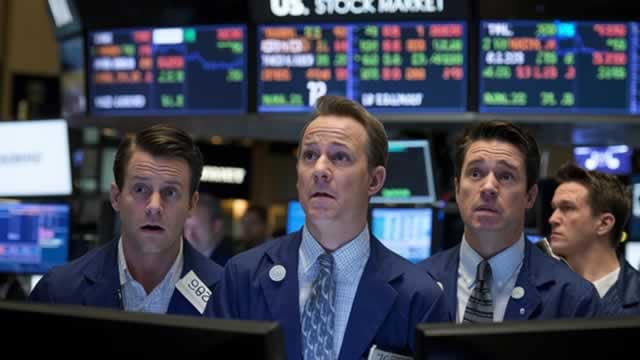
U.S. stocks traded lower this morning, with the Dow Jones index falling more than 100 points on Thursday.
Managing Director Kristalina Georgieva said central banks should leave their key interest rates as they are while they assess the impact of the conflict that began with U.S. and Israeli attacks on Iran in late February.
The International Monetary Fund is poised to lower its global economic growth projections even in the best-case scenario.
I see a fragile two-week ceasefire between the U.S. and Iran. Notably, a day later, the transits through the Strait of Hormuz remain in the mid single digits.

US stock futures sank Thursday morning as oil jumped back near $100 after Iran accused the US of violating its ceasefire agreement and traffic through the Strait of Hormuz remained limited.

US stock opened lower on Thursday, retreating from the previous session's strong rally as investors reassessed risks tied to the fragile ceasefire between the United States and Iran and monitored fresh economic data. Dow Jones Industrial Average fell by about 175 points, or 0.37%, while S&P 500 and Nasdaq 100 slipped 0.15% and 0.12%, respectively.
Kevin Hincks says people are "naive" to expect an immediate resolution to the U.S.-Iran War. That said, even as crude oil taps $100 once again, Kevin points out that options traders are pricing in significantly lower crude moves months down the line.
Trump is open to Iran demanding a toll from Strait traffic and may want a cut for the U.S.

Crude oil prices jumped above $100 a barrel as Iran kept the Strait of Hormuz closed amid a fragile ceasefire. But the S&P 500 turned higher.

This is a developing story.
Monthly price increases as measured by the Fed's preferred gauge sped up in February, showing that inflation remained persistent even before the Iran war began last month.

The Commerce Department on Friday released the February 2026 PCE inflation report, which showed the Federal Reserve's preferred inflation gauge remained stubbornly high for consumers.

The Commerce Department released its second and final revision for fourth quarter GDP which found the economy grew at a slower pace than was previously reported.

Energy will volatility "will go away," just "not any time soon," says Rob Thummel. Seeing ships moving through the Strait of Hormuz on a regular basis is the driver he sees cooling volatility, something he expects to happen months from now.

Airline stocks, including DAL, UAL, AAL, JBLU, and LUV, rebounded post-ceasefire but face significant profitability headwinds. Elevated oil prices and widening crack spreads are the primary threats, driving EBITDA down as much as 62% and margins to 4.9%.

Jeremy Siegel, Wharton School professor of finance and WisdomTree chief economist, joins 'Squawk Box' to discuss his outlook for U.S. markets, what to expect from the Fed, economic headwinds, and more.

During times of turbulence and uncertainty in the markets, many investors turn to dividend-yielding stocks. These are often companies that have high free cash flows and reward shareholders with a high dividend payout.

Government bond yields moved higher on Thursday, reversing course amid renewed uncertainty over inflationary pressures and the outlook for interest rates in Europe. A rebound in oil prices has put the fragility of the U.S.-Iran ceasefire agreement in focus.