
加载中...
共找到 38,501 条相关资讯
With markets selling off one day and rebounding another, it's clear things can turn on a dime, and more than ever, traders are looking for ways to protect themselves from the volatility. Invesco's John Burrello sits down with CNBC's Dominic Chu to explain why he recommends laddering to his clients, a way of ‘slicing up the apple', and managing risk.


Sunaina Sinha Haldea, Raymond James global head of private capital advisory, joins 'Closing Bell Overtime' to talk the impact of the current economic conditions and tariffs on the private markets.

Big banks like JPMorgan Chase (JPM), Wells Fargo (WFC), and Goldman Sachs (GS) saw mixed but notable reaction to their earnings in an attempt to leap over a high bar. Marley Kayden and Sam Vadas talk about the reports, along with what to expect in Wednesday's trading session following commentary from Fed Chair Jerome Powell.

President Donald Trump took another swing at China on Tuesday afternoon, sending the major indexes lower and soybean-related stocks soaring just before the closing bell.

The Dow industrials, down by more than 1.3% in early trading, ended the session higher.

JPMorgan Chase & Co. Chief Executive Jamie Dimon warned Tuesday that when it comes to bad loans, if there's one, more are likely to emerge, especially if the economy weakens.

Federal Reserve Chair Jerome Powell signaled the central bank may stop shrinking its balance sheet in the coming months. The Fed chair also indicated labor-market prospects continue to worsen, a message that supports investors' expectations for another interest-rate cut this month.

After one of the quietest summers for the stock market in years, Wall Street's fear gauge has once again shot higher as investors fretted that a trade standoff between the U.S. and China could escalate further.
Comprehensive cross-platform coverage of the U.S. market close on Bloomberg Television, Bloomberg Radio, and YouTube with Katie Greifeld, Miller, Carol Massar and Isabelle Lee. -------- More on Bloomberg Television and Markets Like this video?

Martin Shkreli, known for his outspoken views in finance, has been shorting quantum computing stocks IonQ, Inc. (NYSE:IONQ), D-Wave Quantum, Inc. (NYSE:QBTS), Rigetti Computing, Inc. (NASDAQ:RGTI), and Quantum Computing Inc. (NASDAQ:QUBT), regularly mocking what he sees as overvaluation and questionable business models.
CNBC's Michael Santoli and Ayako Yoshioka, Wealth Enhancement Group, joins 'Closing Bell' to discuss Yoshioka's thoughts on current equity market levels and much more.

CNBC's Leslie Picker reports on the retail revolution, one of the biggest untapped markets for asset managers right now.
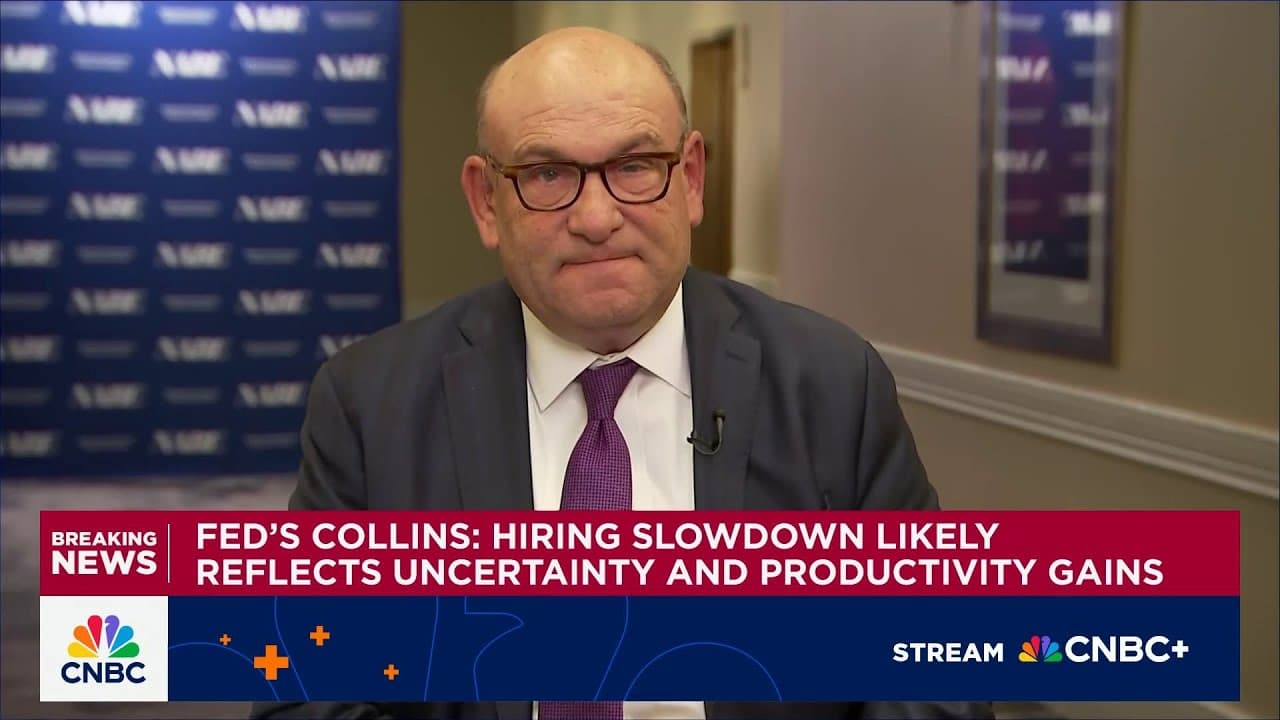
CNBC's Steve Liesman reports on news regarding the Federal Reserve.
Jason Honeyman: Good morning, and welcome to Bellway's full year results. I'm joined by Shane. Simon is with us, too, here in the front row. If I could take you to the first slide, just to set the scene. We had a good performance last year. Volume was up by over 14% to 8,749 homes. Operating margin increased to 10.9%, and that drove a strong increase in operating profit to GBP 303 million. And you can see that we are well positioned with land and outlets for FY '26. Now along with our usual financial and operational detail today, Shane will also set out our new capital allocation framework, which is central to our approach to drive assets harder in a more challenging environment. But firstly, I think it's important to provide some context with regard to recent trading. Trading, since the start of April, has been slower and never really recovered from the levels that we enjoyed in Q1 of this calendar year. Sales rates over the past 6 months have tended to hover between 0.5 and 0.6 per outlet. That said, the order book is still in good shape. We're well placed to have both a decent half year and achieve our full year guided volume of 9,200 homes. And to complement that growth, there is further opportunity for the business. We have a sharper focus on return on capital employed and being more capital efficient. And regardless of that trading backdrop, given our well-invested land bank and WIP position, Bellway have the ability to increase cash generation and returns to our shareholders. And our confidence is reflected in our announcement today to commence a share buyback starting with an initial GBP 150 million. In summary, I would describe our business as being very robust and well placed. But we must be mindful of the softer market conditions. And if the government are serious about growth and delivering more homes in this parliament, then that ambition needs to be reflected in the November budget. Now I will provide more detail on ops and outlook later. But first, our financial results and capital allocation framework with Shane. Shane Doherty: Thank you, Jason, and good morning, everyone. I'll start with the finance review. As Jason said, we've delivered a good financial performance in FY '25 despite ongoing challenges for our industry. The combination of our healthy order book at the start of the year and the improvement in reservation rates supported a 14.3% increase in volume output to 8,749 homes. That growth was driven predominantly by private output, which was up by 20.3% to 6,924 homes. Social output was 3.7% lower at 1,825 homes as the proportion of social completions reduced to a more normalized level at around 21%. The ASP was up by 2.8% to 316,000, and that was in line with expectations. The increase in ASP was driven by geographic and mix changes with underlying pricing remaining broadly firm. Turning then to gross margin. There was some modest progress here with a 40 basis point increase to 16.4%. Whilst we had the benefit of some higher margin land in the mix, this was partly offset by the absence of any HPI and ongoing low single-digit spot cost inflation. We also have higher embedded cost inflation in our WIP, which remains a headwind to margin in the nearer term. And this is reflected in our order book, and we currently expect gross margin progress in FY '26 to be similar to that achieved in FY '25. Looking further ahead with our planned volume output growth, we're working through our WIP balance and a growing proportion of output will benefit from newer higher-margin land. With a stable market supported by a more favorable HPI BCI dynamic as seen in previous cycles, we are well positioned to drive ongoing improvements in our margin in future years. The increase in volume output and revenue drove an improvement in overhead recovery of roughly 50 basis points. This, together with the higher gross margin, led to the improvement in underlying operating margin to 10.9%, which was in line with expectations. Underlying PBT was 27.9% higher at GBP 289 million, which drove the strong increase in the proposed full year dividend to 70p per share. This slide has covered the group's underlying performance. Adjusting items are shown in more detail in the income statement in Appendix 1. These include an adjusting item of GBP 15.4 million through admin expenses relating to the previously announced CMA investigation, comprising both our voluntary contribution and legal expenses. The other adjusting items relate to build safety, which I'll cover later in the presentation. Turning then to our balance sheet. We have a very well robust capitalized balance sheet. And at its foundation, we have a high-quality land bank and a very strong WIP position to support our plans for multiyear growth and increasing cash generation, which I will cover shortly as part of our capital allocation framework. To highlight the key balance sheet movements, firstly, the increase in fixed assets primarily relates to our investment in our new timber factory facility -- timber frame facility. Given that relatively stable market backdrop, our land investment has started to normalize from the lower levels in the previous 2 years. During FY '25, our overall land balance has risen by roughly 3% to GBP 2.5 billion. This increase in land activity is also reflected by the land creditor balance rising to GBP 338 million, although this remains modest overall and represents only 13% of our overall land balance. Jason will cover that in more detail later when he talks about the land bank. The work-in-progress balance, which includes site WIP, show homes and part-exchange properties, rose by GBP 52 million, roughly 2% to just over GBP 2.3 billion. This slight increase was primarily due to spend on our ongoing strong outlet opening program. And to finish on the balance sheet, as you'll see from the bottom of the slide, on our adjusted gearing, and I think this is particularly relevant when we talk about capital allocation later and how we utilize that. Our gearing remains low at 8.3%, including land creditors. And quickly, our NAV per share has risen to GBP 29.89. Turning then to cash flow, and you'll hear a lot of this throughout this presentation this morning. We generated good operating cash flow, and we ended the year with net cash of GBP 42 million. The chart shows a small increase in site WIP I referenced earlier, amounting to GBP 41 million. In relation to land, the monetization of land through cost of sales was GBP 521 million. Whilst this was higher than the cash spend on land as part of our drive -- to drive a more efficient capital structure, our increased use of land creditors towards a more normal level, as shown on the previous slide, helped to fund the GBP 70 million increase in the land balance in the year. After other working capital movements and tax, the operating cash generated before investment in land, build safety spend and distributions to shareholders was GBP 639 million. This represents a 50% increase in operating cash flow on FY '24. Again, I think that's a theme that we will come back to when we talk to capital allocation, strong year-on-year growth, primarily driven by better discipline around WIP investment. When in FY '24, there was a net cash outflow over the same period of GBP 260 million. As a result, the conversion of operating profit to operating cash flow has risen from about 1.8x to 2.1x, and I'll provide more detail on our ambitions in this area later. Adjusted operating cash flow is the fuel for future investment opportunities for the business and ultimately greater value creation and returns for shareholders. In this regard, we invested GBP 472 million in land, including settlement of land creditors and dividend payments totaling GBP 70 million. We also spent GBP 45 million on build safety, which I'll cover now. Overall, we've made good progress on build safety during the year. With regards to movements in the provision, in addition to the GBP 14 million adjusting finance expense, which was in line with previous guidance, there was a net increase of GBP 37.4 million in the build safety provision. I'll now cover the components of and the drivers behind the GBP 37.4 million, starting with the SRT. In December '24, following a period of industry-wide delays in obtaining building access licenses, housebuilders and the government committed to working together through a joint plan to accelerate assessments and remediation. We have now completed 100% of assessments in accordance with the joint plan for all of our legacy buildings in England and in Wales. Following this accelerated and extensive survey program, a higher proportion of legacy buildings was found to require works, both externally and internally than was previously assumed. And this has led to a net increase in the SRT and associated review provision of GBP 50.7 million through cost of sales. With regard to structural defects, there was a net credit through cost of sales of GBP 13.3 million. This was largely due to remediation strategy being finalized for reinforced concrete frame issued identified at a high-rise apartment scheme in Greenwich London in FY '23. This strategy is less invasive than remediation design applied in the previous year and has led to a reduction in the cost estimate for the Greenwich scheme of GBP 19.3 million. This has been partly offset by a GBP 6 million charge relating to a mid-rise building, which was identified during the year with a similar issue to the Greenwich building. We've since carried out further reviews across all of our buildings over 11 meters in height constructed by or on behalf of Bellway, where the same third party responsible for the design and the frame of these 2 developments have been involved. And to date, no other similar design issues with reinforced concrete frames have been identified. The provision at the 31st of July '25 is GBP 516 million, and I'm confident that we are well provided for the remediation works required across the legacy portfolio. Following a year of delivery against our requirements of the joint plan, with a particular focus on completing build surveys and procuring works, we will now be accelerating the pace of remediation. The strengthened team at our dedicated build safety division is focused on completing works as promptly and efficiently as possible. We have spent GBP 191 million on legacy build safety since the start of the program, including GBP 45 million in FY '25. For FY '26, we expect there will be a significant increase in spend to over GBP 100 million, although I must caveat that this level of spend will be dependent on receiving requests for payment from the government for works carried out on our behalf by their build safety fund. To finish off this section now, I'd like to just cover a summary of guidance for FY '26. We are targeting volumes of around 9,200 homes, of which 20% will be social. The average selling price will be around GBP 320,000 with an increase of FY '25 driven by mix predominantly. The admin overhead will increase to around GBP 170 million, and that's driven by underlying wage increases and the full year impact of employer NIC. Together, I think it's important to say with important investments that we see for the efficiency and growth program that we have over the next number of years, that includes areas like IT, timber frame facilities becoming fully operational. We currently expect the operating margin to be similar to the FY '25 level at around 11%. I'd now like to turn to the capital allocation framework. This is my second update that I've given to the city. And I think myself and Jason are very keen that we talk in detail today around our capital allocation framework and what that actually means for the business financially, value creation and strategically for the business. I think it's fair to say we've refreshed our approach to capital efficiency, and it's very much embedded across the group. There's a number of senior leaders here today from Bellway who are very much part of this journey. So I'd encourage you to talk to them as well as just the finance people in relation to this. This is very much a living, breathing thing across the business. And this section of the presentation covers our refined capital allocation framework and the strategy that we have to drive better value for our shareholders. So first of all, I'd like to set out the clear priorities for capital allocation. We have a strong balance sheet, and we have a well-invested land bank, and that will remain the bedrock of the business. And it supports our balanced approach for investing for growth. And it's very important that we don't lose sight that Bellway has a really strong track record of growth, and that's very much the bedrock of this capital allocation framework as well as well as delivering enhanced returns to our shareholders. We're going to run the business with an efficient capital structure with low gearing, and we're going to continue to invest for growth. Whilst our financial strength provides flexibility and headroom to grow our land bank, I think it's fair to say with the current market backdrop, we expect our near-term land strategy to be largely replacement only. We're also sharply focused on driving better efficiencies and our WIP balance presents a significant opportunity for much greater cash generation. If the trading environment remains stable, we can deliver growth in volume and profit. And that will drive strong cash generation, particularly as our elevated levels of WIP start to unwind. Combined with the ordinary dividend underpin, we believe that the value creation opportunities are significant for our shareholders. And I think this is evidenced today, as Jason said, with the launch of our GBP 150 million share buyback program, we're going to run that over the next 12 months. And I think it's important to emphasize we've got the capacity for this to be a multiyear program. This slide summarized our clear priorities for capital allocation, and I'll provide more details on the pillar of the framework in the following slides. Turning to our efficient capital structure. We're going to continue to run the business through the cycle with a strong balance sheet, but there are definitely opportunities to deliver greater efficiencies within the business. We're very well capitalized with total debt facilities of GBP 530 million. That comprises of GBP 400 million of bank facilities and GBP 130 million of fully drawn USPP notes. Over the next few years, we expect to run the business with modest average net debt and low year-end financial gearing of up to 5%. As we referenced earlier, land investment has started to normalize, and there will be a modest increase in the use of land creditors in the medium term. The range is expected to be between 15% and 20% of land value, and that's similar to our historic norms. When taking land creditors into account, our adjusted gearing is expected to rise modestly into the mid-teens. And the chart illustrates that we successfully run the business with a similar efficient capital structure and level of adjusted gearing in previous cycles that we've been involved. I'm confident that this strong and efficient capital structure will enable the group to continue to invest in attractive land opportunities to drive the growth and improvement in returns. It will also ensure that efficiencies generated within the operational divisions as measured to return on capital employed will generate an ROE percentage at similar levels, which I think that's something that's really critical. We're driving to ensure that our return on equity and return on capital employed percentages are as close as they can be. And this will help to ensure that the balance sheet structure doesn't dilute the returns capacity for shareholders from operational efficiencies that are generated within the business. Looking to improvements then in the WIP turn. This is the key area of focus across all 20 of our operating divisions, and it's a significant opportunity for the group. The chart shows our WIP turn fell by around 50% to 1.2x between FY '22 and FY '24. This was primarily driven by a sharp fall in volume output. Bellway stayed well invested in our WIP platform and our supply chain throughout the downturn. I think that's going to stand us -- that strategic decision is going to stand us in really good terms now as we look to harvest that investment that we made in the downturn as hopefully market conditions improve into the longer term. We've made some early progress in FY '25. The WIP turn has increased slightly, but this is an area where our discipline will improve further. We're well positioned to deliver growth in volume over the next 3 years. And if you think about 10,000 homes in FY '28, that would see our revenue increasing by 20% from FY '25 levels, but it will also enable us to monetize our WIP. So that will allow us to target significant net cash inflow on WIP, so you can juxtapose that 20% increase in revenue, and that should allow you to reduce your WIP balance by around 10% over that same time frame. So that 10% reduction in WIP growing your revenue will allow us to get a significant cash release over that time frame. And that would see our WIP turn growing to about 1.8x by FY '28. And I think that's a ratio that we and I think a lot of people in this room will be comfortable with over that time frame, and that's going to be a key driver in increasing asset turn and cash generation to enhance our returns over that time frame. Turning then to capital efficiency and cash generation. As part of our plans to deliver higher volume output and asset turn, we have an increased focus on bulk sales. They represent roughly 10% of our private reservations in FY '25, and they will remain a part of our strategy going forward. We will remain selective with our divisions working with our commercial finance teams, and it will be all around running scenarios and assess if a potential bulk sale is NPV positive compared to standard open market sales. So probably more of an NPV asset turn lens as opposed to just looking at the -- maybe what the margin differential between both options are. And we think that gives more options for our business leaders then who are running the divisions as they trade their way through the cycles, the ups and downs within the cycle. Regarding land investment, as we highlighted earlier, we expect the number of plots will be broadly in line with plots utilized in the year, and that will be a largely replacement-only strategy. So delivering volume growth enhanced by bulk sales will enable us to work through the top tier of the land bank more quickly, which is lower embedded gross margin. These plots will be refreshed with higher-margin plots, and that will include from our strategic sites. Whilst 20% gross margin will remain a requirement for land acquisition, we'll be taking a more balanced approach to liability and the key underpin really will be more around higher levels of capital employed from those investment decisions. And we'll be looking for the return on capital employed on those to be 20% plus underpinned by 20% plus gross margin. I think if you live by that in terms of land acquisition, that will create a lot of value for us and our shareholders over the coming years. The compounding effect of those initiatives and the drive to monetize our WIP, that should deliver a material increase to the group's operating cash flow conversion, and that's illustrated in the chart. If you take FY '23 to '25, Bellway generated an aggregate underlying profit of around GBP 1.1 billion. Our adjusted operating cash flow before land, build safety spend and shareholder returns for that period was just over GBP 1.7 billion. So that represented a conversion between operating profit and operating cash flow of around 1.6x. There was an improvement in each year through the period with that 1.3x rising to 2.1x in FY '25, and we're expecting to maintain the conversion at greater than 2x over the next 3 years. And as an illustration, based on a similar level of aggregate underlying operating profit of around GBP 1.1 billion between FY '26 and '28 of getting to that 10,000 unit number, if we were to improve our cash flow conversion to 2.4x, this would generate an additional GBP 1 million of cash compared to the previous 3 years. That will help cover the ramp-up in build stage disbursements that we have over the next number of years, further land investments and crucially providing returns capacity for our shareholders. So we think that's a very balanced scorecard as we think about capital allocation and fulfilling all the obligations that we have over the next number of years. And I've used that as an example. And whilst it's ambitious, we think it's definitely achievable. I've been at Bellway now for almost a year, and there's a clear focus across the group on delivering on all of these priorities. If the market remains stable, I'm confident that we can deliver greater cash generation and therefore, returns for our shareholders. And I'll turn now to value creation for our shareholders. We're in a strong position to deliver growth in volume output and a significant increase in pretax ROE in the years ahead. These remain our strategic priorities to deliver growth with a supportive market with a well-invested land bank outlet network and with position. Within our divisions, we've experienced teams with operational strength and their significant structural capacity to deliver organic growth. Combined with an efficient capital structure and our drive for greater cash flow conversion, I'm confident that we have an excellent platform to increase returns for shareholders. We will maintain our underlying dividend cover at 2.5x, and this will be supplemented by returns of excess capital. We started this today with an additional GBP 150 million share buyback and with a clear intention of returning further excess capital in future years as it arises. Returning excess capital is a key component of our strategy to increase returns. I think it's really important to say that our management incentives across the business are fully aligned with increasing cash generation and ROE and also profits and volume output that run commensurately with that. A new LTIP proposed for shareholder approval at this year's AGM includes a challenging FY '28 underlying pre-ROE stretch target of 14%. And whilst this would require exceptional delivery and more supportive market conditions than we are currently experiencing, it clearly demonstrates the extent of our ambitions collectively in Bellway. I'll now pass back to Jason, who will cover the operating review and outlook. Thank you. Jason Honeyman: Thank you, Shane. Before I start, I think it's worth recognizing the amount of hard work involved in pivoting the business to being more capital efficient, and much credit goes to Shane, but also to our senior management teams across the U.K., who have embraced the new approach with so much energy and enthusiasm. A deserved well done to all. Now I'll start with last year's trading. We achieved a private sales rate of 0.52 per outlet, with bulk sales contributing to a further 600 homes. Overall, the sales rate was 0.57, with cancellation rates steady at around 13%. Mortgage rates were relatively stable in the period. Affordability is still constrained for first-time buyers or for those without the benefit of a decent deposit, and those purchases are still exposed to rates of around 5%. Overall, I would describe customer demand as sensitive, sensitive to mortgage rates and sensitive to the commentary around further tax increases. And that's clearly reflective in current trading. In the first 10 weeks since the 1st of August, we achieved a private sales rate of 0.51 per outlet, with bulk sales only making a very modest contribution in that period. Pricing has remained firm overall, the Southeast and Southwest areas are still slower, where we tend to deal harder and maximize the use of incentives. Our order book at the 5th of October consists of 5,300 homes with a value of GBP 1.5 billion. And we are currently forward sold by around 65% for FY '26. In general, the market appears to be in the same pattern as last year, where the autumn selling season is largely flat, owing to the timing and noise around the budget. That said, you will recall that we enjoyed a busy start to the calendar year as homebuyers had waited for the outcome of the budget before making a commitment. And we will likely or hopefully see that pattern reemerge with a busy start into 2026. The next slide is about multiyear volume growth and the conditions required to create a path back to 10,000 homes by FY '28. We have assumed a stable market and the following realistic assumptions. A private carryforward order book of around 40%, modest outlet growth to around 260 outlets by FY '28, an increased focus on bulk sales and the private sales rate moving towards 0.6 per outlet. With those conditions or similar, we can deliver 10,000 homes by FY '28. Now if I could take you to the next slide, land bank. We have a total of some 95,000 plots nicely split between owned or controlled and strategic plots. Taking a look at gross margin within the land bank. The current margin for DPP plots is 18% to 19%, and we expect progression through '27 and '28 as the new higher-margin land come through from both pipeline and strategic. In the period, we contracted or acquired just over 8,000 plots. So my short-term ambition, as Shane has said, is simply to maintain the land bank and continue with just replacement land. Today, a land bank length of around 4.5 years feels about right, particularly with an improving planning environment. And based on DPP and pipeline plots with a volume of 10,000 homes per year, that allows me to grow into the land bank rather than invest further. Looking forward, our focus will be on strategic land with the aim to harvest more consented plots from that strat tier of the land bank, delivering better margins for '27 and '28. Turning now to outlets. We opened 56 new outlets during FY '25 and plan to open a similar number during this financial year. Overall, I would expect average outlet numbers to be between 240 and 245 for this year, with modest growth to around 250 for next year. Regarding planning. Government progress remains positive. We do still experience some delays as local authorities take time to adopt local plans. And as you can imagine, some local authorities are more supportive and keen to deliver new homes, whereas others are less enthusiastic. Although I tend not to worry too much about outlets and planning as we are very fortunate to have good visibility on both and already have 85% of our plots with DPP for FY '27, we are in good shape. Regarding production and costs, not much change over the past 12 months. Build cost inflation is still running around 1% or 2%. And it's still -- while still at very modest levels, it's still a margin headwind for housebuilders. And earlier in the year, you may remember, I mentioned Bellway Home Space, our new timber frame facility in Mansfield. We are progressing to plan and due to open in FY '26. Simon can offer a little more detail in Q&A and required, but our plans are very much part of our approach to drive WIP turn and return on capital employed. And finally, outlook. With the strength of our order book, we are well placed to meet our guided volume of 9,200 homes and will hopefully benefit from a busier market at the start of the year to build that order book for FY '27. Structurally, we are able to deliver more volume in the years ahead. We have the land, the planning, the people and the outlets, but we just need a supportive economy in which to do so. The key message from today is our focus on cash generation and our confidence to increase returns to our shareholders, which Shane has already set out. Thank you. We're now happy to take questions. Ami Galla: Ami Galla from Citi. A few questions from me. The first one was on the stretch of pretax ROE targets in your LTIP. Can you give us some sort of building blocks of framework of the sort of scenario where we can see that reasonably coming through by FY '28, i.e., what are the elements that we need to watch out to understand the moving parts there? The second one on the Bellway Home Space facility. I think in the release, you've mentioned, it is one of the drivers of build efficiency for the business over time. At what point into the ramp-up phase can we see that get -- giving us more meaningful gains on the build side as we think about your journey there? And the last one, just on the land market. You've kind of given us a reasonably strong framework of how you think about capital allocation. But in terms of the near-term sort of sentiment in the housing market, do you see any sort of near-term opportunities on the land? And how are land vendors really looking at this market today? Jason Honeyman: Ami, I'm going to give you a selection here. I'm going to get Shane to answer question one, Simon to do two, and then I'll close on three. So you get the full board. Shane Doherty: Do you want to do the ROE first? Yes. So I think if we're sitting up here talking about capital allocation, cash efficiency, and I see a lot of my colleagues sitting here beside me, which makes me very comfortable as we talk about this. It's really important that you've got an incentive scheme in place that, that mirrors it. So we've done a lot of work on both our short-term and our long-term incentive schemes. And it's not a case that the old incentive schemes didn't do their job. They did, but they were very much probably focused around the P&L. And I think that works well in a rising market, but we all know that the market is a bit tougher now. So the underpins within our STIP are around operating profit and operating cash flow. And then the LTIP is around return on equity, not return on capital employed, so return on equity, which means we have to return capital to shareholders as well. But we have to do that in a manner that allows us to grow as a business. So there's an EPS underpin within that as well. The 14% target is very much a stretch target. We've guided to 10,000 units today over 3 years. I think that's a number that we're pretty comfortable giving in the context of current market conditions. That's not going to deliver a 14% ROE. That probably delivers probably close to 12%. I think the thing that we're really keen, if there's one big message that I want to deliver today, I think what we're keen to emphasize is our strategy. It's nothing new or anything. But I think what we pride ourselves in Bellway is that we're very clear, we're very detailed orientated around what we want to do, and we're all about staging, posting where we think we can get to as a business. The sector has suffered a lot in terms of profitability loss and return on equity loss over the last number of years. So the 10,000 units that will still deliver a lot of value for shareholders compared to where we are today in terms of cash returns and indeed the growth and profit that you would see coming off that. But to get to 14%, you probably need to get unit output probably closer to 11,000 units. But both of those scenarios would see a lot of potential capital being returned to shareholders. We've obviously announced a GBP 150 million share buyback today. But clearly, if you get to 10,000 units and you're growing your revenues by 20% plus, there will be a cash monetization in that if you're being very disciplined around how you're doing land buying. I think it's fair to say in the context of the LTIP as well, the stretch component for management is very much between that 12% and 14%. So we're all very heavily incentivized to do obviously better than the 10,000 of the 12% plus, but that's not where we're guiding the market today because that's not where we see conditions. Simon Scougall: Good morning, everyone. So on Home Space and perhaps more timber frame, Ami, we have no doubt it's going to drive capital efficiencies in the medium term. That's very much the strategy by opening the new timber frame factory, which is forecast for early calendar year '26. We're currently at 10% timber frame production across the group. That's predominantly through our Scottish divisions and some other divisions, and we're going to ramp that up to around 30% of output by 2030, but we're going to do it in a very prudent, careful manner. It's a new facility for us. So we want to make sure we get it right. So over the next 2 to 3 years, we'll introduce Home Space products into the group initially through 7 of our operating divisions. But we've also got a partnership with Donaldson Timber Solutions, who are currently helping us across the rest of the group. And between DTS and Bellway Home Space, we'll ramp it up towards a 30% point by FY '30. Jason Honeyman: I'll be brief on land, Ami. Just at the moment, we've got a very full land bank, and I described how we can grow into it. So I'm not in a position that I'm keen to overinvest. I'm a little bit like our purchases at the moment, adopt a wait-and-see approach to see what happens towards the end of the year. We're still buying land, but we're selective. So in those bigger divisions in better selling areas, we're still investing. I guess that dynamic will change. If the market does pick up, then our land appetite will probably increase. But just at the moment, we'll -- we haven't stopped. We've just paused. William Jones: It's Will Jones from Rothschild & Co. Redburn. Three, if I can, please. The first, if you could just update us on your thinking around bulk sales. There was a mention of it on an NPV basis in the presentation, but I think it was 0.03 of the sales rate last year and 0.1 or so the prior year. Where is normal? And I suppose if we continue with somewhat subdued conditions for, say, the next 6 months to hit that flat sales rate for the year, would you be willing to up the bulk sales content? Or would you let the sales rate slip slightly? The second was just coming back to the balance sheet content. You gave some helpful guidance on the WIP balance potentially coming down 10%. How would you think about the land value balance? I think plots broadly steady. Does the value go up a bit as you replace a bit higher than you sell out at? And then last, just a technical one on the finance bill, whether you had any commentary on how we should think about that on a 3-year view as you return more cash? Jason Honeyman: I'll do bulk. You do the other 2. Well, as usual, your figures are more detailed than mine on bulk sales. We did about 8% to be this year in terms of bulk sales. But as Shane alluded to, we've got a bigger appetite and could do a little bit more this year. I don't think it's going to change the dial, but we'll probably do 10% plus. But sometimes it's dependent upon what's happening in the market, how busy it is. But if you talk to our RCs that are with us today, our regional chairs, there's certainly an appetite and some deals on the table that we're looking at. But if you said sort of 10% plus, I think that's about where we need to be, Will. Can I hand you for balance sheet and finance? Shane Doherty: Yes. On the land side, I mean, we've got roughly GBP 2.5 billion in land. That might tick up very slightly over the next 3 years, probably commensurate with our unit output, but it won't be a material movement. Probably the bigger piece there is that we're probably willing to take on more land creditors, and we're happy to let that go as high as 20%. So net-net, Will, that probably means the overall net land balance between land creditors and land won't increase that much. Probably the increase would be offset largely by land creditors. I'm sorry, I missed your third question. Would you mind repeating that, please? William Jones: Finance cost [indiscernible] Shane Doherty: Yes. I don't think that will be a material movement either because we have GBP 130 million of PP money. And when we set ourselves the kind of broad target of how do we actually make sure that return on equity and return on capital employed are broadly similar. Funny enough, when the PP money is kind of drawn fully at year-end, that kind of gives you close to the answer. So I would say our net debt is probably at year-end will probably only be kind of GBP 100 million to GBP 150 million, maybe slightly higher than that. So the finance costs themselves will not move significantly, I don't think, in relation to that. Allison Sun: Allison from Bank of America. Just one question on the share buyback. So I was wondering if in the next few years, if you see a better investment opportunities, for example, will you thinking maybe scale back GBP 150 million? Or is this is like the minimum you want to return per year in the future? Shane Doherty: Yes. Yes. I mean, I think -- I'm glad you asked that question because we're very keen to emphasize that the lens we look at through everything is long-term shareholder return. But long term can't mean that people are waiting forever. So if you were to ask me to anticipate, I would say, I think we will be -- as long as that cash is generated, I think we will be returning it to shareholders. But we look at everything now through an IRR NPV/ROE lens. So if there was an investment opportunity that we could undertake that made sense for us, we wouldn't be found wanting there. And -- but we wouldn't just turn around and say we've decided to make that investment to shareholders, which I think in the sector, we're guilty of doing sometimes, say, we're going to invest that money. I think what we'd be saying is we're investing that money because we actually see the IRR of that investment being greater than actually buying back the share at a certain price and the payback period of it will be X or Y. I think that's the level of precision you have to get down to when you've seen the hit that the sector has taken over the last number of years. So we are going to take our responsibilities around that very seriously, but we are absolutely going to invest in growth where that opportunity exists. Aynsley Lammin: Aynsley Lammin, from Investec. I think I've got 3 as well, please. Just first of all, any kind of extra color on pricing and incentives as we've gone through the autumn selling season? Second question, just on the kind of point you've just making, I guess. If you look at -- if the government does actually improve planning brilliantly and the sales rates do bounce back, is it right to assume that there is flexibility around that share buyback that you would open more outlets? I guess 260 outlets by FY '28 doesn't look that ambitious in terms of what the government wants and how much flexibility is there? And the third question, Jason, just you mentioned this kind of hope the government recognizes a supportive economies needed. I mean just what's your wish list for November budget? Thoughts ahead of that would be interesting. Jason Honeyman: Okay. I might start with 3 of those and just get a bit of help. But pricing, Aynsley, is not flat all across the U.K. Not everything is like the Southwest and Southeast. There are some pockets of buoyant markets. So we explore those as best we can. At the moment, the Southeast and Southwest, it's full fat incentive in those locations at the moment. We deal hard. So we try to balance the books across the U.K. The new year may be different. We look at it quite regularly. And in terms of outlets, I wanted to get across today that our ambition is based on realistic assumptions, and I've adopted the same approach with outlets. And if you assume that we're just going to buy replacement land, for me to offer you ambitious outlet growth doesn't seem right. I think I can deliver realistically modest outlet growth with an improving planning system. And you're quite right. It could get better. But I think what we've offered is deliverable. We need a slight tick up in sales rates. I think if you look at them in the round, the world doesn't end just with outlets from my point of view. And with government support, I look at things, they've done a reasonable job on planning. Let's give some credit. Bellway are in super healthy shape. We've got no debt. We've got the land, the people, the planning and the outlets. All I need is a supportive economy. And sentiment is most of it, Aynsley. We need to lift. Sentiment is low in the market, and we've made 2 requests to government, and that's not just me alone, that's the majors. Firstly, can we undo the stamp duty costs that were imposed on first-time buyers in April? And can we have a long-term deposit support scheme for first-time buyers? Not every young person has the benefit of the bank of mom and dad or fat family financial help to support them. So we think that that's fair to give them some lift. And if we can have that support, which isn't big numbers at the bottom of the housing ladder, we think that will improve the sector and get the market moving. Clyde Lewis: Clyde Lewis at Peel Hunt. Land creditors and large sites normally go hand in hand. But obviously, large sites don't necessarily help that ROE drive. So I'm just sort of looking for a little bit of help as to whether you are going to be more or less happy buying the larger sites, which will allow you to probably drive that land creditor position a little bit more. That was the first question. Second question around London. I mean it's become a fairly small part of the group at the moment, again, given part of the market going on. But where does London sit within your sort of strategic thinking now again, given that ROE backdrop? Third one was on the announcement yesterday from Barratt Redrow and Persimmon around the loan scheme. Are you tempted to get involved in that reside offering as well? But again, where does that sit from a margin point of view more than a capital point of view? I'd be interested on that. And I suppose the last one I had was around demand for PRS and bulk deals. And are you only thinking about vanilla-type deals that you've done in the past? Or are you thinking actually we can maybe change the structure a little bit and look to pull capital from them earlier as part of the deals that you might do? Jason Honeyman: I'll do the first 2, you do the second 2. On large sites, you're quite right. That's where the use of land creditors. We're not buying, Clyde, lots of large sites at the moment. There's 2 guys sitting directly behind you that we'd probably invest in, 2 strong MDs from big businesses in East Midlands and Manchester, and we'd probably invest in those locations, maybe Milton Keynes, too. So strategically, where we think there's long-term demand. But other parts of the U.K., we're probably small to medium-sized sites at the moment. In terms of London, listen, I love London, but the percentage of our business now in London, Clyde, is 2% to 3%. We come out a few years back, as you probably know, we was as high as 20% of our volume in London. And I didn't exit London because I predicted where we're going to be today, certainly not. It was just that the commercial terms were too hard for us to do business. And Bellway was sort of priced out of London. But you do need a function in London market to deliver meaningful improvement in housing supply, and it's not there yet. The viability concerns in London are significant and the housing numbers in London are dire. We will continue building in London, but on the fringes on the outside. Shane Doherty: On the Help to Buy, that is some conversation that we've been part of as well. We're keeping a watch and brief on. I think it's helpful. I think it's going to be a niche product. I think the participants would say that themselves, but I think certainly a welcome addition. We would have similar type measures, obviously, in terms of deposit support and all that for our homebuyers. So we'll absolutely keep an eye on that and see just how it stacks up. I think fundamentally, what's required there is some kind of state support for first-time buyers. I think everyone in the room would acknowledge that. I mean there's a GBP 500 or GBP 600 differentiator in terms of what your monthly mortgage repayment will be depending on whether you're fortunate enough to have a 25% deposit or a 5% deposit. And I think the thing that gives me heart has been relatively new still to this sector, just having worked in another jurisdiction is every division I visit, rental levels are consistently higher than what debt service costs are. So that tells us that the long-term fundamentals are strong. So we will absolutely keep an eye on that initiative and see if it's something that needs more extensive participation from us. On your other point around PRS, I think it's a really interesting question. And yes, is the quick answer to all of that. We will look at all of those things in terms of forward fund transactions, all of those things, if it makes sense for us in terms of asset turn and having greater return capability for shareholders. I think it gives the people running the divisions more tools in their kit as well in a market where the HPI has been pretty much nonexistent. You have to look at every capital efficiency that you can. So we look at forward purchases, we look at forward funds, all of those things. And we've no hard target or how high and low that number will be. It all just depends on whether it stacks up compared to the private sales rate and the private ASPs that you can get. Charlie Campbell: It's Charlie Campbell at Stifel. A couple of questions, one operational, one financial. Mortgage availability, we're aware that banks are allowed to change stress tests and also have slightly higher availability of higher loan to income. Has that made any changes on the ground sort of currently? And will that in future? And then secondly, the financial question is just on the dividend. I wonder sort of how you judge the balance between dividends and buybacks and whether there's a thought to maybe sort of cutting the dividend or widening the cover to do more buybacks. I just wonder how the debate came out on the answers we got today. Jason Honeyman: I'll start with mortgages. Charlie, I think what the banks have done has been really helpful. It's not going to move the dial. It's just a help. It's a movement in the right direction. Mortgage rates for 2- and 5-year money haven't really changed. They're around, I guess, 4.25%, something like that. But being able to loan more is a help for first-time buyers. It doesn't solve the deposit problem, but it's certainly a move in the right direction. So we welcome that. Can I hand... Shane Doherty: Yes. I mean, I think, again, an interesting question. I think where we've landed, I think, is a good balanced outcome. I think if we were sitting here saying that the cash generation wasn't going to be significant over the next number of years, I think we would have to have a hard look at our dividend policy in relation to that and maybe flip into a buyback. But I think you're going to see probably a 2:1 split between buyback and dividends roughly assuming that, that excess capital gets generated. And I think that feels right as a balance because I think having a dividend yield underpin is a good discipline for the business as well, just in terms of the growth ambitions that we have and just shareholders knowing that they'll get a cash return from the business every year as well. Christopher Millington: Chris Millington at Deutsche. Can I just ask about strategic land and how it kind of configures in your outlet opening plans, your margin plans. Perhaps you can also comment on the relative margins versus the DPP land bank so we can understand what benefit it can bring in the future. Next one, just curious about recoveries on the reinforced concrete frame. We had the Barratt court case there, which seem to open up avenues for recoveries. I know you can't recognize them, but would you hope to get some? And then also, is there likely to be anything different in H1, H2 split you can see them getting to the back end of the question queue. We have a question like that at the end. Jason Honeyman: If I do -- I'll do land. And can I ask you to do recoveries, Simon, just to keep Simon involved. If our DPP land bank has a gross margin of 18% to 19%, we think the strategic land is 23% plus. If we are currently delivering 10% of our volume through the strat tier of the land bank, we think, Simon, that we can double that to 20%. It's an ambition, and we might miss it a little bit, but 20% by FY '28. So they're the sort of numbers where we are on strat. So it also gives us flexibility in the market. It's not just margin accretive, Chris. It just gives us a few options. So we quite like that, and you know we've invested in that for probably 5, 6 years now. So it's starting to bear fruit. Is it worth you just commenting, Simon, on recoveries? Simon Scougall: Just picking up on -- just on the strat piece as well, just interesting, but very helpful, Chris. We're aiming to have around 80 planning applications running this financial year on the strategic land portfolio to give you an idea of what we're throwing at this to get our conversion through into the DPP ultimately. So there's a lot of work going on there to try and drive the outlook piece. On recoveries, yes, as you can imagine, we've got a very active program generally across our recoveries piece. It's only recently, of course, we've been able to quantify our liabilities properly with all the assessments being done. So on the SRT side of things, we're now gearing up to go after [ service ] and suppliers, and we've already recovered around GBP 80 million thus far on that. And so far as the structural defect is concerned, we've got good prospects of success against those who are involved in the 2 schemes that Shane has alluded to, and we are heavily involved in litigation on those as well. So I'd expect to see some sort of recovery, decent recovery in the fullness of time. But it's complicated, and it will take years rather than months to get there, but I'm determined to do so. Christopher Millington: Can I just quickly loop back to the strategic land? Let's say, you're up at 260 outlets by '28. Is that assuming you get that full conversion of 10% to 20% is strategic or... Jason Honeyman: It's a [indiscernible], Chris, and outlets. I just couldn't be more specific enough. There's too many moving parts in it, but we think it's doable. We wouldn't give you the number if we didn't think we could achieve it. Yes. Shane Doherty: I think your other one was H1, H2 split. Christopher Millington: Is there anything funny this year? Shane Doherty: No, not really. I mean we were pretty well for it. So it's all coming into this financial year. So it will be -- it won't be massive, 50-50, give or take, I'd say. Yes. Jason Honeyman: Not 70-30. All good. Thank you very much for your time. Thank you.

Daniel Morris: Hello, everyone, and welcome to the presentation of Ericsson's Third Quarter 2025 Results. Joining us by video today is Börje Ekholm, our President and CEO; and in the studio, I'm joined by Lars Sandstrom, our Chief Financial Officer. As usual, we'll have a short presentation followed by Q&A. And in order to ask a question, you'll need to join the conference by phone. Details can be found in today's earnings release and on the Investor Relations website. Please be advised that today's call is being recorded and that today's presentation may include forward-looking statements. These statements are based on our current expectations and certain planning assumptions, which are subject to risks and uncertainties. Actual results may differ materially due to factors mentioned in today's press release and discussed in the conference call. We encourage you to read about these risks and uncertainties in our earnings report as well as in the annual report. I'll now hand the call over to Börje and Lars for their introductory comments. Borje Ekholm: Thanks, Daniel, and good morning, everyone, and a big thank you for joining us today. So we delivered a strong Q3 with continued expansion in our EBITA margin despite the FX headwinds. I would say that reflects our execution against both operational and strategic priorities over the last couple of years. We're optimistic about the growing demand for advanced mobile connectivity as AI is starting to be rolled out. By structurally improving our cost base, we have positioned Ericsson to deliver resilient margins, also in the current market backdrop, which will give further benefits from improving operating leverage when growth comes back and actually comes in reality. Beyond operational improvements, of course, we focus on technology innovation, and that positions us well for the next key driver of our industry, the broader adoption of AI. As AI workloads move to the edge, demand on the network will increase significantly. These AI applications and AI devices will require wireless technology by placing, but it will also place new demands on the connectivity, such as ultra-low latency, high dependability, guaranteed uplink and very high security demands. So best effort connectivity. Think of that as WiFi, 4G and 5G non-standalone will simply not be enough. So to cater to these new type of demands, operators will need to invest in and migrate to 5G standalone networks and later, of course, migrate into 6G. Their success here will depend on high-performing programmable networks. And here, Ericsson is a leader. And we're also seeing some front-runner operators now starting to realize new monetization opportunities of network slices as well as efforts to provide differentiated connectivity to different segments and different type of applications. So now let me move on to some key financial and strategic takeaways before Lars dives into the numbers. So organic sales declined by 2%, but we saw growth in 3 out of 4 market areas with only the Americas reporting reduced sales following a particularly strong deliveries in Q3 last year. FX continues to be a headwind, and we had a negative year-over-year impact of SEK 4.2 billion this quarter. As mentioned, we saw positive development in our margins. Gross margin came in at 48.1%, and we delivered another 3-year high EBITA margin of 14.7%, excluding the capital gain from the iconectiv side, and this is now starting to approach our long-term target. The margin expansion reflects actions we've taken over the last years to increase operational excellence and efficiency, including the work we've done on our cost base. Over the last year, we've reduced our headcount by some 6,000, leveraging new ways of working, and that, of course, includes AI. As we plan for a flattish market also going forward, we will continue our cost measures on levels similar to what we've done in the past years. The effect of actions we have taken over the past years are now kind of flowing through the P&L and establishing the profitability at the new level. Our continued focus on cost management will provide incremental benefits going forward, but it will also give operating leverage should the market improve. We ended the quarter with an elevated cash position, that's driven by strong recurring cash flow, but also, of course, the iconectiv sale. As a result, we see scope for increased shareholder returns through extra dividends and/or share buyback program. And the Board will revert with the proposal in time for the AGM, as you know, is the practice or is the Swedish governance model. In parallel with strengthening the company operationally, we're continuing to execute on our strategy to capture a bigger share of the value created by connectivity. So let me expand that a bit further. In our core mobile infrastructure business, we signed new customer agreements in the strategically important Japanese market following our recent R&D investments. With Japan being one of the countries with a strong industrial base in such areas as automation and one of the densest networks that have still not built out 5G coverage, we see this as a key market going forward. We also increased our share in the U.K. with an 8-year partnership with Vodafone-3 to supply a significant majority of the mobile networks and the entire core network. And this morning, we announced a 5-year strategic agreement with Vodafone in Europe for programmable networks, where we remain their primary vendor with more or less stable market share. Within the telco market, new monetization opportunities are needed to drive more network investments by our customers. So we continue to execute on our strategy to create new use cases for mobile networks. For example, we're seeing good development in fixed wireless access, where customer satisfaction is typically higher than for fiber due to the ease of use of cellular or wireless technology. In the quarter, we announced a contract with Bharti Airtel to support their fixed wireless access rollout with Ericsson's core network portfolio. And we're starting to see good traction in mission-critical including, of course, defense. We're also taking important steps in our strategy to create a market by exposing the capabilities of the networks through APIs. This remains one of the key opportunities for us to capture more of the value created on top of the networks. And as you know Aduna, our JV with the large operators for network APIs, closed this past quarter. Revenues are still small, but we see the uptake in Vonage API business is actually starting to come through. And we see that in areas such as fraud protection as an early use case, but also in industrial applications. And today, we have already applications live in the market. Also, in Vonage, we're expanding our ecosystem partnerships with AWS and added marketplace presence and product integration. So now let me comment a bit further on the market development we saw in Q3. In market area Americas, sales declined by 8% year-over-year with declines both in North and Latin America. This follows, of course, a very strong Q3 deliveries in 2024, where we had high deliveries to a number of large customers. Latin America continues to be a competitive market with overall low investment levels. Sales in Europe, Middle East and Africa grew by 3% year-over-year. But if we look closer at the region, we saw a very strong development in Africa, partly driven by new 5G launches in Egypt and Morocco. In both the Middle East and in Europe, sales declined, and we continue to see European customers being cautious with investments. In Southeast Asia, Oceania and India, sales increased by 1% year-over-year, and India continues to have rather low investment levels, but it actually grew quarter-over-quarter. We saw a decline in networks, partly due to the low level of network investments in India, but also stiff competition in Southeast Asia. Cloud software and service, on the other hand, saw an increase in sales. Lastly, sales in Northeast Asia increased by 10%. That was due to higher network investments and deliveries in Japan. In the quarter, we were awarded new agreements with customers in the Japanese market, including enhancement of SoftBank's 5G SA network, where we have clearly increased our market share. Overall, I would say that we continue to have good discussions with all our customers in Japan. With that, I hand over to Lars to go through the financials in more detail. Lars Sandstrom: All right. Thank you. So net sales in Q3 totaled SEK 56.2 billion, with organic sales declining 2% year-on-year. Most regions grew, but North America declined, mainly reflecting tougher comparisons with a high period of customer investments last year. At the same time, reported sales decreased by 9%, impacted by a negative currency effect of SEK 4.2 billion. Taking a look at IPR performance. Revenue declined by SEK 0.4 billion year-over-year, now standing at SEK 3.1 billion for Q3. It's worth noting that last year's quarter included retroactive revenue, so that skews the comparison slightly. The run rate coming out of Q3 is still around SEK 13 billion. In Q3, adjusted gross income was SEK 27 billion, including a currency headwind of around SEK 2 billion. We saw an improvement in our adjusted gross margin, reaching 48.1%. And this positive development is a result of our cost reduction measures and operational excellence in both Networks and Cloud Software and Services. Looking at gross margin sequentially, we held stable even though we lost a temporary boost from the Q2 IPR settlement. Excluding IPR, the improvement was around 2 percentage points. In Networks, this benefited from organizational effectiveness in the market areas with well-planned and executed service delivery. This helped also manage supply effectively and further optimize inventory. And in Cloud Software and Services, the improvement is mainly coming from services, where we are continuously improving our delivery performance. On the cost side, we made steady progress. Operating expenses, excluding restructuring charges, dropped to SEK 19.3 billion, around SEK 2 billion lower year-over-year. Of this, about half came from our cost initiatives, and the rest is mainly currency. Excluding the iconectiv gain, adjusted EBITA came in at SEK 8.2 billion, up by SEK 0.4 billion, including a negative currency impact of SEK 1.2 billion. The EBITA margin was up around 2 percentage points to 14.7%. Behind this improvement is the good progress we have seen in terms of optimizing operations and lowering our operating expenses. Cash flow before M&A was SEK 6.6 billion, driven by earnings with net operating assets broadly stable. Let's move to the segments. In Networks, sales decreased by 11% year-over-year to SEK 35.4 billion with a negative currency impact of SEK 2.8 billion. Organic sales decreased by 5%. We saw organic growth in market area Northeast Asia, driven largely by Japan, which Börje already mentioned. Europe, Middle East and Africa also grew, driven by Africa. Sales declined in market area Americas and in Southeast Asia and India. Networks adjusted gross margin increased to 50.1%, benefiting from cost reduction actions and operational efficiencies despite change in the market and product mix. Looking at the right-hand graph, the rolling 4 quarters adjusted gross margin reached 49.9% and stabilized at the new level. Adjusted EBITA in Networks decreased by SEK 0.9 billion to SEK 7.2 billion, including a negative currency impact of SEK 1.1 billion. EBITA margin of 20.3% remained stable compared to last year. Then moving to Cloud Software and Services, sales increased by 3% year-over-year to SEK 15.3 billion, which includes a negative currency impact of SEK 0.9 billion. So organically, sales grew by 9%, mostly driven by higher core sales across all market areas. Sales growth was helped sequentially by a softer Q2 as well. Adjusted gross margin came in very strong in the quarter at 43.6%, an improvement of 5 percentage points compared to last year. This was a result of the continued focus on automation, efficiency, commercial discipline and delivery performance. And looking at the right-hand graph, the rolling 4 quarters adjusted gross margin reached 41.3%, a new high level. Adjusted EBITA increased to SEK 1.9 billion with a margin of 12.5%, supported by higher gross income, lower operating expenses and effective implementation of our strategic initiatives, including AI and automation investments and our commercial discipline. In Enterprise, sales decreased by 20% impacted by divestments in currency. So organic sales were down by 7%. Global Communications platform declined by 9%, reflecting the decision to scale back activities in some countries last year. The financial impact of this is now largely behind us, so we expect Enterprise sales to stabilize on an organic basis in Q4. Adjusted gross margin declined to 51.6% driven by the iconectiv divestment. Margins improved in both global communication platform and enterprise wireless solutions. Taking out the contribution from Aduna and iconectiv, which were divested in the quarter, adjusted EBITA landed at minus SEK 1.1 billion. Turning to free cash flow, which was SEK 6.6 billion before M&A, a decline from SEK 12.9 billion in Q3 2024. So last year, our cash flow received a boost from a reduction of operating working capital, driven by the completion of large-scale rollout projects and lower inventories. Operating cash flow was SEK 7.9 billion in the third quarter this year, driven by earnings with net operating fairly stable. Net cash increased by SEK 15.8 billion compared to last year, of which around SEK 10 billion was from M&A. Net cash has now reached SEK 51.9 billion. Next, I will cover the outlook. The outlook assumes stable exchange rates and no changes in tariffs. For Networks and Cloud Software and Services, we expect Q4 sales growth to be broadly similar to the 3-year average quarter-on-quarter seasonality. And as mentioned before, we expect Enterprise sales to stabilize year-over-year on an organic basis. Next, then gross -- Networks' gross margin, we expect Networks adjusted gross margin to be in the range of 49% to 51% for Q4. Restructuring charges for 2025 are expected to remain at an elevated level and with a flat RAN market, cost out remains an important lever also for next year. With that, I will hand back to you, Börje. Borje Ekholm: Okay. Thank you, Lars. So our Q3 report highlights our laser focus on both strategic and operating priorities. Our strong results are a reflection of the actions we've taken to structurally improve our business in the past few years. This, of course, includes both the work we've done to improve our cost base and the way we run the business with greater operational efficiency and commercial discipline. The results of these efforts are now clearly visible in our P&L, and we expect them to continue supporting performance going forward. On the commercial side, we continue to strengthen our competitive position in mobile networks, and we're seeing good traction in key markets. This is a reflection of our technology leadership and the strength of our portfolio. And that has most recently been reconfirmed by both Gartner as well as Omdia. With programmable high-performance networks, our customers are well prepared for the growth in AI applications by having the best network for AI traffic. Our Open RAN-ready portfolio includes over 130 radio models and our future-proof, hardware-agnostic software architecture that is AI native, support both our own silicon, Ericsson Silicon and third-party CPUs and GPUs and is already integrated with more than 10 third-party radios. To put Ericsson on a growth trajectory, we're executing on our strategy to expand the monetization opportunities of the network. Here, we're taking some important steps, of course, including our work in fixed wireless access, mission critical as well as maybe more importantly, we're exposing to developers, the network features through network APIs to drive innovation. This will make it possible for Ericsson and our CSP customers to capture an increasing share of the value created from connectivity, which so far, as you all know, have been going to hyperscalers and over-the-top players. Of course, creating new cases and new markets takes time, but we're moving from proof of concept into commercial deployment. And this is reflected in our Enterprise segment, which we expect to stabilize in Q4. We will continue to invest in technology leadership to ensure that Ericsson is leading in both its core mobile infrastructure business, by having the best network for AI, and of course, into 6G, but also leading the development of new use cases and new applications of wireless networks. Looking ahead, we expect AI applications as well as AI devices to be increasingly the key driver of further investments in the networks. At the same time, we're facing a dynamic external environment with geopolitical uncertainty and the RAN market that has been flat for the last couple of decades. So we continue to take actions to structurally improve our business through rigorous cost management, including, of course, leveraging AI to change ways of working internally. This way, we're ensuring that Ericsson will continue to succeed across varying market conditions. Before we turn to Q&A, I would like to say a big thank you to all my colleagues for all their hard work in making these results possible. With that, let's open up for Q&A, and back to you, Daniel. Daniel Morris: Thanks, Börje. We'll now move to the Q&A section of the presentation. [Operator Instructions] Operator, we're ready to open the line for the first question. The first question this morning will come from Andrew Gardiner at Citi. Andrew Gardiner: So I wanted to follow up, Börje, on the point you were making about the sort of level of sustainable margins that you're achieving at the moment. Another quarter where you're at the top end of the guidance range that you provided back at 2Q. So just thinking historically, oftentimes when Ericsson would talk about gross margins, and in particular, talking to us in the financial market about what we could expect into the future, it was all about mix, and in particular, regional mix. But you've seen over the last year or so that regional mix has been dynamic, as you suggest, and yet you're still delivering pretty consistent gross margins quarter after quarter. Should we be looking less at the regional dynamics as we look into 2026 and beyond? And if so, can you just help us understand what within the business, particularly around the cost-cutting and the product costs that you've now been able to get to sort of this sustainable level of gross margins regardless of whether U.S. is up or down or India is up or down. A bit more detail there would be really helpful in terms of thinking to next year. Borje Ekholm: Thanks, Andrew. Great question. I would -- if just I start, maybe Lars fill-in, but the reality is we've been working over a number of years to structurally improve a couple of things in the business. One is the way we operate our supply chain, clearly. That's been -- of course, COVID disturbed it a bit, but those improvements we've been working on for a couple of years. And the last, I would say, year, we've had more COVID free supply chain, and that has, of course, helped. And that's what you see now coming through. I would say that's one of the key part. The other is on service delivery, where we have improved the way we operate internally by structurally taking out costs. All of these improvements we've done. In a way, actually, it takes out a bit of the mix dependency. We still have a mixed dependency on software, services and hardware in reality, but it's less so of a geographic exposure. So that's why, when you look going forward, there is still a mix dependency for sure, geographic, but the underlying improvements are coming through in other areas, where we still have a bit more to do. I think we can be even better on service delivery and actually leverage automation much more, and we can, for sure, be better on OpEx, but that you'll see come through already, but I think we have more to do there, primarily by leveraging AI and changing our ways of working. I don't know what you want to add, Lars? Lars Sandstrom: I think you covered the full P&L pretty well. And I think, as you highlighted there, it is really the product mix in the market that can vary between quarters depending on share of software, hardware, et cetera, and that is driving customers moving more and more into our advanced products with the margins that will come. That is also making it more even between different regions. Daniel Morris: Thanks for the question, Andrew. Moving to the next question, please. The next question today will come from Erik Lindholm-Rojestal from SEB. Erik Lindholm-Rojestal: One question from me. So Börje, you mentioned some -- you mentioned Edge AI being a key driver to future network investments. And I just wanted to hear your thoughts here. I mean, is this something you are seeing in discussions with operators already today and that operators, they are sort of acting on? Or is this more of something you see in the coming years? Borje Ekholm: Yes. If you look at so far, most of the AI investments have in reality been in the data center part for the -- for developing and training models, right? We see the market increasingly moving towards inference. And that, I would say, is going to be much more latency sensitive. And therefore, it will start to move out towards the edge. And here, we're -- I wouldn't point to an operator that have done investments, but we're starting to see certain application demanding edge compute and edge AI or whatever you want to call it. So I'm actually relatively hopeful that this will come through. It's not going to be next quarter. It's not going to be Q1, Q2. The amount of capital going into the big data centers, that's going to continue. But as applications start to pick up, I think the need for edge compute will be clear. So if you start to think about it, the next step is we've been smartphone-centric in the past. We may well move into other types of form factors. So think about AI glasses, that will require much more low latency performance to be really usable. So as we start to see that coming through, and there have been some launches of devices that actually will require a new form factor and will require new capabilities in the network. So I do think this is starting to happen, but I would still say we take a bit of a prudent look at the market, adjust our cost structure to that prudent outlook, and then, when the demand comes, then we'll be well positioned to capture that through our technology leadership. Daniel Morris: Thanks for the question, Erik. Moving to the next question, please. The next question will come from the line of Sébastien Sztabowicz at Kepler Cheuvreux. Sébastien Sztabowicz: On Cloud Software and Services, your business has accelerated quite substantially in the third quarter with the ramp of 5G Core deployments in many areas. You still see 5G Core picking up again in the fourth quarter and moving into 2026, and is it something that could trigger some upgrades to 5G advanced in the coming quarters? And could it have some positive implication to your mix and gross margin in the coming quarters? Daniel Morris: Do you want to take this one, Lars? Lars Sandstrom: On the financials, then you can fill in on the 5G connection there. But I think when it comes to core, we see a good development there and have seen for quite some time, and that is coming through now when other parts of the portfolio is stabilizing here when it comes to managed service, et cetera. So then, as I mentioned before, also Q2 versus Q3, Q2 was a bit slow. So we got a bit of a boost in the growth rate here in the third quarter. But having said that, we still see good development going forward also in managed services or in Cloud Software and Services, including then, of course, core that we highlight here where we are seeing good position, good reception in market. And to focus on stable, resilient network is very high among our customers. And I think we see that we have a good position there. I don't know if you want to add more on top of that, Börje? Borje Ekholm: Yes, I can add. The one thing which is important is, of course, that the operators need to migrate to 5G stand-alone, and that is something that's going to be required in order to deliver the capabilities of 5G. So when we have spoken in the past of low latency, very high bandwidth, network slices, et cetera, it's all depending on being on 5G SA. And so far, it's, I would say, 1 in 5 operators or 1 in 5 networks maybe are upgraded. There are a couple of big operators that have really solid 5G SA networks now, and they are also starting to realize extra revenues from network slices, from differentiated offerings. So we're seeing that they need to do that migration. And when it happens, it will help our business both in mid-band coverage, but it will also, of course, be in 5G Core. So the position we have in 5G Core is clearly today about leading, and I would say we stand to benefit from that migration that's going to happen over the next few years. So I actually think in that sense, we can be -- we should be optimistic about the prospects. Still, we run the business based on more flattish assumptions. So we run the right cost structure and get the full operating leverage when growth comes. So a little bit of the explanation of the better margins in Q3 is actually the operating leverage we get from growth as well. Daniel Morris: Thanks for the question, Sébastien. Moving to the next question, please. Next question is coming from the line of Andreas Joelsson of DNB Carnegie. Andreas Joelsson: I have a question on the cash flow. Börje, the CEO statement, you mentioned that it's a recurring cash flow, which is a phrase at least I have not seen before when it comes to Ericsson. Can you explain a little bit what you mean with recurring cash flow? Is it because of a better cost base that makes the cash flow less volatile? Or how should we see that recurring cash flow? Borje Ekholm: I could start, maybe. So that is -- the key is that we are a project business, right, and have been. And I think we have put more efforts into a couple of things here. One is to improve the cost base, so we have less exposure to that. We're also gradually changing the way we sell our product, and that will increase the portion of software revenues coming in different models and kind of advanced services also coming in different models. When you put all of that together, we feel more comfortable about the stability of our cash flow generation going forward. And therefore, we start to talk about the recurring underlying ability to generate cash flow, but it comes out of a couple of changes to cost structure and business model. Daniel Morris: Thanks for the question, Andreas. Lars, anything to add? Lars Sandstrom: No, I think that comment is, of course, we will have that can be swings within 1 or 2 quarters, that is normal in the project business that we have. But as Börje said there, we are working actively to sort out. So we have more the terms and condition in a way that also support more solid cash flow and reduce volatility. So that is what we have been working with for quite some time. And I think we can see the result coming out of that. Daniel Morris: Thank you. Moving on to the next question, please. Next question is coming from Sandeep Deshpande at JPMorgan. Sandeep Deshpande: Yes. Can you hear me? Daniel Morris: We do well. Sandeep Deshpande: My question is you're guiding to seasonal growth in both networks and the CNS business into the next quarter, but also flagging our increased uncertainty. Does this mean that if there was increased uncertainty that there will be a change to this growth in the fourth quarter? Or -- and which is the areas in which this increased uncertainty is coming from if there is incremental increased uncertainty that you're pointing to? Or it is just ongoing uncertainty? Lars Sandstrom: When it comes to the guidance for the fourth quarter, this is what we see now coming into the fourth quarter. And as you know, for us, our business is very back end heavy in the quarter, so -- but this is still what we see now. And when it comes to increased uncertainty, it's not so much maybe in the quarter per se, but really a little bit long term. There is an ongoing discussion on tariffs, as we all follow that could impact us or our customers, et cetera. So I think that is more what we are pointing to that area. Sandeep Deshpande: So do you mean that if the increased uncertainty diminishes that your -- you should do better than normal seasonality in the fourth quarter? Lars Sandstrom: No, that is not what we are saying. We are pointing to the reality that we live in. Daniel Morris: Thanks, Sandeep. Moving to the next question, please. Next question is coming from Daniel Djurberg at Handelsbanken. Daniel Djurberg: Congrats to a stable report. Yes, coming back to recurring changed business model on Cloud Software and Services, can you share with us ballpark the percentage of revenue that you consider being a recurring nature or at least a large part of the 5G Core revenues that is recurring? Lars Sandstrom: No, we don't go into those kind of agreements, but what we can say or share, so to say, but what we can see evolving here going forward, continuously, what we are doing is moving into more and more recurring, but also a model based on more connected to the utilization, which as utilization of networks increase also has an impact on our revenues. And that is maybe a little bit achieved from what we have had historically, where we had more kind of fixed price models. So I think that is also supporting our revenue going forward. Daniel Morris: Thanks, Daniel. Moving to the next question, please. The next question is coming from Jakob Bluestone of BNP Paribas. Jakob Bluestone: I had a question on your OpEx. I was wondering if you could maybe give us a little bit of an update on what your sort of current thinking is in terms of OpEx evolution. I guess, second half or Q4, I think you previously said you expected better than normal sort of H on H for the second half, but talk to that Q3 now, which is pretty good. Just kind of any thoughts sort of around OpEx next quarter and also how you see that perhaps evolving a little bit longer term as well? Lars Sandstrom: Yes. When it comes to Q4, I think what we say, we had quite a big impact last year connected to incentive provisioning there. And we -- that was sort of hurting or impacting the numbers there. But otherwise, it's rather normal seasonal. There is normally a bit of an uptick from Q3 going into Q4. So that is what we expect there as well this year. And when it comes going forward, as we talk about, we live in a flat RAN market, that is our, so to say, planning assumption, and that means that we need to continuously fight with inflation coming through, including salary increases. And just to keep flat, we'll require further activities on the cost side. And we will do that also going forward that I think is also part of the outlook that we say that remaining elevated levels. And that work will need to continue. And as Börje mentioned, we have -- just compared to a year ago, we are some 6,000 people less in the group, and that work will need to continue also going into next year. Daniel Morris: Thanks for the question, Jakob. Moving to the next question, please. Next question is coming from the line of Felix Henriksson from Nordea. Felix Henriksson: It's on the North American market. We see some increased appetite for mobile spectrum as witnessed by, for example, AT&T's spectrum acquisition from EchoStar recently. When you discuss with your local clients in North America, how do you expect this sort of to translate into RAN equipment demand for you guys in the coming years? Borje Ekholm: Thanks for the question. As you know, the spectrum is the lifeline of our industry and the -- what keeps it ticking, and it's the scarcest resource in the industry. What the strategies are of our customers, how to deploy that spectrum, I think they should answer. So I'll keep an answer more on the generic level. But this is clearly something that, of course, spectrum and spectrum free up is important for an industry. What we've seen in other markets, typically, it depends on your spectrum portfolio. So how does it fit into your spectrum portfolio, is it adjacent to some existing spectrum? If it is, you can most likely use some of existing equipment. If it's actually other spectrum, you will need more hardware. You will need software upgrades. And what we have typically seen in other markets is it actually drives CapEx in the total market because clearly, you're going to have more capacity, better performance of the network as you use more spectrum. And therefore, other operators to match that typically need also to invest a bit more. So overall, getting into a market where spectrum kind of is actually increasing deployed will typically help the total market and will actually help the customer experience at the end of the day. So in this case, let AT&T comment on their strategy. But I think it is worthwhile also to say that we had, as you may know, no market share with DISH. So let's see where this pans out, but AT&T talks about their own plans. Daniel Morris: Thanks for the question, Felix. Moving to the next question, please. Next question is coming from the line of Ulrich Rathe from Bernstein. Ulrich Rathe: Yes. I wanted to latch on to an earlier question on OpEx development. In the R&D spending, that's down 12% year-to-year -- sorry, year-on-year. You're highlighting in the report 3 percentage point effect. So that's still a very material cut on the R&D spend. Could you comment what measures you use to make sure that you're not underinvesting because there is, of course, in history in the industry, in the equipment industry of underinvestment and sort of result in competitive issues? How do you make sure that the R&D cutbacks don't lead you into that future? Lars Sandstrom: I can just give you a comment on the financials first before you answer as well, Börje. I think you need to remember the currency impact on the OpEx that we have. And as I mentioned here in the beginning, we have around SEK 1 billion in currency impact, and that is, of course, also in R&D. So if you look at Networks, R&D spending, taking out FX is actually rather stable, whereas in Cloud Software and Service, we have done work last years to reduce in some areas in the R&D and made prioritization in the product portfolio, and we had some extra cost on the transition that we did within R&D in Cloud Software and Services last year. So they were a little bit elevated. So you should not see this as a big reduction in R&D spend actually. Then, having said that, we continuously evaluate the different parts of the portfolio, where we spend our R&D and make decisions in that. Anything you would like to add as well on that, Börje? Borje Ekholm: Yes. Just to be clear on a couple of things. So yes, we have -- we -- to actually turn around BCSS, we needed to focus the portfolio a bit. So we actually said in a couple of areas, we're not going to compete. So those we have actually exited. That helps the R&D spend. It doesn't impact necessarily the output where you need to win, right? So that we've done. Then, as Lars said, in a bit of cryptic, but the geopolitical situation has required us to shift resources a bit politically. That led to, as we went through that whole transition, that we duplicated a large part of R&D spend that have now -- we don't need to have that anymore as we have relocated R&D, so rebalanced R&D. So that actually is another part. So yes, your question is well taken. We should always worry that to be competitive we need to spend enough to do that, and we need to really be competitive with the Chinese. So our ambition is clearly to benchmark ourselves there. So it's going to be their ambitions that drive our scaling of R&D. That's been the case for the last several years, at least during my tenure, and it will continue to be the case going forward. So we are not going to jeopardize technology leadership. And if we feel that there is any risk, and that's a risk I don't see today, then we would, of course, need to reassess. But as I see it, this is a natural -- yes, the FX part you can take out, but the other one actually of removing duplication, that's been the key driver and something that was in the plans to do. Just don't -- you didn't want to talk about it until it was done. Daniel Morris: Thanks, Ulrich. Thanks for the question. Moving to the next question, please. Next question is going to come from the line of Simon Granath, ABG. Simon Granath: And so on CSS, it once again delivered a quarter with year-on-year growth and strengthening margins. Now, the rolling 12-month margin is at some 8%. So I'm curious to hear on what sort of ball tank levels we should expect in the medium term. And then a question connecting to this, you continue to emphasize that 5G stand-alone is needed for the operators to fully leverage the networks. And with 5G, there has clearly been a mismatch between deployment of 5G stand-alone and non-stand-alone. But as we look into entering 6G in a couple of years, do you think that the matching will be better, and thus, the leverage of the networks? Daniel Morris: Maybe Lars briefly first on the margin. Lars Sandstrom: We have said to ourselves to work towards a solid double-digit margin in Cloud Software and Services, that is the first step that we are working on. And you can see here, in this quarter, you really see the impact on having a bit of growth on top and the leverage impact that gives together with continued tight ship on the cost side, it really pays off. So that is a continued work on that. And then on the 5G SA and 6G question there, Börje. Borje Ekholm: Yes. The -- it's -- the 6G will most likely be defined in the next few years, right, with first commercial sales. Everybody talks about 2030, I think it will be a bit earlier than that. So having said that, I think it's important to keep in mind. What I do think is that the big change between 5G and SA and 5G SA is that with 5G NSA or non-stand-alone, the market kind of continued to sell 4G plus. It was the established business model of most operators around the world. So it became very natural to take that step. That didn't give -- and then use 5G almost as a marketing icon on the phone. But in reality, it didn't give the extra capabilities. To get the extra capabilities, the operators would have needed or need to go to 5G SA. And I have no doubt that the new capabilities, call it, network slicing, call it low latency, quality improved security will be critical in applications over the next 2, 3 years that, that will require the operators to build out 5G SA. And by the way, when they have built out 5G SA, they will put themselves on the journey to upgrade to 6G when that happens. 6G will be much more AI cloud dependent. But actually, what you do in 5G SA paves the way into that world. And what's more important, by being in 5G SA, you create the monetization models that will be needed in 6G as well. So then you go through the, what I will call the business development portion and the changes in your go-to-market capabilities that you're doing during 5G and then you leverage that into 6G that will again provide better and stronger capabilities, but it will depend on new type of monetization. So that needs to happen. Daniel Morris: Thanks for the question, Simon. Moving to the next question, please. Next question is coming from the line of Sami Sarkamies at Danske Bank. Sami Sarkamies: I still wanted to go back to the strong performance at Cloud Software and Services. I guess, you didn't call out any large deals, but were there any like positive onetime factors impacting third quarter? And then thinking forward, can we assume that sort of the 8% run rate you've been able to achieve during the past 4 quarters? Is that something that you've been able to attain on a permanent basis? Lars Sandstrom: Yes. In the quarter, in Cloud Software and Services on the question around, let's say, onetime items, I think it was actually quite a straightforward quarter. There's always a bit of product mix, et cetera, but it was, I would say, a normal quarter to a large extent. So that is on that. And then the run rate, I think what we're trying to say is that we see that we have managed to increase our gross margins and keeping costs stable here and working -- continuing to work on that. That gives us a good foundation going forward. Then, we don't give guidance on run rate margins per se for segments, et cetera, so -- but I think we are coming out here in the quarter. And as you have seen the step-up over the last quarters, we have come to a new level that I think is good going forward as well. Borje Ekholm: The only thing I would add, Daniel, is the one big effect normally on the margins tend to be our IPR agreements, right? And that is nothing that impacts this quarter. Daniel Morris: Yes. Thanks, Sami. We'll move to the next question, please. Next question is coming from Richard Kramer at Arete. Richard Kramer: I don't know if you can flesh this out at all, but you mentioned that you want to keep a solid net cash position. And while you're considering what to do with the SEK 52 billion you've piled up on the balance sheet, can you talk through what the parameters of a solid net cash position are? Is it a portion of your percentage of your OpEx? Is it something to do with the working capital demand? And can investors assume Ericsson will not be deploying some of that SEK 52 billion to M&A after your experience with Vonage? Lars Sandstrom: When it comes to our net cash position, I think the message is that we want to have a solid net cash position, and that is foundational to ensure that we can maintain our R&D and our technology leadership, make sure that we have the trust of the customers. That is important that we as a partner with our customers have the financial strength to deliver long-term over the contracts and commitments we have together. So I think that is foundational for us. And then, of course, if there are volatilities happening in the market, we should also handle those kind of movements. So that is not a change in that sense. And then also, when it comes to -- but we are coming to a position where we talk now about excess cash and that we need to manage. Also here, after now the divestment of iconectiv coming into our net cash position. And that is the signal that -- and the comment we do here in the report now that this is work that has been ongoing by the Board since that was announced at the last AGM, and that work continues. And I think there is a good work progressing. We give the highlight here now in the quarterly report that we're looking at it. We're looking at the options of extra dividend and/or buybacks. But in Sweden, as we are a listed company here, the decision is made at the Annual General Meeting, which is taking place at spring. And normally, there is a proposal for the Board coming in connection with the fourth quarter report on that topic. So that's why it's coming at that stage. And when it comes to your question around M&A as well, that has also not changed. We see -- we have the product portfolio we need to a large extent. There could be some bolt-on acquisitions coming to -- into the product portfolio when it comes to geographical spread, but no major ones. So that is also unchanged. Daniel Morris: Thanks, Richard. We have time for one brief final question. So one more question, please, into the queue. Final question today is coming from Rob Sanders at Deutsche Bank. Robert Sanders: I just had -- I was just interested in an update on Germany. Given there has been some push to swap out Huawei and ZTE, there is this 2029 shutoff date, but there seems to be some resistance amongst the German telcos to actually go through with a full cleaning out of Chinese vendors. So I was just interested in just an update on that region, where clearly, your share is below what it is globally. Daniel Morris: Börje, anything you'd add? Borje Ekholm: Yes. No, you're right. I would first say that there isn't a need to swap out Chinese vendors by 2029. So that you should keep in mind, that's why it's a slow moving. And I would say there is no real progress on that. But the legislation is rather clear that it allows high-risk vendors in the 5G network beyond 2029. Daniel Morris: Thanks, Rob. Thanks for everyone for joining us. That concludes the conference call today.
Operator: Good afternoon, and welcome to the Brand Engagement Network Inc.'s Second Quarter 2025 Earnings Conference Call. Today's call is being recorded. [Operator Instructions] Before we begin, please note that during this call, our speakers may make forward-looking statements regarding future results and performance. Please refer to the cautionary language included in BEN's filings with the Securities and Exchange Commission, included in their Form 10-K and 10-Q for additional information concerning factors that could cause actual results to differ materially from those forward-looking statements. I would now like to turn the call over to Tyler Luck, acting CEO and Co-Founder of Brand Engagement Network. Tyler, please go ahead. Tyler Luck: Thank you, operator, and thank you all for joining us today. I'd like to begin by addressing the timing of this report. While our Q2 10-Q filing was delayed, I want to be clear that this was not the result of negative financial performance. Instead, the delay reflected deliberate decisions to strengthen the company's foundation. First, we focused on reducing ongoing expenses by negotiating with prior existing vendors to ensure we operate with greater financial discipline. Second, we made positive management changes, including reengagement with our trusted outside accounting fund that supported us from 2021 to 2024, while continuing with our independent audit firm. These steps require time, but we're taking to build confidence in our financial processes. I've been with this company since day 1. I know our technology, our customers and our mission. And I can tell you that the entrepreneurial spirit at BEN is alive and strong. Capital has always been a precious commodity, and we are treating it with the discipline and creativity that investors expect. I'd also like to highlight that our team in Seoul, Korea -- today, our Korean Innovation Lab is home to more than 30 employees, and I'm incredibly proud of the work that they are doing to drive product innovation and client success. This team embodies the energy, expertise and commitment that defines BEN globally. In addition to these foundational efforts, I'm pleased to share some key milestones that underscore our progress in building partnerships and expanding our AI solutions. For instance, we entered a global partnership with Swiss Life, a process that began before our merger in March 2024. The announcement in April 2025 marked an important milestone and as acting CEO, I had the opportunity to attend their global conference in London a few weeks ago. It was encouraging to see firsthand the positive feedback from attendees around the world. And we are focused on supporting their partners globally to benefit from the efficiencies of our conversational AI. We've also made strategic inroads in emerging markets, such as our entry into Mexico with a partner just over a year ago. And this decision aligns well with markets that prioritize data sovereignty, allowing us to test and refine our products, while positioning us for a potential expansion and execution on our current pipeline. In the pharmacy sector, our launch at a conference in Boston a year ago provided valuable market feedback on our AI solutions. We are pleased with the results so far, though as with any innovation in regulated industries, reviews take time as corporations are rightfully cautious of this new era. But these steps are setting a solid foundation for future developments. Looking at verticals like automotive, we see opportunities where AI can help build trusted consumer engagement, a long-standing challenge in the industry. The integrations we've completed today position us well for initiatives we are planning in the coming quarters. And finally, with AI top of mind for many enterprises, it's important to note that brands and regulated sectors approach new technologies with caution to avoid risks from inaccurate engagements. So this is where BEN's emphasis on trusted data shines. By focusing on brand-specific data sovereignty rather than broad web data, we enable authentic and reliable consumer interactions. These efforts reflect our commitment to delivering solutions that meet enterprise needs. And looking ahead, we've already scheduled our next earnings call on November 4, 2025, and our Annual Shareholder Meeting on November 26, 2025. We see this as the start of a new chapter for BEN, one that's built on transparency, accountability and growth. And with that, let me turn the call over to our CFO and CEO, Walid Khiari, who will walk you through our financial performance. Walid Khiari: Thank you, Tyler, and good afternoon, everyone. Our Q2 results demonstrate significant progress in stabilizing operations as well as strengthening our financial position. By reducing expenses by over 55%, we've gained greater flexibility to execute our strategy and accelerate growth initiatives in regulated industries. Looking ahead, we're shifting our focus towards driving revenue growth, supported by a stronger foundation and the operational capacity to launch new customers more rapidly across our target verticals. As for financial highlights, I'll mention a few. Revenue, we did $5,000 of revenue in Q2 compared to none in Q2 of last year 2024, which reflects early traction in some of our conversation AI solutions. As far as operating expenses go, they've decreased, as I mentioned, by 55.6% to $2.8 million for the quarter, down from $6.3 million in the same quarter of 2024, which was driven by streamlined operations and strategic cost optimization. As for other income, plus $3.7 million, primarily from a gain on debt extinguishment of $4 million, which was partially offset by changes in the fair value of warrants. Net income, about $900,000 in Q2 of this year compared to a net loss of $3 million in Q2 of 2024, and our stockholders' equity increased 126% to $5.9 million from $2.6 million at the year-end 2024, which reflects improved financial health. A detailed summary of BEN's recorded financial results is included in the company's Form 10-Q for the quarter, which ended June 30, 2025, which we have filed with the SEC. And with that, I'll hand it back to the operator to begin our Q&A session. Operator: [Operator Instructions] Your first question comes from the line of Jack Vander Aarde with Maxim Group. Jack Vander Aarde: So in -- Tyler, welcome to the CEO role. I don't believe we've spoken last quarter. So would love to get your just kind of thoughts on what you're planning to focus on and if there's any changes on the horizon? Just talk about your management style and what you're focused on. Tyler Luck: Jack, nice to meet you. We haven't met before. So I think it's an exciting time to be leading BEN. And I would say my focus is really on 3 core priorities: the first being execution and discipline, making sure we're delivering against the commitments we've made to our customers and partners and certainly our shareholders. I believe we have built a strong foundation, and now it's about consistent reliable delivery. And secondly, I would say the commercial acceleration kind of translating the momentum we're seeing into scalable revenue. That's super important. That means really tightening our go-to-market motion, deepening customer relationships and, I'd say, expanding our footprint in the verticals that we're already winning. And third, being the -- also the Chief Product Officer, I think it's super important for our focus on product leadership. So continuing to push the boundaries of responsible, reliable AI engagement and BEN's technology has the potential to redefine how people really interact with brands. And we intend to lead that shift. So in short, it's about clarity, focus and forward motion, just really ensuring that BEN not only grows, but grows with purpose. Jack Vander Aarde: Okay. Great. I appreciate that. And maybe just a follow-up, something that was kind of a major ongoing development was the pending acquisition of Cataneo, obviously. I know that, that was terminated. And -- but just maybe can you just touch on what happened there? Or are you still working with them on other opportunities, maybe not M&A related, but just other business verticals and opportunities? And then also is the media -- just -- can you just touch on the media space maybe in general and how that fits into your focus going forward in terms of verticals? Walid Khiari: Jack, this is Walid. Good to hear from you. To answer your question, yes, we're continuing to work with the team at Cataneo. We still think that our partnership is strong. And in effect, we've been working in the field together for quite some time now and have built a good momentum among our customers as well as potential customers. So we see that continuing. I had mentioned in past calls that the advertising side of the business, which is related to media is a very important pillar of this business going forward alongside automotive, health care and financials. And we see that continuing. The media space evolves probably the fastest. I think Tyler alluded to earlier, the fact that some of the regulated industries by definition, and rightfully so, as Tyler mentioned, move much slower. This is one that moves very, very fast. And so being nimble through a combination of buy, build partner approach, I think, is going to be critical. There will be M&A, but there will always be both partnership opportunities in that space on an ad hoc basis as well as aligning with our general strategy to kind of keep rejuvenating the stack dedicated -- the technical stack dedicated to the advertising space around AI. And of course, under Tyler's leadership, continuing on the build side of the strategy by continuing to build a product, which have a common foundation, but find different use cases across industry verticals. Jack Vander Aarde: Excellent. Okay. I appreciate that, Walid. Maybe a follow-up too for you. The $5,000 revenue that came in the quarter, I'm not sure if this is -- not that I'm trying to parse that necessarily, but I would be curious to know, is this -- was this a pilot program? And was it a series of customers? Just maybe walk me through that. And then what do you expect kind of going forward in terms of are there more revenue pickups like this one? Or is this a onetime development? Walid Khiari: Tyler, do you want to take that one? Tyler Luck: Yes. So the $5,000 relates to a pilot program for a client we are working with in Armenia relating to hospitality, customer service in the hotel sector. And we expect this to be recurring. Jack Vander Aarde: Excellent. Okay. Great. I appreciate that. And then just maybe a follow-up, too. Just all of the pilot programs you guys did -- you guys have had in the past over the last few years, a lot of them sound pretty promising, and they've been ongoing for a while. Maybe just to get a quick update on anything in the pharmaceutical health care space? Are these past pilot programs and collaborations, are they still ongoing? Or are we -- I guess, when do you determine if you're moving forward and what to focus on? Because there is quite -- there's quite a number of these, and I'm not sure how you're tackling it anymore. So just an update on any of the prior pilots, just so we have a sense of where we're headed. Tyler Luck: Yes. So I would say all of our pilots are moving forward. I think initially, when we started to take them on, we were really more perhaps in the generative AI space. And naturally as any business comes to ask what is the ROI on this. And so that's when we have started to move more into the Agentic AI or at least a combination. So every AI pilot that we are building and deploying needs to have measurable impact. And so really, the next phase, which most, if not all, that are progressing is really about converting these pilots into scalable recurring relationships. And we're moving in that direction with momentum. And I'd say we expect to share more detailed results as those programs formalize into commercial agreements in the near future ideally. Operator: That concludes the Q&A session. I will now turn the call back over to Tyler Luck for closing remarks. Tyler Luck: Thanks, operator. To close, I want to emphasize once again that BEN is really regaining its entrepreneurial momentum. We are disciplined, focused and committed to creating value for our shareholders through strategic partnerships, market expansions and innovative AI solutions. We look forward to updating you again on our upcoming November 4 earnings call for Q3 results, and we invite you to join us at our Annual Shareholders Meeting scheduled for November 26, 2025. Thank you, everyone, for your time and continued support. Operator: Thank you. That wraps up today's call. Transcripts of this call will be posted on BEN's Investor Relations website. We appreciate your interest in the Brand Engagement Network, Inc.
Operator: Good day, ladies and gentlemen, and welcome to Hancock Whitney Corporation's Third Quarter 2025 Earnings Conference Call. At this time, participants are in a listen-only mode. Later, we will conduct a question and answer session and instructions will follow at that time. As a reminder, this call may be recorded. I would now like to introduce your host for today's conference, Kathryn Mistich, Investor Relations Manager. You may begin. Kathryn Mistich: Thank you. Good afternoon. During today's call, we may make forward-looking statements. We would like to remind everyone to carefully review the Safe Harbor language that was published with the earnings release, and presentation and in the company's most recent 10-Ks and 10-Qs including the risks and uncertainties identified therein. You should keep in mind that any forward-looking statements made by Hancock Whitney speak only as of the date on which they were made. As everyone understands, the current economic environment is rapidly evolving and changing. Hancock Whitney's ability to accurately project results or predict the effects of future plans or strategies or predict market or economic developments is inherently limited. We believe that the expectations reflected or implied by any forward-looking statements are based on reasonable assumptions but are not guarantees of performance or results. Our actual results and performance could differ materially from those set forth in our forward-looking statements. Hancock Whitney undertakes no obligation to update or revise any forward-looking statements, and you are cautioned not to place undue reliance on such forward-looking statements. Some of the remarks contain non-GAAP financial measures. You can find reconciliations to the most comparable GAAP measures in our earnings release and financial tables. The presentation slides included in our 8-Ks are also posted with the conference call webcast link on the Investor Relations website. We will reference some of these slides in today's call. Participating in today's call are John Hairston, President and CEO, Mike Achary, CFO, and Chris Ziluca, Chief Credit Officer. I will now turn the call over to John Hairston. John Hairston: Good afternoon, and thank you all for joining us today. The 2025 was a remarkably strong quarter. With an ROA of 1.46% versus 1.32% a year ago, our results reflect continued profitability improvement, production in our efficiency ratio, and progress on our organic growth plan. Net interest income continued to expand as our average earning assets grew at higher yields and we continue to reduce deposit costs down one basis point this quarter. For the third quarter in a row, fee income grew totaling $106 million, an increase of 8% from the prior quarter. Investment in insurance and annuity fees lead this increase hitting a record high for the organization. Expenses remain well controlled. Compared to prior quarters, adjusted net interest expense was up less than $3 million or 1% from the prior quarter. Much of this increase was in personnel expenses due to our investment in revenue producers along with higher incentive income from a strong quarter of loan production and really terrific fee income. Loans grew $135 million or 2% annualized. As shown on Slide 27 of our investor deck, our production was quite strong, increasing 6% quarter over quarter and 46% from the same quarter last year. The net growth number was impacted by higher payoffs of larger credit including SNCs which were down $114 million and ended the quarter at 8.9% of total loans. Likewise, we encountered a larger than expected reduction in line utilization among industrial contractors as favorable project completion dates led to earlier payments on very large projects. We remain focused on more granular full relationship loans with the goal of achieving more favorable loan yields and relationship revenue. We expect low single-digit growth in 2025 and perhaps low single-digit net growth for the fourth quarter as paydowns persist. Deposits were down $387 million largely driven by seasonal activity in public fund DDA and interest-bearing accounts decreased $269 million. Our interest-bearing transaction balances were up and retail time deposits and DDA balances down reflecting promotional pricing changes inside the quarter. DDA mix ended the quarter at a strong 36%. Earnings contributed to growth in all of our capital while we continue to return capital to investors by repurchasing 662,000 shares of common stock. We ended the quarter with TCE of 10.01%, common equity Tier one ratio of 14.08%. This quarter, we continue to make progress on our organic growth plan. We've hired 20 net new bankers from the same quarter last year, a 9% run rate. We're well underway in our plan to open five new locations in the Dallas market. These branches will open either in late 2025 or early 2026. While too early in the year for 2026 guidance, we do anticipate an increase in the pace of hiring to solidify our target compounded annual balance sheet growth rate. We remain optimistic about closing out 2025 with continued growth and profitability. As we look back over the past several years, we hope investors are pleased to see the combination of a fortress capital stack, solid allowance for credit losses, superior profitability, ample liquidity, benign asset quality, and a new emerging trend of balance sheet growth. Despite the current somewhat dynamic macroeconomic environment, we are confident in the company's ability to navigate any challenges before us, support our clients, and continue running a very successful playbook. With that, I'll invite Mike to add additional comments. Mike Achary: Thanks, John, and good afternoon. As John mentioned, we're very pleased with the company's strong performance this quarter. Our adjusted net income for the quarter was nearly $128 million or $1.49 per share, compared to adjusted net income of $118 million or $1.37 per share in the second quarter. Second quarter results included $6 million of supplemental disclosure items related to our acquisition of Sable Trust Company. PPNR for the company was up $8 million or 5% from the prior quarter. Our NIM was stable at 3.49% and NII was up $3 million or 1%. Fee income was up $7 million or 8% from the prior quarter and expenses remain well controlled up just $3 million or 1% from the prior quarter's adjusted expense. Our efficiency ratio continued to improve reaching 54.1% this quarter compared to 54.91% last quarter. Our efficiency ratio year to date of 54.73% is nearly 100 basis points lower than last year's 55.67%. The quarter's stable NIM was driven by a better earning asset mix, higher average loans, and a higher securities yield, which was offset partially by higher other borrowings volumes and rates. As shown on Slide 15 of our investor deck, the yield on the bond portfolio was up six basis points to 2.92%. We had $135 million of principal cash flow at 3.08% and we reinvested $200 million back into the bond portfolio at 4.61%. Next quarter, we expect about $207 million of principal cash flow at 3.53% that will be reinvested at higher yield. We expect the portfolio yield should increase with continued reinvestment at higher rates for the remainder of 2025. Our loan yield for the quarter was up one basis point to 5.87%. Yields on fixed rate loans were up seven basis points to 5.24% while the yield on variable rate loans was down six basis points. The yield on new loans was flat at 6.78%. With two rate cuts expected in 2025, we expect the overall loan yield will be down accordingly. Our overall cost of funds was up two basis points to 1.59% due to higher average other borrowing volumes and rates partially offset by lower deposit costs. The downward trend in our cost of deposits continued albeit at a slower pace with a decrease of one basis point to 1.64% in the third quarter. The drivers were CD maturities and renewals at lower rates and lower rates on public bond deposits. We expect deposit costs will be down in the fourth quarter following expected rate cuts in October and December. For the quarter, we had $2.4 billion of CD maturities at 3.69% that were repriced at 3.58% with a strong 88% renewal rate. CDs will continue to reprice lower in the fourth quarter given maturity volumes and anticipated rate cuts. As shown on Slide 11, EOP deposits were down $387 million mostly reflecting $269 million in seasonal reductions of public fund balances. DDA balances were down $334 million including an $83 million reduction in public fund DDAs. Retail time deposits were down $145 million but interest-bearing transaction deposits were up $278 million. Our updated guidance is included on Slide 20 and has mentioned includes two rate cuts of 25 basis points in October and December. For the third consecutive quarter, our criticized commercial loans improved decreasing $20 million to $549 million. Non-accrual loans increased modestly to $114 million. Net charge-offs were down this quarter and came in at 19 basis points. Our loan portfolio is diverse and we see no significant weakening in any specific portfolio sectors or geography. Our loan reserves are solid at 1.45% of loans consistent with last quarter. We expect net charge-offs to average loans will come in at between fifteen and twenty-five basis points for the full year 2025. Lastly, a comment on capital. Our capital ratios remain remarkably strong with growth this quarter due to our higher earnings levels. We bought back about $40 million of shares consistent with prior quarter. We expect share repurchases will continue at this quarter's level in 2025. Changes in the growth dynamics of our balance sheet, economic conditions, and share valuation could impact that view. I will now turn the call back to John. John Hairston: Thanks, Mike. Let's open the call for questions. Operator: Thank you. We will now begin the question and answer session. We'll take our first question from Michael Rose at Raymond James. Michael Rose: Hey, good afternoon, everyone. Thanks for taking my questions. Maybe we can just start on loan growth. I think last quarter you guys had talked about a mid-single-digit or 5%-ish growth in the back half of the year. Certainly understand there's been some ongoing paydowns. And just wanted to get a better sense of I know SNCs are at 8.9%. You've talked about 9% to 10% on a go-forward basis. So at the low end there. It looks like Healthcare has had two down quarters in a row. Can you just give some context on are we near or nearing the end of payoffs? And then how should we think in light of relatively solid production, assuming those paydowns would slow. What initial 2026 growth could look like because the underlying production has been pretty solid Thanks. John Hairston: Sure, Michael. Thanks for the question. This is John. I'll try to put all that together. And certainly, you have a chance to redirect if I'm missing the points. But first, just talking about loan production. I think I mentioned in the prepared comments that loan production was up 6% over prior quarter and a healthy 46% over the same quarter a year ago. So really all of the production level that we're getting is, in line with our expectations. And in fact, it was stronger than last quarter when we had a little bit higher end of period growth. So when you look a little under the covers, the average loan growth numbers are quite consistent from Q3 to Q2. It about $180 million between or for each of those two quarters. Just had different end of period numbers. That said, there are several different categories that you mentioned that are either growing as well or better than expected and some underperforming. So for the quarter, and we talked about this on the same call a quarter ago, we'd like to see a little different mix in the growth categories that would command a little better yield. As we go into the end of all the deposit repricing benefit that maybe back with rate decreasing. So first, owner-occupied real estate was an area of interest that grew about $144 million. Investors CRE also grew about $135 million. That enabled equipment finance to come in a bit lighter at $50 million. And as you remember, we get a better yield on the first two categories than the third. So really good production, very solid production in the areas that we wanted to see. With good deal flow and it made its difference in the yield of all the new business. So the contrast I'll kind of run through them to give you better flavor. First line utilization was down about 90 bps. Was about $50 million. That was almost entirely due to large industrial projects that got done a little faster than expected. I mean, those projects fund up and then get paid down and combination of really good weather, throughout the last several months and just good engineering led those projects to finish a little faster. So those paydowns came a little bit quicker than expected. But then the bigger component was we had a number of large client core client sales to larger organizations upstream. That occurred during the quarter. Those happened every quarter, but it was a little bit higher than normal. And then our old friend, private credit and private equity, did take down a few of the healthcare deals, that I would have expected to be closer to flat. This quarter. So it's sort of a tale of ins and outs. The production level was exactly where we expected through the organic growth plan, maybe a little better. The pay downs were likewise heavier. So that brings us to what to expect. I mean, obviously, a mid-single is where we wanna be. We think we can fund that with very high-quality deposits that are lower in cost. At that rate. We're a little over 3% right now at the growth pace we're at. It needs to be closer to mid-singles. And I don't I want to be really realistic about the pay down environment. You know, in your question, you said when do we think that's over. I don't think pay downs are ever are gonna diminish when we have this good of an environment and this many players interested in the Southeastern part of the country. So what that means is we'll have to continue running playbook which is a lot of hustle, but also additional offensive players deployed to take that production level up another couple of $100 million a quarter. Right now, we're running about $1 billion per quarter. It needs to be about $2 billion maybe a little north of that to generate a really consistent and dependable quarter over quarter 5% annualized growth rate. So certainly pay downs could go down, but if we think about money rates burning down or going down, and then all these occupancy improvements that we're seeing across the multifamily space, think it's unrealistic to think they're gonna just go away. They may temper a little bit, but we're gonna assume as we go into 2026 that pay downs remain high. And boost production to cover it running the same disciplined playbook. And when I discipline I refer to that, I mean pricing discipline, credit discipline, concentration discipline, continue running playbook that's led us to have superior profitability. If I missed any of your points, please redirect me. Michael Rose: No, John. That was a lot of color. I really appreciate it. Maybe just one follow-up for me. I did want to kind of address the capital question. I know you guys have talked about over time running CET1 11% to 11.5%. You talked about the buybacks this quarter about $40 million continuing at this pace at least for the next quarter. The CET1 was still up a tick. Know there's some AOCI recovery in there too, but I guess, you talk about the ability to maybe do more on the repurchase front? I know you have the outstanding program, but if you were to get through that over the next quarter or two or maybe three quarters, would you look to re-up that? And then I think there's a pervasive view out that you guys are looking at a deal, potentially a larger one. Can you just address your thoughts around M and A and now given the environment that we're in? Thanks. Mike Achary: Yeah. Hey, Michael, this is Mike. I'll address that question. And the last part first around M and A. So our stance on M and A hasn't changed. Despite what you may be hearing out there. We're not really focused on that right now. At all. We have talked about being opportunistic as kind of time goes by. Opportunities present themselves. But aside from that nothing's changed. So that's first and foremost. As far as continuing to look at capital priorities in a way we think about being proactive in terms of deploying capital Again, a lot has not a lot has changed really in the last quarter or so. I know this notion maybe exists that we've asked the question around where we feel comfortable operating the company. And the answer is for common Tier one to be in the range of 11% to 11.5%. But that does not mean there's an active program to reduce our capital to those levels. Instead, we would like to deploy it in what we would describe as meaningful ways. And the first priority, as it's been for many quarters now, continues to be to deploy capital in terms of organically growing the balance sheet. We have not been able to grow loans as John mentioned this year as much as we would have liked to. And having said that, as we move into 2026, the effort is going to be there to deploy that capital in terms of organic growth. We do have the five branches that we're going to open in the Dallas region late this year, early next year. And the potential certainly exists for us to deploy capital in that manner. In other markets. As far as returning capital to shareholders, I mean that's a great point that you make around the buybacks. And certainly something we could look at in coming quarters is to incrementally increase the level of buybacks. But for now for the fourth quarter, I would assume that we would buy back pretty much the same level we have in the second and third quarter in terms of how much capital we actually buy back in terms of dollars. And then certainly, as we've talked about many times, in the first quarter in January, feel pretty certain that we'll have a discussion with the Board around looking at the dividend. So all of those means of deploying capital and being proactive in terms of how we manage it you know, are still, you know, top of mind and things that we'll continue to do going forward. So hopefully that made sense. Michael Rose: It did. Thank you guys so much for taking my questions. I'll step back. John Hairston: You bet, man. Thanks a lot. Operator: We'll move next to Ben Gerlinger at Citi. Ben Gerlinger: Hi. Good afternoon, guys. John Hairston: Hey, man. Ben Gerlinger: I know you don't wanna give a 26 guide. But on slide seven, you kinda lay out the investment opportunities for further growth of branches and just the future for Hancock down the road. So when you guys think about the numbers that you put on those bullet points of eight and a half for revenue and then 6.2 for facility expansion, is that kind of implying that, like, basically, rough $15 million or so spot to spot expense growth of 25 or four q twenty five into '26? Or how should we layer in expansion and investment down the road? Obviously, be opportunistic on hires, especially with the disruption from m and a in the Southeast. But just kind of what you have in front of you, how do you guys think about that? Mike Achary: Yes. So Ben, when we look at slide seven and talk about the numbers you just mentioned, those are kind of annualized numbers of what we expect to spend this year. On things like expenses related to hiring new revenue producers and in the new facilities in Dallas. So again, are kind of the annual run rate numbers. But the point is well as I mentioned, I think on the question the previous question is when we look at 2026 and beyond, we fully intend to continue to make these kinds of investments. In other markets. So again, when we talk again in January, after fourth quarter earnings, we'll talk about our guidance for 26,000,000 and the same level of detail that we always do. And we'll talk about some of these investments that we're planning for next year. Ben Gerlinger: Got you. Yes. That's good. You probably want to save it for January, but we're the shot. Just wanted to clarify on the forward guide. For it can only have one quarter. Remaining There's no change across the border except for PPNR. It seems like it basically kind of implies lower end of revenue, higher end of expenses. To get that new range. I missing something beyond that? Mike Achary: No. That's right. And, you get to the point where there's one more to go And when you're talking about annual guidance, it's not very difficult to kind of solve for that one quarter. But I think if you look at our numbers for the third quarter, two of the areas that we really outperformed was the income growth as John kind of mentioned in his prepared comments. And then also controlling expenses. So I think as we think about the fourth quarter, what you can expect to see is in terms of fees, probably not the same level of growth in the fourth quarter that we had in the third quarter. And then for operating expenses, the same thing kind of applies but in the other direction. So I think the expense growth in the fourth quarter will be a little bit more than what we saw in the third quarter. So if you put all that together, it does lead you to conclude that the PPNR growth will probably be in the 5% to 6% range. And probably a little bit of a bias toward the upper end of that 5% to six. Ben Gerlinger: Got you. Appreciate the time. Thank you. John Hairston: You bet. Yeah. Ben, this is John. Just a little bit more detail on it. Topic. In terms of next year, we will wait till January. But since it was worth a shot, I'll give you this. The and I mentioned this in the prepared remarks. The pay down environment this year has been higher than we anticipated. Our production has been better than we anticipated. So as we go into next year, any expense growth that you see will be heavily weighted towards the addition of more offensive players. To ensure that we get to I mean, I wanna be at the end of every quarter sitting on pins and needles looking at that loan growth number. I'd like to kind of have it in the bag when we start the quarter. That's going to happen because we have more players out there hustling business. I like the hustle of our current team. We just need more players. And so so I think when we get to next year, we're gonna talk about a more aggressive run rate of bankers than we're on a lot of annualized 8.6%. Run rate now. It needs to be well north of ten. To have that surety and growth. And, and then also in terms of branch locations, know, a couple of quarters ago this isn't new news, but a couple of quarters ago, Mike answered one of those questions around about the same plan for additional offices per year until, you know, we need to let them catch up. And so that would imply that you may see some of the same general comments around new office locations for '26 as we talked about. In '25. Now that's not new news. It's just been a while since we talked about it. In terms of that fee income category, Mike mentioned, just as a pointer, we've got a really great book of fees. I love talking about it. I won't share anymore in case somebody else wants to ask questions about fees other than this. But the chunk of our fees that are more transaction related you know, around specialty fees and syndication fees, derivative fees, some of the SBA fees. As well as some of the fees we enjoy on the wealth management side. About the time we get to Thanksgiving, that environment pretty much pulls back for the holidays. So we really only get about a half a quarter solid run rate for transactional fees versus the full quarter. And so that's the so the annuitized fees are going to come in for Q4 probably just like they did. Q3, we may see a little lesser run rate on the transaction related. Fees because of the holidays. Does that make sense? Ben Gerlinger: Yep. Thank you so much, guys. John Hairston: Okay. You bet. Thank you. Operator: We'll move next to Casey Haire at Autonomous Research. Casey Haire: Great. Thanks. Good afternoon, everyone. Just a I wanted to follow-up on the previous about the the guide. I know it's only one quarter, but if the the NII guide I mean, all the all the line items, NII fees, expenses imply some pretty sizable moves. I guess, just starting with the NII, if I'm reading this right, you have it going from to the low 280s to almost $300 million or $297 million just wondering, like, it doesn't sound like I know NIM is up, but, like, what is the driver behind? What's the significant move quarter to quarter? Mike Achary: Yeah. I don't know that we're going to see an increase quite that high. Casey. We have something I think a little bit more modest So again, the guide year over year is to come in at 3% to 4%. And I think that the bias will be definitely toward the lower end of that range. We do expect to have a pretty good quarter in terms of potential NIM expansion. When I say a pretty good quarter, I'm talking about a handful of basis points expansion. And of course, the third quarter we were flat. to. But I don't know that I see the kind of increase in NII that you're referring. Casey Haire: Okay. Alright. And then just the the pay down pressure that you guys are seeing what is, where are you guys I mean, like, I'm hearing private credit a lot. I know it's difficult to kinda quantify our size, but, like, is it you know, how much of of private credit pressure is coming on the on the pay down side? Is it all of it? Is some of it? Or is it you know, I'm just trying to quantify that that pressure. John Hairston: Yeah. Casey, this is John. I'll tackle that one. In the the list of of contra's I mentioned before, the private credit, you know, slash private equity takedowns were about in line with what we've been experiencing. That really wasn't a real it was higher, but it wasn't the lion's share of it. The primary drivers were the $50 million reduction in line utilization through the industrial contractor pay downs. Not lost clients are just projects completing a quarter earlier than anticipated. And then the number of of of organizations that we bank fully that's sold to upstream organizations, not private credit, was the highest we've had, you know, really in several quarters. Maybe maybe last couple of years. So there was a a driver well in excess of $100 million in reductions from that alone. That really made the difference between about a 5%, 5.5%, end of period growth rate and the numbers that we actually announced. Does that answer your question? Casey Haire: Yes. Thank you. So I would anticipate the the the private credit run rate to be about the same depending on the macro environment. I would certainly expect the amount of pay downs from from industry consolidation to decline. But in my comments earlier, I said I don't wanna bank on that. I don't wanna bet on that. As we go into '26. So the adding of additional players to generate loans to offset that potential is part of the recipe as we move into next year. Hopefully, that makes sense. Casey Haire: Yes. Thank you. Operator: We'll go next to Catherine Mealor at KBW. Catherine Mealor: Thanks. Good evening. John Hairston: Hey, Drew. Catherine Mealor: Was gonna get just another question on the margin. And and you've given us the cycle to date betas, on deposits. Is there any reason to believe the next, let's just say, 100 basis points deposit and maybe even with term loans too, but the the betas will be very different than what we've seen in the past 100 basis points of declines? Mike Achary: Yeah. Hey, Catherine, this is Mike. Short answer is no. We expect to expect to be pretty proactive or at least as proactive as we've been in the past in reducing deposit costs. So no big change and we fully expect to come in and hit the numbers that we've kind of talked about as far as what we expect to do on a cumulative basis. Catherine Mealor: I know I've only had a few weeks since the last cut, but you give any any kind of color around what you saw with that last 25 bps cut? The most recent cut? Yes. Mike Achary: Yeah. I mean, it came in. We were able to reduce deposit costs accordingly. And that's what we'll continue to do going forward. If you look at our promotional rates the most current ones right now, our best rate is 3.85% for five months. Then we have three fifteen for eight and eleven. And then we reduced our money market proactive rate to 3.75%. So all of those have been reduced accordingly. And assuming we get two additional rate cuts which is built into our guidance, we expect to be able to continue to reduce rates. We have a bit more in terms of CD repricing in the fourth quarter of about $1.7 billion coming off at about $3.89 That will go back on at about $3.59 We assume about 86% renewal. So those the dynamics that we're looking at. Catherine Mealor: Okay. Great. Maybe just within the same question, if you look at your variable rate, loan yields, Dave, it's already started to come down a little bit. $3.58 to three fifty two quarter over quarter. Was that just from an impact from the most recent cut and kind of just a few weeks of that? Or was there any other mix change kind of already happening at play that we should just kind of be aware of and think. Mike Achary: Well, when we look at our new loan rates on the variable side, we're actually up one basis point from six eighty seven to six eighty eight. So I think the dynamic that you're seeing again is mostly related to mix and just the pricing that we have to face like every other bank does out there in terms of customer impact and how competitive it is. Catherine Mealor: Great. Alright. Thanks for the color. Appreciate it. John Hairston: Okay. Thank you. Operator: We'll take our next question from Gary Tenner at D. A. Davidson. Gary Tenner: Thanks. Good afternoon. Mike, I appreciate the thoughts you just provided on the deposit beta side of things. Can you just maybe provide the spot rate as of September 30 on the deposit just to give us a jumping off point going to the fourth quarter? In terms of our cost of deposits. Yes. Mike Achary: Yes. It's $163 million in September and the third quarter we were up 164. And our cost of funds in September is flat with the quarter at 159. Gary Tenner: Okay. Appreciate that. And then just as it relates to the increase in non-accruals quarter quarter, anything in there just of note? Is that single credit of size? Or or or a collection of multiple, direct? Chris Ziluca: Hey, Gary, it's Chris Ziluca. Thanks for the question. I was feeling a little lonely over here. Yes. I mean, was really a mix of transactions that were in there. Well, all of them in the the C and I space for the most part. If you look at our our consumer loans, for instance, we've been held holding pretty steady from a non-accrual standpoint. Despite some of the challenges that households and and and individuals are experiencing as it relates to kind of higher operate, you know, cost for household cost. We feel we feel pretty good about where we are on the consumer side. And I think really on the c and I side, not really on Cree, You know, it's just really where we are in the cycle. I mean, there are higher operating costs for these companies. They are starting to kind of normalize in their performance and some of them are having issues. We take them through the accrual non-accrual process and reserve accordingly, and we feel pretty good about where we have them from that standpoint as well. Gary Tenner: Thank you. Chris Ziluca: You're welcome. Thanks for the question. Operator: We'll go next to Matt Olney at Stephens Inc. Matt Olney: Hey, guys. Good afternoon. Hey, just on that last question on the credit front. On the criticized commercial loans, I think we continue to move lower on that front. Just looking for some color going forward here. Just trying to appreciate if you're confident that we'll see criticized commercial loans continue to move lower or said in other way, what's the confidence level that we've seen the peak in criticized commercial loans few quarters ago? Thanks. Chris Ziluca: Yes. Thanks for the question. I think a lot of what we saw in the way of a buildup in criticized loans earlier in the last year. Was really kind of a function of how low we had gotten a criticized loan perspective. I mean, if you look at our historical performance, criticized off the back of the pandemic now five years ago, you know, we were able to really kinda hold steady through the next couple of years before things started to kind of percolate from the standpoint of supply chain. Higher operating costs, wage pressure, things like that. Which started to kind of create a little bit of a migration just in general but also then specifically in the criticized loan area. And in earlier, calls, you know, I kind of indicated that it does take somewhere in the neighborhood of four to five quarters for companies to kind of perform in a way that you know, they could justify rehabilitation back to, you know, a past rating or something better than they are or seek alternate financing, or position themselves in a way that they can seek alternate financing. So I think we're seeing a little bit of that activity, come to fruition. And I think it's a mix of both. I think we're seeing companies able to refinance away And then we're also in a position where some of our customers are performing a little bit better off of some of the challenges they may have had earlier so we're seeing that, you know, no crystal ball in the future, but we feel pretty good about a nice return to moderation in criticized loans. Matt Olney: Okay. Thanks for the color on that. And then I guess switching gears, we John, you mentioned trying to outrun the heavier loan pay downs with hiring some new loan producers. Can you just talk more about the opportunities you're seeing for the new hires so far this year? And I guess since we talked last time, we've seen a few more banks with pending sales in some of your growth markets. Just curious about the opportunities as you move into next year. John Hairston: Sure. Thanks for the question. That's a fun topic. I mean, that, you know, everybody wants good bankers and everybody wants experienced bankers. And so, you know, the landscape is certainly competitive. And, you know, we have a couple of benefits that are maybe a little unusual. One of those is the fact that, being a pretty heavy c and d bank as part of ICREE and having managed that overall number pretty low throughout the pandemic, we're one of the lower CRE concentration banks out there. So for organizations that may find themselves a bit full, that may not be as aggressive at hiring out of disruption than we can be. We're actively looking for folks that meet our experience and credit risk acumen to join, and all of that is really an emerging market. And so Texas, Florida, Tennessee, maybe even Georgia and The Carolinas are all places that our client sponsors do projects. That we have the capacity to grow in. And so I would expect to have a good story there as moving to next year. And production for Ikree is way up over last year. But, you know, it takes a little while in construction. To get to our borrowings from the buyers or the owners' equity. But, we'll begin to see that as we get into next year. The other area are just conventional bankers that are business purpose from business banking all the way up to middle market. And that's primarily gonna be where we already have branch coverage. But we don't have high market share, and that pretty much means Central Florida and really all things Texas. I think the opportunities are certainly there. And as we get toward the beginning of the year and sort of the restart of how people feel about how their look their year is gonna look, those in disrupted organizations have their antenna up and you have to have the earnings firepower, which we have, to take people out of agreements that maybe they have to leave a little money on the table to jump ship earlier than when the final assimilation of the two organizations has occurred. And that same thing would just apply to banks that maybe don't have disruption, but bankers may be looking for a place to where certainty of deal closure may be a little bit better. So we plan to be aggressive. And in terms of adding that firepower. And, you know, hopefully, you know, hope there's not a plan, but if I'm a little bit too cautious on the competitiveness and the pay down environment next year, then that would bode well for net growth maybe above what we're contemplating. But I don't wanna take that risk and not hire aggressively while the disruption's out there. So I think I said earlier, we ran at 8.6% net banker growth number for the previous twelve months. And that's you know, we wanted 10%, so we didn't meet what our expectations were for the past twelve months, and that's gonna have to get a good bit bigger. Between now and this time next year. To have surety in that mid-singles growth, you know, quarter over quarter over quarter throughout next year. So, so we got a little bit of hiring work to do there. Feel confident in it. We've learned an awful lot this year about, who's who's easier to pick on and those that are harder to pick on. And so we'll deploy that knowledge as we move into next year. Matt Olney: Thank you. Last answer on the question about it if I didn't give enough detail. John Hairston: No. That's perfect. Thank you. Thank you. Thanks for the question. Operator: And we'll go next to Brett Rabatin at Hovde Group. Brett Rabatin: Hey, good afternoon, everyone. Wanted to go back to deposits for a second. And just if you look at the guidance, you know, the low single digit are up from end of year in '24. That implies pretty strong growth in the fourth quarter I know there was some seasonality in 3Q related to municipal deposits and other things, But any color on the growth in the fourth quarter expectations And then John or Mike, I was just hoping to get you've given a lot of color on deposit. Trends, was just hoping to get maybe how you think about the competitive landscape and just if that's gotten tougher, easier, the same? I know deposit competition is always pretty robust. Mike Achary: Yes, Brett. I'll start. With the deposit question. So yes, the fourth quarter seasonally is usually a pretty good quarter for us in terms of deposit growth. We're usually able to grow the public fund book somewhere between $203 million, $100 million. No reason to expect that that wouldn't be the case this year. That growth tends to be weighted a little bit more toward the end of the quarter. And then on DDAs, again, the fourth quarter seasonally is usually a pretty good quarter for DDA growth. We expect that to be probably in the $200 million range. So if you put those two together, you're getting close to the $400 to $500 million range in terms deposit growth. And that should put us around somewhere between 33.5% year over year. So again, low single digits. And related to the question about competitive pressures on deposits, and deposit pricing, honestly, no real change from our perspective in the last quarter or so. This cycle for whatever reason seems to be a little bit better behaved compared to prior cycles. I think some of that has to do with in our markets maybe the absence of some some irrational players that are no longer with us. For whatever reason, the credit union seem to be behaving a little bit less irrational. I think that's contributed to the overall basically non-big issue deposit pricing quarter. And no reason from right now we expect that to change. With two rate cuts on the horizon and maybe another two in the first half of next year. Brett Rabatin: Okay. That's helpful. And then the other question was just around the organic growth plan, particularly the Dallas operation. You're obviously pushing pretty hard with some new openings of facilities, etcetera. Can you give us any idea of the goals you might have for that market over the next few years? Then it sounds like you might also be thinking about doing a similar approach in some other MSAs? Just any any color on that would be helpful. John Hairston: Sure. I'll take that and then if Mike wants to add some color, he certainly can jump in. You know, the number of offices that we have in the Dallas MSA today is about the same. I mean, today. It'll more than double over the next several months. But that number of offices is about the same number as we got from the old Mid South transaction back, right before the pandemic. However, the book has completely turned over and is today, very much driven toward business purpose clients both on both sides of the balance sheet. And has been growing at north of a 40% CAGR throughout the pandemic. I would anticipate that growth percentage to go up even though the denominator is larger by virtue of not as much as the branches, but also the staffing complement in those locations, which is slated to be a combination of both financial advisors out of wealth where we have a terrific track record in penetration of fee income into customer relationships and then also adding business and commercial bankers in and around those locations. So the where those locations are provides a little bit more of access to client feeling more local. There's a lot of disruption going on in Dallas today and it will be worse in turn well, will be better next year for us in terms of that disruption. Manifesting in the opportunities. So not quite ready to talk about additional locations and where they would be, but we have four different MSAs right now. That we are debating, in terms of mid to late next year laying down a number of additional location additional financial services operations. But we really want to see kind of what disruption may get announced here in the next couple of months before finalizing that plan. But I'm sure by January, we'll be able to talk about that. With a little bit more definition. So you know? But but I think you read the tea leaves correctly, Brett. Dallas, and particularly North Dallas is a very important market to us, not just because the growth rate, but the quality of the business And, you know, one of our aspirational goals that is becoming more in focus as the quarters go by is becoming the best bank in the Southeast for privately owned business. And that's a big goal to have. It's quite aspirational. Think we're one of the best banks today, but not not the best, and we aspire to get there. And in markets like that where you have a lot and a lot of middle-sized to smaller business, being able to be really good and fast have low amounts of air and not waste people's time. Is really a big sales point for moving relationships and talent. And so I think that'll be a good play You didn't specifically mention the fee income piece, but since you brought up the competitive issues before, I'll mention it. And that know, we set out a number of years ago and we talked about investing in fee generating business on just about every call. Seems like, for about a year and a half. And, you know, we see all that benefit this year. And in fact, just in the area of investments, annuities and insurance, which was a pretty meager producer back four or five years ago. Seven of the last eight quarters, that's thrown off $10 million in top-line revenue. The one quarter we missed it, we only missed it about $200,000. So I think that's been established as a core competency and we have just begun to tap those types of categories in the Texas area through adding FAs this year we'll add more next year. So between that and the treasury advisors, that will be the secret sauce to growing deposits. And fee income as we move into 2026. Did I give you what you needed there or did I miss? Brett Rabatin: Yeah. No. That's very helpful, John. And, yeah, for sure, the annuity fees have certainly been a star for the fee income bucket. Appreciate all the color, guys. Thanks. John Hairston: You bet. Thank you. Operator: And that concludes our Q and A session. I will now turn the conference back over to John Hairston for closing remarks. John Hairston: Thanks, everyone, for your attention. Thanks, Aldra, for moderating the call. We look forward to seeing you on the road. Very soon. Operator: And this concludes today's conference call. Thank you for your participation. You may now disconnect.
Stephan Shakespeare: Good morning, everybody. Thank you for coming and thank you for coming at first -- my first one back. And I hope that it won't be too long before we see the rate of growth we've had before. We're at 388 -- GBP 389 million at the moment with a 16% margin, with 8% increase in reported -- in adjusted EPS, and -- sorry, in reported EPS. And the key thing here is that we're showing stable growth. Now stable growth sounds a bit of a contradiction, but actually, it represents the 2 things we're trying to do this year. One is to return to stability. And that means fixing things. And the other is to invest in growth. So we're not seeing yet the kind of leaps that we have had in the past, but we are investing for that very, very thing. And just to remind you of that story of YouGov's growth, there's a huge graph before this, which shows something like 10 years of growth, and we've just come off that. And we need to be reminded that this is fundamentally a growth company. And it's a growth company because we have always been led by innovation. And when we stop innovating, we go flat. But we are back on the road to innovation, something that I will show you in the second half of this presentation when I talk about the new methodology that we have produced. So in the last year, we've had some good successes, which is the stabilizing part that I've been talking about. We have continued rollout of ID verification on panelists. We spent quite a bit of effort focused on -- we're moving forward from panel. This is something that has been bedeviling the industry as a whole. I think we're a long way ahead of everybody else, partly because of our historical asset of a well-embedded panel and partly because we have been using the latest techniques, and I think we pretty much lead the pack on the reliability of our data. We've invested in our Cube powered products, especially on the data science side. A couple of days we'll be announcing a new addition to the team, a very important addition, someone who has led an important team for 10 years at Nielsen, really representing the seriousness with which we're taking the data science side and growing that to create the richness and the reliability of the entire Cube data. We've also established on the client services side a team that specializes in selling and educating clients about the value of our connected data, our data products. And we've continued our program of updating our dashboards, including putting AI into those to help create -- to help with discovery. And finally, for this section, we have done a pretty good job, I think, of integrating Shopper, it's a major job that was and it has been successful and Shopper is actually doing a little better than our expectations were. So that's a pleasant change. So with that, I hand over to Alex. Alex McIntosh: Thank you, Stephan. I just want to do a quick overview of our lines of business. I just want to point you to the stack charts on the top of the screen. We've gone from GBP 335 million to GBP 388 million -- sorry, GBP 389 million revenue for the year. You'll see the biggest contributor to that. We've got a full year impact of Shopper coming through. On an underlying basis, you'll see the 2 divisions, core YouGov growing at 1%. I think I want to make a -- specifically point out data products. We've turned that from a decline in the last period to growth. It's a lot of investment and a lot of focus that's going into getting us back on track. It was a key driver of our performance for the previous reporting periods that Stephan referenced in terms of those double-digit growth years. And I think you'll see the beginnings of an evolution of things that we're doing in that space. I think we're pleased to see we've had renewal rates normalizing, back up to 82%. And the couple of wins in the media agency space, that may be a little bit of surprise, people saying we are seeing a little bit of weakness as well, but it does go to show when we have high-quality data, there's still a demand for that, and we had a significant win in the retail space as well. In our Research division, a bit of a mixed bag in performance. We've seen some headwinds coming from our government sector and our gaming sector. Gaming has been a long-term decline for us, but we saw some real strength and demand in our academic technology and financial services sectors. Shopper just referencing what Stephan said. On an underlying basis, I mean we don't have this in our numbers. But if we were to look at it on a trailing 12-month basis, it's growing by about 4%. So we're pleased with the way that has performed. I want to make the point is a period of coming off the TSAs under the ownership -- under the sale from NIQ. We're now off the majority of those, a lot of heavy lifting, getting control of the finance systems, et cetera. And so it's been a period of lots of, in a way, disruption moving systems, et cetera, but we're really pleased with the way the teams have continued to perform. You'll see our profit on the bottom of the chart has increased from GBP 49.6 million to GBP 60.7 million. A big driver of that is contribution of Shopper, obviously, but also the amount of cost that we took out at the beginning of the year -- referenced that at the beginning of the financial year, we announced that we made -- we had pressed the button on GBP 20 million of annualized savings. Because of timing, we realized about 70% of that in the year. Just moving to a geographic analysis, a bit of a mixed bag in terms of performance. Europe, you'll see year-on-year growth is 0%. Part of that has been some headwinds that we've had within Switzerland and Germany. We're starting to see some improvement coming into the second half on that. In the U.K., which has historically been a strong driver for us, a lot of disruption going through the redundancy programs. We started that on the 1st of August 2024, lasted about 3 months. And so it was inevitable that we would see a slowdown in performance there as we went through the consultation process. But we've ended the financial year really strong, good trajectory going into the financial year. Areas of growth for us has been Americas. It's always been our big focus. We'd like to see that growing at a much faster pace, but 3% on an underlying basis is broadly in line with how fast the market has grown. And just a small point, Asia Pac continues to grow by 2% -- this chart, which is looking at our sector. We take out Shopper in this because it's so skewed to FMCG and retail, but we continue to be very well diversified. Technology remains our largest segment, and that's a combination of technology clients using our data, but also using more traditional market research type services. Good contribution from banking and insurance. Travel and tourism has picked up again. Retail, I mentioned academic coming through in research. I want to make that point again about shopper. Just moving on to higher -- our cash conversion and our cash capital expenditure. For the year, we remain about the same cash conversion ratio as the previous period. We've had a bit of working capital outflow to do with -- we've had a bit of accrued income increasing. We've also seen panelists redeeming more points this year, and that's in part, we're running a lot of surveys, particularly in America off the back of the U.S. election. CapEx is down slightly. You'll see we spent a little bit less on panel development. That's not necessarily we haven't been getting more panelists. We've been a bit more efficient in how we -- in our conversion, and we'd like to see that improving over time. And we've kept our investment in technology expenditure roughly flat. That's not to say we haven't increased the amount of people in our technology teams. We have been spending a little bit more time on maintenance. And I think when we get to the latter parts of this presentation, you'll see some of the things that they have been working on, which will drive some more performance into FY '26 and beyond. We end the year in a robust balance sheet position. We started the year with a EUR 240 million loan facility. We paid EUR 36 million of that down in the year. We have a EUR 40 million RCF, which of currently EUR 24 million is drawn. We made an adjustment to our amortization schedule in terms of payments. And we had a -- we negotiated particularly aggressive for us. We wanted to delever as fast as possible when we took the loan. We're not trading at the same levels we were before. So we've reduced our payments to EUR 20 million for the next 2 payments, EUR 20 million in FY '26, EUR 20 million in FY '27, just that we have the headroom to continue investing in the group. And again, we really want to get ourselves back into this growth trajectory. But I want to make the point, we remain well within our loan covenants throughout the year. Just moving to current trading and outlook. You'll hear us talk about investing. It's particularly important for the group that we are taking on this market. We used to be the challenger brand, and we certainly see we have a right to win in a number of spaces. So we've got a clear set of execution priorities that we have around panel and product innovation. We've got some investments that we'll be really focused on data science and product development people, which are moving us toward our SP3 strategy of being more of a platform business in the way that we go to market, the way that panelists and our clients consume data. And we're starting to invest in Shopper. And the idea around Shopper is to get their capability expanded in the markets they're currently in, filling out more of the European map. And over time, we'll be looking at how do we invest into getting Shopper into the U.S. For our trading currently has started in line with expectations. I think for FY '26, we expect to see modest improvement in revenue and margin, and that's after making some key investments, particularly in data scientists and technologists. But I think we start the year, I think there's a lot of compelling opportunities for us. I know it's a slightly challenging macro environment, but we're certainly seeing some good opportunities from clients coming into the financial year. And with that, I'd like to hand back to Stephan. Stephan Shakespeare: So yes, I mean, I said the YouGov story is growth through innovation. That was the promise that we made at Capital Markets Day in May 23. And the strategy that we put out there is the one that we are following. We are back on that road to growth, I believe, certainly on that strategic road. And that involves these 5 things: the renewed commitment to increasing visibility and quantity of public data. As you will see in a moment when I demonstrate the importance of public data to us, that is something that drives our reputation, our trustworthiness, our panels and a lot of other stuff. And it's something that we are highly committed to and we have increased our spending on. Innovation around panel recruitment and management of panel. We are changing the panelist experience. Again, you will find always this emphasis that we have on public data on panel, creating data that creates products that are good for clients. This is all part of a flow. And the way that we treat our panelists and the way that we get data from them is being enhanced. We're accelerating the execution of becoming a data platform. More and more of our dashboards are now containing AI and better ways of utilizing our data. Custom research is a huge part of what we do. The degree to which custom research is aligned with our platform is the degree to which our success strategy is working. Those two things being aligned is absolutely critical to us, and we've been putting energy into that. There are aspects of the custom research offer that are not so aligned. We need to bring everything in line. And AI is helping us to do that. And of course, something that we'll be focusing on in a moment, in fact, in the next slide is the innovation in AI that is massive for us leveraging the value of the assets that we've built. So that is the broad strategic view. You've heard it all before. There's nothing new in there other than that we are updating all of that with AI and we're coming at it with renewed enthusiasm. Now YouGov in the Age of AI is the big question that anybody would ask. And we, I believe, and I hope I'm going to show our company that is ideally suited to use this moment, this historic revolutionary moment for our growth because we are all about talking to real people. And the essence of the use of AI is real people. It is building extra value out of the real people in order to get even better data products, even better value to clients. And that is something I'm going to come to several times because we think that our industry has maybe gone a bit wrong in some areas. There are so many wonderful things that AI can do. Replacing humans isn't really the job of a market research company. There's lots of great things that synthetic data can do to get more value to make it easier to do things like ad testing, and there are a lot of places where that really works well. But remember, the vast majority of spend from our clients is in measuring change. That's what people are interested in. And change cannot be extrapolated. Change -- extrapolation is the assumption that things will be the same. Every time you use synthetic data, the underlying assumption must be that things are the same way you're extending into. That is the definition of synthetic data, it's extrapolation. And extrapolation tells you what you already knew. It extends it, but it doesn't tell you where the surprise is coming. And that's why people buy tracking data because they want to know what's changing, that they don't already know. If everything is going the same next month as last month, then it's all nice, but that data isn't very interesting. It's when the change is not what you expected, and that's not going to come from synthetic data. So we are actually very interested in synthetic data. As you know, MRP has been a very big part of our success in accuracy and getting more value out of our data. So we are actually pioneers of synthetic data. And it has fantastic value. There's nothing against that. But the vast majority of the market research spend is in tracking change. And change, you need real people. And real people are the basis of everything we do. So a data company focuses on the flow of data across 4 things: people, data, process and output. And for this to work, we have developed over the course of 25 years 3 major assets. First of all, YouGov has the best panel. We don't have the best panel in every single country, I wouldn't want to pretend that. But in our major markets where we have our strong panels, we have the best panels. Everybody knows we have the highest contact rates. We have the highest levels of representativity. We have the engagement that keeps them there for a long time so that you can build layers and layers of data. It's by building layers of data from engaged panels that you get the second big asset, which is that we have the best data. And it's the best data because it's a single source, it is connected, and it is always recent. It's always being updated. Every single day, it's updated. Recency, representativity and genuineness, which should be a given, but isn't these days, are the things that make great data. To have that, you need good panel that gives you the best data. And I'm putting there that it's also across different areas of demographic data, things about the people, what they're thinking, attitudinal, behavioral, passive data, that's part of that. Qualitative is the bit that's going to be a big new piece, which I'm talking about in a moment, added to quantitative. The third area is our incredibly strong brand. And it's always good to have a strong brand. But for us, it is key. It is a key function of what we do. Because strong brand yields better panels and builds trust amongst clients. And I have 2 examples here that I want to just run. [Presentation] Stephan Shakespeare: The importance of that for us is Trump says that assuming you know what YouGov is. And if you don't know what YouGov, the name still implies it's an authority. That phrase "according to YouGov" is incredibly prevalent in the media. It is what we want -- I used to say Google is to Google. According to YouGov, is our talisman as it were for this. And Meltwater tells us that we are the most quoted company in the world's press. There are over 1,000 mentions about us -- of us, of our brand every single day. The total number of -- is in the small 385,000 mentions in the last year for the YouGov brand. And you can imagine, this is a value in itself. We're also ranked #2, and this comes from the next -- this one and the last one are coming from independent research. We're ranked #2 for aided brand awareness globally among research buyers. And amongst those, switching to the last one, we are the most trusted market research provider. So even when we're not the most famous, we're just #2, we are the most trusted. And anybody I think in the industry would say, who is the most likely to get a result, like it's YouGov. And these are really fantastically important assets. A strong brand is strong reach. What isn't in here is -- sorry, I skipped it, is we have 4,000 active clients. Now all of those active clients, obviously, people that we can talk to and people we can show our new product to. And you could say this slide is a massive strength. And it's also, in some ways, an indicator of we've got a hell of a lot more assets than we've managed to convert to value. And so we know what to do. This is a massive asset. This is stuff that you can't -- you can't create this quickly. This trust, this reach, this visibility. And all of it will feed into the new products or the new methodology that I'm going to show to you. So what changes about all these assets in the age of AI? And it is a revolution that's happening. But for us, it's very much an evolution because everything that AI allows us to do is an enhancement of assets we've already built. Our mantra from Andrew Ng, who was the founder -- co-founder of Google Brain, really fantastic quote for us, "It's not who has the best algorithm that wins, it's who has the most data." And the other people say, oh, most data is, what's the best data or the best insight, all of that. All of that stuff just emerges from the quantity of data. Genuine human data at very high scale creates good data, it creates good insights, all flows from that. There's no shortcut to the value of really large-scale data. And that is what the whole world is turning on. While other people are trying to cut out the real sources of this, trying to say, hey, we can make more money by not bothering all these humans. We are saying no, it's all about the humans. It's all about the number of people talking to you, how much do they talk to you, how much do they give you? And that's what AI lets us do. And AI enables us to do data collection and discovery at scale. Data collection actually, you didn't need AI for until now, but we are talking today about qual data. And qual data is a different type of data. And it's a type of data that we haven't done much with. It's a type of data that is the Cinderella, if you like, of the industry. People do this as a good way of getting insights, of brainstorming and so on, but you can't base big decisions on qual data because it's touchy-feely stuff, right? It's not stuff that you can create a measure out of. Well, that changes. That changes when you have AI to, first of all, use the background data to choose the right people to talk to and to know what to say to them. And then to take all of this unstructured data that's produced by interviews held by AI and turn those into data that the clients can actually use. It's not enough to be interesting, it's not enough to be good for a brainstorm. It has to be things that you can use and base decisions on. And we are now doing thousands of interviews driven by AI on a daily basis. I'm showing you one example of this. Now I'd love to really -- not doing any demos here because you can't really demo this stuff. So I'm going to show you this one thing, which is a snatch of a conversation. And I'll just -- you probably can't read it, so I'll read it out to you. It says, I've noticed you've given top ratings to quite a few music artists recently, everyone from Rick Astley and Hall & Oates, to 50 Cent and Pussycat Dolls. They each got 5 stars out of 5 from you. What shaped your views on these artists given they span such different musical styles? Now this is a question that the bot came up with that was not based on a prompt of us asking them about anything in particular. They have the background data, the panelist, they were definitely told to talk about music, but they got the bot. The bot got the -- found something interesting in the data to turn into a question. And the answer is, I grew up listening to and appreciating music from different genres and eras. Bot comes back and says, what first got you into such a wide range of music? My mom, school friends, going to gigs and music channels. Which one of those -- which one do you think have the biggest impact on shaping your taste in music? Music videos in the '90s and the '00s. It goes on and it can go on as long as you like. But you've taken previous data, turned that into a relevant question that's targeted at this person. They know that you're listening to them. They know that you know something about them. And that's why they're here, by the way. It's not creepy when we do it. It's creepy when Google or Facebook or whatever does it because you didn't ask them for you, you didn't come there for that. You come to YouGov to be listened to. So this is listening to. And it's responding to and it's getting you in a conversation and it's coming up with an insight. And that can be used, built on in lots of different ways. Now we're not doing one of those. We're doing literally thousands of them, thousands that would cost you -- you could never imagine the cost of just this 20,000 conversation study that we're doing previously. And it is a very low cost. I'm not going to tell you what the costs are now because we'll have a Capital Markets Day before too long and we'll go through all the things and our expectations and things. I'm just showing you a new methodology. This is huge scale at low cost. It's automated, customizable, configurable, continuous data collection. Only YouGov can do this. Nobody else has the combination of things that this requires. This requires a large connected data. Imagine that bot going into the 2,000 or 3,000 things we know about a typical panelist and being able to use that and find the interesting things there to maybe open up a discussion, or to look for the particular thing that the client wants. Maybe the client is only interested in their supermarket habits. So the bot goes into there and finds anything you can find about supermarkets and takes that at a starting point. Only YouGov can do that, because nobody else has the range of connected data with live panelists now. Nobody else. And then only YouGov can do the scale of continuous questioning, so not asking 100 or 1,000. We can do 20,000, we can do 100,000 interviews a day. And we can do them at this scale because we have highly engaged panelists and they come back. They're not -- of course, there's a lot of churn, but our stable panel is with us over time, and we can build up a relationship and we can build up all of that data. So this is our right to win. It is the assets built over 25 years, the best panel connected at scale, the strongest brand and now adding the AI. All of that comes into something that is unique to us. This is a slide that attempts to encapsulate just in one picture what we're talking about and really what we're adding. So over here, we have, on the left-hand side, we have the world of things, the entities. YouGov, as you know, covers over 20,000 brands and products in our tracking. When you combine brand index and ratings, it's more than 20,000. But we say that because it's a changing number and ever growing. But it's musicians, it's TV shows, it's media products. It's supermarkets, it's brands, it's consumer goods, everything that you can think of that is in that commercial world that you might want to track is in our database, is in our Cube and it's all being processed through all of these people's heads. That's what's happening here. They're living their lives. And they come into YouGov and they ask questions and they become obviously noughts and zeroes, and that creates a line. And that's brand index. And brand index was the first, is still the only reliable daily measure of brand strength. And it goes up and down. And you really need to know that. You need to know a lot of companies put this stuff into their risk -- I mean, for example, Bank of America, it's embedded in their risk modeling. It's part of their understanding how news flow affects their accounts and new accounts opened and accounts money taken out and so on, is predicted by reaction to news flow measured by YouGov. But what this doesn't do is it doesn't tell you why something has gone down here. You might know why there might have been some incident, and you know why already, in which case, you might want to know, okay, how does it bother people? Who does it bother? And why? Or maybe you have no idea. There's a trend line, you say, I don't know why it's going down. What this new data does, of course, as you've guessed already, is it gives you the why, not the what. I can't remember if I mixed that what and why. But this is the what's happening. This is the why it's happening. It's in here. The way people are talking about your brand, you can be very specific and say, have you heard anything about Tesco lately, to try and pump that, or you can just say, what do you think about Tesco, or which is your favorite supermarket? You can decide how you want the prompt to go and generate these conversations, and then you can find out how are people talking about you. Then you can do several things. You can compare and contrast things within the data and -- within this data, but you will also take all the previous data that you've had because, if you're a Brand Index customer, we'll have a bank of sort of background hum data as to know what the normal conversation is like, and you can compare the normal conversation about you to the conversation happening today and find out what is it, what's driving this change? There's going to be a huge amount of value in this that we have yet to discover. This is like a whole new treasure chest. But just it's not abstract. After this, I can't demonstrate it to you here, but after this presentation, this goes up online, at the end, you'll find 2 links. One is to about 20 transcripts and the other is to the functional output. Now it is an output for one study. So all the buttons don't work the way -- I mean, it's showing you how it would work, but it's specifically around one study. But you can play with it and see. Because if you have all of this vast data coming along and you don't have a way that it turns into something usable, then that's interesting but no good. So obviously, there's a lot going on there. And really, it's very -- it's delivering real value to clients. It gives the why and the what else to the what that we've already done. It's automated, customizable, targetable and actionable. That is to say, it is really a custom thing as well as a product thing because you can turn it onto anything. You can have a single study from it or you can have it on all the time. Its scale reveals the long tail of new information. It isn't just the thought things that you -- and this is kind of under the next thing, it isn't just the thing that you thought you wanted to know, that's the known unknowns. That's what a survey is. You know what you were trying to find out and you write the questions for that. This is the unknown unknowns. The long tail. The stuff is -- what are people talking about? How are they talking about these things? Does somebody, maybe one person in that conversation come up with something anomalous? The AI will surface that and you can find out things you didn't know. And the last bit, all of those first 4 things, of course, happening already. This isn't just a plan. This is actual delivery. But the last part, the alerts, we have not got to and that's something we're productizing. So the idea is as this flows along and you're getting actually just open-ended questions to sort of pick up the continuous hum of chatter -- by the way, not the same as social listening on social media because the whole point about our panels is they're highly representative. They represent all the subgroups of a population and they represent them fairly. So when you get this hum, you find out what people are actually talking about, not what's on Twitter or whatever it is. That's not -- those are not the same things. So you get -- you look for the -- across this entire horizon and you will get alerts to say, "Hey, here's something you might look at, something that was unexpected." This significantly enhances the values to our data products, I should have actually said, to all of our outputs because you can do this to a single survey, if you want. This is not simply a new product, although it will exist as a product, you'll be able to do just a study of this based on conversations. But it enhances every single data output we have. Everything that we do that was a what becomes a what and why. And that's why this for us is a major revolution. It is going to, I think, have as much importance to us, the qual side as the quant side. And that's what's new. So we've got these 3 dimensions: the sheer quantity of data, the recency, the daily collection, and we've got this massive range. Nobody else has the range. Nobody else has the quantity. Nobody else does the daily collection. And you can say, well, you add up all these assets and you add up the stuff that I talked about before about our reach and our trustworthiness and so on, and then you may ask yourself, why the hell do you only make GBP 388 million? And I do think there is a massive gap, and that's something that we really have to address, how we do better at teaching people the value of our data. So that remains something that we are -- that we have ideas about but that we are working on. The last thing about this slide, this data is an ideal for processing and analysis by AI. I've said that AI, I think, is great for some things and not so great for others. This is right in its area of strength, taking large amounts of unstructured data and turning it into something meaningful is what it does like magic. It's like when we first saw ChatGPT talking. You can't really work out how it is. It isn't really the algorithm. It is the sheer quantity of connected data. Right. Well, we already have our first paying client. I have to say it's a tiny, tiny alpha version of this, but very good. So we already have engineered into the system into Brand Index, that if you want a daily collection or an occasional collection of open-ended data, you can trigger that, and you get that every day. And the version we have now is simply one question, why did you say that? So you've given Tesco or whoever it is a good rating or a bad rating, and it comes up and says, "Why did you give us that rating?" And that adds up to a really useful continuous a little bit of insight that we add to the Brand Index subscription. And that's just had its first subscriber. It's only been out -- we've only been talking for a couple of weeks. We have a lot of clients lined up for further discussions there. But what we're obviously really talking to them about is that question becomes a conversation. And that will be engineered in. It will be ready by Christmas. Just a last couple of points. We've talked about one very important use of AI, but we're using it across everything we're doing. It's helping us with fraud detection. And I think that we will be the -- we are the leaders in genuineness of data. It allows us to do new types of data collection at scale. As we've seen, it does data analysis for us. It does discovery and interactivity on our dashboards. And finally, it also is being used, we're working with a couple of LLMs to turn our data into usable things in search and so on so that the public side of our data is inserted in its best possible form inside the infrastructure of search, because we are a trusted source of data. We want to maximize the value of that data. Everything that we do, everything that we do for ourselves, our proprietary data, is available for free in top line form. That doesn't, in any way, hurt our products, I believe, because you always want the detail. No marketer just wants the top line. But the public is interested in the top line, like the President. It's valuable, it's used almost always in its top line form. And the more that's available, the more it teaches about the data that we have. So all of these things add up to YouGov becoming an AI-driven data company built on real people for all society. As I said, at the end, when you look at the end of this presentation later on, you'll find 2 links, one is transcripts, one is to the interface. It is obviously in a curtailed form. There's also a video to watch that's being added. And we are ready for your questions. William Larwood: Will Larwood from Berenberg. Firstly, just if you could provide some color on sort of the visibility for the top line in FY '26. Obviously, we've got the key renewal period for data products in November and December. That would be great if you could share a little bit more detail on that. And then secondly, in regards to sort of pricing more generally, how you're thinking about that in FY '26 and potentially beyond? And then finally, just -- is -- do you feel there's anything further that you need to do in terms of, from a commercial point of view, there's obviously been some change over the last, say, 18 months or so, particularly on sort of both the CPS side and the data product side? Alex McIntosh: I'll take first 2. I'll start on visibility. So I want to point to a couple of things. I'll pick on the U.K. We've got Will, who's the U.K. CEO here. We ended the year quite strong, in particular, building momentum into the second half in some of the markets that, in the first half, it underperformed. And so we go into the year and we have talked in the past about our backlog, the committed revenue that we have coming into the year. We came in 3% higher than we were last year. We're just a shade under 45% this year. We were just -- we were up 41% last year. So we're seeing that backlog increasing. So we've got fairly confidence on a sort of good performance in the first half. We're not talking -- I'll make this point again, expect modest growth. We're really looking at how do we continue doing a lot of work that's happening under the hood. But I think we're moderately pleased with that. Obviously, it shows some strength coming into the year, particularly with the macro environment. And so I think looking forward to the renewal season. For us, that's typically clients take a data product renewal from the 1st of January, and so November and December for us are key months to make sure that we're getting on top of that. We've amended the way the team structure works. We have a dedicated data product team back to the old model of a team that's really incentivized and focused on those renewals, getting those renewal discussions early. I think having some interesting things to talk about, new developments, in particular around this capability that Stephan's pointed to, shows we should be garnering more interest in that. So we're quietly confident on that. A little bit on pricing. I mean FY '25, we didn't touch it, there was a lot of change going on in the teams, and in particular, getting ourselves set up for changing some of the incentive structures in the 1st of August, which it's very hard to change the incentive structures midyear. We are now putting through. It's a relatively small thing, but we are pushing through inflationary price increases. That's something that we hadn't pushed in the last sort of 18 months. That's when we just started. And again, coming back to our peak renewal season, we should see some of the benefit coming from that. I'll pass to you on for the... Stephan Shakespeare: Just one thing I wanted to say about pricing, because you may have some more to say. I just wanted to say that there's something in the -- in one of those slides that I could have expanded on, and I thought we've already spent a fair amount of time on it, that one of the outputs of a data company is a Data Lake with APIs or an API. And we haven't done a lot of that. We have, in fact, got a number of clients who just take a feed of the entire Cube. But if we're a platform company, we won't be always just thinking of selling this product and this project and you have to come in at this high level or you don't get anything. In fact, it should be the opposite. You should be able to buy exactly the bit you want in any slice or any form that you want. If I just want one question and one -- that's always been impossible on Omnibus, but it should be possible for all of our data. And I think this is quite a big project. This is not something we can deliver. The API and the Data Lake bit is available now, and it's -- but it always involves some extra work on something. But a real front end to that, that says, I want just this particular data should be the way that we allow clients in. And part of maybe how -- when I said there's a big gap between all of our assets and what they're buying is make it easy for people to buy any bit that they like. There's no reason for us to say you have to have a very big subscription to Brand Index. You can ease your way into that. And when we've sometimes tried to do little data slices, it's been very successful. It's just we haven't wanted to do that. And that is a bigger project. That isn't an overnight thing. But that is definitely what a platform company would do to sell data at lots of different levels. Alex McIntosh: Further changes to the commercial team? Stephan Shakespeare: Yes. I mean we have put a very large -- not bounty. We've put incentives in place to make data products get more prominence, and hurdles that you have to hit before you make money on selling custom to sell products. And we have a dedicated team that does nothing but products. It's a small team, but it will grow. And this is really the change in our commercial -- in our sales approach. And there haven't been -- it hasn't been a massive -- it hasn't been as some -- somebody said we're having an overhaul or whatever. It's not an overhaul. It is an evolutionary change to our system. It's -- we've done well. We wanted to be better and we've made, as I say, some significant changes, including putting product as the #1 thing we're trying to sell and making it impossible not to sell a product if you want to get -- sell custom as well. The 2 things are so aligned that it is a matter of how you incentivize, when you're selling one, you can sell the other. But it has to be that you have to sell subscriptions first. Otherwise, you're not going to be a data company. Lara Simpson: It's Lara Simpson from JPMorgan. My first question was just to come back to the P&L. So you did GBP 61 million operating profit, which was really in line with expectations, but you clearly have benefited from sort of lower central costs and then some delayed spending in Shopper. Can you just talk a bit around the margin pressure you saw in Data Products and Research? Clearly, profitability was a bit weaker there. So where are you investing? Or is it sort of slow realization on the cost optimization side? And then you've obviously outlined increased investments into technology and data science. Can you just outline, sort of quantify those investments? And then maybe just give us some line of sight on exactly where they'll be going? Alex McIntosh: Yes. On DP, it's a very simple answer. We acquired Yabble at the beginning of the year. It was a loss-making entity when we bought it. This is about just a shade under GBP 3 million. That's been completely allocated to the Data Products division. So yes, the margin pressure is purely as we're ramping up the activity, wrapping up the integration, ramping up the Data Products, the capability behind this is in part driven by Yabble's applications. So we expect to obviously see some of the revenue growth coming from that to help absorb some of that cost that's going into the business. In terms of the investments, we're budgeting around GBP 4 million. There's a question mark on how fast we can bring that, about having head count. And so Stephan pointed to we have a new hire coming in as our head data scientist. And so it will be primarily focused on platform technology, which will support product, depending on the types of activities because Stephan is correct, this could be applicable to customers as well. So once we make a bit of progress, I'm just going to repeat what Stephan said, we'll come up with the Capital Markets Day to really flesh out what that looks like in terms of where do we see the growth rates coming and where do we see that landing. But for now, it will probably be even spread between the 2 because we're going to see some applications that are applicable to both of the lines of business. Lara Simpson: And then just another question for me was around the balance sheet. So you've obviously closed 1.7 net debt EBITDA, maybe slightly higher than what I think some were expecting. You've obviously pushed back some of the payment terms. It feels like there is more sense of urgency to deleverage post CPS. Obviously, now you're investing a bit. Can you just talk about sort of balance sheet expectations over the next 12 to 24 months and how we should think about that new deleveraging as a priority going forward? Alex McIntosh: Sorry, Lara, to kick off. It's still a priority. I mean for us, it's really -- we have to be -- not careful. Careful is the wrong word. We do need to make sure that we have capacity to invest. We do see some clear opportunities for us. As we start to go out of the market talking about some of this capability, if we can see some revenue potential there, then, of course, you'll see us being much more aggressive in terms of being able to go for a market. In terms of deleveraging, we're taking that down to EUR 20 million for the next 2 years. So we expect that to come down, albeit at a slower pace, but we do expect to have delevering happening. And of course the other side of that, we're trying to significantly increase our profits. So we're trying to achieve both, where we'd like to see some significant movement over the next 2 years in that deleveraging and, at the same time, making sure we're getting into that growth trajectory. Jessica Pok: Jessica Pok from Peel Hunt. I've got 3, please. The first is, can you comment a little bit on the custom -- the sentiment for custom research amongst your client base? I mean Data Products slowed down, but also custom research. And the second is on Shopper -- the Shopper segment and the investment going in. What is the key focus for Shopper over the next 12 months? I mean you've talked about broadening geographies and you've talked about product, but which is the main focus? And the final one is just on the new innovations that you've showcased. Does that change the way that panelists are monetized -- are paid by going into this form of interaction? Stephan Shakespeare: I'll start with the last one because I remember it, the -- and the second one, I remember too. It fundamentally changes our relationship with panelists and we're changing the structure of panel. We've already talked in the past about having a core panel that can do a lot more, called YouGov Plus. And we have -- we know that, by the way, people who are doing a lot more are not giving us worse data, they're giving us better data. It isn't like there's a professional survey taker that somehow gives you worse data. They give you better data that's more aligned with the reality, in fact. And so there's a core panel that we would talk to more and that we'll -- we can rely on more. And we are also now recruiting people not on the basis of any cash reward whatsoever, only on the basis of participation. This is a good way of actually making sure they're not frauds in the first place and as they come through the system. But more importantly, lots of people want to take part just for the sake of participation. If you give them large, boring surveys, that's not going to help you very much. But if you give them these conversations, they will -- we know that they enjoy them. And I mean not everybody wants to talk forever, but lots of people do. And so we have not only interesting surveys that are contributing to public data, but we can have these conversations. And actually, they will also do market research surveys and they would do -- and in any case, a lot of the things they notice and talk about is a form of unprompted market research. So these are sort of 2 ends and there's things in the middle, which is like our regular panel, which we don't interfere with because it's worked so well. So we're doing lots of things in panel and changing the relationship at different ends of that range. The second bit was Shopper. And there are, yes, 2 things: more countries and changing the product. So we've invested in the receipt stuff, which is a form of -- well, it's not entirely automated, but it's less onerous than scanning your shopping. Always remember that the old style here of actually scanning or shopping gives you a level of detail that no other methodology does. So that's why that -- even that old-style methodology of Shopper is incredibly valuable and retains its clients, and grows its clients actually because it goes down to the SKU level. But also we're doing passive data collecting and we are looking at other forms of doing that. And that is also something that will drive our entry into America with this behavioral data. I think that's the aim, as we add more types of behavioral data in there. So there's a mix of ways we're looking forward. I don't remember the first question. Alex McIntosh: Yes, just a change in appetite. Yes, we're seeing a little bit of a mixed bag. I think in some of our clients, we're seeing and having seen some good wins in Data Products in the financial year coming into this year, we are seeing some pressure from media agencies. And so we should anticipate that's going to be a bit of a struggle for us. There is an element of doing a fair amount of custom research for that sector. But on the flip side of that, we're starting to see more opportunity to pitch for larger things as well in the U.S. So I think it's, to one degree, it depends on what country you're in. It also depends on what sector you're in, it's a pretty obvious statement. But I think we should still see some progress within the custom team coming into FY '26 besides macro. And to come back to some of the points that Stephan is making, it is around the measurement. It's people looking for more tracking opportunities. We like that. There's lot of visibility in it. And I think the U.S. team has been working pretty hard to uncover some significant opportunities here. There's a couple that we're working on in the U.K. as well. It's difficult to -- when you're in the summer months, not very much happens from a client decision making. So I think when we come into our Q2, we'll start to see some of that, potentially unlocking, we'll see some decisions made from clients. Stephan Shakespeare: And I think that there's a change happening as well in expectations of clients. So they're expecting something new from AI. And they've been holding back, I think, because they're saying, well, what's this amazing stuff going to deliver? And so far, it's delivered essentially toys. The things that you get, people are not paying for those things. They think they should be there because it talks back at you and stuff like that. But it doesn't give you data that you're going to make decisions on, not for the majority of the market. So I think, obviously, I would say this, that our use of AI goes to the heart of what they are looking for. And so I think this is what they've been waiting for. I think they've been waiting for something that is new and yet that they can rely on them, that tells them something they really need to run their businesses. And that hasn't happened from AI yet. And I believe this is the start of that. Hai Huynh: It's Hai from UBS. I have a couple on Data Products and then one bigger picture, please. So on Data Products, you haven't mentioned category view this time. I know you mentioned that you want that to be the way going forward. But is there a bit more of a tangible time line on when you're expecting it to add into the 95% customers you haven't monetized from? My second question on Data Products is just a bit deeper on the margin perspective. So Yabble brought the margins down. But without Yabble from the numbers, it will be 35% margins, right? So what were the drivers in there? Was that the cost savings? And is that going to be continued? Where do you see the margins going forward essentially with Yabble, and deep into that, when do you expect Yabble to break even? And then the third question, a bigger picture, is you mentioned the LLM potential monetization. How big of an opportunity do you see that is? And how aggressive are you pursuing it given the data quality that you have. Do you think monetization opportunities are there? Stephan Shakespeare: I'll do the 2 outside ones. I think the monetization of our data is potentially high but it may be 0. I mean I can't give you a better answer than that because should they want it, of course, they should, because the thing that those models need is recency and trustworthy sources, and that's what we do. But are we of sufficient scale for that? I don't know. So we are going to scale it up, but I couldn't possibly make a -- say something about that. On the first question, category view. It didn't go well. We launched it, and the feedback was, well, we like what you have, but you're missing things that we need. And I'm afraid it was dropped at that point. There was no going back to fixing those things, which are highly fixable, and we are doing that. That is now with Joe Razza, our Head of Product, who is working on that as one of the things he's doing. So it very much ought to work. And it's actually, we have a good way of bringing it back, which is -- well, really, I'm not supposed to talk about it, but I mean, we want to apply it to a new category that doesn't have very good tracking. And that category is AI. And so we'll be seeing for long a variation of category view for that sector. Yes. And on the side, I would say that AI companies are definitely buying from us now. It's -- I have Investor Relations that I shouldn't mention that it's our fastest-growing sector because it goes from so small to something quite large, but we have made our first 7-figure sale to one of the LLMs. And we think that there is a need for our data by them. Alex McIntosh: I'll pick up on the Data Products margin. So a couple of things moving the margin around. Yabble is one of those and another is the cost reduction program. We've also had changes in the level of capitalization that we have and a lot of our developers are focused towards the Data Products. I think coming back to when do we expect Yabble to break even, a lot of that depends on the pace that we can get these particular products out. I do want to make the point -- repeat the point that Stephan has made, you've got a difference in the way that clients are approaching AI products. And some people are finding they don't want to pay for them, they've seen this as a hygiene factor of having summarization, et cetera, built into your tools. We're really looking for ways that we can monetize that. And again, we'll update more concretely when we come up with the Capital Markets Day. But we do think we should be able to get that being a positive contributor fairly quickly. Where do we see margins growing? I think there's a couple of things we'd like to see evolving. So one of those is just referencing back to what Stephan said, around data slices and having clients be able to come and self-service their own delivery of data. Obviously, that would be delivered at a high margin. You're just taking -- it's a repackaging of existing data. But we're also focused on data partnerships. It's evolving the way that we -- the market that we point to, the set of users that we point to. Primarily, we are still talking to market research buyers. I think, clearly, you can see there are opportunities for us to go beyond market research buyers, particularly the LLMs. A lot of people are doing data deals with LLMs. And we already have a relatively small, we call it data activation, but it's data that goes into marketing campaigns, as part of Shopper's investment area, we've also been -- we make a few million pounds in the core YouGov business around that. We can see that also accelerating. The more clients are using AI tools for their own campaigns, it's a clear space for us to be putting data into that. So as the use of that data evolves and the sophistication of clients using data for their own AI models, yes, we see that certainly moving up into their [ forte ] and beyond. But the pace of that is still to be determined. Johnathan Barrett: It's Johnathan Barrett from Panmure's. I guess I've got 3 questions. Just first of all, thanks for the interesting presentation on the AI interviews. I wondered if you could just walk us through the model for that, the commercial side of that. So what sort of volume of interviews do you need for this to be useful? What's the cost of that? And then how do you commercialize it? Is it a case of bundling with other products that you -- where you're already selling? Is that an uplift? Is it just a question of clients expecting more value for money and you end up with the same pricing? Obviously, at the moment, you're saying you're getting inflationary pricing increases through, but that sort of implies that volumes are flat. So is that -- what's the driver there? Does this drive growth in actual customer numbers? Or does it simply enhance your -- the value of the sale to existing? If you could just walk us through that. And then second question, and you've said a few things around this, so I'm just going to sort of try to round it up a bit, I guess, about data activation being used with clients. And just a more general issue of predictive work that you can do. Obviously, you've talked a lot about historic data, the what, the why, flagging what's going on. Can you move in that direction? Can you build your own personas for those purposes? Are you getting any commercial interest from clients? Just if you could wander into that side of the equation as well. And then thirdly, a very simple question, I think. Yes, obviously, we're wandering into this AI period. You're back in the hot seat, Stephan. Are you really just the CEO for this AI period? In other words, the company needs someone experienced like you who's been in the business for a long time to see through this and you don't want to take risks? Sort of a difficult question. I think it's just an open question. So I think we're all keen to understand that. Stephan Shakespeare: Well, on the first one, the business model is, in some ways, it's early -- maybe too early to have been talking about it because there is so much work to do as to how far does this go, what kind of other interviews can you do, how can you use the prompt. We are at an early stage of that. The reason it's legitimate to talk about it today is because we've sold and we will sell a bunch of subscription add-ons from the alpha version. And the methodology is one that is really to be used tomorrow. I mean we have lined up in the U.K., I'm looking at Will, 5 or 10, I don't know how many clients -- 4 clients. Always inflate. We have lined up 4 clients that are -- will be very excited to want to use this. And so it is active and it will be able to answer their questions now. And if you came along afterwards and wanted to -- representing brand or whatever, wanted something, we would do it. We could run it today. It is not a methodology that requires engineering other than what we've already got. It builds on every asset we have. It's putting together things we've already been doing. We've run 20,000 interviews. They are very low cost. It depends on whether you're paying the respondent or not paying the respondent. But if you're not paying the respondent, you can imagine that one of these sections is going to be less than $0.20, right, for -- just I'm talking about that bit of the cost. And this engineered part isn't a high cost thing. Brand Index isn't a high cost to collect. So I can only give you very broad indicators of the numbers involved. I don't know if it's 20,000 interviews per day or 5,000 will do, or it depends how many countries we're in and so on. So it's legitimate for us to talk about it because we are selling it now in some version and more versions over the next weeks. But it isn't in a place where I can give you a business model for. That's what we intend to do and that's what we've just done. And we're looking to see what does that yield. Does that -- is that something we could have got just as well with 5,000 or 3,000? Or did we need 80,000 or whatever? It's -- and it depends, I say, how many countries you do it in. And so we've done it in a way that allows us to come up with conclusions, initial conclusions, about all of those things. I mean the beauty of our system is experimentation is incredibly simple and incredibly interesting from the first -- from the get-go. The second part was predictive, yes. Well, so prediction is hard because prediction is extrapolation really, unless you know -- you can't know what's going to change something. So I think prediction is about extrapolation and tracking. And we've done with MRP. I mean the best thing -- the best measure of prediction is something real, and that takes -- that is totally visible and we are the best predictors of elections. There's no question. We do it in many, many countries. We have just had 3 MRPs in Australia, Germany and Canada, I believe -- may not be Canada. I think it might have been Spain, actually, which were bang on -- huh? Spain, sorry. And as have been -- many previous elections, bang on in market research terms would be within 5% or 10%. For elections, it's like 1% or 2%. And that is our average. So that's a prediction of sorts, but it's assuming that people -- what they say going to do soon. Long-term prediction. I don't see how you do it from what we do. So if there's a predictive model that somebody has, I think they would use us as opposed to us doing that stuff. As an aside, you may remember with the Trump election, one of a hedge known as the Trump Whale, made large amounts of money on betting on Trump, and praised the quality of the data that we had. That data was ours. That was a client of ours. He went on to eventually say. We would not have used it the way he used it, our data. So it's a good example -- we will supply the real data. And if somebody else is better at doing that, that's their job. It's not our job. Our job is to provide the best, most accurate, real description of things now. And that's -- we know how to do that. And my personal stay, I'm here to make sure we're back on track as the growth company we were in the sort of 9 or 10 years that we were growing at double digit year after year. Obviously, I'm not staying for that period, but I'm staying to the point where we feel, hey, we're back on track. Now that could be just the end of this year. I think our expectation was 1.5 years, something like that. I've just gone the half year. If it was 2.5 years, it's too long because I'm -- I should have made bigger success by then. So I can't say. I mean it could be 3 years, but it's more likely to be a year or so. But there's really no point in deciding that by the second. We've got at least 6 months to see what happens before we have to make -- start making a planning decision. I don't know if that's... Johnathan Barrett: It's really just, are you there for handling the AI thing right now? Stephan Shakespeare: Yes. Johnathan Barrett: Everyone's got this headache on the horizon, or it's right there right now hitting you. It's depending on who you are and what industry you're in, but. Stephan Shakespeare: Yes. Steven Craig Liechti: Steve Liechti from DB Numis. Just a few. On Data Products, I guess, in the second half, in my head, we had 3 things that you needed to do, which is category view, the AI -- sorry, the user experience tools and AI tools, which I thought was Yabble. Just talk us through -- you kind of alluded to category view didn't happen. Can you just talk us through on the other 2? And then going into fiscal '26 now, we still got -- have we still got those 3 to get the benefit from plus the qual stuff that you're putting into and launching into Brand Index. Is that the way to think about it? Can we do that, first of all? Stephan Shakespeare: Yes. So on category view, it's exactly what we should have been doing. We should have changed the product once we realized what it was they wanted. And that was -- they wanted more questions. They wanted 2 things. They wanted more questions around specific use in that sector, so more sector questions. And they wanted more -- they wanted historic data that we had. I've tried to avoid going back over what didn't happen and should have happened in my periods. We had a head of product that came to us and did not -- decided not to make category view, not to go back to it, not to fix it, just to move on. And I think it was wrong, and we've picked that up. But it's -- of the 3 things, it's not our -- wasn't our #1 because it already had been dropped. So it's that we're definitely doing category views, as I just mentioned, and reviving it in a new area. The other 2, the -- Yabble, obviously, is a major contributor to the product that we're just looking at. The summarization, they're working out what the data means and so on. And the other part was, I think, yes, the interfaces. And those have been improved and there will be a continuous improvement. So I think that those 3 things, the category view is the one that didn't happen, but is going to happen. Steven Craig Liechti: And you think that the 4 things that I said, i.e. repeating those 3 original plus the qual stuff are the key drivers for DP into fiscal '26? Stephan Shakespeare: Yes. And I think you were asking as well, Johnathan, I think you were asking, was this a separate product or an add-on or just making it more attractive? I think it's a major new type of data, which means it will be deployed as an enhancement to existing things, which you can -- which you have to pay for, or it can be used on its own. So I can't go further than that because I don't know how you will engineer some of these things, on what order we would do it. Number one is it's an enhancement to Brand Index that you pay for, which I think would make Brand Index a more exciting product to sell and therefore -- and to buy. And it would mean that existing users who are interested in this data are likely to be early buyers of it. That would be the beginning. And yes, the AI tool. Steven Craig Liechti: And I suppose we should put in, a fifth one actually, which is a more focused sales team as well on the product side. So that you've got the 5 things. Stephan Shakespeare: Yes. Steven Craig Liechti: So if you took those 5 things and I think about fiscal '26 between the first half and second half, last year, you did about 1% growth in DP in the first half and 1% in the second half, give or take-ish. How do you think that should flow through first half, second half? Is it kind of more of the same in the first half and then acceleration in the second half? Stephan Shakespeare: Well, there are so many moving parts here and, obviously, I'm so optimistic that you shouldn't probably listen to me anyway. But I think that we will have a Capital -- I mean I know that we will have a Capital Markets Day. I know you're going to ask for these updates. And we will have that as soon as we have some -- the next stage of concreteness around this. I would like it to be very soon, but I can't promise it until I have a little bit more customer feedback. Steven Craig Liechti: And then last question, just in terms of the overall profitability of the business, given you're putting in the investment that you talked about, this year, roughly, give or take, 30-30, won't be between the halves, if consensus is now low to mid-60s, how should we think about the profit flow through first half to second half? Alex McIntosh: I think these investments will take us a bit of time to come through. So I think we'll start to see those coming in really Q2, Q3 of our year. So as you project before both going into the latter half of the year with a higher cost base. Of course, the thing that we're still sort of working on, and not to rehash this too many times, we could see an acceleration of client adoption around these things. But for now, we're being fairly conservative in terms of we just can't predict what the uptick will be, it will be very client-dependent. So yes, the main factor will be how fast can we find people and employ them within these data science teams. But we've already made some progress in terms of getting a leader. Jessica Pok: Jessica Pok from Peel Hunt. I just have one follow-up, please, about the new products. Obviously, you're doing a lot of testing for clients in the U.K. who are interested. Do you -- I mean is the process now to deploy it to these initial customers' feedback, reiterate? I mean when do we get to the point, I guess -- or is it more second half of this year? Or are you really envisioning FY '27 of when you could possibly do a full launch of products? I mean, I'm assuming that whilst you're doing this testing, you're holding back a little bit on kind of showing it to all your customers and deploying it to all your customers. Stephan Shakespeare: So I mean, if you -- which you do know the business, you'll know how easy it is for us to do this, because we do at least 20,000 surveys anyway every day. By surveys, I mean, interviews. And we can add this to the end of every single survey and say, would you like to talk about anything that's on your mind now? And actually, we will. We will add it to every single survey as just a final sign-off question. And they can tell us what a s***** survey it was or they can tell us they'd like to do some -- they'd like to chat a bit. And some of these people talk about their divorce. They talk about their football team. In the first few thousand that we had, the variation in those are incredible. People want to talk. Now what proportion? Every single survey that we run, we will ask them if they want to talk some more. So it's really easy for us to set this up. And we have a prompt that allows them to talk about anything they choose or to choose one of the things that we put in there. So they actually can use it the way that they want. And it's sort of pre -- sorts itself as it's going through. It's unbelievably simple and rich in its product and enhances user experience. It isn't a cost for this because we're not going to pay people except when we wanted to talk about something really boring. That's the bit about being a panelist, sometimes you have to talk about your use of OXO cubes or something, and that's not what most people want to talk about. Nobody ever wants to talk about an insurance plan, right? You have to pay them for that. So you do have to do that sometimes. But you don't have to talk to them about music -- pay them to talk about music or about their lives or whatever. And that gives you a lot of background information that you can then divert when you need to and offer extra incentives. So what I'm saying is that this will be very quickly engineered to the entire running of surveys that we do. And we'll be able to do -- create products of it, I believe, all over the place. But it will not run out for a long time of ideas. There's so many things to try. But it just sits there as something people want to do anyway. I mean I should say, just -- please, just last. We have had a box at the end of surveys for years, which nobody reads. And we realized we had 10,000 comments coming in the day every day that we ignored that nobody ever looked at. We still don't know what they said. I mean it's a very bad thing. And that kind of triggered this. Unknown Executive: We have a question that's come in online. It's from Jonathan Cohen from Zipper Line Capital. And Jonathan's question is, SP3 called for 500 million of revenue excluding M&A and CPS, and 25% operating profit. Is that still what you're aiming for? And is that what you're guiding to in the medium term? Stephan Shakespeare: Yes. And you know what I'm going to say to that, I'm going to say that we will have a Capital Markets Day and we will remodel everything for that. It's impossible for me to say that now. But I will say that we are a data company that is incredibly ambitious to be the world's #1 supplier of opinion data everywhere. That's what we can do. It's incredible that we haven't done more in that sense because you see what's there, it's all engineered, it's all there, and we just haven't done enough. So our ambition remains huge. Our execution has not been good enough, and we are doing quite a lot. We haven't talked about this, but we're doing quite a lot. The Board has been very active in helping improve execution at YouGov. We have board members that are actively involved. We have new Board members. Nobody has asked about the Board members, but you'll have noticed, we've had some very high-quality board members. A couple from Silicon Valley, a couple from very good experience in U.K. PLCs, one of them from Kantar. We have high involvement now from the Board in pushing for better execution. And so my answer to that, Mr. Cohen is -- and he's been an interesting contributor in comments, I totally agree that we are pushing -- that we are a data company that should have very high ambitions. And we will give you a more realistic steer on that at the Capital Markets Day that we'll have. We'll have it as soon as we can -- as soon as it's ethical for us to do it. In other words, that we have enough actual information, complete information to base it on. Unknown Executive: Great. Thank you. Thank you, Mr. Cohen, for the question online. We don't have any more online. So unless we have any more from the room... Stephan Shakespeare: Thank you very much. Alex McIntosh: Thank you very much, everybody.
Operator: Welcome, and thank you for joining the Wells Fargo Third Quarter 2025 Earnings Conference Call. All lines have been placed on mute to prevent any background noise. After the speakers' remarks, there will be a question and answer session. Please note that today's call is being recorded. I would now like to turn the call over to John Campbell, Director of Investor Relations. Sir, you may begin the conference. John Campbell: Good morning, everyone. Thank you for joining our call today where our CEO, Charlie Scharf, and our CFO, Mike Santomassimo, will discuss third quarter results and answer your questions. This call is being recorded. Before we get started, I would like to remind you that our third quarter earnings materials, including the release financial supplement and presentation deck, are available on our website at wellsfargo.com. I'd also like to caution you that we may make forward-looking statements during today's call that are subject to risks and uncertainties. Factors that may cause actual results to differ materially from expectations are detailed in our SEC filings, including the Form 8-Ks filed today containing our earnings materials. Information about any non-GAAP financial measures referenced, including a reconciliation of those measures to GAAP measures, can also be found in our SEC filings and the earnings materials available on our website. I will now turn the call over to Charlie. Charlie Scharf: Thanks, John. I'm going to use my time slightly differently today on the call and talk very briefly about the quarter. Then I will spend more time talking about our growth opportunities, what is different with the lifting of the asset cap, our capital levels, and how we see our path to higher returns over time. I'll refer to the presentation posted on our website. I will then turn the call over to Mike to review third quarter results in more detail before we take your questions. Let me start by saying we are very happy with our third quarter results. The momentum we are building across our businesses drove strong financial results with net income and diluted earnings per share both up from a year ago and the second quarter. Our results benefited from the investments we have made in prior years, and we are now on a path to grow more broadly with the lifting of the asset cap. Revenue increased 5% from a year ago, with growth in both net interest income and strong fee-based revenue. I pointed out the investments we have been making in our businesses on prior calls and the early signs of the positive impact on our results and the benefits were clear this quarter with investment banking fees increasing 25% from a year ago. Loan growth accelerated in the third quarter, increasing from both the second quarter and a year ago. Our credit performance was strong and continued to improve. And we increased our capital return, raising our common stock dividend and doubling our share repurchases from the second quarter. I want to spend the rest of my time today addressing the topics I mentioned earlier. First, a refresher on what our management team has accomplished since late 2019. We've talked much about our success in closing 13 regulatory orders and the removal of the asset cap by the Federal Reserve, and I want to reiterate the importance of continuing to build on that work and sustain our new culture. But I want to shift the conversation by reminding everyone that while we are incredibly proud of our success, we have worked in parallel to transform and reposition the company by changing our business mix and how we manage the company, and this has resulted in significantly improved returns and margins. Wells Fargo & Company without the regulatory constraints and with the changes we have made is a significantly more attractive company than what we were several years ago. We believe this positions us for continued higher growth and returns. I'm going to be referring to the slides from our presentation deck starting with Slide three. We love the fact that we are a U.S.-focused bank that benefits from the strength of our nation's economy and markets. More than 95% of our revenues are from U.S. consumers and U.S.-based companies. Our global presence exists because of the strength we have in this country. And while we have opportunities to grow our wholesale businesses outside the U.S., our primary opportunity and focus is growing all businesses domestically. The U.S. is and will continue to be the most attractive market for financial services, and as a U.S.-focused bank, we will continue to benefit from the strength of the U.S. Scale matters, and as you can see on Slide four, we have it in all of our businesses. In many of our businesses, such as consumer banking, wealth management, corporate banking, and commercial banking, we are top three. In these businesses, there is generally a gap between the top two or three and the rest of the market. In other businesses, such as credit card, investment banking, and markets, while we're not top three yet, we have enough scale to compete with the top three and have competitive advantages that we think support the ability to increase our share profitably. Turning to Slide five, we have simplified and refined our business mix by selling or scaling back many businesses. We sold or exited businesses that generated approximately $5 billion of annual revenue, but these businesses were either not core or did not produce high enough risk-adjusted returns over time, and we have targeted our investments in areas with higher growth and returns. While the asset cap constrained our ability to grow loans, deposits, and security financing and inventories, our strategic review uncovered areas across the company where we had room to invest to serve consumers and businesses more broadly and build our fee-based revenues without the need to grow the balance sheet. Moving to Slide six, we have made progress diversifying our revenue mix and growing fee streams and now consistently see the benefits of our refined business mix and strategic investments. Several of the businesses we have invested in are listed on this slide, and revenue from these businesses alone increased almost $5 billion since 2019. More importantly, we can now more aggressively and broadly pursue growth in other areas of the company. As you can see on Slide seven, we have also improved returns by reducing expenses but at the same time, have increased our investment in risk and control infrastructure and our strategic growth initiatives. In total, expenses have declined $3.6 billion since 2019. And just a reminder, I have said that we spent approximately $2.5 billion more on control and regulatory work in 2024 than when I arrived at Wells Fargo & Company. By the end of this year, we expect to have achieved approximately $15 billion of gross expense saves, and this has funded the large increases in spend to make us a better and stronger company and allowed us to reduce overall expenses. Savings have come from across our businesses. But let me highlight just a few examples. Our headcount has declined from a peak of approximately 276,000 in the second quarter of 2020 to approximately 211,000 in the third quarter of 2025, down 24%. With headcount reductions every quarter for five years. I want to note that this was not driven by business sales or outsourcing. But in fact, real improvement in our efficiency. We've also significantly reduced how much we spend on professional and outside services as well as non-branch real estate. Turning to Slide eight, we have made progress improving returns with the goal to achieve best-in-class returns for each segment over time. In 2020, our ROTCE was 8%, and we wanted to put a stake in the ground by setting what we thought was an achievable higher return goal of 15%. We said that this was not our final aspiration and would relook at it after we achieved it. We've made significant progress and are approaching this goal. And while we are proud of our progress, each of our lines of business still have the opportunity to improve further. All should eventually have returns comparable to our best peers who continually invest for the long term. And as you can see on this slide, this is not the case in all lines of business. Our progress will continue to come from both continued efficiencies and the higher revenues driven by our investment in growth. Given our progress and the lifting of the asset cap, we believe now is the time to update our return goal and describe our aspirations. First, our aspirations. To be the top U.S. consumer and small business bank and wealth manager providing industry-leading deposit, loan, investment, and payments products. Also, to be the top U.S. bank to businesses of all sizes, with the goal of being a top five U.S. investment bank. We expect all of our businesses to eventually generate returns and growth equal to our best competitors while continuing to invest for the longer term. We have the scale necessary in all of these businesses today. We have a strong and disciplined management team that has proven they can execute on our priorities. And with the regulatory constraints lifted, we have more degrees of freedom to grow and achieve our goals. Let me now talk about what has changed since the asset cap was lifted on Slide nine. I have consistently said that the lifting of the asset cap would not be a light switch moment where we would immediately expand the balance sheet significantly and change our risk tolerances. Instead, I've said that it would remove the constraints that we've had to grow our balance sheet-intensive businesses and allow us to compete more effectively as I just outlined. Having said that, we are now beginning to use this increased capacity and started to grow our balance sheet. Our total assets at the end of the third quarter were over $2 trillion for the first time in the company's history. We have grown our trading-related assets in the corporate and investment banking, which are up 50% since 2023. This is a client-focused, flow-based business where we serve corporate and institutional investors, most of which have broader relationships with us. We expect this growth to continue as we continue to onboard new clients and accommodate customer trading flows and financing activity without significantly increasing our risk profile. We have not actively grown consumer deposits. And we booked limited and at times reduced commercial and corporate deposits due to the asset cap. Within consumer and small business banking, we are now focused on reaccelerating checking account growth through enhanced marketing and expansion of digital account openings. Average deposit balances have now grown year over year for three consecutive quarters. We are also investing in our branch network and remain on track to have over half of our branches refurbished by the end of this year. Total consumer check account openings and branch-based credit card openings grew during the first nine months of 2025 compared to a year ago. We have highlighted in the past the biggest opportunity in our consumer lending business is credit cards. We've been making enhancements to our product offerings over the past several years, which has started to increase the size of our credit card portfolio, and new accounts grew 9% during the first nine months of 2025 compared to a year ago. We are focused on better penetrating the consumer and wealth management client base and are seeing progress. Just as a reminder, growing credit card portfolios are a drag on earnings and returns until approximately the third year before starting to add to earnings. Over the life of the portfolio, they have strong returns as long as spend balances and credit results are in line with expectations. And this is consistent with what we are seeing, so we are confident that this will become more accretive to our results. Within commercial banking, with the asset cap lifted, we are now focused on growing deposits through our global payments and liquidity business through targeted calling efforts and improved product and digital capabilities. More broadly, we've targeted 19 high-density markets for growth where we have less market share than other parts of the country. While our hiring is not complete, we have hired 160 coverage bankers over the last two years and are beginning to see increased production from this new group. We've also been investing to grow our corporate and investment bank. We're using our competitive advantages, including decades-long deep relationships with large corporates and middle-market companies, a complete product set, significant existing credit exposure, strong risk disciplines, and the capacity and resilience to support our clients through cycles. We have driven growth through investments in talent. Since 2019, we have hired over 125 managing directors across corporate and investment banking. These investments have translated into real growth. In Investment Banking, we have gained over 120 basis points of share in the U.S. since 2022, the most of any investment bank. In M&A, we are winning increasingly bigger and more complex deals. We recently advised Union Pacific's $85 billion acquisition of Norfolk Southern, the largest announced deal of 2025 so far. When you look more broadly at the industrial sector, of the top M&A transactions that have either been announced or closed in 2025, Wells Fargo & Company has advised on half of them. To help drive growth in our wealth and investment management business, we launched Wells Fargo Premier, helping us to better serve our affluent clients. We are starting to see benefits with net investment flows into Premier up 47% during the first nine months of this year. The opportunities remain significant. We estimate that our existing bank customers have trillions in assets at other financial institutions, and we are not fully meeting the lending, deposit, and payment needs of our existing wealth clients. In our wealth advisor channels, we've been investing to improve the advisor and client experience, including making improvements to our independent platform, which has helped to increase adviser retention and the quality of the financial advisors we've been able to recruit. Advisor attrition has declined every quarter this year. You can see on Slide 10 that we are now targeting a 17% to 18% ROTCE over the medium term and managing to a 10% to 10.5% CET1 ratio. We believe our ability to grow the balance sheet after years of the asset cap constraints, the opportunities I've discussed to grow in each of our businesses, and our excess capital position should be catalysts for continued improved returns over time. Our new ROTCE target is obviously dependent on a variety of factors, including interest rates, the broader macroeconomic environment, and the regulatory environment. This is not our final goal but another stop along the way to achieve best-in-class returns by businesses. And ultimately, our returns should be higher than this target. Our confidence in reaching this range is driven by several factors, including our commercial businesses are already achieving industry-leading returns, but will be more sizable as we continue to benefit from our growth investments. Our consumer businesses are currently generating returns below the industry. We've made good progress on transforming and simplifying our home lending business, and the remaining actions should generate a higher return business than we see today. I spoke earlier of the negative impact on our financial results of growing our card business in the early years of investment, but as these vintages mature, we expect our card business to drive increased returns. In addition, as we now seek to grow consumer, small, and business banking, the increased returns in this business should also contribute to higher returns. Many of these opportunities to drive higher returns in our business are distinctive to Wells Fargo & Company given the constraints we were under for many years. Finally, we have significant excess capital today. The results of our recent CCAR exam reduced our stress capital buffer by 120 basis points. We are now managing to a CET1 ratio of approximately 10% to 10.5%, and we may have the opportunity to manage our capital levels even lower pending further changes from our regulators. Our CET1 ratio has been at or above 11% for nine quarters, including the third quarter. Even after we grew our balance sheet, increased our common stock dividend, and repurchased $6.1 billion in common stock. We ended the third quarter with over $30 billion of capital above our regulatory minimums. Not only do we have excess capital today, but we continue to generate more excess capital as well. At today's run rate, we generate over $20 billion in after-tax earnings per year and pay approximately $6 billion annually in dividends. The remaining $14 billion provides us with a lot of additional flexibility to grow our businesses and support our clients and communities, manage through economic volatility, and return capital to shareholders. We believe the dividend payout ratio of 30% to 40% is still appropriate. We are at the lower end of that range today. Optimizing our excess capital provides us with the real opportunity to improve our returns. I want to close by turning to Slide 11, repeating how excited I am about the momentum we are building and for all the opportunities we have to produce higher growth and returns. We have made meaningful progress, and those actions position us well for the future. I have often said that we have one of the most enviable financial services franchises in the world. We have a breadth of both consumer and commercial products that few can match, and now we are able to compete and do more for our customers and clients and build a best-in-class company. This is what attracted me to Wells Fargo & Company in the first place. And I look forward to executing this next phase of our transformation. I will now turn the call over to Mike. Mike Santomassimo: Thank you, Charlie, and good morning, everyone. I'm going to review our financial results starting on Slide 13 of our presentation. We earned $5.6 billion in the third quarter, up 9% from a year ago, and diluted earnings per common share was $1.66. Strong performance reflects the progress we have been making on the priorities that Charlie highlighted, including investing in our businesses, executing on our efficiency initiatives, maintaining strong credit discipline, and returning excess capital to our shareholders. Our third quarter results included $296 million or $0.07 per share of severance expense primarily for actions we will take this year as we continue to focus on streamlining the company and improving efficiency. We continue to believe we have significant opportunities to get more efficient across the company. The areas of focus are broad-based, including third-party spend, real estate costs, and automation opportunities. Turning to Slide 15. Net interest income increased $242 million or 2% from the second quarter, driven by one additional day in the quarter, higher loan and investment securities balances, and fixed-rate asset repricing, which was driven by the turnover of debt securities, residential mortgage loans, and auto loans. While we grew net interest income, the net interest margin declined seven basis points from the second quarter, driven by growth in lower-yielding trading assets as we deployed more balance sheet after the lifting of the asset cap to support our strategy of growing our markets business. Excluding the impact of the markets business, our net interest margin would have been flat from the second quarter. Given the growth in our business, we plan to start breaking up markets net interest income next year. I will update you on our expectations for full-year net interest income later in the call. Moving to Slide 16. Both average and period-end loans grew from the second quarter and from a year ago, and we had the strongest linked quarter growth in period-end loan balances in over three years. Average loans increased $18.4 billion from a year ago, driven by growth in commercial and industrial loans in our corporate investment banking business. Securities-based lending and wealth and investment management, credit card, and auto loans also grew, while residential mortgage loans declined. Total average consumer loans grew from the second quarter after declining for ten consecutive quarters as growth in auto and credit card loans more than offset continued declines in residential mortgage loans driven by our strategy to primarily focus on our existing customers. Average deposits declined $1.8 billion from a year ago as we reduced higher-cost corporate treasury deposits by $37.5 billion, which more than offset deposit growth in our businesses. The growth in average deposits from the second quarter reflected an increase in corporate treasury deposits as well as growth in wealth and investment management and corporate investment banking. Turning to Slide 17. Non-interest income increased $810 million or 9% from a year ago. Our results a year ago included losses from the repositioning of the investment securities portfolio. We had strong growth in the areas where we had focused our investments, including wealth and investment management and investment banking. You can also see the momentum we are building in driving higher fee-based revenue when you look at our results versus the second quarter. Non-interest income increased 4% as growth across all business-related fee categories more than offset a decline in other non-interest income from the second quarter, which included a gain associated with our acquisition of the remaining interest in our merchant services joint venture. Turning to expenses on Slide 18. Non-interest expense increased $779 million or 6% from a year ago. Let me highlight the three primary drivers. First, as I highlighted earlier, we had $296 million of severance expense in the third quarter. Second, we had $220 million of higher revenue-related compensation expense predominantly in the wealth and investment management business driven by strong market performance. Finally, we had higher technology and advertising expenses driven by the investment we're making in our businesses to help drive growth. Turning to credit quality on Slide 19. Credit performance remained strong and continued to improve. Our net loan charge-off ratio declined nine basis points from a year ago and four basis points from the second quarter. Commercial net loan charge-offs were stable from the second quarter with lower losses in our commercial and industrial loan portfolio largely offset by higher commercial real estate losses. Office valuations continued to stabilize, and although we expect additional losses, which could be lumpy, they should be well within our expectations. Consumers continue to be resilient as income growth has generally kept pace with increases in inflation and debt levels. Consumer net loan charge-offs declined $58 million from the second quarter to 73 basis points of average loans, with improvements across all of our consumer portfolios with the exception of auto. Non-performing assets declined 2% from the second quarter, driven by lower commercial real estate non-accrual loans. Moving to Slide 20. Our allowance for credit losses for loans declined $257 million from the second quarter, driven by lower allowance reflecting improved credit performance and lower commercial real estate loans, partially offset by higher commercial and industrial, auto, and credit card loan balances. Our allowance coverage for our corporate investment banking commercial real estate office portfolio declined from 11.1% in the second quarter to 10.8% in the third quarter. Turning to capital and liquidity on Slide 21. We maintained our strong capital position with our CET1 ratio at 11%, well above our new CET1 regulatory minimum plus buffers of 8.5%, which became effective in the fourth quarter. We repurchased $6.1 billion of common stock in the third quarter. Given that we are now managing to a CET1 ratio of approximately 10% to 10.5%, we continue to have capacity to repurchase shares, and we currently expect fourth-quarter repurchases to be roughly in line with the third quarter. During the 94% they've declined 24% since 2019. Moving to our operating segments starting with consumer banking and lending on Slide 22. Consumer, Small, and Business Banking revenue increased 6% from a year ago, driven by lower deposit costs and higher deposit and loan balances. Results also reflected the transfer of approximately $8 billion of loans and approximately $1 billion of deposits related to certain business customers previously included in the Commercial Banking operating segment. Home lending revenue increased 3% from a year ago due to higher mortgage banking fees. We continue to reduce headcount in this business, which has declined over 50% since 2022 as we have simplified the business and reduced the amount of third-party mortgage loans serviced for others by 36% over the same period. Credit card revenue grew 13% from a year ago and included higher loan balances and card fees. While we had strong new account growth, adding over 900,000 accounts in the third quarter, up 49% from a year ago, benefiting from the strong digital engagement and better production in the branches. Auto revenue declined 6% from a year ago due to loan spread compression from previous credit tightening actions, but increased 6% from the second quarter driven by higher loan balances. Auto originations more than doubled from a year ago, and loan balances have grown for two consecutive quarters, reflecting the benefit from being the preferred financing provider for Volkswagen Audi vehicles that began in the second quarter as well as growth in the rest of the portfolio. The decline in personal lending revenue from a year ago was driven by lower loan balances. Turning to Commercial Banking results on Slide 23. Revenue was down 9% from a year ago as lower net interest income due to the impact of lower interest rates and lower deposit loan balances was partially offset by growth in non-interest income driven by higher revenue from tax credit investments and equity investments. Average loan balances in the third quarter declined $7.1 billion or 3% from the second quarter, reflecting the transfer of the business customer accounts to consumer small and business banking. Turning to corporate and investment banking on Slide 24. Banking revenue grew 1% from a year ago driven by higher investment banking revenue with strong performance across leveraged finance, equity capital markets, and M&A. Our results benefited from the favorable market as well as the investments we've been making to help increase our market share. Commercial real estate revenue was down 13% from a year ago, driven by lower loan balances, the impact of lower interest rates, as well as reduced mortgage banking servicing income resulting from the sale of our non-agency third-party servicing business in the first quarter. Markets revenue grew 6% from a year ago with growth across most asset classes. Average loans grew 8% from a year ago and 4% from the second quarter. Growth reflected higher balances in Markets and Banking driven by new originations as utilization rates were relatively stable. On Slide 25, Wealth and Investment Management revenue increased 8% from a year ago driven by growth in asset-based fees, from increased market valuations as well as higher net interest income due to lower deposit pricing and growth in deposit loan balances. Underlying business drivers showed solid momentum from the second quarter in advisor recruiting, net asset flows, loan and deposit balances, and total client assets. As a reminder, the majority of WIM advisory assets are priced at the beginning of the quarter, so fourth-quarter results will reflect the higher October 1 market valuation. Slide 26 highlights our corporate results. Revenue increased year over year, largely reflecting losses we had a year ago from the repositioning of the investment securities portfolio. Turning to our 2025 outlook on Slide 27. Starting with net interest income, we still expect net interest income for full year 2025 to be roughly in line with full year 2024 net interest income of $47.7 billion. Fourth-quarter net interest income is expected to grow from the third quarter to approximately $12.4 billion to $12.5 billion. The drivers of the expected growth in the fourth quarter include continued loan growth, particularly in our commercial, credit card, and auto portfolios, as well as the benefit of the growth we had in the third quarter. Continued repricing of fixed-rate assets at higher rates, including investments in the investment securities portfolio, and higher markets net interest income. Turning to expenses, at the beginning of this year, we expected our full-year 2025 non-interest expense to be approximately $54.2 billion. We currently expect our full-year 2025 non-interest expense to be approximately $54.6 billion and fourth quarter to be approximately $13.5 billion. There are two primary drivers for the increase in our full-year expectation. First, approximately $200 million of higher severance expense than we expected at the beginning of the year. We had assumed approximately $100 million in severance expense in the 2025 guidance we provided at the beginning of the year. As we highlighted, we had $296 million in the third quarter. As we finish our budget for 2026 and plan for our efficiency initiatives next year, we could have additional severance expense in the fourth quarter that is not included in our outlook. Second, approximately $200 million of higher revenue-related compensation expense predominantly in wealth and investment management due to strong market performance in the second half of the year. As a reminder, this is a good thing as higher expenses are more than offset by higher non-interest income. In summary, our improved financial performance in the third quarter reflected the consistent progress we've been making on our strategic priorities. Compared with a year ago, we had strong growth in net income and diluted earnings per share, increased revenue by 5%, including growth in net interest income and fee-based revenue across both our consumer and commercial businesses, continued to execute on our efficiency initiatives, improved credit performance, and reduced common shares outstanding by 6% and increased our dividend. These efforts helped improve our return on tangible common equity to 15.2% in the third quarter. And as Charlie highlighted, we believe we have an achievable path to a return on tangible common equity of 17% to 18% in the medium term. We'll now take your questions. Operator: At this time, we will now begin the question and answer session. Please record your name at the prompt. If you would like to withdraw your question, you may press star 2 to remove yourself. Ken Usdin: And our first question comes from Ken Usdin of Autonomous Research. Your line is open, sir. Ken Usdin: Hey, thanks a lot. Good morning. Thanks for the updates. Just one clarification, I just wanted to wonder. Your new 17% to 18% medium term, do you have a general range of how far out you're thinking for that? Charlie Scharf: Not really. Yeah. I mean, yeah, Ken, think it's obviously longer than a year, but like it's a reasonable timeframe I think when you look at sort of medium term. Maybe I'll just circle back on that. I think just one of the things and I said it in the remarks want to be a little careful about is it obviously is dependent on a bunch of things. So I want to make sure that people take that into account. We've got this substantial amount of excess capital. So depending on how the timing with which we choose to manage that can impact it. And then it's continued positive results in the business. And so as I think it's not it's not next year, but not looking at any extended period of time either. And also note comments in there that it's not our final destination relative to our targets either. Ken Usdin: Yes. Yes. Thank you for that Charlie. Appreciate that. And second question just Mike, can I ask you if you look for a little color on the fourth quarter NII ramp? You mentioned the fixed repricing. Can you talk to us about like what you're still getting on what parts of the book on that fixed repricing? And then secondly, just do you expect market NII to be a meaningful helper to that? And just I know you're going to give us more disclosure on that next year, but any help to kind of just help us understand the third to fourth ramp a little deeper would be great. Thank you. Mike Santomassimo: Yeah. Sure, Ken. I'll try to do that. So just if you look at the drivers there's three or four things that are sort of driving increase from Q3 to Q4. First is overall market NII going up. Part of that's driven by some lending that's in there, part of that's driven by a bunch of actions that we've taken as we've grown the business. And you get the benefit as like as rates start to come down on the front end, we've got higher coupons and bonds in like the mortgage book as an example. We're doing more hedging off balance sheet than on balance sheet in some of the asset classes. Some of our commodity balances are coming down, are dragged NII. So there's a number of things that are sort of that underpin the market piece, but that a component of it. You then get the benefit of the loan growth we saw in the third quarter plus some more that we expect to see in the fourth quarter. And then you really then you get like a little bit of everything else including the fixed asset repricing that you get there. Part of that's in the securities portfolio, which you can see the AFS yields continue to grind up quarter on quarter. You get a little bit of that in the auto book. And some of the other portfolios. Ken Usdin: All right. Got it. Thanks a lot, Mike. The next question will come from Ebrahim Poonawala of Bank of America. Your line is open. Ebrahim Poonawala: Hey, good morning. Guess two questions. One, I think Charlie, mentioned $15 billion of expense saves which were used to fund investments. I think as we think about the ROE improvement from here, just remind us where the opportunities are either on headcount rightsizing of technology, automation of processes, like how big is the opportunity on the cost free of side? That would allow you to continue to invest the way you have while driving improved efficiency? If you could sort of put some framework around that. Mike Santomassimo: Hey, Ebrahim. It's Mike. I'll I'll take a shot and can chime in if he's got anything to add. I think when you think about just the efficiency, it's agenda, as we keep saying over and over, I think we still think there's a significant amount to do across the company. Some of that's people related, headcount related and you can see our headcount just gradually and coming down quarter after quarter after quarter. And we still have more to do there as you start to continue to automate more more processes. AI sort of helps on some of that for sure. But you'll see that I think just continue to get more and more efficient over time on headcount side. And then there's a whole bunch of other stuff outside of the headcount whether it's third party spend, technology coming off over time. You've got more real estate costs coming down. So there's a whole significant amount of things that sort of will will continue to kind of grind down over over time. And then I think each year we'll decide on the investment side of how much we want to redeploy back into investments based on our ability to execute there. And we'll give you sort of guidance as we go. But the efficiency work is definitely part of continuing to drive returns up. Outside of the efficiency though, it's really getting the benefit of the investments we've been making across each of the business investment banking cards, the rightsizing of the mortgage business, wealth management continuing to grow and and the rest of them. And then it's as Charlie said in his remarks, it's it's optimizing capital levels as well. And I think when you add all that stuff, there's multiple paths to get there. And I think we just got to continue to execute on all the things that we've laid out. Ebrahim Poonawala: That's helpful, Mike. Thank you. And I guess just on capital, so you talked about the fourth quarter buybacks. In India, give us a perspective on just inorganic growth like it is interesting like you emphasized being a U.S. Bank and such in terms of your focus. It often comes up that could Wells do an M&A on wealth or global investment banking. And I'm not saying it one's right versus wrong, but would love to get your perspective if you think there are inorganic opportunities that would allow you to kind of accelerate some of these growth strategies in any of the businesses? Thank you. Charlie Scharf: Well, guess I start with we certainly have opportunities to think about things that we wouldn't have thought about in the past. And so it's always incumbent upon us to think about are there opportunities that would be additive to the strategy that we've laid out. What I would say is that anything that I think we would consider at this point we would think about in the context of what we've described this company as and what our strategy is. So it wouldn't be about going into something totally different. It would be asking the question, does it help us get stronger in the businesses that we've said that we want to pursue. But I would say that like what is we spend almost all of our time thinking about are the organic opportunities that we have. Given how constrained we have been and our ability to think differently about those things now. So that certainly I think is the thing that we get most excited about. But we'd be wrong not to about the inorganic things. But I just want to make sure we're not overthinking that at this point. Ebrahim Poonawala: Okay. Thank you. Operator: The next question will come from John McDonald of Truist Securities. Your line is open, sir. John McDonald: Hi, good morning. I was wondering, Mike, if you could give some more color on loan growth, which seems to have good momentum. Specifically, you mentioned not having as much drag. From some areas like CRE and auto and some of it seems like the front book momentum as well. Maybe you could give us a little color there and how much build out of the investment bank might be creating balance sheet opportunities too? Mike Santomassimo: Yeah. Thanks John. Look I think starting on the consumer side, you're seeing less of a drag from residential mortgage coming down. And so that's certainly helpful. And I think that will continue to likely decline in terms of the pace of decline there I think likely continues to get better. And you're seeing really good growth in card and auto. And for the first time in a while we saw overall consumer loans grow on a linked quarter basis. And we're seeing really good traction both on the card space and in auto. So I think hopefully that will continue. So that's good. On commercial side of things, you still see a little bit of a decline in the commercial real estate book. We're seeing the office portfolio in particular pay off each quarter. I think we're down roughly a third from just a couple of years ago in that portfolio. And so that's a good thing I think in that case. But we're seeing good demand across a lot of the other portfolios. So I think over a long slightly longer period of time, you'll start to see that overall grow again. And then in the C&I space, I think what you're seeing is a couple of things. One, we are seeing some growth across the CIB space particularly in some of the non-bank financial loan categories. We're seeing growth there. But we're also seeing growth in a lot of the other sectors which is really good to see it be broad-based coming across the kind of general banking book there. What we're not seeing is growth in the commercial bank yet. And really that's just because the utilization rates and the revolvers continue to be pretty stable now for a number of quarters. I think that likely picks up over time as people continue to gain more confidence that the economy is going to end up in a really in a good place and some other factors there and rates start to come down help as well. So we're seeing good growth despite still not seeing that utilization pickup in the commercial banks. So hopefully that will be a good enabler for more growth as we go into next year. John McDonald: And then maybe a follow-up specifically on credit card. Are you seeing new customers to the bank in card? Or are they mostly growth in existing Wells Fargo customers? Mike Santomassimo: Both. And I think depending on the week, it could be, you know, fifty fifty, sixty forty, the majority are still existing customers coming through, but there are a lot of new to bank customers coming through there. And I think you may have noticed in supplement, did see a big uptick in card originations this quarter relative to last quarter. And the really good part about that is that that's coming out of our branches and coming from our own digital properties. So wellsfargo.com. So it's really good to see that the majority of that growth is actually coming from our own assets, which obviously is the lowest cost way to originate stuff and usually has pretty good credit self-selection there in terms of credit profile. So overall we're pretty happy with what we're seeing there and it's bringing both new customers and sort of deepening what we're doing with the rest of the base. Charlie Scharf: And just to remind you of what we said in the past, but tacking on to this quarter, what Mike said is important, which is like it is continued really good execution inside of the broader bank relative to who the card business is pursuing. And not focused on well, on continued strong credit performance. As part of what this is like we're not chasing credit to get growth in accounts or growth in receivables. John McDonald: Got it. Thank you. Operator: The next question will come from Scott Siefers of Piper Sandler. Scott Siefers: Good morning, Thanks for taking the question. So wanted to start on credit. All the indicators are excellent. Was just hoping you could expand a little on your thoughts on the overall health of the consumer. And then just within there, there are just sort of more emerging concerns on auto in particular. I know you all have been working to become more of a kind of more fulsome lender. How you feeling about sort of the credit box? So maybe broadly thoughts on the consumer and then how it trickles down to you all in particular? Charlie Scharf: Sure. I'll start Mike and then you can pick up. It's one of these things that's have very little to say that's different from what we said last quarter. And it's because it's the performance of the consumers just very, very consistent. Consumer spend kind of week after week is up the same amount on that we've seen over the past bunch of months. On both credit and debit. If fuel prices go up, then you see less discretionary spending and vice versa. And we don't see any meaningful changes across different affluence levels. And again, we don't have any real subprime to speak of in our book. So it might not be representative of necessarily what everyone else might see out there. But we just see a lot of consistency. In fact, when we look at it, payment rates are better as opposed to even flat or worse. Deposits remain strong. And so when you look at it, see really strong credit results. You see strong consumer spend. And stable deposits and those things just kind of paint a picture of a consistently strong consumer. Even though what you read about is would lead you to believe that they're being more cautious. Our results just say that there's a high degree of consistency there without any real pockets of slowing. On the corporate side, we do see consistency in terms of especially as Mike pointed out, middle market companies being cautious. Whether it's not replacing people, not building inventories, as they want to see the whole tariff outcome play out and anything on the broader market. And then specifically in the auto business, the answer for us is we don't see any real change in our results. As we talk about becoming a broader spectrum lender, the volumes that we do at the credit levels below what we would have done in the past are very small. But are performing as we would have expected. So no negative surprises there at this point. Scott Siefers: Perfect. Okay. Thank you. And then Mike, just on the NII, definitely appreciate all that color. I think a lot of your focus was sort of on the asset side, whether it's repricing or volume what have you. Just curious about sort of what you're seeing and expecting on the deposit cost side now that the Fed's in sort of this round two of easing? Mike Santomassimo: Yeah. I mean, I you know, I think on the if you start on the commercial side, you know, the betas are are we still expect them to be, know, quite high. And that's been the experience that been the experience so far. And no reason to think that's not going be the case as we go through the rest of the year and into next year. On the consumer side rates went up less, right? So the betas are going be lower just by definition. But I but we're not seeing any we're not seeing any meaningful competition that's pushing pricing up for sure. And so I think you'll see that grind down a little bit as we go through the year. But so pretty much as we expected so far. Scott Siefers: Perfect. Okay, good. Thank you all very much. Operator: The next question will come from Erika Najarian of UBS. Your line is open. Erika Najarian: Hi, thank you. My first question is a bit of a two-parter, Mike, on the efficiency agenda towards 17% to 18%. The first, you mentioned third-party spend in your prepared remarks. I think that year to date it's about $3.3 billion annualizing of $4.4 billion.0 unchanged from last year. I guess the first question is, is that an opportunity to fund future sort of more revenue-related comp or initiatives? And second, it's clear the momentum in IB and trading and even card. But I'm wondering as we think about WIM, and sort of a sub-twenty pretax margin, obviously your peers are higher than that. I'm wondering if that's an opportunity as well as you march towards 17% to 18%. And should we be thinking about that pretax margin improvement on the revenue side or the expense side? Mike Santomassimo: Okay. There's a lot there. I guess if I don't hit it all just remind me. Maybe I'll start at the end first. On wealth management margins, there's certainly an opportunity to improve our margins in wealth management. And if you think about what drives margins, in that business, it's actually doing a lot more banking and lending business with customers. That's near that's one of the priorities that the team has had now for a while is to continue to do more. And if you look at our lending per dollar of assets or however you want to look at the penetration of lending in that business. It's well below where our peers are on really any way to measure it. So I think as you sort of look at that business that's certainly going be one of them. Second is continuing to make the advisors more productive. That could be through more alternatives, products or other tools that we give them to continue to grow their books. So there's a whole bunch of initiatives that underpin some of that. But we do expect to see a margin improvement in that business and that will contribute to overall returns as we look forward. And then just broadly on efficiency in the professional services, some of that some of the professional services line is driven by volumes in places like markets think market data and other pieces of it. But there is opportunity to continue to get more efficient across the number of vendors we use, There was still cost for completing some of the regulatory work this year. And so there's a whole number of things that will continue. But professional on-site services is definitely one of them. But as I said earlier, there's a there's hundreds of projects that are ongoing at any given point that drive the efficiency work that we're doing. Some of that's going to be the third-party spend, but a lot of it is also going to be continuing to rationalize some of our own costs around real estate continue to drive automation, which not only saves us money, but improves client experience in most of what we do. And so there's a whole range of things that I think will drive that efficiency agenda over time. Erika Najarian: Great. And my second question, I am unfortunately, it's not any less complicated. But in the previous two peer calls this morning, NDFI came up as a significant topic. And wealth has clearly been a big player here for a very long time, no issues. And this is a little bit a deja vu from a call. John will probably recall this from five years ago. And I'll ask this, the question the same way I asked JPMorgan for both you, Charlie and Mike. NEFI is clearly a sort of a broad swath, a broad definition. What should investors be asking banks in terms of assessing NDFI exposure and risk as it relates to future credit quality, And second, should investors be concerned about SSFA in terms of its role in allowing NDFI when wrapped in different structures to have an RWA that could be well less than 100%? Mike Santomassimo: Yeah. Maybe I'll take a shot and then I'm sure Charlie may have a view as well. You know, I think Eric it first starts with understanding what the exposures are. Not all lending to non-bank financials is the same, right? And it's not all credit equal. And so for our portfolio, it really is the biggest by far the biggest piece of that is lending that we do to the big private equity firms and providing capital call facilities through our fund finance group. And I think if you look at we very much focus that lending on the big established players which obviously reduces potential issues that you have when you lend in that area. And it's all pretty plain vanilla stuff that we do for that. And then when you start going down below that, the next piece is the lending we do against middle market loans or commercial loans there. And really our teams have been at this for a long time. They have a really good track record. We underwrite every single loan. We don't lend against portfolios at large. We underwrite all of them. So we underwrite 2,500 to 3,000 loans as an example in that business. And really have a good perspective on what's happening across a pretty broad borrower base there and that informs how we do underwriting. We're cross collateralized against if there's any issues with individual loans that get marked regularly. And so I think that so that we feel really good about the kind of risk return profile that sits on that book. Then the rest of it is spread across a whole multitude of different asset classes, whether it's consumer-oriented, receivables, vendor finance, supply chain. And so when you're really unpicking each component of it, you really need to make sure that you understand sort of the risks that are embedded in there and that you're managing it appropriately. And I think the regulatory capital framework is just one of those inputs into making sure you're thinking about how much capital you need and how comfortable you should be relative to the underlying risk that sits there. Erika Najarian: Great. I'm sure I have a lot of follow-up questions, but I'll save it for my follow-up call with IR. Thank you so much. Operator: The next question will come from Betsy Graseck of Morgan Stanley. Your line is open. Betsy Graseck: Hi, good morning. So thanks for the update on the RoTCE trajectory from here. Two-part question. One is on the trading, you indicated, look, NIM came down because trading leaned into trading, makes a ton of sense. I'm wondering, do you feel trading is maxed out relative to your risk profile and what you're interested in doing and what your client demand is? Or is there more that we should expect you're going to be leaning into trading same pace QQ or year on year? Or is it slowing from here? Mike Santomassimo: Well, I don't think we're gonna get into exact pacing, but I think we still have a lot of opportunity across the markets business. Some of that will be in financing trades. And so a lot of what you saw in this quarter was us putting on financing trades with customers. A little bit of real trading inventory and growth there. And I think we've got a lot of opportunity to do more of both of those over a period of time kind of all within the risk appetite that we have. Betsy Graseck: Okay. And then on the $2 billion of compliance expenses that you initially had to spend, has all of that come out? Are you now back to what you would argue is normalized level of expense run rate for that piece of the business? Or is there more to go there? Mike Santomassimo: No. I think as Charlie said in his remarks, we're spending more now than we did before he got here. Right. And that cost is still in the run rate. And as we've talked about over many quarters now is like over a long period of time, a longer period of time, we'll continue to look for ways to optimize that spend. A lot of what we built was built with plans that we put together five plus years ago at this point. And I think as we look into today, there's plenty of ways that we can make it more efficient whether it's through different use of technology or redefining different aspects of a process. But some of that just takes time for us to get out in a reasonable way. So the only thing that we've really reduced what I'll call it just like some of the project spend the third-party consultants and whatnot that helped us alongside which in the big scheme of things relative to the total amount of money is not a lot of money. So most of that money is still being we're still spending on the things that we put in place. And as Mike said, over time, we do have the opportunity to figure out how to do those things more efficiently now that we're actually living with it. Betsy Graseck: Right. So that should be a material part of the improvement in expense ratio from here. Charlie Scharf: It should be an opportunity for us to figure out how we're going to be able to spend smartly on the things that we want to spend on and be smart about the overall expense base of the company. Betsy Graseck: Thank you. Operator: The next question will come from Matt O'Connor of Deutsche Bank. Your line is open. Matt O'Connor: Good morning. I wanted to follow-up on the comments in the prepared remarks about targeting top five within investment banking. And I guess in short, just how do you get there? It's a pretty big step up from where you are now. I know you made a bunch of hires a few years ago that probably still have some accusing benefits as the wall improves here, but maybe just talk to kind of that big leap from six to five and how much is, you know, already kind of baked in the franchise and how much do you need to hire or expand from here? Thank you. Mike Santomassimo: Matt, it's Mike. Look, think we've added a lot of people over the last three point five years into the investment bank. And I think you're seeing that wallet share market share grow gradually each year. And I think we had a really good investment banking fee quarter this quarter. I think it's our highest quarter we've ever had. And so you're starting to see some of that investment come through. And by the way some of the some of those fees are also generated by people who have been here a long time as well. And so it's a good combination of some of the newer folks and the team that's been in place. And I think we'll just grind that up. I think grind up the wallet share over time. And I think we're going to continue to invest in sectors that we think we need to expand coverage. Think some of the technology sub-sectors I think we'll continue to look to add in people there. And where we need, we'll add some folks some of the product areas like M&A. But it's just going to be a methodical sort of continued effort to get there. And I think we feel that it's more than achievable to get to top five. Charlie Scharf: And the only thing I would add maybe a couple of things would be first of all, we thought it would just be helpful to just kind of put a marker out there of we wanted to get to. We talk about being top five internally. There too, we don't necessarily talk about that as the endpoint as like a waypoint along the way. We don't have a time frame that we feel like we've got to get there by. We're going to continue to do more of what we've been doing. Which is looking at where this franchise has strengths relative to the industries that we're good in, we lend, where we've got cash management relationships, where we have different levels of expertise across the company. Where we have underpenetrated customers like we have in our commercial banking franchise where there's opportunities to do more for them. And if we do that well, then given what we have to offer, then we think we'll continue to be able to not just grow share, make more money. I mean, that's what this is all about. It's about higher returns and making more dollars of profit both of those things combined. We compete with really strong people. But when you look at the people that we still that are still in front of us, we think ultimately we can have as much if not more to offer. And so it will be a continued disciplined build out. That we think we'll continue to do methodically and will help increase both our rankings but also profitability and returns. Matt O'Connor: Okay. Thank you. That's very helpful. And I don't have any follow-ups. Thanks. Operator: The next question will come from John Pancari of Evercore ISI. Your line is open. John Pancari: Regarding the 17 to 18% route to target, can you maybe help us in how to think about the efficiency ratio that you baked into that assumption? And could does it factor in that you're could reach the high 50s as you focus on the efficiency opportunity that you discussed earlier on the call? Mike Santomassimo: Yes, John, it's Mike. I'll probably give you a slightly unfulfilling answer, so I'm not going to give you an exact number. But I think as you sort of get to 17% or 18% returns, you should start getting to a more comparable efficiency ratio as part of that, right? And I think that would reasonable people can have a slightly different number, but that would get you to a number certainly much lower than it is right now. And so whether that ends up in the high 50s or 60s, like we'll see, but like it should be a meaningful improvement as we get to a higher return. John Pancari: Okay. All right. Thanks. And then on your CET1, the 10% to 10.5%. Could you maybe just talk to us a little bit about the cadence of getting down to that 10% to 10.5% level versus the current 11%? In terms of how much would be ideally coming from organic opportunity versus buyback? And then separately, I know you also put in the comment there that you may have the opportunity to manage the CET1 below that level over time depending upon the regulatory backdrop. What specifically on the regulatory front is the key driver there? Mike Santomassimo: Well, think we're still waiting on revised rules around regulatory capital all of Basel III and the correspondent G SIB and the rest of the package there. So I think we got to wait and see where that goes. But in terms of we've given you that we're to buy $6 billion or approximately about that in the fourth quarter. That's the intention at least at this point. And then the rest is just it's going to be a function of the pacing of the growth that we can see. Coming from each of the businesses. And then I think we'll get down to where we're going to imagine it manage it in a kind of in a reasonable time period, some of it may be a function of the pace of growth. John Pancari: Okay, great. Thanks, Mike. Operator: The next question will come from Gerard Cassidy of RBC. Your line is open, sir. Gerard Cassidy: Thank you. Good morning, Mike. Good morning, Charlie. Mike, you touched on credit quality how obviously you guys are seeing some stabilization in the office market and you're seeing lower non-accrual loans. Can you share with us just any color outside of the office market in terms of multifamily or other commercial real estate properties, any trends that you guys are noticing that may be different than earlier in year? Mike Santomassimo: Not really. I think there it's pretty stable overall. And I think the rest of the portfolio is performing quite well. And so you're not seeing any deterioration really or any real change in trend. I think things have been quite stable. If anything in the multifamily space where there were pockets of excess supply in certain parts of the country that's seems to be getting work through in reasonable way. But otherwise, I'd say things have been pretty consistent across the rest of the different parts of the commercial real estate portfolio for a while now. Gerard Cassidy: Okay. And it was a curse a year or two ago to grow commercial real estate mortgage. Do you think that we could see commercial real estate mortgage growth in 2026 for you guys? As if we see continued evidence of bottoming out of the commercial real estate markets? Mike Santomassimo: Are you talking about office or are you talking about the broader commercial real estate portfolio? Gerard Cassidy: In both areas generally speaking. Mike Santomassimo: Yes. I don't anticipate the office portfolio to grow really at all or much. I think on the broader commercial real estate, think there's opportunity to continue to look at like areas of growth there for sure over some reasonable period of time. When that actually manifests itself will be a function of what opportunity there is. But I do want to just come back and just be clear about one thing. Mike's talking about just overall total loans. We are lending across all the different categories in the commercial real estate space. Including office where we think their quality properties with the right sponsors and backing and things like that. So we're actively and have been actively looking at where we can continue to add loans. And the only question is how much is that relative to the payoffs that we continue to see. Gerard Cassidy: Very good. Thank you, Charlie. And then just as a follow-up, some of your peers are using security risk transfers to manage risk. Is that something that you guys have thought about or something that you might consider if you think you need to do it to manage risk? Mike Santomassimo: We've done one Gerard in the past and in the not so distant future and you know we'll decide as we go if we think we need to do more. Gerard Cassidy: Very good. Appreciate it Mike. Thank you. Charlie Scharf: But I'd just add like it is a tool used like in the right size the right way that we'd look at. But at the same time, when we underwrite something and when we do something inside the company, we do it with with the risk lens of we're going to keep it. And so so that's not going to change. And so the question is just as time goes on and we want to manage the overall risk profile of the company, doesn't make economic sense for us to do that. Gerard Cassidy: Got it. Okay. Thank you, Charlie. Operator: And the final question will come from Chris McGratty of KBW. Your line is open. Chris McGratty: Great. Thanks for getting me in. Within your deposit growth expectations within retail specifically, could you speak to geographies or products you're pushing the hardest and maybe where there's the biggest opportunity for growth over the coming years? Thanks. Mike Santomassimo: Well, I think on the consumer side, what we're most focused on is growing checking accounts. And grow and expanding sort of the Active core primary checking accounts. Households. And I think when you look out over a long period of time, that's that's our focus is. Operator: Okay. Thanks everyone for the questions. We appreciate it. We'll see you next time. Thank you all for your participation on today's conference call. At this time, all parties may disconnect.
Operator: Thank you for standing by, and welcome to the Paladin Energy Limited September 2025 Quarterly Results Call. [Operator Instructions] I would now like to hand the conference over to Mr. Paul Hemburrow, CEO. Please go ahead. Paul Hemburrow: Good morning, everyone, and thank you for joining Paladin Energy's September 2025 quarterly investor conference call. With me today are Anna Sudlow, Chief Financial Officer; Alex Rybak, Chief Commercial Officer; and Paula Raffo, our Head of Investor Relations. We had a solid start in the first quarter of the financial year at Langer Heinrich with mining activities increasing significantly to the overall ramp are progressing steadily in line with our plan. I'd like to note some highlights achieved at Langer Heinrich during the quarter. Record quarterly production of 1.07 million pounds of uranium, the highest since the mine restart. Total material mined was up 63% from the previous quarter of the mine. Average realized price increased to $67.40 per pound while unit production costs were $41.60 per pound. Total recordable injury frequency rate of 3.2 per million hours worked on a 12-month moving average basis, better than the company's safety target. There were no serious environmental or radiation incidents or breaches of environmental compliance requirements during the period. Importantly, for Paladin's future growth, we have made significant progress at Patterson Lake South Project with completion of a comprehensive review during the quarter, confirming robustness of the project and derisking development and operation. The strong economics support our unwavering commitment to bring the PLS projects into production by early next decade, while continuing to derisk the development through feed and conducting further exploration to identify future expansion opportunities. An important step moving forward with the development of PLS was the appointment of Dale Huffman as President, Paladin Canada. Dale will be joining the company on the 20th of October. Additionally, the team in Canada continues to progress permitting activity for PLS, including the final environmental impact statement. We have also been progressing consultation with indigenous nations and local communities while continuing engagement with provincial and federal regulators. As the newly appointed MD and CEO, I was personally pleased to see the strength of investor and market support through our fully underwritten $300 million equity raising completed in September, which provides the balance sheet flexibility to support both the PLS developments and the LHM ramp-up to full mining and processing plant operations planned for FY 2027. Looking ahead, our focus remains on completing the Langer Heinrich ramp-up by the end of FY 2026 and advancing the development of the PLS project. I'll now open the call to questions. Operator: [Operator Instructions] Your first question comes from Rahul Anand from Morgan Stanley. Rahul Anand: Look, just wanted to test a bit of the cost base, really good cost performance at least versus my numbers. Just wanted to test how we should think about the fixed cost variable splits going forward? Obviously, you step into the main part of the mine next year, and wanted to understand what type of cost performance we can expect going forward? That's the first one, and I'll come back with the second. Anna Sudlow: Rahul, thanks for the call, and we haven't guided on the split, but I think you should probably assume that the fixed variable split is probably 20% to 30% fixed with the remainder variable. If you look at the -- one of the key costs being the reagents, and they're a key contributor to that mix. Rahul Anand: Got it. Okay. And then, I guess, any sort of clarity into what's going to change in terms of the fixed cost base going into next year. I would think that you probably get a bit more fixed component in your cost base as you kind of ramp up the mine more as opposed to stockpiles? Is that the right way to think about it, or are you there or thereabouts in terms of your fixed... Anna Sudlow: I think if you look at next year, we'll be moving into more mining than we currently are. So I don't see really -- and the majority of that mining cost is going to be the variable cost, right? So I think overall, the balance is probably going to remain pretty much as it is. Rahul Anand: Got it. Okay. Now that's very helpful. And look, for the second one. Obviously, a new uranium sales contract and then also sales volumes a bit weaker than us in consensus. Obviously, there's a bit of variability in terms of how you achieve those. Is there any further color you can provide as to how the analyst community in general can kind of forecast the sales a bit better? And then maybe a bit of an update on that new contract, and how you're seeing the market? Paul Hemburrow: I'll hand over to you, Alex? Alexander Rybak: Yes, thanks. So obviously, we've talked about it at length. Our sales are quite lumpy, and they can be anywhere between 200,000 and 500,000 pounds for any particular sale. In this particular quarter, we had a customer -- we had a shipping delay, which meant that a customer delivery got pushed out from the September quarter into the current quarter, and that was the main reason for that lower sales number. However, we have -- you would have seen we've built up quite a significant inventory balance of 1.8 million pounds. And of that -- all of that is earmarked for customer deliveries. And of that, about 1 million pounds is currently in transit on the water. And in fact, we've received cash for close to half of that 1 million pounds that's in transit already. So uranium is -- does have quite a long working capital cycle as we've previously discussed. But what it means is that it's a timing issue and these sales will come through in this quarter. So that's sort of on your first question. In terms of the additional sale agreement that we executed in the quarter, relatively small sale agreement, but with a very high-quality counterparty, which we've been targeting for quite some time. We're very pleased to have secured that offtake agreement. It doesn't materially move our pounds under contract from 24.1 million to 24.5 million pounds under contract to 31st of December 2030. And within that amount, obviously, we maintain a market-related price bias, but we also have quite a significant base escalated projection in our contract book, which is I think not unexpected in quite a high volatile environment. But we are seeing very strong sort of fundamentals in the pricing at the moment with TradeTech and JORC have increased their term pricing, spot pricing has strengthened which is great news for us because our book does remain tilted towards market-related pricing, and we do expect to realize the benefit of that. Operator: Your next question comes from Alistair Rankin from RBC Capital Markets. Alistair Rankin: Just the first on that total material moved of 5.27 million tonnes was really solid, given you've still only got about 50% of the fleet commissioned at the moment. So you must be very pleased with the team on that. So this strong performance given you a bit of a buffer in terms of the G-pit stripping schedule for FY '26? Or were you expecting to hit this level of material moved over this quarter? Paul Hemburrow: Yes. Thanks for the question, Alistair. We are really pleased with the results. We're seeing really good levels of availability and utilization of the 100-tonne fleet, and it was in line with our expectations for the quarter, but a very pleasing result. Alistair Rankin: Okay. That's great. Then just also on your primary non-low-grade ore. I just noticed that you had about 430 kilo tonnes mined over this quarter. So was all of that fed into the processing plant over this quarter, or did some of it go into stockpile? Paul Hemburrow: Yes. We do a bit of rehandle the outcome of the stockpile, and we blend to make sure we get the best throughput that we possibly can. So there is a bit of stockpile movement. So some drawdown of the MG3 and some of the fresh mine ore go into stockpile. Alistair Rankin: Okay. So I guess, in the next quarter for December, given you're still going to be doing quite a bit of G-pit stripping, do you have a plan to access similar volume of primary ore in the next quarter so you can keep those feed grades around where they are? Paul Hemburrow: Yes. We haven't guided on a quarter-by-quarter basis, but the expectation that we set when we delivered the guidance that the first half of this financial year would be in line with what we saw in the last quarter. And I think that's what we've delivered in this quarter. So my expectation is that the result for the remainder of this half will be in line with what we've seen in quarter 1. Alistair Rankin: Yes. Yes. Understood. And then maybe just lastly, could I just get a reminder on the current sequencing for which pits you're planning to mine? So obviously, doing the G-pit at the moment. You mentioned that you've done a little bit of work on the F-pit. And I think in your guidance for FY '26, you mentioned the J-pit as well. So could you just give us a quick refresher on what the plans are on the sequencing of the pits that you're going to mine? Paul Hemburrow: Yes. So most of our work is focused on G and F at the moment, and we may move into the J as well. We've got quite a well-developed 12-week schedule, and we're doing some reoptimization on the base of the new fleet we're getting. So we'll talk more about that as we get through the year. But fundamentally focused on G and F. Operator: Your next question comes from Regan Barrows from Bell Potter Securities. Regan Burrows: Congratulations on a good quarter in line with what you said. Just following on from Alistair's questions before on total material moved. At full capacity in the second half, what sort of run rate will you be targeting there? Paul Hemburrow: So we provided guidance for the full year at 4 million to 4.4 million, and we absolutely stand behind that. Regan, it actually depends on how quickly we're able to commission the new fleet. We got to go through the receivable of that mobilization of the fleet, recruitment, training, commissioning. So there's a few ifs. But by and large, we expect to stand behind the guidance at a 4 million to 4.4 million pounds rate for the full financial year. Regan Burrows: Sorry, just on -- as in if we sort of had a look at the material move in 1 million tonnes per annum annualized basis, I mean what's 100% operating capacity for that fleet that you're looking at? Paul Hemburrow: Yes. We haven't done -- we haven't guided on that. Regan Burrows: That's right. Okay. And just in terms of, I guess, mill performance over the quarter, can you give us a bit more of a breakdown on that blending strategy. And I guess what was fed into the mill, were you sort of 50-50, I guess, with the stockpile and fresh ore? How does that sort of shape out? Paul Hemburrow: Yes. The blend strategy varies as we go. As I've mentioned before, we typically got 4 types of feed going into the crusher, dry and wet coarse and dry and wet fine clay material. And we blend on the basis of what gives us the best throughput numbers. So as we progress through the MG3 stockpile and find different types of materials, and our blending strategy is adjusted accordingly. So we don't actually have blend strategy. It also depends on the material coming out of the pit and that, of course, depends on how it presents itself. So that blend strategy has varied quite significantly over the quarter. And just interestingly, it's produced the same 437 ppm this quarter as it did last quarter. Regan Burrows: Right. And if I could just squeeze one in there. You mentioned water availability over the quarter was managed well. Can you sort of elaborate on what you sort of mean by that? Were there any issues, I guess, with water availability coming out of the desal plant or your sort of allocation? Paul Hemburrow: Yes. So in terms of our infrastructure on site, we've got our 2 bladders. We're pretty much operating 2 bladders at full capacity. The NamWater system is able to supply at or above our contracted rates. There has been some challenges in the Orano desal system. But by and large, we've been unaffected by that with utilization of our on-site capacity, but we've also improved our unit consumption rates on site as well. So we're progressively having fewer and fewer impacts even considering the system variations from the Orano desal and the NamWater system. So it's going exceptionally well on the waterfront. Operator: Your next question comes from Milan Tomic from JPMorgan. Milan Tomic: Just a question on the sustaining CapEx. It was quite low compared to the previous quarter. Is this just a function of the movement in the stockpile ore? And is the expectation for the next quarter expected to be broadly in line with this quarter. I'll come back with the next one. Anna Sudlow: Yes. Look, I think the main reason the number is just low this quarter is really just a function of the timing. So we're still standing behind the guidance of the kind of [indiscernible] for the full year. It's not to do with the low-grade stockpile or capitalized stripping. They weren't included in that guidance. We've also got some kind of chunky capital numbers in there around in drilling and exploration. So that capital is not going to be evenly allocated over the year. Milan Tomic: Yes. Understood. And just going -- touching on the previous question regarding the water management strategy. Can you just remind me how many days of water buffer do you have on site? Paul Hemburrow: Yes, it's about 8 or 9 days. It depends on our water consumption per cubic meter of feed into the crusher. So it's 8 or 9 days. Milan Tomic: Yes. And has that issue with NamWater being resolved, or are you still relying on the capacity you have on site to provide water to the mill? Paul Hemburrow: Yes. We don't have any outstanding issues with NamWater. Operator: Your next question comes from Glyn Lawcock from Barrenjoey. Glyn Lawcock: Paul, can I just clarify, I think one of the questions or the answers to one of the earlier questions. Just when you look at the costs, obviously lower in the quarter, is it fair just to simply assume that you've got your guidance and as we move into the second half, you'll basically be staying to process what you mine as opposed to capitalizing it. And it's really just that drives the cost higher, or is there some opportunity maybe to do better than your guidance? Anna Sudlow: Yes, Ken, I think you're right. I think we will be ramping up mining. And so as you would imagine, the actual cost will increase because we are using a medium grade stockpile now. So yes, I think it's reasonable to assume that the costs are going to increase as the mining fleet comes on, and there's greater marked proportion of mine material. Glyn Lawcock: Okay. And then, Paul, just I know you've been mining a lot more waste than ore during the quarter, but just how is the pit shaping up? I mean, obviously, clay presence, et cetera. Is it sort of -- are you seeing what you expected to see as you mine through the pits in these early days? Paul Hemburrow: Yes. The G-pit is absolutely in line with expectations. So we don't have a lot of clay material in that area. So it's actually shaping up very, very well. Probably slightly lower weight than anticipated, but it's looking good. So I'm very excited about next quarter and particularly the second half of the year. Glyn Lawcock: Yes. And if I could just squeeze a third one in quickly. I mean everyone now globally is talking about support for critical minerals. I'm sort of unclear where uranium falls a little bit in that. But just what we're seeing, has it provided any more impetus for discussions with local governments here at WA, Queensland to maybe overturn mining? Or are you not really in any active discussions at the moment? Paul Hemburrow: Look, I think we've got plenty to keep us occupied at the moment, particularly finishing to ramp up this year at Langer Heinrich and pushing forward with PLS. So we're not really in the space where we're actively engaged in pushing forward in WA or Queensland at this time. Operator: Your next question comes from Dim Ariyasinghe from UBS. Dim Ariyasinghe: Just a couple of quick ones from me. Number one, on the plant and maybe recoveries, noted it's trended lower over last few quarters. Just wondering if there's anything to read into that as you ramp up, I presume it's all within range, but just any clarity on that? Paul Hemburrow: Yes. Thanks for the question. So typically, our target range is 85% to 90%, and we're in that range. In most plants like this, it's very, very dependent on your plant stability and that's particularly with respect in this circumstance to feed grade. With the stockpile ore and blend strategy that we use to focus on throughput, we do get a bit of feed grade variability, which does drive variability in the overall recovery rate. But as long as it performs within the 85% to 90% target range, we're pretty happy. Dim Ariyasinghe: Yes. And then the other one, so obviously, a bit of focus on the fleet pickup. Just in terms of what you can put through the plant. So you put that was kind of unchanged quarter-on-quarter. Can you -- I guess what's the bottleneck there to start running the plant more even as you're continuing to process stockpiles. Can you go into a bit more detail there, please? Paul Hemburrow: Yes, I can go into detail on this one. Look, there's a couple of different bottlenecks. And of course, it depends on what type of feed you're putting into the plant. So if you put wet clay materials, then the crush is going to be in the bottleneck. What we found is if we put dry coarse material in, then we can increase our plant throughput, and that doesn't become the bottleneck. Similarly, at the CCD, if we have low density feed that we have low settling rate and that becomes a bottleneck in the plant. The leaching circuit is not a bottleneck. Classification is not a bottleneck and the final recovery and packaging facility is not a bottleneck in the plant. So it really depends on the type of feed that we put through as to where the bottleneck appears. Dim Ariyasinghe: And I'm assuming, sorry, just kind of hard to hear a little bit. But as you get into the fresh ore that bottleneck lifts effectively, is that the way to dumb it down? Paul Hemburrow: Yes. Again, it depends on the type of material that we feed into the plant. So it's the feed grade lithology is heavily clay and wet, and that's going to be more difficult to process, and that means we adopt a blend strategy that optimizes our crusher throughput. So although fresh ore largely would be very helpful for us. Operator: Your next question comes from [ Josh Barr Jonathan ] from Canaccord. Unknown Analyst: Congrats on the results. In the last 2 updates, you mentioned how the mine plan has been optimized to now deliver medium- and high-grade ore to the processing plant, while stockpiling the low-grade ore. I was just wondering if you could provide some context around this change and maybe add some color on what this can mean for production during the initial mining phase. Paul Hemburrow: So what we've been doing is we've done several optimizations of the mine. And -- but every time we get a change in new price, for example, we can do some reoptimization to see if we can increase the pit shell as well as doing infill drilling around the fringes of the existing pit gives us a few more opportunities. So we continue to run optimization strategy to determine our feed to the pit. That will be an ongoing process over the life of the mine. Unknown Analyst: And the inventory level obviously appears quite strong at 1.8 million pounds. I was just wondering if there's an optimal level that you'll target moving forward as a buffer against any potential challenges. Anna Sudlow: Yes. I think the inventory level is not a deliberate strategy. It's really just a function of shipping availability and the working capital cycle. So Alex, as Alex said on the earlier Q&A, all of that material that's produced is in marked for sale. It's really about getting it from site to point of sale. So that drives that balance. We don't have a deliberate strategy around inventory other than I'd like it to be as low as possible, but it's a function of the shipping schedule ultimately. Operator: Your next question comes from Milan Tomic from JPMorgan. Milan Tomic: Just wanted to ask more of a high-level question. How is the performance of the pit performing versus the restart plan? I guess do you still see chances of getting to 6 million pounds. And maybe if anything else has changed relative to that study? Paul Hemburrow: Yes. I think what you will see or what we are seeing is that the performance is exactly what we thought it would be. So we guided on that 4 million to 4.4 million pounds full production rates for this financial year. And G-pit is performing exactly how we thought it would. My expectation as we progress through the year is a slightly stronger second half than first half. And when we get to July, we'll be in a position to provide you with the guidance for FY '27. At this point in time, I expect FY '27 to be very strong. Operator: There are no further questions at this time. I'll now hand back to Mr. Hemburrow for closing remarks. Paul Hemburrow: So we're really pleased with the results for the quarter and our performance is in line with our expectations. We appreciate the support from investors through the fundraise, and we're excited about the rest of the year and achieving the guidance that we've set. Thank you very much for joining us on the call today. Operator: Thank you. That does conclude our conference for today. Thank you for participating. You may now disconnect.