
加载中...
共找到 39,015 条相关资讯
Operator: Good day, and welcome to the USCB Financial Holdings, Inc. Third Quarter 2025 Earnings Conference Call. [Operator Instructions] Please note this event is being recorded. I would now like to turn the conference over to Luis de la Aguilera, Chairman, CEO and President. Please go ahead. Luis de la Aguilera: Good morning, and thank you for joining us for USCB Financial Holdings Q3 2025 Earnings Call. With me today reviewing our Q3 highlights is CFO, Rob Anderson; and Chief Credit Officer, Bill Turner, who will provide an overview of the bank's performance, the highlights of which commence on Slide 3. The third quarter of 2025 continued to reflect disciplined financial performance across all key metrics, marking our third consecutive quarter of record fully diluted earnings per share. For the quarter ended September 30, 2025, the bank posted net income of $8.9 million or $0.45 per diluted share, up from $6.9 million or $0.35 per share in the third quarter of 2024. During the third quarter, our profitability metrics remain among the best in our peer group. Return on average assets increased to 1.27% compared to 1.11% a year ago. Return on average equity improved from 15.74%, up from 13.38% last year. Our efficiency ratio strengthened to 52.28%, reflecting disciplined expense management and operating leverage. Net interest margin expanded to 3.14% compared to 3.03% in the same quarter last year. Net interest income before provision for credit losses was $21.3 million, up $3.2 million or 17.5% from the prior year, supported by solid balance sheet growth and prudent pricing discipline. Total assets reached $2.8 billion as of September 30, 2025, representing a 10.5% year-over-year growth. Total deposits ended the quarter at $2.5 billion, marking a robust 15.5% year-over-year increase. Growth was broad-based across business and consumer segments. Our diversified deposit-focused business verticals, namely Association Banking, Private Client Group and Correspondent Banking now account for $672 million or 27% of total deposits. These deposit-focused verticals are highly scalable. And in the past year, we have added new production personnel to further support our growth plans. Liquidity remains strong and well above policy limits, providing ample flexibility to support loan growth and capital initiatives. Loans held for investment grew to $2.1 billion, an increase of more than $199 million or 10.3% from $1.9 billion on September 30, 2024, reflecting steady customer demand and solid credit quality. Again, as consistently focused -- again, we consistently focus on credit quality and diversity, and our loan book has significantly diversified in composition as 42% of our loans are now non-CRE. Credit performance continues to be exceptionally strong. Nonperforming loans declined to just 0.06% of total loans, down from 0.14% last year. The allowance for credit losses totaled $25 million at year-end, representing 1.17% of total loans. During the quarter, we completed a successful $40 million subordinated debt issuance, providing efficient capital at attractive terms. Most of the proceeds were used to repurchase approximately 2 million shares at a weighted average price of $17.19 per share, underscoring our confidence in the intrinsic value of our stock and our commitment to returning capital to shareholders. Following these transactions, tangible book value per share grew to $11.55, 6% higher than the prior year. Our capital position remains a key strength. As of September 30, total risk-based capital ratios were 14.2% for the company and 13.93% for the bank, well above regulatory minimums. Overall, the third quarter's record performance reflects the strength of our business model, our focus on relationship-based growth and our commitment to deliver long-term value to our shareholders, customers and employees. On the following page is self-explanatory, directionally showing 9 select historical trends since recapitalization. Profitable performance based on sound and conservative risk management is what our team is focused on consistently delivering. So let's now draw our attention to our specific financial results and key performance indicators, which will be reviewed by our CFO, Rob Anderson. Robert Anderson: Thank you, Lou, and good morning, everyone. Looking at Pages 5 and 6, I would describe the third quarter of 2025 as a highly successful quarter for USCB. In fact, it was another record for us. Net income was $8.9 million or $0.45 per diluted share, and that's up 29% over the prior year. Return on average assets was 1.27%. Return on average equity was 15.74%, and these metrics benchmark incredibly well when compared to peers. The most notable activity in the quarter was the $40 million sub debt raise and repurchasing 2 million shares or 10% of the company. The weighted average price per share of the buyback was $17.19. While the 2 million share repurchase happened on September 4, the weighted average diluted share count for the quarter was marginally impacted to 19.755 million shares versus the ending share count of 18.1 million. On a pro forma basis, assuming the repurchase happened on day 1 of the quarter with the same $8.9 million of earnings would have equated to an EPS amount of $0.49. This number should help you when updating your estimates for 2026. While the summer months cooled off our loan growth for the quarter, we put excess cash to work in our securities portfolio. As a reminder, our securities portfolio is still reflective of the COVID era, yielding 3.03%. As discussed in previous calls, this represents a tremendous opportunity for us to improve go-forward earnings. I will elaborate more on this in a bit. With the sub debt raise and the excess cash on the balance sheet and in anticipation of loan demand, the NIM retreated slightly to 3.14%. The efficiency ratio was steady at 52.28%. Tangible book value per share was $11.55 and reflects the impact of the share repurchase. And last, credit metrics remain benign. So with that overview, let's discuss deposits on the next page. Average deposits increased $166 million or nearly 29% compared to the prior quarter and are up $380 million or 18% year-over-year. During the quarter, we issued $100 million of brokered CDs, which were used as hedging instruments as we put on an interest rate collar to mitigate interest rate risk. These are 3-month CDs, which will be renewed every quarter at market rates over the next 2 years. The cap rate on the collar is 4.5% with a floor rate of 1.88%. The swaps have a duration of 2 years at inception. While average DDA balances declined $10.6 million from the prior quarter, DDA still comprised 23% of total deposits. Interest-bearing deposit costs remained stable at 3.29%, down 47 basis points from the same period last year. Total deposit costs increased slightly by 7 basis points, primarily due to the decrease in DDA balances and the higher proportion of interest-bearing deposits. While this mix shift puts some pressure on the cost of funds, we anticipate improvement in our funding base in the fourth quarter as more liabilities reprice with rate cuts. Despite the temporary shift, we remain optimistic about deposit growth and continue to execute our business plan in niche verticals to support sustainable growth in core operating accounts and low-cost deposits. So with that, let's move on to the loan book. On a linked quarter basis, average loans grew by $41.6 million or 8% annualized. Compared to the third quarter of 2024, we grew $220.8 million or 11.8%. Both growth metrics are within our stated guidance. Alongside this growth, loan yield decreased 2 basis points to 6.21% and was negatively impacted by the payoff of consumer yacht loans during the quarter. Excluding the effect of the consumer yacht loan payoffs, the yield would have been 6.25%. On a point-to-point basis, the loan book increased $19 million. As you can see from Page 9, our new loan production was lower than our last 4 quarters, but with a strong pipeline and the summer sluggishness behind us, we look to get on our normal run rate in Q4. New loan production had a weighted average coupon of 6.43%, 22 basis points higher than the portfolio's average yield. On Page 10 is a snapshot of our business verticals. 2 are loan-oriented and 3 are deposit-oriented, namely Association Banking, Private Client Group and Correspondent Banking. All business verticals are led by very seasoned experienced bankers and are pivotal to our branch-light model. As Lou mentioned, they are highly scalable. And in the past year, we have added new production personnel to further support growth. Moving on to Page 11. Net interest income increased by $240,000 or 4.5% annualized compared to the prior quarter and was up $3.2 million or 17.5% year-over-year. Our net interest margin for the quarter was 3.14% and was affected by the higher cash balances, the issuance of $40 million of sub debt at 7.625%, delayed loan production and increased funding costs driven by lower DDA balances. Additionally, we received prepayments on yacht loans, which negatively impacted loan yields and the NIM for the quarter. However, looking ahead, we expect improvement in the NIM as we put excess cash to work in loan volume late in the quarter, added to our securities portfolio and cut deposit rates in September. In fact, the NIM for the month of September was 3.27%. All these items are good tailwinds heading into Q4. With that, let's move on to the ALM model on the next page. In the past several quarters, the strategy has been to prepare for a lower rate environment. And according to our ALM model, the balance sheet is liability sensitive and well positioned for the current rate environment. With rate cuts expected in the short term, we anticipate this will benefit our funding costs and overall margin and the effect of these rate cuts will be seen more predominantly in the fourth quarter. For instance, the ALM model contains a deposit beta assumption of 60%, but we have outperformed this beta over time. With the September rate cut, we achieved a 70% beta on our $1.2 billion money market book, which translates into an $840 million repricing fully at 100% or 25 basis points. On the flip side, we have $2.131 billion in our loan book and 62% or $1.3 billion is variable rate or hybrid in nature. 40% of that book or $620 million will reprice in the next year. In short, our liability sensitivity will be dependent on our ability to reprice our money market book faster than our loan book reprices. With that, let's take a look at our securities portfolio. Total holdings stood at $480 million at quarter end with 67% classified as available for sale and 33% as held to maturity. The portfolio yield has improved compared to the previous year, reaching 3.03%. This represents an increase of 42 basis points compared to the same period last year. A significant portion of this yield enhancement is due to our net purchase of $76 million in bonds during the first 9 months of the year, which carry a yield of 6% and an average duration of 4 years. The modified duration is 5.1 and the average life is 6.4 years, reflecting our strategy to purchase longer duration bonds in anticipation of lower interest rates. 79% of the portfolio is invested in agency, mortgage-backed securities, boosting liquidity. Looking ahead, we expect to receive $14.4 million in cash flows from the portfolio for the remainder of 2025 at current rates and approximately $76.4 million in 2026 with a runoff rate of about 3%. These cash flows provide us with significant optionality. They can be reinvested at higher yields, whether in loans or other investments or used to let go of more expensive funding sources. In this way, our investment portfolio should be viewed as a strategic tool for the upcoming quarters, supporting both margin improvement and balance sheet flexibility as we navigate the evolving rate environment. So with that, let me turn it over to Bill to discuss asset quality. William Turner: Thank you, Rob, and good morning, everyone. As you can see from Page 14, the first graph shows the allowance for credit losses is at $25 million at the third quarter end and at an adequate 1.17% of the portfolio. We made a $31,000 provision to the ACL that was driven mostly by the $18 million in net loan growth with no new classified loans and no loan losses in the third quarter. No significant losses are expected in the fourth quarter. The remaining graphs on Page 14 show the nonperforming loans as of quarter end steady at $1.3 million and remained at 0.06% of the portfolio and are well covered by the allowance. No losses are expected from these nonperforming loans. Classified loans also decreased during the quarter to $4.7 million or 0.22% of the portfolio and represent less than 2% of capital. No losses are expected from the classified loans. The bank continues to have no other real estate. On Page 15, the first graph shows the diversified loan portfolio mix at third quarter end. The loan portfolio increased $18 million on a net basis in the second quarter to $2.1 billion. Commercial real estate represents 57% of the portfolio or $1.2 billion segmented between retail, multifamily and owner-occupied. The second graph is a breakout of the commercial real estate portfolios for nonowner-occupied and owner-occupied loans, which also demonstrates their collateral diversification. The table to the right of the graph shows the weighted average loan to values for the commercial real estate portfolio at less than 60% and debt service coverage ratios are adequate for each portfolio segment. The quality and payment performances are good for all segments of the loan portfolio with the past due ratio at 0.38% and nonperforming loans at 0.06% remain below peer banks. Overall, the quality of the loan portfolio is good. Now let me turn it back over to Rob. Robert Anderson: Thank you, Bill. Noninterest income continues to improve with a variety of different revenue streams. Both wire and swap fees increased over the prior quarter. And as mentioned in previous calls, all loans are booked with prepayment penalties. So in the event of an early payoff, we receive compensation. These fees are booked under the other line item and service fees. Noninterest income was 14.8% of total revenue and 0.52% to average assets. Let's take a look at expenses. Our total expense base was $13 million, and while up from the prior quarter, contained $188,000 in onetime expenses. This includes legal fees for the S-3 filing and the administration expense related to the interest rate collar. Since the end of the first quarter, we have added 5 new sales associates with 3 of the 5 in deposit aggregating business verticals. The efficiency ratio was 52.28% and noninterest expense to average assets was stable at 1.85% and consistent with recent quarters. Looking forward, we expect the quarterly expense base to be at this level and gradually increasing due to additional new hires and potentially adding to the incentive accrual with improved company performance. Let's go to capital. In August, the company issued the $40 million in subordinated notes and used most of the proceeds to buy back 2 million shares or approximately 10% of the company. The impact of these 2 transactions can be seen on all capital levels. In fact, all capital levels remain comfortably above well-capitalized regulatory guidelines. And last, I'll note the ending share count for the quarter was 18.1 million. So with that, let me turn it back to Lou for some closing comments. Luis de la Aguilera: Thanks, Rob. Before we open the call for questions, I want to take a moment to put our results in the context of the broader environment here in Florida because the strength of the state's economy continues to be a key driver of our success. Florida remains one of the most vibrant and resilient economies in the nation. In 2025, real GDP growth is tracking around 2.4%, outpacing national averages and underscoring the state's enduring fundamentals. Population growth remains strong with over 23 million residents and continued positive net migration that fuels housing, business formation and consumer spending. Business confidence across Florida also remains high. From Miami to Tampa to Orlando, the economic landscape is driven by diversification in financial services, trade, health care and technology, which continues to create opportunities across our client base. The moderate normalization we have seen in interest rates and inflation trends has also contributed to a more stable, predictable operating environment. For USCB, this economic background aligns perfectly with our strategy. South Florida's growth in middle market business, real estate development and professional services continues to generate high-quality loan and deposit opportunities. Our ability to serve these sectors with a personal relationship-driven approach positions us exceptionally well within this expanding marketplace. In short, Florida's strength is USCB strength. The combination of a resilient economy, disciplined execution and a focus on long-term relationships allow us to continue growing at a steady, sustainable pace while delivering strong results to our shareholders. Thank you again for your time and your confidence in USCB Financial Holdings. So operator, we are now ready to open the line for questions. Operator: [Operator Instructions] The first question comes from Woody Lay with KBW. Wood Lay: Just a question on the yacht payoffs you saw in the quarter. Could you just -- and sorry if I missed it in the opening comments, but could you just quantify the amount of payoffs you saw in that division in the quarter, and when in the quarter they occurred? Robert Anderson: Yes, I'll take that one, Woody. It was a little over $10 million, and that happened in August, and that impacted our loan yields in August and our margin in August. Wood Lay: Got it. Okay. And then it looks like a majority of the loan production came in September. That will obviously be a strength for the NIM next quarter. But just looking into that production, is it a sign of sustained loan momentum entering the fourth quarter? Or was it September just a strong month? Luis de la Aguilera: No, I believe it is. Historically, we always see a seasonal dip in Q3 as vacation time, school stop, school starts. We had the same situation last year and the previous year. And you're right, September was a record-setting month for the year. As we look forward, the go-forward pipeline is absolutely in line with what we've seen over the last 5 quarters. And I just attended with Rob and Bill a pipeline meeting a couple of days ago. We have enough dry powder, I think, to have a very good fourth quarter. Wood Lay: Yes. And then what are you seeing on the loan competition side, especially on pricing? It looks like the yields on new production came down a little bit, but that was to be expected with the rate cut and that can be driven by mix shift. So any thoughts on how competition is impacting pricing? Luis de la Aguilera: Well, without a doubt, this is a very competitive market. There's no question about it. We price to relationship. We price deposits and an overall relationship. We are not a transactional lender. So every deal is priced based on opportunity and based on existing loan balances and deposit balances and overall relationship. We've been very active on the swap side as rates have gone down, there's been a lot of opportunity for that, and we continue seeing the same for the coming quarter. Robert Anderson: Yes. And even while it was down from the previous quarter at 6.43%, that's still 22 basis points above the portfolio average. I would say, I think our yacht loans are priced right around 6.25% right now. We're probably seeing the majority of our new loan production at 6% to 6.50%. Operator: 00:25:51 The next question comes from Feddie Strickland with Hovde. Feddie Strickland: Just wanted to start on the margin, digging a little deeper here. I appreciate the detail on that 3.27% and the discussion on yields and where yields are going. But given that we have a little bit of additional cost, I guess, coming in from the sub debt in the fourth quarter, does the quarter still, I guess, end at that 3.27% -- I'm just trying to figure out if maybe more of that is coming from the cost side for you to kind of land at recovery in the margin there? Robert Anderson: Yes. On the margin, I mean, it came back to 3.14%. August was a month where we had a lot of cash sitting on the balance sheet because we were anticipating a strong pipeline, but all of the loan demand came in, in September. So -- and then we had payoffs on the yacht portfolio that exasperated that issue in August. But 3.27%, I think, is a good go-forward number for the fourth quarter. We had a rate cut in September. There's like a 97% probability in October. We've already done a round of rate cuts on our money market book. We've lowered CD rates. So I think 3.27% or slightly better for the fourth quarter is still a realistic number. Feddie Strickland: Appreciate that. And just wanted to dig in a little bit on the swap fees as well. Obviously, great to see those come up. Is that still a good new run rate going forward? I'm just trying to get a sense for kind of where we could have noninterest income. And within that same vein, what are you seeing on the SBA side, keeping in mind the government shutdown fees? Robert Anderson: Yes. In fact, I'll start with the SBA. We probably had $200,000 that got slow walked at the end of the quarter that will fall into the first quarter. But that's definitely impacting on the SBA side. But we're seeing a lot of activity on the wire fees, predominantly in our correspondent banking group and our Private Client Group. The swap fees specifically with rates being lower, there's a lot of activity on swaps, and I would anticipate a somewhat similar number, maybe between Q2 and Q3 could repeat again in the fourth quarter. So a lot of the loan volume right now, as Lou mentioned, we saw the pipeline. We see what's in there at either fixed rate, variable rate, what's on swaps, et cetera. So there's a fair amount of swap volume in there, too. Feddie Strickland: Perfect. If I could just squeeze one more in. I just wanted to ask about the opportunity set on the condo association banking business line? And just how much do you think you can grow that segment in terms of loans and deposits over the next couple of quarters? Luis de la Aguilera: We're very bullish about the association banking vertical. I think it's one of our greatest opportunities for scale. Just to put things in perspective, there's a 27,500 condominium associations in the state of Florida, 48% of that is in between Miami-Dade and Broward County. And of the overall condominium inventory, 60% of that falls between 30 to 40 years, and they're all subject to 30- and 40-year recertifications. So we, right now, in the current pipeline have more HOA business than we probably have seen in any one quarter. So we are very bullish on this area. It gives us great opportunities for low-cost deposits, shorter-term C&I lending. We hired about 2 quarters ago, a new production officer, which joined us from one of the largest management companies here. She's doing quite well, and we believe that this is an area that we could probably double the book of business in the next 18 months. Operator: The next question comes from Michael Rose with Raymond James. Michael Rose: Rob, maybe I just want to go back to the margin. I think you said that the September margin was 3.27%. I know you guys are liability sensitive and it looks like loan growth is going to reaccelerate. So is 3.27% kind of a good starting point to think about the fourth quarter? And then I would expect as we move through what appears to be, if I use the forward curve, a few more cuts from here, further expansion as we go ahead? Or at some point, do the forces of deposit competition and lower loan rates went over at some point? Robert Anderson: Yes. No, the September was -- on the margin, it was 3.27% and that -- and we had a full month of the sub debt costs embedded in that month. As Lou mentioned, we really had a record month in terms of loan volume. So we put on some securities. We put on loan volume in the month of September. And I would say that's a good starting point. We profile as liability sensitive. We have been aggressive on the rate cuts on our money market book. We've already cut some rates in anticipation of the October rate cut on what is it the 29th and next week, we'll get another update from the Fed, I believe. So I think we're well positioned for the next -- this rate environment and any further cuts. So we would expect expansion on the NIM. The other thing that we mentioned, too, is our securities portfolio. I mean that's still reflective of a COVID era yield. And I think there's a lot of opportunity on the securities portfolio to either rebalance that. There could be a securities trades in there as well. But we have $480 million yielding 3%, and we're earning just under 16% on our equity. If that securities portfolio moved up 100 bps, I mean, that would give us tremendous earnings power and expansion in our margin. So I think we have a lot of opportunity as we go into 2026 with the rate environment going down, a steeper yield curve and our ability to fix our securities portfolio over time. Michael Rose: That's very helpful, Rob. And then maybe just going back to expenses. I think you mentioned relative stability near term, but obviously balancing that with some investments as we move through next year. I know maybe a little bit early, but is rate of inflation, let's call it, 2%, 3% plus GDP plus or something like that a good way to think about expenses for you guys? Or is there going to be some more concentrated efforts to hire folks and maybe we could be thinking or contemplating something a little bit higher for next year? Robert Anderson: Yes. I mean, right now, our efficiency ratio is 52% in our expense to average assets. I always kind of use a benchmark around peers is if we're under 2, I think we're performing well. I think both metrics benchmark well. In terms of the pure number, we've added some sales-facing FTE. I think we've added 5 since the end of the first quarter, all in sales type roles. Lou mentioned the one in HOA. We've got one on the Private Client group. We have other business development and some business banking personnel as well. Sometimes those get a little costly with some upfront money to get that personnel. But I would anticipate the run rate of $13 million a quarter to be at that level to increase slightly throughout next year. But I would say low 50s in terms of efficiency ratio. And it could dip into the below 50. But I would say right now, I'd say low 50s in the near term, but the pure $13 million could inch up in the fourth quarter and then into next year as well. Michael Rose: Very helpful. And maybe if I could just sneak one last one in. Just going back to the comments that you made on the securities portfolio and where capital is at this point. Have you guys given any updated thoughts on any sort of potential restructuring would that make sense for you guys at this point, maybe not right now, just given the use of capital and cash for the repurchases. But would just be curious as to any thoughts you have. Robert Anderson: I mean that strategy is always on the table. We're looking at it every month in terms of the viability, in terms of payback and what that would be. Certainly, with rates coming down a bit, we'd like to see if we could get out of this without doing a restructure. But certainly, I think $480 million at 3%. If we could move that up significantly to even 100 basis points, that would give us tremendous earning power going forward. So I think that strategy is always on the table and should be. I think well-run companies look at it and can act on it from time to time. Right now, we used a lot of our excess capital or dry powder on the repurchase, which I thought was a unique opportunity to repurchase 10% of the company. We bought that back probably at 1.5 tangible book value, but on a forward earnings basis on 2026, it was probably relatively cheap compared to peers in terms of where we trade and how we perform on a performance basis. So I'd say it's clearly on the table. And whether or not we act upon it will depend upon interest rates, earn back, a lot of different factors. Operator: This concludes our question-and-answer session. I would like to turn the conference back over to Mr. Aguilera for any closing remarks. Luis de la Aguilera: Thank you again to everyone joining us today. As we conclude the third quarter, I want to emphasize how proud we are of the consistency and strength demonstrated across all aspects of our business, our record earnings, loan and deposit growth, strong credit quality, our direct results of disciplined execution and a commitment to long-term strategic priorities. Looking ahead, we remain confident of our ability to sustain this momentum into 2026. The fundamentals of our business are solid. Our markets are vibrant. Our balance sheet is strong, and our team remains focused on building lasting relationships with our customers and communities. We continue to invest and capabilities that will enhance our growth and efficiency while maintaining prudent risk management and delivering value for our shareholders. As always, thanks to our employees for their hard work, to our customers for their trust and to our shareholders for their continued support. Thank you, and we will be talking at our next earnings call. Operator: The conference has now concluded. Thank you for attending today's presentation. You may now disconnect.

Jane Morgan: Good morning, and welcome to the Amaero Investor Webinar. I'm Jane Morgan, Investor and Media Relations Manager. And today, I have the pleasure of speaking with Hank Holland, our Chairman and CEO, who's going to be providing a company update. As usual, we will be taking questions throughout the presentation. So please use the Q&A function, which can be found at the bottom of your screen. Hank, I'll hand to you. Hank Holland: Thank you, Jane. Good morning, everyone. As you're aware, Amaero lodged its quarterly financial results yesterday. I'd like to highlight some of the information from the results. And then as always, we'll be happy to take questions as follows. It was quite a transition for Amaero. We reported revenue of AUD 4.7 million, an increase of 445% over the same period a year ago. This included AUD 4.1 million of powder revenue and about AUD 600,000 of revenue from PM-HIP manufacturing of large near net shape parts. During the quarter, we increased atomization by 240% over the prior quarter. Again, that is in the September quarter, we increased atomization by 240% over the June quarter. Notwithstanding the significant step function and increased manufacturing, we could not manufacture enough product to fill all of our orders. And thus, we carried it into the current quarter approximately AUD 0.5 million of order backlog. All of those powder orders have now been shipped that carried over into this current quarter. We ended the quarter with AUD 9.9 -- I'm sorry, excuse me, we used cash in operations of AUD 9.9 million during the course of the quarter. This included AUD 4.7 million of bar stock inventory purchases. We've been very mindful of the last 12 months to carry buffer stock, thus mitigating the risk of any trade disruptions or tariff risk, somewhat timely given the tip that arose about a week ago with the threatened heightened tariffs with China. We are in very good position as far as inventory in stock. We have 20 tons of titanium bar that arrive this week. We have another 20 tons -- another 40 tons actually that will ship before the end of the month. The threatened tariff was to take place in November. So again, we are in very good shape as far as buffer stock of inventory. We ended the quarter with AUD 50.9 million of cash. Moreover, 3 days into the quarter on October 3, we received USD 5.7 million or about AUD 8.8 million from EXIM Bank draw. This was from CapEx spent in the prior quarter. So as of October 3, we had a cash balance of roughly AUD 59.7 million after drawing on EXIM Bank. We've got about another USD 7 million or about AUD 10.8 million left to draw on the EXIM Bank loan, and we will draw that over the course of this fiscal year. Moving on, one of the real focuses this year, really, there will be 2 primary focuses: one, to continue scaling manufacturing production, our throughput and the other will be continue to scale our commercial contracts. Anyone that has been involved in manufacturing, scaling manufacturing is not easy. When you go from development to production, it's a very different process. In anticipation of this, in May of this year, we brought in a gentleman that I've known for many years, Eric Olson. Eric headed up manufacturing consulting at Accenture for 3 decades. I met him at a former portfolio company. We had a SWAT team in for about 6 weeks. They reviewed all of our processes, met with our entire staff, all of our quality controls, all of our safety controls, and they put forth a plan in anticipation of not only scaling from fiscal year '25 to fiscal year '26, but scaling from atomizer, which we had before all the way up to 4 atomizers, which is our plan. They had no shortage of input and recommended changes over time. In fact, there's about 42 items that they identified in our processes and our people and our staffing and various protocols, much of which has already been implemented and some more of which will be implemented in the coming months and/or years as we begin to further scale and automate, for example, the way that we handle and move powder within the facility to do so in a way that is more expedient, but also less risk of contamination and safer. As part of the changes they recommended, our operations over the prior 2 years had really been focused on building our facility and commissioning the equipment. Obviously, now we've transitioned a very different type of operations, which are centered around manufacturing. As part of this, we brought on a new VP of Manufacturing Operations, who is essentially now running our operations, Mark Struss. I'll talk a bit more about Mark later. Mark comes with 25 years of manufacturing experience, including in the auto industry, a much more complex manufacturing process or series of processes than we have here. But again, he has been very instrumental in helping us think about how we begin to scale, how we begin to change these processes. I'll come back to this in the last point here in a minute, but we've gone through a real step function in operations. To that point, we have ordered additional equipment, much of which was ordered earlier this calendar year, some of which arrived in the first quarter of the fiscal year, more of which will arrive in the current quarter and next quarter that will again continue to scale the processes beyond atomization. We have a 5-step process, the first step of which is atomization but a series of processes that follow and this capital equipment will help us further scale those processes. Over the prior quarter, and again, I repeat, over the prior quarter, we had a subsequent or sequential increase in powder shipments of 153% in a single quarter. We shipped about 5 tons of product in the fourth quarter of fiscal year '25. We shipped over 12 tons of product in the first quarter of fiscal year '26. We had a 240% increase in atomization from about 8 tons in the fourth quarter, the June quarter to 27 tons in the September quarter. We were operating in June one 8-hour shift, 5 days a week on a single EIGA. We finished September operating two 10-hour shifts a day, 6 days a week on 2 atomizers. So again, significant scaling over the course of the quarter. In anticipation and recognizing the transition period of which Amaero is in, my wife and my family and myself relocated to Chattanooga during the course of last quarter. We're thrilled to be here for 3 years. I've been traveling back and forth and with a new baby at home, did not want to continue to be away from the family and moreover, have very long days here. I get to the office about 6:30 in the morning. We have a 7:00 a.m. production meeting. It's a little bit after 8:00 p.m. now, which would be a typical day. So again, it gives me a chance to be here all day, every day and be less away from family as I travel. So thrilled to do so, work alongside a great group of colleagues. And one of the things I've always said is people around here can attest, I want to ask anyone to work harder than I work and that being said, there's plenty of people here working just as hard as I am, and it's a heck of a team. Some significant improvements during the course of the quarter from a qualification standpoint as well as ongoing material improvements. As you might recall, with Castheon and ADDMAN, we signed a 5-year preferred supplier agreement in April of 2024. We then qualified C103 in September of '24. This was a very big deal. The founder of Castheon, Dr. Youping Gao is the foremost expert in printing C103 and refractory alloys. ADDMAN owned by one of the leading private equity firms in the industrial space in the U.S. has been very active in additive manufacturing as well. And so qualifying with Castheon and Dr. Youping Gao is a very big deal. We then immediately did some additional work on refining chemistries and we announced in December of '24 that we have made some slight tweaks to C103 chemistry that had shown some improvements. And then we've been continuing since then to make some other refinements. We have completed that. Thrilled to say that we have qualified with ADDMAN on top of the qualifications that we've done before. We've achieved performance specifications that are rock-like. Much of additive manufacturing material is subpar to rock material properties. The prior supplier that Castheon had achieved rock-like material properties, and it was important that we achieve consistent properties with other supplier, and we've now done so. So another significant advancement both in our qualification standards as well as our relationship with Castheon and ADDMAN. We will continue to advance, particularly as it relates to propulsion systems and thermal protection systems. These important systems on hypersonics and space applications, and we'll work closely with Castheon and ADDMAN going forward. Also during the course of the quarter, as you know, we achieved qualification, which was a predicate condition with Velo3D. We achieved that with Auburn University's National Center of Additive Manufacturing Excellence. I'll announce later one of the interesting things, Dr. Jonathan Peck, who had been a senior technician at Castheon, very few people, again, understand and know how to print C103. He had left Castheon and gone to Auburn. That is who we worked with at Auburn. I'm pleased to say that Dr. Jonathan Peck will be joining Amaero at the end of this month and again, one of the important technical hires that we have made. During the course of the quarter, as everyone is aware, we completed a AUD 50 million Placement that was very well supported, strong institutional support and participation. We also had an SPP. The SPP was AUD 3 million, and I would say modestly supported AUD 470,000, same terms and same issue price as the Placement. The Board considered this very seriously and that we were fully funded before -- but the Board felt it was important given that we were 2 years into commercial engagement, go ahead and pull forward some growth initiatives that had been planned for fiscal year '27 and beyond as well as to make investment in Argon recycling that will further improve our cost -- unit cost advantage that we have over competitors and further uniquely position us not only as the largest capacity U.S. domestic producer of spherical refractory and titanium alloy powders, but also the lowest cost. Some important hires that we made during the course of the quarter. Brett Paduch, our Chief Financial Officer, has been fantastic, brings a great audit background in accounting as well as FP&A experience. Mark Struss, I mentioned before, essentially assuming leadership in the manufacturing operations. Dr. Jonathan Peck, I mentioned, has joined us as VP of Technology Development was at Castheon and then Auburn. And then Dr. Arun has been an amazing force at Amaero. He's been promoted yet again. This is actually a second promotion, and he is leading all of our applied research as well as process development and working hand-in-hand with Mark Struss as we continue to refine and develop our operating systems. Also during the course of the quarter, we gave updated financial guidance. Pleased to report for fiscal year '26, we anticipate revenue of AUD 30 million to AUD 35 million and we expect roughly 40% of that would be achieved during the first half of the fiscal year, roughly 60% of that to be achieved in the second half of the fiscal year. On the commercial side, we made progress on a number of fronts. As everyone is aware, we announced a 5-year exclusive supplier and development agreement with Titomic, ASX-listed company for refractory and titanium alloy spherical powders. One of the things that perhaps isn't as well appreciated in the ASX market is spherical powders are very different than angular powders, also very different gas atomized powder than, say, HDH powders. Also reactive or titanium alloys very different than nonreactive, such as nickels and so forth. And so Amaero plays a unique role in the supply chain and particularly when you're qualifying in parts. What Titomic was finding is that the defense primes came to them for development and production parts, mission-critical aerospace and defense applications, the defense primes required it be spherical powder. So they give very specific material specifications. And in some cases, will also define how the powder is manufactured. This is more true, for example, in medical applications, where it is most often plasma atomization or gas atomized powder. We've already begun working with Titomic on a project, and I would expect you'll hear more about that in the coming months. But again, important opportunity for us, I believe, for Titomic as well in the refractory space, in particular, and really scaling their expertise in cold spray applications. Knust-Godwin, we did not announce this as a stand-alone announcement in the course of the quarter. As people will know that have followed this company closely, we tend to be somewhat guarded with not announcing things unless we feel it has a very material immediate financial impact. That being said, Knust-Godwin is an important relationship for us. Knust-Godwin is located near Houston. They're a very pivotal integrated additive manufacturing and advanced manufacturing firm, primarily focused on the oil and gas industry, but increasingly focused on other areas, including aerospace. We work with them on the PM-HIP side of our business, and now we'll be working more closely with them on the titanium side of their printing business. They also use largely Velo3D machines. And obviously, with our partnership with Velo3D, it ties in here nicely with Knust-Godwin as well. During the quarter, we announced about a year ago, we received a contract a little bit over [ $1 million ] with the U.S. Defense Prime Contractor and that we expected to complete First Article parts. Those parts have now been completed. We said we expect to do that in September or October. We will continue to do some testing with our customer over the balance of this calendar year, expect to hopefully finish that by the end of December. And then that will be -- the acceptance of those First Article parts will be a very important milestone as we move forward to advance other development opportunities, but even more importantly, production part contracts with this customer. It also further validates PM-HIP manufacturing as a mature, what in the U.S. we call technical readiness level or TRL level, a mature and scalable alternative to large castings and large forgings, which is very important, particularly in the maritime industrial base, the submarine industrial base, but also in the oil and gas industry. And then finally, we announced in the quarter a development collaboration with a Boeing company. This also, I think, is a very important example of the benefits as well as the immediate insertion of PM-HIP. We are -- we've not disclosed the nature of the part that we're working on with Boeing, but it is a structural part in a next-generation aerospace application. And I would expect you'll hear more from us as well as Boeing as this collaboration advances. I thought it might be helpful to give investors just a representative list of some opportunities that we're advancing. We won't come out and essentially announce these or announce the counterparties until we have binding contracts. That's just our practice. But we are continuing to advance development and production opportunities that support the U.S. Navy and the maritime industrial base. We're continuing to advance C103 powder opportunities, specifically within Missile Systems. Tungsten powder opportunities for the munitions complex. Munitions, as those you might know, is a very significant opportunity given our depleted stocks. And tungsten, very, very important. Tungsten, as you might know, has got a characteristic as a heavy alloy it penetrates, but also it sharpens as it penetrates. And so it's a very important material that is used in munitions. Very few people and very few technologies. Tungsten has a very, very high melting temperature, and thus very few technologies can atomize tungsten. Zirconium opportunities, which are important for nuclear power as well as nuclear propulsion systems. Refractory powder opportunities for cold spray applications, as I mentioned with Titomic. I have been advancing a strategic supplier agreement with a large integrated additive manufacturer, continued to advance a strategic supplier agreement with a large multinational medical device company, investment tooling for a semiconductor large company in the U.S., production contracts for oil and gas, actually companies plural. We're working on an upcycling/recycling opportunity that takes titanium coarse powder and the stubs from our bar to upcycle and recycle that. Atomization and testing of development refractory alloy powders as a more cost-effective alternative to C103 for applications that aren't so mission-critical that they would insist on C103. And then finally, integration and/or co-location of adjacency manufacturing and processing capabilities. This is particularly important to the U.S. Navy. Part of the challenge that we have right now is parts on average are taking about 28 months to manufacture. And yet much of that time has been queued up as these parts travel all over the country for various processing. And so to the extent we could co-locate some of those adjacency processing, it would enable us to shorten the time of production as well as mitigate the risk and improve the resiliency of our production supply chains in the U.S. Jane, I hope that is helpful and would be more than happy to take any questions. Jane Morgan: Wonderful. Thank you so much for that, Hank. And if you could please send through your questions using the Q&A screen that would be great. We've had a few come through already. So let me jump into it. This one came through an e-mail actually, in fact. So one of Amaero's competitive advantages has been stated that the company can produce a far greater percentage of the high-value aerospace grade powder versus the low-value sort of off-spec powder than competitors. So from Amaero's production results so far, is the company achieving the advertised figures across the range of metals? And did this affect Amaero's ability to produce enough finished powder to fill orders this quarter? Hank Holland: Great. So kind of 3 questions in there. First, for those that may not be as familiar, the whole idea of yield. So when we start with the bar, we atomize that entire bar and we had a distribution of powder. And different applications use different particle size distribution. So we might have powder from essentially 0 micron to 400 micron. But in the case of laser powder fusion, which is the most valuable cut of powder, it will tend to be about 15 to 53 microns. Now what the question is referring to is the prior generation of EIGA technology got about a 25% or 30% yield of that 15 to 53 most valuable cut. Plasma atomization, again, a proven and very, very well-accepted form of atomization gets somewhere around a 30% to 35% yield. EIGA premium, the new generation of the technology that we're using is getting a 50% and 50% plus yield. And yes, we are -- we'll continue to improve our yield as we continue to dial in our manufacturing, but all the results that we're seeing today are consistent with what we would have expected. By the way, the other thing that I would say is there's other forms of atomization where you start with scrap and whether what's called HDH, which is a chemical process or other ways that you're making powder. And they might stipulate they've got a higher percentage yield than, say, that 50%. But that's implicit on starting with the correct size powder. That is if you want 15 to 53, you've got to start with 15 to 53 feedstock, right? So again, we're talking about 50% of the entire bar, right? So the EIGA premium has got the highest yield from a bar standpoint of any technology. It also uses half the Argon gas. And so again, our significant unit cost advantage that we drive. Jane Morgan: Wonderful. Thank you. So next one is, in the quarterly, you mentioned that you shipped to Velo3D 500 kilograms of C103 and 500 kilograms of Ti64. So were these included in the revenue performance for the quarter? Hank Holland: Yes. So over the course of the quarter, we had a pretty balanced distribution of revenue. In the course of the quarter, as you mentioned, we shipped C103 to Velo3D. We also had shipments of tungsten, TGM, I'm missing another alloy or two. But anyway, we had -- so we had C103, we had development refractory. We had what we call other refractory and then we had Ti64. So a broad portfolio of powders that were shipped during the quarter. And then as you know, of the AUD 4.7 million of revenue, about AUD 600,000 of that was PM-HIP. We actually had a couple of PM-HIP projects that got pushed into this quarter as part of that AUD 500,000. That AUD 500,000 back order was about half powder and about half PM-HIP, the powder of which that backlog has already shipped so far this quarter. So it was a nice balanced quarter as far as where the revenue came from. What I would say going forward, including the current quarter that we're in, I think that you'll see a consistent increase in the kgs that we ship. So the amount of powder that we ship, though it will be somewhat lumpy in revenue and there will be quarters, for example, we don't ship C103, right? Obviously, C103 has a price 20x higher than Ti64. So where we don't ship C103, that can impact the revenue. But I think you'll see a consistent increase in kgs that we're shipping quarter-to-quarter. Jane Morgan: Wonderful. And so next one is, you mentioned delivery of First Article parts to a defense contractor in September, October 2025. Have these been delivered? And if so, what is the process to progress from First Article to purchase orders or ongoing contracts? Hank Holland: Yes. So the First Article parts have been completed. They are back at our facility. Our customer has seen these parts. We will do some further testing with our customer on these parts through the end of the year. We hope to have it finished -- our customer hopes to have it finished before the end of the calendar year. And that will be a very, very important milestone. We understand from our customer, and I think it is fair to represent that in the area of PM-HIP, Amaero, and I really credit Eric Bono, Fred Yolton, Dr. Aman, we have absolutely have leading pioneering experience in this area and we hear this back from our customers as well. We are addressing some of the most difficult manufacturing challenges as far as parts that are not only bottleneck in the forging ecosystem, but are very difficult to make even with the forging and machining capabilities that we have today. So we feel very good, as does our customer about where we are. And the importance of having these First Article parts accepted is what is in the wings after this to follow is more development opportunities, but even more importantly, immediate production opportunities. And I think that, too, speaks to the technical readiness level and the maturity of PM-HIP as a manufacturing technology. Jane Morgan: Yes, absolutely. I think -- and this one has come through a few times actually, Hank. So what impact is the U.S. government's budget shutdown having on that sort of defense and aerospace contracts? Hank Holland: Yes. It's a very good question, and there's not an easy answer. So for those in Australia that might not be as familiar with the U.S. budget process, our federal budget fiscal year begins October 1 and goes through the end of September. So October 1 of this month, we began our fiscal year '26 budget. As you might recall, last year, a continuing resolution was passed through the end of fiscal year '25. So that expired September 30. And historically, what you would then do is you would pass a new continuing resolution that would be a short GAAP measure until the fiscal year '26 budget is passed, which typically has happened in December, if you look historically. Instead, the House and the Senate could not reach terms on passing a continuing resolution. The continuing resolution we had expired at the end of September. And today, we have no continuing resolution and no pass budget, thus, our government in the U.S. is closed down. Essential services continue to operate, but we are already hearing from customers. And when you -- even when you're in a CR, you can't have new starts or restarts, but this is not even a CR, right? You're just closed, if you will. And so we have not yet seen an impact on our business. We've not yet seen an impact on the immediate quarter or the immediate pipeline. But if this was to go on much longer, I believe this is already the second longest shutdown that we've had in U.S. history. I believe 42 days or 40 days thereabout is the longest. And here we are 23 days into it. If it goes on longer, a, it's not good for our country. It's certainly not good for our readiness as a country, and it will begin to have an impact at some point. So I wish I could give a more definitive answer. Stay tuned. Hopefully, we will -- it's not a great way to run a country. It's certainly not a great way to fund a Department of War. And hopefully, we'll get this resolved shortly. Jane Morgan: Yes. So great. So another one that's come through. So what progress are you making with nondefense, non-aerospace customers who need to buy U.S. sourced materials? You've previously spoken about potential customers in the medical center. Is there any progress happening there? Hank Holland: So one of the areas that we got lucky, if you will, was when we first invested in Amaer 3.5 years ago, a big part of our premise was anticipating that the U.S. would reshore defense industrial base. And obviously, we've seen that in spades. What we didn't anticipate was an administration would take policy actions such as the Trump administration is now to so resolutely reshape international trade policy. And obviously, in the U.S., we've done this with tariffs, and we've done this with other non-tariff trade policies. And what this has created is significant, and I say significant movement of particularly U.S.-based companies that are multinational that had offshored their manufacturing really from the early 90s onward. Obviously, much of that had gone to China and other lower production cost areas. And those companies that their end market is back in the U.S. So take a company such as Stryker, I think I've mentioned this before, 75% of their knees and hips, their orthopedics by value that they sell, they sell in the U.S. But today, 100% of those are manufactured in Ireland and 100% of their powder is sourced in Europe and Canada, right? So you're seeing a lot of companies like that now begin to reshore and better align the manufacturing footprint with their end markets. So a significant part of the opportunity that we're seeing in addition to the defense industrial base are these commercial markets. It's also important for us because we've got to work on immediate now opportunities and then be planting seeds for longer qualification period opportunities. For example, if you're going to qualify powder for a jet engine part, it could be 2 to 3 years before you qualify that material. If you're going to qualify an orthopedic for a medical device, it could be 12 to 24 months before you qualify that material. So we've got to find some now opportunities and then be planting the seed for these longer term, and that's the way we're approaching this. So when I say we're making progress, which I think we are, think of that as we've planted those seeds, we've commenced those commercial engagements, we provided them powder, and we're trying to advance that towards qualification internally. Jane Morgan: Thank you, Hank. Lots coming through, so bear with me. Okay. So is EIGA #3 still on track to arrive in calendar year '26? And are you confident you will have enough orders building to sort of fully utilize the 3 EIGAs into calendar year '27? Hank Holland: Yes. So our strategy has always been not to fully utilize. And this is part of what gives us the opportunity to go after some of these very large commercial accounts. If we were at full capacity utilization, imagine you're a 1 million square foot office building downtown Sydney and you've got a 95% occupancy rate, well, you can't attract a very large single tenant, right? So our strategy has been to be on our front foot making these investments and to operate in the early years at about 50% capacity utilization and thus have room that we could accelerate production further if we can land some of these large commercial accounts. And by the way, in our current plan, we don't assume any of that happens. We assume that we methodically absorb that capacity utilization over a 4-year period of time, right, between now through FY '30. If we do land some of these accounts, it will accelerate that. So that's the first part of the question. As far as timing, what we've announced is the first atomizer we commissioned in June of '24, and that's essentially dedicated to refractory. The second atomizer we commissioned in June of '25. That is in a separate production room much larger that has capacity for 5 EIGAs dedicated titanium. The third atomizer in total, the second one, which will be dedicated titanium is scheduled to ship from Germany in January and to be commissioned by June of '26, so next year. And then with the recent capital raise, we announced that we will go ahead and order a fourth EIGA. We expect to order that before the end of the calendar year, and then that one commissioned 1 year later than the third one. So we'll have a cadence of June '24, June '25, June '26 and June '27, commissioning the 4 EIGAs. Jane Morgan: Thank you. A bit of a different one here. So has Amaero considered atomization of low alpha, high-purity aluminum, which is used in the casing of silicon computer chips and currently produced by some of the largest Japanese manufacturers to obviously supply the next generation of semiconductor fabs being built in the U.S.? Hank Holland: Yes, it is a great question. And part of what I love about having so many great partners right here that are smarter than I am on various issues. If Eric Bono was on the phone, he would have an immediate a very thorough answer to that. I don't have an answer to that question. We are working right now with some semiconductor companies, both on the capital equipment side, which is really a PM-HIP opportunity, but also on advanced materials side. So there is interesting work being done there. I do not know specific to that material. If Jane, if you want to forward me the e-mail, I'd be happy to get to Eric Bono and we'd be happy to respond. Jane Morgan: Absolutely. Okay. Next one. Sorry, there are a lot coming through and a few double ups here. But okay, so looking at the quarterly, as production scales into the December quarter, will there be additional working capital requirements to further build input inventories? Hank Holland: So I'm not sure if the question means more than we have anticipated or simply working capital scales. Certainly, as we scale the business, working capital scales, right? So if you think about as you have more production, you need more feedstock, you carry more inventory. So absolutely, one of the things that we follow very closely is work in progress. And candidly, the immediate priority is scaling production. You kind of take this in sequential steps, if you will. As you scale production, then you'll want to circle back on optimization and you'll be then focused on, okay, we want to do certain things such as further enhance yield to the question earlier about getting to 50%, we actually think we can get materially higher than 50%. In doing so, you reduce your cost per kg. And there's other things that we can do to further reduce the cost per kg. So it becomes a bit of a circular process. But yes, naturally, as you scale the business, the working capital required for the business will also scale, and that is in our model and very much accounted for in the capital that we have on hand. Jane Morgan: Thank you, Hank. Sorry, that's come through. So let me just double check that there's nothing that's sort of been already covered. Look, I think that does cover most of the questions that have come through. I mean, finally, what kind of 3 key messages would you like investors to take away from today's webinar? Hank Holland: Look, I think what's most important for this year, and again, this will be a transitional and transformative year for the company as we transition into commercialization, and we begin to significantly scale production. So what am I paying the most attention to? What are we collectively in leadership, scaling production and scaling commercial contracts, right? That is going to be our focus over the course of this year and candidly, into fiscal year '27. So we hope to have more commercial announcements. Obviously, we had a cadence of long-term agreements and strategic announcements. We hope to have more of those. We certainly hope to have some progress with the U.S. Defense Prime that we've been working with. You can't really control when these things happen. And candidly, when you're working with the U.S. Navy, they don't really care about this quarter. They care about getting it right for a generation of our sailors, right? Getting it right for our next generation of submarine. And so on one hand, most important to us is to be a great partner and do great work. We want these things to happen as quickly as they can. A, it's not within our control; and b, candidly, it's not what's most important. What's most important is for this business to be successful long term. So I would say those would be the key takeaways. Follow our progress in scaling production, follow our progress on additional commercial contracts and scaling our revenue. Jane Morgan: Thank you, Hank. Well, that does look like we've answered all the questions for today. Should we miss anything, please feel free to reach out by the contact details on the bottom of our ASX releases. But thank you all for joining us. Hank Holland: Thank you very much, Jane. Thank you, everyone.
Jane Morgan: Good morning, and welcome to the Amaero Investor Webinar. I'm Jane Morgan, Investor and Media Relations Manager. And today, I have the pleasure of speaking with Hank Holland, our Chairman and CEO, who's going to be providing a company update. As usual, we will be taking questions throughout the presentation. So please use the Q&A function, which can be found at the bottom of your screen. Hank, I'll hand to you. Hank Holland: Thank you, Jane. Good morning, everyone. As you're aware, Amaero lodged its quarterly financial results yesterday. I'd like to highlight some of the information from the results. And then as always, we'll be happy to take questions as follows. It was quite a transition for Amaero. We reported revenue of AUD 4.7 million, an increase of 445% over the same period a year ago. This included AUD 4.1 million of powder revenue and about AUD 600,000 of revenue from PM-HIP manufacturing of large near net shape parts. During the quarter, we increased atomization by 240% over the prior quarter. Again, that is in the September quarter, we increased atomization by 240% over the June quarter. Notwithstanding the significant step function and increased manufacturing, we could not manufacture enough product to fill all of our orders. And thus, we carried it into the current quarter approximately AUD 0.5 million of order backlog. All of those powder orders have now been shipped that carried over into this current quarter. We ended the quarter with AUD 9.9 -- I'm sorry, excuse me, we used cash in operations of AUD 9.9 million during the course of the quarter. This included AUD 4.7 million of bar stock inventory purchases. We've been very mindful of the last 12 months to carry buffer stock, thus mitigating the risk of any trade disruptions or tariff risk, somewhat timely given the tip that arose about a week ago with the threatened heightened tariffs with China. We are in very good position as far as inventory in stock. We have 20 tons of titanium bar that arrive this week. We have another 20 tons -- another 40 tons actually that will ship before the end of the month. The threatened tariff was to take place in November. So again, we are in very good shape as far as buffer stock of inventory. We ended the quarter with AUD 50.9 million of cash. Moreover, 3 days into the quarter on October 3, we received USD 5.7 million or about AUD 8.8 million from EXIM Bank draw. This was from CapEx spent in the prior quarter. So as of October 3, we had a cash balance of roughly AUD 59.7 million after drawing on EXIM Bank. We've got about another USD 7 million or about AUD 10.8 million left to draw on the EXIM Bank loan, and we will draw that over the course of this fiscal year. Moving on, one of the real focuses this year, really, there will be 2 primary focuses: one, to continue scaling manufacturing production, our throughput and the other will be continue to scale our commercial contracts. Anyone that has been involved in manufacturing, scaling manufacturing is not easy. When you go from development to production, it's a very different process. In anticipation of this, in May of this year, we brought in a gentleman that I've known for many years, Eric Olson. Eric headed up manufacturing consulting at Accenture for 3 decades. I met him at a former portfolio company. We had a SWAT team in for about 6 weeks. They reviewed all of our processes, met with our entire staff, all of our quality controls, all of our safety controls, and they put forth a plan in anticipation of not only scaling from fiscal year '25 to fiscal year '26, but scaling from atomizer, which we had before all the way up to 4 atomizers, which is our plan. They had no shortage of input and recommended changes over time. In fact, there's about 42 items that they identified in our processes and our people and our staffing and various protocols, much of which has already been implemented and some more of which will be implemented in the coming months and/or years as we begin to further scale and automate, for example, the way that we handle and move powder within the facility to do so in a way that is more expedient, but also less risk of contamination and safer. As part of the changes they recommended, our operations over the prior 2 years had really been focused on building our facility and commissioning the equipment. Obviously, now we've transitioned a very different type of operations, which are centered around manufacturing. As part of this, we brought on a new VP of Manufacturing Operations, who is essentially now running our operations, Mark Struss. I'll talk a bit more about Mark later. Mark comes with 25 years of manufacturing experience, including in the auto industry, a much more complex manufacturing process or series of processes than we have here. But again, he has been very instrumental in helping us think about how we begin to scale, how we begin to change these processes. I'll come back to this in the last point here in a minute, but we've gone through a real step function in operations. To that point, we have ordered additional equipment, much of which was ordered earlier this calendar year, some of which arrived in the first quarter of the fiscal year, more of which will arrive in the current quarter and next quarter that will again continue to scale the processes beyond atomization. We have a 5-step process, the first step of which is atomization but a series of processes that follow and this capital equipment will help us further scale those processes. Over the prior quarter, and again, I repeat, over the prior quarter, we had a subsequent or sequential increase in powder shipments of 153% in a single quarter. We shipped about 5 tons of product in the fourth quarter of fiscal year '25. We shipped over 12 tons of product in the first quarter of fiscal year '26. We had a 240% increase in atomization from about 8 tons in the fourth quarter, the June quarter to 27 tons in the September quarter. We were operating in June one 8-hour shift, 5 days a week on a single EIGA. We finished September operating two 10-hour shifts a day, 6 days a week on 2 atomizers. So again, significant scaling over the course of the quarter. In anticipation and recognizing the transition period of which Amaero is in, my wife and my family and myself relocated to Chattanooga during the course of last quarter. We're thrilled to be here for 3 years. I've been traveling back and forth and with a new baby at home, did not want to continue to be away from the family and moreover, have very long days here. I get to the office about 6:30 in the morning. We have a 7:00 a.m. production meeting. It's a little bit after 8:00 p.m. now, which would be a typical day. So again, it gives me a chance to be here all day, every day and be less away from family as I travel. So thrilled to do so, work alongside a great group of colleagues. And one of the things I've always said is people around here can attest, I want to ask anyone to work harder than I work and that being said, there's plenty of people here working just as hard as I am, and it's a heck of a team. Some significant improvements during the course of the quarter from a qualification standpoint as well as ongoing material improvements. As you might recall, with Castheon and ADDMAN, we signed a 5-year preferred supplier agreement in April of 2024. We then qualified C103 in September of '24. This was a very big deal. The founder of Castheon, Dr. Youping Gao is the foremost expert in printing C103 and refractory alloys. ADDMAN owned by one of the leading private equity firms in the industrial space in the U.S. has been very active in additive manufacturing as well. And so qualifying with Castheon and Dr. Youping Gao is a very big deal. We then immediately did some additional work on refining chemistries and we announced in December of '24 that we have made some slight tweaks to C103 chemistry that had shown some improvements. And then we've been continuing since then to make some other refinements. We have completed that. Thrilled to say that we have qualified with ADDMAN on top of the qualifications that we've done before. We've achieved performance specifications that are rock-like. Much of additive manufacturing material is subpar to rock material properties. The prior supplier that Castheon had achieved rock-like material properties, and it was important that we achieve consistent properties with other supplier, and we've now done so. So another significant advancement both in our qualification standards as well as our relationship with Castheon and ADDMAN. We will continue to advance, particularly as it relates to propulsion systems and thermal protection systems. These important systems on hypersonics and space applications, and we'll work closely with Castheon and ADDMAN going forward. Also during the course of the quarter, as you know, we achieved qualification, which was a predicate condition with Velo3D. We achieved that with Auburn University's National Center of Additive Manufacturing Excellence. I'll announce later one of the interesting things, Dr. Jonathan Peck, who had been a senior technician at Castheon, very few people, again, understand and know how to print C103. He had left Castheon and gone to Auburn. That is who we worked with at Auburn. I'm pleased to say that Dr. Jonathan Peck will be joining Amaero at the end of this month and again, one of the important technical hires that we have made. During the course of the quarter, as everyone is aware, we completed a AUD 50 million Placement that was very well supported, strong institutional support and participation. We also had an SPP. The SPP was AUD 3 million, and I would say modestly supported AUD 470,000, same terms and same issue price as the Placement. The Board considered this very seriously and that we were fully funded before -- but the Board felt it was important given that we were 2 years into commercial engagement, go ahead and pull forward some growth initiatives that had been planned for fiscal year '27 and beyond as well as to make investment in Argon recycling that will further improve our cost -- unit cost advantage that we have over competitors and further uniquely position us not only as the largest capacity U.S. domestic producer of spherical refractory and titanium alloy powders, but also the lowest cost. Some important hires that we made during the course of the quarter. Brett Paduch, our Chief Financial Officer, has been fantastic, brings a great audit background in accounting as well as FP&A experience. Mark Struss, I mentioned before, essentially assuming leadership in the manufacturing operations. Dr. Jonathan Peck, I mentioned, has joined us as VP of Technology Development was at Castheon and then Auburn. And then Dr. Arun has been an amazing force at Amaero. He's been promoted yet again. This is actually a second promotion, and he is leading all of our applied research as well as process development and working hand-in-hand with Mark Struss as we continue to refine and develop our operating systems. Also during the course of the quarter, we gave updated financial guidance. Pleased to report for fiscal year '26, we anticipate revenue of AUD 30 million to AUD 35 million and we expect roughly 40% of that would be achieved during the first half of the fiscal year, roughly 60% of that to be achieved in the second half of the fiscal year. On the commercial side, we made progress on a number of fronts. As everyone is aware, we announced a 5-year exclusive supplier and development agreement with Titomic, ASX-listed company for refractory and titanium alloy spherical powders. One of the things that perhaps isn't as well appreciated in the ASX market is spherical powders are very different than angular powders, also very different gas atomized powder than, say, HDH powders. Also reactive or titanium alloys very different than nonreactive, such as nickels and so forth. And so Amaero plays a unique role in the supply chain and particularly when you're qualifying in parts. What Titomic was finding is that the defense primes came to them for development and production parts, mission-critical aerospace and defense applications, the defense primes required it be spherical powder. So they give very specific material specifications. And in some cases, will also define how the powder is manufactured. This is more true, for example, in medical applications, where it is most often plasma atomization or gas atomized powder. We've already begun working with Titomic on a project, and I would expect you'll hear more about that in the coming months. But again, important opportunity for us, I believe, for Titomic as well in the refractory space, in particular, and really scaling their expertise in cold spray applications. Knust-Godwin, we did not announce this as a stand-alone announcement in the course of the quarter. As people will know that have followed this company closely, we tend to be somewhat guarded with not announcing things unless we feel it has a very material immediate financial impact. That being said, Knust-Godwin is an important relationship for us. Knust-Godwin is located near Houston. They're a very pivotal integrated additive manufacturing and advanced manufacturing firm, primarily focused on the oil and gas industry, but increasingly focused on other areas, including aerospace. We work with them on the PM-HIP side of our business, and now we'll be working more closely with them on the titanium side of their printing business. They also use largely Velo3D machines. And obviously, with our partnership with Velo3D, it ties in here nicely with Knust-Godwin as well. During the quarter, we announced about a year ago, we received a contract a little bit over [ $1 million ] with the U.S. Defense Prime Contractor and that we expected to complete First Article parts. Those parts have now been completed. We said we expect to do that in September or October. We will continue to do some testing with our customer over the balance of this calendar year, expect to hopefully finish that by the end of December. And then that will be -- the acceptance of those First Article parts will be a very important milestone as we move forward to advance other development opportunities, but even more importantly, production part contracts with this customer. It also further validates PM-HIP manufacturing as a mature, what in the U.S. we call technical readiness level or TRL level, a mature and scalable alternative to large castings and large forgings, which is very important, particularly in the maritime industrial base, the submarine industrial base, but also in the oil and gas industry. And then finally, we announced in the quarter a development collaboration with a Boeing company. This also, I think, is a very important example of the benefits as well as the immediate insertion of PM-HIP. We are -- we've not disclosed the nature of the part that we're working on with Boeing, but it is a structural part in a next-generation aerospace application. And I would expect you'll hear more from us as well as Boeing as this collaboration advances. I thought it might be helpful to give investors just a representative list of some opportunities that we're advancing. We won't come out and essentially announce these or announce the counterparties until we have binding contracts. That's just our practice. But we are continuing to advance development and production opportunities that support the U.S. Navy and the maritime industrial base. We're continuing to advance C103 powder opportunities, specifically within Missile Systems. Tungsten powder opportunities for the munitions complex. Munitions, as those you might know, is a very significant opportunity given our depleted stocks. And tungsten, very, very important. Tungsten, as you might know, has got a characteristic as a heavy alloy it penetrates, but also it sharpens as it penetrates. And so it's a very important material that is used in munitions. Very few people and very few technologies. Tungsten has a very, very high melting temperature, and thus very few technologies can atomize tungsten. Zirconium opportunities, which are important for nuclear power as well as nuclear propulsion systems. Refractory powder opportunities for cold spray applications, as I mentioned with Titomic. I have been advancing a strategic supplier agreement with a large integrated additive manufacturer, continued to advance a strategic supplier agreement with a large multinational medical device company, investment tooling for a semiconductor large company in the U.S., production contracts for oil and gas, actually companies plural. We're working on an upcycling/recycling opportunity that takes titanium coarse powder and the stubs from our bar to upcycle and recycle that. Atomization and testing of development refractory alloy powders as a more cost-effective alternative to C103 for applications that aren't so mission-critical that they would insist on C103. And then finally, integration and/or co-location of adjacency manufacturing and processing capabilities. This is particularly important to the U.S. Navy. Part of the challenge that we have right now is parts on average are taking about 28 months to manufacture. And yet much of that time has been queued up as these parts travel all over the country for various processing. And so to the extent we could co-locate some of those adjacency processing, it would enable us to shorten the time of production as well as mitigate the risk and improve the resiliency of our production supply chains in the U.S. Jane, I hope that is helpful and would be more than happy to take any questions. Jane Morgan: Wonderful. Thank you so much for that, Hank. And if you could please send through your questions using the Q&A screen that would be great. We've had a few come through already. So let me jump into it. This one came through an e-mail actually, in fact. So one of Amaero's competitive advantages has been stated that the company can produce a far greater percentage of the high-value aerospace grade powder versus the low-value sort of off-spec powder than competitors. So from Amaero's production results so far, is the company achieving the advertised figures across the range of metals? And did this affect Amaero's ability to produce enough finished powder to fill orders this quarter? Hank Holland: Great. So kind of 3 questions in there. First, for those that may not be as familiar, the whole idea of yield. So when we start with the bar, we atomize that entire bar and we had a distribution of powder. And different applications use different particle size distribution. So we might have powder from essentially 0 micron to 400 micron. But in the case of laser powder fusion, which is the most valuable cut of powder, it will tend to be about 15 to 53 microns. Now what the question is referring to is the prior generation of EIGA technology got about a 25% or 30% yield of that 15 to 53 most valuable cut. Plasma atomization, again, a proven and very, very well-accepted form of atomization gets somewhere around a 30% to 35% yield. EIGA premium, the new generation of the technology that we're using is getting a 50% and 50% plus yield. And yes, we are -- we'll continue to improve our yield as we continue to dial in our manufacturing, but all the results that we're seeing today are consistent with what we would have expected. By the way, the other thing that I would say is there's other forms of atomization where you start with scrap and whether what's called HDH, which is a chemical process or other ways that you're making powder. And they might stipulate they've got a higher percentage yield than, say, that 50%. But that's implicit on starting with the correct size powder. That is if you want 15 to 53, you've got to start with 15 to 53 feedstock, right? So again, we're talking about 50% of the entire bar, right? So the EIGA premium has got the highest yield from a bar standpoint of any technology. It also uses half the Argon gas. And so again, our significant unit cost advantage that we drive. Jane Morgan: Wonderful. Thank you. So next one is, in the quarterly, you mentioned that you shipped to Velo3D 500 kilograms of C103 and 500 kilograms of Ti64. So were these included in the revenue performance for the quarter? Hank Holland: Yes. So over the course of the quarter, we had a pretty balanced distribution of revenue. In the course of the quarter, as you mentioned, we shipped C103 to Velo3D. We also had shipments of tungsten, TGM, I'm missing another alloy or two. But anyway, we had -- so we had C103, we had development refractory. We had what we call other refractory and then we had Ti64. So a broad portfolio of powders that were shipped during the quarter. And then as you know, of the AUD 4.7 million of revenue, about AUD 600,000 of that was PM-HIP. We actually had a couple of PM-HIP projects that got pushed into this quarter as part of that AUD 500,000. That AUD 500,000 back order was about half powder and about half PM-HIP, the powder of which that backlog has already shipped so far this quarter. So it was a nice balanced quarter as far as where the revenue came from. What I would say going forward, including the current quarter that we're in, I think that you'll see a consistent increase in the kgs that we ship. So the amount of powder that we ship, though it will be somewhat lumpy in revenue and there will be quarters, for example, we don't ship C103, right? Obviously, C103 has a price 20x higher than Ti64. So where we don't ship C103, that can impact the revenue. But I think you'll see a consistent increase in kgs that we're shipping quarter-to-quarter. Jane Morgan: Wonderful. And so next one is, you mentioned delivery of First Article parts to a defense contractor in September, October 2025. Have these been delivered? And if so, what is the process to progress from First Article to purchase orders or ongoing contracts? Hank Holland: Yes. So the First Article parts have been completed. They are back at our facility. Our customer has seen these parts. We will do some further testing with our customer on these parts through the end of the year. We hope to have it finished -- our customer hopes to have it finished before the end of the calendar year. And that will be a very, very important milestone. We understand from our customer, and I think it is fair to represent that in the area of PM-HIP, Amaero, and I really credit Eric Bono, Fred Yolton, Dr. Aman, we have absolutely have leading pioneering experience in this area and we hear this back from our customers as well. We are addressing some of the most difficult manufacturing challenges as far as parts that are not only bottleneck in the forging ecosystem, but are very difficult to make even with the forging and machining capabilities that we have today. So we feel very good, as does our customer about where we are. And the importance of having these First Article parts accepted is what is in the wings after this to follow is more development opportunities, but even more importantly, immediate production opportunities. And I think that, too, speaks to the technical readiness level and the maturity of PM-HIP as a manufacturing technology. Jane Morgan: Yes, absolutely. I think -- and this one has come through a few times actually, Hank. So what impact is the U.S. government's budget shutdown having on that sort of defense and aerospace contracts? Hank Holland: Yes. It's a very good question, and there's not an easy answer. So for those in Australia that might not be as familiar with the U.S. budget process, our federal budget fiscal year begins October 1 and goes through the end of September. So October 1 of this month, we began our fiscal year '26 budget. As you might recall, last year, a continuing resolution was passed through the end of fiscal year '25. So that expired September 30. And historically, what you would then do is you would pass a new continuing resolution that would be a short GAAP measure until the fiscal year '26 budget is passed, which typically has happened in December, if you look historically. Instead, the House and the Senate could not reach terms on passing a continuing resolution. The continuing resolution we had expired at the end of September. And today, we have no continuing resolution and no pass budget, thus, our government in the U.S. is closed down. Essential services continue to operate, but we are already hearing from customers. And when you -- even when you're in a CR, you can't have new starts or restarts, but this is not even a CR, right? You're just closed, if you will. And so we have not yet seen an impact on our business. We've not yet seen an impact on the immediate quarter or the immediate pipeline. But if this was to go on much longer, I believe this is already the second longest shutdown that we've had in U.S. history. I believe 42 days or 40 days thereabout is the longest. And here we are 23 days into it. If it goes on longer, a, it's not good for our country. It's certainly not good for our readiness as a country, and it will begin to have an impact at some point. So I wish I could give a more definitive answer. Stay tuned. Hopefully, we will -- it's not a great way to run a country. It's certainly not a great way to fund a Department of War. And hopefully, we'll get this resolved shortly. Jane Morgan: Yes. So great. So another one that's come through. So what progress are you making with nondefense, non-aerospace customers who need to buy U.S. sourced materials? You've previously spoken about potential customers in the medical center. Is there any progress happening there? Hank Holland: So one of the areas that we got lucky, if you will, was when we first invested in Amaer 3.5 years ago, a big part of our premise was anticipating that the U.S. would reshore defense industrial base. And obviously, we've seen that in spades. What we didn't anticipate was an administration would take policy actions such as the Trump administration is now to so resolutely reshape international trade policy. And obviously, in the U.S., we've done this with tariffs, and we've done this with other non-tariff trade policies. And what this has created is significant, and I say significant movement of particularly U.S.-based companies that are multinational that had offshored their manufacturing really from the early 90s onward. Obviously, much of that had gone to China and other lower production cost areas. And those companies that their end market is back in the U.S. So take a company such as Stryker, I think I've mentioned this before, 75% of their knees and hips, their orthopedics by value that they sell, they sell in the U.S. But today, 100% of those are manufactured in Ireland and 100% of their powder is sourced in Europe and Canada, right? So you're seeing a lot of companies like that now begin to reshore and better align the manufacturing footprint with their end markets. So a significant part of the opportunity that we're seeing in addition to the defense industrial base are these commercial markets. It's also important for us because we've got to work on immediate now opportunities and then be planting seeds for longer qualification period opportunities. For example, if you're going to qualify powder for a jet engine part, it could be 2 to 3 years before you qualify that material. If you're going to qualify an orthopedic for a medical device, it could be 12 to 24 months before you qualify that material. So we've got to find some now opportunities and then be planting the seed for these longer term, and that's the way we're approaching this. So when I say we're making progress, which I think we are, think of that as we've planted those seeds, we've commenced those commercial engagements, we provided them powder, and we're trying to advance that towards qualification internally. Jane Morgan: Thank you, Hank. Lots coming through, so bear with me. Okay. So is EIGA #3 still on track to arrive in calendar year '26? And are you confident you will have enough orders building to sort of fully utilize the 3 EIGAs into calendar year '27? Hank Holland: Yes. So our strategy has always been not to fully utilize. And this is part of what gives us the opportunity to go after some of these very large commercial accounts. If we were at full capacity utilization, imagine you're a 1 million square foot office building downtown Sydney and you've got a 95% occupancy rate, well, you can't attract a very large single tenant, right? So our strategy has been to be on our front foot making these investments and to operate in the early years at about 50% capacity utilization and thus have room that we could accelerate production further if we can land some of these large commercial accounts. And by the way, in our current plan, we don't assume any of that happens. We assume that we methodically absorb that capacity utilization over a 4-year period of time, right, between now through FY '30. If we do land some of these accounts, it will accelerate that. So that's the first part of the question. As far as timing, what we've announced is the first atomizer we commissioned in June of '24, and that's essentially dedicated to refractory. The second atomizer we commissioned in June of '25. That is in a separate production room much larger that has capacity for 5 EIGAs dedicated titanium. The third atomizer in total, the second one, which will be dedicated titanium is scheduled to ship from Germany in January and to be commissioned by June of '26, so next year. And then with the recent capital raise, we announced that we will go ahead and order a fourth EIGA. We expect to order that before the end of the calendar year, and then that one commissioned 1 year later than the third one. So we'll have a cadence of June '24, June '25, June '26 and June '27, commissioning the 4 EIGAs. Jane Morgan: Thank you. A bit of a different one here. So has Amaero considered atomization of low alpha, high-purity aluminum, which is used in the casing of silicon computer chips and currently produced by some of the largest Japanese manufacturers to obviously supply the next generation of semiconductor fabs being built in the U.S.? Hank Holland: Yes, it is a great question. And part of what I love about having so many great partners right here that are smarter than I am on various issues. If Eric Bono was on the phone, he would have an immediate a very thorough answer to that. I don't have an answer to that question. We are working right now with some semiconductor companies, both on the capital equipment side, which is really a PM-HIP opportunity, but also on advanced materials side. So there is interesting work being done there. I do not know specific to that material. If Jane, if you want to forward me the e-mail, I'd be happy to get to Eric Bono and we'd be happy to respond. Jane Morgan: Absolutely. Okay. Next one. Sorry, there are a lot coming through and a few double ups here. But okay, so looking at the quarterly, as production scales into the December quarter, will there be additional working capital requirements to further build input inventories? Hank Holland: So I'm not sure if the question means more than we have anticipated or simply working capital scales. Certainly, as we scale the business, working capital scales, right? So if you think about as you have more production, you need more feedstock, you carry more inventory. So absolutely, one of the things that we follow very closely is work in progress. And candidly, the immediate priority is scaling production. You kind of take this in sequential steps, if you will. As you scale production, then you'll want to circle back on optimization and you'll be then focused on, okay, we want to do certain things such as further enhance yield to the question earlier about getting to 50%, we actually think we can get materially higher than 50%. In doing so, you reduce your cost per kg. And there's other things that we can do to further reduce the cost per kg. So it becomes a bit of a circular process. But yes, naturally, as you scale the business, the working capital required for the business will also scale, and that is in our model and very much accounted for in the capital that we have on hand. Jane Morgan: Thank you, Hank. Sorry, that's come through. So let me just double check that there's nothing that's sort of been already covered. Look, I think that does cover most of the questions that have come through. I mean, finally, what kind of 3 key messages would you like investors to take away from today's webinar? Hank Holland: Look, I think what's most important for this year, and again, this will be a transitional and transformative year for the company as we transition into commercialization, and we begin to significantly scale production. So what am I paying the most attention to? What are we collectively in leadership, scaling production and scaling commercial contracts, right? That is going to be our focus over the course of this year and candidly, into fiscal year '27. So we hope to have more commercial announcements. Obviously, we had a cadence of long-term agreements and strategic announcements. We hope to have more of those. We certainly hope to have some progress with the U.S. Defense Prime that we've been working with. You can't really control when these things happen. And candidly, when you're working with the U.S. Navy, they don't really care about this quarter. They care about getting it right for a generation of our sailors, right? Getting it right for our next generation of submarine. And so on one hand, most important to us is to be a great partner and do great work. We want these things to happen as quickly as they can. A, it's not within our control; and b, candidly, it's not what's most important. What's most important is for this business to be successful long term. So I would say those would be the key takeaways. Follow our progress in scaling production, follow our progress on additional commercial contracts and scaling our revenue. Jane Morgan: Thank you, Hank. Well, that does look like we've answered all the questions for today. Should we miss anything, please feel free to reach out by the contact details on the bottom of our ASX releases. But thank you all for joining us. Hank Holland: Thank you very much, Jane. Thank you, everyone.
Operator: Good afternoon, everyone, and thank you for joining us today for Ategrity's Third Quarter Fiscal Year 2025 Earnings Results Conference Call. Speaking today are Justin Cohen, Chief Executive Officer; Chris Schenk, President and Chief Underwriting Officer; and Neelam Patel, Chief Financial Officer. After Justin, Chris and Neelam have made their formal remarks, we will open the call to questions. [Operator Instructions] Before we begin, I would like to mention that certain matters discussed in today's conference call are forward-looking statements relating to future events, management's plans and objectives for the business and the future financial performance of the company that are subject to risks and uncertainties. Actual results could differ materially from those anticipated in these forward-looking statements. The risk factors that may affect results are referred to in our press release issued today, our final prospectus and other filings filed with the SEC. We do not undertake any obligation to update the forward-looking statements made today. Finally, the speakers may refer to certain adjusted or non-GAAP financial measures on this call. A reconciliation of the non-GAAP financial measures to the most directly comparable GAAP measures is also available in our press release issued today, a copy of which may be obtained by visiting the Investor Relations website at investors.ategrity.com. I will now turn the call over to Justin. Justin Cohen: Good evening, and thank you all for joining Ategrity's third quarter 2025 earnings call. This is Justin Cohen, and I am joined here today by Chris Schenk, our President and Chief Underwriting Officer; and Neelam Patel, our CFO. Ategrity delivered record results this quarter. Gross written premiums grew 30% year-over-year, including accelerating growth in property lines. Our combined ratio improved to 88.7% as we began to demonstrate operating leverage. With investment income, our adjusted net income was $22.8 million, translating into 78% year-over-year growth. These results were ahead of guidance despite industry data pointing to a deceleration in the E&S market. We believe that's because we are executing a model that is truly differentiated. It's built on specialization, analytics, automation and distribution, and we are capitalizing on these strengths to drive sustainable growth and profits. This was a quarter characterized by expanding top line, operating leverage and improved economics. First, on top line growth. We achieved a 30% increase in gross written premiums, supported by 70% submission growth. That's 7-0, not 17. Our distribution network is exceptionally large for a company our size, and we are driving deeper engagement by bringing new and attractive solutions to the market. Second, on operating leverage. Our operating expense ratio improved 2.7 percentage points as prior investments in infrastructure and process efficiency began to deliver. Expense growth moderated while earned premiums accelerated, and we are realizing this upside even as we invest in new lines of business and next-generation technologies that are expected to drive the next phase of leverage. Finally, on improved economics. Our policy acquisition ratio improved 1.8 percentage points as we continue to optimize our business mix. We have been deliberately increasing the percentage of our premiums written in our brokerage channel where acquisition costs are lower. This has been underway for several quarters and is now earning through in our results. Now turning back to the broader E&S market, where headwinds have emerged in certain areas. Competitive intensity has increased, but conditions remain rational in the small- and medium-sized space. This segment has remained relatively insulated given the challenges that new entrants face in trying to profitably write $10,000 policies without the requisite scale. Against that backdrop, we are focused on extending Ategrity's structural advantages of speed, competitive products and technical pricing to drive disciplined share gains. So with that, I'll now turn it over to Neelam for the financials. Neelam Patel: Thanks, Justin. We delivered another strong quarter of financial performance. Adjusted net income came in at $22.8 million, up from $12.9 million in the same quarter last year, driven by top line growth, improving margins and higher investment income. Let me walk you through the main line items, starting with premiums. Gross written premiums grew by 30% in the quarter. Casualty premiums increased by 41%, while property premiums went up by 11%, both contributing meaningfully to our overall growth. Net written premiums grew by 42%, reflecting a higher retention rate year-over-year. Net earned premiums were up by 29%, reflecting the natural led earnings recognition of our growth trajectory and a quota share reinsurance treaty we placed in 2024. Net earned premium growth accelerated sequentially, consistent with our prior comments of abating headwinds in the second half. Our fee income came in at $2.2 million compared to $0.2 million a year ago, reflecting higher policy fees as we continue to implement standard market practices. Turning to underwriting results. Our underwriting income for the quarter was $10.6 million, up nearly 208% year-over-year. This translates into a combined ratio of 88.7%, an improvement from 95.3% last year due to reductions in both our loss and expense ratio. The loss ratio declined 2.1 points to 60% with strong underlying results in our property business. In the current quarter, we had no prior year development compared to 1.7 points last year that were related to a change in how we reserved for legal expenses. Catastrophe losses represented 4% of net earned premium this quarter, down from 12.1% last year, which had an active hurricane season. Our expense ratio declined 4.5 points to 28.7%, reflecting improvements in both operating efficiency and business mix. Operating expenses represented 10.8% of net earned premiums, down 2.7 points from last year and also lower than the second quarter of 2025. The declines were driven by expense leverage and higher fee income. Policy acquisition costs as a percentage of net earned premiums declined to 17.9% from 19.7%. The improvement was primarily driven by favorable mix shift as growth has been concentrated in lines of businesses carrying lower gross commission rates and higher ceding commissions. Moving on to investment results. Net investment income was $11 million in the third quarter, up from $6.8 million last year, driven by increased assets from our IPO and higher yields on our fixed income portfolio. Realized and unrealized gains contributed another $9.2 million, supported by strong results in our absolute return portfolio. Our effective tax rate for the quarter was 20.6%, bringing the net income to $22.7 million. Adjusted net income, which adds back IPO-related compensation costs was $22.8 million or $0.46 per diluted share. Turning briefly to the balance sheet. Our cash and investments grew by $86 million from the second quarter to $1.1 billion, reflecting strong operating cash flow. Book value increased by $29 million, driven by $23 million attributable to increased retained earnings and the rest to increased AOCI. Our book value per share ended the quarter at $12.24. With that, I will hand it over to Chris to talk about our underwriting and operating performance. Chris Schenk: Thanks, Neelam. Ategrity grew 30% and improved margins this quarter. I'll talk to you about the contributors to those results, and then I will provide some perspective on why our differentiated underwriting approach is resonating in the current market. I'll start with top line production. Retentions remained stable. We achieved mid- to high single-digit renewal rate increases. That was in both property and casualty and new business growth was very strong. Four key points illustrate the quality of this growth. First, there was record high demand for Ategrity quotes. This was in both property and casualty, where we saw submissions increase more than 70% year-over-year. Second, we saw stronger partner engagement. Our 2023 and 2024 distribution cohorts contributed meaningfully. They delivered same-store growth in the range of 80%. Third, we expanded our distribution reach. After more than doubling our distribution network from 2022 to 2024, the number of active distribution partner once again grew this year by another 25%. This extends our runway for growth. And fourth, we maintain discipline underwriting. Our hit ratio was in line with plan. That is low single digits in brokerage, and this is because we are staying selective and firm on price. Last quarter, we highlighted 3 growth initiatives: the retail trade vertical, which we launched in brokerage, our professional liability lines and Project Heartland, our Midwest regional strategy. Each once again contributed meaningfully in Q3. Together, they accounted for about half of our growth. Turning to underwriting margins. In our property book, we experienced lower frequency and lower severity. And relative to expectations, casualty losses are developing favorably. We recorded a conservative firm-wide loss ratio of 60%, although our pricing loss ratio is meaningfully lower. From an operating leverage standpoint, while net written premium grew more than 40%, we realized efficiency gains across our business. This translated into only moderate expense growth. In Q3, we processed record submissions and quotes and manage a larger in-force book, all while delivering the speed and service that our brokers expect. As we maintain a conservative hit ratio, automation continues to safeguard operating margins. We also reduced acquisition costs. This is because we wrote more business in our broker channel and capitalized on 2 new growth initiatives. The first initiative is our digital brokerage channel. We launched a technology-enabled solution that provides small business agents with streamlined access to our brokerage product. These agents occasionally need to place midsized policies and have limited options to do so. Through Ategrity's digital brokerage, they can now receive quotes on midsized accounts with what we believe is market-leading response times. The second initiative is a specialty offering for our real estate vertical. We innovated a product that addresses the evolving lending requirements for multifamily developers. These requirements are imposed by Fannie Mae, Freddie Mac and the larger banking sector, and we have developed a casualty product that responds to those requirements. This is very different than our standard casualty offering. And as far as we know, there's nothing comparable in the market. As a result, we have been able to distribute it while achieving superior policy acquisition economics. Finally, turning to our competitive positioning. In Q3, a record number of brokers wanted to present an Ategrity quote to their clients. As we have talked about, our pricing tends to be higher than our competitors. So we believe that this demand is driven by the appeal of our product. Instead of relying on unfair exclusions and wording ambiguity, we deliver fast, high-quality quotes with coverage that the insured actually needs. And for that, we charge a fair and technically sound price. Brokers are telling us that they want an integrity quote because they know and trust our product. With tighter lending standards and a more volatile political and judicial environment, there is heightened focus on coverage quality and contract certainty. And our product strategy, which offers clear comprehensive coverage with only the necessary exclusions is standing out in a very crowded marketplace. So those are some of the dynamics behind our results. In short, Ategrity's productionized underwriting model is doing exactly what it was designed to do. It's delivering disciplined growth and expanding margins and at the same time, it's strengthening our position in the market. With that, I'll hand it back to Justin. Justin Cohen: Thanks, Chris. This was another strong quarter for Ategrity. It reflects an organization that is analytical, efficient and innovative. We are a company that does what we say we're going to do, and we remain focused on driving towards sustainable world-class returns. For the second quarter in a row, we delivered gross written premium growth more than 20 percentage points above the E&S market. As we look toward the fourth quarter, we believe we have the partner engagement, submission flow and delivery capabilities to achieve that outcome again. Based on the industry's current growth pace, we believe that would translate into roughly 30% year-over-year growth. From a margin perspective, we are aiming to deliver a 90% combined ratio in the fourth quarter. Finally, we look forward to spending time with investors and analysts in the days ahead. In addition to discussing our results and strategy, we would love to hear investor input on balancing additional insider support through open market purchases with the desire to increase public float. We intend to increase our float in the course of time at appropriate valuations, as other specialty insurance companies have after their IPOs. We greatly care about doing the right thing for investors, so I would appreciate your feedback on this topic. With that, I thank you again for your time and interest in Ategrity. Operator, please open the line for questions. Operator: [Operator Instructions] Your first question comes from the line of Alex Scott with Barclays. Taylor Scott: First one I had is on the property market and just what you're seeing in the environment. On the casualty side, it sounded like some of the things you're doing are pretty bespoke and nuanced. Do you feel like as we head into 2026, you're going to be able to continue growing in property, the rates you've been growing though? Justin Cohen: Yes. In property, if you'll recall, we talked about last quarter that in the third quarter of 2024, we began raising rates actually somewhat materially in small- to medium-sized property. In the third quarter of this year, therefore, we lapped those rates. We're not going to get into 2026. But as we're looking forward, you see that we accelerated. Well, you see that we accelerated in this quarter from the growth from last quarter, and we're hopeful that we can achieve the same. It is more of just doing -- executing our business model and having now gotten ahead of the curve on pricing. Taylor Scott: That's really helpful. Second thing I wanted to ask you about is just some of the continuation of what we've been doing with technology, but I think it was mentioned earlier on the call that you were looking to advance some of that further. And I was just interested in some of the things you're working on, some of the areas you might push on the tech front to further what you're doing in the market. Justin Cohen: Great. I'll pass it over to Chris to talk about some of the innovations that are actually launching now and others as well in the future. Chris Schenk: Yes. So as you know, we've been launching pre-price solutions and some OCR AI-enabled intake automation processes and a number of different innovations across the business. We have an innovation lab that we funded about a year ago that is now bringing all of these stand-alone solutions into one single platform. That is going to be a critical unlock for us in the coming quarters. But what it does, it makes delivery of innovation much more efficient and which we already have an efficient approach to development. But in terms of maintenance of an innovation ecosystem, having everything in one platform allows us to get more value out of it and also enhance it as technology evolves. Operator: The next question comes from the line of Pablo Singzon with JPMorgan. Pablo Singzon: With the employment picture and small business optimism softening a bit, have you seen any change in the economic health of your clients? Justin Cohen: We have not seen any direct change, but it really matters vertical by vertical. Pablo Singzon: Yes. So in the small -- you said change in our clients? Justin Cohen: Yes, the end clients. The end clients. So there is a dynamic of what we call nano accounts. Nano accounts are accounts that they're very -- they're priced at admitted market pricing. So let's say, a small business with sub-$1,000 pricing. That business is always in between E&S and admitted and there is some pulling back of it into the admitted space. Sometimes a lot of that business also go away. So it has never been core to us, and they don't provide really good economics because lower retention and they could be volatile. So we are seeing that sort of disappearance again of the nano accounts. So it's not a lot of premium. Chris Schenk: It can be volume. But in terms of the -- we are 2 degrees removed from our end clients, but we do study that, and we study the economy. We talked about last quarter how each of our verticals has a different sensitivity. But overall, we have not seen any material change in our end clients' financial and economic health. Justin Cohen: Yes. So what -- where we are seeing some change in consumer preference or insured preferences is in the midsized middle market clients. So think of a family real estate investment firm, 5 apartment buildings. They're now facing tougher lending requirements from Fannie Mae and Freddie Mac. Banks are scrutinizing their financing. Meanwhile, there is regulatory uncertainty that's being driven by adoption of building codes on the property side as well as some things like even the New York City municipal elections, which would affect housing and real estate development. So you have all these dynamics that they are really attentive to coverage. So I've had the privilege of meeting some of our retailers and actually some end insurers over the last quarter. And that's what I'm hearing from them. They're worried about these developments and how they will affect coverage. Pablo Singzon: Okay. And then my second question, the submission volumes, interesting data point there. Are you able to process and quote as much of those submissions as you're seeing? Or is there any bottleneck in your operations right now? Justin Cohen: No, we have a very efficient operation, and that's been part of our story is to be able to handle this kind of volume, and we've done it. And we talked about during the IPO process, how we had front-loaded the investments ahead of growth to be able to manage these. One thing we have done is we've been very conservative about the box and our underwriting appetite. Chris, do you want to talk about that? Chris Schenk: Yes. So on the underwriting -- sorry, the restriction. Ultimately, what you're seeing is a lower hit rates for our business or stable hit rates at relatively low levels, which really speaks to the conservatism of what we're doing, but we can handle this volume. Justin Cohen: Yes. Sorry. Yes. So in one of the -- in my comments, I said also quote volumes went up, right? I think that's a really strong story for us because we have been investing in the technology capability to handle high volume at the top of the funnel, the top of the funnel being submissions, right, where you need to sort through a lot and not everything is going to fit the box, and we have been tightening the box in each of our channels. So we are able to -- we were able to handle and absorb that volume with significantly lower relative cost. And when it comes to quotes, our streamlined quoting process for the small to medium-sized to low medium-sized accounts, which is our simplified productionized underwriting where we're looking at the essential things that matters for the risk at hand and not following the industry's randomness, if you will. For that category, we were able to crank through a lot of quotes with the resources we had in place. Operator: Your next question comes from the line of Elyse Greenspan with Wells Fargo. Elyse Greenspan: My first question, within the fourth quarter guide, right, you guys said that you expect to continue to grow about 20% above the industry. Is that a target? Like when we think out to '26, '27 and beyond, is that something that you guys think you can kind of hit on a consistent basis? Justin Cohen: So thanks for that question. We're not going to talk about '26 guidance, but this is the way we think about the business. And you can -- as we come to the next quarter, you'll hear from us in how we describe how we expect to take share, and we measure that in outsized growth relative to the market. We obviously think we have a big runway here. Our network continues to grow, and we have lots of -- not only our existing growth initiatives that you've been hearing about are still in the early days. We also have new growth initiatives in the pipeline that are to come. As you heard, these type of growth opportunities are really truly proprietary to us, and therefore, we think we have an edge to be able to continue taking share in the market. Elyse Greenspan: And then the fee income, right, piece continues to grow a little bit over $2 million in the quarter, and I think, right, just around 2.4 points a contra on the expense ratio. Is that -- how do we think about modeling going forward just relative to the fee income contribution? Chris Schenk: Yes. The fees can be variable depending on the type of business that we write in the quarter. This happened to be a quarter that lined up for higher fees. We think that we'll even guide to here that as we look to Q4, we think the number would be more like $1.5 million. But furthermore, when you think about how you model that as well, there are direct third-party expenses that go along with those fees. So it's not just a pure top line adjustment. Justin Cohen: So it's really important to understand there's a service at the end of the fee, right? So if the service is required for the insured at hand, that's when we charge it. So depending on what we're writing, it's not premium driven, it's volume driven. Elyse Greenspan: That makes sense. And then from a loss ratio perspective, it doesn't sound like there was anything one-off in the loss ratio. Obviously, some shifting with mix shift towards casualty. But anything within the loss ratio? I know there was no PYD and a small amount of cat, but anything else you would call out in the quarter? Chris Schenk: No. I would just describe that if you're looking at our ex-cat ratios, for example, and you will see that there was some increases there. This is really all associated with conservatism in property. And so we have had a lower, effectively a lower amount of claims. But as a public company, we are not taking any risk in terms of late claims coming in. So we have booked at higher losses. So that's really the dynamic that you're seeing there, conservatism in our property. Elyse Greenspan: And with the conservatism in property, would you settle that in the fourth quarter like in the current year? Or if there's favorable development? Or would that be something you would think about next year? Chris Schenk: It really is rolling, and it's really actuarial based. And so we leave that to our Head of Reserving to do that and look at it on a claim-by-claim basis as well as the trends and the expected downside in terms of late reported claims. Operator: Your next question comes from the line of Andrew Kligerman with TD Cowen. Andrew Kligerman: Justin, I think you guided to just a little while ago to like a 90% combined in the next quarter. And I was -- I thought that the expense ratios were particularly compelling, particularly the operating expense ratio at 10.8%, but the acquisition expense ratio worked better than I had expected as well. Should we be looking at the overall expense ratio at about 29%, maybe a touch less than that as a run rate in that 90% combined ratio that you just cited? Justin Cohen: Yes. That is not far from it. We -- there will be some small benefits coming through on the commission ratio sequentially. but that is going to be an overtime type situation. On a gross basis, it is -- there are strengths there. Remember also that we have the quota share rolling off, which is going to provide more income to us, but that will be an offset as we move forward as well. And then with the operating expense ratio, with the adjustment in fees, there will be a tick up in the fourth quarter, but we are very enthusiastic about our ability to continue to drive operating leverage over time. And so those are some of the dynamics there, and that would lead to that 90% combined. Andrew Kligerman: Got it. That was helpful. And yes, I mean, pretty exciting 70% increase in submissions and I know earlier you were talking about the hit ratio not being super high. But what I'm kind of interested in is the expansion of your distribution and the type of expansion? Is this coming mostly from the brokers as opposed to the agents that are doing kind of smaller ticket stuff? Like maybe a little color around the type of distribution expansion you're seeing more of. Justin Cohen: Yes. It is very broad-based across both brokers and agents, and it also weighs in with our growth initiatives, which are -- we're obviously opening new relationships for these growth initiatives. I'll pass it over to Chris to talk further about the details there. Chris Schenk: So we're attracting sort of a broad spectrum of agents and brokers who focus on the small and medium-sized risk that we are aligned to plus those who have access to unique geographies such as the Midwest. So it's really exciting to watch the numbers come in on our Midwest strategy because these are partners who are -- they are in South Dakota, and you may not think many of our peers would maybe not even visit them, and we have and we have built a strong relationship and explain the value proposition, it's appealing. So that's one demographic that's driving it. The other demographic is really what we've talked about before. It's the digital native brokers. It is that new generation of brokers who are a little bit fed up with the way the business is transacted in this space. And the 5 days -- waiting 5 days to hear back if you're even going to get a quote is just not working for them. we are able to offer something that is appealing. There's a lot of enthusiasm there. And then there is your sort of more established brokers within the larger agencies within the larger brokerages who really value just the straightforwardness of what we're offering to the market. They know what they're getting. They have gone through cycles. They've seen p gimmicks and they're kind of over it. And when you can speak plainly to them and say, this is what we offer, this is what we don't do, it works. Andrew Kligerman: Got it. And maybe if I can just sneak one more in. I was on the Chubb call this morning, and they talked about pricing being particularly soft in property in the large end of the market, and now it's kind of seeped into the larger end of mid but the lower end of mid, it just hasn't gotten there yet and certainly not in small per their commentary as well as many others. So my question to you is, how are you thinking about pricing down the road? Do you think your small business and maybe the lower end of mid will hold up for a long period of time? Or do you see this pricing pressure keeping in eventually and maybe sooner than later? Chris Schenk: Thanks, Andrew. We are endeavoring not to make a market call here. We are -- what we are seeing is we are getting mid- to high single-digit rate increases in property, which is in our space, which is really quite good. You'll remember that we -- I mentioned earlier that we had higher rate increases that we've anniversaried, but we're getting solid rates. Justin Cohen: Yes. So pricing is one of those foundation stones for us. Technical pricing cost, charging the cost of product is essential. So I mentioned product, and that's becoming more and more the requirement. It's not optional for the insured, right? So there's been this hypothesis that it's all about pricing, customers don't care about coverage once they're in E&S. Well, that's not the case anymore because there's a mandate. There's a requirement at the federal level. So I'll give you -- if you'll indulge me, I'll give you a very obscure example that is really impactful and what's happening in the industry right now is nobody else is thinking about it, which is a problem. So there were -- there's new national electrical codes that were established in 2023 that have to do with things like basically grenifying of buildings, right? So when there's a coverage on the property, ordinance and law, where you have to effectively coverage for bringing buildings back up to code once they are repaired. Well, these new requirements are driving up the requirements for ordinance law. So people might say property market is soft, but someone is going to get a loan and they need to now have 25% of their value -- building value towards ordinance and law. So when you start talking about coverage and what is required, they're going to pay a premium for that because they need the loan. So it's not a -- in that mid space, I don't see a soft market or a perceived soft market filtering up. I see actually maybe a hardening in that space because of lending requirements. Operator: The next question comes from the line of Matthew Heimermann with Citi. Matthew Heimermann: A couple of quick ones, I think. Just it's not like you're growing property very rapidly relative to total. But I'm just curious, how much more growth before we have to think about reinsurance structures changing relative to how you've historically articulated PMLs and other risk tolerance metrics. Chris Schenk: Yes. No. If you'll recall, we operate a limited cat strategy, and so we are not exposing ourselves to incremental amounts of cat risk. And our growth is manageable here, and it's well within the context of our existing reinsurance contracts. Matthew Heimermann: Okay. And that's just tying the -- or connecting the dots that's a lot of the property growth you talked about getting was going to come out of Midwest strategy, and that's effectively what we're seeing at this point? Justin Cohen: Yes. So we have talked about our geospatial spread approach to writing property. That's really coming through in the Midwest. There are about 730 hamlets, I'll call them across the Midwest where we never had a footprint, and we are now writing business there. Those are large spaces where we are spread out, right? So that geospatial spread element is coming through as we win in the Midwest. The Midwest, as I mentioned, was along with some other initiatives was responsible for about 50% of our growth, and that was particularly strong in property. So we are not adding in Florida. That's the thing. We're not adding in Texas. We're not only adding in Texas and Florida rather. We are everywhere. Matthew Heimermann: Okay. That's good. As a Minnesota kid, I never really thought about my backyard as the English Country side, but I appreciate the compare. The other -- a couple of other questions I have was just, can you give us any sense of just kind of what the growth rates look by maybe the premium cohorts because you add a couple of brokerage clients through your digital channel with a small agent in the Midwest, right, like that's a disproportionate kind of impact. So I'm just wondering if there's other -- another lens on growth kind of by account size or cohorts. Justin Cohen: Yes. The account size bands have not changed meaningfully in any way. We have -- as Chris mentioned earlier, we've written less of these nano accounts, but we're also writing small midsized accounts. So there are offsets there. So really, overall, the bands themselves are not changing very much. Matthew Heimermann: That's helpful. And I guess the last one is -- well, one numbers question quick was just can you give the -- can you split the utility income disclosure in the press release between kind of income and mark -- sorry, in your investment income disclosure, can you split the utility income between income and marks? Justin Cohen: Yes. It's less than $100,000 net in core NII for the utility and infrastructure investments in NII. Are you asking for further split in the realized and unrealized gains? Matthew Heimermann: No. If I've got that, I can -- I think I can back that out of the utility, and then I can wait for the queue for the rest. The other question was just can you elaborate -- you used this term improved economics, and it wasn't clear as I was listening and maybe I didn't hear what you were trying to say. But in your opening comments, you talked about improved economics. in the quarter. And it implied more than just kind of what's happening with the expense ratio, but I just wondered if you could revisit that if there's anything you'd embellish or clarify there. Justin Cohen: Yes. We were referring to the holistic nature of now that we have scale in brokerage that as we're writing more business in brokerage, that is accretive to our bottom line. And you're seeing that in the commission ratio. You can see it in the expense ratio, but you can't exactly see how that's coming through, but that's what's happening. Matthew Heimermann: That was helpful. I was trying to contrast that with your rate comment, and it wasn't obvious from that, but that would have in and of itself explain it. Justin Cohen: We're expecting for that to acquire an account to fill it. Operator: Your last question comes from the line of Alex Scott with Barclays. Taylor Scott: I just wanted to see if you could give any color on products that you may be prepping to expand into the brokerage area like going upmarket a bit. Can you talk about if you have any of that kind of activity going on over the next, call it, 6 months or so? Justin Cohen: Right. In terms of the -- this question of upmarket, what you've seen, we don't think of it that way. What we've done in the past 6 months is we have taken products and verticals that we underwrite and we have opened them in the brokerage channel. Those are paying off. And those -- we're going to continue to have those work over the next several quarters. Anything else, Chris, you'd like to add to that on product? Chris Schenk: Yes. So we launched a retail vertical, most recently in brokerage, that's an example of what's to come. In terms of true product launches, nothing on the road map that we can discuss now. And what we are continuously doing, though, for the micro segments we're in, we are genuinely studying the external environment and trying to model out those cause and effect scenarios and optimize our offering within each of those verticals. So when we think of product, we don't think about doing more products, we think about like really meeting the evolving needs of these markets that we're already in, and that's a huge opportunity for us. Operator: There are no further questions at this time. Management, do you have any closing remarks? Justin Cohen: No. We just want to thank everyone for joining and listening, and we look forward to catching up with many of you in the days ahead. Take care. Operator: Ladies and gentlemen, this concludes today's call. Thank you all for joining, and you may now disconnect.
Operator: Hello, and welcome to the HCA Healthcare Third Quarter 2025 Earnings Conference Call. Today's call is being recorded. At this time, for opening remarks and introductions, I would like to turn the call over to Vice President of Investor Relations, Mr. Frank Morgan. Please go ahead, sir. Frank Morgan: Good morning, and welcome to everyone on today's call. With me this morning is our CEO, Sam Hazen; and CFO, Mike Marks. Sam and Mike will provide some prepared remarks, and then we'll take questions. Before I turn the call over to Sam, let me remind everyone that should today's call contain any forward-looking statements, they're based on management's current expectations. Numerous risks, uncertainties and other factors may cause actual results to differ materially from those that might be expressed today. More information on forward-looking statements and these factors are listed in today's press release and in our various SEC filings. On this morning's call, we will reference measures such as adjusted EBITDA, which is a non-GAAP financial measure. A table providing supplemental information on adjusted EBITDA and reconciling net income attributable to HCA Healthcare, Inc. is included in today's release. This morning's call is being recorded, and a replay of the call is available later today. With that, I'll now turn the call over to Sam. Samuel Hazen: All right. Good morning and thank you for joining the call. As reflected in our earnings release for the third quarter, the company produced strong results when compared to last year with 42% growth in diluted earnings per share as adjusted. Revenue increased by 9.6%, which was driven by broad-based volume growth, improved payer mix, more utilization of complex services and additional revenue from Medicaid supplemental programs. We also translated this revenue growth into better margins with disciplined operations. As a result, you will see in this morning's release that we raised our guidance for the year to reflect this performance and our outlook for the fourth quarter. Our teams continue to execute our agenda at a high level across many operational measures, including quality and key stakeholder satisfaction. Outcomes were better year-over-year. I want to thank our 300,000 HCA colleagues who once again demonstrated excellence in what they do. As a team, we remain disciplined in our efforts to improve care for our patients by increasing access, investing in advanced digital tools and training our people. These investments allow us to enhance capacity, improve service offerings and gain efficiency. Making it easier for our -- for us to provide better services to our patients, physicians and the communities we serve. Typically, on our third-quarter earnings call, we provide some preliminary perspectives on the upcoming year. Before I get to these, I want to comment on the enhanced premium tax credits. We continue to advocate strongly for the extension of this program for the 24 million Americans who depend on it for health insurance coverage. Today, we believe there is greater recognition by legislators of the negative impact this issue will have on families, small businesses and individuals than earlier in the year. At this point, however, we still do not know how this policy will play out. Because of the fluid nature of the federal policy environment, we will limit our early thoughts for 2026 to our views on demand and the cost environment. We continue to see solid demand across our markets for health care services and believe volumes will be within our long-term 2% to 3% growth range. As it pertains to operating costs, we expect mostly stable trends consistent with the past couple of years. As usual, there are some pressures in certain areas, but we believe our resiliency plan should provide some relief. It is important to note that we are still early in next year's planning process, and these preliminary views may change before our fourth quarter's earnings call when we will provide you with our guidance for 2026. So let me close with this. As we work to complete another successful year for HCA Healthcare, we believe the company is well-positioned to sustain high levels of performance in the years to come. Organizationally, we have strengthened enterprise capabilities to execute at a higher level through our previously restructured management team and improved management systems. Competitively, our networks have enhanced service offerings for patients with more outpatient facilities, greater inpatient capacity and improved operations. And financially, because of the increased cash flow and stronger balance sheet, we have the resources to invest more in our strategic agenda. With that, I will turn the call over to Mike for more information on the quarter and our updated guidance. Mike Marks: Thank you, Sam, and good morning. The company produced solid results during the third quarter. The demand for health care services was strong in the third quarter with same facility equivalent admissions increasing 2.4% over the prior year. Our surgical volume growth also improved with the same-facility inpatient surgical volume of 1.4% and outpatient surgical volume up 1.1% in the third quarter over the prior year. Same facility ER visits increased 1.3% in the quarter over the prior year. Commercial and Medicare ER visits combined increased 4.1% in the third quarter of 2025 to prior year, whereas Medicaid and self-pay ER visits were both down to prior year. We have also seen a slow start to the respiratory season in 2025, which is impacting the year-over-year growth rate in our admissions and ER visits by an estimated 50 and 70 basis points, respectively. Our net revenue per equivalent admission growth in the quarter reflected strong payer mix, improved dispute resolution results, consistent case mix index and increased Medicaid state supplemental payment revenues. Regarding payer mix during the quarter, same-facility total commercial equivalent admissions increased 3.7% over prior year, with exchanges growing 8% and commercial, excluding exchanges, growing 2.4%. Medicare increased 3.4%, Medicaid increased 1.4% and self-pay declined 6%. Regarding Medicaid supplemental payment programs, as we've said in the past, these programs are complex, variable in timing and do not fully cover our cost to treat Medicaid patients. Considering these programs in isolation, the revenue growth from these programs drove about half of the overall increase in net revenue per equivalent admission in the third quarter compared to the prior year. And we saw an approximate $240 million increase in net benefit to adjusted EBITDA from these programs in the third quarter of 2025 over the prior year. This increase was largely driven by Tennessee program payments and the approvals of grandfathered applications in Kansas and Texas. We were pleased with our operating leverage and expense management in the quarter. The improvement in adjusted EBITDA margin was driven primarily by good performance in labor and supplies. As expected, we did see contract labor expenses flat in the prior year. Same-facility contract labor was basically flat in third quarter of 2025 to the prior year and represented 4.2% of total labor costs in the third quarter of 2025. The increase in other operating expenses as a percentage of revenue in the quarter was driven primarily by increased expenses related to Medicaid state supplemental payments and to a lesser extent, professional fees compared to the prior year. Our work progressed to both enhance and accelerate our resiliency program as we prepare for the future. Through these efforts, we continue to identify a robust set of opportunities across revenue and cost to improve efficiencies. The growth in our adjusted EBITDA in the third quarter reflects our strong operating performance and the increase in supplemental payments. We would also note the estimated $50 million impact from the hurricanes in the third quarter of 2024. Moving to capital allocation. We continue to execute our strategy of allocating capital for long-term value creation. Cash flow from operations was $4.4 billion in the quarter with $1.3 billion in capital expenditures, $2.5 billion in share repurchases and $166 million in dividends. Year-to-date, we've been able to defer approximately $1.3 billion in federal income tax payments to the fourth quarter due to the IRS providing relief to Tennessee taxpayers in the aftermath of severe weather in early April. Our debt to adjusted EBITDA leverage remained in the lower half of our stated guidance range, and we believe our balance sheet is strong and well-positioned for the future. So with that, let me speak to our 2025 guidance. As noted in our release this morning, we are updating the full year guidance as follows: we expect revenues to range between $75 billion and $76.5 billion. We expect net income attributable to HCA Healthcare to range between $6.50 billion and $6.72 billion. We expect adjusted EBITDA to range between $15.25 billion and $15.65 billion. We expect diluted earnings per share to range between $27 and $28. We expect capital spending to be approximately $5 billion. We now anticipate our supplemental payment full year net benefit to be $250 million to $350 million favorable comparing full-year 2025 versus 2024. This guidance update does not include any potential impact in 2025 from any additional approvals of grandfathered applications under the Act. And at the midpoint, this guidance assumes a $120 million decline in net benefit from Medicaid state supplemental payments in fourth quarter of 2025 versus the prior year due to onetime payments in the year. Consistent with our comments on the second quarter call, we believe our hurricane-impacted markets will produce approximately $100 million in adjusted EBITDA growth in full-year 2025 over 2024. Year-to-date, adjusted EBITDA in our hurricane markets is modestly below prior year, and we are anticipating all of this growth will occur in the fourth quarter. We are increasing our earnings guidance at the midpoint of adjusted EBITDA by $450 million. This represents an expected $250 million increase in net benefit from the state supplemental payment programs and $200 million increase from operational performance. With that, I will turn the call over to Frank for questions. Frank Morgan: Thank you, Mike. [Operator Instructions] [ Priela ], you may now give instructions to those who would like to ask a question. Operator: [Operator Instructions] Your first question comes from Ann Hynes with Mizuho Securities. Ann Hynes: Great. And thanks for all the detail on the DPP programs. Can you remind us -- I know there's other states that have preprints in for approval for grandfather programs. Can you remind us what states are still pending? And any quantification of what could be incremental would be great. Mike Marks: So as you think about kind of the states, there are several that have applied under the grandfathering programs, we've mentioned Florida before and certainly, that one is under review. There are a few others as well. I might mention Georgia and Virginia as well being in that list. We do not expect that CMS will be approving these additional grandfathering programs during the shutdown. I would say that we have reports that indicate though that the reviews between CMS and these states are active and those reviews continue during the shutdown. I might also mention that we were encouraged, coming up to the shutdown, that several states had approvals coming into the shutdown. So I think we're in a pretty good environment. We are, at this point, not going to size those potential applications until they get approved. But I did note in my comments, and I'll note again that the updated guidance that we gave you just now on this call does not include any potential impact from the applications that are still pending review with CMS. Operator: And your next question comes from the line of A.J. Rice with Credit Suisse. Albert J. Rice: Just to maybe ask on the public exchanges. So there's been some chatter and some of the managed care companies are talking about anticipating a potential step-up in volumes in the fourth quarter, elective procedures, because people are worried that they're going to lose coverage or their co-pays and deductibles will go up dramatically. I wonder if you're seeing an early scheduling for surgeries, for example, elective surgeries or anything else that would indicate that we might see that in the fourth quarter. And then if we do get disruption where people go off during the traditional open enrollment period, but then reset -- are able to reset because after open enrollment, special enrollment period is set up, would you be able -- if people show up in your emergency room, are you basically set up so you could get them re-signed up if that's a possibility under the special enrollment? Provisions if we get an extension, but it comes late. Mike Marks: So if you think about EPTCs and what happens with these exchanges, I would mention a couple of things. I mean, right now, we're really not sizing the potential impact given the fact that it's so fluid. There's going to be an enrollment period, as you know, that opens up here in a couple of weeks. When we get to the fourth quarter call, A.J., we'll have a lot more information. First about what is the deal potentially that comes out of this work in the government? Do they get extended? If they do get extended, what is the form of that extension? And then third, to your point, is timing. Do they -- do we end up with a special enrollment period at the end -- and so it's really difficult to size the potential impact of that until we get a little bit closer to the fourth quarter call, and that's when we'll intend to do that. We do have our financial counseling teams through our Parallon revenue cycle that helps our patients, both with things like Medicaid and with exchanges. It's the idea of them being able to do that on-site is not something that we can do, but we certainly can connect them to the appropriate resources to help them navigate that. And I think we've mentioned this in previous calls. We have structured our efforts here as we've gone through the balance of this year into next year to really beef up our resources with Parallon and broadly as a company to help patients navigate coverage, both on Medicaid and on the exchanges. And we feel really good about our preparation in that area, and we're going to try to help our patients navigate this season is very best that we can. Operator: And your next question comes from the line of Pito Chickering with Deutsche Bank. Pito Chickering: The quarter was a pretty strong beat even if we exclude the supplemental payments in the 3Q, but guidance didn't go up a whole lot past the beat you guys did this quarter, at least at the midpoint of the range. Can you give us any color on how we should think about the range of guidance implied on the fourth quarter, if we just steer towards one or the other? And also, if you can help provide a bridge from 3Q into 4Q as we think about the moving parts between hurricanes and supplemental payments. Mike Marks: When I think about fourth quarter growth rate, there's really 2 main considerations that I would think about and then the third being just operations. But the first would be the hurricane impact for sure. And then the second would be the decline in state supplemental payments that I noted in my comments when you compare fourth quarter of '25 to prior year. When we take those 2 factors into consideration, we believe the implied growth rate is still solid for fourth quarter in the kind of high single digits range, maybe 7% roughly. And then the other note I would give you, when you take those same considerations into account, our sequential growth from third quarter to fourth quarter is in line with our past trends. And so we feel that our guidance for fourth quarter is solid. I might also just note that our range in our guidance is intended to really cover a range of outcomes and including at the higher end of the range, even stronger performance as well. So that's how we're viewing the fourth quarter. Operator: And your next question comes from the line of Ben Hendrix with RBC Capital Markets. Benjamin Hendrix: Just a quick follow-up on the SDP guidance. How much in there did you recognize in the fourth -- or in the third quarter and is included in guidance for Tennessee specifically? And did you include -- recognize anything in the quarter and in guidance related to Texas? I know that got approved later in the quarter. I just want to see if you're including anything in there. Mike Marks: Thanks, Ben. So Tennessee was the largest driver of our net benefit in third quarter. We did receive cash in the third quarter of 2025, and we began accruing this program. So that's the update on Tennessee. Texas, as you know, we did receive approval of the grandfathered application. As this approval was really an enhancement to an existing program, this was really accrued just in our normal manner for third quarter of 2025. I might note being, though, that this grandfathered application really only had 1 month of impact for third quarter. The third one that we mentioned on call is Kansas, where we also received approval of the grandfathered application, we received caps for this program in third quarter of 2025 as well. This is a calendar year program, so 9 months of impact recorded in third quarter of '25. And Ben, let me just mention, like always with these programs, we always talk about that they're complex and variable. There were another number of pluses and minuses that you see across our portfolio of programs. So these 3 states with those pluses and minuses of all the other programs really led to the aggregate of the $240 million net benefit. It's always important to keep that in mind. Operator: And your next question comes from the line of Brian Tanquilut with Jefferies. Brian Tanquilut: Congrats on the quarter. Mike, I appreciate you highlighting how you guys have done really well with expense management, labor and supplies. So just curious, as I think of supplies cost, you guys have done a great job over the last few years keeping that fairly steady. At what point do those contracts reset? And then maybe the follow-up question for me on cost too is, as we think about your efforts to mitigate Medicaid cuts from '28 forward, when do we start seeing those efforts come through the P&L? I mean I'm guessing a lot of that -- those initiatives will start way before '28. Mike Marks: On supplies, Brian, we have a robust ongoing effort with supplies that we've communicated multiple times in the past. I mean, certainly, to HealthTrust, a lot of effort in flight on our contract renewal cycles. We tend to run 2-year cycles, some contracts as many as 3. And so those renewals flow as follows. And we spend a lot of effort in those contract negotiations, and that's certainly one component of our supply expense annual trends. The second component would be mix of technology. And so as you're aware, every year, there's new technology coming in. And then there's management of technologies that goes through its maturation cycle that's a big part of our overall management routines. The third part of our resiliency plan is our efforts to manage utilization. And so we have a very active resiliency plan. Supplies is one of those areas that we are continuing to both enhance and accelerate our resiliency plans focused on appropriate management of supplies and the utilization of supplies throughout the platform. As I think about bridging into the future, the other component that we're keeping a close watch on our tariffs, where our HealthTrust team continues to work through a very diligent effort to manage the tariff risk. Both in terms of sourcing, the way that we negotiate with contracts, our vendor partners on contracts and then also in terms of moving products and moving choices of products across countries of origins. So a lot of work in flight with supplies that I think you've seen not only help us manage supplies over the last several years, but we believe will continue to give us a very strong platform moving forward and our ability to manage supplies. You asked about resiliency. And really, we've had a long-standing resiliency effort in the company. As we've noted on the last couple of calls and noted again today, our work to both enhance and accelerate our resiliency plans continue as we prepare for the future. These are widespread across both our corporate platforms and our field platforms. really proud of the entire team at HCA, helping us to find additional opportunities to drive efficiencies. We're doing this through benchmarking. We're doing this through a robust focus on digital tools. Sam talks often about digital transformation, and it certainly applies to our resiliency and efficiency efforts. It's a big part of what we're doing. And then third, we're focused on our shared service platforms and the strength that they give us and the ability to expand their influence across the company is helpful as we continue to move forward. So a lot of good work going on with resiliency. And as we get into our fourth quarter call, we will intend to provide additional comments about our resiliency effort when we give 2026 full year guidance as well. Samuel Hazen: And Mike, let me add to resiliency. I mean we think about resiliency holistically. There -- it's clearly a financial resiliency culture within HCA that Mike's alluded to, and it's not event-driven. It's really a part of our culture. It's embedded within the disciplined thinking, the disciplined resource allocation and the disciplined execution. But holistically, we also think about other aspects of resiliency across the organization. First is what we call organizational resiliency, and I alluded to this in the fact that we had restructured. We're now embarking upon a more aggressive effort to develop our people, enhance the capabilities of our C-suites across our facilities and so forth, prepare for succession planning, all these things that go into having a very durable organization. And we have great people in HCA. We want to make them greater through our development programs. And we've asked our human resources department to invest even more in ramping up capabilities there. The second aspect of resiliency that's beyond financial, it's something I'll call network resiliency. Our organization within sort of the marketplace is also advancing resiliency with respect to adding more outpatient facilities, improving throughput within our facilities, investing in very targeted ways to improve our overall competitive positioning and then just operating at an even more excellent level when it comes to quality, engagement, efficiency, patient satisfaction, all these important fundamentals that help us endure through whatever cycles we have. And so our resiliency agenda is broad. It's across these 3 dimensions, and it puts us in a very strong position, we believe, to navigate tailwinds, push through headwinds, compete on the ground and produce solid outcomes. And we've got a pattern of doing that, and we're enhancing that now with technology. We're enhancing it with new capabilities within our shared service platform, as Mike alluded to, and we're further enhancing it with development of our people. Operator: And your next question comes from the line of Whit Mayo with Leerink Partners. Benjamin Mayo: I was wondering how you guys are thinking about capital deployment for next year. Obviously, you have the capacity to increase buybacks or the dividend or whatnot. But I know you evaluate every year. So I just wanted to take your temperature on preliminary thoughts. And then I think what I mean is like where do you think you will be spending differently versus prior years? Samuel Hazen: So, this is Sam. We're not ready to give you our financial plan for 2026 yet. I think it's a reasonable assumption to assume that our plan is going to be somewhat consistent with the methodologies we've used in the past. And so we need to get through the planning process that we're in now, see how some of the federal policies land. And from there, we will refine and define our capital allocation plan for 2026. But just as much as the culture of HCA is around resiliency and cost discipline and so forth, we have the same culture around capital allocation and finding the most productive ways to allocate it to benefit our networks and benefit our patients, but also benefit our shareholders. And that thinking will permeate our plan in 2026, just as it's done this year and in past years. Operator: And your next question comes from the line of Justin Lake with Wolfe Research. Justin Lake: A couple of things here. First, I think you mentioned payment dispute resolution is one of the drivers of revenue growth, pricing growth in the quarter. How much of a benefit there? And then another question on DPP. It sounds like your DPP number for 2025 benefit will be somewhere in the -- if I'm right, the $2.3 billion, $2.4 billion range billion this year. Is that the right number? And before any of these additional state approvals come through, what's the right run rate that we should think about going into 2026 when we normalize for stuff that might have been out of period? Mike Marks: So let me walk through NRA real quick, and then we'll talk a little bit about supplementals. When I think about our net revenue per equivalent admission growth, in the third quarter to prior year, first thing, and I mentioned this in them comments, Justin, but the first thing is about half of the growth was related to state supplemental payment increases in revenue. And so that's a piece. I also mentioned and it's the next biggest driver is payer mix. I mean, as we noted, with very strong payer mix in the quarter, and that's the next biggest driver for sure in our overall growth in net revenue per unit. Case mix index was pretty consistent. It was just up a tick, about 30 basis points to prior year. And then we're -- as we've noted in past calls, we continue to work on our dispute resolution activities, and they did provide some support in the quarter. And so those combined really drove the net revenue per unit growth I think on -- as I think about for the year and the state supplemental payments at this point, just keep in mind that we noted that we expect -- and part of what drove the earnings guidance is the net benefit from state supplemental payment programs, we're going to be about $250 million better for the quarter. And so you would just apply that now if you just think about kind of the walk up on state supplemental payment programs and you apply that to our full-year guidance, I think that gives you a sense that now we're expecting it to be $250 million to $350 million, favorable full-year '25 to full-year '24. And that gives you a sense of our kind of our early thinking as we kind of finish guidance right here, this is where we think the year will come in at this point. I did note, and there's a lot of volatility here, that guidance update does not include any additional impact from any other state supplemental payment programs that may get approved by CMS in 2025 once the government reopens. So just keep that in mind as well. Operator: Your next question comes from the line of Andrew Mok with Barclays. Andrew Mok: Last quarter, you called out a few underperforming regions outside the hurricane markets. Can you give us an update on those markets and how addressable those issues are near term? Samuel Hazen: So we did mention that we had 2 of our 16 geographic divisions that had some challenges in the second quarter. One of those, I'm happy to say, has recovered. But within our portfolio, we're fortunate that we have a very diversified geographical base and a very diversified service base. And we've seen, again, very strong portfolio performance across the company in the third quarter. So one of the divisions recovered. The second one is still working its way through some of the challenges, and we're confident that we'll be where we need to be as we push into 2026. I think an important point here is the third quarter over the second quarter is always a challenging period. You got summer dynamics with vacations, physician movement during the summer months and so forth. And in this particular third quarter, we performed sequentially really well. And our core operations were managed very effectively from a cost standpoint. We saw a good mix of volume from the second quarter to the third quarter. So that's an encouraging seasonality aspect to this particular year versus some of the other years that we've seen. And I'm really proud of our teams and how they push through that. And again, with a large portfolio, you always have movements inside of it. But for the most part, none of them are material in and of themselves individually because we have other divisions that are outperforming our expectations and tend to provide cover for those that may have a struggle in the short term or what have you. Operator: And your next question comes from the line of Matthew Gillmor with KeyBanc. Matthew Gillmor: I thought I might ask about the growth in surgeries. There was a little bit of an improvement this quarter versus last quarter. Sam just mentioned some of the seasonal dynamics. Can you give us a sense for some of the service lines that are maybe doing a little bit better? Just anything to highlight there? Samuel Hazen: Well, when we look at our outpatient surgery, we had strong general surgery activity. Our urological service line was very strong on the outpatient side. On the inpatient side, our neurosciences surgical capabilities, our orthopedic surgical capabilities, cardiac, all of these were up and had very good performance on a year-over-year basis. So again, diversification is a powerful element for us. diversification amongst these service lines, different mills use for delivering care to our patients, all of it sort of works as a system to create again the enterprise performance that we're able to produce. But those are some of the categories that moved favorably. We had a couple that weren't as positive. Again, that's par for the course from one quarter to the other and not really indicative of anything structural. Our gynecology business on an outpatient in the third quarter was slightly down. So that's one item that was down, but it was covered by some of these other areas. And then within the inpatient side, our neurosurgery business was down modestly, and that impacted the inpatient business, but it was overcome by some of these other areas. Mike Marks: Matthew, I might also mention on outpatient surgery, that payer mix continues to be solid. Actually, Medicaid and self-pay volumes continue to be below prior year, which obviously implies that our commercial and Medicare business continues to be really strong. So we're seeing that in really good growth in overall net revenue in outpatient surgery and the translation to earnings. Samuel Hazen: One of the things we talked about at our investor conference back in November of '23 was what I term the staying power of HCA Healthcare. And that staying power is really connected to 3 points. One, the relevance of our systems within the communities that they serve. The second thing is the scale across the company when it comes to just the sheer size of HCA Healthcare. The third aspect to that is the diversification. And so you're hearing about how the diversification provides what I call staying power for our organization, allowing us to push forward with our agenda, produce solid returns on our capital and create better outcomes for our stakeholders. Operator: And your next question comes from the line of Scott Fidel with Goldman Sachs. Scott Fidel: I was hoping if you could maybe drill a bit more into the Medicare volumes in the quarter and break those down for us between Medicare Advantage and then fee-for-service, year-over-year and sequentially? And then just observations on case mix or acuity that you're seeing in the volume trends within those 2 categories of Medicare. Mike Marks: So Medicare Advantage was up 4.8% in the quarter over prior year. And then I think look what was traditional over there. [indiscernible] 90 bps, yes. Traditional was up 90 bps. Case Mix Index, the traditional Medicare case mix index was actually up a bit and Medicare Advantage was pretty flat to prior year. So those would be the 2 components of Medicare in the quarter. I think one of the things that we noted, and I'll go kind of more of a macro statement here is the improvement in our volume trends in third quarter to prior year versus second quarter to prior year. We saw that in Medicare. Medicare combined was up 3.4% on adjusted admissions. Medicaid was up 1.4% after being down for several quarters. And then as we noted, we saw good movement in our overall commercial business as well with self-pay being down 6%. So overall, really good operational growth, good demand growth across our payer categories, really with the one exception of being self-pay. Operator: And your next question comes from the line of Ryan Langston with TD Cowen. Ryan Langston: We've heard a lot of news on the pickup of hospital usage in AI, particularly in revenue cycle. Can you give us a sense on how your initiatives there are progressing and how much runway you see with the advances of technology in the future? Mike Marks: So you're right. I mean there's been a lot of commentary around this idea of utilization intensity and maybe coding intensity and the like. And I think it's important to note, we can't speak to all of the dynamics that the payers see across their various geographies and line of insurance. We've already noted from a pure volume perspective, what we're seeing volume-wise. I do think that both Medicare Advantage, the exchanges, you are seeing pretty good volumes this year, at least from HCA, and that's really the extent that we can speak to. As it relates to coding intensity, we think about that as case mix index. And from a case mix index perspective, it's pretty consistent with prior year and with trends. I think it was up 30 basis points in third quarter of '25 versus third quarter of '24 and actually down a little bit sequentially from second quarter. As we look at the individual lines of insurance, whether it's Medicare Advantage, Medicaid, exchanges and commercial, we're really not seeing any material changes in case mix index compared to the prior year at the detailed line level as well. It's always important to note, our coding practices remain consistent and accurate as verified by multiple layers of audits. Specifically related to AI, we do -- as Sam mentioned, we're deep into our efforts around digital transformation across our company, including in our revenue cycle. Our focus in terms of AI automation and our revenue cycle right now is really specifically focused on working to respond to the growing denial and underpayment activities from the payers. We have noted before, we are also both piloting and rolling out ambient AI documentation tools designed to help our physicians be more complete, more accurate and more timely in completing their clinical documentation. So that's a quick update of what we're seeing in the utilization space. Operator: And your next question comes from the line of Raj Kumar with Stephens Inc. Raj Kumar: Just kind of maybe focusing on the expense side and pro fees. Just maybe kind of any color on how that trended year-over-year? And as a sense, if we kind of bridge towards '26 and think about Valesco and how that's historically been a drag of $40 million to $50 million in the past for EBITDA on a quarterly basis, kind of how do you expect that to trend in 4Q and 2026? And what kind of opportunity is still there to maybe potentially achieve breakeven in '26? Mike Marks: So our same-facility professional fees increased 11% over the prior year in third quarter '25 versus third quarter '24. I'll note it's about a 1% sequential increase to second quarter of 2025. So professional fees continue to run hotter than just average inflationary levels across the rest of -- if you think about our cost structure, I might note that this is a bit more related to anesthesia and radiology this year. And so that's a bit of an update on pro fees. Professional fees on an as-reported basis still represent about 24% of total other operating expenses. Remember, Valesco was an acquisition. It's in part of our employee base. And so we don't really call that out separately other than just to say generally, and Sam might note additional commentary here, but we're pleased with our work around integrating Valesco and really making Valesco a strategic asset for the company as we're thinking about not only the ability to manage the cost structure of emergency physician management and hospital medicine. It also really helps us with our strategic work around things like case management, to improve our length of stay and the ability to manage our emergency rooms and drive really good emergency room efficiency. So the work around Valesco continues to mature and really proud of our operating and our physician management teams for the really good work around Valesco. Sam... Samuel Hazen: Yes. The only thing I would add there, Mike, is I would say, generally, we do expect continued financial improvement as we carry forward into 2026. We haven't finalized their budgets yet either. And so we don't have a number specific to that, but we are seeing progression -- favorable progression in the financial performance of Valesco. And beyond even operational improvements, as Mike was alluding to, we expect clinical improvement, patient engagement improvement and other clinical efficacy, if you will, from the opportunity that we have with Valesco being part of our organization now. So we're excited about what the prospects are. Operator: And your next question comes from the line of Ben Rossi with JPMorgan. Benjamin Rossi: Regarding maybe the capacity for incremental volumes, I appreciate your commentary regarding the stable operational backdrop and some of your existing efforts and patient throughput. I guess as we think about 4Q and the typical seasonal uptick in utilization, how would you characterize the incremental cost to manage additional throughput or free up additional capacity? And then are you seeing any variance across your markets and being able to ramp up this capacity in a cost-effective manner? Samuel Hazen: Well, the short answer is we don't see any significant capacity constraints at this particular point in time. If you recall from a couple of years ago, we had capacity constraints that were driven mostly by staffing and not having the workforce that we needed to take care of the patients who desired service in our facilities. We don't have that issue today. We've improved the net headcount of the company, and we believe we have good programmatic efforts in place today to put us in a position to carry forward the workforce necessary to meet the demand that we expect in the fourth quarter. And really on into next year, we're excited about some of the other operational initiatives that are being put forward with our emergency rooms. We have very specific surge planning that we're preparing for and learning from past years to improve our preparation and anticipation of demand surges in whatever periods we have. So we feel much better about our capacity on the labor side. We're also encouraged about the fact that we have more capital coming online in 2026 than we had this year. And that will add physical capacity and align with the workforce capacity that we're creating and put the company in an even better position to accommodate the demand that we anticipate. Mike Marks: I might add as well that the work that we've been putting forth to manage length of stay has also been very helpful. Third quarter showed really good performance around length of stay management. Those efforts continue not only into the fourth quarter, but into 2026. That also gives us the ability to make additional room for volume growth as we head into the future. So I really want to call out to our operating teams and our case management teams for really good work this year to help us prepare for volume growth in the future. Operator: Your next question comes from the line of Jason Cassorla with Guggenheim. Jason Cassorla: Just wanted to ask about the hurricane-impacted facilities. I know you left that the same in guidance. There's a big step-up in the fourth quarter. But how should we think about the ability to recover the remaining $150 million or so headwind versus the $250 million total headwind back in 2024? Would you expect to recover the majority of that remaining headwind next year? Or how do we think about growth off that? Mike Marks: Yes. So let me walk back to just quickly the way the hurricane markets has kind of transversed this year. As you may recall, as we started the year, we actually thought that our 2025 full-year EBITDA would be about flat with 2024. And '24 had this $250 million hit from the hurricanes. And really, that $250 million hit was a hit to our pre-storm run rate of earnings. So think about to '23. As we're now updating guidance, we're -- we believe that we'll recapture, call it, $100 million of that in 2025. The real impact here now is just the continued and lingering effects of that storm and mostly in our North Carolina markets. While volumes have recovered in North Carolina, the payer mix has deteriorated, and we're having to use a significant amount of premium labor to staff those facilities. And so that's the driver there. It's too early to give 2026 guidance. But just to give you a sense of kind of how it's moved through the first 3 quarters of the year, first quarter of 2025 was about flat to prior year. Second quarter was a bit negative, modestly negative in third quarter '25 to '24 combined for our hurricane markets on EBITDA was again about flat. So that's why we said in fourth quarter, we do expect that all plus of that $100 million improvement in year-over-year EBITDA will happen in the fourth quarter. We will give more guidance on our fourth quarter call when we give full-year 2026 guidance about the hurricane markets. But hopefully, that helps as it relates to the movement through the year. Operator: And your next question comes from the line of Stephen Baxter with Wells Fargo. Stephen Baxter: I appreciate the early commentary on 2026. I'm wondering if there's something that you can speak to that gives you confidence in achieving the long-term volume range at this point. I guess the question would really just be without exchange growth, you'd be below the range this year. So I'm sure you thought about that even with an extension, exchange volumes could potentially be flat to down next year. But wondering how you're thinking about what the other moving parts are, whether that could be more level -- more normal levels of Medicaid or self-pay growth in there, too. Samuel Hazen: I realize the past is not prologue here, but we've had 18 consecutive quarters of volume growth. So that gives us a pretty confident foundation that we can continue to navigate through different dynamics within our markets. As I mentioned, we have more capital coming online next year. We have more outpatient facilities. So our ambulatory outreach is growing. We're building new relationships with physicians. All of that's woven into our thinking around 2026 volume. We continue to believe that population is growing in many of our markets, as it has, and there's going to be this consistent level of demand. The exchange piece of it is a small component of the overall, again, diversification that we have as a company. And so when you add all that up, we feel pretty confident that the range will accommodate some of the movement within our overall demand equation. Operator: Your next question comes from the line of Craig Hettenbach with Morgan Stanley. Craig Hettenbach: On the $600 million to $800 million resiliency program you laid out a few years ago, can you just give us a sense on kind of how you're tracking to that? And then how you think about any additional levers to extend that further over time, whether that's technology or increased AI adoption? Mike Marks: Yes. So at our Investor Day back in 2023, we highlighted our resiliency plan, including that target of $600 million to $800 million. We've been working hard on that. And -- but the other thing that we highlighted, so yes, some of those dollars helped us in '24 and in '25 -- but as we've gone through really the last 12 to 18 months, we've been focused at both enhancing and accelerating our development of our resiliency program and our execution of our resiliency program. And that development piece is key. We think about this as a program. In other words, as we have work streams that we identify, we work those through, we pilot them, we execute on them and then we roll them out to scale. And then literally, every day, we're hunting for new ideas. And our teams are really attuned to this idea of the pipeline of resiliency and identifying new ideas. And as new ideas come into our resiliency work stream efforts, those ideas, again, are piloted. They are verified within our markets, and then we try to roll them out at scale. And so think about the resiliency program with all of our benchmarking work with all of our digital technology and development. We have a robust series of use cases that are in flight for AI, machine learning and automation. And then lastly, as I mentioned earlier, this notion of continuing to expand the impact of our shared service platforms, all of those combined really give us encouragement that we are preparing for the future and that this resiliency program is not a static, onetime event. It is a program that allows us to develop financial resiliency well into the future as well. Samuel Hazen: I think, Mike, some of that's reflected. I mean if you just look back in 2023, when we gave the update on the resiliency program and you look at the core operating margin of the company at that particular point in time versus what it is now, it's improved. And so we're experiencing some of that in the margin advancement that you're seeing in the results of the company. And we are continuing to, as Mike said, with technology, with best practices, with benchmarking, with finding other ways to deliver more efficient services. We see this as a growing agenda, not one that's static. Frank Morgan: Priela, let's take one more question. We're running up close to the end of the hour. Operator: Yes. Your last question comes from Joshua Raskin with Nephron Research. Joshua Raskin: I appreciate that. So I wanted to ask about cash flow conversion. We've seen the ratio of EBITDA that converts to free cash flow sort of move from the 30% range into the 40s. And I think this year, you're on track to almost 50%. So maybe talk about the factors that are driving that? Is that a shift to outpatient? Is there an impact from the strong pricing, including the sub payments? And I guess, most importantly, do you think that's sustainable over the next couple of years? Mike Marks: There's 3 or 4 things I would note that are driving our strong cash flow from operations as we think about it. One certainly is just we've had really solid adjusted EBITDA growth. And that strong operational performance that we continue to highlight as we think about the strength of our revenue cycle operations with Parallon, we turn that revenue into cash. And so that's a piece of that. And you're seeing that in kind of our working capital management plans. We have a pretty robust working capital management strategic plan that includes not only net days in ARR, but includes things like inventory levels, prepaid levels. And that work around working capital continues to assist us as we think about growing our cash flow. The other point, and I made this on the call, but it's important to note is that year-to-date, we have been able to defer $1.3 billion of estimated federal income tax payments to the fourth quarter. And so keep that in mind as well. But when I think about the long term, this idea of clearing out your revenue with cash and the strength of Parallon and our revenue cycle operations and the strength of the working capital management plans of the company, I think, puts us in good stead for continued strong management and performance around cash flow into the future. Operator: And that is all the time we have for questions. I would like to turn it back to Mr. Frank Morgan for some closing remarks. Frank Morgan: Priela, thank you for your help today, and certainly, good luck for the rest of the earnings season. If anybody has any questions, we're around today. Give us a call. Thank you. Operator: Thank you, presenters. Ladies and gentlemen, this concludes today's conference call. Thank you all for joining. You may now disconnect.
Operator: Good day, and thank you for standing by. Welcome to the Hexagon Q3 Report 2025 Webcast and Conference Call. [Operator Instructions] Please be advised that today's conference is being recorded. I would now like to hand the conference over to your first speaker today, Anders Svensson, President and CEO of Hexagon. Please go ahead, sir. Anders Svensson: Thank you, operator. Good morning, and welcome to our third quarter 2025 earnings presentation. Today, we have an extended session with a bit of a different format. So I will take a moment now in the beginning just to walk you through how it will work. So in a moment, I will start by taking you through the third quarter performance. First, from a group perspective, and then focus on Hexagon core business performance in the third quarter. I will then hand over to Mattias Stenberg, the CEO of our potential spin-off company, Octave, and he will talk about the Octave performance during the quarter. Mattias will then hand over to Norbert Hanke, our interim CFO, who will cover the financials for Hexagon Group in a bit more details. Following this, I will take an additional roughly 20 minutes or so, to discuss my initial thoughts from my first full quarter at Hexagon, including also immediate priorities, with a focus then on -- also here on Hexagon core. And we will then, of course, open up for questions-and-answers. But starting then with our third quarter performance, and I start directly on the highlights. So in the third quarter, we made solid progress in our financial metrics and delivered a great deal of operational progress. Organic growth was 4%, with growth driven strongly by a demand in Autonomous Solutions and also across some of the other customer segments, such as aerospace and defense, electronics, machine control, mining and general manufacturing. Operating margin strengthened quarter-on-quarter, despite that Q3 is normally our seasonally weakest quarter, but it remained below our targeted levels. Across Hexagon Group, we have identified a cost efficiency program, which has been in action now and will begin to benefit margins gradually from the coming quarter here, the fourth quarter and will then have full effect by the end of 2026. Cash conversion in the quarter was good at 77%, considering that Q3 is normally the weakest quarter in the year. And we remained on course to achieve our annualized target of 80% to 90%. We also made some strategic operational moves during the quarter. We have previously announced the sale of our D&E business in Manufacturing Intelligence to Cadence for EUR 2.7 billion. And we made some changes to the executive leadership team ahead of the potential separation of Octave. And this separation is still on track for the first half year of 2026. And I will talk more about these changes in a moment. But first, I will walk you through the announcement where we are addressing our cost issue. So at my first call during the second quarter report, I committed to review the cost base of Hexagon to address the recent challenge in our operating margins. So across Hexagon Group, we have identified EUR 110 million of potential savings with around EUR 74 million being related to Hexagon core and EUR 36 million being related to Octave. And as I said, we expect to see these benefits gradually starting from the fourth quarter this year and then with full effect at the end of next year. The cost to achieve these efficiencies will be around EUR 113 million. In Hexagon core, we also conducted a review of our balance sheet, which we identified a charge of EUR 186 million related to primarily innovation in history and also some other items like inventory and also discontinued products. These charges were also taken during the third quarter. And I'm very confident that these situations will be less likely in the future as I expect our businesses to manage their profit and loss and balance sheet within normal operations, and key steps we are taking here is to give divisions full accountability for financial performance. It will also enable operational and product decisions to be taken closer to customers to ensure a market fit and also that customer needs are met. We're also strengthening our governance for approvals and review systems, and we are implementing a new performance management system to enable swift response. I'll now turn into recent changes to our executive team. So we have announced that David Mills is stepping down as CFO from Hexagon for personal reasons, and he will be replaced on an interim basis by Norbert Hanke until we find a permanent replacement. We didn't want to see David go, but I understand the reasons and he has my full support. But I'm very happy that David has agreed to remain available for us for the next 6 months as a financial adviser and that we also have a very competent and knowledgeable interim replacement here with Norbert. We have also announced that on the separation of Octave, Ben Maslen and Tony Zana will transition to the Octave leadership team, where Ben will be the CFO, and Tony will be Chief Legal Officer and Corporate Secretary. Ben and Tony has been key members to the Hexagon executive team for many years and still are. And while I'm sorry to see them go, I'm also delighted to see them progress into these new roles with Octave. And I have no doubt that they will be instrumental in driving value for Octave and embrace the future that this company is going into as an independent listed company. And I'm pleased to announce that replacing Ben is Andreas Wenzel. Andreas joins us from ABB, where he has held a number of senior roles, including Head of Strategy and M&A. Replacing Tony will be Thomas De Muynck, who joins us from Jones Day where he was the Head of the Brussels practice. Thomas joined us early in this month, and I'm very happy to welcome him on board to the team. Turning now to the next slide. I will talk briefly on the decision to sell our D&E business. In early September, we announced the sale of our D&E business to Cadence for EUR 2.7 billion. The engineering and simulation market has been consolidating rapidly and electronical design and automation suppliers, EDA suppliers, have been increasingly taking a leading role in this consolidation. And we are then consolidating with physical simulation suppliers like our own D&E business, and we have seen this with other companies like Siemens, Altair and Synopsys, Ansys. And this is a trend which is very difficult for Hexagon to follow. It is therefore better that we dedicate our time and attention to our core, which is precision measurement, positioning and autonomy technologies, where we can use our market leadership position to drive best-in-peer group growth and margin levels. And just to make it very clear for everyone, this is not an exit from software at Hexagon. Post the potential separation of Octave and the sale of D&E, Hexagon software and services revenue will still account for above 40% of revenues and 25% recurring revenues, and we expect these amounts to continue to grow also in the future. The funds released by the transaction expected to be in the amount of EUR 1.4 billion will help support us to build and develop our businesses while also maintaining a very robust balance sheet. We expect the transaction to close during the first quarter of 2026. I'm now turning to the next section, and that's the financial performance of Hexagon core in the third quarter. So I'll move directly into that. So Hexagon core, that means excluding Octave business, grew by 5% organic in the third quarter with an adjusted operating margin of 27%. This is a solid financial performance in challenged end market environments. I will now turn into a focus on Manufacturing Intelligence. So MI reported revenues of EUR 445 million, represent a 3% organic growth versus 2024. There was a strength in general manufacturing and electronics, and it was somewhat offset by continued soft demand within automotive. There was growth across all geographies with good demand in the Americas and growth also in EMEA, where automotive weakness was offset by a strong demand in aerospace. China also grew with 3% in the quarter, strength within electronics and general manufacturing, but signs of weakness is also here within automotive. The division reported EUR 112 million EBIT and an operating margin then of 25.1%, and it was impacted by some negative currency effects. In fixed currency, if you compare the margin year-on-year, it was actually better in 2025 than in 2024. So turning now to Geosystems, where we reported revenues of EUR 353 million during the quarter. And I'm happy to say that represented a 1% organic growth compared to last year. And it was really good to see a return to growth after 6 quarters of negative growth. Last time we had a positive growth was the fourth quarter of 2023. So good to see that we are back on positive numbers. We saw continued growth in the software portfolio and associated recurring revenues and a good contribution from our new product iCON trades, which continues to grow very well. This was, however, offset by continued weakness in hardware related to construction and heavy infrastructure, where the market remains very weak, especially in China. The Americas continued to grow, and there was a return to modest growth in EMEA. Asia remained challenged, of course, given the exposure to China heavy manufacturing or heavy infrastructure, particularly in high-speed railway, offsetting the continued good growth that we actually have in India. And here, maybe adding some interesting facts that in average 2022 to 2024, China was building 3,600 kilometers of rail every year. If you compare to the first half year of 2025, they only was building 301 kilometers. So it's almost a drop of 85%. And that is, of course, impacting Geosystems deliveries in China. EBIT declined to EUR 95 million with an operating margin of 26.9%, reflecting the combined effects of low volume in some product segments, the weaker product mix because the product mix going into this heavy infrastructure is a really positive contributor and also then we had negative currency impacts. Finally, I turn into Autonomous Solutions. And I'm happy to say here we have the standout performer in the quarter, delivered revenues of EUR 178 million, representing 19% organic growth compared to the prior year. There was a very strong performance in aerospace and defense. Mining was also growing well and end markets in agriculture actually remain challenging. So here's the problem child within this division currently. But it's market related, and the agriculture is currently in a serious downturn, and we are seeing signs of improvement, but still it's very low compared to where it should be. By geography, growth was strong in the Americas, which represented the majority of the aerospace and defense demand in the quarter. APAC also grew well, supported by demand in the autonomous road trend project within Australia and EMEA declined, but that was on tough comparables. EBIT came in at EUR 65 million, represented an increased EBITDA margin -- EBIT margin to 36.6%, driven by strong volume, positive product mix, but slightly offset by currency. So in summary, a very solid performance within Hexagon core in general. And I will now hand over to Mattias, who will cover the Octave performance. Mattias Stenberg: Yes. Thank you, Anders, and good morning, everyone. We'll start with, I thought, since this is the first time we report like this publicly for Octave, I thought we'd start with a short description on what the business is and what we do. So we are a market-leading provider of enterprise software that ultimately helps customers design, build, operate and protect mission-critical industrial and infrastructure assets. In terms of numbers, we had about EUR 1.5 billion revenue last year. As you can see also from the slide, we have high recurring revenue and high profitability. We have roughly 7,400 employees around the world. And we have a very strong, I would say, A+ list of customers. As you can see, roughly 60% of the global Fortune 500 companies are customers of Octave today. And you can see some of the logos there on the slide, but of course, many, many more. So what could we do if we move to the next slide and talk about our core pillars. I think, first of all, it's important to say what makes us unique is that we connect all of these pillars together into one platform, one natively integrated data platform, right, all the way from design, build, operate and protect. So you will see product names out to the right here on the slide, some of the flagship products, obviously, SmartPlant 3D, EcoSys, EAM, ETQ, et cetera. But the way we go to market is really by selling a platform. We're selling solutions. We're delivering value, not selling individual products. I think an example of that is that you can also see that products like SDx2, which is our data platform, shows up in several of the different pillars here. Design is our biggest area, as you can see from the revenue contribution pie there. Build would be our smallest one, operate our second largest, and that's also been the fastest growing over the last couple of years. But moving into the quarter, how did we do on the next slide. I guess the headline number is that we grew organic growth 1%. And one has to remember first that we come from several years of good growth, right? I think that's one important thing to say. The other thing to say is that our recurring revenue grew 6%. So I feel confident that we're building momentum for the future. We're adding customers, adding seats, et cetera. So the base is growing. And you can see that by our SaaS revenue that grew strong double digits. However, our lease revenue was flattish, which obviously had a, what you say, dampening effect on the recurring revenue compared to the SaaS. To offset this growth, we did have a decline in perpetual licenses. This is a revenue that varies quite a lot by quarter. It depends if you get a big deal in one quarter or the other, the other thing one has to say also is that it is an intentional strategy and has been for quite a while to transition this revenue into subscription revenue. So if you look at the slide there as well, we described that the license revenue is now 13% in this quarter of total revenue. And this is the revenue that we will gradually, over time, transition to SaaS. If you look at the profitability, we did 26% operating margin, which was lower than last year. And I think it's a combination of things. I mean, one, that the perpetual licenses were down that has a high drop-through. Also that we've had some additional investments partly due to making the company ready for being a stand-alone public company and also to integrate the other business units, SIG, ETQ and Bricsys that we have taken on recently. Important to say, however, that this is a temporary downturn in the margin. We are taking cost effects like Anders talked about. And my expectation is that this will put us back on a growing margin trajectory. If we move to the next slide, I wanted to highlight one very important strategic win we had in the quarter. We won a multiyear 8-figure deal. And I guess you could say also there was very high 8 figures, and I see this as proof that our strategy of selling a platform and our relatively new product, SDx2 is delivering value in the market and to customers. It really also sets a precedent, I think, for other owner operators that want to digitalize their assets. And it will clearly also influence and incentivize other players in the ecosystem, such as EPCs, suppliers, contractors to adopt our platform as they see big owner operators adopting it. Okay. On the next slide, I wanted to say a few words about some key initiatives that are going on right now. Like I mentioned, we are transitioning our business to a SaaS model. So you will see more of that going forward. I also mentioned that we are investing in making the company ready to be a stand-alone public company. Also wanted to highlight the strategic disposal that we did earlier this summer of some noncore assets in the HexFed business, which historically sat in the SIG division. It was around EUR 90 million of revenue, and this will strengthen our margin profile and, yes, sharpen focus for us going forward. Like I also mentioned, we are in the midst of integrating these businesses into one. We are making very good progress on that and we'll, yes, soon complete that. We're also, like Anders mentioned, completing the cost saving program, which will, like I mentioned, put us back on a growing margin path. Finally, we are also making improvements to our organizational structure. So if you go to the next slide, I wanted to highlight the management team that we have put together here over the last couple of quarters. I'm not going to read every resume here, but if you -- there was this press release in September where you can read more about this if you're interested. But I would say it's a world-class management team that we put together that we think really will help us scale this business. It's a combination of Hexagon executives like Ben and Tony that Anders mentioned. And then we have some executives from the former ALI division as well as 2 new recruits that I wanted to say a few more words about. So we've hired a Chief Product Officer in Jay Allardyce. He is a recognized leader in the industry across AI and enterprise software. He has had prior leadership roles at HP, GE, Uptake and Google. So I think he will be a great addition to our strategy and product teams. We also have hired Tamara Adams or Tammy, as she goes by, who is a strong CRO with lots of experience in the industry. She has had recent roles at Honeywell, Oracle and most recently as Chief Revenue Officer of a company called Dotmatics, which recently was acquired by Siemens. So in summary, I'm very happy with the team we put together, and I'm sure they will help us scale this going forward. Finally, on the next slide, I wanted to say a few words about the time line and what you can expect there. So we are obviously well aware of that the U.S. government shutdown, which is impacting the SEC and the review process, but we still feel that we are on track to complete the spin-off in the first half of next year. Also, like we mentioned before, Octave will be listed on a U.S. National Securities Exchange with the Swedish depository receipt expected to run for approximately 2 years. And also like we mentioned in the report, we will -- we are planning to hold an Octave Investor Day sometime in the first quarter next year, and we will come back with an exact date when we have it. So thank you very much. And then I'm handing over to Norbert. Norbert Hanke: Yes. Thanks, Mattias. In the following financial update, I will take you through the Q3 performance for the Hexagon group. Turning now to the next slide. Let us begin with the Q3 2025 income statement. Taking the sales bridge first. Revenue were EUR 1.3 billion, generating reported growth of 0%. Currency was a negative minus 4% on sales, and there was a positive plus 1% from structure, resulting in organic growth of 4%. Gross margin were stable at 67%, considering the impacts of FX. We continue to be confident in driving gross margin expansion as we will have positive impacts from new product releases. Operating earnings decreased by 7% to EUR 349 million, corresponding to a margin of 26.8%. I will break this out further in the profit bridge. Interest expenses and financial costs decreased from EUR 44 million to EUR 32 million, given a delta on earnings before tax of minus 5%. Taxes being at 18%, in line with prior years, bringing us down to an EPS of EUR 0.096 also declining by minus 5%. Just for reference, the EBIT1, including PPA includes EUR 27 million of amortization and so dilutes the EBIT1 percentage to 24.7%. Next slide, please. Moving on to the gross margin development. As I mentioned on the previous slide, we saw stability in the gross margin once adjusting for currency. On a rolling 12-month basis, gross margin of 67% is broadly in line with the prior year. Turning now to the profit bridge, please. So during Q3, currency continued to be dilutive, reducing EBIT margin by 30 basis points. The structural element was accretive with solid contribution from acquired companies such as Septentrio and Geomagic as well as by the sales of the dilutive assets in Octave. The organic impact was negative, diluting the margin by 240 basis points. This mainly reflects a cost base that is not yet fully aligned with the current level of demand. To address this, we have started a cost program to rightsize the organization and mitigating this impact going forward. We expect the benefits to contribute or to start to contribute gradually from the fourth quarter of 2025 and beyond. Turning to the next slide, please. Moving on to the Q3 cash flow, which is a strong performance when taking seasonality into account. The adjusted EBITDA variance at minus 2% demonstrates the continued stronger cash leverage versus the EBIT1 variance at minus 7% due to the increase in D&A. The working capital represented a build of EUR 32.4 million in the quarter, an improvement to working capital management last year that results in a 1% increase in the operating cash flow before tax and interest, which leads to a solid cash conversion of 77% versus 70% last year. Interest payments marginally decreased as expected and cash taxes remained at a similar level to Q3 last year. The nonrecurring items cash outflow of EUR 38.8 million versus the prior year of EUR 22.7 million brings an operating cash flow of EUR 139 million, decreasing by minus 3%. Next slide, please. Moving on to the working capital trend. The Q3 net working capital being a build of EUR 32.4 million versus the prior year build of EUR 56.2 million decreased the proportion to rolling 12-month sales to 5.3%, lower than the prior year level of 8.3%, which is still below the 10% threshold we aim to achieve. To conclude, the divisions have continued to mitigate an uncertain environment to deliver growth, solid cash conversion and stable gross margin. Negative currency has been a headwind to EBIT1 margin development, and we are working to address the cost base through the announced cost program. I will now hand back to Anders. Anders Svensson: Thank you, Norbert. And I will then start by summarizing the third quarter. So to conclude, in Q3, we have seen solid development in our financial metrics. Organic growth of 4%, an improvement in margins quarter-on-quarter and a good cash flow considering the usual seasonalities for the third quarter. While improved, our operating margins remain below our expectations and below our targets. And as a result, we then launched an efficiency program aiming to achieve cost savings of EUR 110 million. And this, we expect to have gradual benefits from the fourth quarter this year with full effect the end of 2026. We do not see the immediate market environment that currently is characterized by delays in customer decisions, as Mattias mentioned and also within the Hexagon core businesses, and we don't expect that to change in the near term. So we see a similar environment in the beginning here of the fourth quarter. But we have also released a lot of products in recent quarters, and we see that as we are set up in a good way when the positive environment returns. Operationally, we had a successful quarter. The sale of D&E, as I mentioned, as one of the key highlights and the release of those funds will then further fund growth for both Octave and Hexagon core. And finally, then, the potential separation of Octave remains on track for completion in the first half of 2026. I'll now turn to my first quarter review slides. So in this section, unless I otherwise mentioned or it's otherwise stated in the slides, it would be relating to Hexagon core businesses. And that means then the type of businesses that are left after the potential spin-off of Octave, of course. And this includes then our business areas, Manufacturing Intelligence, Geosystems, Autonomous Solutions and also the Robotics division. So I will take you through my initial thoughts and observations after now almost exactly 3 months being at Hexagon. And I will then talk about actions we are taking to drive performance further and some more details about our upcoming CMD. So I turn into the first slide here. So Hexagon has created superior value for many decades now, at least 2-plus decades, and we have the potential setup to continue to generate superior value creation for decades to come. And today, we are at a very exciting inflection point in our company's history because our industrial customer base, they value precision and quality more than ever as they try to meet the increased quality demands of everything getting more tight, more small and with less tolerances and also the increased sustainability challenges. They're also driving towards full autonomy as a response to the shortage of skilled labor in the world. Our industry-leading technologies regarding sensors, software and AI are allowing us to deliver ever more value-adding products and services to our customers, and we are well placed to seize the opportunity for autonomous operations in many industry verticals going forward. Our new operating model will enable us to take full advantage of our profitable growth opportunities. But first, a little more on the opportunity ahead. So I turn to the next slide. So Hexagon is ideally positioned to enable autonomy in many industry verticals, and we will do this by combining our capabilities and offerings within various fields. We possess market-leading measurement and positioning technologies, combining multiple types of sensors. We utilize these to deliver sophisticated real-time digital twins, including reality like full 3D environments of buildings and cities. And we leverage advanced analysis on [ AI ] to unlock the value of petabytes of data that we generate. The combination of these capabilities position Hexagon to be a clear leader in the emerging field of Autonomous Solutions. Many of our industrial customers have embarked on a journey towards these autonomous operations as they increasingly struggle to find skilled and qualified labor. And hence, they need to move towards so-called lights-out production. And here, of course, our new humanoid robot, AEON, is a prime example of enabling industry autonomy. Measurement and positioning new technologies and industrial autonomy are only going to become more important as industrial customers face these significant challenges. So let's see how our products are helping. So turning to the next slide. Since late 2024, we have launched a number of important product innovations, which combine our most advanced sensor with latest technology on AI and digitalization. All of them also bring significant advances on autonomy. Taking some examples from this page, we have talked previously quite a lot about AEON and iCON trades. And also last quarter, we talked about MAESTRO, our new coordinate measurement machine. So I will focus on the other one here. So in Manufacturing Intelligence, we have the ATS800, which is the first laser tracker ever to merge scanning and reflector tracking into one system. This portable metrology device is automation-ready and uses AI to pinpoint the true center of each measurement, detect features like holes and edges, et cetera, and this is huge to speeding up the process and removing the need for human intervention. And also now in the beginning of October in Geosystems, we just launched the TS20. And that's the first new total station platform in, I would say, 20 years plus. And it's a full hardware and software overhaul it's the first total station with on-device AI, which enables it to recognize and lock into any prism without user input. And this drastically reduces errors, setup time and operator dependency. And this is a direct response from Hexagon to the shortage of skilled surveyors. So combining our skills in measurement and positioning technologies, digital twins and advances in AI to deliver solutions for industrial autonomy is key for Hexagon, and we are in the middle of this journey. So the products you can see here on the page represent profitable growth opportunities ahead. And this potential is, of course, largely not reflected in Q3 financial performance and will also not be very much reflected in Q4. But going forward, these products will play a major role in Hexagon's delivery. So turning to the next slide. So we know that Hexagon historically demonstrated that we can generate strong organic growth with excellent operating margins. And on this slide, I try to demonstrate a bit the relationship between organic growth and profitability during the last 2 years. And we can see here in this recent history that we have 2 trends. One is that the organic growth has been impacted by the macro backdrop, and we can see it's been negative or at best flattish, while the operating margins have been subject to increasing cost levels internally and hence, a dislocation from our top line alignment and -- a top line development, which has been flat. So you can see we have dropped even more when it comes to profit. The recent quarter shows some signs of reversal of this trend. And with our increased cost focus going ahead here, combining this with our new operating model, we intend to generate a delivery model within Hexagon core that supports profitable growth generation. So let's have a look at the steps we have taken, moving then to the next slide. During the third quarter, we have taken 2 really important steps to enable us going forward to perform at our full potential. The first one is our new operating model, which embraces best practices of decentralization, but then applies them to the specific situation of Hexagon. So we have established 17 divisional P&Ls with our externally reported businesses with dedicated management team, and this would improve accountability within these organizations considerably. This would also improve our ability to quickly respond to end market changes and also to customer changes and make us generally faster to take decisions. It also means that product and operational decisions will move closer to customers, ensuring that we take the right decisions related to the different market dynamics and ensuring we don't take decisions centrally where we don't have the input from markets and customers. The second step that we have taken is to realign our operational performance, and that was to do this restructure program that we communicated of EUR 110 million. And this should be understood that this is in addition and completely unrelated to the operating model. If we would have kept the same model as we already had, we would have launched the same program. So it's not related. We already communicated that we are addressing the cost base challenge to respond to the pressures on these margins. And alongside this, we have taken the decision to review the balance sheet as well and in particular, related to historic R&D spend. This would help us to baseline performance so we can measure our divisional leaders properly on performance going forward. This baselining will only happen once, and we expect our divisional leaders to manage their P&Ls and balance sheet going forward as a part of normal operations, with adjustments only being taken for exceptional circumstances going forward. It could be such acquisitions with partly overlapping offerings. It could be a new COVID situation when we need to, as a group, react quickly. And it could be large restructure within the group, like the spin-off of Octave for example. All other items need to be handled within the business of day-to-day operations. Turning now to some more details on R&D, where we have taken the decision to make these impairments. So innovation power is one of Hexagon's greatest skills and assets and is something that we will nurture also going forward. However, in recent years, investments in R&D has spiked, as you can see in the graph there. And that's mainly due to related to somewhat delayed core product developments and cost overruns in some major innovation projects, and we have seen this not only in one division, it's been actually in several divisions where some of our key renewal projects has been fairly late to market. The positive thing is they're coming to market now. And so that's really positive to see with the TS20, et cetera. But this has meant that we have seen significantly increased R&D spend, while at the same time, the benefits of our organic growth and margins have not yet materialized to be seen. Maybe to be added here as well, there are some elements in this spike that related to software acquisitions that in relation has a generally higher R&D spend than our normal businesses. But with these new product launches across '25 and '26, we expect R&D to stabilize on an absolute basis and then to decrease on a ratio versus sales. However, as we reviewed our innovation and product portfolio, it also became clear that in some cases, we have invested into innovation that turned not fully to meet customer requirements or the target end market situation has changed or we have decided to exit a specific offering. This means that there are some product lines that are not performing and will not be able to generate a return. So we have, therefore, taken the decision to impair EUR 186 million in Hexagon core. Most of this then is related to these R&D spends, but there's also some related to inventories. And this will give our businesses the opportunity to reset and move forward from a more comparable basis. So we are also then able to performance manage on actual performance and not on historical effects. As I mentioned earlier, our new operating model will help us to avoid that we face the need to do such impairments again in the future. I move to the next slide. So this is explaining a bit the new management structure. So we will have 17 profit and loss accountable businesses, which are part of -- these are sort of the main part of our operating model. So I will explain a bit how it will work. So Hexagon has always operated with decentralized structure, which has then entailed a lot of freedom for the divisional presidents to run their businesses, and it has kept the corporate cost levels quite low. However, within the former divisions, the organizational structures became quite overly complex sometimes with slow decision-making and not always focused on end customers. So our new operating model establish clear and common management blueprint on a more granular level. And also, we have historically called divisions. They will now be called business areas instead, and they will have divisions reporting into them. So the previous divisions, Manufacturing Intelligence, Geosystems, Autonomous Solutions will now be called business areas. And they will then have the dark boxes, the 17 -- or you can say 16 smaller dark boxes reporting into them. But externally, we will still report on the business area level. And then you have the 17 dark blue box, which is robotics, and that will then continue to report into the CEO. Division leaders and their teams will then have mandate to deliver superior value creation within the businesses. And I move to the next slide to show how those mandates will be set up. So a division can have a mandate of stability, profitability or growth depending on where they are in the current situation. So we refer to these 3 stages as strategic mandates. And that sets the overall direction for the business and how the management and leadership of those divisions should basically think every morning when they wake up. If you are in stability, it does, of course, not mean that you need to restructure or sell parts of your business. You can also transform it organically. And if you are in growth, it doesn't mean that you need to buy everything, you can also grow organically. But we will allocate capital accordingly. So more capital allocated towards where you are in growth and less when you are in profitability and almost nothing when you are in stability. Moving then to the next slide. So a decentralized management structure with full accountable divisions can only create value sustainably if it's combined with a strong governance and a clear performance management system. And here, we are taking a major step forward at Hexagon with the introduction of scorecards. At the core of the scorecard system is a set of standardized financials and nonfinancial KPIs, which are closely tracked for all divisions in a fully consistent way. The scorecard system will significantly improve transparency, accountability and also speed of action taking to steer the division in the right direction and to pull the right levers to change direction or create more value. I then turn into the next slide, and that's the summary. So Hexagon is a strong company with a bright future ahead. Our fundamentals are very good. We are the market leader in precision measurement technologies. We have strong exposure to high-growth end markets and emerging field markets like industrial autonomy. And this places us very well to capture the opportunities presented from several macro trends, including the main one, labor shortages and skill shortages, increasing quality demands and also, of course, sustainability and safety demands. Our innovation and expertise is second to none, and that's reflected in several of the exciting new products that I showcased in an earlier slide. And as we have a clear plan to achieve superior value creation going forward, we are taking immediate actions to address our cost base. And in addition, we're implementing best practice decentralized operating model, establishing these 17 divisions with full accountability. Operational decisions will then be taken faster and innovation will be anchored in markets and close to customer needs. And last, we will manage our division portfolio very closely for performance and value creation, applying proven tools like strategic mandates and the scorecard system. Turning then to the next slide, where we are inviting you all to Hexagon's Capital Markets Day in 2026. And that's on the 30th April. It will be showcased in London. And on this event, we will discuss in much more detail business area strategies, including the divisional mandates that we have identified. And also, we will also discuss then new financial targets for Hexagon core '26 and forward. So we are really looking forward to seeing you all there. And with that, I think that summarizes the presentation, and we will now move into the Q&A section. Operator: [Operator Instructions] And your first question today comes from the line of Johan Eliason from SB1 Markets. Johan Eliason: I was wondering a little bit, I mean, your new setup of the Hexagon core looks excellent to me. One issue that's been high on the agenda over a couple of years has been the way you capitalize R&D and now obviously, you impair a lot of that. Will you change the strategy regarding R&D capitalization going forward? Anders Svensson: So thanks, Johan, for the question. We will not basically change the way we run capitalization is IAS 38. We will make sure, of course, that we are not capitalizing too early of any of the projects. We will manage our portfolio more like an insurance company. If we believe that we take a larger risk in one project, we can't afford to take larger risks in all projects. So we can manage all that within the normal operational structure of the company. So what we are doing is more strengthening around how we do governance when we approve projects to be started, how we review projects during the way to make sure we don't continue to invest in something that we are aware of will be difficult in a go-to-market situation. So the answer to your question is we will not change the methodology of capitalization and by then restating all our history or something like that. So we will keep the current way of operating, but we will operate more carefully and more controlled and with a tighter governance. Johan Eliason: Excellent. And then secondly, you will have a very strong balance sheet after the D&E divestment next year. How are you thinking about the balance sheet of the spin-off Octave? Is that a business that should be run on a net cash position? Or how should we think about how to split the balance sheet going forward? Anders Svensson: Yes. So this is a decision that the Board will take at the right stage in the process on how we divide the assets, net debts and the firepower within the company generated from the D&E sale. So that's a question we would need to come back to you on. Johan Eliason: Okay. I guess that's topics on the Capital Markets Day. Then just finally, a short question also for Mattias here. In Octave, you talked about lease revenue stable. I'm not sure I understand what lease revenues are. You have subscription license and services in your pie charts. How does this corroborate to each other? Mattias Stenberg: Yes. Yes, good question. And first of all, I should say we will break all of this down for you in more detail at the Investor Day, right, since we are in a public filing process, and we're still a division of Hexagon. There's -- we're not going to give all of the details today. But basically, leases are -- it's also subscription revenue, but it's month-to-month leases, right, of seats. So think of it, it fluctuates more than the SaaS revenue, right? So that's why it's, yes, more, I guess, short-term volatile than the SaaS, if that helps you. Operator: And your next question comes from the line of Erik Golrang from SEB. Erik Pettersson-Golrang: I have a couple of questions. So we'll start with Geosystems and China, which was weaker. And you talked about the development on the high-speed rail side in China. So given you have some peers in China growing much faster, is that basically an end market split dynamic that means Geosystems is growing so much lower? Anders Svensson: Sorry, we had a little bit of a problem here with the sound in the beginning of the question. Would you mind to repeat it? Erik Pettersson-Golrang: Sure. So on Geosystems development in China and your commentary there that a lot of the weakness is related to your exposure towards high-speed rail and that development. And so your take is basically that it's an end market split that means that you are growing slower than particularly some of the local peers in China. Anders Svensson: Yes, I would say the end market exposure that we have in China is related to where very high precision is required and not in the general sort of market for our competitors. So we are in the top-tier segment within China. And the top-tier segment is not required everywhere, of course. It's required when you have sort of high-speed railway manufacturing and other very large infrastructure projects. So our exposure to that sector within construction is much higher than our competition. So when something happens to that specific part of the market, we get hit very hard. And that's exactly what happened if you compare that to local competitors. Erik Pettersson-Golrang: Okay. And then as a follow-up on that, any -- there was never a plan to do with Geosystems similar to with -- as you do with MI now, making China a separate unit within to make it operate a bit more autonomously given developments in China? Anders Svensson: The question is good. And -- but that option is actually not available because the reason why we can do that in MI is that we have been very good in history on localizing our products and our innovation also is localized. So within MI, we have a good, better and best offering. Best is basically the offering that we use globally and the good and better offering is the offering we use within China for China. And it's fully manufactured, developed, et cetera, within China. If you look at Geosystems, basically, very little is localized in terms of supply chains, innovation, et cetera, to China. So it's mainly a global offering that we have. So a lot of the products are imported to China. And this is the reason also, of course, why we are only present in Geosystems in the top-tier segment and not in the general segment in the market. So completely different situations within those 2 businesses. So it wouldn't make any sense to do that within Geosystems. Erik Pettersson-Golrang: Okay. Then for Mattias on Octave, just if you can give some more perspective on the low growth rate. I get that you say that growth has been high for a few years, but I guess that depends a bit on the starting point you use and you certainly have some peers that are growing quite a bit faster. So what -- I mean, what kind of growth rate would you like to get out of Octave in the midterm? Mattias Stenberg: Yes. I mean I'm not going to give a forecast today, as you can imagine, since we are doing the Investor Day in Q1. But fair to say is that it needs to be higher the growth, and it needs to be higher the margin. And I feel confident when I see recurring revenue growing a lot faster than the headline number, the reported revenue. So yes, I mean, I think that's -- I'll stop there, I think, and then we'll discuss more in Q1. Erik Pettersson-Golrang: Okay. Then just one quick at the end. You mentioned for Hexagon core and the peer-leading profit margins. What peers will you compare with? Anders Svensson: We have different peers in the different businesses, of course. So if you look at first, maybe you start with AS, you have peers like Sandvik, Epiroc, Metso, et cetera, right? And if you look at MI, you have ZEISS, Siemens, to some extent, Sandvik as well. You look at Geosystems, you have Trimble, FARO, NavVis, Topcon, do you want to add any? Mattias Stenberg: No, I think that's Renishaw. You mentioned already. Anders Svensson: Renishaw, yes. Mattias Stenberg: That's all, good. Operator: And the question comes from Sven Merkt from Barclays. Sven Merkt: Maybe first, following the R&D impairment, how should we think about R&D capitalization going forward? It looks like you're on track to capitalize around EUR 500 million this year and amortize EUR 300 million. So this gives you a net benefit of EUR 200 million. Where is that heading going forward? Norbert Hanke: Yes, it's Norbert here. From our point of view, as we are managing now the cost -- the R&D costs, and you have heard as well going forward on this, that we are very selective, right, in the sense and we will be very focused. It will be going down in the sense that overall, I think from our point of view, it will slowly decrease the gap from our point of view. Anders Svensson: Yes. And maybe adding here, so let there be no mistake, we are not doing the write-down of the balance sheet to improve the results. And actually, if you would compare going forward with the new products being released and the impairments we are doing on the balance sheet, it's basically a wash from the performance and the gap within the third quarter this year. So there will be no sort of big benefit in our reported results from this impairment. What this impairment does is to set up the new management of divisions and business areas on a right level so we can actually performance manage them on their operational performance and not performance manage them on historical mistakes that we have on the balance sheet that are not generating a return. So this is the reason why we do this. And that enables us then us and the Board to make sure that we take portfolio decisions that are based on facts and not skewed by historical balance sheet issues. That's the reason. Sven Merkt: Okay. Got it. And of the capitalized R&D that you have on the balance sheet at the moment, how much is sitting within Hexagon core versus Octave? Mattias Stenberg: We will not give any, say, further information on that, honestly. We'll do it when we have the spin. You will see it then. Anders Svensson: Yes, you will see it clearly when you have this potential spin executed. Sven Merkt: Okay. Fair enough. And final question, just on the cost savings. How much of that should we expect to really flow through profit and how much you might reinvest elsewhere? Anders Svensson: So what you see on the EUR 110 million of savings that we have communicated, that is what we expect flowing to the bottom line at the end of 2026. So that is net. That is not gross. But you -- I want to add one thing. You should not calculate a big effect in Q4. That is important to understand because this is a process that will take time before you will see the effect. And you will see gradual effect starting in Q4 this year, but then it will ramp up during '26 and give the full benefit at the end of the year. Operator: We will now take our next question. And your next question comes from the line of Johannes Schaller from Deutsche Bank. Johannes Schaller: Three, if I could. I mean, firstly, on the impairments. You said there are certain kind of areas, products, initiatives that are now discontinued or maybe where you didn't have the success you wanted to see. Could you give us a little bit more detail on what that is and which kind of areas are not part of the strategy and the growth profile of Hexagon anymore? And should we expect that this is it now in terms of impairments, maybe for the next 1 or 2 years? Or is that more an ongoing process where maybe in 6 months' time, you also find other areas? That would be my first question. The second was just coming back to China. I know you don't guide, but could you give us a bit of a sense kind of when you would expect that region to be back to growth? And then lastly, just on the Cadence stake that you got as part of that sale, what's the strategy here and the plan with that stake? Anders Svensson: Okay. I counted at least the 4 questions, but... Johannes Schaller: Apologies, you're right. Anders Svensson: No worries. No worries. So starting with the impairment, I will give you a couple of examples where we mean -- what I mean there. It could be related to market changes. We have, for example, one project that we have developed for autonomous driving mass production. And this, as you know, has been quite delayed coming to market all over the world, basically -- maybe except China, where it has come to market a bit at least. So when the main producer of cars then decides to cancel the platform, we have nowhere to allocate this to get any revenues for this. So this is something we need to write off, right? So that's market change. Then you have misalignment to customer needs. And this is also related to ourselves, but customer needs can also change over time, right? It could be, for example, we have developed a product and the expectation of operations from customer is 4 hours, and we can operate for 20 minutes. We don't fulfill the sort of sound levels that are required by the customer, et cetera, which means that we basically can't offload this product even if we would discount it 90% because nobody would buy it. So this is something we need to write off. It's useless, won't generate any revenue for us. And then you have the third area then, and that is when we decide as we now restructure our company given the potential spin-off of Octave, and we are refocusing Hexagon core. We then have areas that we believe are not suitable for us to continue to invest in and continue to take a part of, and they're not contributing positively, either in growth or in profitability. And we have then decided to exit those areas and those products, and then we need to write those off. I will, for competitive reasons, of course, not mention exactly which products these are in this call. And then if we go into -- will this be an ongoing thing? And I think I answered that question during my presentation, I hope, at least twice, but I'm happy to do it again. So my expectation is that our divisions and business areas need going forward to manage this in their operational normal day-to-day business and the operational profit and loss and balance sheet performance, and they will be monitored closely to make sure that we achieve this. The decisions in those divisions will then be taken closer to customers, so we are sure that we are aligned to market needs, customer needs, market changes all the time. We will have a stronger governance also before we start projects and also during projects to ensure that we stop projects early on when we notice that they are no longer aligned with market or customer expectations. And we will have a new performance management system to enable swift response when we see that some of the KPIs that we follow are getting off track. So this is not that some will come back on a regular basis. And I hope we won't do this at all going forward, unless we have one of those big things that I mentioned could be a potential spin-off like Octave. That will, of course, make us do some things in terms of realignment structure, et cetera. It could be that we, as a company, need to react very quickly together, like a new sort of COVID situation or something like that. So those are the kind of situations where we might have to do this again on a higher level on a group level. But otherwise, it could also be that we buy a bigger company and there is product overlap and we need to make some impairments of some of that asset, of course. But those are the only examples. It should not be from normal operations and normal R&D development. That should be managed in the day-to-day business in the day-to-day results. And then China guidance, we are not guiding forward on China, but there are areas in China that are performing very well. So if you look at Manufacturing Intelligence, we are growing quite well in Manufacturing Intelligence on a constant basis in China. I think in Q2, we grew 10%. In Q3, we grew 3% organically. So we continue to grow. The different markets are strong there. Electronics, general manufacturing, we're doing very well. Then we have this construction and larger infrastructure projects, which is very weak currently. And when that change into being more positive again, I mean, your guess is as good as mine, right? So we are all hoping that, that will change quickly. But unless that change, we will not see a speed up or an improvement in Geosystems performance. And Geosystems is now, I would say, what is it, 20% negative growth year-on-year or so. So that is affecting, of course, the full number for China for us. But when that turns, that business turns, of course, we will start seeing better numbers from China on the group level. But underlying, ALI is performing quite well in China. Manufacturing Intelligence is performing well in China. And Autonomous Solutions, which is more bumpy, given mining orders, et cetera, are performing well from time to time in China as well. So our China issue is related to large infrastructure and construction within China currently. And then Norbert, do you want to take the Cadence? Norbert Hanke: Sure. So the question was on the Cadence, if I understood this correctly, because it's a while ago that you asked and the question here was related regarding net gain, I assume from... Anders Svensson: I think it's the EUR 810 million that we have as Cadence shares, right? Ben, you can maybe... Norbert Hanke: Yes. I think, obviously, the focus at the moment is to close the deal, Johannes, and that's still on track for the first quarter of next year. It's obviously a very nice stake to have. Cadence is a super strong company with a great outlook. So it's a nice stake to have. But I think we'll have to come back to you on what the plans for it are because it's tied to the capital allocation discussion between Octave and Hexagon, and that's obviously a decision for the Board. So I think we'll come back to you on that. Operator: We will now go to the next question. And the question comes from the line of Mikael Las en from DNB Carnegie. Mikael Laséen: All right. You stated here, that the division priorities will follow the sequence stability, profitability and growth on Page 37. Could you give a sense of how Hexagon Core is distributed across the 3 categories? And maybe give some examples from the 17 P&L accountable divisions on Page 36. Anders Svensson: Yes. Thanks, Mikael. We will give more clarity on how we rank the different businesses in the Capital Markets Day. We have just now launched the new organizational structure. It will be implemented basically from the 1st of January across the group finally. So it's too early to give any input on that externally. But I would also like to say that if you are in stability, it doesn't mean that it's a bad business. Even a good business could be in stability. I would even say that our D&E business was in stability phase. It's a very good business, but we didn't really know what to do with it. It wasn't growing for us. We were not the right owner for it. So that's why the decision was basically to offload it and reallocate those proceeds into where we are stronger and have a stronger market position. So it doesn't mean that if you are instability that you're a bad business. But in general, of course, we would like to move all our businesses into the growth scenario or strategic mandate. But we have a range of different businesses also within the different divisions. So there's a lot to go through here and to set up with the business areas and the divisions themselves. So we have to come back with that on the Capital Markets Day. Mikael Laséen: Okay. Fair enough. And just curious here about the book-to-bill ratios for the MI segment, if you can maybe comment on that or other areas where you have bookings leading sales? Mattias Stenberg: At the moment, we don't have -- I don't have the information with me now, but we'll come back to you directly afterwards in a sense. Anders Svensson: We will come back to you afterwards and give you the facts. Operator: We will now take the next question. And your question comes from the line of Ben Castillo-Bernaus from BNP Paribas. Ben Castillo-Bernaus: I guess a couple for Mattias to start with on the Octave business. Obviously, some headwinds there from the transition from licenses to SaaS. I just wondered what's your assumption on how long you expect that to take? And so you're sort of mostly SaaS business? And then I guess, related to that, the margin headwinds that we're seeing there at the moment. Obviously, there's some one-off costs going through there. I guess if you look out to 2026 and the sort of margin trajectory, what's your working assumption at this point in time? Mattias Stenberg: Yes, good questions. But what you said I had to be boring and answer you will get to know in the Investor Day in Q1, right? I'm not prepared to give outlook at this point. But we will lay that all out in detail at the Investor Day. Ben Castillo-Bernaus: Okay. I'll try one maybe that can be answered. Just on Autonomous Solutions, obviously, super strong performance there this quarter. How much of that was kind of anticipated and predicted, if you like? And was there any kind of one-off in there that we should think about just in that performance? Mattias Stenberg: Yes. Thanks. If you look at Autonomous Solutions, I mean, we, of course, know our order intake, right? So this -- our result was quite expected internally. Very strong order intake in aerospace and defense area. Also Mining has been very strong, and you can see that also, I think, in related companies reporting Mining numbers also on very good levels. So in general, the underlying markets in here are doing very well. And we have a good order intake in those markets that will also generate a good performance going forward. So we expect Q4 to also perform well. Q4 has a bit tougher comparable, so it will not be on a similar level, but we expect a continued strong market demand within Autonomous Solutions. And as I mentioned, the weakness we see in Autonomous Solutions is agriculture, which is in a quite serious downturn globally. And that weakness is also expected to continue during Q4. So we see a relative similar business climate in the fourth quarter. Operator: We will now go to our final question for today. And your final question comes from the line of Magnus Kruber from Nordea. Magnus Kruber: I just wanted to get back to the delta between impairments and -- or amortization capitalizations in R&D. So is the message that it will be relatively similar in the coming quarters, but gradually over time, it will narrow. And if that's the case, do you expect your new strategy will be able to offset this headwind on the margin side in the coming, say, 2, 3 years? Anders Svensson: Yes. Thanks, Magnus. Yes, that's correct. So given that we are releasing lots of new products to the market, like the TS20 now here in October, for example, we see that amortization of those products released will then completely net the gain that we will get from this impairment. So this impairment by itself will not move basically the amortization and capitalization gap. It will be on the same level in Q4 and in Q1 as it was in Q3. So that's correct. And then going forward, we expect, of course, these new products to generate higher sales numbers. And that is how we will compensate the shrinking gap between amortization and capitalization. And I want to make clear that to capitalize R&D is not dangerous if you capitalize good R&D, then that's the way it should be done, right? And then you take the cost over the life cycle of the product. So that's completely right in how it should be done. The dangerous thing is to capitalize and then not release the product and try to fix it and further capitalize a product which is not good. And then when you release it, you don't get the sales and you only get the amortization. So that is the danger. And that is what the new management structure will make sure that we avoid going forward. Magnus Kruber: Fantastic. That's very clear. And with respect to the EUR 110 million savings, could you characterize a little bit on how the sort of we should expect this to be filtering through 2026? Is it more linear or back-end loaded? Or what's the character of the implementation? Anders Svensson: I would say it's very linear. So you can model in linear with probably less in Q4 than going forward. Magnus Kruber: Perfect. And then just a final one, Geosystems China, I think you said down 20% or something, if I read that right. How do you characterize that slowdown? How long it has been going on? And is there any element of that, that's structural compared to cyclical, would you say? Anders Svensson: I would say it's generally cyclical connected to the large infrastructure projects like the rail. It's impacting very much for Geosystems. In China, we don't have good sales of our whole offering portfolio. We have good sales of the top tier of our offerings, the most sort of precise measuring equipment. That is what we sell in China. On the mid-tier offering, we have very strong local competition. So we have a very little footprint given that we don't have local manufacturing, local R&D, et cetera, within Geosystems. So that's why we get so heavily impacted when there is an effect on those type of industries. And it's been going on now for what is it, could it be something 12 months? Mattias Stenberg: 12 months, round about. Anders Svensson: Yes, that we see this effect coming in for Geosystems. And of course, since this is our top offering, that also gives a weaker mix for Geosystems because we have best margins on these top-tier products because we don't have any competition basically. So that impacts Geosystems mix negatively. And you can also see that in the year-on-year drop in Geosystems in financial performance when it comes to operational margin. You can see the effect there as well of the lack of sales of those top-tier products. Operator: I will now hand the call back to Anders Svensson for closing remarks. Anders Svensson: Thank you, operator, and thank you, everyone, for attending, listening and putting good questions for us. Our next report will be on January 13th -- 30th, sorry. Thanks. Good correction, January 30th, next year. So hoping to see you all then. And until then, be safe. Operator: Thank you. This concludes today's conference call. Thank you for participating. You may now disconnect.
Operator: Good morning, and welcome to FIBRA Macquarie's Third Quarter 2025 Earnings Call and Webcast. My name is Rob, and I'll be your operator for this call. [Operator Instructions] I would now like to turn the conference call over to Nikki Sacks. Please go ahead. Nikki Sacks: Thank you, and good morning, everyone. Thank you for joining FIBRA Macquarie's third quarter 2025 earnings conference call and webcast. Today's call will be led by Simon Hanna, our Chief Executive Officer; and Andrew McDonald-Hughes, our CFO. Before I turn the call over to Simon, I'd like to remind everyone that this presentation is proprietary, and all rights are reserved. The presentation has been prepared solely for informational purposes and is not a solicitation or an offer to buy or sell any securities. Forward-looking statements in this presentation are subject to a number of risks and uncertainties. Our actual results, performance, prospects or opportunities could differ materially from those expressed in or implied by the forward-looking statements. These forward-looking statements are made as of the date of this presentation. We undertake no obligation to publicly update or revise any forward-looking statements after the completion of this presentation, whether as a result of new information, future events or otherwise, except as required by law. Additionally, on this conference call, we may refer to certain non-IFRS measures as well as to U.S. dollars, which are U.S. dollar equivalent amounts, unless otherwise specified. As usual, we've prepared supplementary materials that we may reference during the call. If you've not already done so, I would encourage you to visit our website at fibramacquarie.com and download these materials. A link to the materials can be found under the Investors, Events and Presentations tab. And with that, it is my pleasure to hand the call over to FIBRA Macquarie's Chief Executive Officer, Simon Hanna. Simon? Simon Hanna: Thank you, Nikki, and good morning, everyone. I'm excited to share that we delivered another solid quarter of financial and operating performance with record-breaking results across key metrics. At the same time, we executed on both strategic and opportunistic initiatives that create value for our certificate holders and continue to position us for sustainable growth. The third quarter showcased the strength of our business model, starting at the top line. For the quarter, we achieved record consolidated revenues, up 8.4% in underlying U.S. dollar terms over the prior year. This momentum translated through to our quarterly U.S. dollar AFFO, which increased an impressive 6.6% annually. [ AFFO ], our quarterly distribution reflects a significant 17% increase from last year, all whilst maintaining a comfortable and prudent payout ratio. Turning to our industrial portfolio. We continue to see strong performance amidst a subdued market backdrop with average rental rates increasing 6.8% year-over-year. Notably, we achieved another quarter of double-digit renewal spreads, 17% on negotiated leases with high quarterly retention of almost 90%. Our full year 2025 performance continues to shape up rather well, perhaps best demonstrated by the 6.1% increase in U.S. dollar same-store NOI year-to-date. So in summary, we are very satisfied with the sustained momentum enjoyed from our industrial portfolio through to today, and we expect that momentum to carry through to the fourth quarter, providing for a strong finish to the year. Moving to our capital allocation and asset recycling initiatives. We had an active quarter closing on a number of transactions. I'm excited with the continued growth of our Mexico City footprint with the acquisition of a prime 250,000 square foot logistics facility. We acquired the property through a sale and leaseback for $35 million, leased to a leading global consumer company under a 3-year U.S. dollar-denominated contract. It not only provides 2025 NOI and AFFO contribution, but also positions us to capture embedded real rental rate growth. This acquisition exemplifies our thoughtful approach to capital allocation. In this case, we secured a scarce well-located infill asset that enhances our portfolio quality, while providing visible earnings and NAV accretion. We're optimistic about repeating this type of success in other deal opportunities under our review, alongside pursuing additional strategic land investments in our pipeline. We also continue to selectively pursue asset recycling initiatives. And during the third quarter, we sold a vacant industrial property in Chihuahua City for $14 million, representing a 30% premium to book value. This transaction demonstrates our commitment to active portfolio management, allowing us to accretively recycle capital into attractive opportunities like the Mexico City acquisition, I just mentioned. Turning to our retail portfolio. We also delivered strong results and achieved a post-pandemic record occupancy of 93.6%. Rising occupancy and rental rates contributed to annual NOI growth of 4.1%, essentially reaching record levels of operating cash flow. We maintain a cautiously optimistic outlook on the operating performance of our retail portfolio and expect the medium-term growth trends to continue. Looking at the broader market environment. While we acknowledge the ongoing uncertainty around trade policy, we also remain confident in Mexico's strategic position within North American supply chains. The long-term fundamentals that have driven Mexico's manufacturing growth over the past decades remain firmly intact, including high-quality labor, proximity to major U.S. markets and continued trade advantages. Notwithstanding the evolving geopolitical landscape, our high-quality portfolio, internalized platform and strategic market positioning, enables us to continue to deliver strong results and capitalize on growth opportunities. It is also worth mentioning our unique vertically integrated platform gives us, amongst other benefits privileged access to market intelligence and allows us to respond swiftly to changing conditions. This positioning, combined with our ability to capture embedded rental growth allows us to continue delivering value to certificate holders, while building a long-term portfolio resilience. Before turning the call over to Andrew, I want to highlight our ongoing commitment to sustainability. We are proud of achieving 3 green stars in our 2025 credit assessment, including a score of 94 points for the development benchmark, exceeding our peers on a regional and global basis. We're also taking this opportunity to publish our annual ESG report that is now available on our website, which provides a comprehensive overview of our sustainability initiatives and performance. Andrew, over to you. Andrew McDonald-Hughes: Thank you, Simon. I'm pleased to report another quarter of strong financial performance that reflects both the quality of our portfolio and the effectiveness of our capital allocation strategy. For the third quarter, we delivered AFFO of USD 29.7 million, representing a solid 6.6% increase year-over-year and demonstrated our continued ability to grow earnings on a per certificate basis. Our balance sheet remains exceptionally well positioned. During the quarter, we successfully completed the refinancing and expansion of our sustainability-linked credit facility. This USD 375 million facility comprises a $150 million 4-year term loan and a $225 million 3-year revolving credit facility. The transaction delivered multiple strategic benefits. Firstly, it enhanced our liquidity position to approximately USD 625 million, providing substantial financial flexibility to fund growth initiatives. Second, it reduced our weighted average cost of debt to approximately 5.5%, while extending our debt maturities. And third, the sustainability-linked features align our financing strategy with our ESG objectives through green building certification targets with the sustainability-linked portion of our drawn debt now representing 68%. As of September 30, we maintain a prudent debt profile being 92% fixed rate with our CNBV regulatory debt to total asset ratio standing at 33.2% and a robust debt service coverage ratio of 4.6x. Embedded firepower stands at approximately USD 500 million, whilst managing to a 35% LTV ratio, including the potential recycling of our retail portfolio. Turning to our guidance. We are reaffirming our FY '25 AFFO per certificate guidance to a range of MXN 2.8 to MXN 2.85 and our FY '25 AFFO guidance in underlying U.S. dollar terms to a range of $115 million to $119 million, representing annual growth of up to 5%. We are also reaffirming our cash distribution guidance for FY '25 of MXN 2.45 per certificate. This represents a 16.7% increase in peso terms and translates to an expected FY '25 AFFO payout ratio of approximately 87% based on our guidance midpoint, representing a well-covered distribution. This guidance assumes stable market conditions and no material deterioration of the geopolitical landscape or Mexico's key trading relationships, including the potential implementation of tariffs. Looking ahead, our strong balance sheet, ample liquidity and disciplined approach to capital allocation position us well to navigate market uncertainties, while selectively pursuing growth opportunities that create long-term value for our certificate holders. In closing, I want to recognize the exceptional work of our entire team. Their dedication and expertise continue to drive our operational excellence and strategic execution. With that, I'll ask the operator to open the phone lines for your questions. Operator: [Operator Instructions] And the first question comes from the line of Andre Mazini with Citigroup. André Mazini: Yes. So my question is around the potential economic deceleration Mexico is supposed to be having now in the second half of 2025. A lot of talk on that among investors and media. So I wanted to understand if you're feeling that this economic deceleration in your conversation with tenants, maybe splitting between the 3 tenant types, industrial light manufacturing, industrial logistics and the retail tenants as well. Simon Hanna: Yes. Thanks, Andre. Thanks for the question. Yes, I guess it's a bit of a dynamic backdrop out there. As you can appreciate, really where we're much more correlated with the U.S. GDP, U.S. economy more so than Mexico, and that's obviously going to be where most of the activity will basically drive outcomes for us. When we break it down between those 3 categories, look, I'd say, in general, for industrial light manufacturing, fair to say that our volumes production is slightly off compared to last year. When you look at auto parts production, it's off around sort of 7% compared to last year. So I'd say nothing that's fundamentally causing a problem there from a demand perspective, maybe a slightly lower utilization. But in general, sort of, I'd say, steady demand backdrop and something which we expect to prevail regardless of that Mexican -- Mexican economy dynamic, more so just to do with how trends continue out of the U.S. So that will very much then link into the logistics part of industrial, at least for the business-to-business, where we have most of our exposure. It will be correlated more or less with the trend on light manufacturing. So again, I'd say for both manufacturing and the B2B logistics going pretty steady, and I think the outlook is steady as well. Obviously, the name of the game there is really USMCA as a real catalyst to change that demand environment probably heading towards the second half of next year. Retail, yes, definitely more sort of linked to Mexican economy fundamentals. But I'd say the consumer remains in pretty good health. We're seeing good employment, wage numbers, et cetera. general foot traffic and activity in the shopping centers is we've been happy with that. You would have seen some of the encouraging metrics come through the quarter, record occupancy, rising rental rates, same-store were up about 5% year-over-year at the NOI level. So I'd say generally good conditions there. Cinema is continuing to struggle a little bit more, I'd say, compared to the rest of the tenant mix to be fair. Gym is doing rather well. Supermarkets is doing rather well, restaurants rather well. So that's probably cinema probably the main weakness that we're still looking for a bit of a pickup. But again, we have a cautiously optimistic outlook as well when it comes to retail, expecting fairly steady demand environment. So overall, that leads us up to a pretty good outlook for heading into 2026. Operator: The next question is from the line of [ Helena Ruiz ] with [indiscernible]. Unknown Analyst: I have a couple. The first one is on the stress. I was wondering if you could give us like any color if you expect them to remain like at these levels for the last quarter of the year and next year? And also, if you could give us a breakdown like this growth is coming from all regions like especially one market? And then my second question is on occupancy, like looking at each market, like most markets remain like really strong. The only one that saw a drop in occupancy are Monterrey and Juarez. So if you could also give us a bit of color on why the occupancy fell in those markets? Simon Hanna: Thanks, Helena, for those questions. Yes. Look, when it comes to lease spreads, firstly, taking that one on. Look, pretty good quarter again, around 17%. We have a sort of a last 12-month run rate of around 20%. So that's been tracking, I'd say, at a pleasing level for us. When we look ahead, virtually 0 rollover on 4Q, so it doesn't really move the needle. So we should be somewhere close to that run rate level on a full year basis. Outlook for next year, it's still early. We have about 16% rollover, 17% rollover next year. So we have some opportunity there to continue capturing, I would say, positive momentum when it comes to spreads, a little bit early to say how much. Obviously, the -- a little bit there depend on market conditions. But I think we -- we'd like to think that we can capture positive momentum in the same way we're seeing through the balance of this year. When it comes to some of those, I'd say, market-by-market dynamics, and I'd say there's -- it's quite an active market out there even despite the subdued new leasing conditions. I would say, in general, we are seeing that the same dynamic we have today is what we've seen for the last couple of quarters, where steady occupancy and operating trends with USMCA being the real catalyst to, we think unlock new demand. But taking that down to, I guess, market levels to answer your question, Monterrey is probably the most active market. It's also one of the biggest in the country, around 185 million square feet. So we still see a lot of activity there, a lot under construction. So supply is still coming through. And that's always been the Monterrey way to be fair, but there's probably around 8 million under construction. Amongst all that, though, on a quarterly basis, we're seeing sort of close to 4 million new leasing to basically offset some move-outs of about 4 million. So no doubt, there's a little bit of vacancy there north of 5%. And you can probably say it's more of a tenant market than a landlord market these days. But -- when it comes to the type of product that we're delivering in the market, this is in Monterrey, but in other markets as well, I'd say that we're at the upper end of that tier. And that pro forma vacancy is not so much of an issue for us. We're looking at in terms of the best quality buildings in the market, that's who our competition is because that's what we're building in terms of location, quality of building size, utilities, et cetera. So that real competition is much more narrow. So whether you're even talking someone like Tijuana, where, again, you're seeing a lot of vacancy or supply come on, it doesn't really change the equation for us. We're in the best part of town with some of those flagship developments up against really just a handful of building competitors. And so that noise around sort of 13%, 14% vacancy in Tijuana or 8% in Monterrey, it's not as relevant when you actually just boil it down to what the hard competition is against our Class A development product and we feel very well positioned to have some activity on that as we get through the year in USMCA in particular. Juarez, I'd say, is probably remains pretty soft. That one has got a lot more sort of undifferentiated vacancy. It's a bit more of a slower market than Monterrey at the moment, much more USMCA linked as well. So I think we expect more activity in that second half of next year or maybe the summer. Reynosa, again, sort of a key northern market, I'd say, very, very quiet as well and had a good positive absorption quarter for the quarter. But on a year-to-date basis, it's pretty flat in terms of absorption. And again, you'd expect that to be more correlated with USMCA pickup. Operator: The next question is from the line of Jorel Guilloty with Goldman Sachs. Wilfredo Jorel Guilloty: So my first question is around the recent M&A that you announced or mentioned in the report in Mexico City. So you bought an asset $35 million, sale leaseback. And back of the envelope, this is like $1,500 per square meter. So I wanted to get a sense of what cap rate you saw for this asset? And also, if the idea here is on further capital allocation, if it's in Mexico City that you want to focus on. And then -- and I'm sorry if you spoke about this earlier, but I wanted to ask about Monterrey and Juarez where you saw occupancy declines of 300 and 120 basis points each on a sequential basis. So I wanted to get a sense of what drove that, if it's 1 tenant or multiple, just to understand if this is a one-off or a trend. So any color would be very helpful. Simon Hanna: Okay. Thanks, Jorel. Great questions there. Yes, the Mexico City acquisition, that was a fantastic one to do is irreplaceable location around 15 minutes from downtown in the Vallejo submarket. And so that's a great last mile district to be in for sure. We're able to access that facility, really thinking about the stabilized cap rate at around a 10% level U.S. dollar sort of the rental as well. So that's the way we're looking at it sort of seeing that stabilize into a 10% cap. Now it's got an initial 3-year lease period there with the user. So -- sort of coming in at sort of an 8% area, but that's definitely below where we think the market rates are. So just thinking about that on a real embedded rental rate growth profile when you actually look at 3 years down the track, where you think that should land around 10%. And so if you're able to access Mexico City last mile stabilized 10%, dollarized 250,000 square foot, we take that all day long, and we're very excited about that. And yes, potentially, there could be 1 or 2 other opportunistic deals like that, that could come along. We're currently looking at 1 deal in particular and we'd like to think that maybe there's an opportunity to do that opportunistically. Again, let's see, so I think that was a great transaction to pull off from a capital allocation point of view. And I'm happy to say, repeat that success. Moving to the second question, on Monterrey, Juarez. So yes, I think from our own perspective, we -- in line with the market trends, we did see some vacancy there. But when you actually look at what drove that year-over-year, pretty simple story, Jorel, in the sense that we just delivered some Class A product that has not been leased up. So it's been added into our inventory. Both fantastic buildings, and we think very marketable. And again, something that will probably be more linked to USMCA ultimately, given the type of buildings and locations they're at. So we feel very good about the buildings that have been added to inventory, even though they're unleased in the short term. We do think they've got great income potential over the medium term. And we actually take the step back there, Jorel, actually not just what we've delivered in Monterrey and Juarez, but the other Class A product we have that basically has income potential and you add that up in terms of sort of getting close to 1 million square feet around the country. The exciting thing there is that we actually do have some real embedded growth that I don't think has been properly priced into our valuation or share price. And any type of a meaningful lease up there on that sort of Class A development product that we have, we're fully invested. It's basically built product ready to be leased up, mainly subject to USMCA, if you want to say that. That's got the potential ability to add something like, I'd say, comfortably north of $10 million at the NOI level. And you can obviously just drop that down to AFFO as well given that we're essentially fully funded and built that. So that's a pretty exciting sort of short-term opportunity we think, to help drive NOI and earnings is to basically take advantage of improving market conditions into next year, particularly with USMCA to trigger that lease-up. Wilfredo Jorel Guilloty: And a quick follow-up, if I may. So the sale leaseback opportunity, you mentioned there's a few in Mexico City, but are there opportunities such as those in other markets that you're in? And would it be focused on logistics? Simon Hanna: Yes. I think the answer is there are. Obviously, we're sort of looking at selective opportunities here. We particularly like Mexico City Logistics. That's a favored market for us where we'd like to increase our footprint. There are other opportunities in those other large consumption markets as well, sort of more of a logistics spend, you could say. But as I say, when you look actually see what's in our immediate pipeline and possible opportunities, we're thinking more Mexico City as being executable in the short term. Operator: The next question is from the line of Alejandra Obregon with Morgan Stanley. Alejandra Obregon: Mine is on capital allocation as well. So I was just wondering if you can provide some color on how you're thinking of your uses of cash for 2026. I mean if we split it between dividends, acquisitions, development, how would that look like in 2026? And what are the elements that will get you to any sort of decision on the mix on that front? And then the second one is on the M&A market. So I was just wondering if you're seeing any change in sentiment or acceleration in M&A activity that perhaps could trigger some recycling opportunities for you other than the sale and leaseback that you just mentioned? Simon Hanna: Sure. Yes. Thanks, Alejandra. So yes, look, I think in terms of capital allocation, fairly consistent outlook with how we currently have been deploying our capital. I think the main focus in the medium to long-term is going to be on that industrial development program. We have a land bank there of around 5 million square feet of buildable GLA in core markets. So that's something that we can flex up in terms of development activity. As you know, we've been doing 0 construction starts for the last few quarters. But as we get better visibility on demand fundamentals, that will remain the primary avenue of how we allocate our capital into those development properties, mainly on a spec basis, you could say. We remain also interested in pursuing certain opportunities in the short term. They boil down, as I say, one is 2 opportunistic acquisitions where we can access those sort of development like returns, if you want to call it that, something like the 10% cap Mexico City. If we can do that on a more sort of a bite-sized basis to complement what we're doing on the development program, that's great. I would say the other investment portal would be through strategic land bank investments to basically complement and add to the $5 million that we have so that we will basically continue that runway for building out getting back to that sort of 1 million to 2 million square feet of velocity on a medium- to long-term basis is where you want to be. And adding to that land bank will be an important part of that equation. When it comes to buyback, I guess that's obviously another opportunity. I'm not sure, Andrew, if you wanted to give color on that. Andrew McDonald-Hughes: Yes, happy to. I think as we've said previously, we continue to favor allocating capital to development and value-add opportunities where we see obviously; a, you have a much lesser impact on the balance sheet over the long-term. You're not impacting liquidity overall and you're setting yourself up for valuation upside and the growth of those underlying assets. And so we'll continue to do that. I think historically, we've guided to in the order of $100 million to $150 million of development per year. We've obviously been softer this year given the broader macro backdrop, but we continue to work towards some permitting and predevelopment works with respect to the recent acquisitions that we made in both Guadalajara and Tijuana. And I think there's a good opportunity for those particular projects to progress over the next 12 months. And I think more to the point, we see a broader opportunity for future growth with the embedded potential recycling opportunity of our retail portfolio, along with the broader liquidity that we have access to through the balance sheet, which really sets us up for in the order of $500 million worth of potential firepower over the medium term. So ultimately, from a growth perspective, over the near term, there's a deep sense of embedded value with the development projects that we have delivered to date that are well positioned for lease-up once we see the tailwinds return to the markets, which we're positive on with respect to how that looks over the short to medium term. And just with what we have already completed and delivered; that's in excess of $10 million in potential NOI contribution over the coming years. And we think that, that will come to fruition and have a good line of sight to lease up on those properties as we go through the USMCA renewal and have more, I think, surety on the tariff and macro backdrop going forward through 2026 and into 2027. So overall, I think broadly speaking, from a capital allocation standpoint and the growth opportunities that the business is well positioned. Alejandra Obregon: Excellent. That was very clear. Operator: The next question is from the line of Alan Macias with Bank of America. Alan Macias: My question was answered, but just going back to M&A, anything on the table regarding the retail sector? Simon Hanna: Yes. Thanks, Alan. Good to hear you. So I think retail, we're definitely very satisfied with the general trend of what we're seeing in operating financial metrics at the risk of repeating myself, but happy to say at 93.6%, record occupancy on a post-pandemic basis, NOI essentially at record levels, up around sort of $7 million, $8 million quarterly run rate. It's been a fantastic contributor to the overall returns. As we think about operational performance, probably a little bit more upside to go, I think, even as good as it's been, that we are seeing some interesting opportunities to add to that overall, NOI performance, and that will obviously lead into valuation also becoming higher. And as you think about that sort of valuation number, it's not insignificant by any means, sort of -- we're talking sort of $300 million plus. And so the interesting dynamic that we're seeing just as NOI continues to improve is obviously a more conducive interest rate backdrop with the interest rates locally falling from, let's say, 10% to sub-8% and you're sort of getting into positive leverage territory and sort of more compelling M&A backdrop. So we like the sound of that in terms of how that's all converging and [indiscernible] for an ability to start thinking about that sort of medium-term opportunity that Andrew mentioned around recycling. And really, that's what we've got to be thinking about in terms of -- apart from that short-term catalyst to grow earnings, which is really simple, which is just to lease up the Class A stuff that we've built and is ready for lease-up. The medium-term opportunity is certainly quite exciting and quite compelling when we think about that embedded firepower of around $500 million, that really allows us to flex up when it comes to building out the land bank and thinking about additional investments. We feel quite excited and well positioned with the ability to do that. Operator: Thank you. At this time, there are no further questions. I'd like to turn the floor back to management for closing remarks. Simon Hanna: Yes. Thank you for that, Rob, and thank you for everyone for participating in today's call. Along with Andrew, I would like to thank all of our stakeholders for your ongoing support, and we very much look forward to speaking with you over the coming days and weeks as well as updating you again at the end of the quarter. So have a great one. Thank you. Operator: The conference has now concluded. Thank you for joining our presentation today. You may now disconnect.
Operator: Good day, and thank you for standing by. Welcome to the Gentex Third Quarter 2025 Financial Results Conference Call. [Operator Instructions]. Please be advised that today's conference is being recorded. I would now like to hand the conference over to your speaker today, Josh O'Berski, Director of Investor Relations. Please go ahead. Josh O'Berski: Thank you. Good morning, and thank you for joining us today for our third quarter 2025 earnings conference call. I'm Josh O'Berski, Gentex's Director of Investor Relations. And with me today are Steve Downing, President and CEO; Neil Boehm, COO and CTO; and Kevin Nash, Vice President of Finance and CFO. Please note that a replay of this conference call webcast along with edited transcripts will be available following the call on the Investors section of our website at ir.gentex.com. As a reminder, many of the statements made during today's call are forward-looking statements that reflect our current expectations. These statements are subject to a number of risks and uncertainties, both known and unknown, including those detailed in our second quarter 2025 earnings press release and our annual report on Form 10-K for the year ended December 31, 2024 as well as general economic conditions. If one or more of these risks or uncertainties materialize or if our underlying assumptions or estimates prove to be incorrect, actual results could differ materially from those expressed or implied in our forward-looking statements. On a quick programming note, I would also like to call attention to the fact that Gentex will be hosting investor visits at SEMA and in San Francisco and Los Angeles, the week of November 3. If you are interested in attending, please connect with me after this call. I'll now hand the call over to Steve Downing for our prepared remarks. Steven Downing: Thank you, Josh. For the third quarter of 2025, the company reported consolidated net sales of Gentex and VOXX of $655.2 million, an 8% increase compared to net sales of $608.5 million in the third quarter of last year, which did not include VOXX. VOXX contributed $84.9 million of revenue while Core Gentex revenue was $570.3 million in the third quarter of 2025, which was a 6% decline versus the third quarter of last year. This is in comparison to light vehicle production in the company's primary markets that increased by approximately 2% versus the third quarter of last year. In terms of regional performance for the third quarter, North American OEM revenue increased approximately 5% quarter-over-quarter, supported by robust production schedules and increased content per vehicle. In Europe, revenue declined approximately 14% quarter-over-quarter. The decrease was driven by customer-specific production challenges and a weaker regional vehicle mix. In Europe, light vehicle production volumes moved to lower trim level vehicles that do not typically include higher-end Gentex features. In China, revenue totaled approximately $34 million, down 35% compared to the third quarter of last year. The decline reflects the ongoing impact of tariff and counter tariff actions. Despite the regional headwinds, Gentex delivered solid results through disciplined execution and incremental contributions from the VOXX acquisition. For the third quarter of 2025, the company's consolidated gross margin was 34.4% compared to a gross margin of 33.5% for the third quarter of last year, which did not include VOXX. The core Gentex gross margin was 34.9%, representing a 140 basis point increase compared to the third quarter of last year. The core gross margin improvement was driven by favorable North American customer and product mix, purchasing cost reduction and continuing operational efficiencies. The ongoing improvement in gross margin reflects the company's disciplined focus on cost control and productivity improvements. However, the gross margin was negatively impacted by approximately 90 basis points due to incremental tariffs in the quarter that were not offset through customers. Despite the incremental impact of tariffs on our business, the company has improved the overall gross margin to levels not seen in several years. Consolidated operating expenses during the third quarter of 2025 were $102.8 million compared to operating expenses of $78.3 million in the third quarter of last year, which did not include VOXX. The increase was primarily due to the VOXX acquisition, which accounted for $23.7 million of the increase. Gentex's operating expenses, excluding VOXX, were $79.2 million in the third quarter of 2025, compared to $78.3 million during the third quarter of last year. The increase in core Gentex operating expenses included $1.1 million in acquisition-related costs and Gentex-specific severance expenses. Consolidated income from operations for the third quarter of 2025 was $122.3 million compared to income from operations of $125.7 million for the third quarter of last year, which did not include VOXX. Gentex's income from operations, excluding VOXX, was $119.7 million in the third quarter of 2025, representing a 5% decrease versus the third quarter of last year. Total other loss was $1.8 million during the third quarter of 2025 compared to income of $19.7 million in the third quarter of last year. The reduction was primarily due to a $14.9 million gain included in the third quarter of last year related to the fair value adjustment of the company's original investment in VOXX. During the third quarter of 2025, the company had an effective tax rate of 16.3% compared to an effective tax rate of 15.7% during the third quarter of last year. The quarter-over-quarter change in the effective tax rate was primarily driven by lower tax benefits related to stock-based compensation compared to the third quarter of last year as well as a reduced benefit from the foreign-derived intangible income deduction. Consolidated net income attributable to Gentex for the third quarter of 2025 was $101 million, supported by higher overall sales levels, gross margin expansion and cost improvements. Net income in the third quarter of last year was $122.5 million. The quarter-over-quarter change was primarily due to the onetime gain in the prior period resulting from the fair value adjustment of the company's original investment in VOXX. Consolidated earnings per diluted share attributable to Gentex for the third quarter of 2025 were $0.46 compared to earnings per diluted share of $0.53 for the third quarter of last year, which did not include VOXX. Though VOXX was not consolidated in the third quarter of 2024, earnings per diluted share for that quarter were positively impacted by the onetime gain in the company's original investment in VOXX. I'll now hand the call over to Kevin for some further financial details. Kevin Nash: Thanks, Steve. Gentex's automotive net sales were $558 million in the third quarter of 2025 compared to $596.5 million in the third quarter of '24. The lower quarter-over-quarter automotive sales were largely the result of lower shipments of auto-dimming mirrors into Europe and China in the third quarter compared to the third quarter of last year. However, the lower unit shipments were partially offset by strong growth and advanced feature mirror sales in North America. Net sales from Gentex's other product lines, which includes dimmable aircraft windows, fire protection products, medical devices and biometrics were $12.3 million in the third quarter of '25 compared to $12 million in the third quarter of '24. VOXX net sales contributed $84.9 million during the third quarter of '25. The company continues to work through post acquisition transition with a focus on aligning product strategies, optimizing customer relationships and identifying operational synergies across both businesses. During the third quarter '25, the company repurchased 1 million shares of its common stock at an average price of $28.18 per share. for a total of $28.3 million. And year-to-date, the company has repurchased 9.8 million shares for a total of $230.5 million at an average price of $23.50 per share. And as of September 30 of '25, the company has approximately 39.6 million shares remaining available for repurchase pursuant to its previously announced share repurchase plan. Turning to the balance sheet. Our comparisons today are based on September 30, 2025 versus December 31 of '24. Starting with liquidity. Cash and cash equivalents were $178.6 million, down from $233.3 million at year-end. This decline was primarily driven by the VOXX acquisition and share repurchases, partially offset by operating cash flow. Short-term and long-term investments totaled $267.2 million compared to $369 million at the end of '24. These investments include both fixed income, securities and our equity and cost method holdings. Accounts receivable stood at $384.7 million compared to $295.3 million at year-end. Of that, $320.4 million was attributable to Gentex and $64.3 million to VOXX. The increase in Gentex receivables was mainly due to higher sequential sales and the timing of those sales within the quarter. Inventories totaled $498.8 million, of which $386.9 million represented core Gentex inventory, down from $436.5 million at year-end, largely due to reductions in raw material inventory. The remaining $111.9 million reflects VOXX inventory. And consolidated accounts payable was $252 million compared to $168.3 million at year-end, including $169.8 million for Gentex and $82.2 million for VOXX. Preliminary cash flow from operations for the third quarter was $146.9 million compared to $84.7 million in the same period last year, primarily due to changes in working capital. And year-to-date operating cash flow was $461.6 million, up from $343.8 million for the first 9 months of 2024, also primarily due to changes in working capital compared to the prior period. CapEx for the third quarter was approximately $35.6 million versus $31.8 million last year, bringing year-to-date capital expenditures to $103.8 million, slightly higher than the $102.9 million last year. And depreciation and amortization expense for the third quarter was approximately $25.9 million compared to $22.9 million in Q3 of '24. And on a year-to-date basis, depreciation and amortization totaled $78.8 million, up from $70.9 million in the prior year. I'll now hand the call over to Neil for a product update. Neil Boehm: Thank you, Kevin. The third quarter of 2025 was another strong launch quarter. In the quarter, over 55% of the launches were advanced interior and exterior auto-dimming mirrors and electronic features. Similar to previous quarters, HomeLink and Full Display Mirror were the primary technology introduced. The launch cadence has been strong over the last several quarters, and I appreciate the team's focus on execution to make them successful. Full Display Mirror sales continue to be a key performer in Q3. Demand remains strong, and we are confident in our ability to sell 200,000 to 300,000 more units of FDM in 2025 compared to 2024, as we've previously stated. In the face of delayed or canceled EV platform launches, ICE and hybrid applications continue launching with Full Display Mirrors and consumer demand for our feature remains strong. A few notable FDM launches this quarter include the Ford Bronco, marking the first non-van launch of FDM at Ford. And the continued adoption of FDM in Europe on the DS No. 8 and the Vauxhall Combo. Additionally, we saw the rollout of FDM at Volvo as a dealer-installed accessory available on the majority of their lineup. Customer interest for dimmable sunroofs and visors continues to grow, and our teams have been working incredibly hard to continue moving this product from single unit production into more mass scale capability. As noted in prior calls, this is an incredibly complex and challenging manufacturing process. To date, we've been utilizing partners to execute part of the process while we get our larger scale production equipment in-house and operational. The target is to have this in-house operation running in late Q1 to early Q2 2026. As with any new product or process launch, there will be challenges. But with the manufacturing capability we have at Gentex, I remain confident in the team's ability to bring this product into the market in the next 1.5 years. Now for a quick update on driver and in-cabin monitoring product area. We continue to make great progress with our driver monitoring and in-cabin systems and remain on track to launch with 3 additional customers by the middle of 2026. The acquisition of Guardian Optical Technologies in 2021 set the stage for Gentex to be a premier player within this industry, and we've continued to grow our capabilities since the acquisition. These systems require substantial integration and coordination with our customers, and our teams have achieved high marks for their progress from our next launch customer. As we mentioned in the press release from this morning, we have been very focused on improvements of the Gentex -- of the core Gentex operating structure over the last 2 quarters. We've successfully executed early retirement incentives that were designed to lower operating expenses while not impacting our ability to continue to invest in technologies and products that will propel Gentex forward over the next several years. Additionally, since the closing of the acquisition of VOXX at the beginning of the second quarter, the teams have been working hard on the consolidation of systems, tools, back-office support, purchasing and logistics. So far, we've made great progress. As we look into the final quarter of 2025, there will be an even stronger focus on efficiency and optimization with a goal of having most plans implemented in the first half of next year. The VOXX teams have done a great job keeping the business moving in the right direction, and now we'll begin to collaborate deeper to drive longer-term improvements into the operation. As an innovation-driven technology company, the focus on R&D over the last several years has enabled us to generate a strong pipeline of both automotive and nonautomotive products and technologies. Now we need to keep the focus on the execution of these products and move them forward into production to support our growth objectives. I'll now hand the call back over to Steve for guidance and closing remarks. Steven Downing: Thanks, Neil. The company's light vehicle production forecast for the fourth quarter of 2025 and full years 2025 and 2026 are based on the mid-October 2025 S&P Global Mobility outlook for North America, Europe, Japan, Korea and China. Global light vehicle production for the fourth quarter of 2025 is expected to decline approximately 4% versus the fourth quarter of last year. Full year 2025 production in the company's primary markets is expected to be down 1%, while production in North America and Europe is projected to fall approximately 2% in 2025 compared to last year. Based on the updated light vehicle production forecast and actual results for the first 9 months of 2025, reduced demand in the China market, stemming from recently implemented counter tariffs and the expected incremental sales contribution from the VOXX acquisition, the company is making certain changes to its full year 2025 guidance. The following updated guidance reflects the anticipated impact of all known tariffs effective as of October 23 and can also be found in our press release from this morning. Consolidated revenue for 2025, including VOXX, is expected to be in the range of $2.5 billion and $2.6 billion. Consolidated gross margin is anticipated to be between 33.5% and 34%. Consolidated operating expenses, excluding severance, are forecasted at $380 million to $390 million. The effective tax rate is expected to be 16% to 16.5%. Capital expenditures are projected at $115 million to $125 million. Depreciation and amortization is expected to total $96 million to $99 million. The third quarter is best summarized as a continuation of the underlying economic environment of the last 1.5 years. Light vehicle production levels in our primary markets have improved versus previous forecast, but any progress is in contrast to the declining production levels experienced over the past few years. Additionally, the previous 2 quarters were impacted by mix weakness in Europe, Japan and Korea, as well as continued headwinds in China due to the ongoing tariff environment. While core Gentex revenue in the third quarter of 2025 was lower compared to last quarter and the third quarter of last year, our strong business discipline and operational focus enabled us to deliver another meaningful improvement in gross margin. The company's focus on business discipline, expense management and operational improvements has helped improve margins despite incremental tariff headwinds that were not reimbursed during the quarter. As we move into the fourth quarter, our teams will be focused on bringing the same type of improvements to the VOXX organization to ensure the combined entity is structured to support sustainable profitability and create shareholder value. That completes our prepared comments for today. We can now proceed to questions. Operator: [Operator Instructions] And our first question comes from the line of Luke Junk of Baird. Luke Junk: Steve, maybe if we could just start with the growth headwinds in Europe. Just trying to tease out how much of that was temporary, I would guess, some JLR-related impacts in the quarter versus things that might be more sticky in terms of true mix. And then as you kind of step into the fourth quarter for the company overall, any incremental trim mix impacts that you might anticipate? Steven Downing: Yes. I think -- if you look at the temporary impact, that was really probably $5 million, $6 million in revenue headwinds from one of the OEM shutdowns in Europe. So pretty minor there. If you look at the rest of it, it's really about mix. And really, what we're talking about is the only real growth. Most of the CD&E vehicles in Europe during the quarter were down pretty significantly. I think A and B, specifically B, I believe, was the only thing that really grew and that's where the strength was in the European market. And as you know, we struggle a little bit with content or at least the same level of content on those vehicles versus what we see in the CD&E segment. Luke Junk: And then into 4Q, other than the temporary piece, anything you'd expect to change in trim mix Europe or, I guess, North America, too? Steven Downing: No. I would say -- I wouldn't say it would probably be quite as drastic as what we saw in Q3 in terms of trim mix. But definitely, there -- I think with some of the economic challenges in the EU right now, we're definitely seeing a little lighter content than what we have been seeing over the last 18 months to 2 years. And so some of it, I think, will continue into Q4, but I think Q3 was definitely probably a hair overdone in terms of that -- how much that changed in one quarter. Luke Junk: Got it. Gross margin, yes, I appreciate the color on the tariff impact this quarter. Just be curious how you're thinking about approaching recovering those costs into the fourth quarter and ultimately into next year. And in terms of the fourth quarter specifically, is there anything incremental that you'd have a line of sight to in terms of costs that you need to recover? Steven Downing: No. I think what you're seeing right now, Q2 tariffs, we actually recovered probably 70%, 80% of the tariff costs of Q2 in Q3, and so what you're seeing is a step up in overall tariff from Q2 to Q3. We haven't been reimbursed those yet. We would expect to get most of that reimbursed in Q4, but there's definitely a lag effect as the tariffs have been ramping up over the last few quarters. Unfortunately, there's a lag and how -- when you incur the expense versus when you can recover it. Luke Junk: Got it. And then last question for me, just lots of discussion around Nexperia, of course. Just curious to the extent that you have any direct supply chain exposure there, Neil, and then just what you're hearing from customers real-time. Neil Boehm: Yes, absolutely. Yes, Nexperia, there is -- we do have some supply that we utilize from Nexperia. We do have some in-house inventory available. We've got -- unfortunately, if you go back a few years, we've been through this fire drill a few times on finding alternate supply, designing alternates in and doing it in a fast and expeditious way. So we are exercising that muscle again to find alternates and get the solutions moving to minimize any impact. Steven Downing: We're not expecting any significant impact in Q4, though. Neil Boehm: No. Steven Downing: At least not from our side. Obviously, OEM exposure could create challenges from other suppliers, but... Operator: Our next question comes from the line of Joseph Spak of UBS. Joseph Spak: Maybe to sort of just follow up on some of the European commentary, I know you mentioned sort of the different sort of segment levels, but it also sounds like there's maybe just overall more pressure in that market. And I guess I'm just wondering is in some of those higher segments that you mentioned where you tend to have more content, are you seeing any change in ordering patterns from your customers? Like any consideration to decontent you to maybe make some of those vehicles more affordable? Or is this really just a period where you mentioned AB vehicles really outperform some of those larger vehicles? Steven Downing: No, Joe, it's definitely both. I mean you're seeing some decontenting on higher-end vehicles as well as OEMs look to try to get overall cost points lower. And obviously, as tariffs have impacted OEMs, they're looking for other creative ways to try to get their cost structure lower. So unfortunately, optional content does become in scope for some of them. I would say it's kind of a mix between both of those, both what the vehicle mix is and segmentation changing and then also some decontenting to avoid -- to help lower cost structure. Joseph Spak: Okay. And then just maybe on the implied fourth quarter gross margin. I just want to -- it looks like maybe seasonally, the step down looks a little bit greater, if I'm doing my math right. And I just want to understand what's really sort of considered in that, whether there's still some -- I mean, I know you sort of just talked about some trouble getting reimbursements. Anything considered on like semi tariffs or anything else we should be thinking about? Steven Downing: No, if you look at the real impact and the step down, it's a couple fold. Number one is as a percent of total revenue, VOXX is going to be higher, which will have a little bit of a head -- put a little bit of a headwind on the overall weighted margin. And then the real big factor in the second half is the lower sales levels that we usually see in Q4, especially around the holidays. And so there's not like any structural changes or anything wrong with the cost structure. We actually think Q4 margin, if revenue were exactly the same, we would expect Q4 from a margin perspective to be very, very similar to Q3. Joseph Spak: Maybe just one last quick one. Sorry, if I missed this in the prepared remarks, but is there any update on FDM, especially since I know at least here in the U.S., we're seeing some likely lower demand for EVs. And I think like that was, I'd say, an above-average sort of feature on EVs versus sort of ICE vehicles. And so just how you're thinking about that, especially headed into '26? Neil Boehm: Yes, absolutely. Actually, Q3 was really good growth in FDM again. It's been strong and Q4 still looks really strong. So we -- I think last quarter, Q2 said we'd be 150,000 to 300,000 units above where we were in 2024. And so we just moved that to be 200 to 300 for the end of the year. So we still see us exceeding 2024 numbers by 200,000 to 300,000 units. Joseph Spak: Okay. And any preliminary views into next year on that? Neil Boehm: Not really. I mean, there's... Steven Downing: We're expecting to continue to grow, though. Neil Boehm: Yes, it's not -- we see growth. Absolutely. Kevin Nash: We'll give formal guidance coming in fourth quarter. Operator: And our next question comes from the line of Josh Nichols of B. Riley. Josh Nichols: Good to see the revenue and margin guidance for the year moving to the upper end of the range despite some of the European headwinds that you talked about. I just want to drill down a little bit into VOXX. We're about 2 quarters in now. Any updates on like synergy integration and the realization. Are you still on target to achieve those synergy levels that you previously kind of talked about 18 months after the close? Steven Downing: Yes, absolutely. I think if you look at the first -- through 2 quarters already, if you look at the overall numbers, it shows in this quarter that we -- that VOXX organization is positive on the net income side and accretive on the EPS side. And so that will be -- that was a little ahead of schedule, quite frankly. In that regard, we know the next couple of quarters, especially, there's a lot of work that has to happen to try to figure out where there's any redundancy or overlap between our 2 organizations. We're starting to really make great progress with that organization. And looking forward to what the next 12 to 18 months can look like. But there's no doubt in the overall cash generation side of what we think that business can look like that we don't see any reason why we can't achieve those original targets. Josh Nichols: Yes. And then just one follow-up, looking a little bit further out. Regarding the dimmable sunroofs and visors, you talked about, I think you said you expect to have those in market within 18 months, but operationally running in the first half of next year. What's left to be done in terms of achieving commercial viability for those today to really bring those to market? I'm just curious where you are or what's left to do? I know there's a lot of technicals that go into getting that OEM certified and just want a little bit of an update. Neil Boehm: Yes. Those are still some of the bigger challenges, the requirements of taking that technology into automotive and meeting the environmental temperature, all of the above process requirements as well as when you have really large pieces of glass with a darkened surface, it's easy to see small issues in the process that the dimming materials put down. So that's the big part of the Q1 into Q2 of next year as we are getting that capability in-house so that we can get better control on that process quality. So with those, I think those are some of the biggest hurdles that we still got in front of us. There's a lot of little challenges that we fight every day, but the team has been doing a great job keeping those down and trying to get focus on some of these bigger ones. Operator: Our next question comes from the line of Ryan Brinkman of JPMorgan. Ryan Brinkman: Is there any update you can provide on the place sort of retail consumer fire protection business? I realize it's only been a few months now in the Home Depot stores, but curious what -- any early feedback might be? Steven Downing: Yes. I think probably the most telling portion of that has been so far, the consumer feedback has been really good in terms of ease of install, app integration, what that looks like, ease of use. So I mean, that was our big focus right away. Wasn't just the overall sales levels, but the real focus was, hey, really for our first time going direct-to-consumer with something especially that's feature-rich and app-heavy, how do we make -- do we do a good job executing that app and the interaction side. And so far, I mean, fingers crossed, that all looks like it's going really well in that launch initially. And we never expected necessarily DIY to be a big home run in terms of sales volume. And so the growth over the next couple of years is really going to be focused on how do we get direct to builders, how do you start working on additional channels beyond just big box retail. And so that's where the team is actively focused right now is, first focused on making sure the product was robust and the app was robust. And then secondly, we got to start focusing and looking at how do we get into additional channels that are, quite frankly, new for us. But one of the things we have going for us in this regard is the -- some of the synergies on the VOXX side of the business. They have a lot more experience than we do in terms of how to market direct-to-consumer these type of products. And so we're working really hard with that team on how do we take advantage of the skill sets that they have to help us with the sales channels of that product. Ryan Brinkman: Okay. And then just lastly, on the VOXX side, you got one question already about the, I guess, the opportunity from consolidating sort of the Gentex and VOXX people and systems and public company costs. Maybe just remind us of the targets there and of the cadence, too, because it seems like so far, like a lot of the early retirement announcements have been really on the Gentex side. Is that fair to say? And in terms of the size of the opportunity, is it as simple to just kind of look at the relative difference in the gross margin profile and the operating margin profile of the 2 businesses and say that, that much can really be achieved? Or how much can you achieve and over what period of time? And what have you achieved so far? Steven Downing: Yes, I'll start with the overall target when we kind of got into this. We believe, given that level of revenue that it was absolutely possible to achieve kind of $40 million or so in free cash flow off of their business on a per annual basis. And that's still our goal. We've kind of targeted that to be in about 18 months post acquisition. And we still believe we're on the same timetable to make that happen. I'll let Kevin jump in with a few of the -- what we've kind of accomplished already and where we're at currently. Kevin Nash: Yes. So if you look at some of the audit costs, I mean, we have reduced that overlap, insurance costs, I mean, you're -- between those 2, you're in the low $2 million to $3 million a year, plus you have some of the executive team overlap, those team -- they had run off. But they had already accounted for that prior. So that's why I don't see some of the severance expense coming from those things or the transition expense. But all told, we're over $10 million of annualized savings when you add up all the different things, and we continue to make progress beyond that every quarter. Operator: And our next question comes from the line of James Picariello of BNP Paribas. Unknown Analyst: This is [ Srikanth ] on for James. You guys put a pretty great gross margins in the quarter, especially considering some of the headwinds you saw in Europe. So how should we think about that really going to next year? Are these sustainable? Or are there any other puts and takes we should keep in mind? Steven Downing: ' Yes. I think as we head into next year and like we joke all the time, this is a big fingers cross moment as well. Hopefully, tariffs stabilize from this year going into next year. That would be the one big variable that obviously we can't control and don't really have a lot of insight into other than what's publicly available currently. The other ones start to become more normal puts and takes. So you got pricing at the beginning of the year to our customer base and then what we can get out of the supply chain. Historically, for us, if we can try to offset or make those offset each other, then we got a really good opportunity to maintain the margin profile. And that's what our current stance is heading into next year is that we believe that if we could get up to this kind of high 34%, 35% range on gross margin leaving this year, that we'd be in really good shape to maintain that heading into next year. And we still believe that what our outlook looks like. And that obviously factors in, in terms of overall sales levels and some of the things that are a little unpredictable right now in terms of what happens geographically and with our primary customers all over the world. But as we stand here today, we feel like we're in a really good spot that we've executed most of the cost control mechanisms we needed to internally to get to where we had predicted we would end this year at. And so as we're -- the disciplines there, the efficiencies that we put in place. These are not onetime experiences. I mean these are recurring benefits that we'll see rolling forward. And so if I had to do a way too early version of what the margin will look like next year, I'd say it's really close to where we're at right now. Unknown Analyst: That's helpful. And then it's nice to see you guys have some good news point to in China. Do you think there's more room for improvement, should the trade situation stabilize a little bit more? Steven Downing: Yes. I would never say that it couldn't. I would say, right now, as we look at the China market, there's definitely a trend from OEMs there to go with domestic suppliers over international suppliers. And so we're seeing that trend kind of play out longer term. And so we're constantly looking at new products and saying, hey, it's a real market, significant. How do we try to make sure we have the right product offering to be competitive in that space. But I think there'll be a little more headwinds as we head into the next 18 months in the China market. And so we're kind of preparing ourselves for that. Operator: Our next question comes from the line of Mark Delaney of Goldman Sachs. Mark Delaney: I was hoping to circle back to the content challenges in trim mix issues that the company was speaking about that you've seen in the European market. I guess, first on that topic, as you think about what you've seen, especially the decontenting element and even in some of those CDE segment vehicles. As you think about that category, are there steps you think Gentex can take to get back to growth over market within Europe even with those -- within those segments? Or is it going to be more a function of you just need the market to recover for that category vehicle? Steven Downing: No, there's definitely -- I think there's definitely features. If you look at some of the new technology we've been working on, getting those into the marketplace, in-cabin monitoring, driver monitoring and then longer term, the stuff that Neil is referencing in terms of visors and large area devices, those products, in particular, have ASPs that are well above our current ASP and all have the potential to help us outgrow the marketplace even if it is in a declining market. And so one of the reasons why you've seen such a focus on higher end tech over the last couple of years is preparing for these types of moments. I mean, I think this one is a little more drastic than even we had anticipated a couple of years ago in terms of the total impact of trade relations and what that's done from a margin compression standpoint for us. And so we're trying to make sure we have the right skills, the right products to make sure that we can find a growth opportunity. And what we assume to be initially is probably just a flat market but it's actually become more of a declining market than what we even anticipated. And so the team stays really focused, and that's why you see us continuing to double down on the new tech development because that's the only really way to grow in this market currently. Mark Delaney: And then just in terms of the breadth of the challenge, I mean, is it 1 or 2 OEMs in Europe where you've seen this effect? Or is it kind of a wider range of your customers there have been looking to find savings and you've seen the decontenting? Steven Downing: It's really -- it kind of comes down to a couple of OEMs. I mean everyone's been impacted in terms of -- a lot of OEMs have been impacted in Europe based off their volume and overall trim level, like what they're building and how -- what price point of vehicles they're selling. But the decontenting, I think, is really limited to a couple of OEMs in the European market. Mark Delaney: Okay. And then I guess on this topic, kind of assuming on a global perspective, I mean, cost challenges and tariffs, I mean that's not isolated to Europe. And so I'm curious, do you think there's the risk or have you heard anything from customers this kind of thing may happen in Asia or the U.S.? It sounds like it's only been in Europe, but I'm hoping to kind of think about whether this would or would not occur elsewhere? Steven Downing: Yes. I mean, it's possible. I mean it's really -- that becomes more a function of where the vehicles end up, I believe, it's not just limited to European OEMs per se, but they definitely have -- they have more exposure to the overall European end market. I mean if you look at our primary customers in Asia, you're looking really at [ Honda ] and Toyota as the bulk of that revenue. And fortunately for us, both of those OEMs have held up very well through all this. And so we continue to find growth opportunities with both those OEMs. Mark Delaney: Got it. That's actually my question, nice to see the progress this year with the FDM growth and everything you're working out with the large dimmable area devices, we'll keep an eye on that going forward. Operator: [Operator Instructions] Our next question comes from the line of David Whiston of Morningstar. David Whiston: On guidance, is there any chance of material upside in light of the October 17, the proclamation expanding the parts rebate on U.S. assembly? Or is that pretty much all baked in? Steven Downing: No. I think from a supply standpoint, I don't think it's going to change or impact a whole lot of what you're seeing. I mean if anything, what it does allow us to do, hopefully is it should lessen some of the controversy on tariff recoveries. David Whiston: Okay. And then I guess, could you talk a bit about what's the resistance on FDM for the automakers that haven't yet adopted it? Are they just waiting for future vehicle programs and they know they want to do it? Or are there still some cost or logistical issues beyond that? Steven Downing: Well, you definitely always have the cost side. I mean, that's one that's -- with every OEM that we've been successful with, it's one of the obstacles you have to get past. Beyond that, I think the slow adopters at the beginning were the German OEMs. And I think that was really the only real hold out. If you look at most other OEMs, they had adopted the product to some level. The biggest challenge right now is how do you get it beyond small take rates into more mass market. And the teams have made some real good progress on that in terms of what does standard equipment look like or close to standard equipment on high-level vehicles and have an optional content on lower-end vehicles. And that's where we're starting to see a lot of the revenue growth come from. It's not just pure number of nameplates you're on. It's more about what are those take rates. Operator: I'm showing no further questions at this time. I would now like to turn it back to Josh O'Berski for closing remarks. Josh O'Berski: Thank you, everyone, for your time and questions. We hope you have a great weekend. This concludes our call. Operator: Thank you for your participation in today's conference. This does conclude the program. You may now disconnect.
Operator: Good morning, everyone, and welcome to Grupo Televisa's Third Quarter 2025 Conference Call. Before we begin, I would like to draw your attention to the press release, which explains the use of forward-looking statements and applies to everything discussed in today's call and in the earnings release. Please note, this event is being recorded. I would now like to turn the call over to Mr. Alfonso de Angoitia, Co-Chief Executive Officer of Grupo Televisa. Please go ahead. Alfonso de Angoitia Noriega: Thank you, Elsa. Good morning, everyone, and thank you for joining us. With me today are Francisco Valim, CEO of Cable and Sky and Carlos Phillips, CFO of Grupo Televisa. Before discussing our third quarter operating and financial performance, let me share with you what we believe are the key milestones achieved this year, both at Grupo Televisa and TelevisaUnivision. At Grupo Televisa, let me touch on 4 major achievements. First, our strategy to focus on attracting and retaining value customers in cable has allowed us to grow our Internet subscriber base in the first 9 months of the year compared to the end of 2024. Second, we keep executing on implementation of OpEx efficiencies and the integration between Izzi and Sky to extract further synergies. This has already contributed to expanding our consolidated operating segment income margin by 100 basis points in the first 9 months of the year to 38.2% driven by year-on-year OpEx reduction of around 7%. Third, we continue to keep a disciplined CapEx deployment approach to focus on free cash flow generation. So far this year, we have invested MXN 7.5 billion in CapEx, which is equivalent to 16.8% of sales. In the fourth quarter, CapEx deployment should remain at similar levels to those of the third quarter. Still, our CapEx budget of $600 million for 2025 implies a reasonable CapEx to sales ratio of less than 20% for the full year. We have been able to achieve this mainly because we have had successful negotiations with suppliers, resulting in more favorable terms. And fourth, during the first 9 months of the year, we have generated around MXN 4.2 billion in free cash flow, allowing us to prepay a bank loan due in 2026 with a principal amount of around MXN 2.7 billion. This debt repayment comes on top of the $220 million principal amount of our senior notes already paid on March 18. Additionally, at the end of the third quarter, Grupo Televisa's leverage ratio of 2.1x EBITDA compared to 2.5x at the end of last year, mainly driven by our free cash flow generation. And at TelevisaUnivision, I will mention 3 key milestones. First, engagement and growth for ViX remains solid with strong momentum across both our free and premium tiers. Moreover, the Gold Cup semifinals and final and the compelling entertainment in sports slate that included the third season of La casa de los famosos, Mexico and our broadcast of Liga MX and the NFL helped drive a high single-digit increase in MAUs and robust demand for advertisers and ViX. Second, the efficiency plan to reduce operating expenses at TelevisaUnivision by over $400 million in 2025 is delivering outstanding results. In the first 9 months of the year, our total operating expenses have declined by around 12% year-on-year for total savings of around $300 million. This shows a disciplined execution of our cost savings initiatives, including lower content, technology and marketing costs and the normalization of our DTC related investments. And third, looking at TelevisaUnivision's leverage and debt profile, the company ended the quarter at 5.5x EBITDA an improvement from 5.9x in the fourth quarter of 2024, driven by growth. Moreover, so far this year, TelevisaUnivision successfully refinanced $2.3 billion of debt. As discussed in our second quarter earnings conference call, the company successfully issued $1.5 billion of new 2032 senior secured notes and refinanced over $760 million of term loan A now due in 2030. In addition, more recently, TelevisaUnivision extended its $500 million revolving credit facility and its $400 million accounts receivable facility. These transactions strengthened TelevisaUnivision's balance sheet, enhanced its liquidity and extended its maturity profile with its nearest maturity now almost 3 years away. Deleveraging remains a core strategic priority for TelevisaUnivision and management remains committed to further strengthening the capital structure of the company over the coming quarters. Having said that, let me turn the call over to Valim as he will discuss the operating and financial performance of our consolidated assets. Francisco Valim Filho: Thank you, Alfonso. Good morning, everyone. As Alfonso mentioned, we had an excellent quarter in this third quarter. First, let me walk you through the operating and financial performance of our cable operations. We ended September with a network of almost 20 million homes after passing around 20,000 new homes during the quarter. Our monthly churn rate has remained below our historical average of 2% for 2 consecutive quarters as we continue to execute our strategy to focus on value customers while working on customers' retention and satisfaction. Our broadband gross adds continues to improve on a sequential basis, allowing us to deliver 22,000 net adds during the third quarter compared to net adds of around 6,000 in the second quarter and disconnections of about 6,000 in the first quarter. In video, we also experienced a strong gross adds than in the first 2 quarters of the year and managed to reduce churn. Therefore, we lost about 43,000 video subscribers during the third quarter compared to 53,000 cancellations in the second quarter and 73,000 disconnections in the first quarter of the year. Moreover, we expect the improving trends to continue going forward, influenced by our recently announced multiyear partnership with Formula 1 to provide live coverage of all Grand Prix via Sky Sports channels available through Izzi and Sky. Beginning in the fourth quarter of this year until 2028 season, Formula 1 is the one of the fastest-growing and most passionate sports events in Mexico and around the world, and we definitely see this as a competitive advantage relative to our peers. Moving to mobile. Our net adds of 94,000 subscribers during the quarter continued to gain momentum, beating the 83,000 net adds of the second quarter and doubling those of the first quarter. Our innovative MVNO service developed by ZTE, offering enhanced user experience is already making our bundles more competitive and allowing us to increase our share of wallet from our existing customers. During the quarter, net revenues from our residential operations of MXN 10.6 billion, which accounted for around 91% of total cable revenue decreased by only 0.7% year-on-year. This marked the best quarter of the last 2 years at our residential operations from the revenue growth performance standpoint and compares well to a decline of 3% in the first half of the year. On a sequential basis, net revenue from our residential operations grew by 0.4%, potentially signaling an ongoing gradual recovery. During the quarter, revenue from our enterprise operations of MXN 1.1 billion, which accounted for around 9% of our cable revenue increased by 7.7% year-on-year. This also marks the best quarter of the last 3 years of our enterprise operations from a revenue growth performance standpoint and compares favorably to growth of 3% in the second quarter and a decline of 4.5% in the first quarter of this year. Moving on to Sky's operating and financial performance. During the third quarter, we lost 329,000 revenue-generating units, mostly coming from prepaid subscribers that have not been recharging their services. In addition, beginning in the second quarter, we started to charge an installation fee of MXN 1,250 to all satellite pay TV subscribers to increase the return on investment for this service. This translated into a slowdown of video gross additions for Sky that has been steady over the last 2 quarters. Sky's second quarter revenue of MXN 3.1 billion declined by 18.2% year-on-year mainly driven by a lower subscriber base. To sum up, segment revenue of MXN 14.7 billion fell by 4.4% year-on-year, while operating segment income of MXN 5.7 billion declined by only 0.7%, making it the best quarter of the year as we appear to be very close to reaching operating segment income stabilization. Our operating segment income margin of 38.5% extended by 140 basis points year-on-year, mainly driven by the efficiency measures that we have been implementing and synergies from the ongoing integration between Izzi and Sky. Regarding CapEx deployment, our total investment of MXN 3.6 billion account for 24.3% of sales during the third quarter. This shows a material sequential increase in CapEx deployment, but it is in line with our updated CapEx budget for 2025 of $600 million. Finally, operating cash flow for Cable and Sky, which is equivalent to EBITDA minus CapEx was MXN 2.1 billion in the third quarter, representing 14.2% of sales. Alfonso de Angoitia Noriega: Thank you, Valim, best quarter of the year indeed. Now let me take you through TelevisaUnivision's third quarter results. The company's third quarter revenue of $1.3 billion declined by 3% year-on-year, while adjusted EBITDA of $460 million increased by 9%. Excluding political advertising, revenue fell by 1% year-on-year, marking a sequential improvement compared to both the first and second quarters of this year. On the other hand, also excluding political advertising, adjusted EBITDA increased by 13% year-on-year, underscoring the scalability of a profitable DTC business and the sustained impact of cost reductions initiatives launched at the end of last year. Moving on to the details of our revenue performance. During the quarter, consolidated advertising revenue decreased by 6% year-on-year or 3% excluding political advertising expenditure. In the U.S., advertising revenue was 11% lower as growth in ViX continued to partially offset linear declines. Within ViX, the Gold Cup, semifinals and finals helped drive a high single-digit increase in MAUs and robust demand from advertisers. In Mexico, advertising revenue increased by 3% year-on-year, primarily driven by private and public sector ad sales that powered ARPU growth for ViX. Results this quarter benefited from a compelling entertainment and sports slate that including the performance of the third season of La casa de los famosos Mexico, dramas such as Monteverde and Amanecer and our broadcast of Liga MX and the NFL. During the quarter, consolidated subscription and licensing revenue increased by 3% year-on-year, driven by ViX's premium tier and higher content licensing revenue. In the U.S., subscription and licensing revenue grew by 11%, supported by ViX and results included a mid-single-digit increase in linear subscription revenue and higher content licensing revenue due to timing of content delivery. In Mexico, subscription and licensing revenue fell by 17%. Excluding the impact of the renewal cycle, subscription and licensing revenue in Mexico grew by 5% driven by ViX. To wrap up, Bernardo and I remain confident that our focus on value customers, efficiencies and ongoing integration between Izzi and Sky at Grupo Televisa and further integration and operational optimization at the TelevisaUnivision now that our DTC business has gained scale and achieved profitability will allow us to create greater value for our shareholders throughout this year. Now we are ready to take your questions. Operator, could you please provide instructions for the Q&A. Operator: [Operator Instructions] Our first question comes from Marcelo dos Santos with JPMorgan. Marcelo Santos: The first question is if you could comment a bit the CapEx outlook for 2026. How do you see this trending? And the second question is regarding the insurance claim you received. Was that related to Hurricane Otis? And is there something left to be received? Alfonso de Angoitia Noriega: Thank you, Marcelo. I'll ask Valim to answer both questions. Francisco Valim Filho: We gave -- Marcelo, we gave a guidance of around $600 million, and we should be within that range. Regarding the insurance claim, I think that's the last portion of the claim on the Otis Acapulco situation. So we shouldn't be seeing anything more from that event. Marcelo Santos: Valim, just one question. The CapEx for 2026, so for next year you're... Francisco Valim Filho: 2026, no 2026 is so far away, Marcelo. No, no, no. Alfonso de Angoitia Noriega: Let's finish 2025, then we can talk about '26. Operator: Our next question comes from Matthew Harrigan with Benchmark. Matthew Harrigan: You've actually reached a point in the U.S. when you look at the entire TV industry, there's more consumption on streaming than on linear. And I know your linear is much more durable than your English language peers. But you've got tremendous local programming positions, particularly in news and some of the largest U.S. EMAs. Are you really taking a lot of our -- hopefully, eventually almost all the news content on local stations and the distinctive content on the local stations and moving that to ViX over time because it feels like it would be a shame to lose the local identity. You have those stations because eventually, linear is going to fall off even for Hispanic audiences. And then secondly, clearly, a very dynamic situation in the U.S. and Mexico right now. Are you doing anything more on the BC side in relation to advertising for investments? And also, I can't help but ask, what's your general perspective on the U.S. and the imaginations with the administration on the tariff side and the prospects for near-shoring and everything going on. I know this is kind of ridiculously open-ended question. But just any thoughts on the stability of the economic relationship with the U.S. Alfonso de Angoitia Noriega: Yes. Thank you, Matthew, for your questions. I think, as to your first one, local news is very important for us. We are very strong in the local places where we produce news and local programming. We are exploring the possibility of including that in our streaming platform. We haven't yet included all of that content, but we're exploring that. The good thing is that, as I was saying, the local content is very strong. So very popular. As to your second question, we have made media for equity deals with great companies with great startups. We have assembled a great portfolio, I would say, and more companies are coming to us as they realize the importance of our platforms. And this is because of the strength of our platforms, we can position and grow their products and especially their brands when they're launching. Companies like Kavak, like Rappi, have become our ambassadors. At the beginning, we had doubts about the strength of linear television and most specifically in Mexico. But now they have become ambassadors of ours. We will continue to do these deals as we generate value with unsold inventory. And these companies become regular clients. So it's basically a funnel for these start-ups to grow, to position their brands, to position their products. And we take equity, which is great at very good valuations, and then they become regular clients and this is basically unsold inventory. So we're very happy with the portfolio we have been able to put together, and we'll continue to do this. As to your last question, I think that the Mexican government President, Sheinbaum has done an extraordinary job in dealing with the negotiations, the trade negotiations. I think that Mexico and the U.S. are key partners. If you look at the border region, it's one of the largest economies in the world by itself. The border, the legal border crossings that happened every day are in the millions. So I mean it's an integrated region. It's an integrated economy. So I believe that eventually, we'll be able to get to the right deal for Mexico and for the U.S. Operator: Our next question comes from Alex Azar with GBM. Alejandro Azar Wabi: Few ones on competition, Valim, on cable. If you can share a little bit of color on short-term and medium-term dynamics, especially when seeing how competitors are adding 1 million, 1.5 million net adds per year. It seems that in 2, 3 years, the market is going to be fully penetrated. So that would be my first question. And the second one is on Sky. With the levels of net disconnections you have year after year, how should we think about the EBITDA contribution in the next couple of years from Sky? Alfonso de Angoitia Noriega: Thank you, Alex. Valim? Francisco Valim Filho: Thank you, Alfonso. Well, I agree 100% with you. With this amount of net adds on a yearly basis, the market is very close to being fully penetrated. That's why our strategy is not going after volume because we know that we will be fighting for prices at the lower end of the pyramid. So our aim is to focus on the higher-end clients. That's why we have -- we are the only company in Mexico increasing ARPU consistently across the board. So I think that's the focus. So we think there's obviously a diminishing returns of this fight for the volumes of subscribers. And that's why our strategy moved away from that, and we have been successful in doing that. Regarding Sky, Alex, the way I see Sky is very straightforward. This is a business that will eventually disappear. Why? The penetration of the fiber networks and the amount of OTTs and the availability of a linear TV through cable and fiber operators is something that will obviously position Sky to only subscribers that are outside of those covered areas. So it will by definition then keep on declining. So how we perceive it, we perceive it as a cash flow from existing subscribers minus the programming cost, minus the technological cost of the satellite and all that is involved in that and then it generates a positive cash flow. That's the business and it has been generating positive cash flow and for the foreseeable future, we'll see positive contribution from Sky as a cash flow perspective. Obviously, it has this negative optics on our revenue, but just the way we see it is we've kind of segregate that from everything else and see that as an inflow of cash flow and everything else is more a stable growing businesses. Alfonso de Angoitia Noriega: Yes. And to add to your first question, to add on what Valim was saying, in Mexico, we have a 4-player market, but it's a pretty rational market, except for Telmex, which has kept its entry price unchanged for, I guess, more than 10 years, while also increasing Internet speeds and offering Netflix now for 3 -- for 6 months. They don't seem to be really interested in the profitability of Telmex as they extract value from the lease of fiber owned by other subsidiaries of theirs. And the other Megacable raised prices by around MXN 30 per month from the beginning of the year. So there, you can see that the industry is raising prices, except for Telmex. Totalplay also announced price hikes from April particularly from broadband customers that are heavy data users. So even though it's a 4-player market, it's a rational market and if you look at the prices and ARPU, we feel comfortable, and we feel confident that this will remain like that. Alejandro Azar Wabi: If I can just add a follow-up on Sky remarks. When you say Sky probably will disappear. I'm just thinking that there must be some part of the population that where fiber is not around, and they -- if Sky becomes the only thing that they can use, especially for video. Do you guys have an approximate of that? I don't know. Alfonso de Angoitia Noriega: No, you're absolutely right. I mean there are rural areas where a satellite provider makes sense. I don't know. Francisco Valim Filho: No, I don't think they will disappear per se. It's obviously a diminishing volume like we have been seeing and we'll keep on seeing. But just to give an example, in Central America, we have close to 100,000 subscribers basically flat because in those areas, there are less competitors offering a fiber network or a cable network. And it is very stable. And like Mexico, where we are all deploying network and expanding our infrastructure. So yes, I don't think it will disappear, not just there will be a day that will be just shut down. I think it will still have -- and I think there are just several hundred thousand people living in areas where there's no other option for entertainment and Sky will keep on being a solution. But that's why we don't see this as a -- I understand some people see this as a problem. We actually see this as an upside given the fact that we're generating positive cash flow. Alfonso de Angoitia Noriega: Yes. I think Valim is absolutely right. We see Sky as a cash flow. And the more we extend, we prolong the life of the subscribers, it's going to be an amazing driver for our cash flow. Operator: Our next question comes from Ernesto Gonzalez with Morgan Stanley. Ernesto Gonzalez: Look, I know it's early but going back to the discussion on broadband penetration in Mexico. Do you have any -- or can you share any expectations for cable growth rates next -- sorry, next year? Do you believe that you can accelerate growth for the unit. And the second question is on the sustainability of margins for Cable Sky but also TelevisaUnivision. They were strong in the third quarter. So I wanted to get a sense of how much more room they have to grow going forward. Francisco Valim Filho: Well, I think that -- back to your point Ernesto, I think that it's key to understand that obviously, as penetrations go higher, the level of net adds will diminish for every player in the market. And you have already saw that. As you see quarter after quarter after quarter, we already see a diminishing number of net adds being added to the different players. So that's a diminishing return in other countries like Brazil, for example, where the penetration is significantly higher even than Mexico. You see there's this dynamic as well and companies find ways by selling more products to the same existing customers to keep revenues growing but obviously, you're not going to be seeing high double-digit numbers because of the dynamic of the market. So like Alfonso just said, this is a very rational market. Nobody is flashing, prep is down. The promotions are very reasonable. And everybody is actually making money in this market like our cash flow generation that we have just presented. This is significantly -- is very significant. So I think that's a dynamic in mature market that you'll see. And what happens is you add more products, better products, more speeds and that's how you keep on increasing ARPU. And that's why we think the strategy of going after the high-end customers, they have more disposable income available as opposed to the other end of the pyramid. And I think regarding margins of cable... Alfonso de Angoitia Noriega: No. I think he asked about TU... Francisco Valim Filho: No, no, no. The answer is not over. Alfonso de Angoitia Noriega: Okay. Go ahead. Francisco Valim Filho: So the idea here is we think that we keep on improving margins. This is an ongoing, never stopping exercise that will go internally. And we find that through many different ways, mostly through technology. Obviously, we still are collecting a few synergies from Sky mostly through technology and improvement in how we provide services and processes. So there is an ongoing effort to increase margins. I'm talking about cable. Alfonso de Angoitia Noriega: Yes. Yes. And about -- I mean, TU amazing margins. I think that was a result of the cost cutting and all that we did in terms of costs and expenses in the fourth quarter of last year, which are being reflected in this year. We believe that we have the highest margins in the industry. And that has to do with that cost cutting, $415 million. And also, it has to do with owning the largest library of content in Spanish in the world, more than 300,000 hours of content. It also has to do with the very efficient way in which we produce content, especially in our studios in Mexico. And that allows us to have these amazing margins. So I think those margins in the mid-30s are sustainable. Operator: This concludes our question and answer session. I Would like to turn the conference back over to Mr. Alfonso de Noriega for any closing remarks. Alfonso de Angoitia Noriega: Well, thank you very much for participating in our call. And if you have any questions, please give us a call. Have a great weekend. Operator: The conference has now concluded. Thank you for attending today's presentation. You may now disconnect.
Aki Vesikallio: Welcome to Hiab's Third Quarter 2025 Results Call. My name is Aki Vesikallio. I'm from the Investor Relations. Today's results will be presented by CEO, Scott Philips; and CFO, Mikko Puolakka. And as a reminder, please pay attention to the disclaimer in the presentation as we will be making forward-looking statements. Hiab's Q3 profitability was affected by lower sales in the U.S. Our orders decreased slightly. Comparable operating profit margin decreased to 11.4% due to lower sales in the U.S., which was caused by elevated market uncertainty due to increased trade tensions. However, our services business continued to grow. Sale of MacGregor was closed on 31st of July, and the business is now separated from the company. Let's then view today's agenda. First, Scott will present the group level topics. Mikko will go through reporting segments, financials in more detail and the outlook. After Mikko, Scott will join the stage for key takeaways before the Q&A session. With that, over to you, Scott. Scott Phillips: Thank you, Aki. And greetings, everyone, from my side. I will start with a few highlights looking towards executing on our strategy of profitable growth for the future. First, I'm pleased to share with you that we announced a partnership with Forterra to further develop automated solutions for our lOad Handling Systems business. So really exciting development there. Next, we launched a new 3.5 ton truck-mounted forklift for the EU, which will enable our MOFFETT forklift -- our MOFFETT branded solutions to be the clear industry leader in this size class of delivery solutions. And I would also like to highlight that we announced the launch of the smartest cable hoist solution in the U.S. market under our GALFAB brand. So really proud of the work the teams have done on both sides of the Atlantic there. And finally, we are pleased to announce the revised long-range climate targets, aiming to be net zero by 2050. Now getting into the financials for the quarter. I'll start first with order intake. Our orders received in the quarter declined by 3% to EUR 351 million versus last year comparison period of EUR 361 million. And then as a consequence, as you see on the left-hand side of the slide, we've gone from EUR 900 million order book to roughly EUR 636 million at this time last year and now stabilizing out around EUR 557 million following this quarter. Now for the period year-to-date, our order intake is up 1 percentage point to EUR 1.1 billion versus last year. And as you think about the last 12 months order intake, we're somewhere around the EUR 1.5 billion level, which has been the case for approximately the last 2 years. Now the decrease in orders received was driven primarily by the delayed customer decision-making in the U.S. Of course, that was partially offset by Defense Logistics, and we won a nice Wind segment order that we announced previously in the quarter. Currencies had a 2 percentage point negative impact on orders received in Q3, which we had highlighted would be the case with last quarter's results call. Now looking further into the geographic distribution of the order intake. Our EMEA market was represented 56% of the orders for the quarter or EUR 195 million versus last year at EUR 155 million. So that's up 26%. Year-to-date, we're at EUR 587 million versus EUR 518 million last year. That's a change of 13% year-over-year, year-to-date. In the Americas, however, a bit different picture. In the quarter, we were EUR 132 million versus last year at EUR 185 million. So that's a 29% reduction. Therefore, year-to-date, we're down 14% versus last year at EUR 435 million versus EUR 504 million the prior year. And in APAC, we were up nicely in the quarter by 11% from EUR 24 million versus EUR 22 million last year. Year-to-date, we're at EUR 84 million versus last year's year-to-date figure of EUR 72 million or up 16%. In terms of the operating environment, we do continue to have positive momentum in our Defense Logistics and Energy segment opportunities. So that's good. We have also a big robust replacement demand that's driving the majority of our business. Of course, on the negative side, we still have the uncertainty of the trade tensions. And this, of course, has impacted the demand curve, in particular, in the Americas and in particular, drilling further in the U.S. market, which, of course, means our U.S. customers have remained quite cautious. Then moving into the sales development. Sales in the quarter were down 11%, so EUR 346 million versus last year's comparison period of EUR 388 million. And year-to-date, we're at EUR 1.16 billion, which is 6% below last year's level at this time, which is EUR 1.235 billion. And then on an organic basis or in constant currencies, we're down 8% in the quarter versus last year and 5% year-to-date. Of course, our services percent of sales grew in the quarter to 34% versus last year's comparison period at 29% year-to-date. Services represent 30% of sales versus last year's year-to-date figure of 28%. So sales have leveled out at the -- approximately the level that we would expect given our prior 11, 12 quarters' worth of order intake adjusted for the seasonality effect. But of course, the big story was the negative impact that we had in the U.S. market, which I'll cover in the next slide. So looking into the geographic distribution of the sales. EMEA represented 51% of our sales in the quarter, down slightly from last year, 5%. Year-to-date, EMEA is at EUR 573 million versus last year at this time at EUR 599 million. So that's a 4% decline. In the Americas, however, is where we had the biggest decline. Americas in the quarter was EUR 140 million versus EUR 177 million last year, a 21% drop year-to-date. We're at 9% down versus last year, EUR 508 million versus EUR 556 million. And in APAC, much like the order intake, we were up slightly EUR 29 million in sales versus last year's Q3 of EUR 24 million in sales, representing an 18% positive variance. Then year-to-date in APAC, we're down 1% or EUR 1 million, EUR 79 million versus last year at EUR 80 million. Our ECO Portfolio sales continues on a positive development. We're at EUR 140 million in the quarter of ECO portfolio sales versus last year comparison period of EUR 114 million, so that's up 23% year-to-date, EUR 437 million versus last year, year-to-date at EUR 354 million, up 23%. So as indicated earlier, our sales decline was most prominent in the Americas. EMEA sales declined slightly, of course, linked quite closely to the order intake development in the region. APAC sales increased slightly, which, of course, is also linked to the order intake development in APAC. And on the positive note, our ECO portfolio sales increased, in particular, in our circular solutions from our service business as well as our Climate Solutions and our Lifting Solutions equipment business. Then looking into the profitability. For the quarter, our comparable operating profit was EUR 40 million versus last year, EUR 52 million. That's a 24% drop on the EUR 42 million drop in sales quarter-over-quarter. That puts our year-to-date comparable operating profit at EUR 166 million versus last year's EUR 176 million, representing a 6% drop. which, of course, all occurred within the quarter. On a percentage basis, our comparable operating profit percentage was 11.4% versus 13.4% last year. And year-to-date, we're at 14.3%, which is on the same level as last year due to our good performance in the first half of this year. We were primarily impacted by the EUR 20 million negative impact from our lower sales in the U.S. as I highlighted on previous slides. Our gross profit margin also decreased slightly by 80 basis points, primarily due to the change in the revenue curve, which we weren't able to fully offset with cost out in line with sales development or the revenue development. However, our SG&A costs were lower in the quarter by approximately EUR 5 million. EUR 1 million lower in sales and marketing, EUR 4 million lower in administrative costs, so well in line with our EUR 20 million cost reduction program that we announced last year. And then as a consequence, our operative return on capital employed improved driven by the nice development of managing the working capital within the team, especially as it relates to the days sales outstanding. So really strong execution in that regard. Then as we've done each of the past few quarters, we want to highlight where we are relative to our long-term targets. So just to remind you, our long-term target was to was to be on a level of 7% CAGR over the cycle, 16% comparable operating profit and above 25% return on capital employed. Our progress as of through Q3 of this year, our rolling 10-year average is down slightly to 6%. Our long-term -- last 12 months comparable operating profit is at 13.1%. This compares to 12.7% where we were at this time last year. And our last 12 months return on capital employed is at 29.8%. So with that, I'll hand it over to Mikko. Mikko Puolakka: Good morning also from my side. Let's first have a look on the Equipment segment's performance in the third quarter. Equipment segment had a slightly positive book-to-bill in quarter 3 with EUR 239 million order intake. Gifting equipment quarter 3 orders were actually flat, while the delivery equipment orders declined. This delivery equipment orders decline came from the U.S., as mentioned already earlier by Scott, and this is very much caused by the trade tensions driven slowness in our customers' investment decisions. Equipment sales was EUR 230 million. This is a 17% decline from prior year. Lifting equipment sales was flat year-on-year. So the decline came solely from the delivery equipment and in particular, from the U.S. market. The Equipment comparable operating profit declined to EUR 20 million, which represents an 8.8% margin. This decline in margin is solely again, attributable to the delivery equipment sales decline and very much attributable to the U.S. market. You can see clearly in the bridge on the right-hand side there, what kind of impact the EUR 46 million decline in Delivery Equipment volumes had in our profitability in quarter 3. The gross profit margin was negatively impacted by lower volumes. So all in all, the Equipment as well as the whole Hiab quarter 3 profitability was impacted by the lower delivery equipment sales in the U.S. Services grew nicely in quarter 3. We continue to increase the number of connected units, and there has been also really good intake for maintenance contracts as well. The growth both in orders and sales came from recurring services like spare parts and maintenance. Services grew even in Americas as there is an installed base, which needs to be up and running every day. Services profitability was on a good level, 23.5%, especially thanks to the higher sales as well as commercial and sourcing actions. When we look at the services profitability bridge, profitability improved by EUR 5 million in quarter 3. The main drivers for better profitability were EUR 4 million higher sales as well as the previously mentioned commercial and sourcing actions, which improved the gross profit margin in services. Also, the services fixed costs were slightly lower compared to the previous year. The foreign exchange or the translation impact had roughly 3% units negative impact in Services quarter 3 orders, sales as well as profitability. Let's have a look then at the total Hiab financials, and I'll focus here more on the right-hand side, the profitability bridge. The comparable operating profit declined EUR 12 million from the comparison period. Here, the EUR 42 million decline in sales is the main factor behind the lower profitability. As described earlier in the call, lower sales impacted also our gross profit margin, as mentioned by Scott earlier, it was 0.8% units lower. It's good to remember that some of the costs above the gross profit margin like factory overheads, those are not fully scalable within a few quarters. So when we have lower revenues like we had in quarter 3 that has a slight negative impact on the gross profit margin. We got some tailwind from the lower SG&A, which were roughly EUR 5 million lower than last year and then EUR 8 million year-to-date September. The currencies, as you can see from the picture, had a minor roughly EUR 1 million negative impact on our profitability in quarter 3. On a positive note, our cash conversion, i.e., the cash flow versus comparable operating profit was 173% for third quarter. Net working capital decline was the biggest contributor to the over 100% cash conversion and the net working capital declined mainly in accounts receivables. The reported cash flow still includes July cash flow from MacGregor, but as can be seen on the chart, the contribution to the overall cash flow was relatively small. When we look at our balance sheet, McGregor has now fully been removed from Hiab's balance sheet at the end of July 2025. Hiab is now EUR 308 million net cash position, and this converts to a minus 32% gearing at the end of September. As you have noted, we have also paid an additional dividend of roughly EUR 100 million in October. This is not yet visible in this September balance sheet numbers. If the dividend payment would have taken place in September, our gearing would have been minus 21% in September. Still a very, very strong balance sheet. On the right-hand side, you can see that we have a couple of outstanding interest-bearing debts, one EUR 25 million maturing this year and another bond EUR 150 million in September '26.. About our outlook, we reiterate our outlook for 2025. Our estimation is that the comparable operating profit margin for 2025 is above 13.5%. And please note that this is the floor for our profitability. This outlook is based on the year-to-date September comparable operating profit margin of 14.3%, as well as the order book that we have in hand at the moment and then also the current situation related to ongoing trade tensions. And then I would like to hand the presentation back to Scott for the quarter 3 summary. Scott Phillips: Thank you, Mikko. All right. Summarizing the quarter, a few key takeaways. Market uncertainty has continued to negatively impact our business. And keep in mind, we're a relatively short-cycled business. So we see these impacts in a relatively short period of time. But despite the market situation, we have been able to improve on our last 12 months comparable operating profit margin, so strong execution on delivering what we've committed to deliver. However, as a consequence in the uncertainty level that continues to be the case, we will start planning for a program which would target approximately EUR 20 million lower cost level in 2026, compared to current levels to give ourselves a bit more resilience and flexibility in dealing with the ongoing levels of uncertainty. However, we continue to execute on our strategy and focus on activating growth opportunities where they exist. And I would reiterate that we have an incredibly strong balance sheet, generating strong cash flow and that continues year-to-date, and that will continue to be our primary focus, moving forward. So I think we're well-positioned to deal with the levels of uncertainties that we face in the future and I feel really positive about our ability to deal with the changes in the demand curve, whether they would be up or down. So with that, I'll hand back over to Aki. Aki Vesikallio: Thank you, Scott, and thank you, Mikko. Now we are ready for the Q&A. Operator? Operator: [Operator Instructions] The next question comes from Panu Laitinmaki from Danske Bank. Panu Laitinmaki: I would have 3. Firstly, starting on the margins. I was a bit surprised to see such a big change in Q3 given that sales has been declining for 2 years already. So basically, the question is that what caused this? Is this mainly under absorption of fixed costs? Or is there an element that the lost U.S. sales had like really good gross margin compared to the rest of the business? Scott Phillips: Do you want to take it? Mikko Puolakka: I can take that. Yes. As we mentioned, basically, this profitability decline is fully attributable to the U.S. market and -- this is stemming actually from the fact that we started to see already in the beginning of the year, basically from February onwards, weaker order intake caused by these trade tensions. And as we have a fairly short lead time from the order to the delivery, we started to see that sales weakness already now in quarter 3. And this is stemming very much from the delivery equipment, truck-mounted forklifts, tail lifts in the U.S. market. This is the reason for the lower margins. As you can see, yes, our SG&A costs went down, but those are not enough to volume impact, which is then in addition to the U.S. market decline then also connected with the low seasonal volumes. Scott Phillips: Yes. Just to add a bit more color there. I think just to reiterate for you, Panu, it was a combination, as you pointed out, of sales decline which primarily happen in the U.S., but also it was more impactful than we would have anticipated from a mix perspective. So both of the 2 businesses that were primarily impacted there, normally have margins that are quite accretive to the overall higher margins. Panu Laitinmaki: Okay. Then secondly, on Q4, so what are you seeing in the -- during the rest of this year in terms of orders, like -- are the trends similar? Or should we expect sequential worsening? And also maybe if you can comment on the margins. So should we expect that the seasonality Q3 was maybe the lowest point of the year and how should we think about Q4 as in the comparison period, you had this restructuring costs last year? Scott Phillips: Yes. As you point out, we certainly tend to have a seasonality impact in Q3, which we've called out previously, anywhere in the 10% to 15% range, which we did see that materialize overall primarily due to the lower working days, both in Europe as well as in the U.S. So similarly, we would expect to see Q4 top line to be -- from a sales perspective, more in line with our trailing last month order intake and similarly follow the pattern of seasonality, whether it's negative or positive. So we expect Q4 to be quite in line with what you typically see in Q4. Panu Laitinmaki: Okay. And then thirdly, could you talk about Europe? So we saw pretty good orders in there. What is driving this? You mentioned defense and the wind order, but is this like an overall market recovery or some single orders? And do you have any kind of improvement in the Construction segment yet? Scott Phillips: Sure. I'd say 4 points that I'd highlight here. One, as we alluded to in the presentation material, primarily the demand is replacement cycle driven, which should follow along the lines of pattern that we would expect to see given the life cycle of our products. Two, we certainly are seeing an uptick in activity on the quote side on the lead generation side. We have seen a mixed picture in terms of lead conversion throughout the period, which has been interesting. Then the third point I'd highlight, as I alluded to earlier in the discussion, the Defense Logistics was a positive within the quarter. But then if you add the Defense Logistics from Q2, Q3, we were roughly flattish with an increasing pipeline of opportunity. And then the last point, we have seen a number of lumpy large key account deals. And in this case, in our Wind Energy segment that converted. So that was primarily the drivers for the increased level of order intake in Europe. Operator: The next question comes from Andreas Koski from BNP Pariba Exane. Andreas Koski: So firstly, I want to try to get your thoughts about 2026. When I listen to truck manufacturers, it sounds like the truck market is not going to improve at least substantially in 2026 or 2025. And now you are planning for restructuring program aiming to lower your cost base by EUR 20 million. So should I read that as a signal that you share the truck manufacturer's view that 2026 is most likely not going to be much stronger than 2025? Scott Phillips: Yes, I can start this one. Yes. Thanks for the question, Andreas. The way we think about 2026 is twofold. One is that we will adjust our cost base on the basis of what our trailing order intake levels are. And on that basis as well as the change in the mix that we've seen now reflected in the sales result, it's obvious that we need to adjust the cost base just to make sure that we're covered relative to the changes we've seen both in terms of the trailing order intake as well as then how that's affected from a mix perspective. And then in terms of the top line development for next year, we haven't typically provided forward-looking comments on the top line development. But of course, we want to plan for a scenario that would allow us flexibility to deliver if the demand curve were to pick up. And similarly, we want to manage our cost base so that we're well covered in the event that the demand curve goes in the negative direction. Andreas Koski: Understood. And then I understand that the tariffs might have impacted the demand for your products, but did it in any meaningful way also impact your your cost levels and in combination with that, what kind of price increases did you see in this quarter? And what should we expect for the coming quarters? Scott Phillips: Yes, sure. I can start with this one and Mikko, you can pick up if I miss a point here. Yes. Thanks for the question, Andreas. So what our policy has been our practice, so year-to-date relative to the tariff responses that we're trying to implement surcharges that we transparently share with our customers. So that we could stay neutral from a cost perspective, and that still remains our view today. So I would -- I couldn't say that we got either a positive or a negative impact relative to the tariffs. And if we did, it'd be just a matter of timing. I think Mikko alluded to in his presentation, though, the impact relative to order intake and to the sales level and perhaps maybe you can reiterate the impacts there. Mikko Puolakka: Yes. In our quarter 3 order intake, we had less than EUR 10 million kind of let's say, price increase effect coming from the tariff surcharges in sales due to the lead times, one could say that the impact was almost plus/minus 0. And the main impact there, I would say, from tariffs is on the demand side. So it's -- like Scott said, we are basically moving the tariff cost to the customer prices. Andreas Koski: I might be mistaken, but if I remember correctly, when we discussed on the pre-close call, we talked about price increases of 10% to 20%, but maybe I'm mistaken there, but was that on the case? Mikko Puolakka: Depending on the product category, the surcharges have been around 10% to 20% depending on the product category. These changes all the time because there are also changes in the tariff regulations and what kind of components are included in the tariffs. We are also doing actively measures how to mitigate the tariffs changing our supply chain so that we could make this as, let's say, bearable to our customers as possible. Operator: The next question comes from Antti Kansanen from SEB. Antti Kansanen: It's Antti from SEB. I will start with the same topic on the U.S. orders and sales going forward, kind of reflecting back to the price increases and the tariff surcharges. I mean, I get to a number that on a volume basis, your orders contracted quite a lot on the third quarter compared to what they were on the first half of the year. So I just wanted to better understand that is -- will the volume impact on profitability be much more severe going into Q4 and perhaps Q1 next year as it seems that the volumes that you are getting into your factories are still on a decline. Mikko Puolakka: Yes. If I take this one, you can complement. So overall, you may remember that in quarter 2, we received a key account order Order in the Home Improvement area. Basically, if one calculates the kind of lead times from the order to the delivery, we would start basically the delivery of that order, let's say, in the beginning of quarter 4. So that would then support the top line development in the U.S. in the quarter 4. That would allow them better loading for our factories, both in Europe as well as in U.S., which are supplying that kind of product during quarter 4, and that should also then improve the U.S. profitability in quarter 4. Antti Kansanen: Okay. And then the second one was on clarification on the previous questions on the difference between the communicated surcharges, 10% to 20%, and they achieved kind of the price impact, which I calculate to be around 8% of the U.S. orders. I'm not exactly sure if I calculate it correctly, but is the delta kind of something that you have given up on pricing in order to secure volumes? Or is there something -- some other dynamic in play here? Mikko Puolakka: Now these are basically this 10% to 20%, these are the surcharges. And then, of course, our, let's say, order intake, it cannot be kind of just simply be calculated from our kind of year-on-year order intake development development. So basically, like Scott mentioned, if there is a tariff of EUR 100 that EUR 100 million is reflected in the tariff surcharge to our customer invoicing or in the order intake. Antti Kansanen: Okay. And then on the development outside of Americas, I guess, mainly in Europe where you are flagging Defense Logistics and Energy Wind orders. Is there something regarding delivery times that we should be taking into account? Are there kind of a bigger deals or, let's say, frame contracts in the Q3 orders that would have a longer delivery times? Or should we just assume that it's a normal kind of a backlog to sales rotation? Scott Phillips: Yes, I can start this here and Mikko please jump in if this isn't reflecting an accurate picture. But we reflected in Q3 Antti, relative to the wind order is a consequence of a frame agreement that will be reflected as order intake over a number of quarters. So it's not a case where the entirety of the order was reflected in one quarter, and then it will be delivered sequentially from there over a period of time, but rather the order intake will also be reflected a bit more in line with the revenue recognition. Antti Kansanen: All right. Makes sense. And then the last one for me is the EUR 20 million cost savings program to be implemented next year. Will there be a one-off cost booked on Q4? And will that be included in the adjusted EBIT that you are guiding for? Or will that be a one-off? Mikko Puolakka: In case based on the initiative planning in case there would be one-off cost. We would report those in items affecting comparability -- so separately below the comparable operating profit depends on the planning and then we would be also opening how much that kind of cost we would have in quarter 4 or in 2026. Operator: The next question comes from Tom Skogman from DNB Carnegie. Tomas Skogman: This is Tom from DNB Carnegie. Did I understand correctly does that if you book an EU item, it is kind of above EBIT adjusted, like last year? Mikko Puolakka: So if we book for this EUR 20 million cost savings program, one-off costs, those would be reported as items affecting comparability below the comparable operating profit. So not included in the comparable operating profit. Tomas Skogman: Why will it be different from last year? Mikko Puolakka: This is very much related to the, of course, weakness in the U.S. market. But the EUR 20 million program would be company-wide. Previous programs have been more related to the kind of general optimization of the business, also in line with the order book. But this EUR 20 million is of course, in the first place, very much driven by the trade tensions. Tomas Skogman: Okay. And then I wonder about -- I mean this is perhaps more kind of a general big picture discussion. So last year, Americas was 45% of sales, and you have painted a picture where the Americas is quite an immature market. You have a lot of kind of white spots in distribution in the U.S. But still, I mean, it's been almost half of your business. So -- and I just remember 10, 15 years ago, Spain was the world's largest market. And that market basically never got back to all levels. It was so overheated. So could there be like just a risk that it will take many, many years before the U.S. market is back to where it has been in the last couple of years? Or do you really feel confident that it's just normal fast breaking, fast accelerating in the U.S. market? Or are there some kind of risk elements there that suggest that it could be that it takes many years to go back to all record levels? Scott Phillips: Yes. I'll start with this one. And thanks, Tom. I take this in pieces. So you mentioned our characterization of the U.S. market. And the way that we characterize it is threefold, if you will. So on the one hand, we were quite mature in our penetration of delivery solutions as it relates to serving primarily the building construction supply market. Two, we've had -- continue to have and did have quite a strong position also in delivery solutions relative to retail and last mile. So those were fairly mature markets, a long ways to go, especially on the retail last mile given the market share position relative to the #1 competitor that we face on a daily basis. Then the way we characterize it is we're underpenetrated both in our knuckle boom loader cranes as well as our hook lift and mountable solutions, primarily in waste and recycling, perhaps somewhat in terms of Defense Logistics that the market was definitely underpenetrated relative to knuckle boom loader cranes in the Construction segment as well. the way in which we wanted to attend to this is, is that we have a lot of geographic white spots because we weren't structurally set up similar to how we are structured in a European country, let alone Europe as a continent. And that was a weakness on our part. So the way that we've been attending to it and we continue to execute on the strategy is, is that we're turning on at scale distribution channel partners to cover the geographic white spots with a focus on shoring up those areas that we both were underpenetrated because of just lack of scale of sales and service excellence to support those products, but then also the geographic lack of coverage that we had as well. So that continues to be ongoing. Now in terms of the comparison relative to Spain, I'd say there's 2 things to keep in mind. Of course, let me start with the really obvious one is that just mirror scale, it's an order of 10x magnitude difference in terms of the GDP of comparing the U.S. versus Spain. But then more importantly, probably is the fact that the growth in Spain was primarily driven by one segment that was Construction. So at one time, it was one of the world's, if not the world's largest construction applied knuckle boom crane markets. And of course, that's the segment that had most been impacted following the global financial crisis. And to your point, hasn't quite recovered or hasn't recovered at all relative to the pre-global financial crisis levels. But definitely 2 different comparison cases and thinking through Spain versus the U.S. because the basket of of segments that we serve relative to our full portfolio, completely different opportunity set, if you will, in the U.S. versus, well, any country in Europe, but especially if you think about a country like Spain. Having said that, we've got a lot of opportunity to grow in Spain as we are underpenetrated there. Tomas Skogman: So what do you think then will be kind of -- what are you looking for in the U.S. is a trigger for customers to start ordering more again. What will be the trigger I mean the interest rate is quite high on the housing and the ABI index is not that strong. For instance, or just that you have this tariff situation with the loads of parts imported from Mexico that is just kind of cooling the entire market and we get the solution to that, then this will be normal again. What are you looking for? Scott Phillips: Yes. Yes. I'll sound like a broken record here, Tom, but I think it's still a factor of I can bifurcate it into 2 parts, right? One on the one hand, you're right, we need to see the macroeconomic costs come down a bit for our U.S. customers that we've talked about a lot, especially last year and a little bit in the first half of this year. in terms of overall inflation as well as the general level of interest expense. But I think then moving to the second piece now, of course, it's a matter of getting some stability in terms of being able to plan the business in the future on what your general cost level is going to be, I think that's a key factor as well. And then I would then add one more point to this scenario is that, once you see the level of stability achieved that no doubt will happen, it's just a matter of when. Then you'll start to see a pickup, I believe, from the stimulus bill that was enacted earlier in the year that I think is characterized as the one big beautiful bill. At the same time, we know that with the aging of our equipment in the installed base, there will be a robust replacement cycle coming as well. Tomas Skogman: Okay. And then finally, on the Defense side, I mean, it's just easy to say that it's a promising market generally. But I would like to understand a bit more. I mean we have seen orders from, for instance, the U.S. army and orders from Rheinmetall or bundle -- to Rheinmetall. But -- is it so that we should kind of perhaps also expect that just kind of national defense forces in different countries will be kind of major customers? Or will it be more like kind of defense companies that will order from you or how will it be? Scott Phillips: Yes, I can start here as well. Yes. Thanks for the question again, Tom. In Defense, we have a 40-plus year history of serving not only the U.S. Department of Defense, but then also the majority, if not all, of NATO countries as well as NATO partner countries, which will continue to do moving forward. And you're right, each of the defense organizations have made commitments to increasing spend unfortunately, due to the geopolitical changes that we've seen materialize over the last 3, 4, 5 years. And we expect that to continue moving forward. The challenge that we have is being able to forecast and model that business because the majority, if not all of these opportunities are typically larger tender opportunities that have quite a lot of variability in terms of time of opportunity to decision in terms of who that deal is going to be awarded to. And it's worked on both sides of the equation for us, if you think through the last year. On the one hand, we've seen more faster-moving emergent opportunities. And then on the other hand, we've also seen delays of opportunities that we knew were there prior to this period of increased geopolitical uncertainty that have pushed to the right. So difficult to model on our side in terms of the timing, both of booking the order as well as then how that will materialize and the change in revenue recognition. Operator: There are no more questions at this time. So I hand the conference back to the speakers. Aki Vesikallio: Yes. We will have a couple of questions from from the iPad, from the webcast audience. So first question is about the service order trends. Is there any lagging impact from that? So what is the profitability trend in the services going forward? Scott Phillips: Yes. So on the Services side, the only real lag would be the nonrecurring revenue that we have. And if you think about the mix within the quarter, we were approximately 74%, 75% recurring revenue. So that's been on a nice trend relative to the overall Service, both order intake as well as revenue. Within the nonrecurring, of course, you have installations that are a factor of the equipment lead times. And so that tends to be the piece that lags behind. But otherwise, the rest of the services order intake, will follow and link quite nicely to the revenue recognition. Aki Vesikallio: Yes. Thanks. And then we have a couple of questions. I'll try to combine them. It's both are related to the tariffs. So we went through quite a lot of the parts of the question already but there was also a question, do we see permanent impact that could be caused by the tariffs. For example, could we lose some of the U.S. customers because of these tariffs permanently? And do we have any estimates how long the situation would last? Scott Phillips: Yes. So I'll start with the easy part first, the last part of that question. Hard to tell, right, how long this will last. One thing that's certain is, is that I myself have lived in 9 countries, and I've had a long career of this type of work and serving 100 to 200 different countries and most countries have some form of tariffs. So we can count on that. There will continue to be some form of tariff. I think really, the core of the issue and the question is then how long will this level of uncertainty last? And that's hard to call at this point. So our job is to be as resilient in our overall cost as well as our ability to deliver and execute as we possibly can. So we need to be prepared that this level of uncertainty may continue indefinitely. Aki Vesikallio: And could you please then still repeat what were the mitigating measures that we do? And do we individually negotiate with U.S. to get lower tariffs? Scott Phillips: Yes. So far, no, we haven't directly negotiated with the U.S. government on the tariffs. That one, we haven't had the opportunity to, and I'm not aware that any individual company has. But what we do, however, is that the way we sell our equipment is a function of market list price, and we sell on value. So therefore, from the tariff perspective, relative to our price positioning, this is more mechanical, if you will. So the contribution of the equipment that is under subject to a tariff, then we transparently share that information with our customers. We link that then to a surcharge that is simply a mathematical calculation and we try to work on other mitigating factors on the market list price to see if we can make this more attractive for our customers or not. But to reiterate, the biggest impact at this point from the change in the trade policies has been on the demand cycle because all businesses have a need to be able to forecast the forward-looking cost in order to then be able to take risk on deploying capital in order to catalyze or to run their business or to grow their business. Mikko Puolakka: Supply also to reduce the, let's say, tariff base as an example yes. And then it's good to remember that a significant part of our U.S. sales are assembled in the U.S., but of course, the ultimate tariff depends on where the components are coming from. Aki Vesikallio: Thank you, Mikko. Thank you, Scott. And that concludes our third quarter earnings call. So we published our financial calendar for next year yesterday. So we will be back in February 2026. Thank you for watching. Mikko Puolakka: Thank you. Scott Phillips: Thank you.
Krister Magnusson: Good morning, everybody, and welcome to the Nilörn Q3 interim report presentation. I know that today there's lot of presentations, a lot of companies. So I really appreciate that you take your time to join our presentation here. Myself, I am in Portugal at our factory here. As you probably know, we're doing quite the big adjustments in the factory, uplift in the factory, so here to follow that. So it's an interesting project going on. So I think that will be really good for Nilörn in the future. But I'm sitting here on a small laptop and I think it will work out well. So I will start sharing my screen and put that on presentation mode here. Yes. Now we start. The Q3, we are quite pleased with the Q3. The order intake here was negative 13%. But if we take into consideration that we had a big packaging order in Q3 last year on SEK 18 million, and that will come now in Q4 instead, that is around 7% of the explanation. We also have another currency effect explaining another 6%. So adjusted for the currency effect and this packaging order, it's quite flat. In general, it's a difference between the segments. Luxury segment is still quite weak, though the Outdoor and the other segments are quite strong. So still weakness in the luxury segment, no big improvement there. Sales up 10%, and adjusted for the currency effect, it's actually up 18%. I think it's partly -- we had a quite weak Q2, so it is spillover from the Q2. Looking at the different months, so it was quite strong both in July, August and September. So we're quite even throughout the quarter. And here, we see also in the Outdoor segment and the other segments, but still a bit weaker in the luxury segment. Operating profit, SEK 26.3 million versus SEK 15 million last year, and that gives an operating margin of 11.4% in the quarter. And as you probably know, the goal has been or should be between 10% to 12%. That is the goal we have set. So we in quarter, we target that. Looking at the P&L here. Also, we have a quite strong currency impact on the whole P&L and not only the top line. As you know, most of our business is handling outside Sweden. In Sweden it's mainly sales companies, but we don't do any invoicing from Sweden at all. And then we have the headquarter costs. So we have some costs in Swedish krona, but the majority and all the invoicing is outside Sweden. Yes. And what I want to say more here is also looking at the tax rate, tax rate for the quarter is 24.6%, and that is in line also with the accumulated number. We'll see what happens with the tax rate in the fourth quarter. It's always adjustments and everyone is doing proper calculation, really the calculation of the tax. But we think it will be in line with this 24.6% also for the full year. Personnel cost has quite been stabilized now on this level, I would say, also currency impact on this level and other external costs, but coming back to that a little bit later. Split by product group, not so big difference compared to last year. It's mainly in packaging. That has gone down and it's contradictory to what we do now. We're putting quite a lot of effort into the packaging. And the reason why packaging was down here is due to the luxury segment as we still have quite big packaging delivery to the luxury segment. But they are overstocked so it will take some time. So I think it will take like in mid-2026 until we are back into normal deliveries for the luxury segment in packaging. Looking at the quarterly income statement and the gross margin. Normally, the Q3 has a quite strong gross margin and also this quarter, as you can see here, if you're looking at the historical level. The reason for that is we have less packaging, packaging has a lower gross margin, and less packaging in Q3 normally and also this quarter. Operating cost is also lower normally in Q3 and also this quarter, and that is due to the holiday. Most countries take holiday in July, especially in Europe. So that's why that has a big impact on the quarter 3. Operating profit. As you see, it was a strong operating profit this quarter. And as I explained, it was not only one single month. I think it was strong all the July, August and September. And of course, you who have learned Nilörn now, it's very much volume driven. Once we get good volumes in a quarter or in a year, we also get a good profit. It goes a long way down. So we're very much depending on getting volumes. And then if you look at the similar but in a graph. And also that is to say that in the past, it was always Q2 and Q4 that was sticking out as the best quarter. Nowadays, we see it's very much flat. So it's the change of purchasing pattern from our customers. So they even out much more, buying much more into season and much more shorter lead times. And that makes our pattern different than it used to be. And here, it's also following the profitability, just in a graph. And you can see here now Q3, that was quite strong. Balance sheet. We have a strong balance sheet, an equity level of almost SEK 350 million. And that is good because we're now taking more and more time to search and see for acquisitions and so on. I will come back on that. And also we're doing at the moment both a big investment in Bangladesh and also in Portugal. Also coming back to that later in the presentation. Just want to raise here. As we are an international company, relatively our size, we are in 19 countries and with only the headquarters in Sweden, and therefore, we have a big part of our equity abroad. And that also had a big -- currency has a big impact when we translate the equity in the different countries into the Swedish krona. And this now in 2025, that's had a negative impact on the equity of SEK 32 million. And of course, in the past, we also have had positive impacts. But now due to the relatively strong Swedish krona, that has an impact. Financial indicators, I will not go through them so much. But I just want to mention here, we are almost 700 employees. And as you can see here over these years, we have increased that quite much. That is mainly in the production companies, mainly in Bangladesh, I would say. But also we have invested in other specialist areas, where we employ people to be in forefront with the competitors. And we also invested in countries like U.S. Also coming back to that later on. In U.S., now we have 4 people. This one, this is to explain the movement we have done between year 2020 and today. We, by heritage, has been really strong in design and we continue to be work on that. So design is a strong unique selling competence for Nilörn. We have in packaging started and done much more here effort. We have a really good collection. We have a Category Manager working with that. And so we're really taking a big step forward in packaging. Packaging, as I mentioned, we're also delivering into the luxury segment. But we're also packaging for sports and for Outdoor segment. We're talking here about underwear packaging, sock rider and so on. So it's not packaging for corrugated, standard brown packaging. It's more for the garments and for luxury segment. Financial strengths. We have had a strong balance sheet for many years, but we even now has even stronger. Sustainability, CSR and compliance is an area where we have put a lot of effort and employed people all around the world to build up that, which gives us also -- in the past, we were talking about design. But I would say now sustainability is another core competence that is unique -- I would not say unique, but a selling point for Nilörn, what we push for and where the clients appreciate our offer. Digital solutions and Nilörn:CONNECT, this one is something we didn't have. We had digital solutions like RFID in the past and so on, but now we're taking even more steps into this. I will explain, coming back to Nilörn:CONNECT, what that is all about a little bit later. Global deliveries. What I mean by that is that we're setting up distribution companies in new countries like in Vietnam end of last year and also now in Sri Lanka, but also we are setting up a company in U.S. So we're getting more and more international. Yes. Big currency impact both on the top line and in the balance sheet. And I used to say that we are quite well hedged. We match the cost with the income. So we take a country like Hong Kong, we have big income there. And then we have all the costs matching that. And then in the end, we have a net profit. So in different countries, we are matching quite well. But in the end, we have a profit that will be converted back to Swedish krona. And in my example then, the Hong Kong dollar will have an impact, as you saw earlier on the equity. As I mentioned, still volatility in the luxury market. And we see now less uncertainty due to the tariffs. We'd learned to live and also, I would say, it doesn't affect us directly. It's more indirect effect. It's our client that export to U.S. that has been affected. And I think the uncertainty is most -- I mean, as long as you have the uncertainty, you don't dare to move. But now the uncertainty moves away so it's more movement in the market. Operating profit, we mentioned already. Portugal factory where I am at the moment. We have been here in Portugal like in 40 years. So the factory needs an uplift. We looked at moving the whole factory but we decided to stay. We think there is less risk in that. And we moved out to warehouse to get more space in the factory. And at the moment, we are changing the complete layout inside the factory and to get a much more flow into the factory and also implementing LEAN. So that is good. I think Nilörn Portugal had tough times 10, 15 years ago, but that is now one also a competitive edge for Nilörn, to have a good factory in Europe. Building for the future, that was where we now employed or built up these specialists we have within the group, where we have compliances, our packaging materials. And that is supporting sales. So I would say being a salesperson in Nilörn today versus 5, 10 years ago is a totally different story. In the past, we were out selling labels. Now it's all about selling a concept. And the client is much more demanding now as it has been in the past. Yes, here is the specialist here in different in areas. And then we increased in production capacity. Here, we also have Bangladesh. We are currently -- I mean, we've got the land now and we're doing soil test and we are working on that. But it will take some time. And we said earlier that it probably most likely will be ready by end of 2026. Now we say it will be ready in first half year 2027. We've done geographical expansion, as I mentioned. We see a consolidation in the market. We've seen [ TIMCO ], we've seen SML. We see Avery and all the companies are taking part of that. And we also see companies now that are for sale and actively selling, looking at the label market as such. There are a few big players. It's a mid-segment and there's quite a long tail of small niche players that is working in one market or with a few products. And for Nilörn, we come to the stage now that we're putting much more effort into this, and we have a team dedicated to search for this. And what are we looking for? I think here, we will search for companies that can contribute either geographical expansion in areas and countries where we are not strong in. It could be like France. It could be Holland. It could be Spain. It could be U.S., where we can take more geographical expansion. Or it can be vertical integrations in areas where we are not strong like in heat transfer or in RFID or in packaging. So we're not sure that we will succeed, but we now definitely take this seriously and put much more effort into that. I presented this earlier. There are some new slides. I will just add them quite quick here. What Nilörn:CONNECT is about. Nilörn:CONNECT is the QR code, like you can see on a jacket here, where we have a system -- it is a system behind. That is the Nilörn:CONNECT. And it's a QR code and it's an NFC or RFID. And why Nilörn:CONNECT? We see three reasons why people want to go into buying Nilörn:CONNECT. One is the legal compliance. The legislation, Digital Product Passport, that is here to come. They will come, I would also present that, soon here. So this will be a must for our clients. So this is a headache that we, through our Nilörn:CONNECT, can be part of solving their problems. Then there are more nice to have for them. We can be part of the trend. Now we see repair, resell, recycle, where you have this QR code and the information carrier. And consumer engagement. They, through the QR code, can have consumer engagement and communicate with the end consumers. And that will drive sales, create loyalty and acquire new customers. Just the timeline regarding the DPP. It has been going on for some years with a lot of discussions, a lot of preparation. Some clients are in this already, not in the DPP but into the Nilörn:CONNECT, and have this providing information to the end consumers about their garment and their sustainability. And in 2026, [indiscernible] expected for the first product groups, and the first is apparel and accessories. And in 2027, batteries we go full live with DPP. And the mid of '27, we expect that the DPP will be a fulfillment for textiles. And through this QR code, when you scan it, you can have carbon footprint, you can have the different certificates they have on the garment, production history and the country where it's produced and so on, recycle instruction. All that is within the DPP fulfillment. To the brand owners, we provide them with information so they can see what countries they have been logged in. They can see how many scans they have had, what garments they are scanning. They can also see if they have a QR code outside the jacket and inside the jacket, and they see the difference how that is scanned. So we also provide information to the brand owners. And like this, they can see on the map here where it is scanned. And also what we have been working on is an AI tool, talking to the product. And when you're scanning the QR code, you get to the page where you can write and communicate with them through an AI tool and ask questions. I got this spot on my jacket here, how should I remove that and so on. And that we also do in cooperation with brand owners. So we make sure that we provide the information that they want. We can go out widely in the Internet or we can just provide their database and provide information that they have in their database. And this you have seen in the past, the financial target and so on for Nilörn. We have, yes, achieved 7% growth with an operating margin above 10%. Yes. Good. I will stop sharing this, and coming back to you and see here -- and Maria is also with me, I forgot to mention at the beginning, Maria, the CFO for Nilörn. And Maria, do we have any questions for us? Maria Fogelstrom: Yes. Actually we have only received one question. And that is the question about the sales split between outdoor and luxury, the percentage for each segment. Krister Magnusson: Yes. Outdoor is still the biggest, absolutely biggest. Luxury segment, we started off with a few years ago, and we see that the luxury segment is coming and we think we can do much more there. And the split here, I don't have the exact numbers, but I would guess that the Outdoor is between 25%, 30% and luxury is between 5% to 10%. But what's interesting with luxury is that we can do much more. Luxury, in the country, it's France. It's in Italy. Outdoor is mainly in -- and Outdoor, I would say outdoor sports, it's mainly in Scandinavian countries, in Germany and in the U.K. Maria Fogelstrom: Thank you for that. Now we received some more, so I will continue here. We also got a question about the EBIT. Could you elaborate on how much of the EBIT that comes from operating leverage and how much that is due to recent efficiencies? Krister Magnusson: I think most is -- I mean, as I mentioned, the volume matters a lot. I talked also last time that we intend to do cost savings. We have a program here. We have not launched all of that yet. And cost is -- but we're also taking on cost here, moving into new countries and so on. So for me, this quarter is volume driven, I would say. Maria Fogelstrom: And continuing on the cost savings because actually we got the question about that as well. And the question is, you previously commented on reducing your cost base in Turkey and doing a similar analysis on other parts of the group. Do you have any updates on that front? Krister Magnusson: Absolutely. We have done that in Turkey. So that is being implemented and fully -- and we are now working on other countries. This is partly, but also that we are moving now volumes from a country like Hong Kong, China into Vietnam and Sri Lanka. So that's moving our cost and, at the same time, doing cost savings. And so that is mainly in the Asian area but partially also in Europe. But at the same time, we're also taking on more and more employees in new assets. They are expensive and so on. But my goal is that we can be more clear on that once we have done the restructuring that we are in the middle of. Maria Fogelstrom: Thank you. And now we got a question about the outlook for 2026. Has anything happened during the quarter that changes your view of the market outlook for 2026, specifically regarding different product groups? Krister Magnusson: I cannot say. I think there's nothing new regarding the product group. I hope and think that luxury segment will be back in swing again but I think it will take until mid-2026. For other product group, I don't see any major change, not as it is at the moment, at least. We had, as you know, the Outdoor obviously peaking during the pandemic and then really bounced back. But that is back to normal now. Maria Fogelstrom: Thank you. And the last question that we have received is, are there any ongoing discussions to include segment reporting in the quarterly reports? Krister Magnusson: Segment. Maybe qualify what -- because we do segment reporting in the interim report with country-wise. But I assume here, it's more on product group levels, isn't it, I assume they want to know. Maria Fogelstrom: Yes. I would say. Krister Magnusson: Yes. And absolutely, that's a good point. I think that is something that we should consider maybe and see what we can do there. We have not done it in the past, but it's a good point. Maria Fogelstrom: Thank you. And that was all of the questions we have received. Krister Magnusson: Super good. Thank you very much for participating today. I know it's a super hectic day with a lot of companies presenting. And thank you very much, and have a great weekend. Thank you. Maria Fogelstrom: Thank you.
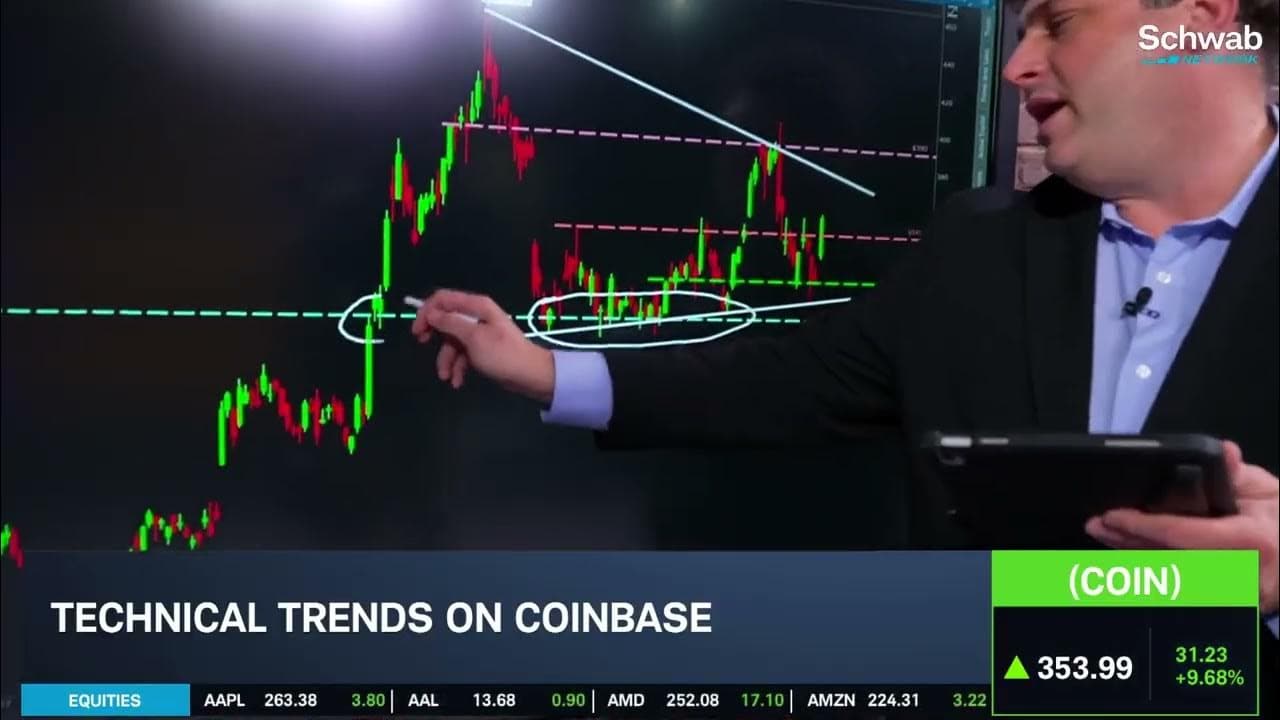
Coinbase (COIN) saw up to a 10% rally on Friday's trading session thanks to a bounce back in Bitcoin and a price target raise from JPMorgan. Rick Ducat notes the stock's close correlation to Bitcoin prices and outperformance compared to the SPX as stock highlights.

Operator: Welcome to Sdiptech Q3 2025 Report Presentation. [Operator Instructions] Now I will hand the conference over to CEO, Anders Mattson and CFO, Bengt Lejdstrom. Please go ahead. Anders Mattson: Hi, everybody, and welcome to our Q3 presentation and Q&A. I am Anders Mattson, CEO of Sdiptech, and I will be presenting the results together with CFO, Bengt Lejdstrom, here today. I will start with the highlights of the quarter before we go into the more general content with the financial results. So in the quarter, we have implemented and streamlined our portfolio and Sdiptech will become a more coherent and better aligned group going forward. Until today, we have consisted of 41 companies in our 4 business areas. We have historically been growing our adjusted EBITA at a good level, but we have, at the same time, been quite volatile. Our portfolio has partially been based on installation companies, companies with exposure to cyclical end markets like construction and quite a few companies with a margin around 10% in the group. And these companies were usually or most of them required before our strategic shift into. So if we look at the financials here for this total portfolio in Q3, we had approximately 19% in adjusted EBITA margin and 12% return on capital employed. If we look in the middle, so what have we done? We have assessed on our key strategic priorities. We prefer product-based companies. We like markets with strong underlying growth drivers. And we would like to see a clear niche, which is usually protected a good way and that's also the reason why we [Technical Difficulty] in many of our business units. So based on this assessment, we have made a decision to divest 11 companies from the group. We have already started the process of finding new homes to these companies, and we have good progress with several of divestments so far. As these 11 companies only stand for roughly 3% of the year-to-date adjusted EBITA, their P&L effect is minor. On the balance sheet, the result will be a write-down of SEK 500 million in goodwill and other intangible assets. And Bengt will come back to this later in the presentation. So if we look to the right here, from today and going forward, we will consist of 30 companies and a better aligned portfolio. We believe we will be able to more proactively drive organic growth with this portfolio. And from our point of view, it's also a better allocation of capital towards our strategic priorities going forward. Financially in the quarter, as I said, is a minor effect. Adjusted EBITA will be reduced by SEK 7 million from SEK 242 million to SEK 235 million. but our adjusted EBITA margin will go up from 19.4% to 21.3%. And return on capital employed will increase from 12% to roughly 13%. So in the presentation going forward now, I will present numbers according to the core portfolio. So summary of the quarter from a financial perspective, net sales increased with 9%. That was 4.5% organic growth and roughly 9% due to acquisition. We were glad to see solid demand from all our business areas. It was positive to see a slow recovery from some larger business units where orders have been pushed forward in the year from Q1 to Q2 and now in Q3, we finally got some sales realized. Adjusted EBITA increased with 9% at 2.4% organic and rough from acquisitions. The increase in sales made EBITA grow as well. So it's not only because of cost adjustment. And year-to-date, we are still behind last year's numbers, but positive with the organic growth in the quarter. We have also been able to maintain the margin of 21.3% in the quarter, which has been quite challenging due to tough market conditions, both on price and also actually to getting the customer to commit to the orders. We had a strong cash flow generation in the quarter as well of 94%, which resulted in SEK 255 million in cash. And that was primarily a result of improved inventory levels from a high level in the last quarter. If we're going into the net sales, the net sales increased with 9% to SEK 1,102 million. And as I said, there was a good demand, solid demand from all our business areas. And the 4.5% organic growth is something we are, of course, satisfied with in the quarter. As I also talked about previous quarters, we have experienced a slow first half of the year, especially from some larger business units in the group. So it's a positive sign that I mentioned as well that we have been able to deliver and recognize sales in the quarter. We have also had a strong contribution from acquisitions. And some of the acquisitions is influenced by strong growth drivers linked to security around data center as one example, and that is in our smallest business area, Safety & Security. In the graph to the right, we have separated the core portfolio since 2023. And from this date, you can see we have achieved a CAGR of 13% in sales growth. If we're looking at the sales split, the sales split of the portfolio looks now a little bit different. After the separation of the core, Sweden has decreased in size and now it's only between 5% and 6% in total sales from the portfolio. U.K. is still our biggest market. We believe we are successful in the U.K. We like the trend with the long-term investments in infrastructure assets. Other Europe is now roughly at 20%. This is a geographic area we foresee to continue to grow in. If you look to the right, turnover by type, proprietary products is the dominant type of revenue for us as a group. Installation has been reduced as a result of the core portfolio. The installation and service that you still hear -- you still see now is primarily on our own products. And we have several companies with a strong service offering that enables stability in the earnings. And that's usually both service on hardware, software and manual labor hours as well. But again, on our -- primarily on our own products then. Coming into the adjusted EBITA. Adjusted EBITA increased by 9% to SEK 235 million. That is, for us, a stable profit growth with 2.4% organic growth. We also had a strong contribution from acquisitions with 10%, and it's coming primarily from companies within Safety & Security and also from companies within Energy & Electrification. And again, that's the trend around security for data center that has been driven this acquisition quite good in the quarter. The margin at 21.3%, we have been able to maintain from last year. As I mentioned before, it's been a price pressure in the market. So being able to maintain this margin is a result of a good cost control, both from activities within purchasing, but also from overall overhead cost development. If we look at the diagram to the right, we see a stable and high level in adjusted EBITA in percentage since 2023. If you also then look at the CAGR, the CAGR of the EBITA is at 11%, and we know we can do better than this. But in this graph, it's affected by a slower pace of acquisitions since last 1.5 year and it's also a weaker, as we know, organic growth since the beginning of 2024. So looking at the development in our 4 business areas, I think it's important to mention that we believe our 4 business areas serves us well as a group. They are broad enough to enable good M&A opportunities within each and every business area. And they also align our focus to the markets with strong underlying growth drivers, which is very important for the long-term development for us as a group. In Q3, all 4 business areas had solid demand. It's also positive to see that our smallest business area, Safety & Security, had a strong development in the quarter. If you look at Supply Chain & Transportation, we have begun to recover in this one after a weaker first half of the year. Several customers in this business area postponed their orders, actually from Q2 during the summer into Q3 and some into Q4. But in Q3, we released some sales, and it was also a good scalability, which led to margin improvements in the business area. Safety & Security, as I already mentioned, had a strong quarter, and there was several smaller units benefiting from favorable market trends, the one I already mentioned around data center, but also around emission control, pollution control, which is a strong area for us. And the new acquired companies in this business area also affected positively. Within Energy & Electrification, performance was mixed. A few units were driven by continued strong demand from energy efficiency, while some units were still affected from some very tough comparison from last year. That was from Q1, Q2 and also now in Q3. In Water & Bioocconomy, several units performed well, although margins were impacted in this business area by some cost pressure. And we are working to -- but we also need to be balanced to foresee future opportunities and future growth in regards to our cost base. And with that said, I hand over to you, Bengt. Bengt Lejdstrom: Thank you, Anders. Yes. And let's have a little bit deeper look into the cash flow and cash conversion for the whole group. As Anders was mentioning, we had a very good cash conversion of 94%, much of that coming from the inventories that were built up during the summer for seasonal sales that have started now and will continue into Q4. Improved the whole situation with inventory levels. We also saw some lower tax payments compared to last year. So all in all, a good quarter. And as you can see there on the chart that typically, we are between 70% to 90% in cash conversion. That's from operations and from working capital ups and downs. And we're now on a last 12-month basis, right in the middle at 81%, comparable with last year's 83%. We also start to show in our reports now the free cash flow per share. We haven't reported that for a very long time, but we report it now. And we had a very good free cash flow. That means all cash coming in from the business and also after the working capital adjustments, but then deducting the amortization of different leasing contracts as well as deducting the capital expenditures for different type of investments in the companies. So really, the only thing not included is when we acquire companies or pay earn-out debts to already acquired companies. So that cash flow was very good. And apart from the good cash flow from the operations, we saw a lower CapEx level in this quarter as we have done also for the full year. We work very closely with the companies, of course, to decide what type of the investments they should do. And we do that by looking at a classical DuPont chart, you could say that we -- where we look at both their EBIT margins and their capital turnover and see what kind of return on capital employed they have and from that decide what's most prioritized. So yes. And also the free cash flow for the last 12 months, as you see here at the last bullet is also very strong coming then both from the operations and from lower capital expenditures. Looking then at some additional metrics. We have the profit after tax, of course, an important measure. And -- but this quarter, it's a bit affected quite heavily actually by this write-down of goodwill when -- and it's all of SEK 500 million, this write-down of goodwill and other immaterial assets. When we moved these companies that will be divested out of the business areas, we could then make a full impairment test of their values. As you know, we do our impairment tests on goodwill, et cetera, based on our business areas because they are our cash-generating units. And all our 4 business areas have been able to defend very well the values that are in there. There is no risk for write-downs of the business areas. But when we then subtract out these specific companies, we have enabled them to look at them individually and in fact did total write-down of SEK 0.5 million. But if we exclude that more bookkeeping exercise, it's not cash generating anything, not affecting the cash flow, then we see that the profit after tax was a little bit lower. The difference is mainly because of the currency effects. We had SEK 14 million of currency loss in the quarter. And as you could see and hear from Anders previously that it affects both top line and profit, of course, this 4%, 5% all in all FX effect. But in our finance net, it affects us with SEK 14 million in the quarter. And that also affects us on the last 12 months. Then total, the finance net is affected with SEK 50 million, most of that coming from currency effects. And as you saw on the chart on our distribution of sales that currency effect could, of course, be quite substantial as the Swedish currency becomes stronger as we have more than 90% of our revenues kicking in from other currencies. Then another measure then taking that profit after tax and take it per ordinary share after dilution, you see then a very hefty minus in the quarter, minus SEK 11.14 per share. But if we then exclude this write-down, it's 2 -- a little bit more than SEK 2 per share, and it's of the same reasons as I just explained. And that also goes for the last 12 months compared with last year. Then taking a look on the leverage. We saw a quite big increase in the financial debt leverage compared with last year and also compared with the year-end last year. And that's because we have paid out earn-out debts. These earn-outs have been provided for in the balance sheet ever since we acquired the companies. So the payout of earn-outs do not affect the net debt in total, the bottom line, but it affects the financial net debt. So that has -- we have paid out about SEK 150 million in the quarter and almost SEK 400 million in the year, year-to-date. So that's, of course, a lot of money going out, but it's going up and it's having performed very well since we acquired them. So it's a good thing to pay earn-outs. The total net debt compared with the adjusted EBITA has decreased since new year since we haven't made so much acquisitions, but it increased from last year September because we have acquired SEK 85 million of profit in the last 12 months. And of course, that affects the balance sheet and since the organic growth hasn't been top notch during that period. That affects the profit and results in an increased -- slightly increase in the net debt leverage. Then as the last financial metric here presented, we look at the return on capital employed, the ROCE. And as Anders mentioned, it was 12% now. It's counted as, of course, on the average capital employed for the last 4 months and then compared with the EBITA profit we have had. And that decreased because we have increased the capital employed from the acquisitions and the organic growth, as I said, has been -- last 12 months have been slightly negative. If we just look at the outgoing balance of capital employed after the write-downs of goodwills, we are at almost 13%. And if we only look at the core businesses, taking their capital employed and their profits, then we're at 13.5% now. So as we divest these companies one by one, then, of course, then the capital employed is reduced and this ROCE will increase slowly, but steadily. If we look upon the operational return on capital employed, that is the average from our operating units, we're at 51%, which is, of course, very good, we believe. Okay, with that, back to Anders. Anders Mattson: Okay. Thank you, Bengt. So coming into acquisitions, which is a very important aspect of our business model. Year-to-date, we have acquired SEK 40 million in EBITA, and we hope to close one small deal before year-end. We have some ongoing discussions that is quite far in the process. So that's the aim for the year. I think it's important to mention our guiding principles here in regards to M&A. Regarding the pipeline, we continue to build the pipeline to meet the customers and customers -- sorry, companies to come to the discussion about the final acquisitions, and we do that, and we have a strong, solid pipeline in place continuously building that one. In regard to valuation, we're disciplined here. We know that it's easy to go away in valuation. And we have -- during this quarter, we have stepped away from 2 deals that I was part of as well due to the valuation was going too high for us. And on the leverage side, as we have said, our aim is to reduce the leverage in the future. So of course, that together with our disciplined evaluation is affecting as well the numbers of acquisition and the number of EBIT we have done so far in the year. I can also add here that we have started to look into Germany. We did it already last quarter, but it's a good progress and a lot of exciting companies in that region for us now and also for the future, we believe. Okay. So last slide before we go into the Q&A, a little bit of the takeaways from the quarter from us. I think the solid underlying demand is positive. A majority of our companies had a stable demand in Q3. It is still uncertainty out there in the market. And the condition for many of the businesses in Q4 is unstable. We see that 2026 is a positive sign for us, but it's still uncertain. And that's what we see right now. And we don't want to say anything more about 2026 than that here today. On the second bullet here, on our strategic actions for the long-term value creation, we have taken some very important steps in the [ quarter line ], our portfolio. We have been talking about that for quite some time, and it's -- I think it's good for us for Sdiptech to finally have done this decision now going forward. Many of the companies, we will divest. We have ongoing discussions with and progress in a good way. We have not set any strict deadline when it needs to happen, the divestment. But both from our perspective, from the company's perspective, we would like to be efficient and fast in the process. So that's what we are driving at. We have -- during the autumn as well, we have looked into our strategy, and we have made some adjustments, and we will present that on a Capital Market Day in end of November. And on the last note then, the acquisition pipeline. It is a solid pipeline that we have. Discussions ongoing, but we keep a strong discipline in our valuation and also around our investment criteria, especially with our aim to decreasing the leverage over time in the future. So that was, I think, everything from us as a presenter, and I think we can open up for our Q&A session as well now. Operator: [Operator Instructions] The next question comes from Max Bacco from SEB. Max Bacco: Well done in the quarter. Three questions from my side, 3, 4 questions. Perhaps starting with the cash flow. As you said, very strong here in the quarter, partly due to lower tax, but also lower CapEx and then quite neutral impact from net working capital. So the first question on cash flow, I think you mentioned this, Bengt. But here in the end of 2025 in Q4, do you see potential for further support from net working capital in terms of the cash flow? Or yes, what's your thought on that, if you start with that one? Bengt Lejdstrom: Exactly. Now typically, Q4 could be quite good from a working capital perspective since we have some seasonal oriented comp. There's no moving equipment and heat work and so on. And they have been building stocks during the summer and starting now then to sell it and turn it into accounts receivables, of course, but then also get the cash in from those invoices. So -- last year, it was actually above 100%, the cash generation. So it's not that high this year, but still Q4 is typically good for net working capital. Max Bacco: Okay. Sounds promising. And then you actually touched upon this also during the presentation that in the quarter, CapEx was a bit lower and that you have a very strict process with the subsidiaries when deciding how to allocate capital. And perhaps thinking a bit more long term than just next quarter, but historically, Sdiptech has been at some 4% of sales in terms of CapEx. Do you see a potential to reduce that number going ahead and perhaps allocate more into acquisitions instead and deleveraging? What's your thought thoughts on that going forward? Bengt Lejdstrom: Yes. I mean it's typically perhaps difficult to say the exact number for the future. But I think if we have been sometimes around 4 and even above, I think we're more around of sales now in CapEx spending. So -- but as I said, it's always depending on the actual situation and what's most profitable for that company, for example. But yes -- but we have tightened up the process quite a bit. Anders Mattson: I can add to that as well, then. Yes, I think what Bengt said there, it's important for us to see the CapEx and the need for the total portfolio and to prioritize in the coming years in a better way. And that's something we have looked into ourselves in our strategic work as well. Max Bacco: Okay. Sounds good. And then changing topic. I mean as you have explained yourself, quite a lot of things going on right now in Sdiptech, I mean, everything from improvement measures in several core subsidiaries. You still have an active M&A pipeline, you have ambitions to divest several companies. And I guess you're preparing as well for Capital Markets Day here in the end of November. Just curious how you allocate responsibilities internally? And do you consider yourself to be able to execute on all parts without, I guess, losing momentum and/or sacrificing quality? What's your thoughts on that? Anders Mattson: Yes, I think from -- I agree, it's a lot of -- on the agenda, but I think we have structured it quite good. The M&A team is not responsible for the divestment. So they are focusing on building the pipeline and meeting and executing on the M&A side. We have other internal individuals responsible for the divestment. And it's going quite good actually with -- we are not going on big broad processes. We are identifying smart, we think, key potential buyers to the businesses, and we drive that process quite efficiently. And from the other perspective is that we are still working on establishing the new business area organization. In August, Daniel started as the new Head of Supply Chain & Transportation. And we are quite far in the process to recruit somebody in the U.K. as well for Energy & Electrification. And I think that will, of course, be very important going forward to have that stable organization in the business area side as well. But so far, it looks -- feels good on that side. Max Bacco: Okay. Perfect. And then one final question, turning a bit more short term again, Just if it's possible, if you could help us how we should think about Q4 here in the next quarter in terms of comparable numbers, both for core and noncore? I mean at first glance, it looks like that noncore or other operations seem to have a quite weak Q4 last year. I guess it's some seasonality into it as well, whereas core had a more -- it looks like more decent quarter Q4 last year. Did you share that view on things? Anders Mattson: Yes. Yes, I can -- definitely, it's correct. In our situation, we look at the divestment process. So it might be that some of the companies might be divested now during Q4. And then, of course, it's going to affect that comparable numbers then. From the core, I think Bengt was touching upon that as well, that it's important that our companies with a bigger seasonal effect deliver now. And it's a little bit -- as we said, it's a little bit unsecured at the moment. We have some more slight negative, so to say. But overall, it's a positive sign for the future. But it's -- right now for Q4, we have said not to guide anything more than this at the moment. Operator: The next question comes from Simon Jönsson from ABG Sundal Collier. Simon Jönsson: First, just I want to say, it's a nice addition with the free cash flow per share KPI. Things like that are appreciated. And then I also have a question, like Max, on the acquisition pace. You -- it sounds like you expect maybe one more smaller acquisition this year. And it sounds like you remain quite active in new deals. So I just wonder how you think about new acquisitions versus your preferred gearing levels sort of what you're comfortable with and where you think your limits might be in terms of gearing and how much you can do on the acquisition side in near term. So I guess that's maybe not Q4, but in coming quarters or so. Anything on that would be helpful how you're thinking? Anders Mattson: Yes. So I think on the first perspective of this, it's important to be active. We prefer to say no to deals than not having the deals to not sit at the table. So we are, yes, definitely building the pipeline and meeting the customer and trying to get to the deal, so to say. But regarding the exact numbers, we will touch upon that, and we have discussed that internally in regards to our Capital Markets Day that we will come up with targets, I think, around some potentially new financial targets there. But right now, we are at 3.2%, as Bengt showed you, but I think we would like to go down from there and not to go up. So that's the balance. We still would like to acquire those value companies that are out there when we can get them at a good valuation, but still ambition is to drive down leverage. But we don't want to make it too fast and not make any stupid decisions when we have the good targets out there. Simon Jönsson: All right. Good answer. Then I just have a follow-up on the margins on the segments, specifically on Water & Bio. You commented briefly on the margins in that segment were impacted by cost pressures. Could you maybe elaborate a bit more specifically due to the margin decline year-over-year and how we should expect that those pressures going forward? Anders Mattson: Yes, we have a company, which is having a lot of big workforce. So from a salary perspective, salary increased quite significantly in the beginning of the year in -- especially in the U.K. And we are having some longer contracts with insurance customers, which is very hard to adjust for those kind of compensation or salary conversations. So there's a tough year for that company specifically in the U.K. And then -- but that's really the majority. And then we have also in other companies, we have been taking some decision to build up a little bit more because it's -- we need that for -- to be able to deliver for a possible upside in the coming quarters. It looks good from a revenue side in projects and orders. Operator: The next question comes from Martin Wahlstrom from Redeye. Martin Wahlstrom: The first one is related to the dynamic you say, where you postpone orders from H1 to H2. Could you give any more color on the split between kind of what lands in Q3 and what lands in Q4? Anders Mattson: I think we have a good -- let's say, part of that was actually now coming into Q3. But yes, it's still -- some of those orders, it's -- I'm thinking specifically of the 3 companies in the group. They have been promised orders. It didn't come in Q3. So yes, potentially, it will come in Q4. The good thing when we have the U.K. companies that they have the budget year in actually end of March 2026. So it's still on the right side in the budget, so to say, for some other companies. But no, it's difficult to say that, specifically how much of it came in Q3 and how much is going to be realized in Q4. Q4 is more about what I think we answered before as well, the seasonality in some of the winter needs to come, and we need to be able to deliver for the season or in season as well. Martin Wahlstrom: I see, I see. And then one final question is related to if you could give some more color on the distribution in your acquisition pipeline when it comes to kind of the split between business areas and geographies going forward? Anders Mattson: So from business area perspective, it's, let's say, it's equally among the 4 business areas. We have had some good discussions within supply chain, but also in Safety & Security in the recent quarter. So I think that's good. It's important that we work with all 4 business areas in acquisitions. From geography, it's actually nothing special there. It's our main geographies. It's U.K., it's the Nordics, it's Italy as well. And then as I said as well, we are going into Germany, and we have some good discussions with German or Dutch as well companies. So the DACH countries. It's -- so that's new and fresh into the pipeline, but nothing more or more significant than other geographies at the moment. Operator: The next question comes from Linus Alentun from Nordea. Linus Alentun: Just a quick couple of questions here from me. Starting off in Water & Bio, what would you say is a normalized margin here once we see a rebound? Bengt Lejdstrom: Well, I could perhaps step in there. Anders Mattson: Yes. Bengt Lejdstrom: Yes, we have seen -- typically, they have been around 24%, 25%. And then as the companies we now count as the core companies in that business area. Now it was 21% in this quarter for the reasons that Anders mentioned. So we're working to get it up there again. So whether it will be 23% or 24%, 25%, that's, of course, still to be seen because there are many different unique situations to take care of. But at least we're working to improve from the current 21%, that much we can say. Linus Alentun: Okay. And on '26 here, you mentioned in the report that, that is when you see a broader recovery. What makes you confident in that? Is there anything -- any indicator you've seen turning more positive or... Anders Mattson: No, I think it's the discussion with the companies. We are in a budget process as well, and we've been asking -- or in our discussions with the companies, it is positive momentum for business areas or business units and orders and they are looking into projects for next year and new potential customers. So no, it's from that perspective, talking to the companies and seeing there what they see for the orders and for the potential in the coming year. Linus Alentun: Okay. Super. That's super clear. And just one last question here. If I remember correctly, you had some swaps here that are contributing negatively in the net financials. What's the time line? When will they stop affecting here? Bengt Lejdstrom: Yes, we have 2 types of hedging arrangements. One is for interest and those interest swaps are right now negative. They were positive before when the interest rates were higher. Right now, we pay an extra 0.2 or so percent on the debt. But they will be closed from end of next year. And so 1, 2 years, you could say. So it's not a very big downside, but still, we pay about 20 basis points more than we should because of those hedging. But they have been giving a good return because they were better before. The other side, we have hedging arrangements on currencies. And there, we tried to hedge our currency exposure in the balance sheet to some extent. And not -- we're still net asset positive, which means that when, for example, British pound sterling is weakening towards the SEK, all in all, we get then a cost in the P&L, but not as much as we would if we hadn't those FX swaps and hedges. Linus Alentun: Okay. Super. So 20 bps there. Operator: [Operator Instructions] There are no more phone questions at this time. So I hand the conference back to the speakers for any written questions or closing comments. Bengt Lejdstrom: Yes. And I could kick off then with the questions. We have received 3 questions in the chat here. I think one we have already answered that was regarding the EBITA margin in the Water & Bioeconomy business area. And the second question was that some of the companies we are now intending to divest among the other companies. They have quite well-performing companies with good margins and product based to some extent. Why divesting such companies? Anders Mattson: Yes. I think I can add to that question is that -- so what I said, what we look for in the companies we would like to buy in our strategic priorities is around 3 things. We would like to have a strong promise that actually have their own products. They sell and they make service to them. We also want to have not cyclical end markets. It has been a challenge with some of the companies, which is very cyclical and working, trying to proactively work with organic growth is quite difficult if you don't have the mindset, that's what it is with those companies. And the third thing around the niche. If you have niche, you can protect it and you can drive growth from that niche. And all of these companies that we're giving examples of here, they have some aspect or they are not meeting that criteria. So it's been -- for us, been challenging, and we would like to allocate that money into more our prioritized businesses and future businesses. And we believe many of these businesses, as we said, it's not because they are performing financially bad, it's more that -- to allocate that capital to something that we believe in the future is better according to us. Bengt Lejdstrom: Thank you, Anders. And then the last written question, as I see, it's regarding the write-down if -- was that a one-off? Or could that potentially continue to be more write-downs Q4 and also next year? But what we have done now is to the best of our knowledge, as it's typically called and also to write down the value. So we don't foresee that we need to do any more write-downs. And of course, it's depending on how much money, high considerations we will get for the companies once we divest. But we believe at least that the value of these companies represent their market value and potential than consideration that we will get. So it shouldn't be any major at least. It could be -- go both ways. We could both have some profits or we could have some smaller losses when we divest, but it shouldn't really be any big numbers. But no write-down of goodwill as such because of any impairment. I think that was all of the written questions. So back to you, Anders. Anders Mattson: Yes. I think then thank you for the written question and asked question. And yes, thank you all for listening in, and we are looking forward. And hopefully, we will meet some of you at the Capital Markets Day in November, which will be held here in Stockholm, and we are looking forward to that. So with that, thank you, everybody, for today.
Operator: Good morning, and welcome to the NatWest Group Q3 Results 2025 Management Presentation. Today's presentation will be hosted by CEO, Paul Thwaite; and CFO, Katie Murray. After the presentation, we will take questions. Paul Thwaite: Good morning, and thanks for joining us today. I'll start with a short introduction before I hand over to Katie to take you through the numbers. We have delivered another strong quarter as we continue to execute on our priorities of disciplined growth, bank wide simplification, together with managing our balance sheet and risk well. Though inflation is above the Bank of England's 2% target, the economy is growing, unemployment is low, wage growth is above the rate of inflation and businesses and households have relatively high levels of savings and liquidity. This is reflected in the levels of customer activity we're seeing across the bank. So let me start with the headlines for the first 9 months. Lending has grown 4.4% since the year-end to GBP 388 billion, in line with our annual growth rate of more than 4% over the past 6 years. Growth has been broad-based across our 3 businesses and we attracted a further 70,000 new customers in the quarter. Mortgage lending was up by more than GBP 5 billion for the first 9 months as we broadened our customer proposition with new offers for first-time buyers and family backed mortgages, and issued mortgages to landlords in collaboration with buy-to-let specialists, [indiscernible]. Unsecured lending grew GBP 2.9 billion or 17.3%, and we made good progress integrating our recently acquired Sainsbury's customers. They're now able to view their credit card, link their Nectar card and view their Nectar points from credit card spending via the NatWest app. In commercial and institutional, we delivered lending growth of GBP 7.9 billion or 5.5% across both our large corporate and institutional and commercial mid-market businesses. in areas such as infrastructure, social housing and sustainable finance. As the #1 lender to infrastructure, we are supporting many large-scale programs up and down the country. And we have delivered GBP 7.6 billion towards our 2030 group climate and transition finance target of GBP 200 billion announced in July. Deposits grew 0.8% to GBP 435 billion as we balance volume with value in a competitive market and as customers manage their savings across cash deposits and investments. And there's more customers across the bank chose to invest with us assets under management and administration have grown 14.5% to GBP 56 billion. This has contributed to growth in noninterest income, along with higher fees from payments, cards and good performance in our currencies and capital markets business. This customer activity has resulted in a strong financial performance. Income grew to GBP 12.1 billion, 12.5% higher than the first 9 months last year. Costs were up 2.5% at GBP 5.9 billion resulting in operating profit of GBP 5.8 billion and attributable profit of GBP 4.1 billion. Our return on tangible equity was 19.5%. Given the strength of our performance, we are revising our full year guidance for income to around GBP 16.3 billion and for returns to greater than 18%. We continue to make good progress on both simplification and capital management. We have reduced the cost/income ratio by 5 percentage points to 47.8%. And and we generated 202 basis points of capital for the 9 months and ended the third quarter with a CET1 ratio of 14.2%. This strong capital generation allows us not just to support customers but to invest in the business and deliver attractive returns to shareholders. As you know, we announced a new share buyback of GBP 750 million at the half year, of which 50% has now been carried out. and we expect to complete the buyback by our full year results. Earnings per share have grown 32.4% year-on-year and TNAV per share is at 14.6% at 362p. So a strong performance for the first 9 months. I'll hand over to Katie to take you through the numbers for the third quarter. Katie Murray: Thank you, Paul. I'll talk about the third quarter using the second quarter as a comparator. Income, excluding all notable items, was up 3.9% at GBP 4.2 billion. Total income was up 8.2%, including GBP 166 million of notable income items. Operating expenses were 2.1% more at [indiscernible] due to lower litigation and conduct charges. And the impairment charge was GBP 153 million or 15 basis points of loans. Taken together, this delivered operating profit before tax of GBP 2.2 billion for the quarter and profit attributable to ordinary shareholders of GBP 1.6 billion. Our return on tangible equity was 22.3%. Turning now to income. Overall income, excluding notable items, grew 3.9% to GBP 4.2 billion. Across our 3 businesses, income increased by 2.5% or GBP 101 million. Net interest income grew 3% or GBP 94 million to GBP 3.3 billion. This was driven by further lending growth and margin expansion as tailwinds from the structural hedge and the benefit from the Sainsbury's portfolios for a full quarter more than offset the impact of the base rate cut in August. Net interest margin was up 9 basis points to 237, mainly due to deposit margin expansion and funding and other treasury activity. Noninterest income across the 3 businesses was up 0.8% compared with a strong second quarter. This was due to increased card fees in retail banking, higher investment management fees in private banking and wealth management. and a good performance in currencies and capital markets with heightened volatility. Given continued positive momentum and a clearer line of sight to the year-end, we have refined our income guidance and now expect full year total income, excluding notable items, to be around GBP 16.3 billion. We continue to assume 1 further base rate cut this year with rates reaching 3.75% by the year-end. This improved guidance alongside strong Q3 returns means we now expect return on tangible equity for the full year to be greater than 18%. Moving now to lending, where we have delivered another strong quarter of growth. Gross loans to customers across our 3 businesses increased by GBP 4.4 billion to GBP 388. 1 billion. with growth well balanced between personal and corporate customers across retail banking and private banking and wealth management, mortgage balance grew by GBP 1.7 billion, and our stock share remained stable at 12.6%. Unsecured balances increased by a further GBP 100 million, mainly in credit cards. In commercial and institutional, gross customer loans, excluding government schemes were up by GBP 3 billion. This includes GBP 1.6 billion across our commercial mid-market customers, in particular, in project finance, social housing and residential, commercial real estate as well as GBP 1.5 billion in corporate and institutions, mainly driven by infrastructure and funds lending. I'll now turn to deposits. These were broadly stable across our 3 businesses at GBP 435 billion. Retail banking deposit balances were down GBP 0.8 billion, with growth of GBP 0.6 billion in current accounts, more than offset by lower fixed-term saving balances following large maturities. Private banking balances that reduced by GBP 0.7 billion with flows into investments as customers diversify and manage their savings as well as tax payments made in July. We saw a small increase in commercial and institutional of GBP 0.4 billion, with higher balances in both commercial, mid-market and business banking. Deposit mix across the 3 businesses were broadly stable. Turning now to costs. We are pleased with our delivery of savings this year, which allows us to invest and accelerate our program of bank-wide simplification. Costs grew 1% to GBP 2 billion, including GBP 34 million of our guided onetime integration costs. This brings integration costs for the first 9 months to GBP 68 million. We remain on track for other operating expenses to be around GBP 8 billion for the full year. plus around GBP 100 million of onetime integration costs. This means you should expect expenses to be higher in the fourth quarter, driven by the annual bank levy and the timing of investment spend. I'd like to turn now to impairments. Our prime loan book is well diversified and continues to perform well. We are reporting a net impairment charge of GBP 153 million for the third quarter. equivalent to 15 basis points of loans on an annualized basis. Our post model adjustments for economic uncertainty of GBP 233 million are broadly unchanged. And following our usual review, our economic assumptions also remain unchanged. Overall, we are comfortable with our provisions and coverage, and we have no significant concerns about the credit portfolio at this time. Given the current performance of the book and the 17 basis points of impairments year-to-date, we continue to expect a lower impairment rate below 20 basis points for the full year. Turning now to capital. We ended the third quarter with a common equity Tier 1 ratio of 14.2%, up 60 basis points on the second. We generated 101 basis points of capital before distributions, taking the 9-month total to 202 basis points. Strong third quarter earnings added 84 basis points and the reduction in risk-weighted assets contributed another 8 basis points. Risk-weighted assets decreased by GBP 1 billion to GBP 189.1 billion. GBP 0.9 billion of business movements which broadly reflects our lending growth and GBP 0.3 billion from CRD 4 model inflation were more than offset by a GBP 2.2 billion reduction as a result of RWA management. This brings our CET1 ratio before distributions to 14.6%. We accrued 50% of attributable profits for the ordinary dividend as usual, equivalent to 42 basis points of capital. We continue to expect RWAs of GBP 190 billion to GBP 195 billion at the year-end, with a greater impact from CRD4 expected in the fourth quarter. Turning now to guidance for 2025. We now expect income excluding notable items, to be around GBP 16.3 billion and return on tangible equity to be greater than 18%. Our cost impairment and RWA guidance remains unchanged. And with that, I'll hand back to Paul. Thank you. Paul Thwaite: Thank you, Katie. So to conclude, we're pleased to report another very strong quarter of income growth, profits, returns and capital generation. This has been driven by customer activity across all 3 of our businesses, leading to strong broad-based lending growth and robust fee income. Our continued focus on cost discipline has delivered meaningful operating leverage. And as we actively manage both our balance sheet and risk, the business remains well positioned to deliver strong shareholder returns. As you've heard, we have upgraded our full year income and returns guidance today. And we'll update you on our guidance for 2026 and share our new targets for 2028 at the full year in February. Many thanks. We'll now open it up for questions. Operator: [Operator Instructions] Our first question comes from Benjamin Caven-Roberts of Goldman Sachs. Benjamin Caven-Roberts: So 2 for me, please. First on deposits and second, on noninterest income. So on deposits, could you talk a bit about deposit momentum in the business? And in particular, you mentioned the retail fixed term outflows over the quarter. Could you talk a bit more about how much of that is reflecting conscious pricing decisions? And then looking ahead, the sort of trajectory for deposits going forward? And then on noninterest income, very strong even when adjusting out the notable items related to derivatives. Could you talk about momentum in that franchise and what business drivers you're particularly focused on looking ahead? Paul Thwaite: Thanks, Ben. Good to hear from you. So let's take them 1 by one. So on deposits, so big picture is up around GBP 3.5 billion, around 1% year-to-date. Different stories within the different businesses. I guess, we talked at the half year around the kind of ISA season and some of the -- get the confluence of debate around the future of ISA and how that led and some of the movements in the swap curves on the back of tariffs and how that led to different pricing. That period is behind us. There's been more normalized pricing since the kind of April, May. If you look at our 3 businesses, I'd say slightly different trends. I'll finish with retail because there's more to unpack there. On the commercial side, deposits are up, encouragingly, that's in kind of the business bank and commercial mid-market. That's good. Private bank cash deposits are down. A combination of things, July, we saw some tax payments -- but also we see more funds shift from cash deposits into securities and investments, which is a net positive trend. In retail, if you look at current account balances, they are up. So kind of operational balances, salary accounts, you can see that the numbers are up there. I think the details are in the disclosures. Instant Access is flat. -- where we've seen some reductions is in fixed term accounts. And that reflects a number of mature -- large maturities that we had during the quarter. We're pleased with our retention rates. They're running about 80%, 85%. But as you alluded to, given our LDR at 88%, LCR at 148% we're finding a right balance between value and volume. So we've been pretty dynamic, and we're focusing on where we see funding and customer value. So that's that's unpacking the deposit story for you. So different stories in different businesses, relatively stable given our overall funding profile, very focused on managing appropriately for value. On the second question, which is non-NII, yes, as you alluded to, we're pleased with the quarter, and we're pleased with the year-to-date. Good momentum in the areas that we've been focusing on. I mean it's quite broad-based actually, when you unpack it, cards, payments, but obviously good contribution within C&I from our markets business driven by the strong FX franchise and by the capital markets business. So we've had a strong quarter 3 there, probably slightly stronger than we expected when we spoke to you at the half year. We feel as if our focus on those areas, whether it's the market part of commercial institutional, whether it's our payments business. But also, as you can see in our wealth business, the fees from assets under management are increasing as well. So it feels like we've got good progress and good momentum on fees and it remains a strategic area of focus for us. Thanks, Ben. Operator: Our next question comes from Sheel Shah of JPMorgan. Sheel Shah: Great. Firstly, on the costs. You've reiterated your cost guidance for the year despite the strong third quarter performance. How should we think about cost growth going forward, given we have CPI going back towards 4%. You're clearly simplifying the bank internally. Do you think a 3% cost growth number is the right level for the bank? Or do you think that maybe understates your ability to manage the cost base? And then secondly, on capital, could you give us a steer on the CRD impact that we expect for the fourth quarter? And maybe thinking about the fourth quarter capital level, how are you thinking about operating in that 13% to 14% range? Is there anything preventing you from moving down towards the 13%? Or are you managing maybe for M&A or anything else maybe in the horizon that you're thinking about? Because this is clearly the strongest capital print we've had for the last maybe 3, 4 years or maybe 2 to 3 years for the bank overall. Paul Thwaite: Thanks, Sheel. Katie, I'll take the cost and then turn it over to you on the capital piece of that okay. Katie Murray: Yes. Paul Thwaite: On cost, Sheel, so as you say, it's a -- it's a strong year-to-date picture if you look at year-on-year comparisons. And obviously, we have the one-off in terms of the integration costs as well of Sainsbury's. I am pleased with the momentum we're getting on the simplification agenda. I think that's -- you can see that starting to bear fruit. It's also I think most pleasingly, it's a bit of a flywheel because it creates investment capacity to drive further transformation in the business. And it's not only cost out it's also improving customer experience and colleague experience as well. So as you alluded to, we're holding with the current year guidance, GBP 8 billion plus the GBP 100 million of integration costs, but we are pleased with the momentum on the agenda -- on the simplification agenda. I'm not going to be drawn on kind of 26 costs or future costs. We'll talk to you in February around '26 guidance and new '28 targets. But what I would say thematically is we still have a very significant focus on cost management, and we're a very high conviction on the simplification agenda. And to help put that in context a little bit for you to deliver the cost print that we are doing this year requires us to take more than 4% out of the kind of the underlying business. so that we can support the investment, the inflation-related changes, be they wages or tech contracts. So we've got good momentum in kind of taking that, driving that efficiency out. been able to invest, but also delivering good cost control. So that's the ethos going forward. And the levers that we're pulling those levers can still be pulled moving forward, whether that's continued acceleration of our digitization, streamlizing and modernizing the tech estate. Just by way of example, we decommission 24 platforms in retail so far this year, which is great. You've seen we've done a lot of work simplifying our operating model, whether it's in our wealth business, moving some of the support areas in Switzerland to the U.K. and India rationalizing our European footprint, legal entity footprint. and just some of the good organizational health measures. So it feels as though those levers that we've been pulling can continue to be pulled -- and then obviously, you lay over that some of the productivity benefits we're seeing from AI and those activities around customer contact, software engineering. So net-net, I'm not giving you a number for '26, but hopefully giving you a sense of how we're thinking about it and where the momentum is coming from, and therefore, our confidence in maintaining a good healthy cost profile going forward. Katie? Katie Murray: Perfect. Sure. So Sheel, I'll just start off talking a little bit with CRD for the interest on capital as well. So look, as you look at it, you're absolutely right. In the quarter, limited CRD4 impact. We are expecting the majority of that in Q4 and a little bit of that may even bleed into 2026. So when you think of our kind of RWAs from here, it's very much about the loan growth, the management actions as well as that more material impact of CRD4 coming in, in the fourth quarter. And then going forward, you're familiar with Basel 3.1 coming in in 2026. That is always important to remember that comes with a bit of a Pillar 2 reduction when it comes through in terms of capital. But when I think of kind of the RWAs is to kind of think of the absolute growth that we're talking about in the book, importantly, the mix of that growth, but also the kind of risk density that you see once we pass the CRD for and the Basel 3.1. And of course, obviously, the continuing strength of our management action program that we have. And then if you turn to kind of capital, clearly, a really strong print today, very pleased with the 101 basis points we did in the third quarter, 202 bps for the first 9 months. I mean a great result by any measure. We've always said that we're happy to operate down to that 13%. We do think about capital generation and when we think of it in terms of dividends and where we're going to land and things like's that, we do debate the sort of next sort of 6, 12 months as well because you've got to think about we really try to manage a consistent program of capital return back to the market, but also it mindful of that RWA generation that's coming, whether it be from regulatory change or the growth the growth within the book. And so as you -- I would kind of as you consider where we might land and what we might think about is think on those various points. Thanks very much, Sheel. Paul Thwaite: Thanks Sheel. Operator: Our next question comes from Aman Rakkar of Barclays. Aman Rakkar: I had 2 questions, please. I guess we're all probably singularly focused on 2026 at this stage. So particularly on income, love to kind of get your take on how we should think about the various drivers from here across I guess margin developments, clearly, loan growth continues to surprise positively, but any color you can provide on kind of the drivers of fee income from here would be really helpful. And I guess the second question was around your longer-term targets that hopefully you're going to present to the market in the new year. And to me, it looks like there is the underpinning of pretty decent operating leverage for a number of years here, not least because of the structural tailwind to '28 that you guys flagged. So I guess one for Paul really in terms of your view on structural operating leverage in your business on a multiyear view from here, how confident you are in that in terms of some of the levers you might want to pull -- and I guess, I'm ultimately interested in the RoTE output. For me, you're doing 18% this year, and there's no reason to think in my mind why you don't accrete quite nicely over and above that level as you realize that operating leverage. So any kind of color you can give on that basis would be really helpful. Paul Thwaite: Katie, do you want to take '26 and I'll talk about. Katie Murray: Perfect. That's great. Thanks, good to hear your voice. Look, we do continue to expect the income growth that we've seen throughout our guidance period, and we do remain confident in that growth trajectory beyond 2025. So as I look at 2026, there's probably a few things I would kind of guide you to. One, growth. I mean, we've talked about this a lot, but we've got a strong multiyear track record of growth across all 3 of our businesses. We outpaced the wider sector on that. if we look at the breadth of our business, we know that we're well placed to capture demand as it comes through, and we'll continue to deploy capital throughout 2026, and we do expect that growth to continue. Obviously, there's a mix of growth across both sides of the balance sheet, and that's very much a function of customer and competitor behavior. The hedge, I think you're all very familiar with the hedge these days. We've talked about it such a lot over this last year, but certainly, strong growth into 2026, over GBP 1 billion higher in absolute terms in 2025. I think that's well understood by all of you. Rate cuts, we do expect one further rate cut in Q1 after our plans still have a rate cut in November. So we get to a kind of terminal rate of 3.5%. And then you'll see the kind of averaging impact of the rates we've had this year coming through into 2026. Paul has already spoken on noninterest income and our confidence in that business, very much the strength of the kind of customer franchise, always dependent on customer volatility and -- sorry, customer activity and volatility, but it served us very well this year. But if I think of all of those trends together, Aman, they will continue beyond next year as well, obviously, with the exception of rate cuts as we believe we'll get to that terminal rate in 2026. But I'd agree with you, we feel quite well placed at the moment. Paul? Paul Thwaite: Thanks, Katie, and thanks, Aman. And yes, A, we've announced today that we'll share targets for '28 in February. So we've been very explicit on that. So we look forward to that session. But as you say, it's obvious we've got good momentum in the business, and that's predicated on strong operating leverage. If you look at today's numbers, we've got a 5% cost/income ratio improvement, and we've guided to over 9% jaws for the year. So a very strong proof point of the operating leverage that we've got in the current business model and business mix, which we have talked about previously. But as I said, I'm just very pleased that it's bearing fruit as the -- both the income growth and the simplification agenda comes through. as I said to Sheel's question, we are high conviction on the simplification agenda. The levers we are pulling are working, and we can see a path to continue to pull those levers, which should further support the operating leverage to link it to Katie's answer as we see the top line growth through the different aspects. It's our seventh year of growth above 4% on the lending side. So that gives us confidence there that we've got customer businesses that will capture demand and have grown above market growth levels over a multiyear track record. So that's what's going to inform our thinking as we go through. But the underlying thesis here is very tight management of costs that creates capacity to invest, growing the customer franchises, strong jaws, generates a lot of capital, over 100 basis points in the quarter, over 200 for the year, and that gives us confidence about the outlook. So hopefully, that gives you a sense how we're thinking about it. And obviously, we'll talk specific numbers in February. Thanks Aman. Operator: Our next question comes from Alvaro Serrano from Morgan Stanley. Alvaro de Tejada: Hopefully, you can hear me okay. I guess the 2 bit follow-ups, but I'm interested. NatWest Markets continues to do very well and hold up very well. And I know there's a history there, and I suspect part of the cautious guidance has been on the limited visibility of the nature -- because of the nature of the business. But given it continues to perform pretty steadily, consensus has it down the contribution in 2026, and there's not a lot of growth medium term in noninterest income. Given the performance the last few years, can you sort of share your reflections on that business? How much is being cyclical versus what you changed in the business? And is that right to assume a normalization down medium term and next year in particular? And second, around loan growth, it continues to do very well. in corporate, I'm thinking now it was lumpy to start with in corporate and institutional, but it does look like it's much more spread out in mid-market now. Again, as we think about the next few quarters, how do you see that momentum? Should we think that this level of growth is sustainable? Paul Thwaite: Thanks, Alvaro. Katie, do you want to take the C&I kind of markets products question, and I'll take the wider lending. Katie Murray: Yes. No, absolutely. So I mean, Alvaro, it's interesting. Obviously, you've been with us for some time, and you've been on that journey in terms of NatWest Markets. And I think the real strategic important thing that kind of has happened really from the beginning of last year is actually the merging of C&I into into that kind of commercial and institutional business so that you have one team really delivering strategically for their customers. And we've really seen the benefit of that coming through. We've had very robust noninterest income. That -- there's been higher fee income coming through in payments and the strong performance from C&I is an important part of that. And it's really around the strategy that we've got of bringing more of the bank to more of our customers. And a result of that, we see -- we saw the strong demand for FX management and then really strong risk management as well against the backdrop of the volatile markets that was there. So really making sure that we were in place for our customers when they needed us in terms of the general kind of market activity. So I would say it is very much the outcome of that strategy of bringing that NatWest activity into the C&I franchise, making sure that we're there to deliver and meet the kind of customer activity as we go forward. And we would expect that to kind of continue from here. Volatility is a big part, of course. It's hard to call where that will land. Customer activity is critical, but we kind of -- we really do see that as a really strong basis going forward. I'd just remind you, as I often do on these calls, is when you're looking at noninterest income, it's always good to look at the 3 businesses. You do get a little bit of noise in the center as you move forward from here that will reduce a little bit as we go forward. But overall income outlook kind of is -- I think we're very pleased with it, and that's what's enabled us to upgrade our guidance for this year. And you've heard me talk around the confidence we have as we go into 2026 as well. Thanks, Alvaro. Paul? Paul Thwaite: Thanks, Katie. And Alvaro, I sense your question on lending was specifically around the commercial institutional business. And -- but just I think it's worth framing our, I guess, our lending growth and our lending opportunity more broadly before that. I say we've got a decent multiyear track record now of growing the 3 businesses. That's 7 years at above 4%. This year, it's currently running up GBP 16 billion. It's up 4.4%. So it's quite broad-based the growth. If you drop down into the commercial franchise, it's a good spot. The quarter 3 print and the growth of around GBP 3 billion is split between, I guess, the large corporates and the mid-market. It's pleasing to see the momentum in the commercial mid-market. You'll have heard me say before, I do think that's kind of a helpful proxy on the kind of wider U.K. environment. When you look at where the growth is coming from in the mid-market, -- you can see it in social housing. You can see it in certain parts of real estate. You can see it in parts of infrastructure. So again, it's quite broad-based. So lending as a total quantum, yes, strong, but the constituent businesses it's coming from is encouraging as well. Infrastructure is a big part of that. And what I'd say is I feel as if our commercial business is very well positioned to some of those bigger structural trends that we're seeing. So whether it is infrastructure, whether it's project finance, whether it's sort of the social housing agenda. So the kind of combination of the structural trends and the policy trends support those areas we are -- we have deep specialisms in and have had for quite a few years. So yes, encouraging, as you say. Thanks Alvaro. Operator: Our next question comes from Chris Cant of Autonomous. Christopher Cant: Can you hear me? Paul Thwaite: Yes, we can. Christopher Cant: Okay. It's still got a little mute icon on the screen, so I was a bit concerned. Paul Thwaite: Crystal clear. Christopher Cant: Just on loan growth, Paul, I mean, I think it's been an area where if I look at consensus, consensus has got 3% or less loan growth in over the next couple of years. It's been something that as a management team, you've typically been reluctant to sort of give an expectation on beyond saying you have a track record of growing quicker than the market. But as you think out to the next planning period, -- how are you thinking about that in absolute terms? I presume you have a view on how much growth you think the market is likely to see and you want to exceed that. But should we be thinking about 4% as a sort of reasonable expectation or in excess of 4% is a reasonable expectation, assuming no kind of macro volatility or blow up? And then on the returns target, please. So again, it's an area where you're a little bit different from your domestic peers. The last 2 return targets you've given, I guess, have been a little bit more of a through-the-cycle expectation where you would expect to hit them sort of regardless of what was happening to rates and the macro environment. Now that things have settled down from a, I guess, customer behavioral perspective, in particular, on the deposit front, are you going to be giving us a different flavor of return expectation when you're looking out to 2028? So will you be guiding on where you think the business will be in '28 with your base case assumption rather than a sort of a floor underpinning a broader range of potentially more downside scenarios around customer behavior and macro activity and so on? Paul Thwaite: Great. Okay. Thank you, Chris. So I'll take the second one quickly first. Obviously, we'll see you in February and talk about it. And obviously, some of the topics you alluded to are what we're thinking about as we go into February and we share '28 numbers. But obviously, we will lay out what assumptions we've made around those targets at that time. But it's a very active debate, as you rightly allude to. On the lending side, I think you characterized the position very well and very consistent with how we see it. We're very confident in the track record that we've had. Our ability to grow above market has been proven year-on-year. It does vary by business and market conditions as to as well. But that's what gives us confidence in terms of the outlook for the lending position. I'm not going to declare new targets or new deltas relative to market growth on the call. I think I've given quite enough color about, I guess, our historic track record and how we're thinking about the business going forward to hopefully give you a sense of confidence and optimism we have around the lending profile. Thanks Chris. Operator: Our next question comes from Jonathan Pierce of Jefferies. Jonathan Richard Pierce: I've got 2 questions. One is on the equity Tier 1 target moving forward. Is that something you'll potentially give us a bit more of an update on in February? Or are we going to have to wait until the back end of the year once Basel 3.1 is pretty much nailed down. I ask, of course, because the MDA is 11.6. I guess it drops 30 bps, something like that on Basel 3.1. And it feels like the scope to probably operate towards the lower end of your current range rather than the middle or the upper end of it. The second question is a bit more detailed, I'm afraid, around deferred tax assets. In the 9 months to date, the DTA deduction from capital has fallen by GBP 250 million, and it was GBP 100 million in the last quarter alone. So it's not an insignificant amount of capital build that's now coming from that DTA. So I just wondered if we should expect that sort of run rate to continue until the stock has run out a few years forward. I guess we should because RBS plc is now generating good profit and so on and so forth. And sorry, just a supplementary on that. The last 3 years, you bought back around GBP 300 million a year of unrecognized DTA back onto the balance sheet. Are we going to see the same again in the fourth quarter of this year, Katie? Paul Thwaite: Okay. Thanks, Jonathan. So Katie, why don't you lead out on the CET1? Katie Murray: And then I will get to... Paul Thwaite: And then we'll get to some of the DTI. Katie Murray: No, that's all right. It's one of my preferred specialist subjects, so I'll make you wait for the answers on that one just for a little bit longer. But on CET1 Look, there's a lot of things going on at the moment, Jonathan, with CET1, as you're very much aware. Obviously, the Bank of England is looking at their review of capital requirements. So we're looking forward to the FEC's update on that assessment. It's due to come out on December 2. So we'll see what comes through with that. Our approach on capital has always been to review it as part of our annual ICAP process and the risk appetite review that we do as well as working with the PRA on their kind of annual stress tests. And you're familiar with the numbers. We can see that our capital position has really improved over the last couple of years as we've derisked the business. We've also added a significant amount of capital into the business as a result of the RWA inflation that we've had. I think importantly, as part of the SREP process that we had this year that just came out in Q3. Our Pillar 2A there was reduced to -- by 17 basis points. which took our statutory minimum requirement to 11.6%. I do expect that number to reduce further once Basel 3.1 is implemented on the 1st of January 2027. And we've got pretty good line of sight in that. So therefore, when you look at it, you can see that we've got strong buffers relative to that lower bound of 13% of our current targets. So I'm not committing today as to the date or what we might do on any change of our 13% to 14% target, but we are actively thinking about the appropriate capital targets and capital buffers that we have required for our business on a more medium to longer term. Look, if you go to the deferred tax aspect of it, I think there's a couple of things to remember within there that the treatment within capital is slightly different than the treatment within accounting. So you sort of -- you can see changes coming through at different times. differences of recognition versus utilization of those assets. But we have just over GBP 800 million of DTA assets remaining. We have written back about GBP 1.2 billion since 2023. So we don't have a significant amount more to recognize. Interestingly, with deferred tax assets, you've got to really look at where they're sitting in terms of the legal entity structure as well and what's kind of -- and the ability to use them is very much structured by that legal entity structure. We do think, however, that our utilization in Q4 would be around in line with Q3. And then for 2026 onwards, we do expect a slightly lower utilization, probably around GBP 100 million to GBP 150 million per year. So continued support to capital generation, but at a slightly different level just given that we've used a lot of the losses up there or given where other historic losses are sitting and your ability to kind of access them. And Jonathan, we happily have a longer chat on DT offline as well with you, if that's something that would be helpful. Operator: Our next question comes from Guy Stebbings of BNP Paribas Exane. Guy Stebbings: So just around NII and the NIM bridge in Q3, and then I had one very short supplementary. So the hedge build was, I think, broadly as expected. The better performance in terms of the NIM bridge, I think came from funding and other and then to a lesser extent, the asset margins, which were up fractionally. So firstly, on the funding and other, I think that included some hedge accounting and reallocations between NII and OI. So perhaps you could just clarify exactly what's going on there. And to be clear, if it's correct to think that we should expect any sort of sequential benefits from there, but nor it reverses, that's the right way to think about it? And then on the asset margins, do you think we should expect to see further growth in there? Or is that really just a function of Sainsbury's coming in fully and then perhaps need to be mindful of some minor mortgage spread churn as we look forward? And then just a very quick point of clarification. On RWAs, I recognize the guidance hasn't changed. You flagged the business growth and CRD IV model changes. But just interested if we're coming into Q4 in a slightly better position than you originally thought and whether that means we might be more towards the lower end of that range for the full year guide. Paul Thwaite: Thanks. Katie, over to you. Katie Murray: Yes, perfect, Lovely. Thanks very much. So first of all, yes, funding and other, up 3 basis points, 2 bps related to treasury, and that's not going to repeat. This bucket is always interesting in the walk. It's got a number of different moving parts within it. And really, it's kind of the reflection of the management of a GBP 700 billion balance sheet that we need to consider kind of in any given quarter. So you do get the odd basis point that comes out. But this quarter, we did implement a hedge accounting solution for some of that FX swap activity that we've talked about over the last number of quarters. It's a one-off 2 bp benefit. in NIM, we don't expect it to repeat nor do we expect it to reverse. But going forward, you should see less volatility in the NIM from that activity quarter-on-quarter, which will be a lower drag to NII, a lower benefit to noninterest income. But really importantly, the same economic benefit overall as we go through. If I look at the asset margin, up 1 basis point is a very kind of small movement. And you're absolutely right, Guy, is benefiting from a whole quarter of Sainsbury's. I'm not expecting particular expansion in that line. It's very much dependent in one quarter on the mix and what you might see kind of happening within there at any time. If I spend a little moment on the kind of mortgage margins that we have within there, you're absolutely right. If you think of where our mortgage margins are versus the NIM overall, that's clearly something that you do see as a bit of a negative -- we've always talked that the book is around 70 basis points. We do see at the moment that we're writing a little below that, just -- and that's very much a symptom of the really intense competition that we're seeing on mortgages. So again, that will be a feature of the NIM as we go through from here. The market does move around in terms of where that is. But certainly, at the moment, there's a little bit of pressure within that space. In terms of RWAs, I would really think of that really as timing as much as anything else. I wouldn't say it's going to be particularly having an impact. In the next quarter, I have talked about more material CRD IV impacts coming through. There'll be a little bit of loan growth, of course. We've obviously continued to work on our risk management -- sorry, our RWA management program as well. But I wouldn't look at that and go actually, that's going to pull them down. It really is just timing. Thanks, Guy. Hopefully, that answered it all. Operator: Our next question comes from Robert Noble at Deutsche Bank. Robert Noble: I wanted to ask one on liquidity, please. So there's been a continued rotation in your liquidity from cash into government bonds that seems to pick up, right? So what's the spread pickup you're getting off that? And hypothetically, could you move all cash into gilts? Or what's the regulatory restriction that caps you out from doing that? And then just on the term deposit outflows in the quarter, should we expect the same next quarter given that 1 year and 2 year ago, rates looked equally as high. Is there a similar maturity issue in Q4? Paul Thwaite: Thanks, Rob. So I take the deposit one quickly and then back to you liquidity piece. On deposits, Rob, we did have some particularly large maturities in the third quarter. And you're right, if you think back 2 years ago when we had the kind of the backup in rates, they related to that. So it's not that we don't have maturities in quarter 4, but they're not of the same size or price or margin price points as what we had in quarter 3. And as I said, our retention rates are actually quite good. We're just being very dynamic in where we see value and retention and where we don't. So that's how to think about that. Katie? Katie Murray: Yes, sure. On liquidity. So we -- a couple of things going on in that liquidity ratio. One, we've recognized the TFSME repayment that we're about to do given the way that's moved through. So don't -- so don't kind of forget that piece, that will be happening in the next kind of few weeks. But you're absolutely right. If I look at the swap we've made into gilts, it really was a question to get some of that pickup. It's about 50 basis points in the 5- to 7-year kind of level. So very pleased to have done that. We wouldn't move the entire piece of our liquidity portfolio into gilts. That would be not quite putting all your money on black. But it's -- we do kind of obviously have some restrictions around where we have to hold and the restriction is really a function of that leverage ratio as well to make sure that, that's the right balance. I would say at the moment, the portfolio is split around 50-50. So there's plenty of opportunity to do a little bit more of maneuvering into gilts if we think that that's attractive as well. But certainly, just as you would expect us to be being quite dynamic in the management of that portfolio. Thanks very much, Rob. Operator: Our next question comes from Benjamin Toms of RBC. Benjamin Toms: First one is just to help my structural hedge model, if that's all right. Your guidance this year for structural hedge maturities of GBP 35 billion. Should we be making the same assumption for next year? I'm just conscious that you added to the hedge in '21 and 2022. So I'm not sure whether that should mean there's a pickup in maturities or whether you're just feathering at the front end, which means maturities should be pretty consistent as we go through the years. And then secondly, on other income, you purchased cushion in 2023 to provide workplace pension solutions. Can you just give us your latest strategic thoughts on that part of the business, what you think you do well and what you think you lack? Katie Murray: Yes, perfect. So in terms of the maturity, I mean, Ben, the way that we look at it, it's GBP 172 billion at the moment. It's obviously a function of current account and NIBs growth. We're pleased to see the growth in that. You'll recall that we do a kind of look back of 12 months as we work out how much we're going to reinvest. We also do some work during the year on the behavioral life in terms of what's happening with our actual current account holders and things like that. But actually, what I would guide you to at the moment is think of it really as GBP 35 billion a year. If we see particularly strong growth on those current accounts, it might change in the future years. But for your model, I would stick to the GBP 35 billion number. It's very even because we've been so mechanistic. So I wouldn't kind of deviate from there. Paul, do you want to? Paul Thwaite: Yes, I'll take workplace pensions. So Ben, cushion is a good business. It's got a strong proposition, very strong technology, and it's proven attractive to our kind of commercial mid-market customers. Obviously, there's kind of legal legal and kind of market dynamics that make it important for a lot of those clients to be able to offer workplace pensions to their employees and colleagues. And it's proven very attractive. And it's -- going forward, I think it's an important part of the proposition that we can provide or facilitate that service. There has also been a series of reg changes in the last couple of years around Master Trust, which certainly lend themselves to Master Trust having significant scale. So net-net, it's a good business. It's an important proposition to be able to offer to our commercial clients, but there have been some regulatory changes as well. So that's how we're thinking about, I guess, that workplace pensions area. Thanks Ben. Operator: Our next question is from Ed Firth of KBW. Edward Hugo Firth: I guess I had 2 related questions. I mean the first one is, if I look at your returns in Q3, they're now -- even if you take out the one-off, over 20%. And if I -- if you can normalize, we can normalize the hedge and capital is quite strong. So you're easily getting into the mid-20s or high 20s. And so I'm just trying to think how do you think about that in terms of what is an appropriate level of return? Because we can talk about the operating leverage and lower capital requirements going forward, et cetera, which would push that up even more. And I'm thinking of that, I guess, in the context of a bank tax potentially in November because it feels like it will be quite a tough discussion between you and the government about levels of return and appropriate levels of return. So I guess that would be my first question. At what level do you think we make enough now and actually we should be focusing on growing from here and fixing the returns? I guess that's the first question. Then the second one is sort of related to that. We're all sort of thinking now about -- I know it's sort of 2 years away, but what happens when the hedge runs out. And if you are at sort of peak returns, what do you do next, I guess, is the question? Because there was various discussions earlier in the year about potentially you buying things, but you obviously stepped away from that. And I'm just thinking, is that what we should think about going forward? Because relative to your own returns, I think it's going to be tough to find anything that makes an equivalent level if that's okay. So rather rambling 2 questions, but I think quite key. Paul Thwaite: Yes. Thanks, Ed. Good to hear from you. I guess there's a number of those points intersect with each other. First thing I'd say is, as you well know, it's taken a long time for a number of banks to return their cost of capital. So in some ways, it's healthy that we're having that discussion. You look at it through another lens, notwithstanding that, U.K. banks are still valued very differently to many other parts of the world for what could arguably be said to be similar businesses, similar business models and mixes and in certain extent, very similar regulatory regimes. I'm going to slightly disappoint you and give you a kind of a politician's answer about what's the right levels of returns. I think the key way we think about it is from a management team perspective and a Board perspective is we need to get the balance right between supporting customers and deploying our capital to do that and helping them grow and hopefully helping the U.K. between investing in the business, it's a very competitive sector, not just the large incumbents, but there's a very broad range of competitors. It's crucial that we invest in the business. And primarily, that relates to technology and people. And we need to make the right returns and return and present what hopefully everybody believes is an attractive investment case. So the debate we have is about the balance between those 3 items. It's a spot RoTE for the quarter. As you say, it has some one-offs in, but yes, fair challenge, it's year-to-date, it's 19.5%. And if you take off the one-offs, it's high 18%. We're working very hard on all the lines, not just the structural hedge. We're trying to grow lending growth. We're driving cost out of the business. We're working the balance sheet an awful lot harder. So we think those returns are the kind of the fruits of our activity. And I think as a Board, you just have to -- we just have to debate, let's get the balance right between making sure we've got a really attractive and sustainable business in the long term, and we're investing it -- we're doing what we need to do in terms of supporting customers and delivering returns. So that's how we think about it. I know I haven't shared a number there for -- because I don't think that's the appropriate way to do it. On M&A or kind of where does that lead, which is a very connected question. The strategy is working. I laid it out 2 years ago. The organic plan is obviously proving successful. We're growing all 3 of our businesses. We're driving a lot of simplification. I think we've got a good runway to go. We've managed to do that without changing our kind of risk profile. That hasn't been a constraint on our growth. We've continued to grow. So that's great. So organic plan looks good. If opportunities come to accelerate that plan, then we'll look at them. You'll have heard probably 5 times my quote about the financial high bar, but that remains true. It has to be -- if we're going to deploy capital on something that we think can accelerate the plan, it has to be compelling from a shareholder perspective. And that's how we look at things. It has to Otherwise, it's -- I think it's a hard case for me to make to investors. So we will look, but we'll be cold eyed. And the counterfactual, as you say, when the organic plan is performing so well, the counterfactual can be arguably more challenging. But I think I have a responsibility to do that in terms of the alternative uses of the capital. So I've expanded a little bit there. Hopefully, that's given you a sense of just how as management, we think about those topics. Operator: We are now approaching 10 a.m. So we'll take our last question from Andrew Coombs from Citi. Andrew Coombs: I guess one follow-up and 2 follow-ups really. Just firstly, on that point about capital return versus inorganic versus organic loan growth. I mean, you yourself have said there's a very high bar for inorganic given the returns you're already producing. And obviously, now you're trading well above tangible book. The buybacks are also slightly less accretive than they would have once been. So when you're thinking about the dividend payout, the 50% policy, any reason why that couldn't be higher going forward? What are the pros and cons of shifting that dividend payout ratio? And then second question, just on the structural hedge. You're still at 2.5-year average duration. Your peers are all now at 3.5 partly due to what they see to be the behavioral life of the deposit base. I'm sure partly due to technical reasons as well. But perhaps you could elaborate on the maturity profile of the hedge and why you don't see the need to increase it here. Paul Thwaite: Great. Thanks, Andrew. I'll take the first. You take the second, Katie? Katie Murray: Okay. Paul Thwaite: Okay. So Andy, obviously, we've increased the ordinary dividend from 40% to 50%. We're in the first year of that. In parallel, we'll also said we'll look at surplus capital at the half year and the full year, as you would expect us to with the Board. We're very keen to have a consistent approach to surplus capital distribution. So we're not actively reviewing the ordinary at the moment. But over time, obviously, it's a responsible thing for the Board to do. Katie, on the average life of the hedge? Katie Murray: Yes, absolutely. So it's interesting -- as we look at the hedge, it's important to remember the hedge has got 2 portions within it. There's the equity hedge and also the product hedge. So you're absolutely right. The product hedge is 2.5%. The total hedge is closer to 3. I think it's important as you look at the assumptions on this is the mechanistic model that we've had has played out very well for us. I mean, for me, I think you'd only increase your duration if you felt the duration of your eligible deposits had increased based on behavioral assumptions. I think given what we are seeing in terms of movement that we have not just on the current accounts, that wouldn't actually necessarily be something that I would say that we've seen in our books. I'm not doing that. And I think it's also really important. We've always been very clear that with the hedge. It isn't there for us to express a view on where rates are sitting. Others sometimes have taken different views on that, and you need to talk to them on that. But that's -- for me, if you were to try to extend at this point, the absolute pickup you'd be getting wouldn't be logical for the difference you would be making in it. And we don't necessarily see that actually within our underlying numbers that we're seeing those changes in behavioral likes that would also support that duration extension of that. But overall, product hedge 2.5 years, total hedge about closer to 3, very comfortable with the performance of it served us well for many, many years. And as we look at that increase in income this next year into 2026, greater than GBP 1 billion and continuing to grow as we go out to 2028 as well. So very happy with how it's performing. Thanks very much. Operator: Thank you for all your questions today. I will now pass back to Paul to close. Paul Thwaite: Yes. Thanks, Oliver, and thank you, everybody, for your questions. We appreciate both your time and the insightful questions on the call. So to wrap things up, we're very pleased with the performance in quarter 3 and the continuing momentum we've got in our 3 businesses. We've upgraded our income and returns guidance, and we continue to see opportunities, as I think we've conveyed today to continue to take market share and grow those businesses. We look forward to catching up with you at a couple of things. We've got the retail banking spotlight on November 25. And also, as I said earlier, we'll update you on our guidance for 2026 and share our new targets for 2028 at the full year in February. So I wish you all a good weekend. Thank you. Katie Murray: Thanks very much. Operator: That concludes today's presentation. Thank you for your participation. You may now disconnect.
Operator: Thank you for standing by, and welcome to the First Hawaiian, Inc. Third Quarter 2025 Earnings Conference Call. [Operator Instructions] As a reminder, today's program is being recorded. And now I'd like to introduce your host for today's program, Kevin Haseyama, Investor Relations Manager. Please go ahead, sir. Kevin Haseyama: Thank you, Jonathan, and thank you, everyone, for joining us as we review our financial results for the third quarter of 2025. With me today are Bob Harrison, Chairman, President and CEO; Jamie Moses, CFO; and Lee Nakamura, Chief Risk Officer. We have prepared a slide presentation that we will refer to in our remarks today. The presentation is available for downloading and viewing on our website at fhb.com in the Investor Relations section. During today's call, we will be making forward-looking statements, so please refer to our Slide 1 for our safe harbor statement. We may also discuss certain non-GAAP financial measures. The appendix to this presentation contains reconciliations of these non-GAAP financial measurements to the most directly comparable GAAP measurements. And now I'll turn the call over to Bob. Robert Harrison: Hello, everyone. Thank you, and thanks for joining us today, and I'll start by giving a quick overview of the local economy. The state unemployment rate continued to drift lower and was at 2.7% in August compared to the national unemployment rate of 4.3%. Through August, total visitor arrivals were up 0.7% compared to last year as strength in the U.S. Mainland arrivals more than offset weaknesses in Japanese and Canadian arrivals. Year-to-date, visitor spending was $4.6 billion, up 4.5% compared to the same period of last year. The housing market remains stable. The median single-family sales price on Oahu was $1.2 million in September, up 3.8% from last year. The median condo sales price on Oahu for September was $509,000, down 1.7% from the prior year. Before we move on, I wanted to discuss the federal government shutdown, and it's too early to measure the full impact on the Hawaii economy, but with a large civilian federal workforce, we expect that many families will begin to face financial hardship. Through the Hawaii Bankers Association, all the local banks have asked affected families to contact their local bank to discuss available relief measures. Turning to Slide 2. We had another strong quarter as net income increased compared to the second quarter. The improvement relative to the prior quarter was driven by higher net interest and noninterest income, partially offset by a higher effective tax rate. As you might recall, our second quarter results included the impact from a change in California tax law, which resulted in a net benefit of $5.1 million last quarter. The effective tax rate in the third quarter returned to a more normalized 23.2%. Turning to Slide 3. The balance sheet remains solid as we continue to be well capitalized with ample liquidity. We held the investment portfolio relatively flat and loans declined by $223 million. Average deposits were higher during the quarter, and we saw a surge at the end of the quarter due to inflows in public operating accounts, and Jamie will cover this in more detail in a little bit. We also repaid the $250 million FHLB advance that matured in September. And during the quarter, we repurchased about 965,000 shares at a total cost of $24 million. We have $26 million of remaining authorization under the approved 2025 stock repurchase plan. Turning to Slide 4. Total loans declined by about $223 million in the quarter. The decline was primarily in C&I. Dealer flooring balances fell by $146 million and paydown on lines of credit by several Hawaii corporate borrowers added about $130 million to the decline in the C&I balances. We're seeing strong originations so far in the fourth quarter and expect to end the year about flat to year-end 2024. Now I'll turn it over to Jamie. James Moses: Thanks, Bob. Turning to Slide 5. Total deposits increased about $500 million in the third quarter. Commercial deposits increased $135 million and were partially offset by a $43 million decline in retail deposits in the quarter. The decline in retail deposits seems to be largely due to seasonality, where we have seen a pattern of declining balances in the third quarter, followed by growth in the fourth quarter. Total public deposits increased by $406 million, and all of that growth was in operating accounts. There was no change in the balance of public time deposits. In the fourth quarter, we expect seasonal increases in both retail and commercial deposits, while seeing outflows in public deposits. The total cost of deposits fell by 1 basis point and the ratio of noninterest-bearing deposits to total deposits was a strong 33%. On Slide 6, net interest income was $169.3 million, $5.7 million higher than the prior quarter. The NIM in the second -- third quarter was 3.19%, up 8 basis points compared to the prior quarter. The increase in the margin was primarily driven by higher asset yields as well as some nonrecurring items such as loan fees. The run rate NIM for the month of September was 3.16%, and we continue to expect positive NIM momentum in the fourth quarter, and our current thinking is that the margin will advance a few basis points from the September NIM. This guidance reflects the impact of our fourth quarter loan and deposit outlook and additional 25 basis point rate cuts in both October and December. Turning to Slide 7. Noninterest income was $57.1 million in the quarter. Noninterest income benefited from higher BOLI income due to favorable market movements and swap income. We continue to expect the normalized run rate of noninterest income will be about $54 million per quarter. There were no unusual expense items in the third quarter. And based on our year-to-date expenses, we now expect that full year expenses will come in below our most recent outlook of $506 million. And now I'll turn it over to Lee. Lea Nakamura: Thank you, Jamie. Moving to Slide 8. The bank continued to maintain its strong credit performance and healthy credit metrics in the third quarter. Credit risk remains low, stable and well within our expectations. We are not observing any broad signs of weakness across either the consumer or commercial books. Classified assets increased $30.1 million due primarily to a single borrower, who is a long-time customer that we know well and are continuing to work closely with. Quarter-to-date net charge-offs were $4.2 million or 12 basis points of total loans and leases. Year-to-date net charge-offs were $11.3 million. Our annualized year-to-date net charge-off rate was 11 basis points or 1 basis point higher than in the second quarter. NPAs and 90-day past due loans were 26 basis points at the end of the third quarter, up 3 basis points from the prior quarter, resulting from a slight increase in nonaccruals. Moving to Slide 9. We show our third quarter allowance for credit losses broken out by disclosure segment. The bank recorded a $4.5 million provision in the third quarter. The asset ACL decreased by $2.6 million to $165.30 million with coverage remaining at 117 basis points of total loans and leases. We believe that we continue to be conservatively reserved and prepared for a wide range of outcomes. And now we would be very happy to take your questions. Operator: [Operator Instructions] Our first question comes from the line of David Feaster from Raymond James. David Feaster: I wanted to talk on just kind of the growth outlook. I mean, obviously, we've had some dealer floor plan with a headwind, some just natural declines in C&I. I was hoping you could first maybe touch on kind of how the pipeline is shaping up, demand that you're seeing and other opportunities that you'd be interested in helping accelerate organic growth, whether it's -- is there any appetite for full purchases or C&Is? Just kind of curious kind of your thoughts on, again, what are you seeing now in the pipeline and demand and organic growth and other opportunities to accelerate that? Robert Harrison: David, this is Bob. I'll maybe start off, hand off to Jamie. So yes, the third quarter was a little unusual in that we saw some pretty significant paydowns in dealer floor plan. Part of that was one of our customers sold several franchises. So that impacted that negatively. But overall, we're still very bullish in that business. We're seeing very strong production in the pipeline. There are some of that's already closed for the fourth quarter. Some of that's C&I, a lot of that is CRE. So we think we're going to have a very strong fourth quarter. And as we look to the future, we have considered pool purchases, but maybe I'll ask Jamie to just comment on that. James Moses: Yes. Thanks, Bob. I think we're looking at just in totality, as Bob said, I think we're looking at being able to get back to flat at the end of '25, roughly to where we were at the end of '24, which speaks to the strength of the pipeline that we see today. But to the broader question of pools and purchases, I think we always look at things. And to the extent that we feel like we have some level of expertise or knowledge in particular areas, we look maybe to carve out things that we have expertise in. So for example, maybe like a residential pool of Hawaii loans, right, might be something where we would think the long and hard about purchasing or if there are opportunities around properties in Hawaii that we might look at as well. So for the most part, we see where that we want to grow loans, but we're really looking for areas where we have some sort of expertise or niche knowledge around in order to be able to do that. David Feaster: Okay. That's helpful. And then maybe just -- I mean, the core deposit growth was tremendous. I was hoping you could maybe touch on a bit. You talked on some continued growth in core deposits. Obviously, there's some seasonality that you alluded to. But could you talk about where you're having success driving core deposit growth? And then just, again, the good and the bad of that is we built liquidity. Like how do you think about deploying some of that liquidity in the coming months? James Moses: Yes. Thanks, Dave. So I guess we're going to expect that our deposit total balance is probably going to be like roughly flat at the end of the year to where we are today. And that mix is going to shift a little bit from -- we expect to see some of our public deposits kind of run out here in the fourth quarter, but sort of replaced by retail and commercial deposits. So where we're having success really is our retail teams and our commercial teams are really out there and really talking to our customers and doing a really good job of maintaining, strengthening relationships in the community. And I think we're really trying to focus on that relationship activity. And so we've had a lot of success with that, and that's due to the efforts of our retail and commercial teams primarily out here on the ground. Robert Harrison: And to add to Jamie's answer, as far as the liquidity that we have, we have been -- we are no longer letting the investment portfolio run down. So we're holding that flat. So we have kind of restarted some purchases after a number of years of letting it run down. So we're keeping that relatively flat with similar duration and very similar categories of securities that we're looking at to purchase. David Feaster: Okay. That's helpful. And then maybe just last 1 for me. I appreciate the margin commentary I mean, look, you're naturally rate sensitive just given the strength of your core deposit base and the floating rate nature of some of your loans. Just kind of curious I mean there's a lot of moving parts in here, right? You got liquidity deployment and all -- there's a lot of moving parts. But I'm just kind of curious, first, how do you think about managing deposit costs as the Fed cuts? And then just given the tailwinds from back book repricing, remixing and some of the liquidity deployment that we're talking about, do you think that we can see the margin continue to expand even with Fed cuts next year? James Moses: I think Dave, that depends kind of on the timing and the magnitude of those cuts. I think that would -- that is ultimately by the end of the year, it could be a challenge to see NIM expansion at the end of the year. But for now, I think, for now... Robert Harrison: End of the year and then 2026. James Moses: That's right. Yes. But for now, what we see is that we have sufficient loan growth and sufficient loan growth just sort of cover this, right? So we're still -- we're looking at -- we're looking at $1 billion of cash flows over the next 12 months. At like -- we'll call that like a 125 basis point spread right now to loans that we're putting back on the books. And we have a 200 to 250 basis point spread on the investment portfolio, right now that we're sort of -- that we're keeping flat. So there are a lot of underlying dynamics. And of course, those spreads will decrease, right, the more the Fed decreases as well. But I think the trajectory for now looks like we can still support increasing expansion of the margin. But of course, there will be a natural spot. I think that's maybe like 1% or so from now. So 4 to 5 rate cuts, something like that. There'll be a natural floor to our ability to drive out further decreases in the deposit book. So good and bad news, right? We got a great deposit base, but it can only go so low, right? There's a floor on that. And so I think there is opportunity to continue to expand the NIM. And again, I think that is going to be largely dependent on our ability to generate loans. Operator: And our next question comes from the line of Charlie Driscoll from KBW. Charles Driscoll: This is Charlie on for Kelly Motta, if you could remind us of your capital priorities, how you're viewing the buyback? And from an a perspective, the environment is obviously heating up. Just remind us of your strategy on that front? Robert Harrison: Yes. Thanks, Charlie. So the capital priorities continue to be the same. We'd love to -- we're doing all the loans that fit our credit box and profile. We want to do all those that we can -- and we have a share buyback authority of $100 million. You see that we've done $74 million so far, and the rest of that is going to depend on, I'll call it, market conditions for sure. And I think the dividend is pretty good yields kind of a place. And also just in terms of the ratio of earnings that we pay out is relatively high. So probably not going to see an increase in the dividend or anything like that as part of that at the moment. Charles Driscoll: That's helpful. And then I guess, like circling back to the deposit rate conversation. The pricing has been rational and anticipating some cuts, like we've been hearing some changes in expectations from bank. Maybe just put some numbers around how you're thinking about betas on the way down? Robert Harrison: Yes. So Charlie, we tend to talk about it as beta on our rate-sensitive portfolio. So we continue to have roughly $4.5 billion rate-sensitive deposit portfolio. We've been very successful in -- with past rate cuts. We're talking maybe 90%, 95% betas on that portfolio relative to a Fed rate cut. We think that we're -- that drives a little bit lower and it gets successively lower for each rate cut that we have, but I think right now, I think about maybe like a 90% beta on the next rate cut, 88% on the next 1 after that, 85%, something like that. So we -- we still think we have a range there where we can drive deposit costs lower of course, when the Fed cuts rates as well. So it's a decreasing ability to do that for sure, but still relatively high at the moment. Charles Driscoll: Great. And then I guess, just like a little bit of detail with the margin expansion and the 50 bps of additional costs, are you assuming any loan purchases in that or... James Moses: No loan purchases in that. That's just what we're looking at in terms of looking at our pipelines and talking with the teams over the past month or so, we just expect to have really strong loan growth here in the fourth quarter. Operator: And our next question comes from the line of Anthony Elian from JPMorgan. Anthony Elian: Jamie, just a follow-up on NIM. Just a follow-up on NIM. Slide 5 to 6, you saw a really nice tailwind from loan repricing and looks like every 1 of your loan yields increased from the prior quarter. I'm just wondering how much of a tailwind is left from loan repricing, maybe in 4Q and beyond, just given the outlook for rate cuts on the forward curve? James Moses: Yes. So I think there's still a tailwind there. I guess I'll start with that. But then as we look out, we have $1 billion of fixed rate cash flows coming off of the portfolio over the next 12 months. And right now, we think that, that's repricing higher at like a 125 basis point spread at the moment. So there's still a pretty significant tailwind there. Now the 125 basis points, that's an average. And more the Fed cuts, the tighter that spread gets for sure. But there is still an ability to reprice those cash flows higher. On the investment portfolio, where we're seeing $500 million to $600 million of runoff over the next 12 months, we're getting like a 225 to 250 basis point spread on those purchases. So there's still a really significant sort of balance sheet role impact that we're seeing. That should be a tailwind not only in the fourth quarter, but into the first and second quarters as well. Now again, all of this is dependent upon being able to replace those cash flows with loan growth. And we think we can do that. but it will be dependent upon that sort of loan growth trajectory. And to the extent that we don't get the loan growth, we would consider other things we would consider maybe increasing the size of the investment portfolio. It's not our preferred option. But there are things that we would do to manage the balance sheet and to try to manage that NIM to continued expansion or at least sort of trying to keep it flat as we get those third and fourth and fifth anticipated rate cuts. Anthony Elian: Okay. And then my follow-up, I think you pointed to $54 million of fee income in 4Q. Just what are the areas or headwinds you expect to decline this quarter? Is it just the 2 items you call out on Slide 7. James Moses: Yes. I think that's right, Tony. Yes. It's not really headwinds. It's just we kind of got some good positive surprises here in the third quarter and wouldn't necessarily expect that to continue into the fourth. Robert Harrison: Yes. And to add to that, we have been kind of messaging more in the 51% to 52% range. And now just given the strength of the overall fee business, we're moving that up to 54% as kind of our expected run rate. Operator: And our next question comes from the line of Matthew Clark from Piper Sandler. Matthew Clark: Just to close out the NIM discussion, do you have the spot rate on deposits at the end of September? James Moses: That was 136 basis points end of September. Matthew Clark: Okay. And then the negative migration you saw in substandard this quarter. Can you just speak to what drove that increase? Lea Nakamura: So it's primarily that single loan to our long-time customers. And we're not really worried about loss or anything like that. We work closely with the customer. We just feel it's prudent to continue to update the ratings as we see the financials. Matthew Clark: Okay. I may have missed it, but the type of customer and the situation there? Robert Harrison: We didn't share that one, Matt. So we'd rather not. It's a small town. Matthew Clark: Understood. And then just on the capital question. I don't think you finished up on the M&A piece. But -- and again, I may have missed it, but just any updated comment on M&A discussions you might be having, whether or not things have changed materially since last quarter. Robert Harrison: No, unchanged. We're still open to talking to people and we certainly consider the right opportunity, but no change from previous guidance and discussion. Operator: [Operator Instructions] Our next question comes from the line of Timur Braziler from Wells Fargo. Timur Braziler: Jamie, your comment on total deposits, I want to make sure I heard that right. Is it flat for 4Q or flat for the year? James Moses: It's flat third quarter to fourth quarter. So we expect public to run out in the fourth quarter a little bit, while we increased retail and commercial. Timur Braziler: And then maybe back to Matt's last question. Just more specifically, Mainland M&A. It sounds like that's been something that's at least on the table more recently? Just is that still the case? And maybe just remind us if that is the case, kind of what you'd be looking at as far as criteria goes? Robert Harrison: No change to what I said. Timur, I think the only thing would be it would only be mainland M&A for us because with our HHI market share here, there's nothing we'd be able to do in Hawaii. So but no change. We're certainly open to talking to people and would consider the right opportunity. Timur Braziler: Okay. That's a good point. And then, Bob, your starting comment on expecting many families will face potentially some real hard ships here from a prolonged government shutdown. I guess that comment and then looking at the last few UHERO report, which is calling for a mild recession over the course of the next year. I mean is that any different really from kind of the operating trends on the island over these last couple of years? Does that change the way that you guys are thinking about the local economy and, I guess, more pointed just how much of that is already factored in, in the reserving that you have, particularly on the consumer side. Robert Harrison: Yes. Maybe I'll start and ask Lee, if she has any additional comments. Really no change. We think that the local economy is resilient. I mean people are not the first time this has happened. It's been a little while since there's been a shutdown that's affected salaries and all that. But we just want to make sure, and that's why we want to do it with all the banks here. I want to make sure we're open and people know they can approach us if there's a need. But we've had just very few inquiries, Lee, maybe if you have any additional comments. Lea Nakamura: Not really. We haven't really seen any effects in the credit metrics yet. And -- but we're always cautious and we always take it into consideration, when we try to figure out what the right valuation is for the ACL. Robert Harrison: And on that, I mean, to speak to consumer credit metrics. Lee did mentioned it earlier, but the 2 that tend to pop up soonest is credit cards and indirect and they're doing quite well. So really no -- nothing observable at this point, Timur. Operator: And our next question comes from the line of Jared Shaw from Barclays. Jared David Shaw: Everybody. Following up on that, when you look at the impact of federal spending apart from military in Hawaii. Do you -- are you concerned at all that it could be impacted by reshifting of federal priorities? Or is it still pretty heavily defense focused. So while we're dealing with the shutdown now, you still feel that's not going to change the long-term contribution of federal government spending into Hawaii? Robert Harrison: Yes, Jared, this is Bob. Totally agree. The long-term trend is defense focused, and it's going to be very strong. I'm heading down to Guam for next week, and the spend there is phenomenal and the projects on deck here are very, very strong. So we're not expecting that our core federal employee workforce is pretty stable. The largest employer being the Pearl Harbor and naval shipyard, which is -- and has been identified as a key resource in the Navy. So really stable to improving, I guess, would be the long-term view. Jared David Shaw: Okay. And then in conversations with your floor plan dealers, what's their expectation for sort of auto sale volume going into the next year? Are they -- are they thinking that there's going to be a slowdown in purchase activity? And is that incrementally, I guess, better for you with floor plans if inventories stay around longer? Robert Harrison: Certainly, we have really great customers with strong credit, so we'd love to see higher balances with those same customers. The discussions haven't been as much around next year. It's really been more topical about tariffs and the impacts of tariffs and different manufacturers are picking up some of the impacts of those additional costs. Others, I think we'll start based on the conversations we're having, we'll start to soon start passing those through to customers. And so there's a fair amount of uncertainty still on the end impact of the tariffs that started at the beginning of this year and what consumers will do with potentially higher price points and how that will affect demand. If it slows down demand, maybe not in the next year, but even into the fourth quarter first and second quarters of 2026. That would definitely help us. Jared David Shaw: Okay. And then just finally for me. Have you seen any change in sort of pricing behavior from some of the change in ownership of other Hawaii competitors over the last year. It sounded like earlier in the year, there wasn't really any big change, but are you seeing any change in how they're approaching pricing in the markets? James Moses: Yes. We haven't seen any change in the market as far as competitive dynamics or pricing. Operator: And our next question comes from the line of Janet Lee from TD Securities. Sun Young Lee: Hello. Going back to M&A, just quickly, I know you guys touched upon it just a few times on this call. But can you remind us what is your stance -- what is your current stance on that M&A -- potential M&A opportunity if you are looking to -- you're considering opportunities? Like what would be -- what would make sense in the Mainland? Robert Harrison: Really nothing to add to our earlier comments, I guess the only thing would be in the Western states. It's not that we're going to go center or East. But it's just -- we're open to talking to people and we're considering the right opportunity and really nothing more to share than that at this time. Sun Young Lee: Okay. Got it. Fair. I think people are entertaining the idea of resi mortgage coming back if the rate comes down to the 5 handle, is was that something that would be helpful to your market or perhaps not because it's more of a supply issue. How should I think about the positive impact from that point on your resi? James Moses: Yes, Janet, it's a good question. I think that the lower the rates go, just the more activity you will see. You are correct that there is some sort of supply constraints around that for sure. But I think it will be helpful for balances. I think that there's -- that there should be some good opportunities there. So yes, I mean, I think, ultimately, for the mortgage business, in particular, if you -- if the rates go a little bit lower, we could see some increased activity in that area, and that should be constructive. Sun Young Lee: Got it. And apologies if this was already covered, but the paydown on $130 million of paydown on corporate lines, is that -- was that just seasonality that is coming back or just one-off? Or is it really a big quarter for paydowns? Robert Harrison: No, it wasn't necessarily seasonally. These were earlier draws for specific things, and now that that's done, they're getting repaid. It's it was odd in that several happened in the same quarter, but there is nothing unusual about the borrowing and repayment. It's just -- just all kind of lend -- the draws weren't in the same quarter, but the paydowns were. So that's why we didn't call it out on the way up, but we're calling it out when it got repaid. Operator: [Operator Instructions] And this does conclude the question-and-answer session of today's program. I'd like to hand the program back to Kevin Haseyama for any further remarks. Kevin Haseyama: Thank you. We appreciate your interest in First Hawaiian, and please feel free to contact me if you have any additional questions. Thanks again for joining us, and have a good weekend. Operator: Thank you, ladies and gentlemen, for your participation in today's conference. This does conclude the program. You may now disconnect. Good day.
Operator: Good morning. My name is Audra, and I will be your conference . At this time, I would like to welcome everyone to the Stellar Bank Third Quarter Earnings Call. Today's conference is being recorded. [Operator Instructions] After the speakers' remarks, there will be a question-and-answer session. [Operator Instructions]. At this time, I would like to turn the conference over to Courtney Theriot, Chief Accounting Officer. Please go ahead. Courtney Theriot: Thank you, operator, and thank you to all who have joined our call today. Good morning. Our team would like to welcome you to our earnings call for the third quarter of 2025. This morning, the earnings call will be led by our CEO, Bob Franklin; and CFO, Paul Egge. Also in attendance today are Steve Retzloff, Executive Chairman of the company; Ray Vitulli, President of the company and CEO of the bank, and Joe West, Senior Executive Vice President and Chief Credit Officer of the bank. Before we begin, I need to remind everyone that some of the remarks made today constitute forward-looking statements as defined in the Private Securities presentation Reform Act of 1995 as amended. We intend all such statements to be covered by the safe harbor provisions for forward-looking statements contained in the act. Also note that if we give guidance about future results, that guidance is only a reflection of management's beliefs at the time the statement is made, and such beliefs are subject to change. We disclaim any obligation to publicly update any forward-looking statements, except as may be required by law. Please see the last page of the text in this morning's earnings release, which is available on our website at ir.stellar.com. For additional information about the risk factors associated with forward-looking statements. At the conclusion of our remarks, we'll open the line and allow time for questions. I will now turn the call over to our CEO, Bob Franklin. Robert Franklin: Thank you, Courtney, good morning, and welcome to the Stellar Bancorp's Third Quarter Earnings Call. I'm pleased to report that we delivered solid results, including increasing our net interest income and our net interest margin. Our balance sheet expansion was driven primarily by deposit growth, reflecting our bankers' emphasis on getting the full client relationship. Credit quality has found its way back into the headlines. While we experienced some charge-offs in the quarter, they were spread over several small credits, most of which were already identified and appropriately reserved. We feel comfortable at our present level of reserve based on our portfolio and the markets that we serve. We have little exposure to nonoriginated credits and only have 3 shared national credits, all with long-standing and additional business ties to the bank. Overall, credit trends remain favorable and our market's stable. Paul will provide more detail on our expenses during the quarter, including some onetime expenses and some increased advertising spend. As we continue to strengthen our capital position, we have repurchased shares, and we have paid down $30 million of our subordinated debt just after quarter end. Our well-capitalized position gives us valuable flexibility and we remain committed to deploying capital in ways to enhance our shareholder value. We are focused on growing our company. We believe that if we continue to be disciplined in building quality assets protecting margins and focusing on full balance relationships, we will drive long-term value for our shareholders. Now I'll turn the call over to Paul Egge, our CFO, for more content. Paul Egge: Thanks, Bob, and good morning, everybody. We are pleased to report third quarter 2025 net income of $25.7 million or $0.50 per diluted share as compared to net income of $26.4 million or $0.51 per share in the second quarter. These -- represent an annualized ROAA of 0.97% and an annualized ROATCE of 11.45%. Key highlights of our third quarter performance were improvements in our net interest income and margin on incrementally larger interest-earning assets. Our balance sheet growth was driven by strong deposit growth, and we feel great about our liquidity, capital and overall balance sheet positioning. So during the third quarter, net interest income was $100.6 million, representing an increase from the $98.3 million booked in the second quarter, largely due to higher earning assets and net interest margin for the quarter. This translated into the net interest margin of 4.2% relative to 4.18% posted in the second quarter. Purchase accounting accretion in the third quarter was $4.8 million, down from $5.3 million in the second quarter. So if you were to exclude purchase accounting accretion, tax equivalent net interest income increased by slightly more to $95.9 million from $93.1 million in the prior quarter, and that change in net interest margin, excluding purchase accounting accretion, was also greater going from 3.95% in the prior quarter to 4% in the third quarter. We're really proud to get NIM excluding purchase accounting accretion back to a 4% level, and we continue to feel good about our ability to defend and perhaps incrementally improve on our top-tier margin profile by focusing on staying true to our core relationship banking model. Walking further down the income statement, we booked a provision for loan losses of $305,000 in the third quarter, which was driven primarily by an increase in our allowance for unfunded commitments and growth in that category. While we did experience $3.3 million in net charge-offs in the third quarter relating to over 10 relationships, most of these were previously identified and already specifically reserved for, therefore, not impacting our quarterly provision. For a year-to-date perspective, our net charge-offs totaled $3.7 million or approximately 7 basis points annualized. Our allowance for credit losses on loans ended the quarter at $78.9 million or 1.1% of loans, which is down slightly from $83.2 million or 1.14% of loans at the end of the second quarter. Moving on to noninterest income. We earned $5 million in the third quarter versus $5.8 million in the second quarter of 2025. This third quarter decrease was mostly due to approximately $445,000 of write-downs on foreclosed assets and other -- lower other noninterest income during the quarter. On to noninterest expense. Our expense increased to $73.1 million from $70 million in the second quarter, primarily due to an increase in salaries and benefits into a lesser extent, increases in professional fees and advertising. Salary benefits expense included severance expenses reported relating to 2 upcoming branch closures in the fourth quarter, which totaled about $0.5 million as well as elevated medical insurance expenses relative to prior quarters. We view our third quarter expenses as an outlier, and we expect fourth quarter expenses to be closer to our run rate for the first half of the year. So all of this drove solid bottom line results of $25.7 million in net income, which continues to fuel our track record of internal capital generation and our very strong capital position. Total risk-based capital was 16.33% at the end of the third quarter relative to 15.98% at the end of the second quarter. Year-over-year tangible book value per share increased 9.3% from $19.28 to $21.08 per share and that is after the effect of dividends and meaningful share repurchases. I should note that our share repurchases in the third quarter was lighter than prior quarters, totaling just under $5 million relative to a total of approximately $64 million in share repurchases year-to-date. In closing, we really like where we sit, both financially and strategically. Even more so, since recent M&A disruption in Texas accentuates our key differentiation among the only truly focused franchises with scale in a competitive landscape comprised of increasingly larger out-of-state competitors. We've built a strong balance sheet that can support quality growth and with growth, we're positioned to deliver positive operating leverage through adding scale to the Stellar Bank platform, while maintaining the financial flexibility to be opportunistic. Thank you, and I will now pass the call back over to Bob. Robert Franklin: Thank you, Paul. And operator, we're ready for questions. Operator: [Operator Instructions] We'll take our first question from David Feaster at Raymond James. David Feaster: I just wanted to start on -- let's start on the growth side. I know somewhat of the decline is strategic, and we've talked about that given your focus on a balanced approach. But I just wanted to get a sense on, first off, what's driving the payoffs and pay downs. How much of that is competition versus just asset sales and those kinds of things? And then just how do you think about the growth outlook as we look forward? I mean, Texas is a very competitive market on 1 hand. And that's -- maybe that could be a headwind. But at the same time, you talked about the disruption and that creates a ton of opportunities, just given the strength of your franchise and your relationships. Just wanted to kind of taking that all together, like how do you think about growth? And just any insights you can provide on that? Ramon Vitulli: Sure, David. yes. So I'll start maybe a little bit with what's impacting the growth when we talk about the payoffs, like you asked the color around that. So payoffs this last quarter were about $50 million more than the previous quarter. So we talked about a run rate of around $300 million of payoffs. They were $330 million in last quarter. Year-to-date, about 44% of our payoffs are related to sale of collateral sale of business. About 25% is kind of in that competitive area of refinance elsewhere. So -- and those are the things that we take a look at around 1, and as Bob already mentioned, us remaining disciplined around full relationships. So some of that, it will go away. But on that refinance elsewhere, if we put our best foot forward to try to keep some of that, but that's some of what we're faced with. On the other component of that in the waterfall is, we call it -- we've talked about it before, but what we call our carry, which is our advances versus our paydowns and scheduled payments. And as Paul mentioned, we had a reserve related to unfunded that continues to grow, but we're still not seeing the lift from that. So compared to the previous quarter, that was almost another $50 million of increase in the payments and paydowns exceeding the advances. So I mean that's an area where we think we will get a lift as we continue to originate loans. We're really pleased with the originations last -- third quarter, we originated almost $500 million of loans compared to $640 million the previous quarter. But the real thing that I think we want to make sure we communicate is just overall year-to-date or compared to last year, first 3 quarters, we're up 62% of loan originations and the mix that we like with a little bit more C&I in that mix. So things are headed in the right direction. We just have to continue to convert on our pipeline. And pipeline remains healthy. I think a little bit of the originations that were down compared to the previous quarter were really due to -- in some cases, it's competitive, obviously, but also just some things that are going to get pushed into the fourth quarter. But the pipeline remains healthy, and we're really pleased with where we stand there. David Feaster: That's great. Maybe touching on the credit side a little bit. Concerns are -- they've gotten heightened in the industry right now. I guess, first, I was hoping you could maybe touch on -- what are you seeing on the credit front? Is there anything that you're seeing broadly that's causing you any concern? And then secondarily, I was just hoping you could maybe touch a bit on your approach to credit. Collateral management, stress testing and ongoing monitor. It seems like some of those are what maybe the investors are concerned about in the industry. So just was hoping you could elaborate maybe a little bit on your process and your approach to managing credit. Paul Egge: Yes. I think -- the best way to manage credit is when they come in through the front door, David. I mean so that's how we manage that most of the time. However, we do stress testing. We do all the things that folks do to monitor portfolios. And we're moving our portfolio from what those 2 smaller community banks into a larger community bank. And it has a different look. I think you see that on our balance sheet as we've gone from where we used to run our banks that say 90% to 100% loan to deposits, we're now down about in the low 80s, we feel comfortable there. We're able to make money there. We're changing the mix of debt. To try to have a little more emphasis on stickier C&I credits. Now -- we do -- we are very careful about how we approach C&I and how that's getting monitored and what we do to make sure that we have solid results around C&I. But we also continue to do real estate loans, and those things have been good to us over the years. We're in a market that continues to grow. And so real estate continues to be a good active place for us to put money. So we're -- I think we would be more concerned, if we are in a less dynamic market, but we're in a very dynamic market all the things that are affecting the world, for that matter, of tariffs and the various things that are happening today, I think, are being absorbed pretty well in Houston and Dallas and the markets that we're in [indiscernible]. So we feel supported by our markets and I think it's about decision-making with them, and that's kind of how we approach it. David Feaster: Okay. That's helpful. And then just wanted to maybe switch gears to the deposit side. I mean your growth was really strong this quarter, cost decline. Just wanted to get a sense of some of the drivers behind that how much of that is new clients versus increasing liquidity or relationships with existing clients? And then just, again, with the liquidity build, I mean, even after paying down borrowings and buy a little bit of security. Just kind of curious what your plans are for some of that excess liquidity going forward? Ramon Vitulli: David, I'll touch -- well, let me touch a quick. On the deposit growth piece. So really pleased there, as we've already mentioned. So of our new deposits that were onboarded in the quarter 51% were to new customers that have not been here before. And we've seen that kind of hover in that 40% to 50% all year, which we really like. And we think that's really a reflection of continued brand awareness of Stellar, our bankers that are really having good success with market share gains. We've had improvement in our Net Promoter Score, really getting into like a best-in-class area there and customer satisfaction is all heading in the right direction. I think that just points to the fact that we continue to bring new customers to the bank as well as this expansion of our existing customer base, which represents that other 50%. But -- so really, the growth is really around those new accounts and the deposits associated in that, that are well exceeding in dollar amount the closed accounts and our carry was nice and gave us a little lift. Robert Franklin: Yes, David, we just feel very strongly that low-cost deposits is something that everyone is going to be fighting over, and it's something we put a big emphasis on in any relationship that we have. And so we're going to continue to do that. I think we've seen some success as we did this quarter. And hopefully, we'll continue to see that as we keep the push on that going forward. We are building some liquidity. And I think deploying that, both in loans and securities is something that we intend to do in the future. But we want to grow the loan portfolio. We want to -- that's where we grow customers and that's how we continue to grow the bank. And it's important to us to continue on that block. A lot of turmoil in our markets, a lot of M&A going on, a lot of -- so it's given us opportunity for customers. It's given us opportunity for new employees and people to join our company, which is great. I think it's -- but it's also had some negatives to it and that you have new players in that want to buy the market, and you're seeing some interesting things around not only pricing, but covenant packages and sort of credit light. And we're not going to join that party. That 1 doesn't fit us and if we have to retreat a little bit we'll do it. But we've been operating in a competitive market for a long time. We feel like we know how to do that. We'll get our share. And if we continue to do the right things, which I think we are, from a customer acquisition standpoint, we'll continue -- we will grow the bank. So that's kind of how we're approaching it. Operator: We'll move next to Stephen Scouten at Piper Sandler. Stephen Scouten: Just following up on the deposits quickly. You've tended to have some seasonal strength in the fourth quarter. Is that something you would expect here this coming quarter as well? Paul Egge: We talk about that all the time because we do have seasonal strength of some of our government banking deposits. And in fact, last year, we had about a $200 million deposits that came in, in the last day of 2024. It's kind of hard to predict as it relates to that. We'll keep you guys abreast, if there's anything that majorly kind of create a meaningful deviation from norm as we did, I think, last year. And [indiscernible] checked how much represents what we would call seasonal excess. So we'll note that when we report the third quarter -- fourth quarter, I should say, if and when some of that tax revenue seasonality comes in before year-end. A lot of it really hits in January and February, and it's kind of gone by March. But sometimes in last year was a great example, where sometimes it comes in right before the end of the year. Robert Franklin: But that's not reflected in this quarter's deposit growth. It doesn't happen until late in the fourth quarter in most government deposit. Paul Egge: Precisely. Stephen Scouten: Perfect. Great. That's great color. -- when you were talking a little bit about the expense ratio, saying it looked like this was maybe a bit of an outlier this quarter and can get back to that $70 million level. What makes this quarter more of an outlier. I know there was the severance payment in there in salaries. But what makes this an outlier? And do you think that kind of $70 million range is the level you can hang around in '26? Or should we see just some kind of general inflation build from here? Paul Egge: I'll say to be more specific. I said that we'll see fourth quarter earnings closer to our first quarter -- or first half run rate than what we posted in the third quarter. So it might not be just as great as the $70 million per quarter we were posting in the first half of the year, but definitely closer to that than the $73 million we posted in the third quarter. Separately, we will see some inflation. I mean as you guys know, we've been focused on holding the line, where we can and really being focused on just that. We feel great about how we've been able to kind of stop the creep in expenses, particularly as it relates to a lot of what we had to build in crossing over the $10 billion threshold. We're in optimization mode on a go forward, and we've been really pleased at how we've been able to do just that, while remixing kind of with attrition and things along those lines in our human capital base. So we feel really good about where we sit. And the goal is to continue optimizing and holding the line as much as we can going into 2026 and beyond. Operator: Next, we'll move to Will Jones at KBW. William Jones: So Paul, maybe just sticking with you and moving to the margin discussion. I mean, if you exclude purchase accounting, we've kind of hit that 4% and those on that felt like kind of the overarching near-term target for you guys. And I go back to your comments on the call about feeling good about the ability just to defend that level, if not even improve from here, but as we think about this next period of Fed easing, will that ability to defend will that really be more of just some tailwinds from fixture pricing? Or do you intend to be relatively aggressive lowering deposit costs from here? Paul Egge: We're going to be focused on lowering deposit costs, where we can that predominantly is going to be on more of your specials and exception level pricing. That's where we've got some index pricing for certain deposit products that we're going to get immediate benefit from when rates change. So we feel really good about kind of the initial repricing dynamics. And then separately, there is some tail trends that are helping us in how our securities and loans reprice. So we're still in a kind of a pretty good backdrop to defend that margin. As the deck get reshuffled at every rate cut, there could be some timing distinctions. But we feel like we've got the benefits are likely to sufficiently mitigate the drawbacks of how those reprices go on. So we're feeling good about the pending. Actually, we're pleasantly surprised to have gotten the 4% NIM, excluding purchase accounting accretion as fast as we did. We certainly did not promise that to the market and do not expect it necessarily to materialize as quick, but we're really pleased that we were able to do that, notwithstanding being a little less loaned up than what our budget and forecast are in our plans to drive loan growth really, are. William Jones: Yes. I mean well done there. And could you just remind us, is there a kind of a terminal interest-bearing deposit beta that you guys are trying to manage to through this cycle? Maybe just as you look at what you were able to accomplish on the uprate cycle? Paul Egge: We don't necessarily think of it in terminal basis, we're trying to gain as much ground as we can where we can. So just like on the upswing, where we didn't -- we weren't as mean, as aggressive and necessarily moving a lot of our kind of base sheet rates. And we're more focused on, okay, how do we manage this exception population and what -- in this index population, how do you really manage your most price-sensitive customers on the deposit side and we're going to continue to do that on the way down. And it's a nuanced approach. We feel like we're approaching it with more discipline than we really ever have in having a game plan for every rate cut and being ready to manage all those conversations and really get the highest beta out of our most -- out of our largest absolute value exception customers. And that's all a reasonable ask and so far has functioned pretty well in the September rate cut. So we'll follow the same game plan as we go forward. William Jones: Yes. Okay. And then maybe to follow-up, when we talked about deposits and the growth that's happened there and kind of the excess liquidity that you have as a result, if we do continue to find the paydown bug a little bit and to the extent loans don't really ramp up in growth meaningfully in the near term. Could you look to be a little more opportunistic adding to the bond book from here? Paul Egge: It's definitely an option. And it's something that we talk about every day, really what is the right size of the bond book, how do we manage our balance sheet best. We feel awesome about the fact that we're building an even more fortress-like balance sheet with strong capital, strong liquidity and a really nice foundation to grow upon. So we think that flexibility can allow us to be opportunistic, when more meaningful loan growth presents itself or when other strategic opportunities can present themselves. So we are very pleased to be having a very healthy and strong balance sheet. Operator: [Operator Instructions] We'll go next to Matt Olney at Stephens. Matt Olney: I want to circle back on the loan growth discussion. And we talked about the elevated pay off few months ago. I'm just curious, when do you expect this to slow? I mean we're seeing rates move lower in the fourth quarter and expectation that continues now for a little bit more. I would think that would just create more payoffs, not less. But just curious what your expectations are as when we could see this pressure ease up? Ramon Vitulli: Matt. So 1 of the things that we will get a lift we will get a lift from our advances exceeding our paydowns and payments. And that's -- when we go back and look at our history of when we were getting a lift, it patterns kind of that it matches up with our loan originations. So as I said, we -- loan originations were up 62%, but we will get some lift there, whether that's -- we may be a couple of quarters away from that, helping us and not taking away from loan growth. So that's kind of in the good news category, I think we're going to have to manage through the fact that we've got the way the portfolio the nature of the portfolio of this $350 million of payoffs that we have, and we'll do our best to try to limit that through some of those loans that refinancing elsewhere to put our best foot forward. But the real story is going to be on that side is going to be the funded portion of the new loans that we originate. So our -- again, our pipeline is healthy. If we're in this like last quarter, $600 million of origination, that's getting us closer to where that will give the fundings even with the payoffs to get us -- as you know, last quarter, we had a slight gain or slight increase in net funded loan balances. So it's just -- it's a matter of delivering on that pipeline and continuing on the path that we've seen in the last couple of quarters and really year-to-date, we said before that we thought growth would manifest in the second half of the year. Of course, we still have the fourth quarter. But going into '26, we feel good that we will pivot to that. Matt Olney: Okay. Appreciate that, Ray. And also want to get the updated thoughts around M&A. We're definitely seeing more M&A deal announcements in your backyard. Just curious about the conversations you're having with strategic partners and expectations for finding a partner for Stellar Bank? Robert Franklin: Yes, Matt, we continue to own conversations. We've talked to a lot of folks. I think you've seen some transactions that we have some interest in and some not. But I think the thing to remember and the thing that we want everyone to understand is that we're very protective of the balance sheet that we've built and the deposit base that we've built. And as we look at partners out there and how they've structured their funding, it would be -- it would not behoove us to join somebody that takes away from the funding base that we have just to be larger. So I think what we want to do is make sure that we find the right partners that think about the world the same way we do and find themselves in a similar fashion. So -- we continue to have conversations. I think there's a possibility that we could be active in this space, but we're going to be careful about how we approach it. Matt Olney: Okay. Thanks for the commentary and I agree, it's a high-class problem to have protecting the balance sheet. And just lastly for me, I guess, over to Paul. Paul, I heard you mention the purchase accounting accretion in the prepared remarks, looking for the updated fair value mark on that portfolio? Paul Egge: I believe that $58.1 million of what's left of the loan discount. Operator: And that concludes our Q&A session. I will now turn the conference back over to Bob Franklin for closing remarks. Robert Franklin: Thank you very much for joining our call today. And with that, we are adjourned. Operator: And this concludes today's conference call. Thank you for your participation. You may now disconnect.
Operator: Good day, ladies and gentlemen, and welcome to the Baker Hughes Company Third Quarter 2025 Earnings Call. [Operator Instructions]. As a reminder, this conference is being recorded. I would now like to introduce your host for today's conference, Mr. Chase Mulvehill, Vice President of Investor Relations. Sir, you may begin. Chase Mulvehill: Thank you. Good morning everyone, and welcome to Baker Hughes' Third Quarter Earnings Conference Call. Here with me are our Chairman and CEO, Lorenzo Simonelli; and our CFO, Ahmed Mogul. The earnings release we issued yesterday evening can be found on our website at bakerhughes.com. We will also be using a presentation with our prepared remarks during this webcast, which can be found on our investor website. As a reminder, we will provide forward-looking statements during this conference call. These statements are not guarantees of future performance and involve a number of risks and assumptions. Please review our SEC filings in website for the factors that could cause actual results to differ materially. Reconciliations of adjusted EBITDA and certain GAAP to non-GAAP measures can be found in our earnings release. With that, I'll turn the call over to Lorenzo. Lorenzo Simonelli: Thank you, Chase. Good morning, everyone, and thanks for joining us. First, I'd like to provide a quick outline for today's call. I will begin by discussing our strong third quarter results. Next, I will highlight key awards announced during the quarter and provide some thoughts on the broader macro environment. Following this, I will share an update on the current progress in the LNG sector. I will then hand it over to Ahmed, who will present an overview of our financial results, followed by an update on our continued focus on portfolio management, including the Chart Industries acquisition. To conclude, I will summarize the main points before we open the line for questions. Let us now turn to the key highlights on Slide 4. We continue to execute at a high level, delivering another quarter of strong results. Adjusted EBITDA rose to $1.24 billion, above the midpoint of our guidance range. This performance reflects continued momentum from our business system deployment, positive trends in gas technology and strong outperformance in U.S. land, where our leverage to production is a clear advantage. Oilfield Services and Equipment margins softened in response to the broader macro environment, while Industrial and Energy Technology reported improved results, contributing to a 20 basis points year-over-year increase in consolidated adjusted EBITDA margins to 17.7%. This margin progression highlights the resilience of our portfolio and the foundation we have built through disciplined execution. Given the strong operational performance year-to-date, we now expect full year adjusted EBITDA for the total company to exceed $4.7 billion. Turning to orders. IET continues to build strong momentum, achieving $4.1 billion during the quarter, driven by LNG equipment, record Cordant Solutions orders and ongoing strength in gas infrastructure and power generation. As a result, IET backlog grew 3% sequentially, reaching a new record of $32.1 billion, further reinforcing the durability and visibility of our growth outlook. Through the first three quarters, IET orders totaled nearly $11 billion, including $1.6 billion from New Energy, already reaching the high end of the $1.4 billion to $1.6 billion guidance range. With good visibility into fourth quarter awards, we now expect full year IET orders to exceed our prior midpoint. Looking ahead, we are targeting at least $40 billion of IET orders over the next three years. This outlook is supported by the breadth and versatility of our technology portfolio, which continues to generate a robust pipeline across an expanding range of end markets. We expect growth to be led by gas infrastructure, power generation and new energy markets, while LNG equipment orders are expected to remain consistent with our solid performance over the past two years. In OFSE, Subsea Surface and Pressure Systems delivered a record quarter with $1.2 billion in orders, driven by major contract wins in Turkiye and Brazil. Turning to Slide 5. As I highlighted, we made strong progress on IET orders year-to-date, reflecting continued momentum across LNG, power generation and new energy markets. With strong visibility into our current pipeline, we expect this strength to carry into 2026. In LNG, we secured over $800 million in equipment orders this quarter, including Trains 3 and 4 of Sempra's Port Arthur Phase 2 and Train 4 of NextDecade's Rio Grande LNG. At Rio Grande, our Cordant Asset Health digital solution is being deployed on the first three trains. These awards reflect continued investment in large-scale LNG infrastructure and demonstrate our ability to deliver value by integrating equipment and digital capabilities to reduce downtime and boost availability and production. In power generation, we continue to experience strengthening demand for distributed power, cogeneration and geothermal solutions throughout the oil and gas, industrial, data center and geothermal markets. Notably, we secured a significant award from Dynamis for mobile power generation for oil and gas operations in North America, supplying more than 1 gigawatt of aeroderivative gas turbines to meet rising energy needs across upstream and downstream markets. We also made meaningful progress in geothermal power, securing a contract to design and deliver equipment for five organic rank and cycle power plants for Fervo's Cape Station project in Utah. This site will generate 300 megawatts of clean, reliable power, enough to supply approximately 180,000 homes. This builds on our earlier collaboration with Fervo, where OFSE provided subsurface drilling and production technologies. Together, these wins demonstrate the growing relevance of our integrated portfolio for scalable, low-carbon energy solutions. We also signed a collaboration agreement with Controlled Thermal Resources for the 500-megawatt Hell's Kitchen geothermal project in California. As part of this broader trend, we are seeing continued momentum in data center power demand. Year-to-date, we have now booked more than $700 million in power generation equipment orders for data center applications, led by our NovaLT technology. We remain confident in achieving $1.5 billion of data center orders ahead of our original 3-year time line, underscoring the increasing relevance of our power solutions in this fast-growing market. On aftermarket services, we secured a long-term service contract with bp for its Tangguh LNG facility in Indonesia and extended our agreement with Pembina Pipeline to support upgrades for the Alliance Pipeline system in North America. These awards reinforce the convertibility of our installed base into aftermarket and service opportunities, reflecting the resilience of our life cycle model. In offshore, a market we continue to see as a compelling long-term growth opportunity, IET secured an award to supply power generation and compression equipment for an FPSO in South America. This award further demonstrates our ability to deliver integrated solutions for critical energy infrastructure. SSPS delivered a record order quarter driven by a significant award for subsea trees in Turkiye. We will supply Turkish Petroleum with integrated subsea production and intelligent completion systems for the third phase of the Sakarya gas field. In offshore Brazil, we also announced a frame agreement with Petrobras for up to 50 subsea trees, marking our return to the subsea tree market following an extended absence. In flexible pipe systems, we booked an additional 66 kilometers of rises and flow lines for hydrocarbon production, CO2 injection and gas lift, again, highlighting our technical leadership in complex offshore developments. We will also provide an all-electric integrated completion system for the Buzios field in Brazil, enabling more precise subsurface control, increased operational efficiency and enhanced reliability. Petrobras also extended contracts for our Blue Marlin and Blue Orca stimulation vessels. In Saudi Arabia, we won a major multiyear award from Aramco to expand coiled tubing drilling operations, including six new units and extensions for four existing ones, supporting both reentry and greenfield projects across the Kingdom. For Production Solutions, we signed a 5-year extension to provide hydrocarbon and water treatment products and services across Valero's North America and U.K. refineries. We also continue to see strong demand in Mexico for our downstream chemical solutions as we help Pemex manage crude quality challenges. These awards highlight our ability to serve downstream markets as well as upstream and midstream. In ammonia, we booked a major order from Technip Energies for the Blue Point #1 project in Louisiana. This facility is set to become the world's largest low-carbon ammonia plant with a capacity of 1.4 MTPA. We will supply critical compression equipment for ammonia production and CO2 transportation along with steam turbines and generators for power solutions. Overall, we continue to see strong momentum across an increasingly diverse opportunity set, supported by the breadth and depth of our technology portfolio. Now turning to the macro on Slide 6. The macro environment has remained relatively resilient throughout 2025 despite geopolitical and policy-related headwinds. A key factor contributing to this resilience is the powerful new growth dynamic related to the rapid deployment of generative AI. This wave of investment is unlocking new growth vectors across a wide range of industries and serving as a broad stimulus for the global economy with recent estimates indicating that AI-driven investments account for approximately 30% to 40% of U.S. GDP growth this year. Globally, McKinsey projects over $1.5 trillion in data center infrastructure investments over the next three years, a major opportunity for Baker Hughes. We are seeing a clear acceleration in project activity and commitments from leading AI companies with our Power Solutions portfolio well positioned to meet this demand for resilient energy-efficient infrastructure. Now turning to oil. The market continues to navigate a range of cross currents. On one hand, there are concerns around softer demand and rising OPEC+ production. On the other, persistent geopolitical risks in the Middle East and Russia continue to support commodity prices. Despite the accelerated return of OPEC+ supply, Oil prices in the third quarter remained somewhat resilient. While it is possible some OPEC+ nations do not have the capacity to fully meet their production quotas, the near-term potential for oversupply continues to weigh on sentiment, keeping operators cautious amid the risk of short-term pricing pressure. As we shared last quarter, we continue to expect oil-related upstream investment to remain subdued until the market fully absorbs this incremental OPEC+ supply. Against this backdrop, our outlook for 2025 is unchanged, maintaining expectations for a high single-digit decline in global upstream spending. Looking ahead to 2026, early indicators point to another year of subdued activity, possibly leading to another year of global upstream spending decline. Longer term, the outlook is more positive, especially internationally and offshore, where substantial investment will be required to sustain production growth in response to rising demand. We also expect continued growth in OpEx-driven upstream investment as operators focus on enhancing recovery rates and extending the life of existing fields. On natural gas, we continue to see growing divergence between oil and natural gas fundamentals. It's abundance, low-cost reliability and lower emissions set natural gas apart from other fossil fuels. That structural advantage is increasingly reflected in both policy and capital allocation. By 2040, we expect natural gas demand to grow by over 20% with global LNG increasing by at least 75%. This growth outlook creates a favorable environment for Baker Hughes. LNG demand continues to demonstrate solid growth increasing by 6% this year, largely driven by a strong storage injection season in Europe, although this was partially offset by softer demand in China. This demand is driving record LNG contracting activity, which is essential for future project FIDs. According to Wood Mackenzie, 84 MTPA of long-term LNG offtake contracts were signed in the first nine months of the year, surpassing last year's total of 81 MTPA. Over the past two years, nearly 75 MTPA of LNG projects have taken FID with an additional 25 MTPA needed to reach our 3-year target of 100 MTPA. This would increase the global installed base to our long-held target of 800 MTPA by 2030. Beyond this, we see continued growth in the installed base, which I'll address shortly. In summary, we are seeing strong momentum in our key end markets, especially natural gas and AI-driven power despite persistent headwinds in global trade policy and oil. Our diverse portfolio positions us to manage volatility and we remain confident in our ability to continue executing against our long-term strategy. Turning to Slide 7. Let me take a few minutes to share our updated perspective on global LNG capacity expansion beyond our long-held target of 800 MTPA by 2030. That milestone is now largely supported by projects that have already reached FID, but are not yet commissioned. Looking beyond 2030, we now expect global LNG installed capacity to increase to approximately 950 MTPA by 2035. To achieve this level of capacity, an additional 175 MTPA of projects would need to reach FID by 2031. Our positive long-term outlook is anchored in a simple reality. The world needs more energy. This requirement is being amplified by the exponential growth in AI-driven power demand. Natural gas is well suited to meet this demand, offering abundance, affordability and lower emissions than coal without the intermittency issues associated with renewable sources. In many emerging markets, natural gas accounts for less than 5% of the power mix compared to over 40% in the U.S. This disparity presents substantial potential for natural gas to displace coal and support the transition to a lower carbon economy, especially in regions with high energy requirements that demands reliable and affordable power solutions. Nonetheless, periods of market volatility may occur due to the nonlinear nature of supply growth. Historically, declines in spot prices have encouraged new buyers to enter the market, thereby spurring the next wave of demand and supporting LNG's sustained long-term growth trajectory. Turning to our technology portfolio. This remains a core differentiator for Baker Hughes. Our best-in-class liquefaction solutions pair advanced compression technology with the industry's broadest selection of drivers including heavy-duty and aeroderivative gas turbines and electric motors. We consistently raised the bar for efficiency, throughput and uptime, helping customers achieve superior LNG project economics. The LM9000 aeroderivative gas turbine exemplifies this, delivering 44% simple cycle efficiency and setting new benchmarks in performance and reliability for large-scale energy infrastructure projects. We expect that the integration of Chart will further enhance the value we bring to customers, enabling greater optimization across the LNG value chain. This allows for more efficient project design, improve and better life cycle economics which we expect will result in superior outcomes for our customers. Importantly, an increasing installed base supports structural growth over the next decade in our Gas Tech services business, a key driver of long-term growth and earnings durability for Baker Hughes going forward. The service agreements are critical to ensuring the performance, reliability and emissions performance of LNG facilities over their full life cycle. Overall, we see sustained LNG growth well beyond 2030, driven by rising global energy demand, the push for decarbonization and infrastructure expansion in emerging markets. Baker Hughes is well positioned to capitalize on this trend, leveraging deep market expertise, innovative technology and reliable execution to support our customers with solutions that improve performance reduce emissions and enhance project economics. Now let me summarize the key points before handing it over to Ahmed. The first quarter was marked by strong execution and meaningful strategic progress. Operationally, we continue to form at a high level. IET delivered another quarter of strong order momentum, further demonstrating the breadth and versatility of our portfolio. At the same time, our business system continues to drive consistent performance across the company. The announced acquisition of Chart represents a significant milestone in our journey to become a leading energy and industrial technology company. We see substantial opportunity in combining our portfolios, and we expect that the acquisition will enrich our differentiated technology offerings and enhance the value we deliver to customers across critical, high-growth markets. As we announced earlier this month, we are conducting a comprehensive evaluation of our capital allocation focus, business, cost structure and operations in connection with the pending acquisition of Chart. This evaluation reflects the disciplined actions we have consistently taken over the years to establish a proven track record of driving strong performance and represents a natural progression in our ongoing value creation strategy. We have made substantial progress in driving operational improvements, advancing our portfolio and delivering leading shareholder returns and we are confident that we have the right strategy to build on this momentum and continue creating long-term value for shareholders. Lastly, I want to take this opportunity to extend my sincere congratulations to Ganesh Ramaswamy as he embarks on his next chapter as our CEO. During the past three years, Ganesh has been an exceptional leader at Baker Hughes, successfully implementing our business system and leading the organization with purpose. To maintain continuity and sustained progress within IET, Maria Claudia Borras, a seasoned and highly respected executive at Baker Hughes will step in as Interim EVP of IET. With that, I'll turn the call over to Ahmed. Ahmed Moghal: Thanks, Lorenzo. Starting on Slide 9. As Lorenzo highlighted, we delivered another quarter of strong orders with total company bookings of $8.2 billion, including $4.1 billion from IET. Adjusted EBITDA increased by 2% year-over-year to $1.24 billion based on revenue growth of 1% as margins increased by 20 basis points to 17.7%. This performance continues to reflect the benefits of structural cost improvements and continued deployment of our business system, driving greater productivity, stronger operating leverage and more durable earnings. GAAP diluted earnings per share were $0.61. Excluding adjusting items, earnings per share were $0.68. We generated free cash flow of $699 million. For the full year, we expect free cash flow conversion of 45% to 50%, with a typical strong performance expected in the fourth quarter. Turning to capital allocation on Slide 10. Our balance sheet remains in a very strong position. We ended the quarter with cash of $2.7 billion and net debt to adjusted EBITDA ratio of 0.7x and liquidity of $5.7 billion. During the quarter, we returned $227 million to shareholders through dividends. Our near-term priority is to maintain the strength of our balance sheet in preparation for the closing of the Chart acquisition. On portfolio management actions, I'm pleased to report that we closed the acquisition of Continental Disc Corporation on August 7, the sale of precision sensors and instrumentation and the creation of the surface pressure control JV with Cactus are progressing as expected with closing anticipated early next year. When these two divestitures close, they will reduce annual EBITDA by approximately $150 million and generate around $1.4 billion in gross cash proceeds. Turning to the Chart acquisition. We were pleased to receive shareholder approval on October 6. We're currently working in a number of countries to achieve the customary approvals and continue to expect the deal to close in mid-2026. As stated in the Chart acquisition announcement, our objective is to achieve a net debt to adjusted EBITDA ratio of 1 to 1.5x within 24 months following the close of the deal. This reduction will be accomplished through a combination of existing cash balances, ongoing free cash flow generation and proceeds from continued portfolio management initiatives, which are anticipated to yield $1 billion of incremental proceeds. We have formed an integration management office and commenced integration planning with the team at Chart. In the near term, the focus is on harmonizing systems and processes, supply chain, commercial and operations structured across 14 dedicated work streams. This disciplined and targeted approach is designed to enable a seamless integration and position us to realize the full $325 million in anticipated cost synergies. Our early collaborations have demonstrated that both organizations possess aligned cultural values, prioritizing the customer at the core of all activities. The integration planning team is directed by the principle of making decisions that support the future enterprise and prioritize value creation while also acknowledging the strengths and capabilities of the legacy businesses. In addition to the significant cost synergies, we're excited about the commercial opportunities enabled by the combined product and technology portfolios. The combination expands Baker Hughes capabilities in key growth markets such as LNG, data centers, gas infrastructure, hydrogen and CCUS while also enhancing our ability to deliver differentiated value-added solutions to customers. Let's now move to our segment results, starting with IET on Slide 11. During the quarter, we secured IET orders totaling $4.1 billion, including more than $800 million of LNG equipment and a second consecutive record for Cordant Solutions. With a book-to-bill of 1.2x for the quarter, IET achieved another record RPO of $32.1 billion. This RPO level and a structurally expanding installed base provides strong revenue visibility for 2026 and beyond. IET revenue increased by 15% year-over-year to $3.4 billion, led by double-digit growth in Gas Technology Services, Gas Technology Equipment and Industrial Solutions. Segment EBITDA increased 20% year-over-year to $635 million as margins expanded by 90 basis points to 18.8%. This strong performance was led by record GTE margins and the highest Cordant Solution margins in the past four years. Turning to OFSE on Slide 12. OFSE revenue this quarter was $3.6 billion, up 1% sequentially. Well construction led growth with a 4% increase driven by drilling services. OFSE delivered EBITDA of $671 million, slightly above the guidance midpoint. EBITDA margins declined by 30 basis points sequentially to 18.5% as cost inflation and business mix were largely offset by cost-out initiatives and overall productivity improvements. In International, revenue declined 1% sequentially, where declines in Saudi Arabia, Argentina and the North Sea were largely offset by growth in Asia Pacific and Middle East, excluding Saudi Arabia. In the Kingdom, we see the potential for measured rig additions during 2026. In North America, revenue was up 6% sequentially. Onshore revenues increased slightly compared to the second quarter significantly outperforming the 6% decline in North America land rig activity due to our strong weighting towards production-related businesses. In SSPS, we continue to see positive momentum offshore, where we booked record orders led by significant subsea tree awards in Turkiye and Brazil. Moving to Slide 13. I want to provide an update on our outlook as well as the ongoing impacts of the trade policy changes. Starting with trade policy, the net tariff impact to EBITDA remained near prior quarter levels. We now project this net impact will be at the low end of our $100 million to $200 million range. We continue to execute several mitigation actions to minimize the financial impact and these measures will continue to play a critical role in managing ongoing exposure. Note that this assumes no further trade policy escalation, including retaliatory tariffs and continued success of our mitigation actions across both segments. We are also monitoring the evolution of U.S.-China trade policies, particularly with the 90-day pause potentially ending on November 10. Next, I would like to update you on our outlook. The ranges for revenue, EBITDA and depreciation and amortization are shown on this slide, and I'll focus on the midpoint of our guidance ranges. For the fourth quarter, we anticipate total company adjusted EBITDA of approximately $1.255 billion, primarily driven by sustained growth and margin expansion within IET. Specifically, IET's fourth quarter performance is expected to reflect ongoing momentum supported by strong revenue conversion from the segment's record backlog and continuous productivity improvements through our business system. As a result, we project IET EBITDA of $680 million, implying more than 100 basis points of the year-over-year margin increase. For OFSE, we anticipate fourth quarter EBITDA of $650 million. This projection reflects the potential for tempered year-end product sales across offshore and international markets as well as anticipated E&P budget constraints affecting U.S. land. Now turning to our full year guidance. We have updated the ranges to include actual year-to-date results and the fourth quarter guidance. Accordingly, we are raising the midpoint of total company adjusted EBITDA to $4.74 billion. For IET, we are raising the guidance range for both revenue and EBITDA, increasing the midpoint for revenue to $13.05 billion from $12.9 billion and EBITDA to $2.4 billion from $2.35 billion. Additionally, we're increasing the midpoint of the IET orders guidance range by $500 million to $14 billion, reflecting robust year-to-date results and anticipated incremental LNG and power generation orders in the fourth quarter. The major factors driving our guidance ranges for IET will be the pace of backlog conversion in GTE, the impact of any aeroderivative supply chain tightness in gas technology, foreign exchange rates and trade policy. For OFSE, we're increasing the midpoint of revenue by $150 million to $14.35 billion and holding the EBITDA midpoint relatively unchanged at $2.62 billion. Factors driving our guidance ranges for OFSE include execution of our SSPS backlog, the impact on near-term activity levels in North America and international markets, trade policy, foreign exchange rates and pricing across more transactional markets. Looking ahead to 2026, we remain focused on delivering profitable growth alongside continued margin expansion. In IET, we anticipate continued EBITDA growth even with the PSI divestiture taken into account. This positive outlook is supported by a record backlog and another year of strong margin improvement. We remain firmly committed to achieving 20% IET margins next year. In OFSE, we expect operator activity to remain subdued throughout much of 2026, suggesting a modest reduction in global upstream spending due to softening oil fundamentals. Taking into consideration the deconsolidation of SPC's results, we anticipate positive SSPS momentum into 2026 driven by strong backlog levels. Against this backdrop, we will continue to prioritize margin resilience and closing the gap with peers. Before turning the call back to Lorenzo, I also wanted to briefly highlight the key financial commitments of our Horizon Two strategy, which we laid out in September at the Barclays conference. We are targeting total company margins of 20% by 2028, representing a substantial increase from our 2025 implied margin guidance. Over the next three years, we also aim to secure at least $40 billion in IET orders which highlights our strong market visibility and robust technology portfolio. Lastly, we remain committed to achieving at least 50% free cash flow conversion by 2028. These targets do not factor in the expected accretive benefits from churn. In closing, we are proud of our strong third quarter operational results, which further demonstrate our commitment to delivering long-term value for our shareholders. Looking ahead, we remain focused on driving sustainable improvements in both financial performance and operational efficiency, ensuring that our actions consistently translate into attractive returns and ongoing value creation for our shareholders. With that, I'll turn the call back to Lorenzo. Lorenzo Simonelli: Thank you, Ahmed. Our strong third quarter performance represents clear evidence of the consistent execution and operational discipline embedded across the organization. We have fundamentally changed the way we operate. And today, Baker Hughes is in its strongest position since the merger nearly a decade ago. Through Horizon One, we have delivered substantial operational improvement, expanding adjusted EBITDA margins by 320 basis points, while achieving tremendous commercial success. Looking ahead to Horizon Two, our focus remains on continued margin expansion, targeting a 20% margin for total company adjusted EBITDA by 2028. As we pursue our Horizon Two targets, it is important to recognize the broader context in which we operate. Baker Hughes sits at the convergence of the energy and industrial ecosystems at a time when their interdependence has never been more critical. The rise of AI is a transformative force driving both productivity and energy consumption. Combined with the rising energy demand in emerging economies, this reinforces our conviction that natural gas will play a central role in the global energy mix going forward. This is the age of gas, and Baker Hughes is well positioned to benefit. The Chart acquisition further expands this runway and is expected to enhance both our revenue growth profile and long-term margin expansion opportunity. We have outlined the significant commercial opportunities ahead as well as delivers to continue driving margin expansion and ultimately delivering stronger shareholder returns and meaningful sustained value for our customers and shareholders. As we look to the future, we are encouraged by the breadth of the opportunity in front of us with our disciplined strategy, expanding technology portfolio and teams fully aligned we believe Baker Hughes is well positioned to deliver long-term value at the intersection of energy and industrial markets. To conclude, I want to thank the entire Baker Hughes team for once again delivering outstanding results. Your passion, discipline and pursuit of excellence continue to push the company forward. With that, I'll hand it back to Chase. Chase Mulvehill: Operator, we can now open for questions. Operator: [Operator Instructions] Our first question comes from David Anderson from Barclays. John Anderson: So power has been a huge theme over the last quarter. It kind of seems to be ramping up in the last month or so. I was wondering if you could please talk about some of the various opportunities you're seeing today and over the next several years in power generation. Obviously, the data center demand for your NovaLT is getting a lot of attention. But the Dynamis order today shows how distributed power is also a growing in store in the oil patch. Then you mentioned the geothermal opportunities and then also offshore. I was wondering if you could kind of put that all together for us and talk about kind of the size and the duration of these opportunities, but also what else is out there in terms of end markets for power generation? Lorenzo Simonelli: Yes, Dave, definitely. And it's an exciting time when you think about power generation at the broad side of what's happening in the world. And really, it's a demand growth across power generation solutions, and it's definitely beyond just the NovaLTs for data center applications. When you think of Baker Hughes, we've got an equipment offering that includes generators, synchronized condensers, electric motors and geothermal solutions that really serve across power and industrial and oil and gas markets. And in addition, obviously, we've got the aeroderivatives and heavy-duty gas turbines that are available for the oil and gas power applications. And as you mentioned, we booked a significant order from Dynamis this quarter. So if you think about this award, and this quarter, we booked $800 million of power generation-related orders this quarter. And looking ahead, the pipeline is very strong. And I think it's important to note that it's not just data center, but it's really across oil and gas and industrial markets. And when you think about it, it's accelerating across the oil and gas sector. When you look at some of the basins, specifically U.S. shale basins, electrification, grid constraints are driving a steep change in the need for distributed power demand and you saw that example by the Dynamis Award, and we see that continuing also in the downstream markets. And as you look at data centers, we continue to see strong momentum. Year-to-date, we've booked approximately 1.2 gigawatts of data center power solutions. We remain confident that we'll achieve the $1.5 billion of data center orders ahead of the original 3-year time line that we mentioned. And you mentioned that as well, geothermal power generation and very pleased with the relationship that we have with Fervo and others and the award for the organic ranking cycle that we announced 300 megawatts of power and that's enough to power 180,000 homes. And as we look forward, there's continued opportunities as well with our OFSE business and the relationship we have with Fervo on the subsurface drilling production technologies, gas leak lines and really an integrated solution that we can offer that leverages both OFSE and IET capabilities. So as we think about it, in summary, there's going to be strong performance going forward on the IET side as well as the integrated solutions. The power generation business is going to be continuing to be a key contributor and really allows us to show the diversification of the solutions that we have across the total portfolio. And importantly, this continues to expand our installed base. And as you know, that turns into services business and calories as well with a long margin durability and reoccurring revenue for Baker Hughes going forward. So exciting times as the world continues to need more energy. Operator: Our next question comes from the line of Arun Jayaram from JPMorgan. Arun Jayaram: My question is wondering if you could talk a little bit about some of the key financial targets in Horizon Two and kind of give us -- Lorenzo, I meant some of the building blocks you see that are necessary to get to the 20% corporate adjusted EBITDA target by 2028 and maybe some thoughts on achieving $40 billion of IET orders over this time horizon. Lorenzo Simonelli: Yes. Sure, Arun. And let me start off with maybe the order side of the $40 billion, and then I'll pass it over to Ahmed. I think he can cover the margin progression and -- as you highlighted, we're on pace to, again, book just over $40 billion of IET orders during Horizon One, and we're extremely confident in our ability to deliver at least that level over Horizon Two, which is what we stated as the goal going forward out to 2028. And importantly, it's -- you got to remember that does not include the Chart acquisition, obviously, at this stage. And what's giving us confidence is a really strong visibility to the project activity, the pipeline that we see and the versatile technology portfolio we have across multiple areas of LNG, power generation, industrial and new energy. So if you take them one by one, if you think about LNG, we estimate 25 MTPA of FIDs that are going to take place during the course of the next 15 months to really reach our 3-year target of 100 MTPA. And that will take us to the 800 MTPA by -- that we announced for 2030. And then as we look going forward, there's going to be more FIDs taking place. And as you saw from the prepared remarks, installed capacity rising to 950 MTPA by 2035. And so as we look at the LNG space, continued order momentum going out in the next few years. And that provides with it also the opportunity for strong upgrades and service activity across our installed base as well. If you look at gas infrastructure, again, durable long cycle opportunities. As you think about natural gas and you think about gas being a prominent energy mix in the future, you're going to need more gas infrastructure as you think about the elements of being able to get the gas from out of the ground and the compression and the pipelines. We see a growing opportunity for that gas infrastructure going forward. On power generation, I mentioned it before, again, the step function change in demand for distributed power cogeneration and also geothermal solutions that we mentioned previously also to Dave. And if you look at another theme of data centers, again, emerging as one of the key new end markets, and we've secured several awards for our NovaLTs and we expect $1.5 billion target to be achieved ahead of schedule. And let's not forget new energy. And as you look at this year already, we booked $1.6 billion of orders already at the high end of our 2025 guidance, and we expect this momentum to continue across hydrogen, geothermal and Carbon Capture and Sequestration going forward. And lastly, digital. You're applying productivity and efficiency across all of this and our Cordant solutions and the capabilities we have around iCenter and really tracking over 2,000 turbomachinery assets across the globe continuing to be an opportunity as we go forward in enriching the installed base. So if you look at those factors, and it gives us a lot of confidence that the $40-plus billion of IET orders in Horizon Two out to 2028. And with that, I will hand it over to Ahmed to go through the margin. Ahmed Moghal: Yes. Thanks, Lorenzo. So look, Arun, as we look at the construct to that margin target and looking at '25, our guidance implies EBITDA margins slightly below 17.5% for the total company. So total 20% company margins represents about 250 basis points of margin improvement over those next three years. So just as a reminder, that 20% margin target does not include the expected accretion from the pending Chart acquisition. And when we step back and look at it to achieve this margin target, there are two broad buckets at the overall company level. And then maybe I'll give some color on the segment dynamics. So at the total level, continuous improvement, we continue to do that through the Baker Hughes business system. And that will always remain a cornerstone of how we execute our strategy, consistent execution, cost control and leverage and process discipline. The other piece to that, and we haven't talked about this much, but AI, I think when we look at it, it allows us to unlock new levels of efficiency and productivity. And we see that as a good tailwind over the next few years. And that goes all the way from enabling functions as well as optimizing supply chain, engineering, logistics and so forth. So this is a really exciting area for us. And then you've heard us talk about portfolio optimization, and that will remain a key lever. So over Horizon One and specifically, when you look at this year, we've made meaningful progress, and we intend to build on that momentum as we enter the horizon Two until the next three years or so. And in Horizon Two specifically, we're targeting at least $1 billion in proceeds from noncore asset sales going through the structure that we laid out in terms of how we assess that with a focus on reducing that exposure to more cyclical OFSE markets and shifting that increasing our presence in more industrial-like higher-margin areas. So that's at the overall company level. And then when you look at the segments, some color on that. For IET, first and foremost, our near-term focus is to ensure that we hit the 20% IET margins next year, so 2026. And then beyond that, we see further upside given the structural growth of the installed base that you're seeing with the book-to-bills of IET over the last few years, and the strong services pull-through that will allow for as well as the strong margin rates that are sitting in backlog, and we continue to drive that through the book-to-bills. And then in OFSE, Just to round it out, while it's a more challenging upstream market, our priority is to make sure we preserve the margin rates in the near term, as we continue to work the cost out actions, and we've been doing that over the last few years and continue to do that this year. And the focus will be continue to close the margin gap with the peers in this area. And so once -- the other thing I'd say is once Chart is closed and integrated, we expect it to be accretive to that 20% margin target. So hopefully, that gives you a little bit of color on the building blocks to the margin target. Operator: Our next question comes from the line of Stephen Gengaro with Stifel. Stephen Gengaro: So you have the Chart merger pending, and you've done a tremendous amount over the last five years, really reshaping the portfolio. And then in early October, you had a press release out and you mentioned this earlier about performing a comprehensive evaluation of capital allocation, the business costs and operations in general. Can you talk a bit more about what this entails and what we should expect to hear from Baker over the next couple of quarters? Lorenzo Simonelli: Yes, Stephen, and thanks for the question. We've been focused on enhancing shareholder value and accelerating our transformation into a differentiated energy and industrial technology company. The pending acquisition of Chart represents a major strategic milestone in that journey. And with the shareholder approval now in hand, this is the right time to evaluate additional value creation opportunities and importantly, like you said, this approach is not new to us. Over the last several years, we've consistently been taking action to drive value for our shareholders and the -- this disciplined approach has translated into tangible results during Horizon One, with EBITDA margins up over 300 basis points, while EBITDA has increased by approximately 60% which has helped us to drive significant outperformance for our shares. So we think there's still meaningful upside ahead and we'll continue the evaluation as we've been, which reflects the ongoing disciplined approach to unlocking additional value creation opportunities. And as you think about what's next, ourselves with the Board will continue to explore all the path to drive shareholder value, carrying out the -- as previously announced, comprehensive evaluation of our capital allocation focused business cost structure and operations. And I think importantly, we want investors to know that we're not resting on our laurels of recent outsized returns. We believe that there's substantial value to be recognized in the near, intermediate and long term for Baker Hughes shareholders. And we won't speculate today, but we'll keep working through the evaluation and make sure that we continue to increase shareholder value. Operator: Our next question comes from Scott Gruber from Citigroup. Scott Gruber: It's been a couple of months since the Chart acquisition announcement. You mentioned the integration planning underway. But can you provide some more color on what you can do now through the early close period to really accelerate the time to full synergy capture and accelerate the timing to full integration of Chart into IET? Lorenzo Simonelli: Definitely. And Scott, let me start by reiterating why we continue to be very confident in the strategic and industrial logic of the acquisition. And we believe that this combination is going to significantly enhance the value we can deliver to customers. It really aligns with the IET segment, adding key thermal management and air and gas handling solutions to our portfolio. The combination also expands IET's capabilities in key growth markets, unlocking commercial synergies by offering customers value-added solutions. The breadth and diversity of the combined portfolio is going to allow us to go after aftermarket potential. And again, the aftermarket service opportunity is significant also with digital opportunities. And so I feel very good about the combined portfolio being more industrial and less cyclical positioning the company to be able to deliver more resilient and consistent long-term performance. And that's going to provide significant revenue synergies as we go forward in the future. And I'll let Ahmed speak to some of the progress to date in setting up the integration team. Ahmed Moghal: Yes. Scott, as we look at the integration itself, the focus, as you said, is really the progress we can make before deal close. So we formed the integration management offices and the teams have a very strong operating rhythm. What we've seen very clearly are the cultures are very closely aligned customer at the core of all activities, which allows us to really drive some of that commercial synergy work. So in the near term, across those 14 work streams that are dedicated individuals across the board, they're focused on systems integration architecture, all sorts of systems, supply chain, commercial go-to-market and operations. So a lot of work there. And as we progress, we're keeping a very clean sort of view on that swift integration and making sure that we can realize the full $325 million in anticipated cost synergies. And just as a reminder, for the integration itself, it's now going to be led by Jim Apostolides, who's our Chief Infrastructure and Performance Officer. And he's got 25 years of operational and multi-industry leadership experience. And then specifically, when it comes to integration work at both GE prior to Baker Hughes, and at Baker Hughes. He's led many complex projects in the past and led those post-acquisition leadership teams. And so as an example, the GE separation across the enterprise that he was involved in. So he's been already working closely with the integration team given that many of the areas in the interim are, of course, focused on areas that fall under his supply chain scope. So we're really pleased on the momentum we're driving there. And with respect to timing, obviously, we mentioned the shareholder vote and the approval from Chart shareholders and we remain focused on all customary approvals that are in the queue now. So from a timing perspective, we feel good about expecting to close the deal in mid-2026. Operator: Our next question comes from the line of James West with Melius Research. James West: So I wanted to dig in on the OFSE business and particularly the margin because you guys significantly outperformed the peer group on the third quarter. You've given guidance for 4Q for a little bit more degradation, but not a lot, which is differentiated. And so I'd love to hear about the moving pieces on the margin, what you're doing to kind of address and kind of maintain high margin rate. And then -- and if you could also expand on maybe next year as you think about -- you've given kind of the -- your guidance on what you think exploration and production spending will be for next year, down slightly what do you expect for the margin to do in that segment as we go through the year? Ahmed Moghal: Yes, James, I'll take that. So look, we're pleased with how the OFSE team has performed given these market conditions and the resilience that they've been able to drive. So maybe what I'll do is I'll give an overall and then go a little bit in 3Q, 4Q and then a look forward into '26. So at the midpoint of our '25 guidance, OFSE margins, we're expecting them to be down 10 basis points despite an 8% decline in revenue. So that just shows the resilience of the work the team has been doing on cost-out initiatives that they started late last year and the continued simplification that Amerino has been driving as part of the overall OFSE organization. So that's what's really helped deliver that year-over-year margin outperformance relative to the peers in this area. And then when I look at the third quarter specifically, that modest margin decline was really driven fundamentally by business mix and a little bit of cost inflation coming through, but the team was able to offset most of that by cost-out initiatives and overall productivity that they're driving through the fields and the shops. So that again goes back to the resilience. The fourth quarter, as you mentioned, the midpoint of our guide points to both modest revenue and margin declines. And that's really built up through, I would say, a couple of things. One is typical seasonality in the Eastern Hemisphere and the other thing is tempered year-end product sales across both offshore and international markets. And then lastly, what we see as some E&P budget constraints affecting U.S. land specifically. So that wraps up the year. And then when you look into '26, as we mentioned, we expect operator activity to remain subdued throughout most of the year, and that would suggest a modest reduction in global upstream spending due to what we see as a softening of oil fundamentals. But within SSPS, as an example, our strong backlog levels, we expect to drive positive momentum into 2026, excluding the effects of, of course, the SPC deconsolidation that will happen at the beginning of the year. So stepping back, when I look at this against this macro backdrop, we're going to continue to emphasize what we've been doing, which is cost efficiency, pricing discipline and upselling opportunities and ultimately prioritizing margin quality over volume. So that is the work that's ongoing to make sure we close the gap with the peers in this area. So hopefully, it gives you some color, James. Operator: Our next question comes from the line from Marc Bianchi with TD Cowen. Marc Bianchi: I wanted to ask about NovaLT, you had a really good first half year for NovaLT, but it seems like 3Q didn't have much. What are you expecting for NovaLT in 4Q and into 2026? And what's the lead time look like for customers placing those orders? Ahmed Moghal: Yes. Marc, I'll take this one. So as we've noted, third quarter year-to-date, we've seen a sharp increase in orders for our NovaLT turbines this year. And that's across not only data centers but also traditional and emerging industrial markets. So the diversity of this industrial gas turbine is one that's really strong. So in total, when I step back and look at it, we probably expect to book over $1 billion of NovaLT orders in '25 with oil and gas applications being roughly 1/3 in data centers and broader industrial making up the difference. And of course, that's a record orders year for Novas by a wide margin and the pipeline we see is quite strong. So as we highlighted, the demand for power gen applications is really broad, and we expect it to be quite strong going forward. So in terms of capacity and how we're supporting this growth, we're -- we've been significantly increasing our manufacturing capacity. And we continue to make targeted investment in enhancing the actual performance of the industrial gas turbine in Nova, including expanding its power range and reducing startup time. So there's a piece around the actual product efficiency but also overall capacity. So we're seeing strong demand for delivery slots well into '28 and beyond. And so the durability and resilience of the market is quite strong as we can see from the backlog as well as demand signals we're looking at. And then, of course, the NovaLT that allows us to drive substantial potential for aftermarket services growth, given its industrial gas turbine. As I mentioned, new capacity going in, both on the production side but also supplying spares. And as we expand that installed base, that's going to be a key area. So that recurring revenue opportunity, that new unit pipeline is one that we're very excited about. And we see quite a lot of potential in this specific area. So hopefully, Marc, that helps you a little bit. Operator: That was our last question. I will hand you back to Mr. Lorenzo Simonelli, Chairman and Chief Executive Officer, to conclude the call. Lorenzo Simonelli: Thank you to everyone for taking the time to join our earnings call today, and I look forward to speaking with you all again soon. Operator, you may now close out the call. Operator: Ladies and gentlemen, thank you for participating in today's conference. This concludes the program. You may all disconnect.
Operator: Ladies and gentlemen, welcome to the Sika 9 Months 2025 Results Conference Call and Live Webcast. I am Mathilde, the Chorus Call operator. [Operator Instructions] The conference must not be recorded for publication or broadcast. At this time, it's my pleasure to hand over to Dominik Slappnig, Head of Communications and Investor Relations of Sika. Please go ahead. Dominik Slappnig: Thank you, Mathilde, and good afternoon, everyone, and a warm welcome to our 9 months results conference call. Present on the call today is Thomas Hasler, our CEO; Adrian Widmer, our CFO; Christine Kukan, Head of IR; and Jomi Lemmermann, IR Manager. We are excited to share with you the highlights and key messages for the 9 months. Earlier today, we published our results and made the investor presentation available on our website. With this, Thomas Hasler and Adrian Widmer will provide further details on the results and the outlook. Afterwards, we will be ready to take your questions. I hand now over to Thomas to start with the highlights of the 9 months. Thomas Hasler: Thank you, Dominik. And also from my side, a warm welcome to this afternoon call. And let me quickly summarize the publications of today and some highlights underlying that we would like to share with you this afternoon. Sika has delivered a resilient performance in the first 9 months in a market that has -- remains to be dominated by uncertainty of various kinds. We have been able to increase our sales by 1.1% in local currency despite a heavy impact from our China construction business with a double-digit decline. Also this year, we are facing an unprecedented foreign currency impact. It's almost 5% and primarily due to the weaker U.S. dollar. But let me summarize a little bit our regions. And here, starting with EMEA. EMEA has seen for the whole year so far, a very nice double-digit growth in the area, Africa and Middle East. This is in line with the trend we have seen from last year, and it's strong also to continue. At the Eastern Europe business, we see green sprouts of growth. Eastern Europe is moving back to growth. It's mainly coming from the residential, so from the retail side, but it is clear this has picked up in pace and will also support the future evolution in EMEA. The region overall has reached 1.5% organic growth in the first 9 months. Americas on the other side, offers huge opportunities in the U.S. Here, we are collecting everyday data center opportunities that are unprecedented and growing and are not impacted at all by the uncertainties that are influencing other segments. The data center business has become a cornerstone of our direct business in the U.S. Just similar to our infrastructure business, which is doing very well in the U.S. Also here, we see more and more the impact of the Infrastructure Act that is delivering us opportunities from the East to the West Coast. We also see that the U.S. currently has some uncertainty that holds back on the reshoring. But here, plenty of these projects are ready to start, and we are also expecting that soon there will be more clarity and then production or construction start -- can start soon. We also see in the mature market of North America, a huge backlog in refurbishment, which is an opportunity to come soon as this backlog cannot pushed out very long. When I come to Asia Pacific, this is the region which has been most challenged, mainly influenced by the decline in our China construction business. If you would take the China construction business out of the equation, actually, the region, Asia Pacific would have been the region with the highest growth -- organic growth of around 4% in local currency. This comes from Southeast Asia and India with high single-digit growth. But as I mentioned, the China business is challenged and also we have taken here decisive measure to take here the margin and profit orientation above the volume orientation. But let me now move further into the P&L. And here, I would see the material margin increased to 55%, a significant demonstration of the synergies that we have been able to further increase from the MBCC and other acquisitions, efficiencies in our operations, and also a good cost management on the input cost side. This has also then trickles down to the EBITDA margin, which has rise by 10 basis points to 19.2% compared to prior year. Also here, the bottom line impact by the FX is quite significant. It is almost CHF 100 million when we look at the EBITDA alone. As mentioned before, we are taking decisive actions. This is in line with our manage for results key principle. We introduced our Fast Forward investment and efficiency program today, which builds on our leadership position. It will enhance customer value. It will improve operational excellence through digital acceleration and therefore, drive growth and profitability in the future. This program is built on a few blocks like investments CHF 100 million to CHF 150 million in the coming years. It is also coming with a shorter-term oriented structural adjustments in markets where we see ongoing weak momentum. Here, the China construction most pronounced, where we are making adjustments, which come with one-off costs of roughly CHF 80 million to CHF 100 million in '25 and the workforce reduction of up to 1,500 employees. The program overall will drive annual savings of CHF 150 million to CHF 200 million per annum with the full impact to come then implemented in the year of 2028. But now I hand over to Adrian to provide us more details and flavors to the financial 9 months performance. Adrian Widmer: Thank you very much, Thomas, and good afternoon, good morning to everybody attending. After Thomas' highlights, I would like to now put additional insights here to the financial results. In a market environment that remains challenging, as we have heard, we have achieved a modest sales growth in local currency of 1.1% in the first 9 months of the year, driven by acquisitions, while organic growth was flat year-to-date, owing to a minus 1.1% decline in Q3, driven by China. Without China, organic growth year-to-date in local currency was 1.7% or close to 3%, including acquisitions overall. Acquisition growth primarily came from the initial contribution of the 5 transactions we have consummated this year, including some residual impact of last year's bolt-ons, overall adding 1.1% of additional growth in the first 9 months of 2025. Sales were clearly adversely impacted by foreign exchange effects, especially as mentioned, related to a weak U.S. dollar, but also the RMB and the general strengthening of the Swiss franc. Overall, adverse foreign exchange effects reduced local currency growth by 4.9 percentage points in the period under review with a Q3 impact of minus 5.9%, slightly improved from a more significant impact in Q2, but still above the overall run rate. Corresponding growth, therefore, in Swiss francs was minus 3.8% for the first 9 months. Looking at the regions, region EMEA showed a similar Q3 trajectory as in the first half year, growing 2.1% overall, 1.5% organic and 0.6% through acquisitions. As Thomas has highlighted, business performance was particularly strong in the Middle East and Africa, where we recorded double-digit growth, but also with a good momentum in Eastern Europe. Here, foreign exchange effects at minus 3.3% year-to-date remained unchanged in Q3. Sales in the Americas region increased by 2.9% in local currencies, while Q3 growth was in line with Q2. Overall, year-to-date organic growth was 0.8%, while acquisitions continued to add 2.1% of growth in the period under review. While the business year got off a good start, U.S. trade policy measures triggered the mentioned uncertainty in the markets and slowed down momentum. While this caused Sika's growth in the U.S. and Mexico to soften, performance remained solid in Latin America overall, but also in the U.S., as highlighted by Thomas, some strong momentum in several areas. Here, adverse foreign exchange effects were most profound and reduced local currency growth by minus 7% in the region in the first 9 months, driven by particularly here the strengthening Swiss francs against the U.S. dollar of more than 10% starting in Q2, but also the devaluation of the Argentinian peso. Sales in Asia Pacific declined by minus 3.9%, while organic growth was minus 4.3% for the period. This result is mainly attributable to the challenging deflationary market environment in the Chinese construction sector for which we are focusing here on protecting our margins and driving efficiency. If we exclude here the impact, sales in the region would have been around 4% in local currencies. And also here, most -- or the strongest market was in India and Southeast Asia and also in Automotive & Industry, where Sika continued to expand its share in its technologies in both the local as well as international manufacturers. Also here, an M&A impact, namely the acquisition of Elmich contributing here 40 basis points of growth, an adverse foreign exchange impact at minus 4.6% reduced here local currency growth to minus 8.5% in Swiss francs in the first 9 months. Now turning to the full P&L and looking at material margin. Here, we have, as highlighted, driven up gross result by 30 basis points year-on-year due to also a very strong Q3 expansion, 55% of net sales in the first 9 months. This is also in spite of the deflationary environment in China and a small dilution of 10 basis points coming from M&A, but also overall material cost in recent months, also driven by our procurement initiatives showed a slightly declining trend. Reported operating cost this year, including personnel costs as well as other operating expenses, decreased slightly under proportionally in the first 9 months of the year versus the same period of 2024. Here, continued strong MBCC-related synergy trajectory as well as efficiency measures were offset by ongoing yet reducing cost inflation, currency impacts as well as initial onetime cost of around CHF 18 million in Q3 related to our structural cost reduction program. In looking at personnel costs specifically, which were down by minus 0.3% year-on-year on a reported basis, we have seen continued underlying wage inflation at around 3.5% per annum on a like-for-like basis. This is partially and increasingly being offset by cost synergies as well as operational and structural efficiency initiatives, but negatively affected by this initial fast forward severance expenses. Other operating expenses decreased strongly over proportionally by minus 6.5%, driven by accelerated efficiency measures and MBCC synergies. Overall, the integration of MBCC is largely concluded, while strong delivery of synergies is ongoing. Realized total synergies amounted to CHF 130 million in the first 9 months of '25 an incremental CHF 41 million versus the same period of last year, representing an annual run rate of CHF 166 million and therefore, well on track to push towards the upper range of the increased guidance of CHF 160 million to CHF 180 million for this year. Overall, EBITDA margin, as highlighted, increased by 10 basis points to 19.2%, up from 19.1% in the first 9 months. Absolute EBITDA decreased under proportionally by minus 3.3% from CHF 1.702 billion to CHF 1.645 billion due to foreign exchange translation effects, broadly in line with the effect on the top line also here highlighting our strong natural hedge and decentralized cost base in line with invoicing currency. Depreciation and amortization expenses were virtually flat in absolute terms at CHF 407 million or 4.8% of net sales as favorable translation effects were offset by PPA effects on the intangible side as well as a slightly higher depreciation rate. As a result, EBIT ratio decreased by 10 basis points to 14.4%, while absolute EBIT also was impacted by currency translation effects. If we turn below the EBIT, here, net interest expenses decreased and continued to increase significantly by CHF 16 million to CHF 105.5 million in the first 9 months. This compared to CHF 121.6 million in the same period of last year. Decrease is largely related to the scheduled repayment of our first Eurobond in Q4 '24 that was taken out for the financing of MBCC. And in addition, other financial expenses also showed a favorable development, representing a net income of CHF 10.2 million, up roughly CHF 7 million compared to the same period of last year, unfavorable hedging cost development, lower inflation accounting effects and also higher income from associated companies. On the tax side, group tax rate increased from 21.5% to 23.8% in the first 9 months. This is largely related to a positive onetime effect in the previous year. This is primarily the deferred tax benefit relating to a foreseen legal restructuring. And this year, we had also higher withholding tax on internal dividends distributed in the second quarter this year. As a result, net profit ratio was modestly down to 10.1% of sales. This is 20 basis points lower than last year. And also here, absolute net profit of CHF 870.9 million was impacted by currency translation effects. On the cash flow side, operating free cash flow in the first 9 months was CHF 630 million, which continues to be about CHF 220 million lower than cash flow in the same period of last year. However, cash generation in Q3 was strong and in line with last year. And the reduction here is primarily due to unfavorable currency movements compared to last year, particularly impacting here hedging of intercompany financing, but also partially due to a modestly higher seasonal increase in working capital slightly higher CapEx as well as higher cash taxes. For the full year, we expect to partially close the gap in Q4 and full year operating free cash flow in line with our strategic targets of higher than 10% of net sales, additionally supported by group-wide working capital initiatives. With this, I conclude my remarks on the 9-month financials and hand back to Thomas for the outlook. Thomas Hasler: Good. Thank you, Adrian. Yes, let me be short and brief on the outlook. We have published our outlook, and we confirm for '25, our expectation of modest increase in net sales in local currency for 2025. And our EBITDA margin of approximately 19%, including the one-off costs from the Fast Forward program, which I referred to earlier. The medium-term guidance, we confirm our profitability and cash flow expectation with reaching the band of 20% to 23% EBITDA in 2026. And we have created here a new guidance based on the revised growth assumptions for the market of 3% to 6% local currency net sales growth for the period of '26 to '28. Dominik Slappnig: We are -- with this, basically, we are now opening the line for your questions, please. Operator: [Operator Instructions] The first question comes from the line of Ben Rada Martin from Goldman Sachs. Benjamin Rada Martin: I have three questions, please. My first was on, I guess, the annual savings you've introduced today, the kind of $150 million to $200 million amount. Could you maybe break down the source of these between the two programs being the efficiency program and investment program? The second would just be on pricing growth. I assume you're starting to have some conversations around 2026 pricing. Could you maybe just give us a steer on what kind of level of pricing growth you expect at the group level? And then finally, on China construction, thank you for the disclosure today around that business. I'd be interested for our kind of housekeeping side, what share of the China business would be in construction at the moment? And what would be the split between, I guess, the channel side and the project side within China construction? Adrian Widmer: Yes. Thank you, Ben, here for the question. I'll start with the first one. We will provide more granularity here on, let's say, sort of the breakdown and the content of the impacts here then in November. But maybe at this stage, we expect about CHF 80 million out of the CHF 150 million to CHF 200 million to hit the P&L in a positive way in 2026. On maybe the pricing, and I'll take this one here, too, we had about 0.6% price increase year-to-date here, excluding China. China in a negative environment with negative pricing, but about 60 basis points for the first 9 months, which we're expecting to sort of roughly stay at that level for the full year basis. Thomas Hasler: Good. And to the third question in regards to our China business, our China construction business is about 70% of our China business. The remaining 30% is related to the automotive industrial manufacturing business, a business that is growing nicely in line also, let's say, with the transformation to e-mobility and the increased volumes overall. The 70% of the construction-related business, the larger portion, also roughly about 70%, 75% is the indirect business. It's the business that is related to the tile setting business in the residential area. And then the 25% direct business is especially strong with sensitive infrastructure programs and with the foreign direct investments of multinationals building in China. As we all know, the residential business in China has some challenges with huge inventories still being around and the foreign direct investment business has declined this year substantially, roughly 25%. These are the two drivers for the very soft business that we are facing and also then mandating that we take here decisive steps to structurally adjust to this condition as we don't see that quickly to resolve in the near future. Operator: The next question comes from the line of Priyal Woolf from Jefferies. Priyal Mulji: I just got two actually. So the first one is just on the rebasing of the midterm local currency sales growth. Would you mind just reminding us what the contribution was from market growth back when the target was 6% to 9%? Was it around 2.5%? And I'm just asking that in the context that you've obviously cut the midterm target by 3%. Are you effectively now implying that market growth will be flat or possibly even down for the next couple of years? Or is there something else sort of buried in the target cut today in terms of lower outperformance or lower pricing or lower M&A. And then the second question is just on the CHF 120 million to CHF 150 million investments that you're talking about. Is that CapEx? Or is there some sort of P&L cost involved with that? Thomas Hasler: Okay. Thank you, Priyal. I'll take the first one. And here, you are absolutely correct. Our former guidance was built on a 2.5% market expansion. And our current or our adjustment is basically correcting for the current, but also for the foreseeable future and here is more neutral or slightly negative. The elements of the strategy, the market penetration and the acquisition are from our side, unchanged, but the market has changed substantially longer than anybody could have anticipated. And therefore, we made this readjustment, but it's mainly -- or it is the market that really is unpredictable at this point, and we have taken that down to a neutral, slightly negative level. Adrian Widmer: Then the second one here, Priyal, on the investment program, the CHF 120 million to CHF 150 million. This is largely CapEx. There is about a 30% OpEx element as this is also relating to implementation of platforms, ongoing support digitalization, also training activities and so on. So about 30% of this is ongoing here OpEx, which we don't see as sort of onetime costs, but really sort of ongoing implementation and support cost. Operator: We now have a question from the line of Paul Roger from BNP Paribas Exane. Unknown Analyst: It's [ Anna Schumacher ] on for Paul today. I have two. Does the rightsizing China suggests you believe the slowdown is structural rather than cyclical? And will it impact your distribution strategy in the country? And secondly, when do you expect to see any benefits of reshoring in the U.S.? And how meaningful could it be? And what are your expectations for U.S. infra next year? Thomas Hasler: Okay. Thank you. Yes, I think on -- we have to differentiate in China between the two segments. I think the residential market expectation also for the next 1 or 2 years are still on a very low level. So this overbuild is not being addressed and it is also of less a priority for the Chinese government. So here, this is a market that will remain challenged probably for a year or 2 longer. And therefore, our, let's say, adjustments are structural in nature by now serving the reduced volumes with our market leader position that we have in that segment and also adapting the portfolio to the key application, the tile setting and waterproofing area, where we have a dominant position and also, let's say, discontinue low-margin sections of that market. The distribution channels are well established. They are the backbone that we serve. Here, actually, we are adapting that distribution channel to increase the spread and be able to further get closer to the market. So here, actually, we are increasing, and this is also helping to get better coverage and build on our market leadership in the segments where we have very good margins and where we also see possibilities to outperform the market. The construction direct business is a business where we believe that this is cyclical in a way that this foreign direct investment has an impact. But at the same time, we have in China also a more maturing, let's say, base infrastructure in place that requires more refurbishment and renovation. We are working in building up this in China with our competencies. So here, I would say the foreign direct investments, not that speculative how fast that will normalize, but we have there also possibilities to offset. And here, we are structurally adjusting also to be more dominant in the refurbishment, which when you look at mature markets like Europe or the U.S., this is the core of our business in construction. It has been relatively small in China so far, but that's a great opportunity for us to offset some other weaknesses. And then on the U.S., I'm always optimistic about the U.S. market. The U.S. market has seen a great start into the year. It has then been challenged with uncertainties and unpredictabilities, which many projects for industrialization or reshoring have been put on hold, ready to go. These projects have been, let's say, engineered to the level where it can start digging and building. And this is now a bit speculative question when will enough clarity be there. But I think with the tariff discussions, things are more and more becoming, let's say, not predictable, but it is easier for corporations to make conclusions. And I expect that we see in '26 on the reshoring, some nice progression as this holdback of projects as we see at the moment, will probably then be overwhelmed by also serving the increased demand. The consumption in the U.S. is not that bad. And I think this is a bit artificially pushed back. And here, I'm more optimistic that this will take place going into'26. Operator: The next question comes from the line of Elodie Rall from JPMorgan. Elodie Rall: I have three, if I may. First of all, on the China restructuring, you're talking about reducing headcount by 1,500. So can you give us a bit of color about how much that this represent as a percentage of China headcount? And also how much does this represent versus the CHF 80 million to CHF 100 million total cost savings? How much is China from there? And how could we think about China growth in H1, therefore, next year, given still the hard comp, I believe. So all the growth will be H2, I believe. Second, you talk about other weak markets driving this midterm growth outlook cut. So maybe you can elaborate on what they are? And lastly, on dividends, I was wondering if you would aim to protect the dividend level given additional cost savings -- costs this year. Thomas Hasler: Okay. Let me start with the China restructuring. The 1,500 employees and the largest portion from a single country comes from China. And it is a substantial reduction. It's a double-digit reduction of the Chinese workforce that is ongoing. This is something we are implementing without any further delay, but this is substantial. But we also have other markets that are -- or segments of markets is maybe the better way to put it because it's not countries or markets. It is actually segments that have softer performance. And here, this will then, in some, come up with the 1,500 employees. You asked about the China impact in H1 next year. it is clear that we will have some spillover from this year into next year as the effects that you have seen in Q3 and that we also expect to be significant in Q4 will, of course, compared to the base of the first half of '25, still be negative, but it will then also turn in the second half of next year and the impact will also, let's say, reduce. And as I mentioned before, Asia Pacific has a strong performance. It is the strongest if we exclude China. So here, we're also confident that Asia Pacific will contribute to the overall group growth next year, having strong engines in Southeast Asia and India. Then the dividend, maybe. Adrian Widmer: Well, maybe on the dividend, obviously, this is then a decision by the Board. This has not been taken yet, but I'm not expecting here that, let's say, the program will have a negative impact here on our dividend policy. Elodie Rall: And sorry, just to come back on China. How much does this represent in terms of the overall CHF 80 million to CHF 100 million cost savings -- cost this year, cost restructuring? Thomas Hasler: This is a bit too early. I mean we are going to really make an effort then in 4 weeks' time to give you more granularity about the program in regards to the investments, but also in regards to the cost split and so on. But it's clear, it is significant. I mean that's -- but it would be premature now to go into the details, but China is a large portion of the structural adjustment. Elodie Rall: And just to finish up on my previous question, what are the other markets that you have identified as weak? Thomas Hasler: Yes. The point is, as I mentioned, markets are soft. Weak is something I attribute to segments, segments where you see that, for instance, in Europe, we had a very good initiative on energy savings initiative coming from the Green Deal. These are fading. These are implications that we are, of course, considering also in our business. But the markets overall are soft. Europe is soft, but we see Eastern Europe is coming back. We also see that the northern part of Europe. So here, when I look into '26, I'm quite optimistic that we will see positive trends. Operator: We now have a question from the line of Ephrem Ravi from Citigroup. Ephrem Ravi: So two questions. Firstly, given the reduction in the overall growth target to Priyal's point, 2.5% was the market. But does this change your view on the market going forward? Or this is strictly a function of the fact that last 2 years, the growth has been less than your 2023 to 2028, 6% to 9%. So you're just resetting for the -- for what's already happened and your medium-term actual view in terms of how the markets are going to grow hasn't really changed. So it's just mainly a mark-to-market of what's already happened in terms of local currency growth so far? And secondly, China, I thought it was about CHF 1.2 billion of sales last year. And if it is down double-digit percentage, probably goes down to closer to CHF 1 billion. So given the low base, do you expect that to kind of be less of a drag going forward? So in theory, you should see faster growth just because of the mix effect of China not being a drag being on the numbers? Thomas Hasler: Yes. I think what is very important in our adjustment of our midterm guidance, this adjustment is related to our assumptions of the market compared to the original assumption. For us, most important is the outperformance of the market wherever they are. And this is in our strategy clearly outlined with the market penetration. We have not changed our ambitions on the outperformance of the competition and the market. And we also haven't changed our approach to be the consolidator in a very fragmented market through our acquisition activities, which I think also this year, we see with 5 transactions and the full pipeline of prospects. I think we are very confident on those elements where we have it in our hands. The markets, we had to reflect and also consider that there is also not a balancing act between the regions. We have a situation where actually softness is a global topic, with a few exceptions like maybe the Middle East, but not so relevant in the global scheme. So here, it is -- this is the driving factor for the adjustment is that we do reduce the market aspect, but do not change our commitment to outperform organically and then also on the acquisition, we will deliver as we originally have indicated. Operator: The next question comes from the line of Martin Flueckiger from Kepler Cheuvreux. Martin Flueckiger: Martin Flueckiger from Kepler Cheuvreux. I've got three questions. And I suppose I'll take one at a time. Firstly, I'd just like to go back to your statements regarding pricing in the 9-month period. If I understood you correctly, you were talking about 0.6% up year-to-date, excluding China. Now I was just wondering what does that mean for the group overall because that's really the number, I guess, that interests most people. That's my first question. I'll come back with the second one. Adrian Widmer: Yes. I mean, this means overall, it's pretty much a flattish picture for the group overall. Martin Flueckiger: Okay. And then secondly, you were talking about -- I think Thomas was talking about data centers being ramping up pretty rapidly in the U.S. Can you -- if I remember correctly, in the U.S., data centers account for about 8% of sales -- construction sales. Has that number changed in the 9-month period? And what kind of growth do you expect from this vertical in 2026? That's my second question. Thomas Hasler: Yes, you are right. This is about the magnitude. And this is the fastest-growing segment in construction and therefore, also logically, the contribution to the overall construction business in the U.S. is increasing, but it's about 8%. And what makes us very optimistic, I mean, these are also projects that are lined up. They are executed. They are actually rushed in execution whenever possible. So the lineup of projects that we have visibility gives us high confidence for the next 18 to 24 months. So this is a business that we like very much as it is also a premium business. It is driven by customers that buy not, let's say, products or systems, they buy peace of mind. They want to have undisrupted operations 24/7, 365. And that's a key element of our unique position in that market. Not only in the U.S., this spreads all over the globe because the owners of the data centers have very similar names at the end, and they don't want to take risks when they go abroad. And therefore, we are also leveraging that very much into Europe and other parts of the world. Martin Flueckiger: Okay. But sorry, just to clarify, when you say it's the fastest-growing segment in the U.S., I guess that's not really surprising. But I was just wondering whether you could tell us what kind of growth Sika is expecting from data centers in the U.S. in 2026. Do you have any broad idea at this point in time? Thomas Hasler: Of course, I have. And I would sum it up this is double-digit growing and this is significant. So it is not 10% or 11%. It's really a business that has drive and where we also put full focus on. This is the time. Martin Flueckiger: Okay. That's helpful. And then finally, my third question, could you talk a little bit about competitive pressures in construction chemicals this year, what you're seeing on the ground and whether it's intensifying or whether it's stable, whether there are any particular regions apart from China where you're seeing competitive pressures easing or worsening? Thomas Hasler: I think here -- I mean, China is a particular case, and I think Adrian indicated, China is, of course, price is super relevant. And as he mentioned, the overall group is at 0.6% without China. With China, we are at neutral. So China is a market in itself. But when I look at the rest of the globe, you can say -- when you have a booming market, pricing is probably less pressures because it's about getting the jobs done. We don't have booming markets everywhere. Therefore, I would say this is a normal situation where price is of high relevance, but nothing exceptional. Nothing -- would you say this is kind of strange. This is a normal behavior of markets when volume are slow, and this comes from small, medium, large. This is nothing in particular, nothing has really changed. But of course, when you have soft markets, then here, the tendency is that you have more pressure on price. But I think our performance in the first 9 months demonstrates we do have pricing power. We have here a leadership position that we can. This is probably for small players, midsized player, a bit less convenient as they are suffering more in soft times. Operator: We now have a question from the line of Cedar Ekblom from Morgan Stanley. Cedar Ekblom: I've got some follow-ups, please. On the growth for 2026, the exit rate at the end of this year is likely to be breakeven, maybe even modestly negative if trends don't really change in your core markets. I'd like to understand how we get to 3% in 2026. I think Elodie touched on this question, but I'd like to hear explicitly if you actually think 3% is the right number for 2026 based on what you see today, appreciating that things can change or if in 2026, we should actually be anchoring around a number below that range within the potential for growth to accelerate into '27 and beyond. So that's the first question. And then the second question, just in terms of the guidance on year-on-year margin improvement into 2026. So this year, I think it's 19.5% to 19.8% without the costs. And then if I've got the moving parts right, you have CHF 80 million of cost saves from the program next year. You have CHF 40 million synergies still to come if I look at the midpoint of what you're guiding to. So that gives me about 100 basis points of margin improvement. But I'd expect your leverage is still going to be negative. I mean, if I look at that chart on Slide 8, I think it is, you have negative operating leverage this year with growth that's probably not dissimilar to what the growth is going to be like next year unless anything doesn't change. So what other levers should we be thinking about into next year that actually allow us to see margins rise? Is there something we should be thinking about on gross margins improving? Is there some other kind of cost initiative that we should think about beyond this CHF 80 million program, just like sort of ordinary course of business efforts that's sort of coming on top of the CHF 80 million sort of special program? So those would be the two questions. Exit rate on growth is clearly below the 3%. How do we get to 3%? And then how do we actually get higher margins year-on-year even withstanding the 100 basis points or so of improvement that comes from this program plus synergies not yet come through from MBCC. Thomas Hasler: Okay. Thank you, Cedar. And I take the first question, and it's probably the most difficult question because it is clear. We don't know what's going on to happen next year. So let me phrase it in a way. This is not a guidance for next year. But if we assume everything equal, China, Europe, North America and so on, your assumptions are correct, that the exit rate at the end of the year will be low modest growth going into next year. We will still have spillovers from China. We will have benefits from trends that are supporting, but the magnitude to the lower end of our midterm or our adjusted midterm guidance is still there. So this is not yet a guidance, but it's also not a promise that every year of the coming 3 years will be within that range. I think the first year is probably the one that has, let's say, the highest challenge, but we also anticipate that there's a good likelihood in '27, '28, where we can substantially also move on that depending on how markets are evolving. So here, I think we have to be clear. This is not a straight line. This is also a line of recovery, which we can drive to some degree ourselves. I think we have a healthy acquisition pipeline. We see there some opportunities. I think also when we look at the pricing power that we have and also expecting that China is going to, let's say, be less impactful. So we have this element as well. But this is not a guarantee at this point of time that this 3% to 6% will be applicable to every of the consecutive years. Over the 3 years, we are very confident. But going into next year, we will assess the situation, of course, we will assess the markets and then we will establish our proper guidance for 2026. Adrian Widmer: And on the, let's say, the elements here of the margin improvements, and it's essentially the ones we're driving. I think there is also an opportunity on, let's say, the material margin, the gross margin to continue to drive. I mean, you have the synergies, as you mentioned, there will be another 30 to 40 basis points. And our improvement, let's say, bucket, which will clearly be driven here by Fast Forward program here, let's say, the sort of the CHF 80 million impact plus the ongoing activities we have, but there is not going to be an additional, let's say, program on top of it, but really sort of driving the different elements to an EBITDA of above 20%. Operator: We now have a question from the line of Arnaud Lehmann from Bank of America. Arnaud Lehmann: Could we talk a little bit about the gross margin? I guess that was quite a solid performance in the third quarter. I think a 5-year [indiscernible] when there was back in Q3 2020. So is this the new normal? Is 55%, you believe the new normal going forward for Sika and into 2026? That's the upper end of your historical range? Or do you think there could be upside to this? My second question is coming back on the Fast Forward plan. Is it something you've been thinking about in the last years or in the last months, let's say, was it something you were going to do anyway? Or is this more of a reactive move on the back of the recent decline in Chinese volumes or maybe a little bit of both? And the third question and last one on -- you hinted in the previous question around M&A activity. Considering the slower trends in underlying markets, do you think you could ramp up M&A activity while remaining within the criteria of your A- credit rating? Adrian Widmer: Let me take here the first one. Thanks, Arnaud, for the question. I think here, of course, the 54% to 55%, that's is for us clearly sort of also a range where we sort of monitor and steer the business. I mean it's never been sort of a very sort of dogmatic, let's say, hard target. And I think there is several elements obviously impacting here material margin, which, again, for us is an important element to steer the business. I think we're obviously here that the pricing element, selling value, driving innovation, also being able for us to position our solutions at the higher value point is important and an ongoing activity. I think on the input cost side, we have more recently seen, I would say, a more favorable picture also driving here clearly initiatives to improve it. So I think there is obviously a bit of upside here on the material margin, although this is influenced by many sort of different elements. So I think it's obviously something we actively steer as one of our here profitability buckets overall. Thomas Hasler: Okay. Then Arnaud, on the Fast Forward question, it's an interesting question because it has both elements. Digitalization is something we have highlighted as a megatrend in our strategy. And we are doing quite well in progressing. We are doing -- we bring digital solution. We just announced this week our Sika Carbon Compass. You can say, yes, we do. We are implementing SAP across the globe. But honestly, the speed of adoption, the speed of implementation is, in my view, not the speed that I would like to see. Digitalization has a different speed than construction industry and the construction industry is our great opportunity to be here the unprecedented leader in digitalization. So this has been, let's say, something I have observed over a longer period of time than 2, 3 months. And I see this as a great opportunity here to make firm steps, invest into the customer value. The customers are challenged in many different ways. Digitalization can ease, let's say, those complexities, can make business easier to execute and focus on core things. I think this is something that we want to drive, and this is the opportunity to integrate it also into this fast forward program. We have done great. I mean, Sika has a unique data pool. It's the leader in the market, the innovation leader, it's the market leader. We have data all over the globe. We are creating a pool that we can exclusively use to do data mining and leveraging those competencies. So for me, I'm a big fan of this digitalization, and I'm happy that Fast Forward gives us now also the possibility to accelerate substantially, let's say, on the tools, on the solutions, but also upskilling our organization that we also here can adopt much faster than in a regular environment. The other part, let's say, the China, the restructuring in general is something that has become in line with our, let's say, guidance adjustment for the midterm. Markets are soft, markets, we cannot change them. But in markets that are soft, this is the best time to make substantial adjustments. This is the time to act because when you act at this time out of a position of strength, you can then -- when backlogs are worked off, when markets are turning, you are in the strongest position to benefit from a boom in construction that will come, that has to come. The underlying demand is there. It's not served. So it is also a point that came to our realization over the course of this year and then more pronounced in the second half, which ultimately results in this Fast Forward program with the two elements that are super relevant, short term improvements, but of course, then also more midterm, let's say, benefits for the customer, driving our growth and utilizing the unique, let's say, digital footprint that we can have and that we want to have going forward. This is something I consider these digital capabilities, a key competitive advantage that we are going to achieve. Here, size matters. The globalization matters. We have a global input. We have it from Japan, China, India, Middle East, Europe, North and South America. Now all these bundled together gives us huge opportunities, which I want to tackle with our Fast Forward in an accelerated way. Arnaud Lehmann: And on M&A? Thomas Hasler: Sorry, M&A. I think here, I come back to the prior question. I mentioned smaller and midsized companies are more challenged when it comes to pricing power in soft markets. And we see here a clear, let's say, pain level reach for small and midsized player that they are considering selling their companies, even so it is probably not the best time to get the best price, but they hang in there and they consider selling much more now than maybe a year or 2 ago. And yes, we do have here also opportunities to, let's say, to acquire for attractive multiples business that maybe a year or 2 ago would have rejected to entertain. And I do think with our strong cash generation that we also have the ammunition to serve those increased possibilities. But it's also -- I think as always, every challenge has its opportunity. The opportunities on M&A are excellent, and we have the power and the will also to take advantage. Operator: The next question comes from the line of Ghosh, Pujarini from Bernstein. Pujarini Ghosh: So I have a few. So my first question is on the EBITDA margin guidance for this year. So without the restructuring costs, you have not cut your margin guidance. And in 9 months, you've done 19.2%. So to get to the bottom end of the range without the restructuring, you would need to do something like 20.5% in Q4. And looking at the historical trends, we've never seen such a big jump between Q3 and Q4. So could you explain why this year might be different and the various levers that you could pull in Q4 to get close to your target? And my second question is just a housekeeping. So what is your current guidance on the tax rate for the full year and for future years? And finally, coming back to the China restructuring plan. So could -- so of the CHF 150 million to CHF 200 million cost savings, could you give the split between how much of this would come from the restructuring in China and how much from the investment program that you're going to do? Adrian Widmer: Thanks, Pujarini. I'll take here the question one by one. On the 2025 EBITDA guidance here, I think a couple of points. On the one hand, you're right, the 19.2% here in the first 9 months. As I mentioned here before, we have about CHF 18 million of here one-off costs already included in Q3. So that's one element that basically puts here, let's say, the anchor at 19.4% and also in terms of, let's say, the one-offs we're guiding for the CHF 80 million to CHF 100 million, not everything is EBITDA relevant. We have about 25% to 30%, which is more sort of write-downs and impairments overall, which obviously then for Q4, yes, means, of course, a solid profitability quarter to, let's say, get at least here to the lower range here of the 19.5% to 19.8%. On the tax rate, here we had in previous years as reported, also one or the other positive impact, one-off effect. I'm expecting here for this year sort of around 23% in terms of the overall tax rate, which is also the level here of the next years to be expected roughly. And thirdly, on the question here of, let's say, sort of the China impact and the breakdown, again, I would like to defer here the answer and more granularity then to our November event where we will provide more sort of granularity on the various aspects of the program. Operator: We now have a question from the line of Patrick Rafaisz from UBS. Patrick Rafaisz: Two questions. One is on your cash conversion targets. You confirmed the 10% plus for this year. I was just wondering with the extra spending for the Fast Forward program, both on the cost and the CapEx, would you already fully commit to a 10% plus cash conversion also for '26? That's the first question. Maybe related to that, can you also talk a bit about the phasing of these investments? And then the second question would be on China and the portfolio adaptation you talked about. Can you add some color around the share within the China business that we are talking about that you are exiting due to the maybe market conditions or too low profitability? And also how long that will take to implement? Adrian Widmer: Good. Well, let's -- thanks, Patrick. I'll take the first two on the cash conversion, yes, clearly also confirming for '26 here, the targets to remain in place in terms of the cash conversion of at least 10% of net sales. Obviously, here, there is an additional element of CapEx, but that will be within that threshold. Second one on the phasing, again, I'll try again to convince you that we will provide more granularity then on the various sort of elements of the program, also the impact and the phasing then at the end of November. Thomas Hasler: Good. And then Patrick, on the China business. Our China distribution business is built on exclusive distributors all over China. And with the start of the softness of the market, our China team has tried to introduce, let's say, lower-margin trading products to support our distributors so that they can take a bigger share of wallet. And this came, of course, at the backside that the top line was then still showing some progression, but dilutive on material and profit margin. And this came then to a level where we had to say this needs to be reversed. So this has been a rather short-term element that has been introduced, and it is also something that we can flush out relatively soon. But it will be visible this year and next year as we -- some part is still in this year from the first half, and it will be out in the second half next year. So we will have some comps there that are maybe not so clear to read, but this is rather something that has been used tactically, but had to be revised. And that's what I mean with the core range. The core range, which is our tile shaping range and waterproofing range, which we produce ourselves and not tolling products that are adjacencies. Operator: The next question comes from the line of Alessandro Foletti from Octavian. Alessandro Foletti: Just on the automotive business, maybe we don't speak much about it. Obviously, it has been growing strongly in China, but how is it doing in the other regions, particularly also, yes, Europe and the U.S., I would guess. Thomas Hasler: Yes. I take that lately. I think, yes, we haven't talked much. But as you have seen, our growth in the industrial area is at organically 0.8%. It is doing better than our construction organically. It has here support from China, but also our business in Europe and in North America is holding strong despite a declining volume situation. And also, especially in Europe, we have still, let's say, a bigger, let's say, variation of models in the market, which means we are carrying more complexity serving, let's say, our customers. And despite that, we can still have above the build rate top line and especially also maintain a very healthy bottom line in that business. It is having a different direction. I think in Europe, we see also going forward, probably a comeback of the incentives for the electrification. This will be very positive. Germany is considering this for the years to come. So I'm on the automotive side in Europe, with the conversion, we will have more contribution. We have more opportunities. So I think we will see a positive trend in Europe. And in North America, we have there a bit the holdback with the tariffs. The automotive business in North America is highly, let's say, linked between the three countries with the supply chain. We serve the market out of Mexico and of the U.S. But also here, there's a different demand. The electrification is less of a relevance. It is truck and SUVs, pickups are relevant. These are for us higher contribution vehicles anyhow. But we also expect that when the new North American trade agreement is finalized, which hopefully takes place by the beginning of next year, then there will be also clarity and investments in automotive so that they can come back with competitive offerings to the end market, which at the moment is hesitant to buy in North America. I'm optimistic. I mean the business also in Brazil is doing very well. The business in Southeast Asia is doing very well. They are, of course, of smaller volumes than the three main markets. But I think we will have year-over-year, nice contribution from the automotive or industrial side. Alessandro Foletti: Right. But I'm not sure I get it right. It seems from your talk that maybe both in Europe and the U.S. is maybe still slight negative or flattish? Thomas Hasler: Yes. Yes. I mean the build rates are minus 3%, minus 4%, the car build rates. And we are flattish in Europe and slightly below in North America. Operator: We now have a question from the line of Yassine Touahri from On Field Investment Research. Yassine Touahri: Just two questions on my side. We've seen oil prices coming off over the past couple of months. Does it mean that we should see limited raw material inflation in -- at the beginning of 2026? Or -- and also a relatively muted pricing environment? Should we think of the coming quarter being close to what we've seen with relatively prices up a little bit and costs broadly in line with this pricing? And then my second question would be on the competitive landscape. Do you see -- I think some of the largest building material company in China, CNBM and [ Conch ] have started to invest in mortar, in construction chemicals. Do you see competition in China being tougher today than it was 5 years ago? And another one on this -- on the competitive landscape. I think Kingspan in the U.S. is planning to open a PVC roofing membrane next year. Do you think it could have an impact on your activity? Or do you believe they will target different segments? Thomas Hasler: Okay. I think the first question was on oil prices, right? Yassine Touahri: Yes. And whether it means that we should continue to -- we could continue to have an environment with limited price increase and limited cost inflation. Thomas Hasler: Yes. I mean we -- this is quite volatile. It is low at the moment. This is, in general, for us a positive. But I would say it's limited. I mean, this is also what we have talked about this year. There is -- some commodities have some softening, but others are still increasing cement, for instance. So I think on the input side, I think we are having here as far as we can predict, we have a relatively stable environment. So that is giving us also the possibility to make our price adjustments in line with our margin expectation. So I'm not concerned. But of course, things can change if one source comes unavailable and prices could rapidly move upwards. But at the moment, it's not a major concern. The -- and the second question was on the competitive landscape in China. I mean, here, you have to see that we are the only remaining sizable international construction chemical player in China for years. This is not just yesterday or the day before. This is our position in China. We have an exclusive position in the direct construction market. This is -- these are the higher-end construction. I talked about the multinationals, but I also talk about, let's say, sensitive infrastructures, nuclear power plants and others, airports and so on. So we have been able -- I mean, there are thousands of players in China and super aggressive in all aspects, but we have been able to hold strong in this market. And I believe our possibility to benefit through our, let's say, global excellence in a market that is maturing in a market that is also demanding higher building codes. The government is pushing for higher building codes as they see the adversal effect of cheap, let's say, infrastructure built 10 or 20 years ago. And we have a reputation in China that is outstanding, and we can also enlarge our addressable market in China through this trend. So this is on the direct side. On the indirect side, I talked about our distribution. I talked -- but you have to see that this is an application where our company has a market-leading position in China. Our brand, our international brand stands for reliable products to the homeowners. Homeowners, they buy, let's say, expensive tiles from Italy and homeowners do care that they are installed with a brand of trust. That's our unique -- of course, our products are up to the highest standards. But it is also our network that involves not only the applicator, but also the owner bring across this value. And this is very difficult for, let's say, the mainstream Chinese competitors to attack us. They attack themselves. So it is Oriental Yuhong and Nippon Paints that are crossing each other's way left and right and through brutal price war try to steal each other's market. Our market is much more protected through our unique positioning with our brand in China. And then... Yassine Touahri: Kingspan, yes. Thomas Hasler: I think -- I don't know if I should comment. I mean, I don't see it as a threat, not at all. I mean the North American roofing market is huge, and it has sizable players. I mean, sizable. And we are active in a very, let's say, clear designated area with large commercial buildings, where we have a reputation, where we have specifications, where we have applicators, I feel well protected. I have no fear. But if you go in such a market where there are the big boys playing, I would say I have respect for the courage to go into that market, but that's not me to comment and it's not me to make assessments there. It is an attractive market. I agree. It is for us, a fantastic market. But I think we have here also a unique position with our focus on the high end on durable and sustainable solutions with owners, with the focus on clear commercial large-scale roofs. Dominik Slappnig: Thank you very much. I think this brings us to the end of our call. We take this opportunity as well to highlight the date of our Fast Forward Investor and Media Conference on November 27. The conference will be held in Zurich, Tüffenwies, and it will start at 10 a.m. CET. So for all these who would like to fly in and out the same day, I think this will be possible. With this, we thank you for listening to our call and for your interest in Sika. We wish you all the best. Thomas Hasler: Thank you. Adrian Widmer: Thank you very much. Bye-bye. Operator: Ladies and gentlemen, the conference is now over. Thank you for choosing Chorus Call, and thank you for participating in the conference. You may now disconnect your lines. Goodbye.
Operator: Welcome to Metropolitan Commercial Bank's Third Quarter 2025 Earnings Call. Hosting the call today from Metropolitan Commercial Bank are Mark DeFazio, President and Chief Executive Officer; and Dan Dougherty, Executive Vice President and Chief Financial Officer. Today's call is being recorded. [Operator Instructions] During today's presentation, reference will be made to the company's earnings release and investor presentation, copies of which are available at mcbankny.com. Today's presentation may include forward-looking statements that are subject to risks and uncertainties that may cause actual results to differ materially. Please refer to the company's notices regarding forward-looking statements and non-GAAP measures that appear in the earnings release and investor presentation. It is now my pleasure to turn the floor over to Mark DeFazio, President and Chief Executive Officer. You may begin. Mark DeFazio: Thank you. Good morning, and thank you all for joining our third quarter earnings call. In aggregate, MCB's results this quarter reflect how our strategic position fuels our performance, highlighted by strong balance sheet growth funded by core deposits. Importantly, our continued growth strategy is underpinned by our unwavering commitment to risk management in all of its forms. In the third quarter, loan growth was approximately $170 million or 2.6%. Year-to-date, we have grown the loan book by approximately $750 million or more than 12%. Total loan originations year-to-date were $1.4 billion. As well, core deposits were up approximately $280 million or 4.1% in the quarter. Year-to-date, we have grown deposits by over $1 billion or 18% and that's without the acquisition of any teams. Our strategic funding initiatives include the maintenance and development of existing deposit verticals as well as the identification and pursuit of new verticals. In addition, we are moving forward with new branch openings in strategic markets well known to MCB in Lakewood, New Jersey, Miami and West Palm Beach, Florida. The third quarter marked our eighth consecutive quarter of margin expansion. The net interest margin increased 5 basis points to 3.88%, up from 3.83% in the prior quarter. Our financial highlights of the third quarter include Board approved $50 million share repurchase program and the payment of our first common stock dividend. These actions reflect our unwavering commitment to provide our shareholders with a meaningful return of their investment. We will utilize these capital management tools with a level of discipline that is appropriate and necessary for a growth company such as us. We continue to move forward with our new franchise-wide technology stack. We anticipate full integration to be completed by the end of the first quarter. We are confident that these new technologies will support and scale with MCB's diversified and growing commercial bank for years to come. I am equally excited about the launch of MCB's AI strategy. The hiring of MCB's first AI Director last quarter was a great start. We will approach AI reasonably and we will align ourselves with the regulatory expectations and will identify and prioritize use cases that advance MCB's franchise value overall. Our asset quality remains very strong with no broad-based negative trends identified in any loan segment, geography or sector impacting our portfolio. We actively engage with our customers to gather insights on current and expected market stress. The feedback to date has not indicated any specific areas of concern. Importantly, our thorough analysis of the Medicaid and Medicare features of the recently passed "One Big Beautiful Bill," indicates that the proposed cutbacks will not affect our borrowers in any material way. Our third quarter provision expense was $23.9 million, $18.7 million of that provision is related to 3 out-of-state multifamily loans extended to a single borrower group in 2021 and '22. The specific reserve is a clear outlier considering that over 26-year operating history, we have experienced minimum actual credit losses. I will discuss the ongoing workout during Q&A. The balance of the provision of $5.2 million was driven by adverse movements in the forecasted macroeconomic factors underpinning our CECL model and, of course, the loan growth. As we look to the future, deposit -- despite recent market volatility, favorable tailwinds for banking industry are building, and we are well positioned to benefit from them. Loan growth remains solid, and we are diligently managing the expanding our deposit funding opportunities. We remain committed to managing asset quality and optimizing profitability while further solidifying our presence in New York and complementary markets. Our focus for 2025 and beyond is to capture additional market share through traditional channels and strategically position ourselves to seize opportunities that enhance shareholder value. At this time, I would like to extend my gratitude to all of our employees and the Board of Directors for their dedication and hard work, which drive our continued success. Lastly, I want to thank our clients for their engagement, loyalty and continued support. I will now turn over the call to our CFO, Dan Dougherty. Daniel Dougherty: Thanks, Mark. Good morning, everyone. MCB's strong performance in 2025 continued in the third quarter. I'll begin with a few comments on the balance sheet. As Mark said, we grew the loan book by approximately $170 million or 2.6% in the quarter. Year-to-date, we're up more than 12%. Importantly, our underwriting standards and loan pricing parameters have not all been altered to achieve our growth results and goals. Total originations and draws of approximately $583 million ready weighted average coupon net of fees of 7.27% in the quarter. The new volume origination mix was about 70% fixed and 30% float, which is in line with our current modeling assumptions. While the coupon delta between new volume originations and back book maturities has narrowed, it is noteworthy that we still have more than $1 billion of upcoming loan maturities with a WACC of about 4.65%, including $365 million that will run off -- roll off by the end of 2026. Our loan pipelines remain strong. We project between $100 million and $200 million of additional loan growth for the remainder of the year and our first quarter '26 pipeline is shaping up to deliver continued robust growth. Recent headlines have reached concerned about nondepository financial institution lending. Our NBFI book totals to about $350 million or about 5% of the loan portfolio. Our channel checks on this portfolio have not identified any credit issues or stress in the portfolio. All credits within that portfolio are currently rated pass. In the third quarter, we grew deposits by about $280 million or approximately 4%. Clearly, the depth and diversity of our deposit funding model is the strength of MCB. Quarter-over-quarter, the cost of interest-bearing deposits declined by 9 basis points. As you all know, late in the third quarter, the FOMC did reduce the target Fed funds rate by 25 basis points from 4.5% to 4.25%. As our balance sheet remains modestly liability sensitive and about 1/3 of our indexed deposits reprice on the first business day of the month following a rate change, the benefits of the mid-September reduction in short-term rates will become much more apparent in the fourth quarter. We have $1 billion of hedged indexed deposits, which display positive carry down to a Fed funds effective rate of approximately 3.5%. In our forecast model, we're using a generic funding rate of the Fed funds target rate minus 50 to 75 basis points. We repriced approximately 80% of our unhedged interest-bearing deposits by a full 25 basis points after the Fed rate move. As Mark mentioned, our net interest margin in the quarter was 3.88%, up 5 basis points from the prior quarter. For the fourth quarter, we expect modest further expansion of the NIM due to a decline in cost of funds supported by expected further monetary policy easing and continued repricing of the loan book. As well, supported by our continued deposit growth, the average balance of relatively expensive wholesale funding declined by about $275 million in the third quarter. Based on current trends, I expect that the fourth quarter NIM will be between 3.90% and 3.95% and that our annual NIM this year will be north of 3.80%. That forecast includes only 125 basis fourth quarter rate cut in December. As a reminder, each 25 basis point cut in the Fed funds target rate will, all else being equal, drive about 5 basis points of NIM expansion annually. Now let's move on to some high-level comments on our income statement. I'd like to start by emphasizing the continued earnings strength and momentum of the franchise. For the third quarter, net interest income was $77.3 million, up 5% on a linked-quarter basis and up more than 18% versus the same quarter last year. Diluted EPS for the third quarter reported at $0.67. On a normalized basis, adjusting primarily for the Q3 specific provisioning, I estimate diluted EPS would have been closer -- would have been approximately $1.95. And that estimate does not include the reversal of $675,000 or about $0.04 per share of interest income related to the new nonperforming loans. Our linked quarter noninterest income was $2.5 million. That's essentially unchanged from the prior period. Noninterest expense was approximately $45.8 million, up $2.7 million versus the prior quarter. The major movements in operating expenses quarter-over-quarter were as follows, an increase of about $1.4 million in comp and benefits, primarily related to growth in headcount, a $1.6 million increase in technology costs, the primary driver of this increase was a $900,000 increase related to the digital transformation project. In the aggregate, for the third quarter, digital project costs were about $2.5 million. Another OpEx item was an $890,000 increase in licensing. That's due primarily to increases in a deposit vertical that leverages third-party software. And then finally, we had a $1 million decline in the FDIC assessment. On a go-forward basis, the quarterly run rate for the FDIC assessment should begin at about $1.5 million per quarter. And of course, this expense will scale with risk-weighted asset growth through time. Fourth quarter operating expenses are expected to be approximately $46 million inclusive of $3 million in onetime digital project costs. Finally, the effective tax rate for the quarter was approximately 30% and as a housekeeping note, detailed guidance for next year will be provided after we report fourth quarter earnings in January. I'll now turn the call back to the operator for Q&A. Operator: [Operator Instructions] Our first question comes from Gregory Zingone with Piper Sandler. Gregory Zingone: I'm stepping in from Mark this morning. Could we start -- if you can give some additional details on that one CRE multi-family relationship, metrics like debt service coverage, LTV, size and geography would be appreciated. Mark DeFazio: The geographies are Champagne, Illinois and a city in Ohio. These are basically vacant buildings that were going to be renovated and then stabilized. It's a complicated story around the situation of why they didn't finish -- why the renovations didn't get done and why the properties didn't get stabilized. But we're at a point now where we are working through a restructuring with the client and cautiously optimistic that a material part of this specific reserve will be reversed in either the fourth quarter or the first quarter of next year. Gregory Zingone: Awesome. Thanks. If there's any more detail you could provide on the $5.2 million provisioning. I know you said it was forecasting related to the CECL model. But is there any more detail you could share with us? Daniel Dougherty: That's really just a feature of the CECL process, Greg. We rely on a third-party vendor to provide the reasonable and supportable forecast for macroeconomic variables, Moody's who we use. And as it turns out, Mark Zandi's forecast was a little negative on the CRE price index and his -- the model -- our model is highly levered to that index. And so it's not aligned generally with our specific concerns, but those macroeconomic variables as forecasted by Moody's drive the result. So $5.2 million, probably $3.5 million of that is related to the macroeconomic variable forecast deterioration and then the other part is growth. Gregory Zingone: And one more question for me. What's the bank's policy and insider selling prior to earnings releases? Mark DeFazio: Well, obviously, when you're in a blackout period, it goes without saying you can't sell and the comment that you guys made last night in your flash note, you would have noticed that the insider training from offices are under a 10b-1-5 (sic) [10b5-1] agreement. So they've been in place for some time. So nobody does insider trading here and nobody would violate a blackout period. Daniel Dougherty: Let me further that. You may have noticed that we shifted our reporting date by a week. So the 10b5-1 plans are set up to trade on the 20th. And that's -- we shifted our reporting date for a couple of reasons. One was the Columbus Day holiday, but the bigger reason was that my financial reporting team is very much involved in the ongoing digital project and our loan servicing system dress rehearsal was last weekend. So they've been putting in a tremendous amount of work to support that process. And as such, we thought it was a reasonable to shift our reporting date by a week. And that's why the trade date was before the earnings release. But again, all insiders that are selling stock are subject to 10b5-1 plans or blackout periods as required by the SEC. Operator: Our next question comes from Feddie Strickland with Hovde. Feddie Strickland: It's great to hear when I see a recovery on that new NTA. I was just wondering if you could provide a little more color on how many other CRE loans or kind of what percentage of the book is out of market today? Daniel Dougherty: We're going to have to dig for that one, Feddie... Mark DeFazio: Hold on a second, Feddie. In our investor deck... Daniel Dougherty: I can tell you that we have no other -- beyond what was posted in the third quarter, no other immediate concerns about other CRE, whether in market or out of market at this juncture. We're just trying to dig out that number. Feddie Strickland: Actually, I think I found it. Mark DeFazio: Yes. Feddie, Page 14 of the investor deck, you have -- you'll see a whole slide there. So 19% is in Manhattan. And -- so if you look at a couple of the other borrows, so a good percentage of the portfolio is outside of the New York -- the Greater New York City area. If you go to Page 14 of the Investor deck. Feddie Strickland: And are those relationships kind of just -- it's the same borrowers that you know and work with in New York, but they're just doing some projects in other parts of the country? Mark DeFazio: Generally, that is always the case. We have followed -- there's been emerging markets over the last couple of decades, and we have followed New York owners and operators of not only commercial real estate, but of commercial businesses and in health care, expand their franchises outside of the New York area. Yes, you will never find MCB to show up on Main and Main somewhere and say we can be competitive. So we generally follow very good sponsors and who have the ability to expand outside of their original footprint. Feddie Strickland: Got it. Appreciate that. And just switching gears to deposits. It looks like you had pretty strong growth across pretty much all the verticals aside of retail. As we look forward there, can you talk about where you see the most opportunity? Is it still that kind of EB-5 title and escrow bucket? Or is it elsewhere? Mark DeFazio: I think it's spread fairly evenly. That's how we approach it. And that's one of the value propositions of continuing to be a core-funded institution. We have so many different deposit verticals. We don't have to rely on any one of them to drive 10%, 15% or even 20% balance sheet growth. So we're very fortunate to be able to spread that challenge out throughout all of these categories. And we're working on a number of other opportunities that we'll talk more about in early '26. So we expect all of them to continue to contribute. Feddie Strickland: Got it. And then just on the digital transformation side, I appreciate the color and what your expectations are there. Given that you expect it to wrap up in the first quarter of '26, should we expect a little bit of a ramp in the digital transformation expenses in the first quarter, just given I think you still have about $11 million or so left in the budget. And I think you said there's about $3 million coming next quarter. Daniel Dougherty: Yes. You got that right, $3 million in the fourth quarter, approximately $3 million. And then there will be a bit of a tail in the first quarter, but we're kind of managing through that number right now and have -- we'll have a lot more detail about that when we release the fourth quarter. But to put it to kind of pin in it, it's going to be less than $2 million. It should be, I think, well less than $2 million. Operator: Our next question comes from David Konrad with KBW. David Konrad: Just a follow-up question on the credit here. Maybe I missed this, but what was the size of the credit? I know CRE NPAs went up around $41 million quarter-over-quarter. Is that a good proxy for what this is? Mark DeFazio: There were 3 loans in particular. One was around $8 million, one was around $17 million. And I believe the third one -- the total was around $34 million. Daniel Dougherty: $34 million... David Konrad: Okay. So then, I mean, the allocated reserve is about 55% of that exposure. So pretty healthy provision. Mark DeFazio: Very conservative. David Konrad: Okay. And then maybe -- I mean, you talked about this qualitatively, but just maybe a little more details on trends on criticized and classifieds or past dues just outside of this relationship kind of the asset quality. Daniel Dougherty: Yes. If you kind of strike this particular credit migration, this out-of-state multi-family, we -- there are no other noticeable credit migration movements within our portfolio. Very, very much static quarter-over-quarter. David Konrad: So then it sounds like -- just my last question, it doesn't feel like this credit is going to deter any of your near-term growth strategies or anything? Mark DeFazio: No. And this is an outlier that we'll work through it, but we just felt it was prudent to take this specific reserve. Remember, it's not a charge-off. This is a specific reserve this quarter right. . Daniel Dougherty: No impact on go-forward with -- no impact on go-forward lending. As I mentioned, Q4 is looking good. We're going to grow -- continue to grow right into year-end. And we did a channel -- we've done channel checks in the pipeline and even first quarter next year is shaping up to look very strong as well. Operator: And we do have a follow-up from Feddie Strickland with Hovde. Feddie Strickland: Just one more follow-up, just as we're thinking about -- I appreciate the year-end margin guide. And just looking at your interest rate sensitivity disclosures and the likelihood of multiple cuts next year. I mean, is it feasible that we could see the margin really approach 4% here in 2026. If we get multiple cuts, do you think that, that's something that's possible? Daniel Dougherty: Very much so Feddie. Very much so. Yes. We continue to be liability sensitive slightly, modestly. My forecasting, yes, we here is 4% when I look at that. And I'm a bit less aggressive than the market in the outlook for cuts. But when we model in 1 this quarter and 3 next year, yes, indeed, we can get very close or above 4%. Mark DeFazio: And Feddie, that's the base case. We're working on -- working really hard here to replace GPG. As you know, we exited that business last year. And we're working on other deposit opportunities that will drive lower cost of funds, which we're trying to control margin expansion and not relying on the Fed exclusively. So we're expecting to see some expansion by our own efforts, not just through the Fed. Operator: This concludes the allotted time for questions. I would like to turn the call over to Mark DeFazio for any additional or closing remarks. Mark DeFazio: Just like to say thank you for taking the time out this morning and your continued support of MCB. Thank you. Have a nice day. Operator: This does conclude today's conference call and webcast. A webcast archive of this call can be found at www.mcbankny.com. Please disconnect your line at this time, and have a wonderful day.
Johan Andersson: Good morning, everyone, and welcome to the presentation of Saab's Q3 Report for 2025. My name is Johan Andersson, and I'm honored to have been appointed Head of Investor Relations here at Saab. With me here in Stockholm, I have our CEO, Micael Johansson; and Anna Wijkander, our CFO. Anna and Micael will present the report, and thereafter, we will start the Q&A session. And you can either ask your questions over the phone or you can enter them in the web interface, and I will read them out loud here in Stockholm. So with that quick intro, I will hand over to our CEO, Micael. Micael Johansson: Thank you so much, Johan, and thank you all for joining us this morning for the quarterly 3 report and the first 9 months. I want to welcome Johan as well as Head of Investor Relationship. So you're most welcome to the company. And I also want to thank Merton Kaplan for an excellent job during so many quarters and back old -- looking backwards. And then I wish him luck, of course, in his continued journey within Saab. Before I go into the highlights of this quarter, I just want to say a few words about the day we had Wednesday in Linköping, where we the had honor of receiving President Zelensky and his delegation and also our Prime Minister and his delegation to host them for this important statement and letter of intent that they signed in the direction of creating a strong air force in Ukraine going forward. This was, of course, a unique day and it was an important statement which we have been waiting for to now continue our journey in exploring scenarios and planning for how an establishment and delivery so quite a few aircraft will look like in Ukraine. And it also adds to our assessment of investments that we need to do looking into that. With all due respect, I mean, there's no contract yet. Still a lot of work to do. You heard the President Zelensky and also Prime Minister Kristersson talking about sort of the financing solution and what needs to be established there. And then, of course, there are a couple of other things. But we will start doing our work to sort of support this going forward. And it was great to see our employees in Linköping spontaneously applauding and sharing when President Zelensky stepped out of the car, and we're so much committed as a company to support Ukraine going forward. That was a unique and fantastic day. And now we will work hard to sort of make this happen as well, of course. So with that, I just want to go into a few highlights then of the quarter. It has been a strong demand in the market. We still have lots of geopolitical tensions, of course, around us and strong demand from many countries in all avenues of our portfolio and we develop contracts really well. We had a strong quarter when it comes to order intake, as we've seen. But it's also timing. It's sort of on the same level as the quarter last year. But in October, only after the closing of this quarter, we have SEK 16 billion in order intake. So we're looking toward a really strong year when it comes to contracts as well. We have a number of campaigns apart for our product sort of demand in the market that we are running, of course, both when it comes to the Gripen side, and we'll come back to that; and also GlobalEye, where a number of countries have a huge interest in our system. As you know, we've been selected by France, and now we're just waiting to sort of -- them to sign the contract in that country as quickly as possible. And then we have interest actually from NATO and from Germany and from Denmark, and a number of other countries is looking into our GlobalEye system. So there is still a need to continue to invest in capacity, which we're doing in a diligent way, I think. And looking at the execution this quarter, which has been solid in sort of a normally weaker quarter, but it's really been stronger this quarter. And as you've seen, I mean, the first 9 months is now an organic growth of 21%. So we've done really well also adding the third quarter to the first two ones here. And we will continue to look at our development of our profitability, which has also been good. But we'll also never trade off versus sort of investing in capacity to sort of meet the demand in the market, of course, but also being relevant when it comes to new technologies that we have to invest in going forward. All in all, it's been a strong quarter, and we have, as you've seen now, upgrading the outlook for '25. I will come back to that in the end. But we're now sort of raising our guidelines on top line to 20% to 24% from 16% to 20%. So back to the numbers. As I said, almost SEK 21 billion in order intake, a good increase in the medium-sized story. It looks a bit different between the quarters. And I think, as I said, we added SEK 16 billion only in October, which we have press released. So it looks really good going forward as well. We have a book-to-bill of 1.3x and a very strong organic growth in this quarter, the strongest quarter we've ever had on top line and also in absolute numbers when it comes to EBIT. So the margin is now 8.7% in the quarter but 9.3% looking at the first 9 months. Cash flow is on the same level. If you look at the first 9 months, sort of minus SEK 1 billion roughly. We have still the same view as last year. We will generate a positive cash flow. We have a number sort of important payments coming in now during the fourth quarter. So I'm confident that we will meet our guidelines on that as well. A few statements about the different business areas as usual. Yes, of course, a big interest in the Gripen conversion now. We have contracted Thailand during the quarter, the first 4. And they are looking into further contracts as well, of course. The batch 2 and batch 3 of their contract is being discussed already. And then, of course, we have been selected by Colombia and we are negotiating a contract there. We have no contract yet but we are moving ahead in a good pace in Colombia. And then, of course, the interest now from Ukraine is something we will sort of take into account and start planning for, as I mentioned. We have a good strong quarter from Aeronautics. They have gone 34% up sort of compared to the quarter last year. So they had really good project execution in the Gripen program mainly. But still, the profitability level is affected by ramp-up costs that we have mainly in the T-7, the trainer aircraft in the U.S. in West Lafayette. So that is still sort of a burden to Aeronautics, but they're moving in the right direction definitely. Dynamics, again, good growth. A quarter that is normally quite weak for Dynamics has been quite strong actually. If you look at the first 9 months of Dynamics, they have grown 34% or something, maybe even 36%, if I remember correctly now. It's an extremely strong year for Dynamics. They have had a number of medium-sized orders but also a large one from the Czech Republic when it comes to the medium, short-range air defense system RBS 70. So there is still a big demand in the market and we are investing heavily, as you know, to increase capacity in this area. I think we have only in the Karlskoga sort of 40 projects ongoing to expand everything and building factories in the U.S. and in India, as you know. And they have a huge backlog now of almost SEK 90 billion as we speak. Surveillance, also a very interesting portfolio. I said that the campaigns for the GlobalEye are a number of them now. So we are intensifying that, of course. I hope that we will see this GlobalEye system, which is the state-of-the-art system, most modern one, taking a bigger position also within the Alliance with multiple countries going for GlobalEye. So that's what we're working. And the first one that we were selected upon is, of course, France that you know all about. So there is not only on the GlobalEye side, but the surface side, the surface sensors, the sensor side of Surveillance is really strong and getting more and more contracts. And they deliver quite well as well, growing 8%. And honestly, the quarter 3 of Surveillance is the strongest ever top line-wise. So they are doing well also when it comes to project execution, and they have a huge potential going forward, I would say. I also want to mention that we are divesting TransponderTech, which is communication and automatic identification system type of entity, as we have also already press released. And we will close that deal now in quarter 4. Also a very big backlog on the Surveillance side, as you can see, SEK 55 billion. Saab Kockums also have a big interest in many segments. We're working campaigns now on the submarine side with Poland, and that we're putting a lot of effort into, of course. And it makes lots of sense to have Sweden and Poland work together to protect the Baltic Sea. But also on the surface side, we have the Swedish corvette/frigate program coming out, which is called Luleå class, which we are also seeing as a big potential going forward. But there are many other export contracts where we are involved. And we have also now invested but also got the contract to look to design and test a large underwater unmanned vehicle with the Swedish Navy, which is great to see that we're moving in that direction. Because also on the Navy side, it's not only in the air you will see collaborative combat entities working with manned entities. That will also happen on the surface and subsurface going forward. We also got a task, which is a fantastic honor, to lead the project within NATO when it comes to underwater battlespace project, connecting and creating interoperability between manned and unmanned systems. So that, we look forward to execute. And the growth is really good, 17% year-on-year when it comes to the quarter, and they are really moving in the right direction. And they have a substantial backlog. I need to mention, of course, that after the quarter in October, we got an additional contract, as you've seen, on the submarine side for SEK 9.6 billion, adding to the backlog now going forward. And then finally, when it comes to our business area, Combitech. We have, of course, a very well moving forward Combitech, our technical consultant entity. They are growing also rapidly year-on-year 17%. It's all about sort of employing new people, of course, and getting utilization into the operations that create these numbers. And I think we've employed 200 people up now only in this quarter from the Combitech side, and that adds to the growth, of course. We're doing well as a consulting company. We're absolutely in the right areas, in the right niches right now, cybersecurity, critical infrastructure, critical communication, creating security operation centers for many type of industries and also from the -- in the public side, the authorities. And everything connected to total defense in terms of resilience is something that sort of generates business now for Combitech going forward. So they had a good quarter as well, definitely, and they're growing quite a lot over the year as well. So I just want to say a few words about something that's been discussed every day, every week in terms of what's happening in Ukraine when it comes to drones and what kind of drone capability do we need going forward and counter-drone capability. And also the EU Commission have launched projects now during the last few weeks, which is sort of a drone wall, making sure that we have resilience versus big drone capabilities coming from the East. And I just want to mention that this is something we really are investing in, and we already have solutions in place. We don't talk so much about this, but we have already used these solutions in NATO missions in Poland. We call one system -- the way we approach this, I say, is to make sure that we are quite agnostic when it comes to what effectors or interceptors do we use. We can use everything from Bushmaster Gun to an electronic warfare type of effectors to nets or kamikaze drones or actually RBS 70, and we are now investing in a new missiles that you've heard about called Nimbrix, which is in a segment between the guns and the RBS 70. So that's sort of agnostic. We can sort of integrate the system that would manage different types of threats. And the Loke system is sort of a brand name of the system includes, of course, a sensor capability with the Giraffe 1X, which is excellent and the most state-of-the-art radar, that you'll find everything from micro drones to larger drones and cope with many threats at the same time, a commander control system, which is really compact and then an interceptor vehicle that would have sort of the chosen effector on it. That -- a counter UAS system already established in Sweden and used in NATO missions. The loitering munition side or actually having a known swarm technology capability. We have already released that we have something that is self-organized in terms of software and using AI to have swarm of drones during different types of missions. And I think we are focusing, among other things on not only surveillance but also loitering munition. That is important because of how you would manage an aggressor going forward, not only with support weapons that called Gustav and anti-tank weapons, but you can also use drones to accomplish part of the mission and work together with support missions. So we are involved in this area and ramping up our capabilities, and we already have existing systems. A couple of highlights from the sustainability area, a very important area to us. We have this quarter established a biogas facility in our site, which is the Barracuda entity in the Gamleby, which is doing camouflage and signature management. which reduces our energy dependence on fossil fuel, of course, dramatically. And if you compare year-to-year in the first 9 months to last year, we have reduced 4% on the CO2 emissions. And we are on a good track now to support our SBTi targets, where we have said we will be 42% down 2030. And if you look at the base year compared to where we are now, we are 33% down. We have a good progress on operational health and safety. We really make sure that we have a safe operational environment within the company, and we measure this all the time. And we must report every incident to mitigate everything that could happen. And another thing is, of course, diversity and inclusion. We are happy to see that we are now moving up when it comes to our female employees in the company, now at 27%. That is a very good step, and we want to go further also, of course, when it comes to female managers. But we are moving in the right direction. And since we have employed 2,700 people net up during the first 9 months, 34% of that employment is actually female. So we're going in the right direction. I'm really happy to see this. So last but not least, I already said that at my first slide that we have -- because of the good progress this year, the first 9 months, organic growth of 21% and also good visibility, of course, into the backlog which is now over SEK 200 billion, and we know what we need to deliver the remaining part of the year, we have now said that we will take this step from 16% to 20% growth rate to 20% to 24% instead. So that's our new guidance. And we still retain the other portion, saying that EBIT will grow more than the organic sales growth. And we will generate a positive cash flow and we are confident doing that going forward. I just want to thank all our employees for doing a fantastic job during the first 9 months and supporting this growth and the commitment to creating societies and having people in societies safe is a strong sort of purpose of the company, which is supported by our employees. I'm really pleased to see that. With that, I think if I have not forgotten anything, I will hand over to Anna, our CFO. Anna Wijkander: Thank you, Micael, and good morning, everyone. Yes, as you have heard, we are delivering a strong third quarter especially from a sales growth and EBIT growth perspective. So I think now it's time to dig more into the financial numbers. And we start with the order backlog. We left the third quarter with a strong backlog, increasing it to SEK 202 billion. In particular, it was the medium-sized orders that increased during this quarter. They more than doubled actually this quarter. So we booked SEK 21 billion. And we have, since the quarter closed -- we booked additional SEK 16 billion in order intake. So the start of Q4 looks promising. 73% of our orders in the backlog are international, and its Dynamics and Surveillance that is the majority of the order backlog, 71%. If you look at to the left in the graph, you can also see that we are increasing our deliveries from the backlog for the fourth quarter with 35% compared to the last year. And we can also see that we're increasing the deliveries from backlog the year 1 and 2, that is '26 and '27 compared to last year. So that really shows that we have -- we are in a growth journey and that we are also expanding our production capacity to deliver on our commitments. Let's turn into some more comments on the drivers of our sales and profitability then. And yes, as you have heard us saying, this was our highest sales and EBIT ever in a third quarter. And we have strong sales growth, 17% reported or 18% organic for the group. And the EBIT grew 16% in the quarter. What's also good to see is that the gross margin is increasing in all business areas in the quarter due to high project activities. And looking in then to more in each business area, Aeronautics, 34% growth this quarter, driven very much from the Gripen deliveries and high activities in the business areas. Also, we see improvements in the commercial business in the sales growth. However, the EBIT is still impacted by the startup costs that we have in the T-7 factory as well as a bit higher marketing cost for all the Gripen campaigns, and also we're starting to do amortization on a capitalized R&D that's impacting the EBIT. Dynamics, again, continued the strong growth from Q2. It grow 12% this quarter and also delivered a higher EBIT margin, 19.3% in the quarter. And that is a result also of project execution, several deliveries, a mix situation. You know in Dynamics, we had a lot of delivery projects. And in this quarter, lots of deliveries from ground combat that is impacting the margin in a positive way. Also, Surveillance grew 8% in the quarter. Good project execution and EBIT level at the same level almost as last year. Here, it's very much deliveries from also the Giraffe 1X radar production that's impacting in a positive way, but also good project execution in the business area. However, on Surveillance, we can mention that there are still negative impact from the Civil business impacting their margins. Kockums, also a high activity level and a very significant growth in their EBIT margin year-over-year. That is very much driven this quarter from both high project execution and, in particular, in their export business. To mention also Combitech, they grow 17% in the quarter. High utilization, high activity, and as we heard, that they are in -- working very much in an area which is growing as well. And their EBIT margin was on par with their EBIT margin last year if we deduct the divestment that we made in the Norwegian operation last year. And from a group perspective, mentioning also that on a corporate level, we have some corporate costs that are SEK 200 million approximately higher this quarter, and that is something that we expect to continue. It was driven very much of these share-based incentive program but also somewhat higher costs for IT and security as we're growing the company. The financial summary then. I think I mentioned all items above EBIT. So I think focus more here on the financial net that turned negative this quarter. And the reason for that is mainly because of the revaluation of shares in a financial investment of around SEK 50 million that impacted the financial net, and we had also a lower result from currency hedges related to the tender portfolio if we compare it to last year. This revaluation that I talked about impacting also the tax rate this year. So compared to last year, it's a bit higher. And then all in all, the group net income is in line with last year and as well as the EPS. Let's zoom out then to 9 months and look how it looks for us after 9 months has passed. On a group level, the sales increased 20% or organic 21% related to effect on currencies. All our business areas have double-digit growth year-to-date. So that's very positive to see. Also our gross margin is improving 70 basis points, and it's all business areas that are contributing to this gross margin increase, but in particular, its Dynamics and Surveillance where we see the improvements. So after 9 months, our EBIT is up 30% and we delivered a margin of 9.3%. Year-to-date, the financial net is positive. And here, it's supported by the appreciation from currency hedges related to our tender portfolio. And following that, we also have a lower tax rate decrease due to lower share of taxable income from foreign operations. So net income and EPS improvement driven by the EBIT growth and also the improvement then in the financial net. Next, our cash flow. I think we can say that we have a strong cash flow from operations despite increased working capital that is driven by our business growth. After 9 months, we have generated SEK 7.3 billion in cash from operations. That's SEK 1.9 billion more than last year. Also in line with our sales growth, we are building working capital, and we're doing that in line roughly with the same amount as we did last year. So if you look at the operational cash flow and deduct the change in working capital, we actually have a positive cash flow of SEK 3.9 billion after 9 months. But as you know, we need to do our investments. That's something that we have communicated earlier in the Capital Markets Day and continue to communicate. It's important for our growth. And we have increased our investments. SEK 4.9 billion is the amount now. That's SEK 1.7 billion more than last year. And so we end up with a negative cash flow year-to-date. But we expect the operational cash flow to be positive this year since we are expecting several large customer payments by the end of the year. Finally, on this slide, I just want to mention also that it's very positive to see that we are improving our return on capital employed, it's now almost 15%, and that's driven both by our profitability but also by increased return on capital turnover. Finally, our balance sheet. We have a strong financial position and a solid balance sheet. Our net debt-to-EBITDA is on a healthy level, 0.1x. This quarter, we have a net debt of SEK 700 million, and that was mainly due to that we have a new -- the lease of our newly opened office in Solna here in Sweden, and that's impacting around SEK 1.3 billion in the third quarter. We have cash and liquid investments of SEK 12.2 billion. And during the quarter, we had issued total bonds of SEK 2 billion additionally. Additional to that, we have an unutilized revolving credit of SEK 6 billion. So all in all, that puts us in a strong position to capitalize on future growth opportunities both through increased investments and also enable us to do potential acquisitions. So in summary, I think a strong quarter both in sales and EBIT across the business. The group has a solid financial position and we have a strong order backlog to deliver on. So with that, I hand over to you, Johan, to open the Q&A. Johan Andersson: Thank you very much, Anna and Micael, for a great presentation. So let's start the Q&A session. And we will start with the questions from the phone conference. [Operator Instructions] So please, operator, do we have any questions from the telephone conference? Operator: [Operator Instructions] The first question comes from Daniel Djurberg with Handelsbanken. Daniel Djurberg: Then I will go to Aeronautics, I think. You had a good quarter, nice growth. A little bit lower EBIT margin versus last year's quarter, [ 30 basis point ] I believe. But it's still the -- as you mentioned, the T-7A program lingering. Can you both give us an update on this in terms of both the cost or margin impact and also how -- for how long we should expect this to linger and if it will increase in size or the opposite. Micael Johansson: Thank you. No, I think when you look at Aeronautics, I would say that a normal Aeronautics with a reasonable scale of Gripen contracts and what have you should be sort of in -- I don't guide, but we talked about this before, sort of high single-digit numbers. So the effect is still there from T-7, absolutely. We've turned around the commercial business in a good way. We're not sort of adding lots of profitability really yet, but it's still okay. So I would say still a couple of years, it don't -- it won't go in the wrong direction, it will go in the right direction. But before it's actually a good addition to our Aeronautics business, it will be sort of 3 years ahead from now, roughly, I would say. But it will go in the right direction over time, of course. Operator: The next question comes from Ian Douglas-Pennant with UBS. Ian Douglas-Pennant: So I've got several questions but I'll limit myself to one on Gripen, please. Could you expand on the comments that we've read, I think, in the press this morning that you could expand Gripen capacity very rapidly if required? I wonder if you can just educate us on this group as to what we said there and how quickly that could happen. And in order for that to happen, do you need to see deposits coming in before you consider making those investments? Or would you consider investing elsewhere? Micael Johansson: Well, as I've said, I mean, we still need sort of set a scenario, that is, if we now get sort of the financing in place, if the politicians sort that and you get support refinancing Ukraine to go into contract on the Gripen E and expanding the production will be important. The way I see it is that, and I've said that this morning that right now, we are looking at expanding production with investments that we've taken to somewhere between 20 and 30 aircraft a year. And of course, as you know, with the numbers that was stated in the Wednesday's meetings, that sort of would add a lot to that. So that we're looking into that now, how quickly can we take another step because this investment we're talking about is sort of look to be implemented sort of next year and the year after that, roughly get to that level, and then you can take another step, of course. It will be adding more to the Linköping production lines if we do that, and that's sort of a few years ahead. But it would also mean that we would sort of expand our hub in Brazil. And we are initiating, as we speak, other sort of partnership discussions in countries that would have an interest for the Gripen, of course. So this will mean that we would need another hub beyond sort of the hub we have in Brazil and expanding in Linköping as well. Well, we said that, okay, if Ukraine push the button, we would deliver the first one in 3 years' time, and that is sort of what we commit to. And then it depends on what is the stretch of the delivery schedule with Ukraine and when we have to have this capacity in place. Normally, it takes like 2 to 3 years to get sort of improved capacity in place, I would say. That's sort of the view I have on how quickly we can do this. But there is absolutely an opportunity to implement this. Will we -- yes, I would like to see sort of a more solidified financing solution in place before we take the big step to start sort of adding huge sort of investment to this. But since we're already moving in the investment direction, we can add a little bit more maybe at risk to actually make sure that we keep the lead times. That's the way I see it without quantifying exactly. Operator: The next question comes from Aymeric Poulain with Kepler Cheuvreux. Aymeric Poulain: Clearly, the demand outlook is great. And it's the third year you're going to be growing at 20% or 25%. So the question is, do you expect that rate to be maintained? Or are the supply chain challenges, especially regarding the staffing or specific material that are starting to emerge given the very strong demand situation? Micael Johansson: Well, it's a bit sort of premature to sort of talk about sort of the next years beyond, I would say, this year right now. You know we've committed to a midterm target of 18% CAGR over the time period of '23 to '27. We will come back and refresh -- revisit that, not refresh it, in the year report quarter, I would say, in February next year. And then we will have a new view from our perspective on how quickly we can continue to grow. So that's where we are right now. If you look at what is the pain points, what's the limiting factors to grow, you are touching upon the right things. We need to bring with us the supply chain and maybe sometimes invest in supply chain. But they have to invest also. To find a whole ecosystem supporting us is absolutely necessary. And there are a few pain points there but manageable, I would say, going forward. And then I am assuming long term, of course, that we will resolve the rare earth elements discussions we have with China and also start to invest to have sovereign capacity on that side. But then we're talking years ahead because that will affect every industry, I would say, if that is not sorted. But yes, that's the way I see it. Johan Andersson: Excellent. Thank you. Let's take a couple of quick ones from the web. One is, what's the difference between Gripen and E and F? And when can we see the first Gripen F? Micael Johansson: Okay. Yes. We are maybe a bit of nerds using all these acronyms. But as you know, we have the Charlie, Delta version in operations right now. And yes, we have delivered an Echo version as well. The C is -- the E is a single-seat version. The F is a dual-seat version. And we will deliver this dual-seat version to Brazil in '27. So that's where the first aircraft is being manufactured right now. This has been a design that's been done together with the Brazilian industry and Brazil and that is in line with the plan that we have. Sweden has not contracted any dual-seat versions of the Gripen F. I hope I was not too complicated here. It's simple, actually. Single seated version, dual-seated version. Johan Andersson: I think it was pretty clear. Another one. You talked a lot about your drone capabilities in your strategy there. How much are you doing and developing by yourself? And how are you looking and doing things with partners? How do you think strategically there what's important? Micael Johansson: That's a really good question. I think from a software-defined perspective, we're doing everything ourselves and then, of course, when it comes to sensors and effectors, we have also things in-house. Then we are looking into how can you scale something quickly either yourself, lots of 3D printing or storing, parts that you can actually assemble quickly and how many partners do we need there. So I think on that side, when it comes to platforms, there will be more partnerships. But it's a bit different depending on what kind of drone you're talking about, of course. Johan Andersson: Good. Excellent. And we had a quick one for Anna. Do you expect your backlog to continue to increase going forward? Anna Wijkander: With our growth that we're foreseeing, I think that is something that we can assume that today's backlog will increase going forward. Yes. Operator: The next question from the phone comes from Björn Enarson with Danske Bank. Björn Enarson: Yes. On Dynamics and the super solid backlog and -- but the mix is very, very important. Can you give us some color on how you look upon the mix situation in the backlog? As profitability can swing quite a lot. We have seen that over the years depending on what Dynamics you have. Micael Johansson: In the Dynamics area, you mean. Björn Enarson: Exactly. Micael Johansson: Well, I think I won't go into exact details on the mix as such, but of course, it's quite dominated today by support weapons and missiles. Both have a substantial backlog in that and both will add good profitability numbers. I will sort of -- we have always talked about what's the ambition level in terms of sustained EBIT level on Dynamics side. And I've always said that depending exactly on the question you asked, the mix between the different portfolio entities in Dynamics, but it should be always sort of in the mid-double digit numbers, around 15%. Now we've had good quarters now. So we are above that. And of course, that's very nice to see. But it will always be on that level, so to say. But I won't go into exactly a part of the SEK 87 billion, what's what there. But the main parts are absolutely support weapons and missile capability, and you can probably sort of draw that conclusion from contracts that we have received. Anna Wijkander: And it varies, of course, between different contracts, also within the same business unit within a Dynamics. So it differs. So that could also impact. But I think it's a good, as you say, Micael, in the mid-teens mid-15s, what you say... Micael Johansson: Mid-double digit numbers, the number between 10 and 20, not sort of between 10 and 100. Operator: The next question from the phone comes from Carlos Iranzo Peris with Bank of America. Carlos Peris: I just want to ask on the GlobalEye because it looks that it's having a strong commercial momentum recently. So can you help us to understand how big the GlobalEye opportunities could be for you midterm? Micael Johansson: Well, I mean, this is one of the mega deals that always will take sort of a Prime Minister or a Defense Minister to decide in the end. But I mean, we have campaigns ongoing. As you know, France have selected and they will start with 2. We have 3 in production for Sweden. There is an interest for a number of aircraft when it comes to Germany and NATO. We have a couple of interest also in the Middle East. So it adds up to a number of platforms with a strong potential. But I would hesitate to sort of bring too much of mega deals into our growth. And this is not part of our growth this year or sort of a big portion of our business plan going forward. We look upon mega deals in a careful way. They are adding substantially when they happen. But it has to be continuous growth anyway. So I just want to say that, yes, there are many platforms that could come into play, but I wouldn't sort of jump into conclusions because they are megadeals campaigns. And political decisions will also be involved in that. But I look very positively upon sort of the future of GlobalEye. That's what I can say. And I mentioned a few countries now that have an interest. Operator: The next question comes from Tom Guinchard with Pareto. Tom Guinchard: A question on the risk guidance here. Any changes in delivery pace across the different business areas? Or what's changed since your last guidance? If you could break that down, please. Micael Johansson: Well, I think everyone is actually picking up nicely when it comes to expediting deliveries and pushing sort of things from the backlog into sales. And also some of it is connected to that we get our capacities coming into place. And also seeing, yes, that we have added 2,700 people to the company net up this year adds lots of push into this. And we are sort of optimizing our way of working and automating production. So it's a number of things that comes together that sort of had lacked visibility in the beginning of the year. But now we are more confident that we have actually succeeded in many things that we put ourselves forward to do. So it's actually in all areas. And of course, I mean, Dynamics is growing dramatically. You see 36% growth over the first 9 months. So it's an engine in this. But also the other business areas are growing, and there's lots of potential in Surveillance, and Aeronautics have now really stepped up in terms of growth. So I wouldn't sort of point something specific, but you can see from the numbers 9 months now what's driving this and what comes into play first. Operator: The next question comes from Sasha Tusa with Agency Partners. Sash Tusa: It's Sash Tusa here. I've got a couple of questions. First is just to R&D. On a 9-month basis, it's doubled over the last 4 years. Going forward, if you have investments, particularly in counter-UAS, do you expect continued growth in R&D? Or is there just going to be a shift in the mix probably towards the counter-UAS area and away from other areas? I wonder if you could just give some color on how the R&D is expected to develop. Micael Johansson: No. What I can say is I want to grow the R&D investments as much as I can but still keeping to the guidelines that we have, the trade-off between sort of here and now, top line growth, increasing our profitability but still having the strength to grow our investments in R&D. And we need to do that when it comes to AI, autonomous systems in all domains and also, of course, in the way we develop software. We have established a common tech organization that is pushing sort of software out on the business unit in a different way with sort of solidified architectures and stuff. So we need to continue to invest, make no mistake. So if we continue to grow, it will not only be a mix and shift in that, so to say. We have to do a number of things going forward in all core areas both when it comes to sort of autonomous systems in the air, which we call collaborative combat aircraft, the unmanned underwater vehicles. We have, as you know, a collaboration with General Atomics to do an autonomous sort of airborne early warning capability. So there are a number of things that we have to do and which I look forward to do. So it will continue to grow. But I won't quantify it how much. It is always this trade-off between the different pieces I mentioned. Anna Wijkander: Just maybe I can add. We have also some capitalized R&D that we have started to depreciate now that is also impacting. And that's something positive because we are delivering in our projects and, therefore, we can -- we depreciated the capitalized R&D. So that's also going to increase during the year. Operator: Excellent. Thank you. The next question -- sorry, did you have a follow-up there? Sash Tusa: Yes, please. That's helpful. Yes, I just wondered if you could elaborate on the Luleå frigate program, which seems to be in a degree of flux. You clearly said that it's now more of a frigate than a corvette. Corvette was probably a bit of a euphemism anyway. But could you just give us some color on where that program is? And in particular, the reported bid by France to export frigates directly to Sweden, possibly as part of the offset for the GlobalEye program, how do you see that developing? Micael Johansson: I think it's a question you should ask to Swedish customer mainly. And I want to underline it's probably -- I mean, it's probably corvette, of course. I mean, maybe it's my ignorance. But listen, we have put forward a very strong offer together with Babcock, our main partner here. And I hope that, that will prevail and be the selected thing. Yes, the Swedish customer has opened up, as I know, for other sort of proposals. And it's up to them now to select. But I still think we and Babcock have the strongest proposal. Now it's up to the Swedish Navy, Swedish FMV, the defense material organization to make a selection. And exactly when that is going to be done, I'm not sure. But time is of essence, of course, since they want the frigates to be operational sort of '29, '30 something. Operator: The next question comes from Marie-Ange Riggio with Morgan Stanley. Marie-Ange Riggio: The question that I have is on your current capacity expansion. Clearly, we see that 25 is quite a record level for you. you announced some capacity expansion at your last CMD mainly for Dynamics and Surveillance. I'm just wondering, given the level of backlog that you have today and the demand that you are seeing in the coming years, are you already increasing further the capacity compared to the guidance or like compared to the indication that you gave at your CMD? Or you are still expecting basically the orders before like moving forward from those targets? Micael Johansson: I would say for the year, we are in line with what we talked about at the CMD. It's not sort of a walk in the park to get everything executed. So that is really sort of a high ambition to invest all that money into capacity increases that we talked about. And we're looking into what do we need to do next year, of course. And we'll come back to that next year. But we will continue to invest in capacity increases, obviously, because of the demand in the market. But what are we doing right now is supporting what we talked about in the support area going from sort of below 100,000 units to somewhere in between 400,000 and 500,000 units when we get all the capacity in play. And I look forward to getting the factory in Grayling, Michigan up and running in the end of next year and also then India, of course, to add to this. So we'll come back on that, but we will see more -- again, we stick to our guidelines. But we will not compromise, making sure that we have the capacity to support the demand in the market and not compromise to make sure that we invest in the right technologies to be relevant all the years to come. And this is the sort of the puzzle that we work with all the time to make that sort of really efficient going forward. But we will need more capacity investments, absolutely. But we'll keep to the CMD statements that we had. Marie-Ange Riggio: If I may, on that, I mean, are you afraid about the lead times for your policy? Because like -- are you afraid basically that the lead time about increasing the capacity can limit further growth going forward given the fact that, I mean, it will take time. If I'm correct, you have drone combat where you can increase the capacity pretty quickly. But for the rest, I think that takes a bit more time. So that's why I was saying like if you are trying to be ahead of the curve in terms of adding capacity because clearly, the backlog would support further growth or not. Can you probably just remind us a bit the lead time for any other projects that is not ground combat if you increase the capacity? Micael Johansson: If you talk about the lead times to get increased capacity into play when it comes to ground combat, it's like roughly 2 years. So we started early, fortunately. But there are different movements. As I said, there are 40 building projects ongoing in the Karlskoga area only. So they are not in the same sort of schedule as we speak, all of them. But it's roughly to get to full-fledged sort of big step-up on the capacity of support weapons, I would sort of simplify it to say it's roughly 2 years. Johan Andersson: Excellent. Thank you very much for the questions. I think we need to move on to some of your colleagues. But just take one question from the web here. Micael, in your CEO statement, you write right that Colombia has selected the Gripen and that you are in negotiations. Do you dare to set a time frame here? Or how should we view that? Micael Johansson: As I said before, I hope to conclude that during this year. That's sort of what I've said before. I'll stick to that. I won't give a week or a month or so, but we've been doing good progress and I'm pleased to see that. So I hope we will conclude this year. Johan Andersson: Good. Another one is on your drone capabilities. Should we start to see that, that also can be some larger orders here? Or will it be more of test and trials and so forth? Or in the future, would you see that this can also grow to more products and bigger-sized orders? Micael Johansson: No, I anticipate that to happen because I think also looking at what capabilities the commission has stated as flagship projects, if you want to implement that, of course, you need plenty of counter-UAS systems. And if you want to have another capability sort of more aggressively, you also need quantities. But we're not really there yet, but we're seeing contracts coming now. So I think that's an avenue that will grow, absolutely. But exactly how and when it's -- I can't say. But we're in that race. Johan Andersson: Good. Okay. I think we have a number of more questions over the telephone conference so let's spend the last 5 minutes there. Please, operator, next question. Operator: The next question comes from Renato Rios with Inderes. Renato Rios: This is Renato of Inderes. Congratulations on very good results today. Great work. It's similar to the question that was just asked regarding drones and AI. Looking ahead to, say, 2026 to 2030 or even beyond, how do you see drones technology and AI-driven unpowered products and systems moving from development to sort of recurring revenue and contracts? How significant a share do you think this could become in the medium to long term? And would be interesting to hear your view on the revenue mix, how it could look like across the ground, air and marine domains and the largest product categories. Micael Johansson: Good questions. I think looking into the crystal ball and trying to understand how quickly AI and autonomous capabilities will take an operational role and great quantity is really a difficult one, I must say. It's all connected to also the end user, how quickly are they prepared to change a bit of their concepts of operations from doing what they're doing now to using these capabilities in a new way. I mean, it's different looking at Ukraine, which are moving really quickly ahead with short iteration cycles, upgrading the drone capability on a weekly, daily basis, very decentralized to keep trying winning the war. And they take a bit of a risk, of course. It's different in an environment where you change the CONOPS of a defense force or an army to do things. It will take a little bit of time, I think, but it will definitely prevail and be there going forward. Technology was developed much quicker than I think we understand. And how much you can do on an autonomous basis and how much support you will have from AI agents, agentive AI going forward will be tremendous. But to quantify the share is -- I can't do that today. I have to make sure that we are part of that journey and that we invest in that going forward. Between the domains, I think the land domain will continue to grow and will be substantial if you look at the company from our side. Maritime and air is a bit sort of dependent on the mega deals, of course, a bit different in that domain. But then it will be a sustained business, of course, in the background as well. So I think land domain is more sort of sensors and products and weapons will continue to grow. And also, we hopefully will continue to grow a lot in the air domains as well. But that will be a bit dependent on the mega deals, honestly. Johan Andersson: Excellent. Operator, do we have a final question from the telephone conference? Operator: Yes and It comes from Afonso Osorio with Barclays. Afonso Osorio: I just wanted to come back to this Gripen deal with Ukraine. I mean the 100 to 150 jets is a massive potential order here. So firstly, what will be the total length of these contracts, assuming the delivery starts 3 years from now, as you just said? And then what would be the profitability of that contract compared to the other contracts you have within the Gripen family? Micael Johansson: Good questions that I'm sure you understand I can't sort of nail that down completely. But I mean, I've said before, I mean, that size of the contract would of course create scale and improve the profitability of the Aeronautics domain. Then it depends on many other things, what kind of availability do they need, what kind of flexibility and agility do they need, ground support equipments, training and all of that in terms of the whole contract. But you can sort of look at Brazil and then you do your mathematics on what sort of 100 or 150 contract. It's in that ballpark, but it depends on the number of things that we haven't nailed down yet to look at the size of the contract. But everything that adds that scale to the operation would, of course, add profitability. That's for sure. But I won't sort of say how much today. That's not sort of possible. We will start working this now and look what the expectations are from Ukraine comes to schedule, delivery rates and when the first aircraft needs to arrive and then offer them something that needs to be discussed. And apart from that, all these things around financing must come into play as well. So we will work that diligently, of course, no question about it. And I look forward to it. Can I say one thing before we end, which I forgot actually. You've seen probably the press release that I just want to say that we have now appointed a new position in our corporate management, strategy and technology. And it is Marcus Wandt, who is a great technology guy and a visionary guy, a good leader that will take that role. And we do this because there are cross-company initiatives that we have to have a thorough discussion about in corporate management and all the initiatives that comes from me or NATO, of course, as well. But technology is moving so fast. So we need to be sure that we have the right discussion in corporate management. So I look forward to welcome Marcus Wandt 1st of November to my corporate management. Johan Andersson: Thank you very much, Micael. And with that, good ending. We finalized this call for the third quarter, and very much look forward to the Q4 call that we will have then in beginning of February. So thank you again very much for listening in and also joining over the web. And if you have any further questions, do not hesitate to reach out to us at the Investor Relations department. And have a really, really nice day. Thank you. Micael Johansson: Thank you. Anna Wijkander: Thank you.