
加载中...
共找到 39,026 条相关资讯
Operator: Good morning, ladies and gentlemen, and welcome to EastGroup Properties, Inc. Third Quarter 2025 Earnings Conference Call and Webcast. At this time, note that all participant lines are in a listen-only mode. Following the presentation, we will conduct a question and answer session. And if at any time during this call, you require immediate assistance, please press 0 for the operator. Also note that this call is being recorded on Friday, October 24, 2025. I would now like to turn the conference over to Marshall A. Loeb, CEO. Please go ahead, sir. Marshall A. Loeb: Good morning, and thanks for calling in for our third quarter 2025 conference call. As always, we appreciate your interest. Brent W. Wood, our CFO, is also on the call. And since we will make forward-looking statements, we ask you to listen to the following disclaimer. Please note that our conference call today will contain financial measures such as PNOI and FFO that are non-GAAP measures as defined in Regulation G. Please refer to our most recent financial supplement and our earnings press release both available on the Investor page of our website and to our periodic reports furnished or filed with the SEC for definitions and further information regarding our use of these non-GAAP financial measures and a reconciliation of them to our GAAP results. Please also note that some statements during this call are forward-looking statements as defined in and within the safe harbors under the Securities Act of 1933, the Securities Act of 1934, and the Private Securities Litigation Reform Act of 1995. Forward-looking statements in the earnings press release, along with our remarks, are made as of today and reflect our current views on the company's plans, intentions, expectations, strategies, and prospects, based on the financial information currently available to the company and on assumptions it has made. We undertake no duty to update such statements or remarks whether as a result of new information, future or actual events, or otherwise. Such statements involve known and unknown risks, uncertainties, and other factors that may cause actual results to differ materially. Please see our SEC filings, including our most recent annual report on Form 10-Ks for more detail about these risks. Thanks, Casey. Marshall A. Loeb: Good morning, and I would like to start by thanking our team. They have worked hard this year, and we are making solid progress towards our 2025 goals. I am proud of our results. Our third quarter results demonstrate our portfolio quality and resiliency within the industrial market. Some of the results produced include funds from operation at $2.27 per share, up 6.6% for the quarter over the prior year. And now for over a decade, our quarterly FFO per share has exceeded the FFO per share reported in the same quarter prior year. Truly a long-term trend. Quarter-end leasing was 96.7% with occupancy at 95.9%. Average quarterly occupancy was 95.7%, which, although historically strong, is down 100 basis points from the third quarter of 2024. Quarterly releasing spreads were 36% GAAP and 22% cash for leases signed during the quarter. Year-to-date results were slightly higher at 42% GAAP and cash, respectively. Cash same-store rose 6.9% for the quarter and 6.2% year-to-date. Finally, we have the most diversified rent roll in our sector with our top 10 tenants falling to 6.9% of rent, down 60 basis points from last year. We target geographic and tenant diversity as strategic paths to stabilize earnings regardless of the economic environment. In summary, we are pleased with our results and the increase in prospect activity we are seeing. Converting that activity into signed leases still takes time, but we are pleased to see the growing pipeline. In terms of leasing, the third quarter improved materially from a slower second quarter in both the number of leases signed and square feet. From another angle, those metrics were also markedly improved versus the third quarter of 2024. Similar to last quarter, the market remains somewhat bifurcated such that we are converting prospects 50,000 square feet and below. Our larger spaces have prospects, and we are cautiously optimistic with improved activity in these spaces. In the meantime, with larger prospects being somewhat deliberate this year, it is impacting us in several ways. First, delaying expansion means the portfolio remains well leased and is ahead of initial forecasts. Our quarterly retention rate rising to almost 80% is an indicator of tenants' cautious nature. On the other hand, our development pipeline is leasing and maintaining projected yields but at a slower pace. This in turn lowered development start projections from earlier in the year. And our starts, as we have stated before, are pulled by market demand within our parks. Based on current demand levels, we are reforecasting 2025 starts to $200 million. Longer term, the continued decline in the supply pipeline is promising. Starts were historically low again this quarter. Couple this with the increasing difficulty we are experiencing obtaining zoning and permitting, and as demand increases, supply will require longer than it has historically to catch up. This limited availability and new modern facilities will put upward pressure on rents as demand stabilizes. And as demand improves, our goal is to capitalize earlier than our private peers on development opportunities based on the combination of our team's experience, our balance sheet strength, existing tenant expansion needs, and the land and permits we have in hand. From an investment perspective, we are excited to acquire the previously announced properties in Raleigh, North Carolina, new development land in Orlando, where we will break ground this quarter, and new buildings and land in the fast-growing supply-constrained Northeast Dallas market. Brent W. Wood: Brent will now speak to several topics, including assumptions within our updated 2025 guidance. Good morning. Our third quarter results reflect the terrific execution of our team, the solid overall performance of our operating portfolio and the continued success of our time-tested strategy. FFO per share for the quarter exceeded the midpoint of our guidance at $2.27 per share compared to $2.13 for the same quarter last year, an increase of 6.6%. Our outperformance continues to be driven by good fundamentals in our 61 million square foot operating portfolio, which ended the quarter 96.7% leased. From a capital perspective, we took advantage of favorable equity price early in the year, which allowed us to enter the quarter with a reserve of about outstanding forward shares agreements. During the third quarter, we settled all our outstanding forward shares agreements for gross proceeds of $118 million at an average price of $183 per share. Our guidance for the remainder of the year contemplates that we utilize our credit facilities, which currently have $475 million capacity available and issued $200 million of debt late in the fourth quarter. As we often emphasize, our evaluation of potential capital sources is a fluid and continual process that can result in varying outcomes depending upon market conditions. Our flexible and strong balance sheet with near-record financial metrics allows us to be patient when evaluating options. Our debt to total market capitalization was 14.1%, unadjusted debt to EBITDA ratio of 2.9 times, and our interest and fixed charge coverage increased to 17 times. Looking forward, we estimate FFO guidance for the fourth quarter to be in the range of $2.30 to $2.34 per share and for the year in the range of $8.94 to $8.98, representing increases of 7.9% to 7.3% compared to the prior year. Our same-store occupancy for the fourth quarter is projected to be 97%, which would be the highest quarter for the year. As a result, our revised guidance increases the midpoint of our cash same-store growth by 20 basis points to 6.7%. We lowered our average portfolio occupancy by 10 basis points due to the conversion of a few development projects prior to full occupancy. Considering the slower pace of development leasing, we reduced construction starts by $15 million. Our tenant collections remain healthy, and we continue to estimate uncollectible rents to be in the 35 to 40 basis point range as a percentage of revenues, which is in line with our historic run rate. In closing, we were pleased with our third quarter results and remain hopefully optimistic that signs of macro uncertainty subsiding and consumer and corporate confidence strengthening setting the stage for next year. Now Marshall will make final comments. Marshall A. Loeb: Thanks, Brent. We are pleased with our execution this quarter and year to date, moving us ahead of original expectations. Market demand seems to be dusting itself off and beginning to move forward again. Regardless of the environment, our goals are to drive FFO per share growth and raise portfolio quality. If we can do those, we will continue creating NAV growth for our shareholders. Stepping back from the near term, I like our positioning as our portfolio is benefiting from several long-term positive secular trends such as population migration, nearshoring and onshoring trends, evolving logistics chains, and historically lower shallow bay market vacancy. We also have a proven management team with a long-term public track record. Our portfolio quality in terms of building and markets improves each quarter. Our balance sheet is stronger than ever, and we are upgrading our diversity in both our tenant base as well as geography. We would now like to open up the call for any questions. Operator: Thank you, sir. Ladies and gentlemen, if you do have any questions at this time, please press star followed by one on your touch-tone phone. You will then hear a prompt that your hand has been raised. And should you wish to decline from the polling process, please press star followed by two. And if you are using a speakerphone, you will need to lift the handset first before pressing any keys. And also note that out of consideration to other callers and time allotted today, we ask that you please limit yourself to one question and get back in the queue should you have any follow-ups. Thank you. And your first question will be from Samir Upadhyay Khanal at Bank of America. Please go ahead. Samir Upadhyay Khanal: Marshall, thank you for your commentary. I guess maybe expand on leasing a little bit. Kind of the color that you provided, especially as it relates to the development pipeline. Know you have got World Houston, other projects in Texas. You also take, you know, said the conversion to sign leases are taking longer for those bigger sort of boxes there. So maybe talk around, maybe expand on your comments a little bit and maybe what these prospects need to see to get to the finish line? Thanks. Marshall A. Loeb: Okay. Hey, good morning, Samir. Good question. I will try to cover it. I think I would say a couple of things. One, we are certainly more encouraged at the tenor of those conversations is kind of each month gotten better. Maybe starting in May, which is really, was May was when we felt kind of the tariff impact through today. So better than say, when we were I got asked that question earlier in the week when we were at your conference in September, for example. In our portfolio, and maybe we are a little unique in that so much of our of that a third of our development leasing is existing tenant expansion and movement within a park. So we have seen and you seen it in our numbers, we our retention rate especially in third quarter, ran pretty high at almost 80%. So the portfolio is benefiting our same store numbers are benefiting. And then on the flip side of that, and we have we have hit the pop the slow button on our development pipeline or starts, a few times kind of each quarter, bringing it down of like, look, and and we do have more prospects than we have had as the years played out. It is getting them and and I do not know. I was hoping you know, one, if we have one interest rate cut, According to Your Economist, we will get another one coming, at least the emails I am seeing. This morning and things like that. So hopefully that, maybe a little bit of ceasefire in The Middle East, things like whatever it takes to get business sentiment a little bit better, and I would say it it is. I people got beyond the shock factor. But look, we know our task at hand, which is to lease these development projects once they will the ones that are in lease up where we finish the construction and the ones that have transferred over. So we are we are not assuming any spec leasing in the balance of the year budget. So I am hoping there is potentially upside there. We are running out of time this year. But we also build out spec suites in our our vacancies. So if someone needs to move quickly, which they all do in these smaller spaces, we are able to accommodate that. So things are better, but they are not it just it has been an odd year that you send out leases, and they have not always come back. I remember that more. That has been more eventful this year than it has been in the prior five years. Thank you. Sure. Thank you. Operator: Next question will be from Blaine Matthew Heck at Wells Fargo. Please go ahead. Blaine Matthew Heck: Great. Thanks. Good morning. Following up on development, can you just talk about how construction costs have trended more recently and whether that has been a constraint on starting more projects. And kind of related to that, where do you think market rents are relative to rents that would generate acceptable yields for you guys on those development projects? Marshall A. Loeb: Good morning, Blaine. We are we have seen construction pricing come down really with a lot of it is we have we have been watching with everything going. We have not had labor issues. And usually what our construction teams will say is that we get pricing. It may be a little high, but once they realize you are really serious, that that has come down maybe 10 to 12%. Because people are so hungry for projects given just the lack of outside of data centers. No other sectors are really going as quickly. And I guess thinking of data centers, we do getting transformers and the electrical equipment is challenging. So we can get those, but there is a lot of demand and a long lead time. So the the land we acquired this quarter, we will usually underwrite it on today's rents. Not forecasting any growth I hope it grows, but we are not forecasting that. And today's construction pricing And everything is still kind of penciling out into the seven or low sevens. It is not easy to find the land, the permitting and zoning on these infill sites gets harder and harder, but we are pleasantly pleased with how that is going. It is not construction costs that have slowed us down. So much as demand, which was really strong in fourth quarter a year ago, and first quarter slowing in second quarter. It picked up In third quarter, we got more leases and more square footage than we did in second. Quarter or third quarter last year, so we are pleased with that. We just need to keep that momentum and get our look at our potential revenue get leased up what we have already spent the capital on, and we will look, it is more fun to go as fast as the market tells you to go. But this year, we are trying to go as slow as the market tells us to go as well. Great. Thank you, Marshall. You are welcome. Operator: Next question will be from Craig Allen Mailman at Citi. Please go ahead. Craig Allen Mailman: Hey, guys. Not to dwell on the development pipeline, but the incremental leasing there was was pretty muted quarter over quarter. I I saw you did get some leasing done at Dominguez, but you also kind of pushed out the stabilization date there. But I guess my my bigger my bigger question here is, you know, you talked about sending leases out but not hearing back. I mean, if you look at the availability and the development pipeline, how how much of that availability has active prospects on it? Versus, you know, just quieter from a tours and and interest perspective. And you know, is there a is it rent related where you can toggle that up or down or can concessions, or is it just if people do not want to make a decision because of concerns, they are just it it other pricing stuff does not matter as much. Marshall A. Loeb: Yeah. Hey, Craig. Good morning. I would say during the quarter, kind of since the last call, we ended up with about you are at total, I wish it was a bigger number, about $6,215,000 roughly, 215,000 square feet. What is I guess, being more specific, at least on Dominguez, we oddly enough, we sent out five leases on that space and the fifth one is the one that came back. And so as we threw out a bigger net, we said we would subdivide the building, or even consider a cell, which we are we have not ruled out that, although we have gotten part of it at least. And in subdividing the building, we are adding an an office component on the other end of the building. So that is what we decided, again, trying to rather than lease it as one two sixty that we would break the building up, so it is delayed the delivery adding more a few thousand more feet. Of office in LA. And then kind of broadly speaking, you know, the other thing within our development numbers, and I do not remember us doing this, we got a a 97,000 foot development lease signed for full building in Texas And within a week, and they had a broker, an attorney, they reach back out to us to tell us they have changed their mind. So it has been a little bit of a maddening year and terms of leases sent out that did not come back or this case a signed lease that someone and we are working through the termination and some things like that, but and that is not in our account. So I am leaving that lease Even though it was a signed lease, we pulled that one back out. Now I do not think they are going to occupy. So that is odd or atypical for most years. And in terms of kind of looking at our development schedule, I would say about about everything has some degree of activity You know, we need to get it signed. I am trying to think, and and some of these are are odd, where to me, it it hits me like I am looking at the list. Horizon West 5, where it is probably our seventh building in a park, same architect, same broker, but that building is a little bit slower than we would like. Although we have got activity and Orlando is a good market, that is just it tells me where the market is, where where it is the seventh, eighth building in a park, which usually goes faster than the first buildings in a park, but they are taking a little bit longer. So we have activity. You know, the other thing I will say, and I will say it carefully, we have in the last thirty days, more large tenant more kind of prelease. Again, given that lack of supply, activity, what, 92% of our revenue is from tenants under 200,000 feet, and we have several deals. They will take a few quarters that we are working on with tenants or and or prospects that would materially move that number where we would be building up a non shallow bay building that they are out, that they like our land or their existing tenants who need to expand. So that is promising, and I am hopeful, but I would rather show you those But the good news is there is more in the pipeline and about every building has a certain amount of activity. It is just where things shook out, you know, between third quarter through today's call. So we just we know we have got our officer meeting next week. We are all getting together, and we know our task at hand, which is to get you know, sign space, collect rent. Thank you. Operator: Next question will be from Nicholas Patrick Thillman at Baird. Please go ahead. Nicholas Patrick Thillman: Marshall, you kind of commented on the overall operating portfolio and the leasing volume you have there. As you are kinda looking at the expiration schedule for next year, rents are a little bit lower here as we look at the mix, it is pretty much in line with your exposures Could we see another kind of just overall strong year in spreads here in the mid-30s for a gap Just just kinda looking at the mix and what you guys have been seeing on that activity level. Marshall A. Loeb: Yeah. Good morning, Nick. Yes. I believe we will and if a couple of things. Third quarter was a little lower. One difference and again, maybe offline, welcome for feedback. We are a little bit of an oddity in the industrial REITs in that we report releasing spreads on leases that got signed during the quarter where most of our peers report on what commenced So our numbers we like I think invest trying to be investor friendly. It is a little more real time than what may have gotten signed a few quarters ago that commenced in third quarter. But I guess that and then really focusing on your question, yes, I think we could kind of maintain those third quarter levels. Certainly, next year, end of next year, where I I keep waiting, and I know one of our peers made the comment, this is the best setup they have seen in forty years. I have not I have not done this forty years. I have done it a long time. I am not that level, but I really like the low supply. I saw the deliveries in third quarter nationally were the lowest level since 2018. So it is hard to get inventory built and becoming harder and there is not much of it out there in the shallow bay. So look, I think our we have embedded growth. I think it will level out And then I think when demand turns, it will not take much because there is about 4% vacancy in our markets in shallow bay and there will be a flight to quality as people expand too. So I think we will have another leg up in rents. I think if things stayed where they were, we could keep at that level. But I am hopeful between you know, maybe now and the end of next year that there is you know, in a midterm election year, maybe the headlines will be a little bit less that people will when things turn, they surprise me how quickly they turned at the end of last year. And in the first quarter. It has gotten to where the headline risk has more impact than probably I thought it would, looking back the last the headline in fourth quarter, the headlines in April, and maybe next year if we can avoid some headlines I think you could have a kind of a rent squeeze. Someone used the quote. There is a cost to waiting on leases. And things like that in our peer group. I am not sure we are there exactly yet, but I could easily see that coming. And I again, I would rather I am better at calling things in hindsight than forecasting, I will admit. Nicholas Patrick Thillman: Very helpful. Thank you. Operator: Next question will be from Connor Mitchell at Piper Sandler. Please go ahead. Connor Mitchell: Appreciate all the commentary so far. And Marshall, you have given a couple of specific examples on some of your markets, but just wondering if you can kind of provide a bigger picture or even drill down a little bit on just kinda what you are seeing for the regional breakouts, whether it is Texas, Florida, California, some of the other markets, where where you are seeing some more of the the strength in those markets or weaknesses in those markets for you know, the retention rate that you mentioned, but then also, adding some new tenants into the pipeline as well. Just kinda get a feel for how you are thinking about each of the markets and almost like a ranking of them in a sense. Marshall A. Loeb: Sure. I guess hey, Connor. Good morning. I would say the Eastern Region, you know, with a broad brush has been strongest region or had the strength kind of from mid year on. Florida has been broadly speaking, a good, really strong market there. I wish we were bigger in Nashville, but that is a really good market. And you have seen us growing in Raleigh. We like that market a lot. Texas, generally, you know, we are we like that You saw us acquiring more land there. At the moment, we have got too many buildings and too many tenants, but I will thank our our Texas team. We are a 100% leased in Dallas. So we need expansion space that land for tenants to expand. So we are happy there. The other market, I will complement our team in Arizona, there is a lot of vacancy in the Arizona market. There was a lot of supply that came in, but we are 100% in Phoenix, 100% in Tucson, and been able have been able to push rents and our development leasing is there. So those would be on the good side. On the a little bit of a beat the same drum. I will The California markets are still slower. Than our other markets really with LA, The Inland Empire had positive net absorption but LA has had I think it is 11 consecutive quarters of negative So I would love to have just a flat quarter in the city of LA, a little over a million square feet. Negative in third quarter. I thought they would turn. I am glad we got the activity we did. On Dominguez and got that signed. And then Denver is another market that has been a little bit slower for us. We are not all that big in Denver, but those, if you said, what are the markets where you are kind of thinking a little more Denver has been a little bit slower for us on our development leasing there than we would like. And California has been a tough market for eighteen months or longer. Connor Mitchell: Appreciate all the color. Thank you. Marshall A. Loeb: You are welcome. Next question will be from Richard Anderson at Cantor Fitzgerald. Please go ahead. Richard Anderson: Thanks, and good morning. So back to the releasing spreads, the 22% cash based number for the third quarter, let us just say hypothetically that this deliberate tenant thing continues, for whatever reason. And, you know, it is two years from now, and and we are still sort of on a treadmill ish type of thing. How how much time do you have for that that 22% to sort of close in on a fairly pedestrian single digit type number? I mean, how much more bites of the apple do you have? Do you think, before you need to start to see activity really start to ramp so that starts to revert the direction starts to reverse? Again. Marshall A. Loeb: Hey, Rich. Good morning. I will I will take a stab at it and let Brent add color. I think the one I think I have kidded. I do not remember much about econ one zero one, but when I just look at supply and it would not take much demand to kind of tilt the rents. But but but hearing your question, if we stayed steady state, we typically you know, next year, I think we have got 14% doing this from memory from our supplement, rolling. And so it would take several years before we could address those leases. Again, the later the latter you got into that, what, that would be seven years, but some of those there is a number of leases pending term of that lease that just got signed in the last couple. So there is probably not maybe 20% rent growth in there. But it would take a while just I guess when the market is good, it takes us a while to get to that embedded growth. And as the air goes out of the balloon, which may be kind of your it will take a while for the air go out of the balloon with kind of most of our leases are somewhere between three to ten years. It would take a while for us to move all those to market. And and and I cannot yes. So if that happened, that is how it would play out. I cannot imagine the market seems to net for better or worse, never stays flat like that. Brent W. Wood: Yeah, I would agree, Rich. Hey, this is Brent. Yeah, I mean, when you are rolling 15% to 20%, of course, you can do the math and figure out when when you start having flat and how long in terms of rental rates. Could say four to five years and how far are you into that already. But and again, know that is a hypothetical, but it feels much stronger than that with supply. Supply really in my career and time, seeing supply get this tight really kind of excites me because it would not take much shift in sentiment and some execution for, I think, the markets development starts and those type things to turn very quickly, much quickly, more quickly. I think people are thinking. And kind of along those lines, question of rents and does that impact construction starts. I think the good news there when you kind of think of this as as a four legged stool and the cost side as Marshall said decreasing generally Rents have been very sticky because talking about the third leg supply is very tight. It really comes down to that last leg being demand. As we have talked about, there is there is interested parties there, there is demand there. We are getting leases signed and certainly getting very acceptable yields. It is not a function of cutting rates or trying to increase activity that way. It is just strictly confidence gaining to the point where they are pulling the trigger and then we can move that conveyor belt of new starts along a little more quickly. But yeah, back to your question, how long would it take I think we would still be a number of years out But I do not feel like the table is set for that to play out. Certainly hope we are not on that treadmill you referred to there, Rich. Richard Anderson: Yep. Okay. Agreed. Second question, while you guys are kind of a consumption oriented story, not so much a supplier manufacturer story. Do you agree though that with everything that has happened during the pandemic in terms of simplifying supply chains, and now with tariffs, you know, with one one, you know, result possibly being more in the way of manufacturing, onshoring. Is that the leading sort of dynamic to to help industrial overall get out of, this like, the current sort of, you know, sort of lackluster, situation? Manufacturing lead it followed by consumption? Is that your way of thinking about it? Or do we have that, you know, kinda completely wrong? Marshall A. Loeb: You it it is hey, Richard. It is Marshall again. You may be right, and one, the consumer is certainly our strategy has been to always be how close can we get to a growing number of kind of higher disposable income consumers But that said, the consumers carried the economy a long time. I do not know how much upside there is. Hopefully, the economy gets better and they continue to push the economy You are right though, that new source of demand is, I think, through our portfolio and especially kind of our our markets we are seeing the manufacturing companies and the relocations a lot into Texas, and we do not you are right, that could, that will be a driver in that we do not have we have a number of Tesla suppliers in Austin, and in San Antonio. The new chip plant with Intel's building in Phoenix. We have we actually have Intel related to construction there, a supplier to Intel. Same thing with the Texas Instruments Plan as I am kinda thinking out loud and Northeast Dallas. We have a supplier there. So we do pick up a lot of suppliers. And as those plants get built, it is I guess my hesitancy in putting consumer ahead of or manufacturing ahead of consumer, I think it I think you said, and maybe our children's children, really get the benefit of that, but we are certainly seeing onshoring and nearshoring, we are having those type conversations in Arizona as well of we need more man light manufacturing space. We have got relocations from California type discussions going on. And things like that. So it I would like to think of kinda like ecommerce. It is an it was a new additional tenant within our portfolio. We were already pretty full, but we have seen a pick with e commerce. It was one more demand source And I think now we are you are right, we are seeing it for supplier source for these big plants. And a lot of them are getting built in The Carolinas, and in Texas and Arizona and markets like that. They probably have an outsized market share Richard Anderson: Great color. Thanks, Marshall. Thanks, Brent. Marshall A. Loeb: You are welcome. Operator: Next question will be from Jon Petersen at Jefferies. Please go ahead. Jon Petersen: Oh, great. Thank you. Good morning, guys. So, actually, I wanted to ask you. Is there any change, or can you give us the level of bad debt in the quarter and then related any change in the tenant watch list? Brent W. Wood: Yes. Good morning, John. The bad debt continues to be thankfully a non factor. We are still in that 30% range or something like that. And really the last two quarters have been at a run rate about half of the prior five quarters. Again, it tends to be contained amongst just a small number of tenants. Our watch list has been very consistent this year. In terms of the number of tenants, nothing really growing there. So that has felt good and testament to portfolio and the credit and the groups, the tenants we have in place. But yes, we are still seeing that 30% or so, 30%, thirty five basis points relative to total revenue. As being pretty consistent here over the last couple of quarters. Jon Petersen: Okay. Alright. That is helpful. And then you know, as we are seeing interest rates come down to ten years, just a touch below 4% right now, You guys have allowed your your debt levels to come down. You have leaned more on equity. I guess, what is the right interest rate where we would expect your leverage levels to kinda start to tick back up to to your long term target? Brent W. Wood: Well, think that is a component of a few things. I mean, it would be the interest rate, but relative to say what is our equity opportunity and what are other opportunities. So we are constantly weighing those out. And yeah, in the guidance we showed bumping some capital proceeds, which was and I think I said in my prepared remarks, we are looking here in the fourth quarter doing $20,000,000,250,000,000 dollars maybe in in the way of unsecured term loan. Think that could price in the low $3.04, 4 type range, which we view as very attractive. I would just backing up for a moment, the two and a half, three years we are into these higher interest rates now, take a lot of pride that we have not not that we would be anything wrong with it, but we have not issued debt even with a five handle at this point. And yet, we have continued to fund our growth and we have, as you point out, delevered the balance sheet now to a 2.9 times debt to EBITDA. So very, very low. We have a lot of dry powder there. So I think you are going to see us in the fourth quarter begin to dip into that. We continually are monitoring public bonds, the public debt markets Certainly at some point in the future, whether it is near term, long term, whatever it is, we will be there. But you weigh all that, you weigh your equity, cost of equity. And the balance of that and where you are And so it is all kind of a fluid moving situation. But the other thing I would point out, John, is that our over time, the revolver balance or the revolver rate now, though it is variable, it is much more tied, a little more to how the Fed fund rate moves. And that is now moved into like a 4.7 ish sort of range. So we will probably begin to keep a little bit of balance on our $675,000,000 revolver there. And that gives us time and availability to be patient and look for our different opportunities there. So we feel real good about our capital position, our ability to to tap into that debt. And thankfully, team, three good acquisitions this quarter, continue to to make a way through our development pipeline. And so they continue to we continue to have a need for capital because they are finding good way to put it to work and accretive for the shareholders. But we are in a good spot and feel like things are turning the right way and giving us more options. We are excited about that. Jon Petersen: Alright. Thank you very much. Appreciate it. Brent W. Wood: Yep. Operator: Next question will be from John P. Kim at BMO Capital Markets. Please go ahead. John P. Kim: Hey. Good morning. I was wondering if you could provide the average rent per square foot signed year to date and how we should compare that to the 2026 expiring rents which at the beginning beginning of the year were at $8.42. I know there might be a a mix or timing discrepancy between the two, but just trying to see some of the building blocks for the gap same store NOI next year. Brent W. Wood: Yes. Good question. We can dive into that. I could go off line and see if we can get some numbers for that. I would give you the standard answer that across all of our markets, the average rent per square foot can move around quite a bit. California is certainly very high rates relative to some other areas the country even though there is been softness there. But looking at our average role next year in of where that square footage is rolling, What I would say, John, maybe give you some color backing up for a moment is, even though we have seen rental rates come down off their peak or highs, they still, as I alluded to earlier, they are still very sticky and certainly they have moderated a little bit from the highs, but getting rental rate out of deals has not been the big part of the equation. It is just been more the sentiment and the demand pace more than anything else. But we are not sensing a lot of headwind to still having, as Marshall alluded to earlier in the call, having strong rental rate growth numbers. So I guess what I am trying to say there is we do not see anything there that is going to change that in a material manner. But in terms of numbers on an average per square foot, we could circle offline and give you some color there. We would have to run a few numbers there. John P. Kim: Then maybe as a follow-up, can you comment on the acceleration you saw the Gap same store NOI this quarter and whether or not that is that is a good run rate going forward? Well, Brent W. Wood: the gap yeah. We are having really think, of an untold story here is we are having a terrific operating year in our existing portfolio. I mean, obviously, there is been a little more slowness in the pace of which we have moved our development leasing than we would like But I would point out that our same store guide up into the approaching 7% and you could do the math and work backwards, but to get to our midpoint cash same store for the year guide, we are looking at like 8.2% fourth quarter cash same store number. And that is based off of, as I said in my comments, a 97% exactly ninety 7% same store occupancy number. So the operating portfolio, when you look back, we really hit the low point in fourth quarter last year, at 95.6% in our same store occupancy then that moved in first quarter to 96% and to 96.3% and then the third quarter 96.6%, we are projecting 97% for fourth quarter So a very good steady stable growth story in the operating portfolio at an 80% retention. So all of that feels very good. That momentum feels very good going into next year and hats off and compliments to our team for putting that together. But yeah, in terms of your run rate, we feel good about where we are, where the numbers are trending, throughout this year has been pretty consistent stabilization in operating portfolio as we lead into next year. John P. Kim: Thank you. Brent W. Wood: Yep. Operator: Thank you. Ladies and gentlemen, a reminder to please limit your yourself to one question and get back in the queue, please, if you should have any follow-up. Thank you. Operator: Next question will be from Brendan James Lynch at Barclays. Please go ahead. Brendan James Lynch: Great. Thank you for taking my question. Historically, I think you focused more on stabilized acquisitions and you had a few this quarter as well. When you think and the rationale was that you want to limit lease up risk to the development pipeline, As you kind of bring down the development pipeline now, does that change your perspective on acquiring vacancy going forward? Marshall A. Loeb: Good morning. A good question and this is Marshall. I would say the way we think about it is try to at the end of the day, we want to own well located kind of shallow bay near consumer buildings. And at different points in the cycle, the risk reward shifts. There for a while, I thought that the tariffs cap rates might go up. But they really those have been sticky. And so what we have bought has been pretty strategic. And usually, what we have liked is it and we have got a couple of things we are working on. They are in submarkets. Where we are strong and have we have been for years, and they are immediately accretive is another way we look at them, probably. And and they have all been one off. The portfolio deals get more expensive, but broad brush, we are usually about we have been around up six or just north of a 6% net effective return, new buildings, and so I would put them in the top third of our portfolio. So maybe in a kind of a flatter market where we have been a little bit acquisitions, you are right, are more attractive. I think what we will turn, you will see us be a more active developer And then in that and it is been maybe another interesting trend that I think is a good sign, we have had more inbound calls to us looking for us to to be the equity partner or get involved with a local regional developer. I am not sure the market is quite there yet. You are seeing it in our own development numbers, but it is telling me there is not a lot of capital for development starts. But as the market kind of heats up, we did a number of that or the leasing where we bought vacant buildings or partnered with people to help them build buildings. So we will you know, we will try to step on the gas and that is why we like having a safe balance sheet. When things are good to create that value and sometimes you are better off, you know, again, trying to be patient and find the right quality and kind of build our cluster our buildings that we try to do in the right parts of the markets we like. But that is and again, I think the trick is being nimble enough to turn the dial, kind of figuring out where the market is. And it is usually based on inbound calls of where the best risk return is right now. Brendan James Lynch: Great. Thank you. Marshall A. Loeb: You are welcome. Operator: Next question will be from Todd Thomas at KeyBanc Capital Markets. Please go ahead. Todd Thomas: Hi. Thanks. Good morning. I wanted to follow-up on some of that commentary a little bit. And also around the pace of development leasing and how you are seeing conditions thaw out a little bit. It sounded like some of your peers may be leaning in a little bit to development. Your comments were constructive around the broader environment for starts, which was you mentioned that a low dating back to 2018. And I am just curious if some of the delays on your side push into '26 and you ramp back up with a higher amount of starts? Or if you think the slower pace could sort of persist a little bit further and put a little more pressure on starts in the near term as you think about 2026? Marshall A. Loeb: Hey, Todd. Good morning. I guess it is hard to look, I have been calling the recovery. I have missed it by several quarters. I keep thinking we are about there. It feels like you are at the starter's block. And it keeps getting delayed. I am hopeful next year, and it it would not take a lot, you know, when I look at our development pipeline or our transfers, it is not a huge amount of square footage that is not, you know the if I take out what is under construction, you know, we do not need a lot of quantity of leases. And like the one where the lease as I think about it, where it it flipped, where we had a signed lease, which meant we were out of inventory, We were getting ready to break ground on the next building and the tenant changed their mind on it. So it can kind of just flip that quickly. I would like to think next year, I would to think we will be north of $200,000,000 in STAR That may be back depends on when things pick up. But if the market is not there, I think we should we owe it to our investors to come down from 200,000,000 But if the market picks up, the the beauty of having the parks and the team we do and the sheet is our team will say part of their job is to have the permit at hand. And we can build the building and call it eight to ten months. So as things turn, and we feel pretty confident about the last project leasing up or running out of space, or tenants needing expansion, we will go ahead and break ground. So it will be fun when we reach that point, and we are just trying to be patient and see the demand maybe rather than call the demand on it. Because I think do not think that we really will get punished too badly in any market for being I would rather be a slightly late than than too early. And right now, we are seeing the activity. We just need some signed leases, and that will pull that next that next round of starts. Operator: Thank you. Next question will be from Omotayo Tejumade Okusanya at Deutsche Bank. Omotayo Tejumade Okusanya: Sorry to beat a dead horse about the the mark to market this quarter, but I just wanted to understand or clarify the deceleration this quarter was that mainly a mix related issue, or was there also some pricing pressure? Brent W. Wood: I think this is Brent. I think it is more just a mix Like I say, certainly if you look back a few quarters and look at our peak and high, we are certainly off that a little bit. But it is within reason and modestly. And as Marshall alluded to, we report leases signed which we think obviously gives you direct information about what we did this quarter. If you were to look at just leases commenced for the third quarter, as opposed to a 35% GAAP number, which is what we reported, we would have been 45%. So look, but that being said, can be a different mix, but again, as we talked about that that mid-thirty, 30 range of GAAP leasing increases feels very sticky. Like I say, the the vacancy continues to be tight. When you look at vacancy in the less than 100 square foot space range, which is where we live, work and play, I mean, that is looking at like 4.5%. So again, part of our challenge that potential prospects compare us to eight other options in the market and you are to figure out a way to whittle your rate down to make the deal, it is it is more so just having someone that is really committed to moving their business into and occupy a new space. And once you do that, you have pretty good leverage on the rent side because there are not many options. So certainly from a quarter to quarter, it could move five percent one way or the other just based on the mix. But by and large, it feels like that area that we are in, that 30% gap sort of range is, as I keep saying, pretty sticky. Omotayo Tejumade Okusanya: Thank you. Operator: Yes. Thank you. Next question will be from Michael William Mueller at JPMorgan. Michael William Mueller: Yeah. Hi. You kinda touched on this before, but going going to development, you started the project in Dallas. But out of curiosity, when you look at the overall pipeline at kind of 9% pre leasing, based on what is under construction and recently completed. Does that come into play at all? Like when you are thinking about what to start or not? Is there is there some sort of a cap on spec development lease up space that you want to have? Or is it really the opportunity you are looking at is going to dictate whether or not you put a shovel in the ground? Marshall A. Loeb: Yeah, I guess hey, Mike. Good morning. It is Marshall. And I am trying to be cute. From your answer, it is probably yes. I think it is a It is a little of both. And that we do look at kind of call it risk at the entity level. Yes, there is a level we should have I am not sure we have got a calculation. We have usually looked at it as a percent of assets, kind of valuing it. It may have ended up doing it like maybe 6%. Things like that, and we have not been close to that. And that could be a combination of land value add, meaning unleased build and what is under development. So we do track that on a quarterly basis. We have thankfully been below that. And then really more day to day, it is you know, part by part, submarket by submarket of what is the activity do we have there, and you try to stay ahead of it, but maybe only a little bit ahead of it of you know, it would be Brent and I calling you saying, hey. We are 50% leased. I have got good activity on the balance, and a couple of tenants say they want more space. So that is when we will we will break ground and build the next building or two. So it is I have I have always said, what I what I like about our model versus a lot of the traditional developer model, it is not us pushing supply into the market. It is really getting pulled by our teams in the field saying, I need more inventory And so that is where you know, look, we have we have pulled back and slowed the manufacturing line where we said, okay, you have got the inventory. You do not need anymore. Let us get that accounted for. And then we will we will try to keep the factory going as fast or as slow as the market tells us it wants it. But right now, again, it is yep. I am happy, as Brent mentioned earlier, happy where the portfolio is. It is exceeding our expectations this year. I like our same store numbers. I would like to think our occupancy has more upside. We were coming off record highs, and so we have been battling occupancy declines on same store for several quarters that that have a chance to pick it up on rent and occupancy. And then development is really look, the capital is been spent. The office space has been built out. And a large amount of these spaces that we have either transferred over and lease up, and so we just need to to kinda get those prospects to convert next. And that is what we need to show you. Sure. Got it. Michael William Mueller: Okay. Thank you. Operator: Welcome. Next question will be from Ronald Kamdem at Morgan Stanley. Please go ahead. Ronald Kamdem: Hey, just, I guess, a quick one. Just on the the death starts, coming down, just can you talk through just which markets did you think could pencil or did you want to stuff at the beginning of the year that you maybe have pulled back on currently is part one. And then just if I could just ask a quick follow-up on I think you talked about next year maybe getting a chance occupancy gains and, you know, you have the rent escalators and so forth. So is the spreads really going to be the big sort of delta for you guys as you are thinking about same store for next year? Thanks. Marshall A. Loeb: Well, I will maybe touch on hey, Ron, good morning. And I will touch on developments and maybe Brent or between us will on the on the same store. Look. I we always have kind of a list of starts that that you feel comfortable about and then potential starts based on if a leasing falls one way or the other. So it is not any one market, although I will say one of the Texas markets where we had the signed lease we were out of space in the park and we were starting the next building. That was probably $2,025,000,000 dollar swing. That we you And, again, it is it is okay. We will work our way through it long term. It is not an issue. It just you know, based on what we knew at one point in time, we thought we needed to build another building and And today, we have got inventory we need to backfill. So that is probably the swing there. And and again, there is still I think there is only a couple of three starts this quarter that we have got programmed in. Feel pretty good about those. But but, again, that is some of that is based on leases that are out for signature that would pull that next ticket. And so Yeah. And in terms Ron, good morning. In terms of the same store certainly on the rent side, as I mentioned earlier, it is still feels although off the highs, it is still from the cash standpoint that 20% range still feels sticky. So if you figure you are rolling 20% of your portfolio in any given year, maybe you have got 4% to 5% there in terms of potential growth then as I mentioned earlier, began this year '25 at about a 96% same store occupancy and we are projecting to finish the year closer to 97%. So as you flip the calendar, if we can maintain that or even incrementally build on that, then then for the first few quarters of early next year, ideally that should stack up favorably. Now we obviously have not looked at numbers or looked in specific on that. But certainly, we feel like the ingredients are there for a solid same store run rate going into next year. Kind of tag along with what Marshall says, It excites me that we have been in in the top of our peer group, really in the top one or two in FFO growth Last year, we grew our earnings at about 7.9%. This year, we are four forecasted about 7.3%. So 15% combined. And we have done that despite slower development leasing, which is can be at times a really big catalyst to our growth. And so to have this space poised and ready to go, as Marshall said, money spent office space ready to go, just an incremental increase in activity and signings and confidence and then that would be an entire cylinder that could fire more strongly than it has been that could even give us more lift. So again, feeling that could be a lift to us going into next year. Ronald Kamdem: Helpful. Thank you. Operator: Yep. Next question will be from Michael Anderson Griffin at Evercore ISI. Please go ahead. Michael Anderson Griffin: Great. Thanks. Wondering if you can give some color around leasing costs and how you expect those to trend maybe over the next couple of quarters? And Marshall, maybe specifically as it relates to the development could you look to get more aggressive, whether it is you know, TIs or or other aspects to kinda get these deals over the finish line, or are you expecting to remain pretty judicious and the leasing cost perspective? Marshall A. Loeb: I think and and I will say California, we have seen in terms of lease true dollars out of pocket or maybe on the construction costs, those have been pretty sticky and really lease by lease. We have, with the increase in rents, we will spend I am just looking at, you know, usually a dollar 10, a dollar 20 a square foot, and the it is gotten to where more of that is the commissions. Than the actual cost per pocket. One advantage we have in a as a as a larger entity, and in some cases, the smaller developers who are usually they have a bank loan or this or that, they can be more limited on TI. They can offer tenants, whereas if the credit is there and we can protect ourselves on the credit side, we can certainly fund more TIs than some of our smaller peers can, thankfully. So and it is it is not that I would say it is not that good questions. But it is not that companies do not like the rent. They do not like the TI package or this or that. It is it usually comes back in a one where they took they wanted a full building, then they took the space down and we got a lease signed. This is all this year or in the last few months and now we are talking them about an expansion, which I am glad we are, but it is really people trying to predict their businesses more than the economics we are offering. And I think as they get more comfortable, which they seem to slowly be doing or kind of mentioned, dusting themselves off and ready to kinda look at I have got a run my business in spite of whatever headlines are out there. Then we we are making market deals and those make sense. I do not think near term, I think given the lack of construction going on nationally, I would think our commissions will probably continue trending up just because they are a percent of rents. And our TI should hold pretty steady and look, those are those call it a dollar 20 a foot per year lease term, Thankfully, for industrial compared to other property types, we are we are getting off life. From that front. It is easier to do the credit risk. It is lower. Michael Anderson Griffin: Great. That is it for me. Thanks for the time. Marshall A. Loeb: Okay. Thanks, Michael. Thank you. Operator: Next question will be from Jessica Zheng at Green Street. Please go ahead. Hi. Good morning. It sounds like the smaller tenants have been more active on new leases. Just wondering if you are seeing any changes in overall tenant credit quality or lease term preferences on these leases. Brent W. Wood: Yeah. No. This is Brent. I it is really been same type tenancy that we have seen. As we talked about earlier, our bad debt being good, our we are always betting credit depending on the deal, but we have seen nothing really changing there. And as Marshall alluded to, really the TI packages and that type of thing, it is all been thankfully for us, we are still in that twelve, percent office finished rest warehouse. Any particular deal might have some nuance to it. But all of that continues to be to be pretty consistent. So, really no changes in terms of the specific type or credit of tenant that we are seeing or evaluating relative to any other time, really. Jessica Zheng: Okay. Great. Thanks for the color. Marshall A. Loeb: Sure. Operator: Next question will be from Michael Albert Carroll at RBC Capital Markets. Please go ahead. Michael Albert Carroll: Yeah. Thanks. Marshall and Bren, I would I wanted to tie and try and tie together some of your comments that you made throughout this call. I know that you seemed encouraged about the improving leasing prospects but the company also reduced its occupancy guide, I mean, modestly. The development start guide and pushed out a few development stabilization. So I mean is both true that you are seeing better prospects, but your expectations were a little bit too aggressive last quarter, so you needed to right size those? Or are we just seeing this temporary law right now and things should bounce back as you kind of get into 2026? Marshall A. Loeb: Yeah. Good morning. I think on our occupancy, it is really the the portfolio is more full than we same store portfolio occupancy has gone up. It is the first time I can remember the last two quarters, we have raised our same store guidance but as you said, slightly lowered our occupancy. And that is a reflection of developments rolling in a little bit more slowly. So development leasing as a whole has certainly, over the course of the year, the portfolios outperformed the revenue from developments has not we were aggressive in our underwriting on that. That is come in light. Glass half full or half empty, that is our as Brent touched on, that is our potential for next year to go from zero to whatever those rents are there. So that is the opportunity ahead of us. But that is probably where it is and developments really, I guess, if I am tying the comments together, look, the best way to lease up phase two within our park is not to deliver phase three. So we have slowed down our development starts simply as a fact a function of we have the inventory available. It is still on the shelf. We do not need to create more inventory. So we have slowed the developments. And I think with our retention rate of 80%, things like that, that tenants have been sitting still given kind of some of the headlines. I am more in if I go back, call it sixty, ninety days, our prospect conversations are materially, in terms of just number of prospects and then the size range of a few of those conversations. Give us a couple of quarters, and we will we need to get those turned into signed leases. But I am more encouraged by the prospect activity. Certainly, it is much better than we saw in June. But until it turns into a signed lease, it it it is just that. It is prospect activity. So that is if that helps, I am trying to be consistent and kinda paint, but that is how that is where we have had it direction wise. And we will just kinda go as fast as the market allows us to. Michael Albert Carroll: Great. Perfect. Thanks. Operator: You are welcome. And at this time, Mr. Marshall, we have no other questions registered. I am sorry, Mr. Loeb. We have no other questions registered. Please proceed. Marshall A. Loeb: Okay. Thanks, everyone, for your time. We appreciate your interest in EastGroup Properties, Inc. If there is any follow-up questions or thoughts feel free to reach out to us, and we hope to see you soon. Brent W. Wood: Thank you. Operator: Thank you, gentlemen. This does indeed conclude your conference call for today. Once again, thank you for attending. And at this time, we do ask that you please disconnect your lines. Have a good weekend.

Operator: Good day, and thank you for standing by. Welcome to the Orchid Island Capital Third Quarter 2025 Earnings Conference Call. [Operator Instructions] Please be advised that today's conference is being recorded. I would now like to hand the conference over to your first speaker today, Melissa Alfonzo. Please go ahead. Unknown Executive: Good morning, and welcome to the Third Quarter 2025 Earnings Conference Call for Orchid Island Capital. This call is being recorded today on October 24, 2025. At this time, the company would like to remind the listeners that statements made during today's conference call relating to matters that are not historical facts are forward-looking statements subject to the safe harbor provisions of the Private Securities Litigation Reform Act of 1995. Listeners are cautioned that such forward-looking statements are based on information currently available on the management's good faith, belief with respect to future events and are subject to risks and uncertainties that could cause actual performance or results to differ materially from those expressed in such forward-looking statements. Important factors that could cause such differences are described in the company's filings with the Securities and Exchange Commission, including the company's most recent annual report on Form 10-K. The company assumes no obligation to update such forward-looking statements to reflect actual results changes in assumptions or changes in other factors affecting forward-looking statements. Now I would like to turn the conference over to the company's Chairman and Chief Executive Officer, Mr. Robert Cauley. Please go ahead, sir. Robert Cauley: Thanks, Melissa. Good morning. Hope everybody is doing well, and I hope everybody has had a chance to download our deck as usual. That's what we will be focusing on this morning. And also, as usual, turn on Page 3, just to give you an outline of what we'll do. The first thing we'll do is have our controller, Jerry Sintes go over our summary financial results. I'll then walk through the market developments and try to discuss what happened in the quarter and how that affected us as a levered mortgage investor. Then Hunter, I will turn it over to Hunter who'll go through the portfolio characteristics and our hedge position and trading activity, and then we'll kind of go over our outlook going forward. And then we will turn it over to the operator and you for questions. So with that, turn to Slide 5, Jerry. Jerry Sintes: Thank you, Bob. Slide 5, we'll go over the financial highlights real quickly. For Q3, we reported net income of $0.53 a share compared to 29% loss in Q2. Book value at 9/30 was $7.33 compared to $7.21 at June 30. Q3 total return was 6.7% compared to negative 4.7% in Q2, and we had a $0.36 dividend for both quarters. On Page 6, our average portfolio balance was $7.7 billion in Q3 compared to $6.9 billion in Q2. Our leverage ratio at 9/30 was 7.4% compared to 7.3% at 6/30. Prepayment speeds were at 10.1% for both Q3 and Q2. And our liquidity was 57.1% [indiscernible] parity, up from 54% at June 30. With that, I'll turn it back over to Bob. Robert Cauley: Thanks, Jerry. I'll start on Slide 9 with market developments. What we see here on the top left and right are basically the cash treasury curve on the left and the SOFR swap curve on the right, there are 3 lines in each, red largest represents the curve at June 30. The green line is as of 9/30 and then the blue line is as of last Friday. And the bottom, we just have the 3-month treasury bill versus the tender note. So what I want to point out though, basically the curve is just slightly steeper for the quarter, just reflecting the fact with the deterioration labor market, the market's pricing in Fed cuts, so the front end of the curve has moved. If you look at basically the movements on these 2 lines, I think it's the same for both from the red to the green line, that just reflects the deterioration of the labor market. Ironically, the way the quarter started the first event of the quarter was really on the fourth of July when President Trump signed a new law, the One Big Beautiful Bill Act. And initially, the market sold off 10 years point slipped off by about 25 basis points. And at the end of July at the Federal Open Market Committee meeting, the Chairman was actually fairly [indiscernible] that was on July 30. And then quickly on the first of August, the [indiscernible] payroll number came out it was weak, but also it was very meaningful downward provisions and that kind of started the extremes, which started to pin a very clear picture of a deteriorating labor market, the QCEM, which are the revisions to prior payroll numbers through the first quarter of 2025. We're much more negative than expected. And then, in fact, ADP in the last 2 months were negative. So that changes the picture that changed the way the Fed looked at the world. And then the market started to price in Fed easy, and that's what you exceed here, which you've seen between the green and the blue line, so to speak, is what's happened since the end of the quarter. Basically, the government shut down, absent today's data, we basically have had very little data to go on -- and basically, you see really what would be described as just a ground for yield. There are a few securities that offer a yield north of 4% and the long end of the treasury curve has seen pretty good performance quarter-to-date. The bid continues. In fact, that's even present in the investment-grade corporate market where in spite of the fact, if credit spreads are very tight, you're still seeing strong demand. And it's probably just because there's a lack of alternative investments that you can buy with that kind of a yield. But I guess if I had to summarize it, from our perspective, it was actually a net -- a very quiet quarter rates were essentially unchanged. And importantly, law was down, and I'll get to that more in a minute. And then of course, the Feds in place. So a steepening curve, low interest rate volatility always good for mortgage investors. Turning to Slide 10. On the top, you see the current coupon mortgage spread in a 10-year and then on the bottom, we have 2 charts that just kind of give you some indication of mortgage performance. The 10-year treasury is a typical benchmark people look at when they think of occurrences on mortgage or to kind of appraise mortgage attractiveness and this makes it look like the [indiscernible] is off the lowest to a large extent because, for instance, if you look at where we were in May of 2023, that spread was 200 basis points and tap since then, it's 100, but I think you have to keep in mind that the 10-year treasury is a great benchmark over very long periods of time. But the current coupon mortgage does not have a duration anywhere close to the 10-year fact, it's about half. Most street shops at the hedge ratio for the current coupon, somewhere around in here of 5 years -- or 5 or half of the 10 years. So a more appropriate benchmark might actually be a 5-year treasury and of course, swaps. We have some charts in the appendix. For instance, if you look on Page 27, and you look at the spread of the current coupon mortgage to the 7-year swap in particular, and I'm just going to go there. Now if you don't mind, on Slide 27, I just want to give you a more accurate picture of what we're looking at. The blue line there just represents the spread to the 7-year swap. That's kind of the center point for our hedges and this is a 3-year look back. And I just want to point out that if you look at this chart, you see that we're currently at the low end of the range, but we're still in the range. Whereas with respect to the tenure, we've broken through that. I think that just reflects the fact that the curve is modestly steep, and you're basically benchmarking a 5-year asset against a 10-year benchmark. And so it looks like it's tightening when, in fact, it really isn't. And the other thing I would point out to, and we've talked about this in the past as well. If you look at Slide 28, I think this is important is what this shows are the dollar amount of holdings and mortgages. The red line represents the Federal Reserve and of course, they're going through Q2. So that number just continues to decline, but the blue line is holdings by bank, and they are the largest holder of mortgages that there are. You could see this line while it's increasing, is very, very modest. In fact, what we hear most of their purchases are just in structured product floater and the like. And I think until they get meaningfully involved, mortgages are not going to screen tighter. So there is some attractiveness, if you will, in the mortgage market. And I suspect that that's going to stay, as I said, until the banks get involved. If you look at the bottom left, you kind of see the performance. And as you saw, we did tighten -- and if you look at this chart on the left, one I show every time, it's normalized prices for 4 select coupons. So all you do is you take the price at the beginning of the period, you said it to 100. And you can see most of the move upward was in early September. And the reason I point this out is if you think of it this way, but with the bank's absent, the marginal buyer of mortgages are basically either money managers or REITs. And what we saw around that period were in addition to the prolific ATM issuance by REITs, we also saw 2 preferred offerings by some of our peers and a secondary by another at large. So those were kind of chunky issuances. And I think that's what drove that kind of spike tighter. If you were to look at the spread of our current coupon mortgage to the 5-year treasury, you see a spike down right around that day. It was over about a 2-week period. At same time, we've kind of plateaued. And so mortgages have still retained some attractive carry. Hunter is going to get into that in more detail. I don't want to bring on his grade, but I just want to point out that mortgages, while we had a good quarter, are still reasonably attractive. On the right, you see the dollar roll market. Generally, dollar rolls are impacted by anticipated speeds with the rally in the market. That's become a big issue. And I would just point out one of these. If you look at the little orange line, again, this is like a 1-year look back. That orange line represents the Fannie 6 role. And you can see towards the end as we entered September, with the rally that rolls cut way off and the market's pricing in extremely high speeds. And as a result, spec poles, which are the beneficiary of their call protection and performed well in a [indiscernible] have done extremely well. The cash window list that we've come out every month. In October this month, they did very, very well and I suspect they will probably continue to do so going forward. The next chart on Page 11, again, this is very relevant for us as a levered mortgage investors since we're short prepayment options. And you can see on the top, this is just normalized mall. This is a proxy for volatility and interest rate market. The spike there, which was in early April, that was liberation Day. And you can see since then, it's done nothing to come down -- continue to come down. In fact, if you look at the bottom chart, this is the same thing, but with a much longer look back period. And you can see the spike there around March of 2020, that was the onset of COVID it's always a very volatile event. [indiscernible] need it after that, we had extremely strong [indiscernible] part of the Fed bonds, treasuries and mortgages. So it's kind of like a rate suppression environment where they're buying up even and driving rates down, which is a byproduct of that is that they drive volatility down. And as you can see on the right, we're getting near those levels. And I don't think that means that rates are going to 0. But what we are seeing is interest rate volume pushed down I think part of what's behind us is the fact that we all know that next year, the Fed chairman is going to be replaced when his term ends in May. In all likelihood, that's going to be by someone who's pretty [ dullish ]. So the market expects kind of a very dullish outlook for Fed funds in range in general. And of course, to the extent that, that happens and needs to say that it will, but it would also continue to be supportive for us as a levered agency MBS markets because mortgages, you would think would continue to do well in that environment. Turning to Slide 12. This is a relatively important slide because this really is focused on funding markets. And this is what's really become a hot topic, if you will, so what we see on the left are just swap spreads by tenure. And if you'll notice in the case of the purple one, which is the 10-year and the green one, which is the 7 year, they've all kind of turned up. In other words, they're less negative. So we would say they're widening even though it's counter to if there's a spread to the cash treasury is actually getting narrower, but is what it is. What happened here was that the Chairman recently in a public his comments mentioned that the end of Q3 was in the next few months. Most of the market participants were expecting that in the first, if not the second quarter of 2026. So that was news. And more importantly, what we've seen since, especially this month, is that SOFR has traded outside the 25 basis point range for Fed funds, which is between 4% and 4.25%. In fact, it's been consistently well outside that range, which points to potential funding issues and will in all likelihood address that and quite possibly at the meeting next week. What that means, if they [indiscernible] QT is that the runoff in their portfolio, which we saw in that chart in the appendix is going to start just plateau, but they'll likely do, and I don't know this, of course, with certainty, but I suspect it's the case, the treasury paydowns will be reinvested back in the treasuries and mortgage paydowns since they don't want to hold mortgages long term. We'll also be invested -- reinvested in the treasuries probably more so in bills. And what that means then is going forward, given that the government is remaining large deficits is that the treasurer that the Fed will become a buyer of treasuries. As a result, the cash treasuries will not continue to cheapen as they have in swap spreads, which have gotten really negative have gone the other way. And that just reflects the anticipation by the market that the Fed as a buyer of treasuries is going to keep issuance in check and keep issuance from flooding the market and driving spread wider and term premium higher. And that is significant for us because if you look at the right-hand chart, this is our hedge positions pie chart, obviously, by DV01. In other words, the sensitivity of our hedges to movements in rates. And as you can see, 73.1% of our hedges are in swaps by DV01. So obviously, this movement has been beneficial to us to the extent it continues. Of course, it will continue to be beneficial. In fact, I just look at swap spreads before I came in on the call today. And if you look at pretty much every tenor outside of 3 years, every 1 of them on a 1-, 3- and 6-month look back at their [indiscernible] after we picked 100% of the wides. So that's a significant movement. That being said, as we did mention, there has been some issues with the funding market with super being outside of the range and spreads -- funding spreads to SOFR have been a little bit elevated. We typically used to be in the mid-teens. It's there to the high teens now. But the fact that the Fed is very much on top of this is good for us because it means they're going to be a tenant to it and keep us for repeating what we saw, for instance, in 2019. The next slide is 13, refinancing activity. And this kind of paints a very benign picture, frankly. I just want to talk about it. If you look at the top left, you can see the mortgage rates in the red line and the refi index. And while rates have come out, some the refi index has bumped up. It's not much. In fact, if you look at the left axis, you can see we were at 5,000 level in December of 2020, and we're far below that. The second chart on the right just shows primary secondary spreads and they've just been very choppy. There's really not a story to be told from that. But what I want to focus on is the bottom chart. And what this shows is the percentage of the mortgage universe that's in the money. That's the gray shaded area, and then you have the refi index. And as you can see on the right-hand side of this chart that this is -- there's some gray area there, but it's very modest. So again, it paints a very benign picture, but it's misleading. And the reason it is so is because this is the entire mortgage universe. Most of the mortgages in [indiscernible] today or a large percentage of them were originated in the immediate years after COVID. So they have very low coupons, 1.5, 2, 2.5, 3, and they're out of the money. But if you were to do the same chart for just '24 and '25 originated mortgages, it would be an entirely different picture. It would be a much higher percentage of the mortgage university in the money, probably be north of [ 50% ]. And since we, as investors in the space and like our peers, we own a fair number of '24 and '25 provisioning mortgages. In fact, to some extent, somewhat of a barbell in the sense that most of our discounts are very old and most of our newer mortgages, the higher coupons are lower wall. And so that really means security selection is important. And in a moment here, I will turn the call over to Hunter, who will talk about what we've done in that regard in great depth, but I just want to point out this picture that this chart is someone dating. Before I turn it over to Hunter. As always, I'd like to say a bit about Slide 14. Very simple picture. There are 2 lines on this chart. The blue line just represents GDP in dollars, and the red line is the money supply. And what it points out is the continuing fact that the government or fiscal policy, if you will, is still very stimulus. The government is running deficits between $1.5 trillion to $2 trillion. That's in excess of 5% of GDP. And the takeaway is that in spite of what might be happening with respect to tariffs or the weakness in the labor market or geopolitical events, but government is supplying a lot of stimulus to the economy, and you can't re-get that looking forward. And that's probably why in spite of the tariffs, among other reasons, obviously, but while the economy really has not weakened materially. And with that, I will turn it over to Hunter. George Haas: Thanks, Paul. I'd like to talk to you a little bit about our portfolio of assets evolved over the course of the quarter. Our experience in the funding markets, our current risk profile our portfolio is impacted by uptick in prepayments and give a little bit of my outlook, I suppose, going forward. So coming out of [indiscernible] second quarter, we took advantage of attractive entry point by raising $152 million in equity capital and deploying it fully during the quarter. The investing environment allowed us to buy Agency MBS at historically wide spread levels. During the second the second half of the quarter, equity rate has been slowed, but our -- but the assets we purchased in the third quarter were tightened sharply during that second half over the third quarter. As discussed on our last earnings call, our focus has been 35.5, [ 6s ] and to a lesser extent, 6.5 coupons. And those didn't tighten quite as much as the [indiscernible] coupons, but we feel like they offer a superior carrier potential going forward. The portfolio remains 100% Agency RMBS with a heavy tilt towards call-protected specified pools. These tools help insulate the portfolio from adverse payment behavior and reinforce the stability of our income stream. Newly acquired pools this quarter, all had some form of prepayment protection. 70% were backed by credit-impaired borrowers like low FICO scores or loans with high GSE mission density scores. 22% were from states experiencing home price depreciation or where refi activity is structurally hindered. Those pools were predominantly Florida and New York geographies. 8% were loan balance pools of some flavor. As a result of these investments, our weighted average coupon increased from 5.45 to 5.53, effective yield rose from 5.38 to 5.51 and our net interest spread expanded from 2.43 to 2.59. Across the broader portfolio, pool characteristics remain very diverse and defensive towards prepays exposure, 20% of the portfolio now is backed by credit-impaired borrowers Florida, Florida pools, 16% New York pools, 13% investor property pools and 31% have some form of low [indiscernible] story, if you will. We have virtually no exposure to generic or worse to deliver mortgage securities, and we were net short TBAs at 9/30. Overall, we improved the carry of our prepayment stability of our portfolio while maintaining conservative leverage posture and staying entirely within the agency MBS universe. Turning to Slide 17. You can see sort of visual representation of what I just discussed, you can clearly see the shift in the graphs, the concentration building in the 5.5 and 6 coupon buckets across the 3 graphs. These production coupons remain the core of our portfolio and continue to offer the best carry profile in the current environment. And I'd like to discuss a little bit about the funding markets repo lending market continues to function very well and Orchid maintains capacity well in excess of our needs. That said, we observed friction building in the funding markets, particularly in the -- during the weeks of heavy treasury bill issuance and settlement. These dynamics have led to spikes in overnight so and the tri-party GC rates relative to the interest paid by the federal reserve on reserve balances, particularly around settlement dates. This is largely attributable to declining reserve balances and continued heavy bill issuance. Orchid typically funds through the term markets, which has helped insulate us from some of the overnight volatility, but still term pricing has been impacted. We borrowed roughly SOFR plus 16 basis foods for most of the year, but in recent lease that spread has drifted up a couple of basis points, say, SOFR plus 18 more recently. Looking ahead, we expect the Fed to end QT potentially as early as next week's meeting and begin buying treasury bills through renewed temporary market operations. If and when this occurs, it should provide a positive tailwind for our repo funding costs, especially if it's paired with further rate cuts by the FOMC. This would help with the continued expansion of our net interest margin. Just wanted to make a brief note about this chart on this page. It might seem a little bit counterintuitive. The blue line on the chart represents our economic cost of funds. This metric, as you can see, is slightly higher in spite of the fact that rates are coming down, then this is really due to the fact that as we've grown. There's a diminishing impact of our legacy hedges on the broader portfolio. So recall that this metric economic cost of funds includes the cumulative mark-to-market effect of legacy hedges. So it's sort of [indiscernible] to the rate paid on taxable interest expense with the deferred hedge deductions factored in. On the other hand, the red line, which has been moving lower, represents our actual repo borrowing costs with no hedging effects. As the Fed cuts raise any unhedged repo balances will benefit directly from this decline. As of June 30, 27% of our repo borrowings were unhedged, and that increased to 30% more recently modestly enhancing the benefit to lower -- or potential benefit to lower funding rates. Turning to Slide 19 and 20, speaking of hedges. On September 30, Orchid's total hedge notional stood, as I said, $5.6 billion, covering about 70% of our funding liabilities. Interest rate swaps totaled $3.9 billion, covering roughly half the rebook balance with a weighted average pay fixed rate of 3.31% at an average maturity of 5.4 years. Swap exposure is split between intermediate and longer-dated maturities, allowing us to maintain protection further out the curve while taking advantage of lower short-term for funding costs. Short futures positions totaled $1.4 billion comprised primarily of SOFR 5-year, 7-year and 10-year treasury futures as well -- I'm sorry, SOFR 5-year [indiscernible] 7-year treasury futures as well as a very small position in year swap futures. On a mark-to-market basis, our blended swap and futures hedge rate was 3.63 at 6/30 and 3.56 at 9/30. If you think of this metric as the rate we would pay if all of our hedges had a market value of 0 at each respective quarter end part rate, if you will. Our short TBA positions totaled $282 million, all of which were, I think, Fannie 5.5%. A portion of this short is really part of a bigger trade where we're long 15-year 5, a short 30 year 5.5%, so a [ 15, 30 ] swap structured to provide production against rising rates in a spread-widening environment. The remainder of the short position was just executed in conjunction with some pool purchases late in the quarter following a period where spreads have tightened materially. So we didn't want to take the basis exposure quite yet. Orchid held no swap [indiscernible] during the quarter, which was [indiscernible] as a sharp decline in volatility at June 30, approximately, as I mentioned, price a 27% of our repo borrowings were unhedged. That figure then increased to 30% by September 30. This increase reflects the impact of the market rally and the corresponding shorter asset durations, which allowed Orchid to carry a higher unhedged balance while maintaining minimal interest rate exposure. In other words, this shift does not indicate that the portfolio is less hedged. In fact, at June 30, our duration gap was negative 0.26 years. And by September 30, it grown to negative 0.7 years. So still highlights a very flat interest rate profile. Speaking of which, Slides 21 and 22, get a real pitch sense of our interest rate sensitivity. Agency RMBS portfolio remains well balanced from a duration standpoint with the overall rate exposure very tightly managed. Model rate shock showed that a plus 50 basis point increase in rates would estimate -- we estimate would result in a 1.7% decline in equity, while a 50 basis point decrease would reduce equity by 1.2%. So again, it's a very low interest rate sensitivity, at least on a model basis. The combination of higher coupon assets and intermediate long-term longer-dated hedges reflect our continued positioning that guards against rising rates and a steepening curve. This positioning is grounded in our view that a weakening economy and lower rates across the curve while potentially introducing short-term volatility should be positive for Agency MBS and the broader sector in general. As such environments are offered often accompanied by stress in equity and credit markets and investors often seek safety and fixed income and REIT stocks. Conversely, if the economy remains strong or inflation proves sticky, we would expect a corresponding rise in rates and basis widening in the belly of the coupon stack with outperformance shifting to shorter duration high-coupon assets, which are currently making due to prepayment exposure. And that's a perfect segue to Slide 23, where we talk about our prepayment experience. This has been something that we've largely glossed over for the past couple of years. other than a brief period of time following a 10-years brief run at [ 360 ] last September. In the third quarter, speeds released in the third quarter, including the September speeds released in early October, Orchid experienced a very favorable prepayment outcome across the portfolio. lower coupons continue to perform exceptionally well. 3, 3.5 and 4s was paid it at 7.2, 8.3 and 8.1 CPR compared to TBA deliverables, significantly slower at 4.5, 2.9 and 0.7. 4.5s and 5 paid 11 and 7.5 CPR for the quarter versus 2.3 and 1.9 on comparable deliveries. Among our low premium assets, which are 5.5 largely through up most of the quarter. These were largely in line with the deliverables, 6.2 was our experience, 6.2 CPR versus 5.9. However, in the most recent month, generic 5.5 jumped up to 9 CPR while our portfolio held steady at 6.3, really underscoring the benefit of pool selection and the relatively low wall of the portfolio. In premium space, 6s and 6.5s have paid 9.5 and 12.2 CPR for the quarter compared to 13.8 and 29.5 on TBA deliverable as refi activity spiked in September, the various forms of call protection embedded in our portfolio predicts very sharp divide though in the most recent month, our 6s paid 9.7% versus 27.8% for the generics and our 6.5 paid 13.9 versus a 42.8 CPR on the generics. So you can really see the benefit and potential carry above and beyond TBA for those coupons. Overall, the quarter's results highlight our disciplined pool selection where call protection -- what call protected specified collateral continues to deliver materially better prepaid behavior than the TBA deliverable, as I mentioned. Just a few concluding remarks for me. In summary, we experienced a sharp rebound in the third quarter, more than offsetting the mark-to-market damage done during the vote liberation day widening in the second quarter. Orchid successfully raise $152 million during the quarter and deploy the proceeds into approximately $1.5 billion of high-quality specified pools. The pool required a historically wide spread levels and a certain meaningful driver of increased earning power for the portfolio in the coming quarters. While our skew towards high coupon, specified pools and bare steepening bias resulted in slight underperformance relative to our peers with more sellers to belly coupons, we remain highly constructive on our current asset and hedge plant. We believe our positioning will continue to deliver great carry and be more resilient in a selloff, particularly given our call protection and 1 of the convexity exposure. Looking ahead, we're very positive on the investment strategy. So I have mentioned, several factors that could provide significant tailwinds to the Agency RMBS market and our portfolio for the quarters ahead are continued Fed rate cuts, the anticipated end of QT, a renewed treasury open market operations to help stabilize the repo and build markets, potential expansion of GSE retained portfolios, a White House and treasury department that are openly supportive of tighter mortgage spreads. We also continue to see strong participation from money managers and the REITs, as Bob alluded to. There's potential for banks to reenter the markets more meaningfully as funding and regulatory capital conditions improve. Taken together, we believe the current opportunity in Agency RBS is still among the most attractive and recent memory, and we're well positioned to capitalize on that. With that, I'll turn it over to Bob Robert Cauley: Thanks, Hunter. Great job. Just a couple of concluding remarks, and then we'll turn it over to questions. Basically, just to reiterate kind of our outlook. I think that it's kind of hard to say where we go from here from in terms of the market and the economy. I think that we're possibly at a crossroads. On the one hand, we've seen a lot of labor market weakness, and it's gotten the Fed's attention and they appear ready to cut rates, which could lead to a prolonged low rate environment, but we also see a lot of resiliency in the economy, very strong growth. Consumer seems to be in sync shape. And as I mentioned, the government is running large deficits, plus you have the benefits of AI and the CapEx build out, all that tied into the One Big Beautiful Bill and a very favorable tax components of that. So I think the market in the economy go either way. But the important thing is, as Hunter alluded to, is that the way the portfolio is constructed with the high coupon bias with hedges that are a little further out the curve and the call protected nature of the securities we own. I think that we can do well in either. So for instance, if we do stay in a low rate environment and speed stay high, we have very adequate call protection. And to the extent that the opposite occurs and the economy restrengthens and we start going into a higher rate environment. We have most of our hedges further out the curve and we have higher coupon securities that would do well in the sense they have enhanced carry in that environment. So I guess one final comment is that we do expect now, especially after the data today that the Fed will likely cut a few times. And over the course of the next few months, we're probably going to potentially adjust our hedges to try to lock in some of that lower funding and maybe had a little uprate protection because we think if the fact the Fed does ease a few times that in all likelihood to move after that's a hike. So with all that said, we will now turn the call over to questions. Operator: [Operator Instructions] Our first question is going to come from the line of Jason Weaver with JonesTrading. Jason Weaver: Congrats on the results in the quarter and the growth I guess, first, given the relatively consistent leverage and even greater liquidity now as well as sort of the positive net as we mentioned in the prepared remarks, especially lower vault. Is there anything particular on the horizon macro-wise that you'd be looking for to change overall risk positioning, maybe like notably like maybe leaning more into leverage? Robert Cauley: Well, as I kind of said at the end, be -- we could with leverage. I mean, like I said, there's 2 paths. I see the market following. One is where we kind of stay where we are. The Fed continues to cut rates stayed low in that environment, we're going to benefit obviously from the first few rate cuts because the percentage of our funding that is hedged is on the low side. I think in the event that we do see that, as I mentioned, I think we'll probably look to lock that in. And if we do so, we probably would be comfortable taking the leverage up some. To the extent the market -- the economies rebound and we see a strengthening, which I think is very possible. Frankly, I would say I would take the under on the number of rate cuts between now and the end of next year. Then I would say we would not be taking leverage up. We would be looking to kind of protect ourselves one lock in funding as they look to protect ourselves on the asset side from extension and rate sell-off impact on mortgage prices. Jason Weaver: Got it. That's helpful. And then second, referencing the remarks on the high coupon spec pool you purchased just as of late. Do you have any view on pay-ups upside potential here, especially if we see more refi momentum growing? George Haas: We've really seen pay-ups a ratchet and higher in the beginning part of this quarter. This most recent cycle of the GSEs, we saw pay increase sharply. A lot of that is attributable to the fact that there were people who were long TBAs as kind of strategy when the roll markets were more healthy. And that those that carry from those roles has just completely evaporated. And so you've seen people who might have had heavier concentrations in TBAs really be forced to dive in and just start buying everything they could find to to supplement that income. We fortunately didn't have that problem. And most of the best pools we bought was really kind of the first half of the quarter. So yes, that's just to reiterate that point. I mentioned we had the spike tighter in mortgages like in early September. I -- forgive me, you mentioned this, I missed it, but of the capital we raised in the quarter, 70% of that was deployed before then. So we benefit from that. And then also, I just -- we talked about this at the end of the second quarter. At that time, the weighted average price of the portfolio was basically par, it was like 99.98%. And most of what we added all of that we added were higher coupons. But that being said, the average price of the portfolio now is a little over 101-- [ 101 and 7 ] and our average payoff is 33 ticks. So while we've been adding call protection, we're not paying up for the highest quality. Frankly, we don't think that it's been warranted. Not get too into the weeds of what we own, but we've gotten, as you saw in our realized prepayment speeds, very good performance out of those securities without having to pay extremely exorbitant pay-ups. I don't know that we're ever going to get back to where we were in '20 or '21, just by comparison, back then, our higher coupon, New York, whatever coupon they were the pay-ups were multiple 4 and 5 points. I don't know that we're going to see that anytime soon, but it's -- we've done quite well without having to go anywhere near those kind of levels. Operator: Our next question will come from the line of Eric Hagen with BTIG. Eric Hagen: I think you guys have kind of talked a little bit around it. But are there scenarios where dollar roll specialness would return to the market in a more meaningful way? How do you feel like special sort of effect like trading volume and kind of market dynamics overall going forward? Robert Cauley: Sorry about that. I don't know that -- I mean we saw that really in space back in the early days of QE when the Fed was buying everything. I don't think we're going to see QE. In fact, it's been made pretty clear by the Fed that when they reinvest pay-downs with respect to mortgages, they're only going to be buying treasuries would probably build. So I don't know I don't really see the specialists of the rural market coming back in a big way. We've historically not been big players in that regard, as you probably know. So I don't see it as a core -- one, I don't think it's like going to happen; and two, I don't -- it's never been a core element of our strategy. George Haas: No. It's looking as long as -- especially in the upper coupon, that's really being driven by fear of prepayments and the speeds that are being delivered into these worse to deliver rules that are being delivered in the TBAs are pretty bad here. So I mean I would expect them to continue to be so for the next couple of months. So I think it's going to stay depressed, at least in that space. until we pop out of this. It will either pop out of this rate environment that we're in there. So turns back to the top or middle of the recent rate range or [indiscernible] rate is meaningfully lower. But I think we're kind of in a spot here where we're not going to see too much in the role space. Eric Hagen: Okay. Yes. That was interesting. Can you talk through some of the -- what the supply and availability for longer-dated repo looks like right now? I mean do you see that as like an effective hedge for the Fed not cutting as much as what's currently anticipated? Robert Cauley: We like to be doing so. We've looked into it a lot. Unfortunately, the spreads are just too wide. We've done some and we will continue to do so. But as Hunter mentioned, we were historically in the mid-teens. We're approaching the higher teens, but you're getting above that when you start going out in terms. So we have done some just to try to lock in as much as we can. And we do it opportunistically. So for instance, if we were to see, let's say, the government reopens and you get some [indiscernible] non-payroll number in, the market prices in 7 or 8 cuts that's when we try to do those things. So it opportunistically. George Haas: Yes, it's been -- Eric, it's been more effective to do in future space for us, and we do so from time to time. I think I alluded to the fact that we have a pretty good chunk of the portfolio that is hedged right now. So we can certainly have room to move in and do some shorter-dated short futures in the first year or 2 of the first couple of years of the curve or some kind of a swap or something like that with a relatively low duration. But we joke around that repo lenders are always very quick to price in hikes and very reluctant to price cuts. So that's been kind of the experience that's kept us from -- and you just think about the dynamics of what usually happens when the Fed gets involved and it has to cut 5 or 6x. It's usually coincides with a credit market rolling over or a weakening economy and doesn't not particularly comfortable environments for repo lenders. Operator: Our next question will come from the line of Mikhail Goberman with Citizens JMP. Mikhail Goberman: Hope everybody is doing well. You guys talk about call protection. About what percentage would you say of your portfolio is covered with call protection and if rates were to go down, say, 50 basis points in a sharp manner? George Haas: Almost 100% of the portfolio has some form of call protection. We have little pockets of what we call our kind of lower pay-up stories like LTV, that sort of thing. We're still constructive on those in spite of the fact that they are relatively low at low in terms of PAP. But we have housing market that's under pressure and borrowers doing -- it's difficult for borrowers for high LTVs to turn around a refi at every opportunity. They will ultimately be able to do so, but -- it's not very cost effective for them. So a little -- it's not the lowest hanging fruit, I guess, the more generic stuff is. So almost all of it is. We have some stuff that we keep around just in case we have a dramatic spread wiping, some really low pay-up pools that that if we ever have to get in a situation where we need to quickly reduce leverage by just delivering something in the TBA. But the rest of the portfolio has got some form. And most of it's been working out really well for us. Robert Cauley: And as far as the rally, as I mentioned, our weighted average price at the end of the quarter was a little over 101. I think the average coupon is still high 5s. So we're -- it's premium, it's in the money, but it's not so extreme, so another 50 basis point rally gets you obviously, like a north of the 6, which is like a 12 or 3 price. So they're going to be faster. But what the call protection we have, I don't think the premium amortization is going to be so detrimental. In fact, I think our premium amortization for this quarter was very, very modest. So it was uptick of you from there, but it's nothing like [indiscernible] what we saw in the immediate aftermath of COVID when those numbers were very, very large. As we bounced around kind of this rate range, where we have bought the more expensive, I guess, or the higher quality stories has been kind of in that first discount space. And the rationale there is just they're relatively cheap at that point in time. So like when rates were a little bit higher 5s were 98, 99 handle. We bought a lot of New York 5s in the very beginning part of the quarter where rates were a little bit higher. And so those will do very well as if we continue to rally. Mikhail Goberman: That's helpful. And if I can ask one about the -- flesh out your comments a bit about the hedge portfolio. If swap spreads were to widen back out, how much benefit do you guys see to the portfolio? Robert Cauley: We said, why not they've been widening, right? I know it's unusual. Mikhail Goberman: Continue to widen, yes. Robert Cauley: Yes, continue to benefit from that. I mean it's -- I don't know if we have a dollar amount on it, but it was -- if you look at. George Haas: its around 2 million DV01, so you can think of it in those terms yes. Robert Cauley: Like it's like the long end is like a negative 50. So let's say you went to 40%, obviously, something like that or I don't know how much further you can go, though, because you could argue that the market is really priced in the end of Q2 and the Fed stepping in to reinvest paydowns in the treasuries. I think in order for that to happen, you'd almost have to see meaningful culture investing pay down. But what Hunter said. So $2 million [indiscernible] wants it to get like another 10 bps, what is that, and it's something like $0.15 or something like that or $0.12 book. Mikhail Goberman: Fair enough. And if I could just squeeze in. Any update on current book value month to date? Robert Cauley: It is up a hair basically, we don't audit that number every day because we get $1 -- an amount every day, it's up very, very modestly from quarter end. Operator: Thank you. And I would now like to hand the conference back over to Robert Cauley for any further remarks. Robert Cauley: Thank you, operator. Thank you, everybody, for taking the time. As always, to the extent anybody has any questions that come up after the call or you don't get a chance to listen to the call live and you wish to reach out to us. We are always available. The number here is 772-231-1400. Otherwise, we look forward to speaking to you at the end of the fourth quarter, and have a great weekend. Thank you. Operator: This concludes today's conference call. Thank you for participating. You may now disconnect. Everyone, have a great day.
Operator: Hello, and welcome to the Gjensidige's Q3 2025 Results Presentation. My name is Serge and I'll be your coordinator for today's event. Please note, this call is being recorded. [Operator Instructions] I will now hand you over to your host, Mitra Negård. Head of Investor Relations, to begin today's conference. Thank you. Mitra Negård: Thank you. Good morning, everyone, and welcome to our Third Quarter Presentation of Gjensidige. As always, my name is Mitra Negård, and I'm Head of Investor Relations. As always, we will start with our CEO, Geir Holmgren, who will give you the highlights of the quarter; followed by our CFO, Jostein Amdal, who will run through the numbers in further detail. And we have plenty of time for questions after that. Geir, please. Geir Holmgren: Thank you, Mitra, and good morning, everyone. The third quarter saw a relatively stable weather in our region. However, earlier this month, Storm Amy reminded us of the growing impact of climate change and extreme weather, affecting large parts of Norway and areas in Denmark. The storm caused significant property damage through strong winds, once again, testing our organization's resilience. In preparation for the event, cross-functional teams across the organization were mobilized to ensure customer safety and uphold the consistently high standards of service. Billion lessons from past events, we have streamlined our processes for faster, more effective support. According to the Norwegian Natural Perils Pool, over 11,000 claims have been registered in Norway with total industry-wide insurance losses from Natural Perils estimated at NOK 1.5 billion to NOK 2.1 billion. Additional claims for cars, boats and water-related incidents fall in a separate insurance schemes. You can see this total claims cost for Amy in Q4 2025 is estimated at approximately NOK 400 million net of reinsurance and including reinstatement premiums. With the emergency phase behind us, the focus is now on supporting our customers in repairing and replacing what has been damaged. Events like Amy highlight the need for continued climate risk preparedness, the insurance industry remains committed to prevention, collaboration with the municipalities and developing solutions that reflect the changing risk landscape. So now let us turn to Page 3 for comments on the third quarter results. We delivered our profit before tax of NOK 2,067 million. This result includes a nonrecurring expense of NOK 429 million related to the termination of the new core IT system in our pension business. We generated a general insurance service results of NOK 2,271 million, significantly up year-on-year. Our strong growth momentum continued in the quarter with 11.3% increase in insurance revenue when adjusted for the positive effect of the change in recognition of home seller insurance. The combined ratio declined to 79.7%, reflecting the improvements in both loss and cost ratios. The underlying frequency loss ratio improved by 1.4 percentage points and our investment generated returns of NOK 534 million, contributing to delivering a solid return on equity of 29.6%. We have a solid capital position and our solvency ratio was 191% at the end of the quarter. Jostein will revert with more detailed comments on the results for the quarter. Turning to Page 4. I will start with private property insurance in Norway, which sold lower profitability this quarter, reflecting the inherent natural volatility in claims. Claims frequency increased by 5%. Repair costs increased by 4%, in line with our expectation. We continue to implement price increases, although at a more moderate level, reflecting the outlook for inflation and frequency and the current profitability level. Average premiums increased by almost 16%, over the next 12 to 18 months, we expect the repair cost to remain within the range of 3% to 5%, and we will continue to price at least in line with expected claims inflation. Our current average rate of price increases of private property in Norway is 12.5%. So moving over to private motor insurance in Norway. Profitability for this product line improved over the same quarter last year, thanks to our targeted pricing measures. Claims frequency increased by 4%, reflecting an elevated claims level in July, likely as a consequence of the good weather and high traffic density in the vacation weeks. We estimate that the increase in the underlying claims frequency was in the range of 1% to 2%, repair costs increased by 4.4%, well within our estimated range. Average premium increased by 18.6%, although inflationary pressures are easing. The overall level is likely to remain within the 3% to 6% range for the next 12 to 18 months. We are monitoring the key drivers closely and acknowledge the uncertainty stemming from, among others, geopolitical risk and escalated trade tensions. Our current average rate of price increases of private motor in Norway is 13%. Moving on to Page 5. The strong performance in Norway continued this quarter, driven by sustained growth momentum and focus on efficient operations. We are very pleased to see that our retention rates for both the private and commercial portfolios, remain at a very high levels despite the necessary price increases. Sales activity has been strong, leading to an increase in both customer numbers and volumes for private in Norway. We continue to maintain strong competitiveness in the SME part of the commercial market with strong focus on profitability as we move closer to the January renewals. In Denmark, profitability improved for the private portfolio with solid revenue growth driven by both volume and pricing. Profitability for the commercial portfolio was lower, reflecting the inherent variability. We are satisfied with the underlying developments. The implementation of our new core IT system in Denmark is progressing steadily, supported through our testing and a strong focus on quality. Sales are being rolled out gradually, and we are preparing for the migration of the portfolio next year. We are seeing clear benefits from the experience gained during the implementation and use of the system in the private portfolio. And I'm pleased to see that our Swedish operation continued to build on positive momentum, showing sustained progress through solid growth and improved profitability. We are currently conducting a thorough assessment of the core IT system in Sweden, taking into account the specific characteristics of our operations in that market. Over to Page 6. We continue to actively pursue our strong sustainability ambitions. As shown on this slide, we have launched a number of innovative initiatives that are designed to create significant customer value, while reducing claims costs over time. So with that, I will leave the word to Jostein to present the third quarter results in more detail. Jostein Amdal: Thank you, Geir, and good morning, everybody. I will start on Page 8. We delivered a profit before tax of just over NOK 2 billion in the third quarter. The insurance service result increased significantly to NOK 2,271 million, driven by continued strong top line growth and a lower loss ratio. A further decrease in the cost ratio also contributed to higher results. Private delivered a higher result driven by both Norway and Denmark. The improvement in Norway mainly reflects revenue growth across all products, improved profitability for motor insurance and a lower cost ratio. And nonrecurring effect related to home seller reinsurance also added to the result. The positive development in Private Denmark was driven by a combination of revenue growth for all main products, higher profitability for property and motor insurance and a lower cost ratio. Decrease in results from commercial was driven by our Norwegian portfolio due to revenue growth for all products, improved profitability for Accident & Health, motor and property insurance and a lower cost ratio. Higher runoff gains also contributed positively. Our Danish commercial portfolio showed lower results, primarily driven by a higher number of fires impacting property insurance and lower run-off gains. In Sweden, the increase in insurance service result mainly reflected higher profitability for private and commercial property and private payment protection insurance. Our lower cost ratio also contributed to the improved results. The pension segment reported a loss of NOK 414 million, largely related to the nonrecurring expense of NOK 429 million related to the termination of the core IT system. The net result from our investment portfolios amounted to NOK 441 million in the quarter with positive returns from all asset classes. The negative development in the result under other items this quarter is attributable to profits from Natural Perils insurance transferred to the Natural Perils Pool and provisions related to the termination of cooperation agreements with 7 fire mutuals, effective from next year. We are taking proactive steps to secure our market position in the affected areas, and we expect only a limited impact on revenue. The result from our Baltic business is recorded as discontinued operations, pending regulatory approval for the sale. We expect to close the transaction in the beginning of next year. The higher result reflects the write-down of goodwill related to the sale of the company recognized in the third quarter last year. The insurance service result also contributed positively driven by an increase in runoff gains and lower loss and cost ratios. Turning over to Page 9. Our strong growth momentum continued in the third quarter with insurance revenues for the group increasing by more than 11% in local currency when adjusting for the nonrecurring effect in Private Norway. I'm very pleased with the increase, which was mainly driven by pricing measures across the private and commercial portfolios in all geographies, solid renewals in the commercial portfolios and higher volumes in Denmark and Sweden. The growth in our Private segment was driven by both Norway and Denmark. Private Norway showed a strong growth momentum even when excluding the home seller insurance product. This strong development was primarily driven by price increases in all main product lines. And I'm very pleased that we also saw increased volumes from motor, property, travel and accident and health insurance. The growth in Denmark was also strong, thanks to both price increases and higher volumes for all main products. Growth in commercial was also driven by both Norway and Denmark. In Norway, the growth was driven by price increases for all products and solid renewals. As in the previous quarters, this year, growth for some products within accident insurance was muted due to continued focus on profitability improvements. Growth in Commercial Denmark was good. Adjusting for an accrual last year, the growth rate was 6.4% in local currency, driven by price increases for all main products and higher volumes for property, accident & health and liability insurance. Growth in Sweden was negatively impacted by accruals. The underlying growth, however, was good, mainly reflecting higher volumes for leisure boat insurance in the private portfolio and higher volume and price increases for commercial motor and private property insurance. Turning over to Page 10. I'm very pleased with the development in the Group's loss ratio, which improved by 3.2 percentage points compared with the third quarter last year. Part of the improvement was due to lower large losses, which are random in nature. Another important driver was the improvement in the underlying frequency loss ratio of 1.4 percentage points. I'm very satisfied with the development in all the segments and particularly encouraged by seeing an improvement for Private Denmark. Let's turn to Page 11. Our commitment to operational efficiency remains strong. The group's cost ratio was 10.8% this quarter. The 1 percentage point improvement was driven by private in Norway and Denmark, commercially in Norway and the Swedish operations. We continue to strengthen our competitiveness, particularly in Denmark, and we're working to optimize our cost base across the group to create greater capacity for future investments in technology and growth. Over to Slide 12 for comments on our pension operations. Our pension business delivered a pretax loss of NOK 414 million this quarter, significantly impacted by the nonrecurring expenses from discontinuing the new core IT system project. For the time being, we will continue using the existing core system as recent improvements have enabled us to extend its operational life span. The underlying development in results for our pension business is good. Business volumes for the insurance products were high this quarter, which together with price increases lifted insurance revenue. Adjusted for the nonrecurring termination expense, the insurance service results improved year-on-year, but it was still in the red, due to asymmetric recognition of onerous contracts and expected future profits from new contracts. Net finance income contributed with just over NOK 1 million this quarter, reflecting running yield and higher interest rates. The unit-linked business continues to grow with a number of occupational pension members increasing by 5,500 to almost 335,000 at the end of the third quarter. Assets under management rose by NOK 4 billion to NOK 100 billion. This drove an increase in administration fees and management income, improving the net income from the unit linked business when excluding the nonrecurring item. Moving on to the investment portfolio on Page 13. Our investment portfolio generated positive returns for all asset classes, driven by running yields, lower credit spreads and positive equity and real estate markets. The match portfolio net of unwinding and the impact of changes in financial assumptions returned around 40 basis points, mainly reflecting lower credit spreads and the fact that the investments did not fully match the accounting-based technical provisions. The free portfolio returned 110 basis points, reflecting positive returns from all asset classes. The risk in our free portfolio remained low. A few words on the latest development of our operational targets on Slide 14. The customer satisfaction score is measured annually in the fourth quarter. We continue to identify measures and take steps to maintain a strong customer offering and high customer satisfaction. As Geir mentioned, retention in Norway remained high and stable. Retention outside Norway improved slightly during the quarter, with increases seen in Sweden and the private and commercial portfolios in Denmark. We are steadily progressing toward our 2026 target of achieving a retention rate above 85% outside Norway. The improvement in the digital distribution index this quarter reflects an increase in digital sales and digital customers, somewhat offset by a decline in digital service. Distribution efficiency is progressing well, primarily as a result of higher sales in Norway, but also in Denmark. Increased sales following the acquisition of Buysure contributed positively, improving this metric by 2 percentage points. Digital claims reporting increased during the quarter driven by Denmark and Sweden, and automated claims in Norway increased as well. Now over to Page 15 and a few words on our successful Tier 1 bond issue of NOK 1.2 billion in September. We aim to take advantage of what we viewed as attractive market condition, while also preparing for the first call of another Tier 1 bond in April next year. The issue was substantially oversubscribed, and we are very satisfied with the floating rate coupon of 3-month MBR plus 215 basis points. We also took the opportunity to buy back NOK 487 million of the Tier 1 bond with the upcoming call, resulting a net increase of NOK 713 million in outstanding Tier 1 capital. Over to Page 16. We had a solvency ratio of 191% this quarter, up from 182% in the second quarter. Solvency II operating earnings and returns from the free portfolio contributed positively total eligible own funds, while the formulaic dividend which corresponds to a payout rate of 80%, reduced eligible loan funds by NOK 1.3 billion this quarter. The net increase in Tier 1 capital, I just mentioned added NOK 713 million to the eligible own funds. The capital requirement increased slightly this quarter, primarily due to growth in our pension business. The non-life underwriting risks were stable, reflecting growth, offset by the effect of settlement of larger claims and changes in currency rates. And with that, I hand the word back to Geir. Geir Holmgren: Thank you. To sum up on Page 17, we are very pleased with the performance and continued progress across the private, commercial and Swedish segments this quarter. And our capital position is strong. We continue to implement measures and maintain a strong focus on operational efficiency, progressing well toward delivering on our financial targets this year and in 2026. So finally, on Page 18. Before we open for questions, I'm very happy to announce that we have set a date for our next Capital Markets Day, which will be held on the 26th of February next year in Oslo. We are looking forward to this opportunity to speak about our ambitions and plans. We will provide more details in a while. But in the meantime, please save the date. And with that, we will now open the Q&A session for this presentation. Operator: [Operator Instructions] Our first question is from Hans Rettedal from Danske Bank. Hans Rettedal Christiansen: So my question is around the claims frequency numbers that you gave in motor and property. And I guess there's a lot of sort of volatility, especially between Q2 last quarter and Q3 this quarter with quite a sizable effect on the overall claims outcome. So I was just wondering if you could give a little bit more color on your confidence that sort of frequency will come down and also perhaps just a bit more elaboration on what was driving the July pickup in motor and also in property? And just a very small question on the amounts recovered from reinsurance, which is lower than it typically is of only NOK 12 million this quarter. I know there's nothing typical about reinsurance, but still any help on why this is or sort of drivers behind it would be interesting to hear. Operator: We'll now move to our next question from Ulrik Zürcher from Nordea. Geir Holmgren: Operator, we'll try to answer the question first, please. Hans I can start with the claims frequency volatility. As you know, we are -- have an improvement when it comes to online compared this quarter to the third quarter last year. We see an improvement both on the group level and private and commercial and also in the Swedish operations. When it comes to volatility within the Norwegian part of the business, we see in the property side, more fires this quarter than you normally see. So it's also a kind of impact on some level of volatility, which is a part of our business from quarter-to-quarter. In addition, we saw a pickup, as you mentioned, on the motor side in the start of the third quarter. That's more due to higher frequency in July due to higher traffic density vacation weeks with this time tended to be more have a kind of an impact on the frequency side when it comes to motor. We do have quite high pricing measures, as mentioned in the October renewal. We see pricing measures, both for property and motor in Norway with renewables on 12.5% to 13% price increases on average, which is still above what we expect when it comes to frequency development and inflation going forward. Jostein Amdal: Yes. On the reinsurance recoveries, comment on specific claims. There is -- there has been a reduction of the estimates from some previous large claims, which have been above the retention limits. And that has then an effect that assumed the reinsurance recoveries will come down. So they're kind of -- if you have -- I try to explain it more clearly, if you have a reduction in a large claim estimate with no net effect because they have a reduction in gross claims and a reduction in assumed reinsurance recoveries. And that's the main reason why it's such a low number in the third quarter. Was that clear, Hans? Hans Rettedal Christiansen: Yes, very clear. Operator: Our next question is from Ulrik Zürcher from Nordea. Ulrik Zürcher: Just a short one. Jostein, when you say limited effects from the fire mutuals. Is it possible to -- like how much is that of premiums? And then secondly, just a technical one. You're trying to switch on profits to the Natural Perils Pool. I was just wondering, how will this work going forward? Jostein Amdal: Okay... Ulrik Zürcher: Is it like a quarterly thing or? Jostein Amdal: Yes. I get the question. The fire mutual there's a limited effect on the future development because there is -- this is -- first of all, this is a situation we also had 5 years ago when we had the termination of a number of fire mutuals as well. And it's then the fire mutuals have sold fire insurance in their own account, and then they have had been an agent on -- for all of the products for Gjensidige. And so we have both the fire mutuals and Gjensidige has had the customer relationship. And of course, we will be competing for the same customers. And we do expect a limited negative development on the premium development from this. So we will be strengthening our efforts within these geographical areas where these fire mutuals have operated. Yes. Geir Holmgren: If you talk about the impact on the profitability, I will also mention that because that's due to kind of agent distribution setup. We also definitely reduced expenses going forward regarding distribution. So we improved the distribution efficiency when it comes to existing customers through that channel. Jostein Amdal: The second question on Natural Perils technicalities is that when the line of business called Natural Perils has a surplus that surplus is transferred to the Natural Perils pool accounts in a way and that's then something we have to pay to this central Natural Perils Pool. Yes, and that's then on the negative on the others, other lines, other items. So it's a good year -- the positive will then be in the -- in a way where it's just a surplus or deficit. So if it's a surplus, it's a negative other. So there is no positive in a way. It's just a net negative. Ulrik Zürcher: Okay. So but will this be like done on a quarterly basis or annual? Jostein Amdal: In reality is every month, but then you, of course, get accounts every quarter. Operator: We'll now move to our next question from Derald Goh from Jefferies. Derald Goh: So my question is around the cost ratio. Now you're running at 12%. Is this the new base that is sustainable or would you -- and I guess, would you consider maybe reinvesting some of that into growth? Jostein Amdal: We are very happy to see reduced cost ratios. We have very strong cost discipline, and we have many cost efficiency measures going on in the organization and in our business. Our target at the moment is around 13% next year, but we are aiming for keeping the business still cost efficient, of course, and work every day to try to improve the cost efficiency. This, at the moment, as you mentioned, it could probably argue that it's some kind of room for doing other types of investments. But every type of investments we are doing have -- will have a good business case and will make -- improve the profit over time. So we are still focused on being a cost-efficient business and that's part of the core of our business and the way we are thinking. Derald Goh: But just to be clear, I guess, is it expected to assume that some of this 12% is a reasonable run rate for now? Jostein Amdal: I think we will not give any kind of guiding on our cost ratio going forward. The best thing to mention is our target for next year, which is around 13%. Operator: And we will now take our next question from Thomas Svendsen from SEB. Thomas Svendsen: Yes. So a question to the pension operation from my side. So can you just explain a little bit more why you scrap this system? Are there any changes in -- sorry, your market approach or something other? And also just remind us of the business plan for your business -- for your pension units? And also, could you sort of indicate sort of what to expect to be sort of normalized pretax profit level given the current asset base there? Geir Holmgren: Okay. the reason for terminating the core system within the pension business is due to our needs and requirements regarding the business we have today regarding pension business and pension-related products. Our assessment is that we are not getting the full benefit out of the existing core system, which was terminated and that has developed during the years we have doing the development, I would say. So this is a conclusion on something we -- the kind of assessment and consideration we have done in the past. And our assessment is that this is not the right system for Gjensidige going forward, taking care of our pension business in the Norwegian market with all the kind of requirements needed for doing that efficiently and with high quality. Our pension business in Norway is when it comes to a more strategic view on that. It's a very integrated part of our commercial business, especially in the SME areas, we see that we are running this business very cost efficient when it comes to distribution. It's capital efficient as well due to the types of products we have in the pension business. And I'm very happy to see the growth we have had within that business during the last couple of years, and it's a very motivated organization to keep that up on a high level going forward as well. So we are focusing on occupational pension and are happy to see that the market has a high level of growth, which we definitely take our earned part. So yes, I think that's probably on the business side. Jostein Amdal: I can add on the kind of financial guiding. I mean we don't guide us on much, but we have stated a return on equity target for the pension business back in the Capital Market Day in November '23, where we said that based on IFRS earnings, which is the company accounts for the pension business, we need to -- or target to return more than 15% return on equity. And if you exclude this nonrecurring item, year-to-date, the return on equity is 20.7%. So we are well ahead of our stated financial targets for the pension business as a company. Geir Holmgren: And if you look at the accounts for IFRS 4 in that business, it's -- actually we had a very good quarter when it comes to underlying profitability, good growth on the income side, revenue side, and it's run very cost efficient as well. Operator: We'll now take our next question from the next caller, please introduce yourself by your name and the affiliation after the automated prompt. Unknown Analyst: This is [indiscernible] from Autonomous Research. Can you hear me? Geir Holmgren: Yes. Unknown Analyst: I have just one question just on solvency given the very strong progress year-to-date. I was wondering whether you could comment on where your preferences in terms of capital deployment currently lies in terms of whether you see some good M&A opportunities on the horizon or whether you are more leaning towards passing your capital and potentially repatriate some in the form of special dividend or share buyback? And then secondly, look to the capital situation, if you could comment on any update, if any, on the approval process for your own partial internal model? Geir Holmgren: Okay. Yes. I'm very happy with the capital position. We have a strong solvency number, 191, which is above our target interval. We are -- the Board will do their assessment when it comes to dividend at year-end. We are not aiming for having any kind of surplus capital within the group. So this is definitely a part of the consideration when doing the assessment of ordinary and extraordinary dividends by year-end. Yes. Jostein Amdal: And -- yes, on the process, really no update at this point, really, we are still in the process with Norwegian FSA. Unknown Analyst: And so if I could follow up. And there's nothing interesting on the M&A profit you see at the moment? Geir Holmgren: No, we are focused on organic growth in the business. So we are not considering any structural way of growing the business. We are happy with the position we have in Norway and improving the business we're having in Denmark by many operational measures, and that's our focus now. And yes. Operator: [Operator Instructions] We'll now take our next question. Vinit Malhotra: This is Vinit from Mediobanca. So my one question would be just following up on your comment on the July weather effect driving the 1 to 2 points you mentioned on the underlying. I'm just curious, is there a similar explanation? Or is that the same explanation for commercial Denmark, which seems to have worsened about 4 points in the quarter when compared to 3Q '24, is there any comment on that you could share that also throw some light on what's happening there? Jostein Amdal: Thank you, Vinit. No, it's not related to the same cost. This is more just inherent quarterly volatility on our commercial book of business. So it's really specific explanation around it, we do see a somewhat increased level of both size and frequency of claims within that business, but nothing we regard as giving the indication of a future trend, so it's volatility. Operator: We'll move to our next question. Michele Ballatore: Yes. This is Michele Ballatore from KBW. So my question is related to the -- in general, the pricing regarding your comment earlier. So can you tell us what is the status of the -- your pricing, both in private and in commercial across Norway, Denmark and Sweden? Geir Holmgren: Starting with Norway. We have over time now, 2 years' time, we have had a quite heavily pricing measures going on, which also have increased the pricing level substantial -- substantially for both property and motor insurance. The average decrease within property was approximately 60% last year and promoter between 18% and 19%. The ongoing pricing measures are still having quite high price increases. But compared to what we have done in the past is a more moderate level, but we are talking about 12% to 13% price increases on average for property and motor insurance in Norway. That's above what we expect when it comes to inflation in the next 12 to 18 months, and it's about the frequency development. So -- but we have a very good and stable position in Norway, still high retention numbers and still I'm very happy to see our competitiveness in the Norwegian market, both on private and commercial side. When it comes to commercial, large parts of the portfolio have renewals at 1st of January. So we are preparing for that as well with quite high price increases due to what we have done in the types of considerations we are doing. In Denmark, we have price increases going on in the private segment. As I mentioned before, we have not been satisfied with the profitability in our private Danish business. We have had many, many quarters with red numbers. Happy to see that we have -- can pace of progress during second quarter and third quarter and cost profitability. But price increases are needed to improve that business in addition to cost measures and improving the cost efficiency of that business. On the commercial side, my opinion is that we have a very, very strong position in Denmark when it comes to our commercial business. We do have a good relationship with the main brokers. We have recognized brand name, a stable good portfolio. When it comes to results, it will be some kind of volatility from quarter-to-quarter, but our starting point going forward is at a very, very good level when it comes to our pricing power and our position in the commercial segment. And for Sweden yes, still ongoing pricing measures, I'm very happy to see that we have succeeded when it comes to improve our efficiency and to improve the way we are doing business with more digital solutions. And it's a small business, but we have -- but the business we have succeeded to improve profitability over time during the last couple of years, and I'm very happy to see that. Michele Ballatore: Sorry to follow up on Norway. If I understood correctly, you were talking about 12%, 13% price increases. I mean this is -- am I wrong in assuming I mean this is significantly above inflation. And you have, of course, quite sizable market share in Norway. But my point is, is this something -- I mean, is there the same level of discipline in the market? I'm just trying to understand what you're doing compared to what the market is doing in Norway, specifically? Geir Holmgren: Yes, good question. We started with repricing our private portfolio in Norway, third quarter 2 years ago. So it has been ongoing pricing measures above inflation now on -- during the last 2 years. My impression -- my view is that Gjensidige probably started that kind of price using pricing measures quite heavily, started that first in the Norwegian market. So we are actually a first mover when it comes to having the pricing measures. Yes. We still see that we have good pricing power. The retention rates are still high. We are prioritizing profitability before growth and used market situation, and you also see that our competitors are doing price increases that we are still continuing with quite high price increases as well. The pricing level you mentioned, that's correct. On average, 12.5% to 13% within motor property within private above inflation numbers as we see and frequency development, as we have seen in the past. So we also take care of the kind of claims mix which you will see from time to time when you get new cars in the market and different types of claims, and that would also change from quarter-to-quarter due to the weather conditions. Mitra Negård: Operator, are there any further questions? Operator: Yes, we have a question from Hans Rettedal. Hans Rettedal Christiansen: I guess it's a bit general, but I was just wondering sort of related to the previous question, do you see any effect from the price hikes that you've implemented now on customers, perhaps dropping coverage or changing coverage, changing terms of deductibles or any sort of movements on the customer side as an effect of kind of pricing having increased quite significantly over the past couple of years? Geir Holmgren: We spend more time with the customers now than we have done in the past due to everything that's happening in the market. But we also have a situation in Norway and in Denmark that we see quite high price increases due to what we have seen in the past. So the pricing discipline among our peers are at a high level as well. But this situation also makes the customer more -- doing more considerations regarding the insurance contracts, and they are checking prices more than had done in the past. But we don't see any negative impact on our business volume when it comes to that kind of activity. We still see that the retention numbers are still high. And I'm very satisfied with the level of customer satisfaction and customer loyalty. We do have in our -- especially our Norwegian portfolio. So my view is that we still have a very good pricing power when it comes to do all the necessary measures we have mentioned. Operator: And we have another follow-up question from Derald Goh from Jefferies. Derald Goh: The first one is a clarification. Could you say what are the rate increases that you're putting through in Denmark? Like what percentage is it? And how does it compete to the claims inflation in both private and commercial side of Denmark? And then could you maybe speak to how conservative you might be recognizing some of the margins? I think there are a few questions that has already being that the rate increases seem to be far outstripping the claims inflation number. Is it a case that maybe you are building up a bit of a reserve buffer? Jostein Amdal: I think on the first, what are the actual price or rate increases that we are putting through in Denmark, we haven't been as clear as we have been on the 2 main products in Private Norway, but we are looking at price increases that are well above our expected development in claims, which is a combination of claims inflation and number of claims, the claims frequency. So that's why what we're aiming for. And of course, as always, what we will get through will be a function also of the competitive situation there. And I remind you that our business is quite a lot larger in commercial than in private -- in Denmark, and we have very strong position within Commercial Denmark. We are looking at combined ventures at around 85%, 86%, depending on if you look at the quarter or year-to-date, which is a healthy profit. But we still continue to put through price increases above our expectations of the claims development. Operator: We have another follow-up question from Thomas Svendsen from SEB. Thomas Svendsen: Yes. This is Thomas again. So just on customer behavior in Private Norway. Is there -- this change in behavior by clients, do you see much more inbound call. Clients want to discuss the price? And also do you need to sort of get back to rescue clients that are leaving you? Is that an increased activity there within the net retention levels that you talk about? Geir Holmgren: We haven't seen any change this quarter compared to the last couple of quarters when it comes to that kind of activity. If you look at the number of customers, we are increasing the number of customers in our private portfolio in Norway compared to what we had year-end '24. So I'm very satisfied with the sales activity, distribution efficiency. But in all respect, we do talk more to customers during the last couple of quarters than we have done in the past due to all the high price increases, different types of customers meet across all insurance providers and for different insurance contracts. Jostein Amdal: I'll also remind you that the growth in Private Norway was although mainly price. We had an increase in the kind of the volume, the number of customers, as Geir mentioned, but also number of cars, houses, travel insurance policies and so on. So there's an underlying volume growth as well, although the main part of the growth is price driven. Operator: And we have another follow-up question from Mediobanca. Vinit Malhotra: Vinit from Mediobanca. The second question from me is on the inflation outlook, because I remember that we were all expecting you to provide an update on inflation in this quarter, and it appears to be unchanged versus Q2, whereas, obviously, in Q2, we heard you talk about reducing some of the price increases, and we see that in the numbers. So could you just comment that is this inflation being unchanged Q2 versus Q3, a surprise to you? And what are the drivers and are you still happy with lowering the price increase within Norway, even though inflation outlook is unchanged? Geir Holmgren: Starting with property in Norway, the actual inflation third quarter this year compared to -- or during the last 12 months was 4% and our expectation for the next 12 to 18 months is between 3% and 5%. That's a combination of repair cost and labor expenses in the property segment. We -- when it comes to motor, actual inflation in the last 12 months, around 4.4% expected. The next 12 to 18 months is quite big interval between 3% to 6% and the kind of uncertainties regarding trade barriers and what's happening in especially in the motor industry. And so it's a kind of a certainty, and that's the reason for having big interval as well when it comes to inflation, expected inflation going forward. But -- as mentioned, we are having pricing measures at the moment, which are definitely above the expected inflation, including also what you have seen on the frequency development in the past. Jostein Amdal: May I also add that remember that these are the what we tell you about are the price increases that are in place for policies that will be renewing now, whereas the accounting effect is a function also of all the price increases and the levels of price increase that we had over the last 12 months, which we have informed about every quarter, which have over the last 12 months, bit slightly higher than the ones we are currently putting through to the customers. So there's an overhang of kind of all the previous price increases now. And as Geir said, given that these price increases are higher than what we expect, at least as a future claims development, that should bode for a margin improvement also further down the road. Operator: And we have a new question from new caller, please introduce yourself and your affiliation. Unknown Analyst: It's Yulis from Autonomous Research. I was wondering if you could comment on the revenue growth dynamics in the near term. I mean, in the third quarter, your 13% year on growth was -- kind of helped by some one-off factors. At the same time, you're also -- because it can earn revenue, it's also benefiting and reflecting the higher rate increases that you implemented in the past year. So I was wondering whether that 13% is a sustainable level in the near term or whether it could potentially improve on the basis that it's reflecting the earned written premiums going forward? Jostein Amdal: First of all, I remind you that we talked about a onetime effect due to a change in principle on the home seller insurance. So the kind of current adjusted for currency, and that is 11.3%, which is kind of the level we report. And nonrecurring is, of course, not -- should not influence your forecast. So it's more like the 11%, which is based on the premiums that we have implemented over the last 12 months. And we've also given the growth numbers per segment. I think that is kind of the best way for you to try to predict what's going to happen. And we combined -- commented on the kind of effects on Commercial Denmark, which is 6.4%, rather than 4.4% in the currency, if you adjust for an accounting effect last year and also that the Swedish number due to the accruals is underlying a bit higher than what we have reported, which is 2.7%. So it's more in the 6%, 7% range as well. I think that is the building blocks you should probably use for your estimate of future revenue development. Operator: And we have another question, please caller introduce yourself. Qian Lu: It's Qian Lu, UBS. I just have one on the ongoing pricing measures in Norway, which slowed down quarter-on-quarter. I'm wondering if this is implying a more proactive strategy to enhance our competitiveness in the market and grow policy accounts? Or is it more of a reaction to increased competition in the market? And I guess related to this, given one of your peers has indicated that they plan to normalize price increases from next year onwards. I wonder how you are thinking about the time line for your price adjustments? Geir Holmgren: The price increases we are having at the moment and which are implemented as mentioned, it's above expected claims inflation and frequency development. The high level of price increases we have in the past is also a response on the frequency development we have seen during the last 2 years, especially on the motor side, but we have also seen some more volatility regarding property insurance, high number of fires in some quarters, more water-related claims and so on. So we have -- that's the reason in the past for doing quite heavily pricing measures and to improve the profitability, which was weaker going 2 years back. Going forward, I'm not in a position, where I can comment on future price increases due to antitrust and competition rules. But we are only commenting on what we're doing and have done at the moment, and we are still having price increases, which is above frequency development and inflation numbers. And we don't expect the frequency development we have seen in the past. We don't expect that to continue in the kind of way it has done during the last couple of years, but we have seen especially -- for instance, on the motor side, we have seen in the last quarter, underlying development on the frequency side is between 1% and 2%, and we still expect to have some kind of frequency development also for motor going forward, but not at certain levels we have seen during the last 2 years. Operator: And appears there are currently no further questions in the queue. With this, I will like to hand the call back over to Mitra for closing remarks. Over to you, ma'am. Mitra Negård: Thank you. Thank you, everyone, for good questions. We will be participating in roadshow meetings and a seminar during the next few weeks, starting with Oslo today and London next week. Please see our financial calendar on the website for more details. So with that, thank you for your attention, and have a nice day.
Operator: Good day, and thank you for standing by. Welcome to the Alpine Income Property Trust Q3 Earnings Call. [Operator Instructions] After the speaker's presentation, there will be a question-and-answer session. [Operator Instructions] Please be advised, today's conference is being recorded. I would now like to hand the conference over to your speaker today, Jenna McKinney, please go ahead. Jenna McKinney: Thank you. Joining me in participating on the call this morning are John Albright, President and Chief Executive Officer; Philip Mays, Chief Financial Officer; and other members of the executive team that will be available to answer questions during the call. As a reminder, many of our comments today are considered forward-looking statements under federal securities laws. The company's actual future results may differ significantly from the matters discussed in these forward-looking statements, and we undertake no duty to update these statements. Factors and risks that could cause actual results to differ materially from expectations are disclosed from time to time in greater detail in the company's Form 10-K, Form 10-Q and other SEC filings. You can find our SEC reports, earnings release and most recent investor presentation, which contain reconciliations of the non-GAAP financial measures we use on our website at www.alpinereit.com. With that, I will turn the call over to John. John Albright: Thank you, Jenna, and good morning, everyone. We are pleased to report another strong quarter highlighted by AFFO per share growth of 4.5% compared to the same quarter last year and meaningful investment activity, both during and shortly after the quarter end. We believe this investment activity has set a foundation for continued earnings growth through the remainder of 2025 and into 2026. Starting with our investment activity. During the quarter, we acquired 2 properties ground leased to Lowe's for $21.1 million at a weighted average initial cap rate of 6% and a weighted average lease term or WALT of 11.6 years. Investment-grade rate at Lowe's is now our largest tenant by AVR, surpassing investment-grade rated DICK'S Sporting Goods, which now ranks #2. Year-to-date, through the third quarter, property acquisition volume totaled $60.8 million at a weighted average initial cap rate of 7.7% and a WALT of 13.6 years. Regarding the property dispositions during the quarter, we sold 3 assets for $6.2 million, including an Advance Auto Parts, our vacant theater arena in a vacant property formerly leased to a convenience store. Year-to-date, disposition volumes through September 30 was $34.3 million, of which $29 million, excluding vacant properties was sold at a weighted average exit cap rate of 8.4%. As of quarter end, our property portfolio consisted of 128 properties totaling 4.1 million square feet across 34 states with approximately 99.4% occupied, with 48% of ABR derived from investment-grade rated tenants and a WALT of 8.7 years. Additionally, after the quarter end, we acquired a four-property portfolio for $3.8 million with a weighted average initial cap rate of 8.4% and went nonrefundable on a sales contract on 1 of our 8 remaining Walgreens for $5.5 million. Now moving to our loan investments. As a result of our long-term reputation and deep relationships, we continue to see and capitalize on exciting opportunities to originate high-yielding quality loans with strong sponsors at compelling risk-adjusted returns. During the quarter, we originated 2 loans and 1 upsized loan totaling $28.6 million at a weighted average initial yield of 10.6%. This included a first mortgage loan for industrial redevelopment and a seller financing note related to the sale of our former theater in Reno. Year-to-date, through September 30, we originated $74.8 million of commitments for loan investments at a weighted average initial cash yield of 9.9%. Additionally, as disclosed in our earnings release, we have originated 3 loans since the quarter end. Most notably, a first mortgage loan secured by luxury residential development located in Austin, Texas metropolitan area. Under this loan agreement, we have funded $14.1 million at closing related to a Phase 1 loan with a total commitment of $29.5 million. The loan agreement also provides for Phase II loan with a commitment of up to $31.8 million, all additional funding is subject to the borrower satisfaction of certain conditions. Currently, we anticipate funding the balance of the Phase 1 loan by year-end and the Phase II loan in early 2026. The 36-month loan initially bears interest at 17% inclusive of 4% paid-in-kind interest for the full loan term, stepping down to 16% for month 7 to 12 and 14% thereafter. The loan will be repaid as collateralized home lots are sold with such sales anticipated to begin as early as late 2025. We believe this loan as all of our loans is secured by strong real estate backed by high-quality sponsor. As is often the case with our larger loans, there is institutional interest in pursuing a purchase of a senior tranche of this loan, and we currently anticipate participating in a portion of it out to reduce our net hold and further enhance our yield. In summary, we believe that our recent investment activity across both property and loan investment positions Pine for continued growth through the remainder of 2025 and into 2026. With that, I'll turn the call over to Phil. Philip Mays: Thanks, John. Beginning with financial results. For the third quarter, total revenue was $14.6 million, including lease income of $12.1 million and interest income from loan investments of $2.3 million. FFO and AFFO for the quarter were both $0.46 per diluted share, representing 2.2% and 4.5% growth, respectively, over the comparable quarter of the prior year. Year-to-date through September 30, total revenue was $43.6 million, including lease income of $36 million and interest income from loan investments of $7.4 million. FFO and AFFO were both $1.34 per share, representing 3.9% and 3.1% growth, respectively, over the comparable period of the prior year. Regarding our common dividend, as previously announced, during the quarter, we declared and paid a quarterly cash dividend of $0.285. Our dividend represents an annualized yield of approximately 8.25% and remains well covered with an approximate AFFO payout ratio of 62% for the third quarter. Moving to the balance sheet, we ended the quarter with net debt to pro forma adjusted EBITDA at 7.7x and $61 million of liquidity, consisting of approximately $1.2 million of cash available for use and $60.2 million available under our revolving credit facility. However, with in-place bank commitments, the available capacity on our revolving credit facility can expand an additional $31.3 million as we acquire properties, providing total potential liquidity of more than $90 million. Regarding our property portfolio, we ended the quarter with annualized base rent of $46.3 million on a straight-line basis. As noted before, this amount includes approximately $3.8 million of ABR related to 3 single-tenant restaurant properties acquired in 2024 through a sales leaseback transaction. Under GAAP, we are accounting for these specific sales leaseback transactions as financings. Accordingly, the current annual cash payments of approximately $2.9 million are reflected as interest income in our statement of operations as opposed to lease income. Given the level of loan activity after quarter end, let me provide a current update. Our loan portfolio as of today, reflecting the activity John discussed and some other recent activity, is now approximately $94 million at a weighted average interest rate of 11.5%. Notably, of this amount, approximately $21 million at a weighted average rate of 10.4% is scheduled to mature in 2026. We currently expect to utilize proceeds from these 2026 maturities, selling a senior tranche of 1 or more loan investments, property dispositions and existing capacity on our revolving credit facility to fund loan commitments. One quick note, the $1.9 million impairment charge recorded this quarter related to Walgreens that is currently under contract to be sold. Now turning to guidance. As a result of our recent elevated investment activity, we are increasing both our FFO and AFFO outlook for the full year of 2025 to a new range of $1.82 to $1.85 per diluted share from the previous range of $1.74 to $1.77 per diluted share. With that, operator, please open the call to questions. Operator: [Operator Instructions] Our first question comes from Michael Goldsmith with UBS. Michael Goldsmith: A lot of investment activity, both during the quarter and subsequent to quarter end. So can you just provide a little color on how you're thinking about funding all of this activity? John Albright: Michael, it's John. Thanks. Look, we -- as you know, we've been very busy on the recycling side. So some of that's going to come from asset sales as we keep on continuing to increase the credit quality of our portfolio. And then a little bit of this is our loans maturing. And then basically a little bit going to be net growth in anticipation of additional sales so a little bit of balance on both sides. Michael Goldsmith: Got it. And then all this loan activity, you're seeing really nice yields on that, I guess the way it cuts the other way is it can generate lumpiness in the quarters as they come due. So can you talk a little bit about how you're thinking about managing that and these loan expirations just to ensure the AFFO doesn't move around too much. John Albright: Yes. So obviously a good question. I mean when we started this kind of loan program about 3 years ago, that was a little bit of the pushback was, well, you can't replace these loans at these rates. But here we are. We are doing it with really existing relationships without even trying and so certainly, as we see more opportunities, part of that funding mechanism that Phil mentioned is selling off senior pieces of these loans. And these loans are very -- are very bite size, and there's a lot of capital out there. So there's a lot of opportunities. So I would -- I'm not worried about replacing these and having kind of earnings coming down because of these are onetime sort of opportunities. We're seeing a strong pipeline of super high-quality kind of assets and sponsorships. Michael Goldsmith: Got it. Well, if you're doing this without really trying -- excited to see what you do when you put some effort into it. I'm just kidding. Thank you very much, good luck in the fourth quarter. Operator: Our next question comes from R.J. Milligan with Raymond James. R.J. Milligan: John, with the recent activity now in residential development, I think you guys have a loan in Industrial. Just can you tell us how you're thinking about other property types and if you're going to continue to pursue things outside of retail? John Albright: Yes. It's not by design, kind of going out here just these unique opportunities with very strong sponsors and very strong assets. The industrial property that we did in Fremont outside of San Francisco, that was actually a retail property that the sponsor is basically converting to industrial to a higher and best use. So part of our underwriting on that is if it was -- if we ever had to foreclose it's roughly 50% of the acquisition, it could still be retail and work on our basis. So to answer your question, we're going to stay more focused on the retail side for sure. But not -- but if we see unique opportunities in that short duration, we're not opposed to taking on those opportunities. R.J. Milligan: Okay. That's helpful. And then, Phil, you talked about some of the sources of capital next year, some of the loan maturities, potential asset sales. Should we expect that to get reinvested? Or will those proceeds be used to pay down debt, lower leverage? Philip Mays: A little bit of both, but I think, first, they're going to get reinvested into a lot of the loans that were recently done, R.J. So the maturity is coming back from the '26 loans are going to -- we're just kind of proactively redeploying that capital a little early with the loans going out first. The new loans going out first. So a lot of that is going to just recycle into that. But on the margin, you could see leverage tick down a little bit. Operator: Our next question comes from Alec Feygin with Baird. Alec Feygin: So on the luxury residential development in Austin, can you talk about how you got comfortable with the loan and what stage of development it currently is at? John Albright: Yes. So we're familiar, if you think back at our origins of CTO and when I got here 14 years ago, we had 14,000 acres of land in the Daytona Beach to sell. So we are very familiar with residential lot development through that experience. So with regards to kind of where this project is, it's really at the kind of finish line of delivering lots and actually, there'll be some lot sales starting next week, in fact. So it's really kind of coming in at the late stage and not on the early stage. Alec Feygin: Nice. And kind of on that loan, how much of the loan are you looking to sell? John Albright: We'll probably look to sell potentially 50% of it. It really depends on how fast the proceeds come back. So it could be less, but potentially up to 50%. Alec Feygin: And then switching gears a bit with the vacant assets that were sold in the quarter, how much do we need to remove from operating expenses that you're carrying? Philip Mays: Yes. This is Phil. So the 2 largest vacant properties we have are the theater in Reno, which was sold, that had an annual run rate on the expense side of about $400,000. And the one that we have left at large is the former Party City and that also has a run rate of close to $400,000 on an annual basis. So you can -- if you were to run rate the current quarter, that will come down another about $400,000 on an annual basis once Party City is sold. Alec Feygin: And Party City wasn't sold this quarter that... Philip Mays: It was not. Reno was sold in the quarter. It was sold early in the quarter. So pretty much the full impact of that is reflected. But Party City is not sold yet. Alec Feygin: Okay. There were 2 vacant assets sold in the quarter. So is the other one just minor? Philip Mays: Yes, there was a little -- we have -- those are the 2 largest, Reno and Party City. We have a few. We had former convenience stores that are really small. There's sold one during the quarter, there's 2 left. Altogether, those don't even come up to $100,000 on an annual run rate. So they're very small and on the margin. Operator: Our next question comes from Rob Stevenson with Janney Montgomery Scott. Robert Stevenson: Is the sale large loan interest that you may do, is that in the disposition guidance or dispositions just properties in terms of the guidance? Philip Mays: It's -- if we were -- it's not -- it would be on the high end, Rob, that happened or exceeding the high end if it happens before the end of the year. The timing of it is a little hard every day. It could be just before the end of the year or it could be a little bit after the end of the year. If that were to happen before the end of the year, that would put us on the high end or over the high end of guidance on the dispose side. Robert Stevenson: Okay. But you would classify that as a disposition? Okay. Philip Mays: We historically put dispositions of loans with properties there. And if you look at the guidance, we kind of added the line for that a little bucket when we put year-to-date actuals and there was a line that had loan sales and it showed 0 just to kind of help clarify that we do kind of look at that as a disposition, but if the loan 1 were to happen, we would probably be just over our high end. Robert Stevenson: Okay. Because the reason why I ask is, if I look at the year-to-date investment in disposition volumes versus the guidance, they are sort of implying between $50 million and $65 million of net investments in the fourth quarter. You got $27.5 million in terms of rough numbers from the proceeds from the repayment of Publix and Verizon. Just trying to figure out how you're going to finance that especially given where the stock price is. I don't know, John, if you're comfortable issuing equity here or whether or not you guys just use the line, but was sort of curious as to like how you guys are thinking about the sort of incremental there and where does sort of leverage peak out at here in the fourth quarter if you do decide to fund any of those net investments on the line? Philip Mays: Yes. So just before -- and then I can -- I'll let John answer. But on the investments, we always put the full amount for the properties, obviously. And for the loans, we put the origination or the initial amount committed. So today, we're sitting at almost $200 million if you include all the subsequent activity on investments. And of that $130 million, $135 million is loans, Rob, but only 72 have funded so far. So we also, in the guidance, put in brackets there kind of on the loans just to help clarify, because it's a great question, how much of the loans are funded year-to-date. So the full amount of that won't fund because the loans won't fully fund by the end of the year. Robert Stevenson: Okay. So the net would wind up being lower than that sort of $50 million to $65 million that you're implying because that's including the full value. Philip Mays: Yes. I mean there could be $50 million, $60 million of that, that's loans that are not funded. Robert Stevenson: Okay. That's helpful because it was looking like that leverage was going to peak out at something more substantial here if you guys did it all on the line? Philip Mays: Yes, yes. So there could be $50 million to $60 million of that number that's loan related, that's unfunded by year-end. And then on top of that, you could also see like an A note sale prior to the end of the year that would further help lighten that load for the funding. Robert Stevenson: Okay. And then I guess, John, what is sort of left within the property portfolio that you want to sell? I mean, is this going through in sort of cleaning up anything remaining? Is it whittling down some of the dollar stuff? How are you thinking about when you look at dispositions, not only in the fourth quarter but in 2026, like what are you sort of thinking that you're going to wind up selling and where is the market for those type of assets today? John Albright: Yes. So as we discussed previously, we still have some Walgreens that we definitely are moving through and with dollar stores, as you hit on certainly will be something we'll trim back on. And then there's some other -- we've sold Advance Auto Parts and that sort of things in Tractor supplies and so those sort of assets will continue to kind of grind through, if you will, as we see good pricing. So it's just really using that as a way to kind of reinvest in some of the high credits that we put on this quarter, Lowe's and so forth. So you'll see us be active at the end of the year here with continuingly bring in some real super high-quality type credits, and we're looking forward to kind of what this company looks like starting next year. Robert Stevenson: And then I guess given the acquisition of the Lowe's, was that opportunistic? Or just from your standpoint, is the property acquisitions going forward going to be more targeted towards the higher credit quality and basically investment grade and above quality tenants? Or are you still looking to acquire stuff across the spectrum on a property-specific basis? John Albright: Yes. On the Lowe's, that was off market. It was a relationship driven. We had seen these assets before a couple of years ago, and they're pulled off the market. So we're extremely excited about having those in our portfolio. With regards to -- so you'll see more of the high-quality credit, big box sort of assets coming in. You probably won't see us be active in buying a generic Tractor Supply. Clearly, we don't have car washes. So we like that distinction that no car wash is in the portfolio. So we feel like we're set up pretty strong to kind of offer investors something a little bit different, getting the Lowe's and DICK'S in the top 5 just gives investors an exposure that they can't get at other locations? Robert Stevenson: Okay. Then last one for me. Is all of beachside open and producing at this point? Or is there still some of that stuff that's down and that you're getting insurance payments on? John Albright: No, it's all been open for a while. I mean they opened those up less than 4 months after the hurricane last year. And interesting enough, I mean, they still -- when they open, they weren't obviously as polished looking as they were previous to the hurricane, but they did better sales than they did pre-hurricane. So a lot of pent-up demand from customers and unfortunately, some of their competition did not reopen. So it just kind of drove more traffic to those restaurants. Robert Stevenson: Okay. So rent coverage today is actually higher than where it was pre-hurricane? John Albright: Yes. Robert Stevenson: Appreciate the time, and have a great weekend. John Albright: you, too. Operator: Our next question comes from Gaurav Mehta with Alliance Global Partners. Gaurav Mehta: I wanted to ask if you had any update on your properties that are leased to At Home. John Albright: Yes. So those properties as we kind of -- the one is in Concord, North Carolina, that could be sold in the not-too-distant future. And the others are the same situation where we're monitoring kind of what At Home is doing. But if they come back, we have -- we're working on replacement tenants. So the idea would be if At Home vacated 1 of the properties, we would have a replacement tenant in and then we would sell it at a better cap rate than as At Home. So it's a manageable exposure and potential upside. Gaurav Mehta: Okay. Second question, I want to go back to the 2 loans that you did after September, the interest rates on both of them are higher than the year-to-date loan activity, can you provide some color on why the rates were higher at 17% and 16%. John Albright: Phil, do you want to handle that? Philip Mays: Yes. So he was just asking about why the interest rates on the residential and the mixed use are significantly higher than the blended rate for the portfolio. John Albright: Yes. So on that, basically because it's such short duration loan that so kind of give you more background than maybe you want. Is that the competition for a loan for that sort of product would be mainly from an opportunity fund or a credit fund and those funds really aren't looking to invest where the duration is less than 2 years in order to kind of get a multiple. So we're able to give highly flexible loan, but for that we charge a much higher rate. And so just the flexibility of our loan in the short duration gives us that higher interest rate investment. Operator: Our next question comes from John Massocca with B. Riley Securities. John Massocca: So maybe given all of the investment activity on the loan front, in particularly subsequent to quarter end. Do you view that as maybe kind of the max level you want to be at in terms of a loan balance if this all kind of blends out? Or could you kind of pursue more of that and become, I guess maybe more of like a mixed loan net lease type 3. It feels like the amount of loan investments are starting to -- certainly in terms of the investment activity outweigh the net lease transactions. John Albright: I would say that the -- it just kind of really kind of came together here this last quarter. But the loan activity could tick up from here for sure. But as it's a little bit in anticipation of things burning off, paying down, paying off. And then we are super active on the core net lease side with larger type assets. So you'll see the similar balance, but we think we're delivering -- we know we're delivering really strong free cash flow and high earnings and there's other net lease REITs out there that do the loan program as well. And then you have REITs like VICI that have a balance of net lease and loans. So it's not like we're in a new frontier here. John Massocca: I just remember thinking and maybe I'm misremembering, the loans are kind of an opportunistic thing a couple of years ago, and now it feels like they've become a bigger part of the investment strategy. I'm wondering if that's something you view as like permanent on a go-forward basis? Or if it's still something that's temporary where you found this kind of opportunistic way to kind of accretively deploy your capital even in a challenged equity market? John Albright: No, it's definitely a good point. Yes. So when we are opportunistically thinking that it was like a onetime opportunity. It's become repeat, customers are coming back to us because of the flexibility and the speed that we can transact on. They're willing to pay a higher rate. And then as you know, we get right of first refusal on acquiring these assets. So if the market stalls and cap rates tick up, we have an opportunity to bring these into our portfolio. And so like I've said before, we're getting paid a much higher yield than going out and buying some sort of generic net lease property in the middle of nowhere. We're basically in Austin with very opportunistic type yields with very high-quality sponsor and high-quality asset. And then the Publix that we had payoff in Charlotte, Publix in Charlotte, I think that paid off because they sold it at 5.25% cap. So these are we're getting double-digit unlevered yields on assets that will sell for really, really low cap rates. So it's great to see the opportunities that we're able to kind of -- it's become more of a permanent fixture as the sponsors are still very active in the development side on these credit tenants and the banking system just really is slower, less proceeds, and this is -- we're just basically providing an answer to their capital needs in a much more efficient fashion. John Massocca: Understood. And then maybe on a very like micro level, with Cornerstone Exchange, pretty significant jump up in the amount you're kind of lending on that project. Why -- I guess maybe why did it increase by so much? John Albright: It's basically -- they ended up signing some additional leases. So as they've proven out their development with leases, we weren't alone on it until they have a signed lease and so that's what happened. The development has gotten larger as they've signed leases. Operator: Our next question comes from Craig Kucera with Lucid Capital Markets. Craig Kucera: John, I want to circle back with a few questions on the Austin loans. It sounds like you're not taking any entitlement or approval risk at least on Phase 1. Is that a fair assessment as Phase 2 need to be approved? John Albright: It's a fair assessment on both. The entitlements are there for both phases and everything needed to basically deliver. Craig Kucera: Okay. Great. And what is the current LTV at those loans? John Albright: I would put that one in kind of the -- on a discount NPV basis, we're in the 70s. Craig Kucera: Okay. And if you were to sell the senior tranche or a portion of those loans, and I think Phil mentioned it might be upwards of 50%, what would your yield be if you're holding the junior piece? John Albright: I don't want to like go out there with -- I mean it will be higher. I don't want to give you specific numbers. Craig Kucera: Fair enough. All right. Changing gears to Lake Toxaway mixed-use development. Is that just raw land now? Or has the developer started or kind of where in the process of that development? John Albright: Yes. The developer has started. So kind of we're coming in like when they really need to really start doing some additional work and delivering pads and that sort of thing. Operator: Our next question comes from Barry Oxford with Colliers International. Barry Oxford: John, real quick, a couple of questions on the dividend. Given what I'm hearing on the conference call, you want to retain as much capital as possible. Is it fair to say that even though you could raise the dividend for lack of a better word, substantially, any dividend increase will probably be minimal because you want to retain as much capital from an asset allocation. John Albright: That's right. I mean -- so as we progress here and earnings grow, there will be pressure to freeze the dividend just based on what we need to pay out as a REIT. Barry Oxford: Right. So you don't run afoul of the REIT rules. John Albright: Well, we don't want to pay a check to the IRS. We'd rather give it to our shareholders. Barry Oxford: Right, right, right. And then one thing that I noticed in the press release was the credit rate at tenants. Now your investment-grade tenants, the percent of the portfolio was still roughly the same, but you had a fairly good drop with the credit rated tenants. What was going on there? Philip Mays: Credit rated as a percent of the total portfolio. So at the end of the last quarter, it was 51%. Barry Oxford: Yes, it went from 81% to 66% and the credit. Yes, the credit is fine, but... Philip Mays: Yes. That was more -- Barry, that's more the Walgreens and the like that used to have a credit rating dropping them that were very, very low and h ad gone from credit rate to not from investment grade to not investment grade, but we're still carrying a rating. It's more related to a couple of tenants like that, like At Home, Walgreens and such dropping the credit rating altogether, and that's what caused that decrease. Operator: And I'm not showing any further questions at this time. And as such, this does conclude today's presentation. We thank you for your participation. You may now disconnect, and have a wonderful day.
Operator: Good day, everyone, and welcome to the Mohawk Industries Third Quarter 2025 Earnings Conference Call. [Operator Instructions] Please also note today's event is being recorded. At this time, I'd like to turn the floor over to James Brunk, Chief Financial Officer. Please go ahead. James Brunk: Thank you, Jamie. Good morning, everyone. Welcome to Mohawk Industries quarterly investor conference call. Joining me on the call are Jeff Lorberbaum, Chairman and Chief Executive Officer; and Paul De Cock, President and Chief Operating Officer. Today, we'll update you on the company's third quarter performance and provide guidance for the fourth quarter of 2025. I'd like to remind everyone that our press release and statements that we make during this call may include forward-looking statements as defined in the Private Securities Litigation Reform Act of 1995, which are subject to various risks and uncertainties, including, but not limited to, those set forth in our press release and our periodic filings with the Securities and Exchange Commission. This call may include discussion of non-GAAP numbers. For a reconciliation of any non-GAAP to GAAP amounts, please refer to our 8-K and press release in the Investors section of our website. I'll now turn the call over to Jeff for his opening remarks. Jeff Lorberbaum: Thank you, Jim. Our third quarter net sales of $2.8 billion were in line with our expectations, slightly ahead of prior year as reported and flat on a constant basis. Though economic conditions across our regions weakened more than anticipated compared to the prior quarter, we believe we outperformed in most of our markets. Our sales and product mix continue to benefit from the success of our premium residential and commercial offering and collections introduced during the past 2 years. Our adjusted earnings per share of $2.67 reflected benefits from ongoing productivity and restructuring initiatives as well as the impact of favorable currency exchange and lower interest expense, offset by higher input costs and temporary plant shutdown. Across our markets, material and energy expenses are now improving from peak levels, though higher costs from early in the year will still impact our fourth quarter earnings as expected. With our markets remaining challenged, we're executing targeted actions across the organization to drive performance such as operational enhancements, administrative process improvements and technology advancements. We are lowering our cost structure without impacting our long-term growth potential when the market recovers. We've identified additional restructuring opportunities to rationalize less efficient assets and streamline logistics operations and administrative functions. These new actions will result in annualized savings of approximately $32 million at a net cash cost of approximately $20 million after asset sales. Combined with our previously announced restructuring actions, we anticipate delivering $110 million in savings this year. During the quarter, we continue to focus on our working capital management and generate approximately $310 million in free cash flow. We repurchased 315,000 shares in the quarter for approximately $40 million as part of our current stock buyback authorization. Year-to-date, we've purchased $108 million of our outstanding shares. Across our geographies, consumer uncertainty continues to limit discretionary spending on large projects, particularly if financing with debt is required. Postponement of large renovation projects and declining home sales have been the primary driver of weakness in the residential remodeling during the current cycle, while the commercial sector has remained stronger. In most of our markets, central banks have lowered interest rates to encourage economic growth and benefit housing turnover. The Federal Reserve's September rate cuts and potential future actions should benefit the U.S. housing market by bringing in potential buyers who have waited for better rates. As the supply of existing homes on the market rises, price increases have slowed, which should benefit future sales. Builders are attempting to offset weakness in the new home sales with price cuts, rate buydowns and closing cost assistance. The Fed's actions should also stimulate future business investment in nonresidential new construction and remodeling. European consumers have accrued record levels of savings since the pandemic and are now experiencing lower inflation rates, both of which should encourage greater discretionary spending. To address the ongoing housing shortage in Europe, several governments are initiating programs to incentivize new home construction. Our industry is currently at various stages of passing through the impact of higher tariffs on imported products and should compensate for increased product cost over time. As previously stated, we continue to address the situation by optimizing our supply chain and implementing price adjustments on affected product categories. Ocean freight costs have been declining and are partially offsetting the tariff impact for U.S. importers. Based on the recent changes, engineered wood and laminate imports will now be subject to reciprocal tariffs like our other flooring product categories, which should benefit domestically produced products. Because the evolving tariff situation will require some time to reach equilibrium, we will continue to adjust our strategies with the changing rates and market conditions. With that, Jim will review our financials for the quarter. James Brunk: Thank you, Jeff. Sales for the quarter were just shy of $2.8 billion. That's a 1.4% increase as reported and flat on a constant basis as our hard surface and commercial business continued to outperform the overall residential channels. In addition, FX benefited our business on a reported basis. As we noted in the earnings release, Q4 has 1 additional shipping day. And for planning purposes, Q1 of 2026 will have 4 additional shipping days and Q4 of '26 will have 4 less. Gross profit for the quarter was 23.7% as reported and 25.3%, excluding charges, as strengthening productivity of $57 million and favorable impact of FX of $15 million were offset by higher input costs of $39 million, continued pressure on price/mix of $20 million and lower volume and temporary shutdown costs of $23 million. SG&A expense for the quarter was 18.8% as reported and 17.9% excluding charges. That gave us an operating income as reported of 5%. Nonrecurring charges for the quarter were $69 million, primarily related to our ongoing restructuring initiatives. Combining the projects announced in Q3 with our previous actions, we should have savings of approximately $110 million this year. It gave us an operating income on an adjusted basis of 7.5%. That's a decrease of 130 basis points as the impact of inflation of $52 million, lower volume and temporary shutdown costs of $22 million and unfavorable price/mix of $20 million offset the benefit of productivity and restructuring actions of $62 million for the quarter. Interest expense was $5 million. That's a decrease versus prior year due to lower overall debt balance and the benefit of our interest income activity. Our non-GAAP tax rate was 17% versus 19.8% in the prior year, mainly due to geographic dispersion of our income. We are forecasting in Q4 and for the full year a tax rate of approximately 18%. That resulted in earnings per share as reported of $1.75 and on an adjusted basis of $2.67. Turning to the segments. Global Ceramic had sales of just over $1.1 billion. That's a 4.4% improvement as reported and 1.8% on an adjusted basis due to favorable price/mix in both channel and product categories, partially offset by lower unit volume. Operating income on an adjusted basis was $90 million or 8.1%, which was a decline of approximately 50 basis points as higher input costs of $31 million and lower sales volume were partially offset by favorable price/mix of $8 million and strong year-over-year productivity gains of $24 million. Flooring North America had sales of $937 million. That's a 3.8% decrease as residential new construction and remodeling remain under pressure. From a product perspective, our LVT and our laminate categories continued with positive gains versus prior year. Operating income on an adjusted basis was $68 million or 7.2%, which is a 190 basis points decline versus the prior year as productivity gains of $29 million were offset by higher input costs of $22 million and the impact of lower sales and increased temporary shutdown costs of $17 million and unfavorable price/mix of $10 million. In Flooring Rest of the World had sales of $716 million. That's a 4.3% increase as reported and an increase of 0.9% on an adjusted basis. The volume growth was driven by expansion in our insulation and panels business as well as in our laminate flooring category, partially offset by continued pressure in price and mix. Operating income on an adjusted basis was $59 million or 8.3%. It's a 220 basis point decline versus the prior year, primarily due to unfavorable price/mix of $18 million, partially offset by continued productivity gains of approximately $8 million. Corporate costs for the quarter were $12 million, in line with the prior year and for the full year should be approximately $50 million. Turning to the balance sheet. Cash and cash equivalents were $516 million with free cash flow for the quarter of $310 million. Inventories were just shy of $2.7 billion. That's an increase of approximately $80 million, primarily due to the impact of foreign exchange and inflation and some increase in imported goods. Property, plant and equipment were just shy of $4.7 billion with CapEx of $76 million and D&A of $170 million in the quarter. We have lowered our full year CapEx plans to approximately $480 million with D&A of $640 million. Overall, the balance sheet is in a very strong position with gross debt of $1.9 billion and leverage at 1.1x, positioning the company to be able to take full advantage of the changing market conditions. Now Paul will review our Q3 operational performance. Paul De Cock: Thank you, Jim. In the Global Ceramics segment, our performance benefited from our premium collections, commercial sales and expanded distribution. All of our markets faced pricing pressure due to excess industry capacity, though we were able to offset due to the strength of our product and channel mix. Across our markets, our commercial business is stronger as the A&D community embraces our industry-leading product innovation and design. Tile market trends are shifting to 3D surface applications that create premium visuals and our advanced technology and design expertise position us to lead the market in this transition. We are the only manufacturer in our markets to offer coordinated collections for very small to oversized options for both floors and walls, which makes selecting our products for a project easier for consumers. In the U.S., our commercial performance outpaced residential due to growth in the hospitality, health care and education sectors. We are leveraging our national distribution footprint to expand our relationships with contractors, specialty retailers and commercial specifiers. In the period, we announced price adjustments based on the current tariff rates. Due to importers building inventories earlier in the year, the tariffs have not significantly impacted the U.S. ceramic market at this point. Our countertop business grew in the quarter through new retail and high-end builder partnerships that will support increased production from our new quartz line that features advanced veining technology for greater realism. In Europe, we improved sales volume in a difficult market. Pricing pressure persists with low market demand and our mix and productivity gains offset higher-than-anticipated input costs. Residential remodeling and new construction remain constrained, while the commercial channel shows continued strength, particularly in hospitality. Across Europe, our regional showrooms and education sessions for architects and designers are enhancing sales of premium collections and our commercial participation. Our porcelain panel sales continue to grow due to our advanced printing technology, yielding more authentic marble and stone looks. In Latin America, markets have softened due to persistent inflation and weakness in housing. In Mexico, we are capturing volume by introducing new textures and a wider variety of sizes and expanding our distribution. In Brazil, our volumes increased across most channels as we enhanced promotional activity. In both markets, we are enhancing our product offering to improve our mix and lowering our cost with productivity and restructuring actions. In our Flooring Rest of the World segment, our results benefited from strength in panels and insulation with rising volumes increasing plant utilization. Our core European markets continued to experience weak remodeling and new construction, which is constraining flooring sales. In response to these conditions, we implemented selective price increases, continued to reduce our cost structure and lowered input costs by optimizing our supply chain. In the segment, we are rationalizing less efficient assets, consolidating operations and reducing administrative and manufacturing overhead. During the quarter, sales outside Western Europe were more stable, with the U.K. performing better as the government increased investments in social housing. With the laminate category remaining under pressure, we have increased participation in the DIY channel, and we are expanding our distribution in Southern and Eastern Europe. Pricing and mix remained difficult during the quarter, and we are executing promotional activities to optimize our sales. The European LVT market is becoming more competitive, and we are addressing this with product innovation, including new battling technology and parquet wood looks. We're expanding sales of both loose lay and glue down LVT, which is used in commercial applications. We are also reorganizing our sales teams to maximize opportunities with residential builders. In a difficult market, our panels division delivered sales growth in MDF boards and decorative panels, which we are expanding into new markets. Our insulation business delivered solid results in a competitive market. We increased our customer base and volumes, which improved our utilization. To support our forthcoming insulation plant in Poland, we are growing sales in Eastern Europe, where the economy is growing faster. In Australia, our expanded hard surface offering is gaining traction with our customer base, while pricing actions and productivity initiatives benefited our soft surface results. We have entered into an agreement to purchase a small New Zealand manufacturer of premium wool carpet, which we will integrate into our existing business. In our Flooring North America segment, we believe Mohawk's hard surface categories outperformed the overall market due to our growing relationships with major retailers and builders, successful promotions and our innovative products with superior visuals and performance features. Our restructuring projects in this segment remain on track as we retire high-cost assets, consolidate logistics operations and reduce overhead. We delivered productivity gains that offset higher energy, material and labor costs flowing through. Retail volume was affected by low consumer confidence that continues to impact large purchases, though some retailers reported improvement in store traffic as the quarter progressed. Market pricing remained competitive and in response to recent tariff changes, we announced pricing adjustments. To address pressure from input and labor costs, the industry also announced price increases in carpet collections. Our hard surface volume rose during the quarter as we expanded placement of our industry-leading laminate, hybrid and LVT product offering. As we expand our accessories portfolio, consumers are increasing attachment of these accessories with our hard surface collections. To grow our commercial participation, we continue to increase sales and marketing activities to expand our customer base. We are implementing promotions to grow volume in main street soft surface sales, and we also enhanced our commercial LVT offering to align with current decorating trends. I will now return the call to Jeff for his closing remarks. Jeff Lorberbaum: Thank you, Paul. All of our markets face a shortage of available housing as supply has failed to keep pace with household formation. To meet growing demand, new home construction and remodeling must expand, which will also lower housing inflation pressures. Most central banks have shifted from prioritizing inflation reduction to stimulating economic growth. Declining interest rates in the U.S. and around the world should gradually encourage increased home sales and remodeling. While we believe these actions will benefit the housing market over time, we remain focused on optimizing the controllable aspects of our business, including our sales strategies, product innovation and operational productivity. Our previously announced restructuring initiatives continue to benefit our results by streamlining our operations and reducing our cost structure. We have identified additional restructuring projects that should deliver approximately $32 million in annualized savings. We are leveraging the scope of our product portfolio, distribution advantages and industry-leading brands to expand our relationships with current and new customers. Our product mix continues to benefit from our premium collections and commercial sales, which is mitigating some of the pricing pressures in our markets. We are managing the impact of tariffs on our U.S. imported product offering through pricing actions and supply chain optimization, and we are reinforcing the value of our domestic manufacturing. Based on current trends in our regions, we believe that market volume should remain soft through the end of the year. Given these factors, we expect our fourth quarter EPS to be between $1.90 and $2 with 1 additional shipping day and excluding any restructuring or other onetime charges. For more than 3 years, the flooring industry has been impacted by both consumers postponing large discretionary purchases and low home sales, which have reduced new construction and remodeling activity. Housing turnover has a significant effect on our industry with U.S. consumers spending an estimated 5x as much on remodeling their flooring in the first year after buying a home than nonmovers. Declining interest rates, increased disposable income and higher home equity should support greater home sales and remodeling in our markets. The housing stock in our regions is aging and requires significant renovation to preserve property values. During the cycle, we have enhanced our operations, cost position and product offering to capitalize on the future market recovery. While the inflection point remains unpredictable, market fundamentals, significant pent-up demand and Mohawk's unique business strengths support long-term profitable growth. We'll now be glad to take your questions. Operator: [Operator Instructions] And our first question today comes from John Lovallo from UBS. John Lovallo: The first one is, in July, I believe you guys noted that 4Q EPS could potentially outpace the normal seasonal decline of about 20% quarter-over-quarter. I guess the question is, what do you view as the most significant changes that have occurred since then that sort of lowered those expectations? And how are you thinking about revenue and margins by segment embedded in that outlook? James Brunk: John, conditions did weaken since we last talked during the quarter with interest rates remaining elevated. The other aspect is consumer confidence decline, which affected our remodeling. Builders have actually slowed a little bit from a construction standpoint and international markets have softened. Inflation has eased, but our costs are still higher than the prior year. John Lovallo: Got it. Okay. That's helpful. And then there was a couple of mentions of outperforming the market. I know hard surfaces in North America was one area you called out in particular. But just curious if there were other product categories and regions where you guys outperformed? And what do you kind of attribute the outperformance to? Jeff Lorberbaum: Our ceramic sales in the third quarter grew, we think, more than the markets due to our improved product and channel mix. We have a larger commercial business than our other segments, which also enhances it. We benefited from new product introductions as well as operational improvements. And then we continue to get benefits from the restructuring in the Flooring Rest of World, as we mentioned in the original remarks, we also had the insulation business and the boards business whose volumes were up. And then across the business in the U.S., we had our hard surface business we're doing well as some examples. Operator: Our next question comes from Matthew Bouley from Barclays. Matthew Bouley: Question on the price increases that are related to the tariffs. I'm curious, it sounded like some of the initial price increases may not be fully flowing through yet, if I heard you correctly, given some of the inventory in the channel. So if you can just kind of delve into a little detail on kind of what's happened with the initial price increases and then some of these additional price increases that you've announced, when might those begin to benefit you guys? Paul De Cock: Yes. So the priorly announced price increases are flowing. And so we have also announced in the third quarter additional price increases, both to recover the tariffs and to recover inflation in carpet. For the tariffs, we announced an additional price increase between 5% and 10%. And for carpet, we have announced approximately 5%. And so as they are now announced and as we see realization of that, that will take us some time until it reaches equilibrium. And then given the volatility, we will also adjust our strategies if tariffs would change or market conditions would change because things are quite volatile, as you know. Jeff Lorberbaum: Just as a comment. Most of our tariffs today range between 15% and 50% of the pieces. We've taken actions to optimize the supply chain, which is negotiating different pieces, moving products between countries, dropping and adding different product categories, and we're implementing price increases to offset the balance. We've also got some benefit from lower freight rates that have been declined during the period, which is helping. And it will take some time for the market to equilibrate as he said. Matthew Bouley: Okay. Got it. Maybe I guess that then leads to the tariff question then. I'm just curious, since the reciprocal tariffs ended up in place over the summer, if there's an update or if you can quantify perhaps sort of the mitigated or unmitigated headwind and if any of that is in your fourth quarter guide or if we should think about more of a Q1 impact as those tariffs flow through? Jeff Lorberbaum: If you take the average of what we're paying, it's probably approximately 20% on all the imported products in general. That relates to, on an annual basis, about $110 million impact before any mitigations that we've done is that with the -- we just talked about the different things we were doing is that we have announced price increases, and it will take a while for them to flow through in the markets to absorb them as we go through. So we think as we go into next year, we're hoping to have everything aligned. James Brunk: And Matt, right now, to answer the second part of your question, we have seen some impact from a cost perspective in the third quarter. I expect to see it continue in the fourth quarter. But also, we've seen the benefit of the initial price increases, both in the third quarter and the fourth. And yes, it is contemplated in our guidance. Operator: Our next question comes from Collin Verron from Deutsche Bank. Collin Verron: You guys also called out raw material and energy costs have come down from their peak. Can you just help us think about the magnitude of declines that you've seen in your raw material costs? And maybe how early in 2026 they'll begin to help margin just given the normal lag from when it will move from your balance sheet to your P&L? And maybe touch on the order of magnitude we can expect in each segment. James Brunk: From an inflation standpoint, in the fourth quarter, we will see raw material prices easing from their peak earlier in the year. Energy and wages will continue to be higher than last year. And as I just noted, tariffs will also increase our costs. We do anticipate continued inflation in our input costs next year, and those can be across both from a material perspective, wages and benefits and energy. Collin Verron: Okay. Understood. That's helpful color. And then Rest of World, they reported adjusted sales growth, I believe, in the quarter. It was a little bit better than normal seasonality from 2Q to 3Q. I was just wondering if you could comment on if you think you found the bottom here in Rest of World? And are you anticipating year-on-year growth in the fourth quarter in that segment? Paul De Cock: Yes. Conditions in general in Europe and the housing market in Europe continue to be slow. We also have the geopolitical events in Europe that are reducing consumer confidence. And most of the Western European countries budgets are stretched. And so we think with the decreasing interest rates down to 2% in Europe, that housing should improve over time. We also know that households have built record savings levels and that inflation is coming down in Europe. And so both of those would fuel a recovery. And then lastly, also energy prices have continued to decline a little bit in Europe. That's kind of the European conditions we see at this moment. Operator: Our next question comes from Rafe Jadrosich from Bank of America. Rafe Jadrosich: I just wanted to follow up on the last question. Just on the material costs, like looking at oil prices have come down and natural gas has come down, I think some recycled like poly is lower. understanding like there's a lag when you guys realize it. Like what's sort of the visibility on inflation into 2026? Like could there be a relief as we go into next year? James Brunk: Well, to answer the first part of your question, it usually takes 3 to 4 months for it to cycle through the inventory. And as I stated, as we look forward into Q1, you'll have the normal wage and benefit increases -- and right now, we still see impact on the tariffs, obviously impacting Q1 and still some minor impact on the higher material costs. Rafe Jadrosich: Got it. Okay. And then can you just -- the cost savings initiatives that you've -- the previously announced and then the additional one that you just announced this quarter, can you just walk us through like the cumulative tailwind to the fourth quarter and then what you expect to carry into 2026? And then just remind us, do you expect additional productivity on top of that? Or is that inclusive? James Brunk: Sure. As we previously said, we were looking at savings about $100 million, fairly evenly spread across the quarters with the additional actions we announced, plus with a little better performance on the previous ones, we're up to about $110 million, so a little bit more in the fourth quarter. As I look forward to 2026, just from the restructuring actions, we should have approximately $60 million to $70 million of favorable impact next year. And again, fairly evenly spread across the quarters. In addition to that, you are correct that we continue to have our normal ongoing productivity initiatives really across the business. Operator: Our next question comes from Susan Maklari from Goldman Sachs. Susan Maklari: My first question is going back to the new products and knowing that there's a lot that's going on across the business, but maybe focusing mostly on the North America piece. Can you talk about where those launches are in terms of their life cycle? How much more momentum we could see next year? And any plans for additional products that could come through that could allow you to realize favorable mix or even outgrow the market in 2026 if the macro and the housing environment stay more challenging? Jeff Lorberbaum: Every one of the businesses has product innovation coming through it. So in ceramic, the business is going towards 3-dimensional tiles and different surface textures to make them look different. There's also new decorating technologies to enhance them further. In the LVT collections, they are updating the decorating trend as well as we're introducing PVC alternatives that we just lump into a group we call hybrid. We have a new quartz countertop line that's coming in that should be helpful today with the increased tariffs on those, especially because a large part comes out of India is it. So that's starting up, and it has new technology that will introduce new looks that I don't believe anyone else in the world can make. And then we continue to always increase the realism in the laminate, introduce new formats and sizes and shapes. And then continually, all the businesses are incrementally improving the offering. Susan Maklari: Okay. That's helpful. And then, Jeff, can you talk a bit about how you're thinking about the path for margins next year? How do we think about what the businesses can achieve given the company-specific elements in the macro that you'll likely be facing? And how that compares to the longer-term target that you've set for the business in kind of that high single, low double-digit range? Jeff Lorberbaum: Jim and I can get that together for you. First, in next year, we're looking at next year as being a transitional year from the cyclical low, and we're expecting it to improve somewhat as we go through. Central banks, we believe, with the lower interest rates everywhere should improve spending on housing around the world. We see the mortgage rates are declining. There's high home equity rates as the prices of houses have gone up and the increased housing supply around the world should help and benefit the category. There's also where we're going into, and this is a really long cycle. I don't remember one, I think, in my career that's lasted more than 3 years like this one has. And so there's a huge pent-up demand in the remodeling business as people have postponed larger projects. We anticipate with this higher volume and improved pricing and mix next year, we should see the restructuring and productivity initiatives that Jim talked about earlier should help lower our costs and improve the margins. And the exact point of the inflection point and when it's going to happen, we don't know exactly when, but we know it's going to. And then when it happens, there's usually multiple years of above-trend growth as we recover from the bottom of the cycle. James Brunk: And I would build on to that, certainly emphasizing the cost structure reductions that we've made should leverage our margins as we start to see those volumes increase. Input costs as we go into the first quarter of next year, as I said, will continue to go up in total, but productivity and tariff price increases should help us offset. And as Jeff said, it's tough to predict when the turn actually happens, but we're anticipating better results for the year based on the combination of our product innovation and our cost reduction actions. Operator: Our next question comes from Sam Reid from Wells Fargo. Richard Reid: I wanted to know if you could quantify the benefit to ceramic volumes in the third quarter from that new Daltile initiative into Lowe's. And then any sense as to whether there's plans for additional sell-in benefits in the fourth quarter that might be embedded in the guidance? Jeff Lorberbaum: Lowe's purchased ADG. And so we were a long-standing partner of both of them. At this point, it really hasn't impacted the business in the third quarter one way or the other. Our goal with every -- like with every customer is to optimize our business together and maximize our results together. Richard Reid: That helps. And then maybe just more of a housekeeping question. But if I heard correctly, I believe there's going to be 4 additional shipping days in the first quarter and then a corresponding 4 fewer days in the last quarter of '26. Can you be able to just quantify the impact from those shipping days, maybe the top line and to bottom line, especially in that first quarter, just so we have some context there for modeling? James Brunk: Well, it is a reset year for us in terms of the calendar. And so those 4 additional days from a year-over-year perspective, it's about 6.5% benefit on the sales line. And obviously, it really depends on by segment, the flow-through of which products and such for a margin perspective. But from a sales perspective, you could plan on kind of every day is roughly 1 point to 1.5% change. And then the fourth quarter obviously has, as you pointed out, has the same reduction in days. Operator: Our next question comes from Keith Hughes from Truist. Keith Hughes: One of Paul's comments about some improved retail traffic in the quarter. I didn't show up on sales it looks like. Can you talk more about that, where you're seeing it? And has that continued into October? Paul De Cock: Yes. As we went through the quarter, we saw a slightly improving retail traffic. We had some information from our customers. But in general, the current consumer uncertainty continues to limit remodeling activity. And so the postponement of large discretionary projects and also the declining home sales have significantly reduced the flooring sales through the specialty retailers. And so we are now, like Jeff said, 3 years into consumers deferring these projects. And so we anticipate when it turns that it could lead to a relatively strong recovery in that channel. Operator: Our next question comes from Michael Rehaut from JPMorgan. Michael Rehaut: I just wanted to start off with maybe just going back to tariffs for a moment. And I wanted to better get a sense of -- I think you kind of started to quantify a little bit of the impact from a cost standpoint on your own business. Just wanted to make sure -- maybe if you could just repeat those numbers. And what I'm really looking for is if you kind of think about 1Q, 2Q, 3Q now, what the cost impact has been on your business? And for each of those quarters, what have you been able so far to recover in price? I understand you expect 2026 for it to be fully offset, but kind of where we are today in that quarter-by-quarter? James Brunk: As Jeff talked about earlier, right now, we're doing -- we're seeing about an average impact of about 20% or just over $100 million to $110 million before the mitigating action. Again, that's an annualized amount. We've started to see in Q3, as I previously stated, some impact on -- from a cost perspective. But as planned, we are offsetting that with pricing both in Q3 and in Q4. And then we'll continue, I imagine, to see it build as you go into the first quarter of next year. But remember, from a pricing perspective, we are on our second price increase due to the tariffs on those specific products that are impacted. Michael Rehaut: Okay. I appreciate that. I guess, secondly, I just wanted to shift to the balance sheet and capital allocation. I know you kind of edged down, I believe, your CapEx outlook for this year. Your balance sheet remains pretty strong. I know you bought back a little bit more stock this quarter. Just trying to get a sense of what's kind of holding you back for being a little more aggressive in the share repurchase department. I know historically, all else equal, if it's a healthy market, you have a pretty active M&A program and certainly like to keep a certain amount of dry powder. I'm wondering if the reason for maybe this more continued restrained share repurchase approach is you have eyes on the M&A market over the next couple of years, if there are certain assets that are coming up because otherwise, I feel like people might have expected a little bit more on the share repurchase side. James Brunk: Well, really from share repurchase, just to recap, we bought about $108 million back year-to-date, and that's on free cash flow from a year-to-date perspective of about $350 million. We're going to continue to use that as part of our overall capital allocation strategy, and we expect to continue investments in our businesses as the market improves. Remember, that's one of our priorities to try to drive an increase in our margins and our results. We'll optimize our product offering and continue to increase productivity during that period. We should see, to your point, more opportunities to acquire businesses as the environment strengthens. And again, share buybacks will continue to be part of our strategy as we go forward. Operator: Our next question comes from Adam Baumgarten from Vertical Research. Adam Baumgarten: Given some kind of relative stability on the tariff front, again, relative being the key term, are you finding that the industry now is a bit more coordinated from a tariff-driven price increase perspective versus maybe over the summer when things were a bit more hectic and everyone was trying to figure things out, maybe it's a bit more kind of broad-based at this point? Jeff Lorberbaum: I'm not sure it's coordinated. The whole industry has the same impacts from the tariffs going up. the industry, like other ones, tried to increase inventories, not knowing what's going to happen to reduce it. So there's high inventories going into it. So -- and then with the changes in place, we put through an increase to the first of the year. At the moment, most of the industry has announced increases about now going into the fall, and it has to flow through all the pieces and get done. And we're assuming it will take until the first of the year for it to level out, given there's -- everybody has got different inventories and different strategies. But we assume that somewhere about the first of the year, it will equalize out. Adam Baumgarten: Okay. Got it. And then just on commercial, I know that's been a nice outperformer relative to residential for a while now. But you had at least last quarter, kind of talked about maybe some leading indicators pointing to some potential slowing. Are you actually seeing any signs of demand in that channel is slowing at this point? Paul De Cock: So yes, you're correct. Around the world in the different markets and segments that we are active, the commercial channel continued relatively to outperform the residential market and our backlogs have remained stable. But we also see in some markets and segments some slowing activity. And so we are trying to compensate that by pushing our higher-end products with unique advantages, which helps in pricing and in margins. And in general, also our Ceramic segment and our ceramic businesses have a higher exposure to the commercial segments than Flooring North America and Flooring Rest of World. Operator: Our next question comes from Philip Ng from Jefferies. Philip Ng: Now that you actually have a better view on where tariffs could land, remind us how you stack up from a cost standpoint in the U.S. in some of your major categories versus your competitors, like whether it's ceramic, laminate, LVT and then of course countertops, as you kind of pointed out, a lot of that's coming from India. So there's some pretty sizable tariffs coming in. Is your laminate product becoming even more competitive versus other laminate products and a better substitute for LVT? And have you started seeing any new placement from your channel partners, whether it's the builders, retailers or the R&R side of things? Paul De Cock: Yes. So you're right. Our waterproof laminate collections continues to be an excellent alternative to LVT, and we are indeed seeing builders shifting to our laminates given its performance and aesthetic and also installation advantages. And so with imported laminate now also included in the reciprocal tariffs, this should benefit us because, as you know, all our laminate products are produced here in the U.S. Philip Ng: Okay. Do you have a big cost advantage for most of these at this point, your products, some of these bigger categories that are impacted by tariffs? Paul De Cock: I mean laminate is a very good value-oriented product in the market compared to other options. And so with our domestic assets in North Carolina, we have a very competitive setup in that category. James Brunk: And then in ceramic, most of our portfolio comes -- is manufactured in the U.S. and Mexico, which is advantaged of tariffs increase. Philip Ng: Okay. That's helpful. And then A lot of moving pieces. Certainly, there's a price/cost element lag for your prices coming through early next year. And then obviously, input costs have come down, and there's a lag associated with that as well, and you got the productivity gains. I think, Paul, in your prepared remarks, you mentioned the word equilibrium. And then Jim, can you kind of help us unpack all that? I know a lot of moving pieces here. But when we look to early next year, is the goal that productivity restructuring plus price cost is kind of neutral and then whatever volume growth you have will ultimately drive EBITDA and profitability. Is that the right way to think about things? Jeff Lorberbaum: Jim will answer, but the equilibrium we were talking about was in the tariffs and the passing the tariffs through and the industry equilibrating so that it's a little confusing with the different inventories and strategies as people implement them. So we think by the first of the year, the tariff situation will equate. Jim, do you want to answer the second part? James Brunk: Yes. The second part, Phil, is if you kind of start with Q1, we'd expect somewhat normal seasonality, obviously, adjusting for the 4 extra shipping days, I noted. Input costs -- and again, when we say input costs, it's everything. So it's not only material, it's wages, it's labor, it's energy and shipping costs, and that should continue to go up, but productivity and tariff price increases really should offset. And although it's difficult to kind of predict the volume trajectory, we do anticipate that the results should improve from a year-over-year perspective. Philip Ng: So Jim, did I hear you correctly, the productivity and price and all that should offset the inflation that's like in equilibrium? Is that? James Brunk: Yes. The combination of all those, that is the plan right now. They should be able to basically offset. Operator: Our next question comes from Stephen Kim from Evercore ISI. Aatish Shah: This is Aatish on for Stephen. Just going back to the commercial question. Can you give us an idea of how large the commercial piece is for the company overall and by segment as well? And then which of the larger verticals, maybe like on a dollar profit basis, are you seeing strength in and which ones are the most challenged? James Brunk: Well, overall, from a company perspective, we have about 25% exposure to commercial, but a larger piece of that is in our Global Ceramic segment. And so you see strength not only in the U.S. but in Europe as well. And then in our U.S. business in Flooring North America, you have seen the backlog remained fairly stable, led by the government and education channels. Jeff Lorberbaum: And the Rest of World channel has the lowest amount with very limited commercial in it. Aatish Shah: That's helpful. And then just kind of taking a step back, overall, during this kind of challenged period, how are you managing your sales force? And then is there any distinction between how that's managed between commercial and resi? Any kind of color there would be helpful. Jeff Lorberbaum: [ Shah ] what you're looking for. The sales forces -- we have different sales forces in each business in each region. Depending upon the region and the size of the business, they are more or less specialized depending on where it is. The most specialized ones would have very specific sales groups calling on retail. They have national accounts. They would have multifamily would be separate and builder. And you would have a unique sales force calling on each one of those. And then same thing and you get in the commercial categories, they would be broken down by different segments and each of the segments would have specialists in it to be able to convey the value of the products to each. Now those would be the most specific. And then depending upon country and product category and how big it is, it could be very limited segmentation up to the extreme of every category segmented. Operator: Our next question comes from Trevor Allinson from Wolfe Research. Trevor Allinson: A follow-up question on the latest round of restructuring. Can you just talk about what you're accomplishing with this round that you didn't play with the previous restructuring? Is it just incremental capacity coming offline? And does the recent restructuring impact either different product categories or geographies and previous actions? Just how should we think about that being distributed across your segments? James Brunk: It's fairly spread, Trevor, across all 3 segments. The segments continue to kind of challenge each of their structures. And so there's nothing necessarily specific, but we're looking at unprofitable products or plants that we could do a consolidation in as well as just exiting inefficient assets. Jeff Lorberbaum: And it's also taking out costs in the administration as well as sales and marketing in addition to the operational costs everywhere. Trevor Allinson: Okay. That's helpful. And then I think Paul mentioned the LVT market in Europe becoming more competitive. Do you think that's due to more product moving into Europe from Asia due to the U.S. tariffs? Or is it simply just due to a weaker European market overall? Paul De Cock: Yes. The LVT is the largest imported category in Europe. And although it's a lot smaller than in the U.S., it's also growing a little faster than the market. And so imports from China are growing and the market continues to be competitive. And then in Europe, we are combining both manufactured and sourced products to optimize our position in the market. Operator: And our next question comes from Mike Dahl from RBC Capital Markets. Christopher Kalata: This is Chris on for Mike. Just going back to North America price/mix. I'm just trying to get a better sense of net of the tariff dynamics, the key drivers there. Could you just provide a little more color on the competitive pricing pressures you talked about? How much of that is driving the inflection lower in price mix this quarter? And how much is just mix down? James Brunk: Sure. What we're seeing, obviously, is demand is lower and less than last year that's creating -- competition is very aggressive and promotions are being used. Residential remodeling is probably impacted the most by consumer confidence, which is deferring projects and also creating some trade down. Internationally, political events are certainly constraining those markets. And in the midst of all this, we are continuing to see our ceramic with its commercial penetration outperforming the other segments. Christopher Kalata: Got it. Okay. And then in terms of the outlook on price/mix and layering in the tariff pricing out there, do you guys have a best guess in terms of when we could see that segment return to positive price/mix or some of the offsets and uncertainty around tariffs still leave that uncertain? James Brunk: From an overall company perspective, I would anticipate from a year-over-year variance that we will see some improvement in the fourth quarter as more pricing comes online. And then again, as we go into next year, continued improvement in that area. Christopher Kalata: And just to clarify, is that improvement sequentially in terms of still year-on-year headwind but moderating or year-on-year growth? James Brunk: I'm talking about year-on-year. Operator: We do have one additional question. It looks like it's from Timothy Wojs from Baird. Timothy Wojs: Maybe just one clarification and one question. So the clarification just on Phil's question, when you were talking, Jim, about kind of pricing and productivity kind of offsetting material costs. Were you talking more as you kind of enter 2026? Or are you kind of saying that should kind of be the expectation for '26? James Brunk: I was talking about as we entered 2026, looking at the first quarter into even the second quarter, depending on, obviously, what happens to material prices as we exit the year. Timothy Wojs: Okay. Okay. And then the second question, just in areas like ceramic, where your competition is raising prices because of tariffs and you're advantaged, how are you kind of approaching situations like that with regard to kind of optimizing price and volume? Are you trying to take price at the same time? Or are you kind of keeping price consistent and really pushing for volume and placements? Jeff Lorberbaum: This is really a balance between all of them. You have to take each market, each product and what's going on. And dependent, you can see in our carpet business, the industry has been absorbing the pricing for 3 years where we haven't had a price increase. We have inflation every year. So the industry -- or we announced prices and the whole industry has announced prices to try to get some of the coverage of the inflation back. We have to go through each product and category and evaluate it at the time. Operator: And ladies and gentlemen, with that, we'll be ending today's question-and-answer session. I'd like to turn the floor back over to Jeff Lorberbaum for closing remarks. Jeff Lorberbaum: Mohawk is taking many actions to prepare for the recovery of the markets that we're in. We are at the bottom of the cycle. We can't determine the exact inflection point, but there is significant demand for housing, remodeling that's been postponed. And with the interest rates coming down, we know we're going to see better times ahead. We just can't pick the moment. We appreciate you joining our call, and thank you for taking time to be here. Operator: And ladies and gentlemen, with that, we'll conclude today's conference call and presentation. We do thank you for joining. You may now disconnect your lines.
Operator: Good morning, ladies and gentlemen. Welcome to Hammond Power Solutions Third Quarter 2025 Financial Results Conference Call. Certain statements that will be discussed in this conference call will constitute forward-looking statements. The forward-looking information and statements included in this discussion are not guarantees of future performance and should not be unduly relied upon. Forward-looking statements will be based on current expectations, estimates and projections that involve a number of risks and uncertainties, which could cause actual results to differ materially from those anticipated and described in the forward-looking statements. Such information and statements involve known and unknown risks, uncertainties and other factors that may cause actual results or events to differ materially from those anticipated in such forward-looking information and statements. These factors include, but are not limited to, such things as the impact of general industry conditions, fluctuations of commodity prices, industry competition, availability of qualified personnel and management, stock market volatility and timely and cost-effective access to sufficient capital from internal and external sources. The risks just outlined should not be construed as exhaustive. Although management of the company believes that the expectations reflected in such forward-looking statements are reasonable, it can give no assurance that such expectations will prove to have been correct. Accordingly, listeners should not place undue reliance upon any of the forward-looking information discussed in this call. I'd like to hand the call over to Mr. Adrian Thomas, Chief Executive Officer of Hammond Power Solutions. Mr. Thomas? Adrian Thomas: Thank you, operator, and good morning, everyone. Thank you for joining us for our third quarter update. In the quarter, we recorded revenue of $218 million, marking this our second best quarter for shipments ever, and a 14% increase when compared to Q3 2024. The increase was driven primarily by U.S. shipments with gains in all of our channels to market. The U.S. market experienced its strongest growth in private label channel and steady growth in the distribution channel with strong sales into data centers, switchgear manufacturers, motor control and mining. While sales of stocked products has grown, they have been outpaced by higher sales of custom products. At the same time that our sales grew, profitability for the third quarter remained below the prior year results, with gross margin of 30.1%, mainly due to ongoing material cost pressures and overhead expenses associated with our new facilities in Mexico. In September, we announced that changes to steel and aluminum derivative tariffs, Section 232 tariffs have affected certain products. Although we worked closely with customers and suppliers to address and mitigate these increased costs, our margins experienced short-term negative impacts. Pricing adjustments to offset these added costs were implemented in the final weeks of the third quarter, and we expect margin improvement in the fourth quarter as these adjustments take full effect. We remain vigilant on our cost structure while maintaining strong customer relationships. While material cost inflation and overhead costs relating to our new facilities in Mexico have pressured margins, recent sales developments give us confidence in the quarters ahead. As I have said over the last few quarters, quotation activity has been strong and has now translated into order volume. This increase in order volume grew our backlog in the third quarter by 28% compared to the beginning of the year, mainly driven by our U.S. distribution network and our OEM business. Digging down a little further, we saw data center activity accelerated in the quarter, and we are pleased to note that several large orders were received shortly after it's closed, amounting to 53% of total Q3 closing backlog. These orders are expected to be shipped primarily from our new facilities in Mexico over the next 12 to 18 months. As we have said in prior quarters, particularly with data center customers, we are delivering quotes for larger projects than what had been our historic averages. In addition, these customers require commitments of delivering high volumes within a reasonable time frame. Our Monterrey IV facility was built to provide that ability and the projects we have received have been possible due to those expansions. Due to the nature of some of these projects, we'll be able to exceed our original capacity designs by reconfiguring our equipment, streamlining supply chains and further maximizing square footage. In addition, we will be adding equipment to further increase our production capacity. These new additions and adjustments will add approximately an additional $100 million of capacity to our 2 new Mexico facilities, bringing our total manufacturing capacity to around $1.2 billion by 2027. Speaking for Richard and myself, it is incredibly rewarding to have a team capable of building and launching a new manufacturing facility within just 12 months and pairing that achievement with a sales team that's already engaging with customers to fill that new capacity. I give full credit to our build teams and to our customer service teams, quotes teams and salespeople for their hard work and dedication to meeting our customers' future plans. With that, I will turn it over to Richard for some financial details on the quarter. Richard? Richard Vollering: Thank you, Adrian, and good morning, everyone. I'll start by rounding out some of the items that Adrian touched on earlier. With respect to sales, we've seen a surprisingly resilient U.S. market in terms of shipments of standard and configured products in the distribution channel. We've also seen a significant improvement in bookings for longer lead time custom products led by strong data center orders. Overall, shipments in the third quarter of 2025 to the U.S. and Mexico increased by 21% versus last year. In contrast to that, the Canadian market showed some weakness with sales down by 3%. We believe that this decrease is likely the result of the Canadian economy experiencing slower growth and greater uncertainty in recent months. Gross margin continued to show a decline versus last year and was 30.1% in the third quarter of 2025, down from 30.7% in the second quarter of 2025 and 33.8% in the third quarter of 2024, which is a record high. The decline is a result of higher input costs continuing from the second quarter, with the added impact of tariffs and products being shipped into the U.S. from manufacturing locations outside of the U.S. In the third quarter, we continued to have unabsorbed overheads in our newer factories in Mexico, negatively impacting margins by 233 basis points. Pricing actions taken in September should offset some of these impacts, and we expect absorption to improve as we ramp up production to address a rapidly growing backlog. General and administrative costs are growing more slowly in the third quarter versus previous quarters, improving leverage. Net earnings were $17,440 million in the third quarter of 2025 or $1.46 per share. Adjusted EBITDA was $30,290 million, which was lower than adjusted EBITDA of $34,377 million in the third quarter of 2024. The decrease is attributable to lower gross margins, offset by higher sales volumes. Adjusted EPS was $1.56 in the third quarter of 2025. Working capital requirements increased in the third quarter of 2025 with inventory being the most significant factor. Inventories rose in the quarter due to delays in shipping of certain large projects, safety stock requirements for certain projects and tariffs. Capital spending tracked as we expected with year-to-date spending at $27 million. Looking forward, the increased backlog will help to alleviate the under absorption challenges in the newer factories in 2026, and we expect pricing actions to offset some of the negative inflationary impact on material inputs. We look forward to the quarters ahead. I will now hand the call back to the operator to take any questions from our participants. Operator: [Operator Instructions] Our first question comes from Matthew Lee with Canaccord Genuity. Matthew Lee: I want to drill down on the demand picture a bit. You provided some commentary on the October orders would be very impressive. Do you feel like the large orders are a bit of a onetime item? Or are you seeing sort of a sustainable shift in terms of the bidding environment? Adrian Thomas: Matth, it's Adrian. So I think a couple of things. One, our orders in the quarter were up. We had those significant orders which came in just after quarter close that were significant. What we see, generally speaking, and I made a comment in my remarks is that we're seeing more activity around quotations for larger projects. So we see a trend towards larger projects, particularly in the data center business where people are trying to build quickly and they need large quantities of transformers. So I think that trend is continuing, and I think the ability for us and other manufacturers to supply those quantities is critical to winning those jobs. Matthew Lee: And maybe as a follow-up to that, why are these big projects choosing Hammond over some of the peer groups or competitors? Adrian Thomas: So one, so we've got an established reputation in the industry for the quality of our products and for delivery. And second, as I mentioned earlier, just the confidence of the customer that we have the capacity to deliver those quantities of equipment. Matthew Lee: Okay. Great. And then maybe just one on the CapEx side. You mentioned that you're able to kind of do $1.2 billion in capacity with Monterrey IV. But I mean if demand continues this way, how easily could you open up a Monterrey V? Or would capacity beyond $1.2 billion be difficult to create? Adrian Thomas: Yes. So we're always evaluating the capacity requirements and locations. I think what you saw, we built 2 factories in Mexico successively pretty quickly. We have the ability now that we have those 2 new facilities to add some equipment in there, maximize the footprint. The other thing unique about these orders, although they're custom transformers, they're high quantities, high runs. So we're also able to utilize our footprint more effectively for those. So we'll continue to analyze that. We'll continue to add equipment, and we will continue to add capacity so that we can meet our future demands. Operator: Our next question comes from Baltej Sidhu with National Bank of Canada. Baltej Sidhu: So a few questions from me. So if we're looking at Line 4 in Mexico, how are conversations with potential customers evolving, appreciating the incremental investment for capacity? And just following up on that, could you provide color on how booked out Monterrey IV is? Adrian Thomas: So we were able over the last year to bring a number of customers down to Mexico to show our facilities and our operations and progress on the plant. And so I think that built confidence with our customers that they saw the capacity coming on board. Sorry, what was your second question? Baltej Sidhu: So just any color that we can have on Monterrey IV and capacity utilization and how booked out it is? Adrian Thomas: Yes. So when we announced it, we had announced sort of $120 million capacity. We will be adding additional equipment, and we'll be optimizing supply chains. So I believe with some additional CapEx this year, we should be able to add another $100 million of capacity to that factory. Baltej Sidhu: Okay. Great. And then just turning over to the backlog. Great to see the growth in Q3. And particularly of interest was the 53% of total value booked already a month in the quarter. Could you give any color on what percent of that sales would be from data centers in the backlog? Adrian Thomas: Nearly all of it is data center. Operator: Our next question comes from Nicholas Boychuk with Cormark Securities. Nicholas Boychuk: I just want to confirm my understanding on something here. So $100 million of new capacity that you're adding, is that specifically from Monterrey IV? Or does that include the other organic initiatives and facility improvements that you're doing across the spectrum of your assets? Adrian Thomas: Primarily [ not ] Monterrey IV. Nicholas Boychuk: Okay. So are there other things that you mentioned in the MD&A quickly that there are both capacity improvements, flow improvements, things that you can do at existing facilities. Is there additional capacity we could think about on top of the $1.2 billion outside of that? Adrian Thomas: So it's primarily Monterrey IV. We are reshuffling some of our production footprint. So we will utilize other factories as we optimize Mon IV. So we are doing some enhancements at other factories that will allow us to get more output out of Mon IV by taking some other loads and putting in other factories. So it's all inclusive of our other footprint. Nicholas Boychuk: Okay. Got it. And then just thinking about Mon IV, can you guys comment at all on the contribution margin and how we should be thinking about what that looks like on the custom business versus what you've historically done in wells? Is it fair to say that once you get that facility operational and fully humming and it's doing some of these larger data center projects, is the contribution margin higher than what we've historically seen? Richard Vollering: Yes. Nick, it's Richard. So Yes. Listen, I think -- I mean, as you know and as you can imagine, manufacturing in Mexico is less expensive. And having some of these projects where we can do longer runs is more efficient, particularly when you're ramping up labor and training and that kind of thing. So the other side of that is, of course, the pricing equation, right? And so I think you have to put the 2 of those things together. And because some of these large projects, I mean, as you can imagine, they're going to be competitive, very competitive. So I wouldn't -- I don't have an expectation that it's going to be significantly accretive to our margins, but it will definitely help our absorption. So to the extent that we are unabsorbed in those factories today, a lot of that will go away as we ramp them up with this new volume. Nicholas Boychuk: Okay. Makes sense. And when you say that these are longer run items, does that mean that you have greater visibility into data center demand where you'll be able to sell the similar product into other data centers? Or does it have applicability into other more traditional segments that you've sold into? Adrian Thomas: So when Richard -- so every data center customer has a unique sort of architecture, but there's a lot of similarities. So the longer run is when we do one design and then we're producing it. So what we see in a lot of other industries, we will do a design, and there will be a handful, maybe 2, 3, maybe 6 transformer for that design for the project and then you do a different design. When Richard says longer runs, you may see hundreds of the same design for some data center buildup. So that gives us some efficiencies. To reconfigure for -- we can use the same equipment. There is some spacing and some other things that minor tweaks that we do. So that does allow us to pack more in when we're doing these longer runs that we would have to reconfigure if we had a different mix. So that's how the longer runs help us. Nicholas Boychuk: Okay. Got it. And then last for me, just on the backlog. I know in the past, you've mentioned and even in the MD&A, highlighted again that the backlog isn't necessarily fully indicative of somebody placing an order. It's not a firm deposit. But given that these data center contracts that came in subsequent to Q3 are much larger than you've historically seen, were you guys able to get them to place an actual cash deposit or make this a little bit more of a firm order that you can then bank on versus an indication in the past? Adrian Thomas: Yes. These orders have deposits and firm commitments. Operator: [Operator Instructions] Our next question comes from Jim Byrne with Acumen. Jim Byrne: Richard, could you maybe just help us quantify the Mexico impact here on Q3 margins? Is it 1%, 100 basis points from kind of a drag from where you would expect margins to be? Or -- just help us understand that. Richard Vollering: Jim, yes. So in the MD&A, we talked about the impact of absorption having a 233 basis point impact on the margins. Jim Byrne: Okay. That's helpful. And then just thinking about the stock product and kind of distribution, maybe just starting with Mexico, I know that, that was something that was kind of a goal of yours to implement more and achieve more product distribution down there. How is that going? Adrian Thomas: So we continue to develop customer relationships. We have been able to develop some relationships because of our custom product down there, and then that drives some interest in customers working with us on standard products. I would say, Jim, overall, particularly with how much the U.S. has been growing recently. It's small in the total dollars, but we're making incremental progress. Jim Byrne: Okay. And then maybe just lastly, I didn't see or didn't hear any commentary just kind of on stock product in general in the U.S. Are we past kind of the construction slowdown that kind of was impacting results earlier in the year and you're kind of seeing a more normal market down there? Richard Vollering: Yes. So it's interesting because I think generally, a lot of the segments in the market are showing some weakness. And that hasn't really trickled through to our standard product sales. There is business out there. I think maybe one of the things to remember is that construction, it can be office construction, it can be data center construction, but they all need transformers. They need the large custom transformers, but they need smaller distribution transformers as well. So I mean that demand comes from a lot of different places. But the short answer is no. I mean we haven't seen a slowdown in stock products. It's been doing quite well. Operator: Next question comes from Baltej Sidhu with National Bank of Canada. Baltej Sidhu: Just one more for me here. So private label sales strength continued into Q3 from Q2. What would be driving that demand? And could we see this sustain going forward? And would it be fair to say that this would be typically custom product? Adrian Thomas: You cut out on our end, could you repeat your question? Baltej Sidhu: Yes. So private label sales strength continued into Q3 from Q2. What would be driving that demand there? And could we see this as sustained? And would this be fair to say that, that product mix would be oriented more towards custom? Adrian Thomas: Yes. Almost all of that is custom. And generally speaking, it's commercial construction. There is some data center in there as well. But predominantly, it's general commercial construction activity. So I think, as Richard mentioned, we continue to see sales on stock product that's going into general construction, and we saw good volume in the private label side. But there is a mix of data center business in there as well. So we would expect the private label volume to continue either way. Operator: That concludes today's question-and-answer session. I'd like to turn the call back to Adrian Thomas for closing remarks. Adrian Thomas: Thank you, operator. We're proud of what we have accomplished over the last few months and are motivated by our major customer projects to continue driving our growth trajectory and expanding our organizational capacity. While we'll continue to explore acquisition opportunities, I believe our ongoing production initiatives and capital expansion plans position us well for sustained growth in a world increasingly driven by demand for data and electricity. I thank everyone for joining us today. Operator: This concludes today's conference call. Thank you for participating. You may now disconnect.
Operator: Hello. Welcome to the Signify Third Quarter 2025 Results Conference Call hosted by As Tempelman, CEO; Zeljko Kosanovic, CFO; and Thelke Gerdes, Head of Investor Relations. [Operator Instructions] I would now like to give the floor to Thelke Gerdes. Ms. Gerdes, please go ahead. Thelke Gerdes: Good morning, everyone, and welcome to Signify's Earnings Call for the Third Quarter of 2025. With me today are As Tempelman, Signify's CEO; and Zeljko Kosanovic, Signify's CFO. I would, first of all, like to welcome As to his first earnings call as Signify's new CEO. During this call, As will take you through the first -- the third quarter and business highlights. After that, he will hand over to Zeljko, who will present the company's financial and sustainability performance. Finally, As will return to discuss the outlook for the remainder of the year and share some first reflections and priorities. After that, we will be happy to take your questions. Our press release and presentation were published at 7:00 this morning. Both documents are available for download from our Investor Relations website. The transcript of this conference call will be made available as soon as possible. And with that, I will hand over to As. A.C. Tempelman: Thank you, Thelke, and good morning, everyone, and thank you for joining us today. As Thelke said, this is my first earnings call in this role, and I look forward to this engagement with you this morning. Now I joined the company six weeks ago at a time when the markets are indeed very challenging. So let's begin with some of the key market developments I have observed in my -- over the third quarter. Firstly, we see the ripple effects of tariffs as Chinese overcapacity is redirected from the U.S. to Europe and other regions. And this is creating additional price pressure, especially in the professional trade channels in Europe and Asia, where competition has intensified. Secondly, in our Professional business, we also see continued softness in important European countries, such as France, the Netherlands and the United Kingdom. And increasingly also in the U.S., where demand is slower or has been slower than expected in the third quarter. And this is especially the case for the public sector projects with government funding. And thirdly, in our OEM business, we see further compression of demands and continued price pressure, particularly in Europe as well. And this has been, again, intensified by the increased imports of Chinese components putting pressure on the market for nonconnected. However, I'm glad to say the market also presents opportunities that fit our strategy well. Our growth in connected and specialty lighting and particularly in consumer is very encouraging. The consumer business grew in all major markets and was particularly strong in India. And this strong performance of consumer was boosted by the expansion of our Hue portfolio, and I'll cover that in a bit more detail a little later. Now overall, connected and specialty lightings grew by high single digits across both the professional and consumer businesses. And worth mentioning is also our agricultural lighting business that delivered a strong seasonal performance, helping to offset some of the weaker areas of the portfolio. So overall, if I would have to summarize, this quarter underlines the resilience and growth potential of our connected and specialty lighting and the price pressure on the more commoditized products in the traditional trade channel. Now let me move to an example that illustrates how our connected solutions are creating value for our customers and wider communities. I mean despite the challenges in the European public sector, there are still great projects. And one of them is presented here. We just completed the street lighting project for the municipality of Montbartier in France. And the local municipality set out to modernize its public lighting with the goals of improving safety, enabling remote maintenance in a sustainable, cost-efficient way. And by implementing our SunStay Pro solar luminaires that are fully integrated with our connected lighting managements and the Signify Interact platform. And this all-in-one solar powered solution allows the municipality to optimize luminaire run time, control the systems remotely and significantly reduce energy costs, while addressing environmental impacts. So it's a great example of how solar and connected technologies come together to support energy transition goals, while delivering meaningful benefits for customers and communities. And we hope to see a lot more of that going forward. Let me move to the second example, second highlights. I talked about this earlier, the exciting new portfolio expansion that supported the strong third quarter performance of our consumer business. And I just installed the Philips Hue system myself, and I have to say, I've been super impressed by it. It's a really cool product. And Hue is truly the leading connected lighting system for the home, with a very strong brand and a loyal growing customer base. And the launch in September exceeded our expectations, creating strong demands with excellent execution, including well-managed availability on our e-commerce sites. And among the new innovations was a new feature that transformed existing Hue lights into intelligent motion sensors that respond to movements. So really, this way, we continue to extend the role of Hue beyond illumination in our customers' home to integrating security, entertainment and intelligent lighting. And also worth mentioning, we introduced the new Essential range that introduces you to customers at a more accessible price point. So these are some highlights. And with that, I'll hand it over to Zeljko, who will continue to cover the financial performance of the quarter. Zeljko? Zeljko Kosanovic: Thank you As, and good morning, everyone. So let's start with some of the highlights of the third quarter of 2025 on Slide 8. We increased the installed base of connected light points to EUR 160 million at the end of Q3 2025 from EUR 136 million last year. Nominal sales decreased by 8.4% to EUR 1.407 billion, including a negative currency effect of 4.5%, which was mainly related to the depreciation of the U.S. dollar. Comparable sales declined by 3.9%. Excluding the conventional business, the comparable sales decline was 2.7%. This is reflecting the continued weakness in Europe's Professional business and a softer demands in the U.S. In addition, the OEM business saw further demand compression and continued price pressure. The adjusted EBITA margin decreased by 80 basis points to 9.7%. We sustained a robust gross margin, particularly in the Professional and in the consumer businesses. But we, at the same time, saw headwinds in the OEM business and conventional, which I will address later in the presentation. Net income decreased to EUR 76 million, reflecting a lower income from operation as well as a higher income tax expense as the previous year included one-off tax benefits. Finally, free cash flow was EUR 71 million. I will now move on -- move to our 4 businesses. Starting with the Professional business on Slide 9. Nominal sales decreased by 6.8% to EUR 928 million, reflecting lower volumes and a negative FX impact of 4.6%, mainly related to the depreciation of the U.S. dollar. Comparable sales declined by 2.1%, driven by different dynamics. First of all, we saw a softer-than-anticipated U.S. market. Europe remained weak, especially in the trade channel, and these developments were partly compensated by the continued growth of connected sales in most geographies and also a strong performance in agricultural lighting during the peak season for this segment. The adjusted EBITA decreased to EUR 97 million with an EBITA margin sustained at a robust level of 10.4%, however, contracting by 40 basis points compared to last year mainly due to the lower sales. The business maintained a solid gross margin, which expanded sequentially, but contracted slightly against the high comparison base in the previous year, and we also retained strong cost discipline. Moving on to the Consumer business on Slide 10. The positive momentum we saw in the first half of the year continued and strengthened in the third quarter, supported by sustained demand across all key markets. Nominal sales decreased by 1.1% to EUR 301 million, reflecting a negative currency impact of 4.8%, partly offset by the underlying growth. Comparable sales growth was 3.7%, driven by the continued success of our connected portfolio, particularly Philips Hue, and the recent new product launches as was highlighted by As a few minutes ago. We also saw a further acceleration of online sales, particularly through our own e-commerce website. Our Consumer business in India also continued to deliver strong performance, particularly in luminaires, further contributing to the segment's overall growth and profitability. Adjusted EBITA increased to EUR 27 million, while the margin expanding by 150 basis points to 9.1%, supported by a robust gross margin and operating leverage. Continuing now with the OEM business on Slide 11. As anticipated, performance deteriorated in the third quarter. Nominal sales decreased by 26.1% to EUR 93 million, while comparable sales declined by 23%, driven by lower volumes and the persistent price pressure in nonconnected components. The impact of lower orders from two major customers highlighted in previous quarters continued to materially affect the top line. Price pressure continued to be intense in this market as in the previous quarters. And overall, we are also seeing a further weakening of the market demand, especially in Europe. Adjusted EBITA decreased to EUR 4 million, with the margin contracting to 4.7%, mainly reflecting the gross margin decline due to the volume reduction and price pressure. Looking ahead, we expect market conditions to remain challenging, with limited recovery in demand in the near term. And finally, turning to the Conventional business on Slide 12. Performance in the third quarter was broadly in line with expectations, reflecting the ongoing structural decline in this part of the portfolio. Nominal sales decreased by 25.3% to EUR 76 million impacted by lower volume and a negative currency effect. Comparable sales declined by 21.5%, consistent with the gradual phaseout of conventional technologies across most regions. The adjusted EBITA margin decreased by 230 basis points to 17%. This was mainly driven by a lower gross margin, which was impacted by temporarily higher manufacturing costs as we are rationalizing our manufacturing sites. Let me now dive into the financial highlights on Slide 13, where we are showing the adjusted EBITA bridge for total Signify. The adjusted EBITA margin decreased by 80 basis points to 9.7% due to the following developments. The negative volume effect was 70 basis points, reflecting the decline of our OEM and Conventional businesses. The combined effect of price and mix was a negative 170 basis points, reflecting the further stabilization of price erosion trends across our business. As mentioned, we see higher the effect of price erosion in some parts of the business, such as OEM and Professional Europe, but also a positive pricing in the U.S. Cost of goods sold overall had a usual contribution year-over-year this quarter, with four main elements within that. First, we continue to deliver strong bill of material savings across all businesses, in line and even slightly higher than in previous quarters, which was including an accelerated price negotiation savings. Second, the overall manufacturing productivity was impacted specifically in the OEM business by significant volume decline, and in the Conventional business by temporarily higher manufacturing costs as a result of the site rationalization mentioned earlier. There were also one-off elements that impacted cost of goods sold positively last year, but did not repeat this year. And finally, the cost of goods sold in the third quarter included the effect of incremental tariffs, which were mitigated through pricing action, and are therefore neutral on the total gross margin level. The indirect costs improved by 130 basis points on adjusted EBITA margin level, reflecting the continued cost discipline across our business. Currency had a negative effect of only 10 basis points as we limited the effect of FX movements on our bottom line. Finally, Other had a positive effect of 40 basis points and related mainly to the outcome of a legal case. On Slide 14, I'd like to zoom in our working capital performance during the quarter. Compared to the end of September 2024, working capital increased by EUR 20 million or by 70 basis points, from 7.7% to 8.4% of sales. Within working capital, we saw the following developments: inventories decreased by EUR 70 million; receivables reduced by EUR 52 million; payables were EUR 156 million lower; and finally, other working capital items reduced by EUR 13 million. The increase of the overall working capital ratio is mainly driven by 2 factors: the ramping up of consumer ahead of the peak season and the impact of the top line compression on the OEM inventory churn. Now before I hand it back, I would like to touch on our progress toward our Brighter Lives, Better World 2025 commitments. Starting with greenhouse gas emissions. We are ahead of schedule to meet our 2025 goal of reducing emissions across our entire value chain by 40% compared to 2019. That's twice the pace required by the Paris agreements. Next, on circular revenues, we reached 37% this quarter, well above our 2025 target of 32%. The biggest driver here continues to be serviceable luminaires within our Professional business, where we're seeing strong adoption across all regions. When it comes to Bright Lives revenues, the part of our portfolio that directly supports health, well-being and food availability, we increased to 34% this quarter, up 1 point from last quarter and again, above our 2025 targets. Both our Professional and Consumer businesses are contributing strongly here. And finally, on diversity, the percentage of women in leadership positions remained at 27% this quarter. While that's below where we want to be, we are continuing to take concrete steps to improve representation from more inclusive hiring practices to focused retention and engagement efforts to help us reach our 2025 ambition. So overall, we are making good progress, with strong momentum in most areas and a clear focus on where we still need to accelerate. I will now hand back to As for the outlook. A.C. Tempelman: Thank you, Zeljko. So moving on to the outlook. Based on the softer than previously expected outlook, particularly for the Professional business in the U.S., and further demand compression in the OEM business, we are updating our guidance for the full year 2025 as follows. So we expect comparable sales growth of minus 2.5% to minus 3% for the year, which is equivalent to 1 -- minus 1 to minus 1.5 CSG, excluding Conventional. And as a result of this lower expected top line, we are also adapting our adjusted EBITA margin with a guidance to 9.1% to 9.6%. And finally, we expect our free cash flow to land at around 7% of sales. That's on the outlook. Now I wanted to share a few reflections and talk a bit about the priorities as I see them going forward. Almost eight weeks into the role now -- let me do that. There is a lot to be proud of at Signify. I mean we have very committed, capable professionals, a really impressive world-class innovative engine and a strong culture of cost and capital discipline that continues to serve us very well. At the same time, we are also clear about the difficulties that we face as a company. The lighting market remains very challenging. Growth has been lacking and the performance has been volatile. So coming in, I see the following immediate priorities. First, to outperform in what is a very tough markets. So we must focus on commercial and supply chain execution. We need to manage price pressure, continue to win in the connected and the specialty lighting and close efficiency gaps. We also need to maintain strict control and capital disciplines to enhance our profitability and cash flow. And I will make sure that, that discipline, we will stay with that going forward. Secondly, we can, and we should be clearer about our strategic intents and our strategic objectives. And therefore, we are planning to review our strategy. We will organize the Capital Markets Day towards the middle of next year, where we will provide clarity on our portfolio on how we deliver durable growth and on capital allocation. And thirdly, as key enablers, we will focus our R&D resources and continue to invest in accelerating digitalization and AI adoption. Now 18 months, the company launched a new operating model that we will not change, and we will fully leverage to its full potential. And at the same time, we will start shifting the culture, from products, to a more market-led mindset and approach. And from what I've seen so far that by addressing these priorities, I'm confident that we will set up Signify for future success. And with that, I'll hand it back to the operator to facilitate the question-and-answer session. Operator: [Operator Instructions] Our first question comes from Daniela Costa from Goldman Sachs. Daniela Costa: I hope you can hear me well. I will ask one and then the follow-up. But I just wanted to ask on your kind of early thoughts in terms of the OEM business. So it seems to be mentioning intense pricing pressure, lost some customers. Do you see this as more structural or more cyclical when you look at it? And have -- was that anything to do with -- what prompted you to talk about reviewing the portfolio, I wonder. A.C. Tempelman: How do we see the OEM business going forward? Well, first of all, we saw the impact of the loss of two specific customers that was quite significant. That also is explaining a large part of the drop we saw. That, of course, will go away after a year. But going forward, we expect that current conditions will continue to be challenging, both in terms of demand as well as the price pressure. But it's too early to call what exactly that will look like in the next year. Daniela Costa: And then just following up on the topic of tariffs. I mean in the release, they weren't too many references to it, but I was just wondering if you could give us a little bit of what is happening on the ground, given the U.S. market was highly dependent on Chinese imports on lighting. What's sort of the inventory attitude you've seen at distributors. Has there been any restocking of Chinese product? Could this be impacting what you are seeing in the market right now? And ultimately, as you look medium term, if the tariff stand, do you see them as a positive or a negative for Signify? Is it an opportunity to gain market share and put prices through? Or also you are very dependent on Asia and it's not really -- we shouldn't see it this way? Just a little bit more color there would be very helpful. Zeljko Kosanovic: Daniela, so maybe to give a bit of an update and a summary on what we see. So first of all, I think in general, on pricing, the scale players have generally taken price increases to the extent that was needed. Our price adjustment, on the Signify side, were generally in line with the market, and we also saw that prices increase are sticking. Now overall, we've been able, in the third quarter like we did in the previous quarter, and we expect to be able to continue to do so to successfully mitigate the tariff increase with pricing. So with a slightly positive impact on the top line for our U.S. business and a neutral impact on the bottom line. So overall, the strategy we have set up and of course, all the activities that we have taken on the supply chain side to adapt and to reduce the exposure or to optimize our cost base and outsourcing, I think, are really being executed really exactly in line with our plan. So there we are basically implementing what we had. And of course, we continue to maintain the agility to adapt, moving forward, depending on how the situation will evolve. But overall, slightly positive on top line, neutral on the bottom line and implementation in line with our strategy. Daniela Costa: So you don't see it as a market share grabbing opportunity or something a bit more structural medium term is just a pass-through? Zeljko Kosanovic: Look, the answer on that would be probably -- we should go more in detail, depending on the portfolio. Of course, what we are doing in the different portfolios is to find the balancing act between prioritizing market share gain where we do see opportunity and where we are extracting those opportunities very clearly, while protecting the margins. So I think it's really, at a more granular level, let's say, that this is going to be a different answer. But overall, it's to make sure that we can absolutely take advantage. And we have seen a clear example where we've been able to do so, while protecting the profitability, as I just mentioned. So this has actually been our strategy, and we are seeing that, of course, evolving, depending on the landscape of tariffs that has also been changing quite a bit over the last few months. Operator: The next question comes from Martin Wilkie from Citi. Martin Wilkie: It's Martin from Citi. Just coming back to the overcapacity being redirected from China that you referred to, just understand where we are in that process. And obviously, we hear a lot about China's antipollution drive to reduce overcapacity across other industries. You probably hear more about markets like solar, batteries, things like that. But is there a reduction or an anticipated reduction in Chinese overcapacity? Or is that something that you expect to remain like this for the foreseeable future? A.C. Tempelman: Yes. Thanks, Martin, for the question. So indeed, we look also at all the export statistics and what is happening with the trade flows. And indeed, what we see is that you see some of the decline in terms of trade flows from China to the U.S. seeing kind of an equal amount of quantities lending in the rest of the world and in Europe. So -- and that does cause some additional price pressure. To your question around, hey, do we expect that -- how sustainable is that -- in China, we see that is kind of flattening out, that price erosion. And well, to whether we see a significant consolidation in the Chinese market is still to be seen. So I wouldn't want to conclude anything on that at this point. Martin Wilkie: And just related to that, just keen to hear about your first impression of industry dynamics and the side that we might get a lot more detail at the Capital Markets Day next year. But when you consider what's happening with Chinese competition, but also, as you pointed out, you have some great connected products and so forth at Signify, what are your first impressions of Signify's competitive position and in particular, the moat around the business to address some of these competitor challenges? A.C. Tempelman: Yes. So there you really need to -- Martin, you need to really go deeper. What I see is that on the professional side, we play in many, many segments, and each segment has kind of its own dynamics. And equally, if you look at the business by trade channel, the dynamics around projects is very different than the competitive dynamics around the more traditional and online trade channels. So we need to make very explicit in our strategy and we will do that at Capital Markets Day about where we want to focus our efforts. And what is the portfolio that we want to build going forward. So that clarity will be created there. Operator: The next question comes from Akash Gupta from JPMorgan. Akash Gupta: My first one is on North America. So maybe if we can zoom in on U.S. business a bit. One of your U.S. competitors, they reported kind of flattish revenues in U.S. lighting, professional lighting, while you are talking about softness in the quarter, which was weaker than what you expected. Maybe if you can provide some color on what do you see in various categories in Professional channel? And I think you did talk about some weakness in public side. So maybe if you can talk about where do you see growth where you don't see growth in North America Professional. And is there any loss of market share that we should be aware of? So that's the first one. A.C. Tempelman: Yes. Sure. Good question. And indeed, the U.S. market, I mean year-to-date, we are growing in the U.S. We had expected more of the U.S. market in the third quarter, but that was not as high as expected. So we saw more flattish pattern. Now the two key messages on the U.S. market, I think, and you mentioned them yourself. One is that we see project activity is softening, and that is particularly driven by public sector projects. Will that change in the fourth quarter, that is to be seen. It's not that we lost projects, to your question around market share, but we see more of delays, right? So there's clearly a delay there. And then there's the trade channel where there, we see quite tough competition, particularly on the lower end of the product portfolio. So to your question about how are we performing in that context. So I think it's fair to say that we are on par with markets when it comes to professional projects. We are outperforming when it comes to connected and agricultural lighting, and we are probably a bit below par when it comes to the trade and do-it-yourself channels. Akash Gupta: And my follow-up is on organic growth guidance. So for this year, you are now guiding minus 1 to minus 1.5, excluding Conventional. And year-to-date, we are at minus 1.0. So that would imply that for Q4, you have -- the best expectation is flat organic growth. I think you already said consumer -- not consumer, sorry, OEM is going to be a bit weak in Q4. But maybe if you can tell us about the moving parts for both Professional and Consumer in Q4 that we should be aware of? And also on the growth, how much of this is also driven by price/mix compared to, let's say, simply lower than previously expected volumes? Zeljko Kosanovic: Yes. Akash, maybe to give a bit of color on the -- as you said, the building bricks on the dynamic of the top line in the fourth quarter. So first of all, if you look at consumer there, we see, as we mentioned, a strengthening momentum and we expect this to continue, and we have confidence on the momentum to continue with a strong Q4. Of course, this is the highest and the strongest quarter for that business. The Conventional business also is more predictable. Now to your question, I think the two areas where we see the most challenges and where we've looked, of course, at the different scenarios, Professional business. So this is trade as mentioned, in both U.S. and Europe and also the public sector in general as well as OEM business. So look, in the -- what is reflected in the guidance is the translation of what we see out of those scenarios of what could evolve in the fourth quarter in the continuity of our third quarter trends. So as we said, for the U.S. it's softer than what we had previously anticipated, but it's basically a softening of the momentum that we remain resilient in many parts of that business. Now on the price, maybe looking back, what we've observed across all our businesses is a stability in the pricing trends over the last quarters. However, with more price intensity, clearly, in the nonconnected part for the OEM business and also definitely in the trade part in Europe and also to some extent, in the U.S. So look, in terms of the price dynamics, it's not for price and mix dynamic. Of course, the mix will be impacted by our portfolio mix. But overall, no major change. And I think the softer or the update of the guidance is fundamentally driven by volumes. And as we said, mostly linked to professionally in the U.S. and OEM. Operator: The next question comes from Chase Coughlan from Van Lanschot Kempen. Chase Coughlan: My first one regarding the Conventional business, you, of course, talked about rationalizing the footprint a little bit more, which might have a several quarter and had some profitability.Can you just elaborate a little bit on the exact plan there? How much more can you rationalize, for example, how many facilities are you operating at the moment? And what will that be in a few quarters? Zeljko Kosanovic: Okay. Look, yes, the line was not totally right. But if I understood, and please correct me, the question, it's about the further rationalization of our manufacturing in convention. So look, yes, we've been, I mean, consistently, over the last few years, in driving, I think we used to have over 30 factories, now down to 3. So we've been doing proactively adjusting the manufacturing base, and we have a clear line of sight and a clear road map to do so. Of course, as I indicated earlier, in the process of doing so, then you do have adjustments that you need to really manage in the manufacturing process. So this is where we see temporarily, some headwinds or higher manufacturing costs in the process and the transition of doing so, but I think we have a very clearly established road map to drive that further, to the extent that is required to recalibrate the supply chain of that business, which we have been doing consistently over the last few years and for which we had, again, a clear road map for the coming years. Again, in that business, as a reminder, we are three parts. The general lighting or the conventional general lighting part of conventional, which is, of course, the part that is declining at a faster pace. We have the digital projection piece, which has a line of sight, let's say, another few years with very specific customers being served, and we have the specialty lighting, which has within that, growth opportunities. And that, of course, has a different road map of evolution in the future. And that will, of course, as we go along, see those pieces being bigger in the overscale of the conventional business. A.C. Tempelman: Yes. Maybe just to add to that, I was -- I spent some time with the conventional team, and I was very actually very impressed with that multiyear road map, that is really nicely faced with clear milestones and sign posts to bring that business -- harvest that business to the best extent possible. So I think the team is doing an extremely solid job on that. And to the question, is there more to go after? Yes. So we are now single-digit plants, but we also know how the trajectory will -- what it will look like going forward. Chase Coughlan: Okay. That's very helpful. I hope the line is a bit more clear. Now just on my second question, my follow-up, as you spoke about, capital discipline is one of the priorities going forward. And I'm curious on -- we're seeing net debt year-over-year increase. Earnings are, of course, coming down at the moment. Can I get your thoughts on the ongoing share buyback scheme? Is that something that you think should be continued going forward? Or do you have any, let's say, preferences for capital allocation elsewhere? A.C. Tempelman: Well, it's not that we don't have a capital allocation now, and I'll leave it to Zeljko to comment on that. But my promise was more around, I -- coming into this role, you talk to customers, partners, colleagues, but of course, also to investors. And I think what many investors rightly so ask for is, "Hey, what is your road map to sustainable growth"? What about your footprint and your portfolio? But also what about your capital allocation going forward? And I think we owe you that clarity, and we will include that in the Capital Markets Day mid next year, likely June, yes. Operator: The next question comes from Wim Gille from ABN AMRO -- ODDO BHF. Wim Gille: My first question is around Nexperia. Obviously, there's a lot of turmoil around this company at this point in time in terms of supply. And given that both Nexperia as well as you guys are at Philips. Are there any connections left there in terms of supply chain? And should we be looking into this in relation to your business? And the second question is, can you be a bit more specific around, let's say, the market share that you are looking at in the United States in terms of volumes? In particular, when I compare the performance of acuity versus you guys and if I did take into account a large part of the market used to be Chinese, which are no longer welcome there, I would have expected a bit more clarity on kind of your ability to win market share in terms of volumes in the U.S. Zeljko Kosanovic: Yes. Maybe first on the -- your question on Nexperia. So the Nexperia components are used in some Signify products. However, we do not anticipate a material impact to our supply in the near term. It's a very limited impact and mostly in the OEM business. And also at the same time, we do have an active and proactive supply chain risk management, right? So we continue to monitor the situation. And we always consists -- constantly review all the alternative sources. So that has allowed us to, in this specific case, also to apply with a lot of agility, the required mitigation. And yes, I think overall, I think we are seeing limited impact and we do have -- and the teams have been able to, of course, very, very fast, adapt and mitigate. And that's part of the strategy we have of proactive supply chain risk management and multiple sourcing to be prepared for those kinds. So limited impact for us in the near term. A.C. Tempelman: And then on the U.S. questions, are we keen to grow market share in the U.S.? Of course, we are. The -- but we need to make sure it's on strategy, right? So on the project side, clearly, we are doing well, and we are aiming to continue to grow. As I mentioned that we are probably a bit below par in the trade channel, and that is also where you see that dynamic indeed of the Chinese products. We are adding products into our portfolio that better fit that trade channel. So indeed, we see opportunities, right, in the U.S. to continue to grow our market share. Wim Gille: And then lastly, in terms of your priorities at the last slide, you also mentioned that you're looking to rationalize your portfolio. Are we then talking about significant chunks in terms of sales that you might exit or divest or whatever? Or is this more fine-tuning around the edges and it should not have a major impact on sales? A.C. Tempelman: Now let me just emphasize, Wim, that at this point, I say we are reviewing our portfolio. Don't read that as rationalizing because it's too early for me to say, "Hey, we're going to cut this or add that." It's too early. Now that said, I mean, I think, ultimately, the portfolio choices should follow your strategy. So what we'll do is we will create clarity about where -- what is the narrative for the company, where do we want to go on a 3-, 5-year horizon. If this is the company we want to build, then these are logical steps to take in terms of portfolio. And you should not only think line of business level there, but also around, "Hey, we are currently present in over 70 countries." We play in many different segments. But indeed, we also need to create clarity around how the different lines of business hang together and how we want to take that forward. So the answer is it's a review and all is included. I don't want to exclude anything at this point, nor do I want to create false expectations given where we are today. Operator: The next question comes from Marc Hesselink from ING. Marc Hesselink: A question is actually I mean two things related, both, one on gross margin and one on the OpEx. So I think given what you said before, it's likely that the lower gross margin versus previous quarters is here to stay or maybe even increase -- the pressure will increase a bit. In the quarter itself in third quarter, you really offset that by significantly adjusting your -- predominantly your SG&A cost. Is that also the way forward that when the gross margin remains under pressure that you will take more action in your short-term SG&A cost? Zeljko Kosanovic: Yes. Marc, thanks for the question. So I think, look, first of all, on the dynamic of the gross margin, what's very important to see in the dynamic. And as you said, comparing to -- I think we had 7 consecutive quarters with a margin -- gross margin above 40%, which typically would be on the higher end of the -- what we indicated as an entitlement. I think when we look at professional and consumer business in the last quarter and as we expect moving forward, we continue to see a very robust gross margin. So the -- let's say, the sequential decrease to 39.5% is entirely linked to the two headwinds I was mentioning earlier, first on the OEM business. So there is -- there are clearly the implications of the magnitude of the decline we see in OEM business on the manufacturing productivity. So this is really linked to the OEM business. And second, the temporary or transitory increase or headwinds on the manufacturing cost base of the conventional business, which we do expect to normalize by mid of next year. So I think in the dynamic of the gross margin, very clearly, very strong professional, very strong consumer. When we look, of course, at the dynamic for Q4, consumer having it's strongest quarter. And that, of course, will have a positive sequential implication on the evolution of the gross margin. So I think the dynamic on those two key pieces of the business are -- remain very strong and remain very much in line. Actually, we even saw sequential expansion of the gross margin in the Professional business quarter-over-quarter and a very limited, let's say, a decrease compared to last year, which was a very high comparison base with some one-off elements. So look, the trajectory of our gross margin remaining very strong. The two specific elements which are impacting on the OEM business linked to the volume and on the conventional business, which is more transitory. Now to your question on the evolution of the SG&A or the cost base indirect costs. As we indicated earlier, we are, of course, driving and further driving the optimization, making sure that we are deploying the investments needed to support the execution of our strategy, and this is what we are seeing clearly delivering on the connected parts and the specialty part of the business. And then, of course, at the same time, continuing to optimize and to adjust where needed, where we do see the most challenges. So I think this is a combination of those two elements that you see in the dynamic of our indirect cost base and that we expect to move forward. But the most important point is really the robustness of the gross margin absolutely sustained and confirmed for consumer and professional. Marc Hesselink: Great. Clear. And then maybe on the CapEx because also in last quarter and this quarter, the CapEx is a bit higher than last year. Is it a bit of timing? Or do you have -- is there a reason why CapEx would be increasing a bit? Zeljko Kosanovic: So there within the CapEx, I think you have, on the tangible part of CapEx, it's a limited increase, but it's more linked to some of the intangible product development. So there, we do have some -- but again, in the magnitude, I think it remains on a relatively low base, while the business remains a very low CapEx intensity. So you're right, we've seen sequentially some increase, but this is linked mostly to capitalized developments in innovation, R&D and also in the digitalization part. Operator: The next question comes from Elias New from Kepler Cheuvreux. Elias New: Just wondering on your other segment, which has seen strong momentum over recent quarters, but in the current quarter, seen a sequential decline in sales. Could you just perhaps give us some color on what is driving this? And how you would expect this to develop going forward? Zeljko Kosanovic: Yes, maybe to -- what is included in others is linked to the ventures business, and we do have one specific venture that has been developed and positioned on the connected consumer space in China. And as you mentioned, we've seen a very strong momentum. I think this venture that is continuing to perform very well. However, there were some, I think, favorable, let's say, contribution or propelling drivers coming also from the subsidies that were deployed by -- in China that were supporting an accelerated level of growth in the last quarter, which has normalized as we've seen in the third quarter. So this is the main -- the main element behind, but this is one of the ventures that is seeing a very successful traction and very well positioned in one part of the Chinese market, which is overall challenging, but that's one part of the market that has a good dynamic. And indeed, the translation of that has been lower in the last quarter compared to the previous quarters, but still substantially growing year-over-year. Operator: The next question comes from Sven Weier from UBS. Sven Weier: It's just one. And I think we've discussed a lot about relative performance of Signify against other lighting players. But I'm more curious about the relative performance of lighting within construction against other construction segments. And we're obviously seeing quite a bit of an underperformance here of lighting against other segments in the last couple of years. I guess my suspicion has always been around the renovation side that you see the kind of lagging effect of a higher LED installed base and longer replacement cycles, which I think has kind of been a bit denied by the company. I was just wondering if you're also aiming for the Capital Markets Day to provide us more color on that very point because I think it could be an important point to get a sense when does that kind of underperform potentially start to phase out and provide us more visibility on that item. That's my question. A.C. Tempelman: Yes. Thanks, Sven. And it's important so that we always start with market, not ourselves. And indeed, I think we -- the market is at the final wave of ratification, if you want, but we are not at the end of it just yet. So you still see that then having an impact, I guess, on the lighting sector in comparison with other construction-related sectors. On your question, will we create some clarity, yes. I think we'll create some clarity about how we see the harvesting road map for conventionals, but also how we see the market when it comes to ratification. And also where we see the growth opportunities because, clearly, beyond the hardware, we see then, of course, a lot of growth in connected, and that presents us with good opportunities as well. Yes. Short answer is yes, Sven, we will come back to that. Sven Weier: And so you agree that this could be a factor that you especially see on the renovation side out of the longer replacement cycles? Would you agree that this could be potentially one of the drags relative? Zeljko Kosanovic: Maybe what I can say on -- look, when we look at the dynamics of the market, how it translates because we, of course, have leading indicators that to understand exactly what you are pointing out, the look -- in short, I think the way -- the market, and of course, renovation is the most important piece of our exposure. I mean we are higher -- our indexation to the renovation is higher than to the new build in the professional nonresidential space. So to your question, I think, when you look at the different dynamics market per market, I would say, the answer to your -- or at least the conclusion you are taking is not the one that we would have. So I would understand that this has to be probably better articulated on how we see it forward, and we'll take note of your comment. But that's not what our analysis would indicate at least with the data we have. Operator: We have time for one last question, and it comes from George Featherstone from Barclays. George Featherstone: It's just about the capital allocation going back to some of the questions you've had already. Cash on the balance sheet is down about 35% year-over-year. Free cash flow is down 40% year-over-year on a year-to-date basis. You're obviously now guiding for lower cash generation ahead. How concerned are you about these trends? And do you plan to take any proactive actions to conserve cash given the weaker market trends that you talked about already? Zeljko Kosanovic: Yes. Thank you for your question. So first of all, if we look at the -- as part of our capital allocation policy and priorities, I think we've been very clear and that's what we've been driving consistently also over the past year to ensure and to sustain a strong capital structure, a strong balance sheet and a level of leverage that is supportive to an investment-grade rating sustained. So when we look at our leverage year-over-year, it has slightly decreased. So it's in line with what we expected. We have just completed, as was communicated also our refinancing with now a longer tenure for the EUR 325 million that was at maturity in the last quarter. When we look at the dynamic of cash generation versus the implementation of our capital allocation policy defined for 2025, I think there is no change or no concern to your point because we look at -- we are well on track on the execution of our share buyback program. We are able to define the priorities supporting growth as we intended. So look, no, I think the dynamic and the adjustment that we have indicated are not leading to a correction on the overall equilibrium, let's say, on the cash generation versus cash utilization that we defined in our policy for 2025. So no major change there. George Featherstone: Okay. And just specifically on the buyback, do you intend to complete that? I mean I think it's on the guidance you've given is an up to EUR 150 million. Is your intention to go all the way to EUR 150 million at this stage? Zeljko Kosanovic: So for now, we are well on track with the plan for the year. And yes, we are intending to complete, as what was committed again in our capital allocation policy, which still fits totally with the plan we have defined. So there, we are on track and expect to complete as was indicated. So in short, we had given a clear capital allocation policy for implementation in 2025, and we are executing to it consistently and expect to do so for the rest of the year. Operator: And with that, I will now turn the call back over to Thelke Gerdes for any closing remarks. Thelke Gerdes: Ladies and gentlemen, thank you very much for joining our earnings call today. If you have any additional questions, please do not hesitate to contact us. And again, thank you very much, and enjoy the rest of your day.
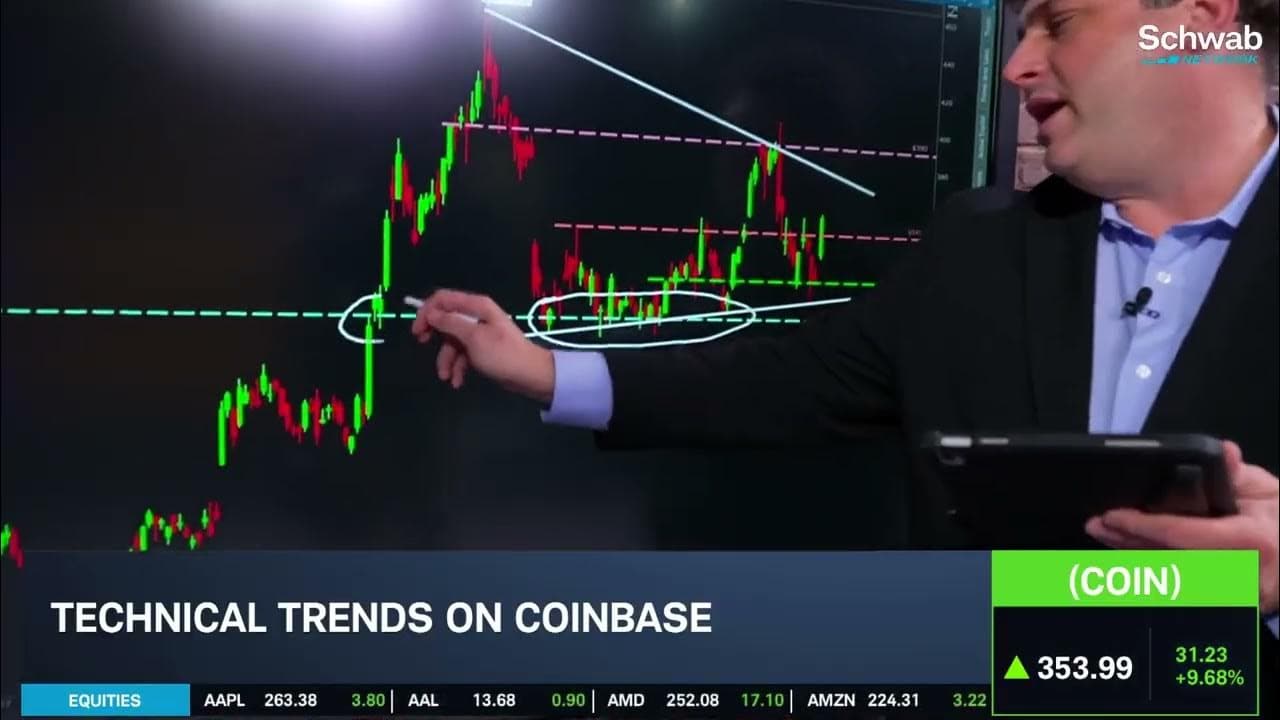
Coinbase (COIN) saw up to a 10% rally on Friday's trading session thanks to a bounce back in Bitcoin and a price target raise from JPMorgan. Rick Ducat notes the stock's close correlation to Bitcoin prices and outperformance compared to the SPX as stock highlights.

Operator: Good morning, and welcome to the Minerals Technologies Third Quarter 2025 Earnings Conference Call. [Operator Instructions] Please note, this event is being recorded. I would now like to turn the conference over to Lydia Kopylova, Head of Investor Relations. Please go ahead. Lydia Kopylova: Thank you, Gary. Good morning, everyone, and welcome to our third quarter 2025 earnings conference call. Today's call will be led by Chairman and Chief Executive Officer, Doug Dietrich; and Chief Financial Officer, Erik Aldag. Following Doug and Erik's prepared remarks, we'll open it up to questions. As a reminder, some of the statements made during this call may constitute forward-looking statements within the meaning of the federal securities laws. Please note the cautionary language about forward-looking statements contained in our earnings release and on this slide. Our SEC filings disclose certain risks and uncertainties, which may cause our actual results to differ materially from these forward-looking statements. Please also note that some of our comments today refer to non-GAAP financial measures. A reconciliation to GAAP financial measures can be found in our earnings release and in an appendix of this presentation, which are posted on our website. Now I'll turn it over to Doug. Doug? Douglas Dietrich: Thanks, Lydia. Good morning, everyone, and thanks for joining today. I'll start today's call with a review of our third quarter, followed by an update on what we're seeing across our key end markets. I figure it would be helpful to provide some perspective on how our markets have changed over the past year and how they continue to move within the global economic context. I then want to highlight some of the recent investments we've made to support the long-term growth we are seeing across several of our product lines. Erik will then take you through the detailed financials and share our outlook for the fourth quarter, and then we'll open it up to questions. Let me start with our Q3 numbers. We had strong execution across our business. delivering solid financial results despite facing mixed market conditions, which I'll get into a bit later. Our sales increased 1%, both sequentially and over last year to $532 million. Operating income came in at $78 million and earnings per share were $1.55, a company record for the third quarter. Cash flow was strong and was up 24% year-over-year. We continue to strengthen our balance sheet, providing us with a financial foundation from which we can evaluate different investments and opportunities to drive growth. We also returned $20 million to our shareholders in the quarter and last week announced a 9% increase to our regular quarterly dividend, making this the third consecutive year that MTI has had a dividend increase. We recognize our sales growth has been sluggish this year due largely to the softer market conditions we've been experiencing in residential and commercial construction, heavy truck and agricultural equipment markets and in Europe in general. These softer market conditions have largely offset the growth we are seeing in many of our other product lines where we are executing on opportunities in markets that are structurally expanding and where we have built a distinct competitive advantage. I'll highlight some of these specific investments and opportunities in a moment and outline how they will set us up for meaningful expansion across several product lines, both in the near and long term. But first, let me provide an update on our current market conditions. As a general overview, after the first quarter, most of our end markets have been and remain relatively stable. A few continue to be weaker than last year, and we expect them to remain so through the fourth quarter. Let's start with our Household & Personal Care product line. Pet litter market conditions in North America and Europe have remained stable and at similar levels compared to last year. We continue to see discounting activities from branded producers in North America, and in response, we've worked with our customers to make promotional adjustments to the products we supply them. These activities have had a positive impact on our sales volumes and profits. The pet litter market in Asia, and more specifically, China, continued to show strong growth. Our volumes are momentum there, and we are making investments to support this long-term growth. In our other consumer these markets, demand for our natural oil purification and animal health products has been strong, with our sales this year up 18% and 12%, respectively, and we see this trend continuing. In Specialty Additives, we're facing mixed market conditions in paper and packaging. Asia continues to be a market with good opportunities for us to expand our base business and introduce new technologies. However, this year, North America demand has been weaker. Elsewhere in this product line, demand in the residential construction market has been relatively flat all year. We did see some signs of further softening late in the third quarter, which may make it a slower end of the year. For our high-temperature technologies product line, conditions have remained relatively stable for steel production in the U.S. with utilization rates remaining in the mid to upper 70% range. It is not the highest level we've seen over the past 2 years, but healthy enough for stable volumes. Europe continues to be more of a challenge with steel utilization rates dropping below 60% this year. The U.S. foundry market has also remained relatively steady for most of the year, buoyed by stable auto production. Two areas that have been soft for this business all year are the agricultural equipment market and heavy truck markets. When these markets begin to rebound, they will provide good eye for foundry demand. The China foundry market has remained relatively strong this year despite the impact of tariffs and ongoing trade disputes. In fact, we've seen strong volume across our metalcasting business there with year-to-date volumes up over 10% from last year. In environmental and infrastructure, commercial construction remains slow compared to historical levels, and these similar conditions exist for the environmental lining and remediation markets. We expect to see some improvement in project activity as interest rates ease and projects are financed. We are already specified on several large commercial and environmental projects and expect an inflection in this product line sales when these projects commence. Elsewhere, we've seen strong pull for our infrastructure drilling products this year, increased geothermal drilling and fiber optic cable installation has been driving the increased demand. As you can see, we continue to experience mixed conditions across our end markets. But despite the impact these conditions are having on our top line this year, our team has navigated these conditions to maintain margins, profits and cash flow. At the same time, we've not deviated from our focus on investments in technologies and markets where we see the biggest growth opportunities, which I'll go into more detail on the next slide. We've spoken about our strategy to build positions in higher growth markets. Markets with economic or macro trends where we can deploy new technologies or expand our existing technologies to drive higher levels of growth and balance the more cyclical portions of our company. We've been executing on these opportunities, expanding our pet care business, investing in technology serving a variety of consumer-driven end markets, and deploying new technology in some of our more traditional businesses like refractories and paper and packaging to expand our value proposition globally. As you've likely seen, we announced a few recent investments made in support of these strategies, and I want to highlight a few of them to remind you of the opportunity we continue to see. Let's start with a few opportunities in our Consumer and Specialty segment. In our pet care business, we remain confident in the long-term growth trends of this market and in the private label portion in particular. We expect the North America pet litter market to continue to grow by 3% to 4% and in the Asia market to grow by 6% to 8% per year over the long term. Over the past 5 years, our pet litter business has grown organically at a 9% compound rate. Adjusted for the 2 acquisitions we've made over this period. To support this continued growth, we recently made investments at our plants in Dyersburg, Tennessee; Branford, Ontario, and Chaoyang City in China. We've broadened these plant manufacturing capabilities to increase throughput, lower cost and offer greater packaging flexibility to meet customer demand. Dyersburg and Branford are both strategically located and well connected to large portions of the North America market. These recent investments to expand capacity upgrade capability at these sites enabled us to secure some significant contracts beginning in 2026. In China, we've outgrown our existing facility and are bringing online a completely new one to meet the demand that we are seeing from this rapidly growing pet litter market. The upgrades across these 3 plants are expected to be completed by the end of 2025 and will fortify our position as the largest high-quality private label cat litter supplier to customers around the world. In our natural oil purification product line, we announced an investment at our plant in Turkey to support the significant growth we are seeing in this market. Since 2018, our Bleaching Earth business has grown at a compound rate of 20%, and this is our third expansion since we opened the facility to support this level of revenue growth. Our facility in Turkey at both mines the raw materials and manufactures absorbents and Bleaching Earth products sold under the brand name Rafinol , which are used for the purification of edible oils and renewable fuels. Including biodiesel, renewable diesel, sustainable aviation fuel. The market opportunity here is significant. The global natural oil purification market size was $1.1 billion in 2024. The renewable fuels portion accounts for over 12% of this market and is the fastest-growing segment. Demand for sustainable aviation fuel, in particular, is growing rapidly and is being bolstered by supportive regulatory changes in the U.S. and Europe. Our Rafinol product line is differentiated in the market with its high-performing absorptive properties that succeed in the most challenging applications like sustainable aviation fuel. Also worth mentioning, we've made other investments to meet the increased demand for our natural animal health products, and also for our higher tech Fabric Care solutions for dry laundry detergent. In our Paper and Packaging business, we continue to secure new contracts in Asia and in the next 6 months, we expect to commission 4 new satellites in the region. There continues to be a significant unpenetrated addressable market in Asia for our technologies. We've been driving the deployment of engineered calcium carbonate and the introduction of renewable technologies to the paper and white packaging industry as producers expand and look to upgrade their product quality. Since 2022, our volumes there have grown by 20%, including the doubling of our sales to the white packaging industry. We've always been the leader in the region and are well positioned to continue to grow by delivering the best calcium carbonate solutions including innovative technologies like NewYield. On the Engineered Solutions side, our MINSCAN installations and our Refractories business continue to go strong. We just signed our 18th MINSCAN contract and we'll be installing 6 new units this coming year. There's a large addressable market with over 130 electric arc furnaces in the U.S. and Europe capable of using MINSCAN, providing us with a significant runway to grow over the next several years. In summary, we expect these investments to generate $100 million in incremental revenue over the next 12 to 18 months as they ramp up. And these are just a few examples of the investments that we've recently made to support the growth opportunities for which we have strategically positioned ourselves. I want to be clear that these are just a subset of the initiatives that we are pursuing. Other areas like PFAS remediation, natural skin care additives, geothermal drilling products and further penetration of our greensand bond technologies into Asia are all progressing nicely as well. Together, they provide several significant pathways for us to drive sales higher going forward. And when our weaker markets begin to rebound, we see that providing additional upside to our top line growth. With that, let's have Erik take you through more detail on our third quarter financials and our fourth quarter outlook. Erik? Erik Aldag: Thanks, Doug, and good morning, everyone. I'll start by providing an overview of our third quarter results followed by a review of the performance of our segments, and I'll wrap up with our outlook for the fourth quarter. Following my remarks, I'll turn the call over for questions. Now let's review our third quarter results. Overall, our team delivered another solid performance while continuing to navigate mixed market conditions. Third quarter sales were $532 million, up 1% sequentially and 1% higher than the prior year. You can see in the sequential sales bridge on the top right, that sales increased in 3 of our 4 product lines. In Consumer & Specialties, our Household & Personal Care product line was up 2% sequentially and driven by increases in cat litter and other consumer specialties. In Specialty Additives, sales were 2% lower sequentially as we moved into the seasonally lower period for residential construction applications. In Engineered Solutions, sales in high-temperature technologies increased slightly from the second quarter as higher sales to steel customers were partly offset by lower sales to foundry customers in North America. And we saw a 5% sequential increase in our environmental and infrastructure product line, driven by increased demand for offshore services as well as infrastructure drilling products. To summarize, conditions played out mostly as we anticipated, and I'll take you through more of the details when I cover the segments in a moment. Operating income for the quarter was $78 million, down 1% sequentially and versus the prior year, and operating margin was 14.7% of sales. In the operating income bridge on the bottom right of the slide, you can see that unfavorable volume and mix primarily in the Consumer & Specialty segment impacted income directly by $1 million. And lower volume also contributed to temporarily higher operating costs at a few of our facilities in the quarter. Higher pricing of $1 million offset inflationary input costs, including higher tariff costs in the third quarter. EBITDA was $100 million, up 1% from prior quarter and prior year and EBITDA margin was 18.8%. I'd like to point out that versus the third quarter last year, we've done well to offset $10 million of higher costs, including tariff costs raw material increases, energy and temporary increases like higher logistics costs associated with our U.S. cat litter plant upgrade. We offset these cost increases with a combination of productivity improvements, supply chain actions, price increases and our cost savings program. And I would also highlight as we move through the temporary cost increases, we should see margin improvement from these actions going forward. Earnings per share, excluding special items, was $1.55 , the same level as the second quarter and up 3% from last year, representing a record third quarter for the company. We recorded special items of $7.5 million in the quarter related to litigation expenses. Now let's turn to a review of our segments, beginning with Consumer & Specialties. Third quarter sales in the Consumer & Specialty segment were $277 million, flat sequentially and down 1% from last year. In Household & Personal Care, sales improved by 2% from prior quarter to $130 million, driven by improving volumes in our cat litter business and continued progress on growth initiatives in consumer specialty applications. Most notably in edible oil and renewable fuel purification, where sales grew 18% with last year. In Specialty Additives, sales were $148 million, 2% lower sequentially. The Global Paper and Packaging volumes were flat compared with the second quarter as volume increases in Asia offset lower volumes in North America. Meanwhile, demand for residential construction products was incrementally softer in the quarter, which pulled volumes lower for the product line. Despite the volume pressure in Specialty Additives, the segment continued to build on the operating performance gains we saw in the second quarter, delivering a modest improvement to operating margin sequentially. Operating income in the quarter was $37 million, representing a 13.5% of sales. Looking ahead to the fourth quarter, in Household & Personal Care, we expect continued sequential growth in cat litter, edible oil and renewable fuel purification. And in Specialty Additives, we're expecting lower sales sequentially, primarily driven by typical seasonality for residential construction products. We do expect softer-than-normal residential construction volumes in the fourth quarter as some customers are indicating they have efficient inventory levels heading into the winter months. and they are planning to adjust production schedules accordingly. Overall, for the segment, we expect sales to be flat or slightly lower sequentially. Now let's turn to the Engineered Solutions segment. Third quarter sales in the Engineered Solutions segment increased by 2% sequentially and grew 4% from prior year to $255 million. In the high temperature technologies product line, sales of $179 million were similar to prior quarter and up 2% year-over-year. Sales to steel customers in North America continued strong more than offsetting continued weakness in the Europe and Middle East steel market. Sales to foundry customers were mixed with North America volumes impacted by continued softness in the heavy truck and agricultural equipment markets, in addition to the typical third quarter customer maintenance outages. On the positive side, we saw continued strong demand across a with foundry volumes up 5% sequentially and up 17% versus prior year. In Environmental & Infrastructure, sales led by 5% sequentially and were up 9% from prior year driven by a for offshore services and strong pull for infrastructure drilling products. The segment did a nice job of mitigating tariff impacts and turned in another strong operating performance. Operating income was $45 million, and operating margin improved by 20 basis points sequentially to 17.6% of sales, a record level for the segment. Looking ahead to the fourth quarter, we expect environmental and infrastructure sales to be 10% to 15% lower sequentially and due to typical seasonality for large project activity. And in high-temperature technologies, we expect sales to be slightly lower sequentially as several of our foundry customers in North America have communicated longer than towards the end of the year. This is due to the continued softness seen in the agricultural equipment in markets and in anticipation of some acute automotive production disruptions. While these plans could change, our current outlook assumes a reduced number of foundry working days in December, along with the temporary margin impact of the associated lower productivity at our plant sites. Overall, we expect segment sales to be lower by around 5% sequentially. Now let me turn to a summary of our balance sheet and cash flow highlights. We delivered another solid cash flow performance in the third quarter. with free cash flow of $44 million. Capital expenditures totaled $27 million in the third quarter, and we remain on pace for approximately $100 million of capital investments for the full year. Some of the key investments that Doug outlined earlier will be commissioned during the fourth quarter with revenue ramping up in the beginning of 2026. And we expect that sort of cadence to continue into next year with additional start-ups expected throughout the first half. In total, we returned $20 million to shareholders in the third quarter through share repurchases and dividends in keeping with our stated balanced approach to capital deployment. Our balance sheet remains strong, and our net leverage ratio remains at 1.7x EBITDA. Below our target of 2x EBITDA. Now I'll summarize our outlook for the fourth quarter. Overall, we expect fourth quarter sales to be approximately 2% to 4% lower sequentially and primarily driven by seasonal patterns in a few of our end markets. Operating income for the quarter is expected to be between $65 million and $70 million, with earnings per share between $1.20 and $1.30. Our sales range of $510 million to $525 million considers a number of factors. On the positive side, we expect continued traction with our growth initiatives in Household & Personal Care. The cat litter business is gaining sales momentum and the fourth quarter is typically a strong one for cat litter. In addition, we expect continued growth in edible oil and renewable fuel purification. As I noted earlier, some of our customers serving the residential construction and foundry markets in the U.S. are signaling the potential for slower order patterns and extended outages around the holiday. Which would impact volumes of some relatively high incremental margin products in both our Specialty Additives and high-temperature technologies product lines. We are also watching for potential volatility in order patterns due to uncertainty around tariff policy. As we've communicated, we don't have a significant direct exposure to tariffs. However, we're mindful of potential near-term impacts on our customers. Our guidance takes all of these to accounts and where we land in the range depends on how they play out. In summary, we have positive momentum across a number of product lines as we head into the fourth quarter, and we are focused on delivering the growth initiatives that will carry this momentum into next year. With that, I'll turn the call over for questions. Operator: [Operator Instructions] Our first question today comes from Daniel Moore with CJS Securities. Dan Moore: Pet Care. It looks like you saw an uptick in catlier volumes in Q3. How should we think about -- you described the market dynamics, how do we think about those and the potential to get your pet care business back to that kind of term mid-single-digit plus growth rate cadence, not necessarily 2026 guide, but over the next 12 to 24 months. Erik Aldag: Yes. I appreciate that. Look, Dan, as I mentioned, let me start. I'll hand it over to DJ for some details. There's been a challenging pet term market for us. But this is one year we -- I tried to make some comments to highlight, if you take a longer-term view on the market and our performance in it, we've grown organically. I mean, we pieced the business together through some acquisitions. But even adjusting for some of those over the past 2 years, the business has grown by 9% compound. This year, a little bit flatter, we've seen some dynamics in the market that haven't been seen before in terms of something. We've made those adjustments. We have to work with our customers to make those adjustments. We've done that. We've seen those the volume improve as a result. And I think that carries through the fourth quarter and into next year. The biggest thing is, I think this is a good business for us, vertically integrated. We're global, obviously the largest with the technology, and we're confident in that long-term growth rate of it, that I mentioned, 3% to 4% North America, 6% to 8% in Asia. And we're making investments to be able to support the growth that we see and what's going to be coming forward and short term next year. I'll let D.J. talk about that. But these are good investments to make this business is going to revert to that growth rate. I never said it's going to be a straight line, but we will have that business growing next year. And I'll pass it over to DJ to let's give you some details on what we're securing with some of these upgrades. D. J. Monagle: Yes. Thanks, Dan. We kind of close out some of the market dynamics and then just give you a sense of the return back to that upper single-digit growth rate. On the North American market, what we did see early on, and we had mentioned in previous calls, these battles among the brands and is the only way I would describe the significant discounting that went on the brands, that caused some pretty big market share shifts within the brands, but it also had an effect on private label. Most pronounced at some specialty pet stores and grocery stores. We want to adjust with our private label partners and come up with a promotional schemes that still keep their private label relevant. That includes price discounts, changes in packaging, changes on shelf allocation. And so we feel that, that part of the market has stabilized pretty well. Doug had mentioned some pretty significant investments that reposition us for some future growth and coming pretty quickly, Doug had mentioned some contracts. So what you'll be seeing is of some $30 million plus of growth that will be going into next year as those contracts come online, that's towards the end of the first quarter. So we feel really good about that. There's some further growth that's capable or enabled by these investments in North America, especially with the product flexibility and packaging flexibility. The other thing Doug mentioned that we're very excited about is the reinvestment or the establishment of a new facility in Asia. We outgrew our old facility. We've got a lot of pull from a wide range in the market on how to take advantage of that growing region. And the difference for Asia with us is that it's a much broader and more profound mix of branded customers, global brands that want to grow in Asia, and we're well positioned to manufacture and co-pack for them, but also supporting the regional private labels as well as an emerging e-commerce business there. So this investment does that for us. So that would be additional growth. So I think the market has stabilized. We've made some adjustments with our branded partners, and we're very well positioned to get that back on track as projected in 2026. Dan Moore: Really helpful. And just pulling on that string. With all of those investments you're making, how do we think about just the overall increase in capacity as we exit '25. Douglas Dietrich: Well, some of them in North America, so the overall increase in capacity. So we're looking at that 6% to 8%. I'll start with China. We've made this investment. It's a new facility. We've put in capacity to probably sustain it for the next 3, 4 years. It's a big enough facility that we can add additional packaging capacity to meet that growth over a longer period of time. So that one, we're starting with modular kind of growth to meet the incremental investments over the next 10 years. In North America, the investments we've made in Canada and here in the U.S. and these 2 we talked about were a lot of quality upgrades handling upgrades. Again, these are 2 acquired facilities. So these were planned a long time ago. We needed to find the right time to be able to shift production around keeping our customers supplied while we made these changes. That's a lot of the cost increase you've seen and some of the margin -- a bit of the margin deterioration you saw this year. But that's -- we're through that. And we've made upgrades to material handling, quality packaging, packaging flexibility, throughput, all of which have reduced cost as well and should accrue to profitability going forward. So it's a number of different things, but we've got plenty of capacity in these facilities to grow at those rates for I'd say the next 5 to 10 years. But again, we can also have space in them to add modular packaging capacity if we need to keep up with the market. So I think we're in good position, Dan. These investments, they're not significant huge investments for us, but they did put us in a position to be able to secure higher quality contracts. And as DJ mentioned, we see about $30 million of that coming in starting in the second quarter next year. Dan Moore: Very helpful. Switching gears, Environmental and infrastructure, little pockets of strength there at least this quarter. I know maybe a more difficult seasonally slower period that we're going into, but just talk about momentum as we kind of think about -- or to think about turning the page towards '26. Douglas Dietrich: We saw some momentum. Actually, this quarter was in our offshore water treatment business, which has been doing really well. I guess I'll start with just construction and environmental remediation, relatively flat. We've seen some projects come I mentioned were specific projects. We thought that business would probably turn this year. It still hasn't Commercial construction, large building is still relatively flat. I think when -- it's interest rate sensitive. I do think when interest rates start to move down, we will see more of that on the shelf activity come into play, and that will be positive for us. But this quarter a lot of water filtration stemming from our capability around PFAS remediation, our ability to take complex things out of water. And that was some new projects we secured offshore, and that really came through in the quarter, and we think that's sustainable through the fourth and into next year. Dan Moore: Very helpful. Just in terms of the Q4 guide, revenue down 3-ish percent sequentially at midpoint, op income down more like low teens. So a little bit of a higher decremental margin. I appreciate the color on boundaries, which is high margin. Are there other corporate incentive comp, any other expenses, which you might call out in Q4 that could pinch margins more than might be typical given the volume decline? Erik Aldag: Yes. Thanks, Dan. This is Erik. No, nothing unusual from a corporate expense standpoint in the fourth quarter. The main drivers are really the ones that I called out in the prepared remarks in terms of the mix. I mean, the markets that are down seasonally for us, Q3 to Q4 and then the foundry and some of the residential construction products that we have, those are higher incremental margin products for us. And so we do have a mix impact that goes against us in terms of the decremental margins that we're seeing Q3 to Q4. The only other thing I would highlight is we had some strong margins in the third quarter in the Engineered Solutions segment. That was continued strong performance from the team's offsetting tariffs, continued strong productivity, variable conversion cost control. We did have a couple of the equipment sales in the high-temperature technologies product line that helped margins in the third quarter, and we don't have any of those equipment sales forecasted for the fourth quarter. But as Doug mentioned, we've got about 6 to come next year in terms of those MINSCAN installations. Operator: The next question is from Mike Harrison with Seaport Research Partners. Michael Harrison: I was hoping we could talk a little bit about the margin performance in Consumer & Specialties. I think it was relatively close to where you were expecting, but you are kind of tracking like 150 to 200 basis points lower than you were last year. I was hoping that we could maybe break down or help kind of bridge some of those key factors that have driven that weaker margin performance. Maybe just talk about how you see the discounting or promotional activity in pet care. Maybe mix, maybe the volume declines in Specialty Additives and on that resi high-margin stuff as well as the temporary cost from pet care expansions like -- can you help us understand what's going on there? And then maybe just directionally help us understand what that -- as we start to think about consumer and specialty margin into next year, how some of those items should trend? Erik Aldag: Yes. Thanks, Mike. This is Erik. So I think you hit on a lot of the key themes there. And actually, for the third quarter, the margins were right where we expected them to be for the segment. The largest driver there is some of these temporary cost impacts we have. I mean we have a significant upgrade going on at one of our U.S. cat litter plants. And we've had to move around production across our footprint in North America, and there's been an increase in logistics costs as a result. So that's the primary driver of the margin pressure, I'd say, from Q2 to Q3 -- in Q2 as well as in Q3. That facility is going to be ramping up here in the fourth quarter. And so we're moving through that more temporary impact. You mentioned discounting. We're not seeing a negative margin impact because we've been helping our retail partners with discounting. And the reason for that is we've had some incremental pricing discounts on our products but it's helped with our volumes. And so as we get more volumes running through these plants, there is significant fixed cost leverage benefit that we get. And so we haven't seen margin donation from any of the discounting that we've been participating with our retail partner. As far as where this is going, the segment is set up well for 15%. We were very close to 15% last year, and we're going to get there again as we move through some of these more temporary issues. But that's our target. This segment should be delivering 15% operating margin. Douglas Dietrich: Michael, the only thing I'll add, and I'll put that same as echo what Erik just said. We'll get back to and probably exceed last year's margins in the segment. And that's going to come from a couple of things. A, the ending of the temporary logistics expense, number one, and some of the other ancillary expenses that came across as we made these investments in these facilities. Two, we have seen some lower volumes due to this discounting, which we've adjusted. And as Erik just mentioned, those volumes are coming back. That is helping profitability. And three, the additional volume that we're going to be putting through these plants next year, starting in the second quarter, is going to be very accretive to those margins. And so I think, as Erik said, we're set up to get back to last year's margins next year and probably see them with some of this additional volume. Michael Harrison: All right. That's very helpful. And then maybe just on the investments that you're making in Turkey with the Bleaching Earth for renewable fuel. . Can you help us understand what the dollar amount of that investment looks like? How much is your capacity expanding? And I guess, should we think about the investments as mostly mine expansion or is there something that you're doing on the, I guess, refining or processing side that's helping to improve your capabilities as well. Douglas Dietrich: Sure. I want to be careful about giving some information out there and how much capacity we're putting into the market. So I won't give you a ton give you a percentage. -- again, we built the facility 8 years ago. We built it with enough room to expand it. At the time, we want -- we were looking more at the edible oil market, which grows at about 3%, 4% kind of GDP business and we had a great product for that application. Since that time, we saw the development of the market for renewable fuels. And we started supplying that market probably 4 years ago, 5 years ago, and then more recently, the development of sustainable aviation fuel through regulation changes in Europe, in particular, now U.S. has really started to pull that product much harder. And so this expansion, $9 million, $10 million type expansion. We've expanded the plant by about 30% and in terms of capacity to be able to meet the growing demand. Like I said, we've been growing at about 20% per year for the past 8 years. But a large portion of what's happening is what started as a 100% edible oil kind of application and product sales has now moved probably 34% of our business is now in sustainable aviation fuel and renewable fuels. And that's growing very quickly. And so this expansion was -- it's going to supply both, but it will probably be consumed very quickly with some of the renewable fuels. We have sufficient reserves in the region for decades. And we will look probably to expand the facility again over the next 5, 6 years, depending on how the market goes. But this one is an incremental step within the current footprint. The next one might be a whole new footprint if we continue to grow at this pace. Michael Harrison: All right. Very helpful. And then last question I have is just on the cash flow and maybe some of the working capital dynamics. You mentioned the higher logistics costs, but I assume you're carrying some additional inventory in the pet care business as you work through these expansions. And then is there anywhere else that maybe inventory is a little bit elevated right now? I'm thinking, in particular, maybe MGO as you're trying to navigate or mitigate some of the tariff impacts. Just trying to think about how working title trends in Q4 and how we should think about it as we're starting to look at next year? Erik Aldag: Yes. Thanks, Mike. So in terms of working capital, AR, AP, both in good shape. We watch those metrics closely and no major changes there. We are holding on to a little more inventory, and you touched on it to a few of the spots there. a little higher inventory in pet care, but some strategic positions, I would say, in the high temperature business. MGO being one of them, every couple of years, there's a river closure in the middle of the U.S. that we have to work around and we build up some inventories to manage around those. We're going to be working through a lot of those inventory positions in the fourth quarter. And so we should be ending the year sort of at a more typical level in terms of the inventories. We'll still have some of those strategic positions in place, but more of a typical level from an inventory perspective. From a cash flow standpoint, we're expecting a strong fourth quarter as usual for the company, strong cash from ops, the free cash flow number is going to depend a little bit on the pace of some of these growth capital investments that we've talked about. We've got a number of them ramping up in the fourth quarter. And so the capital number that ends up happening in the fourth quarter could depend a little bit on the timing of how those come through. But overall, expecting a strong cash flow quarter in the fourth. Operator: The next question is from Pete Osterland with Truth Securities. Peter Osterland: I wanted to start just by following up on the recent investments across pet care and Bleaching Earth, so you've talked about an aggregate targeting $50 million of growth investments supporting $100 million of additional revenue -- just in aggregate, how much of those targets are represented by what you've already in a currently in progress. And to the extent that there's more to come, we're across your portfolio are you still targeting for additional organic growth investments? Erik Aldag: So if I understand -- Pete, this is Erik. If I understand the question correctly, the $50 million of CapEx and the $100 million of revenue that we've talked about, those are the investments that Doug laid out today in terms of the highlight on growth capital projects that we have. But importantly, that is just a subset of the growth opportunities that we have much of the opportunity we have is supported by existing capacity, and so it isn't requiring necessarily growth capital to support it. Those are just investments that we wanted to highlight supporting the growth opportunity. Douglas Dietrich: Yes. I guess I'll add, Pete, this is just -- when I look at -- when you look at those markets, and so the North America pet litter market, the Asia pet litter market, the bleaching earth market of $1.1 billion and the renewable fuels growing as the fastest segment. And then also with paper and packaging and our MI scans. -- just these investments are $100 million over the next 12 to 18 months, right? But that trend continues. That's not just the opportunity in those markets alone, right? I think just the MI scans, if you do the math on the MI scans, each MINSCAN is probably worth to us $1 million -- $1 million to $2 million depending on the size of the vessel that is going on, et cetera. So you're looking at just the 18 that we've installed are probably worth about $20-plus million of reoccurring revenue every year. And there's a whole runway of those to go. Not that we'll get 130 million of them, 100% of them, we might. But that market, that's a $0.25 billion market for us just in that product line, right? Look at the bleaching earth market with renewable fuels. We're targeting $75 million of growing this business to $75 million over the next 2 years. Pet care, we're a $400 million business. We think that business grows with some of the investments we're making to $500 million, and that's been our target for 2027. And I think we're on target for that. Given this year, it might be another 6 months, 9 months, but we're still seeing that, that business is another $100 million to grow. And these investments that we've made will support that. So all the way down the list, you're looking at hundreds of millions of dollars of opportunity that we positioned ourselves for -- these investments are the first step in tapping into them, but we've been making these investments over the past 5 years. This is our third bleaching earth expansion. We've upgraded these other facilities in pet care. Now we're upgrading these 2 or 3 key ones. And so these are investments that we've made before, we've delivered on. We're making them again, and they're setting us up for that continued growth. So I think you're going to see that. So I took your question a little bit further, but these are big opportunities, but we've positioned ourselves in these markets for these opportunities, and now we're taking advantage of. Peter Osterland: No, that's very helpful. And just kind of following up on the pet care investment specifically that you're expecting to finish by the end of '25. I guess what's the time frame to realize that run rate of incremental revenue that you discussed? I mean, is it kind of a gradual ramp throughout the course of '26, so you kind of expect that to continue driving growth into '27? Or how should we think about that? Douglas Dietrich: For pet care, in particular, as DJ mentioned, these investments will set us up for longer-term growth. But in particular, we've secured about $25 million, $30 million of contracts on an annual basis that should start to ramp up through the first, but be full run rate by the second. So I think if you snap the chalk line at the end of March and ran 12 months, we think that's $20 million, $25 million of revenue right there. So next year, probably expecting $20 million, $18 million of that $25 million to hit in pet care alone, and that's going to continue. And we've got capacity -- further capacity in China for that market that continues to grow. So we think we're getting this thing back on track. These investments position ourselves with high-quality operations, low-cost operations and strategically located to deliver on the business. And so I think you'll start to see that growth rate revert in the second quarter. Peter Osterland: Very helpful. And then just lastly, I wanted to ask for any update on Talc. It looks like litigation expenses have trended higher each quarter during this year. Just was wondering if you have any update to share on the time frame or expected cost to resolve? And would you expect that until it's resolved, with the $7.5 million of litigation expenses you saw in the third quarter, would that be the run rate of what to expect going forward? Douglas Dietrich: This quarter was a little bit higher in terms of activity. I think our average has been more $3 million to $4 million per quarter. We think it probably reverts back to that. I will say that we're continuing very diligently to work on establishing a 524G trust. There's not a lot significant in terms of updates to report this quarter. We're waiting to hear back from the Southern District of Texas District Court on a number of motions to figure out which lane we'll be in, whether it will be in the District Court or back in the bankruptcy court. And as I mentioned, we're continuing to work to establish that 524. We are wide open to getting this done and getting it done quickly. But the court systems, they take their time and they schedule themselves, and we have limited ability to kind of impact that portion of it. But -- so not a lot of progress, but rest assured, we are working to get this behind us as fairly and as finally and as quickly as possible. With regard to costs, the reserve that we have on our balance sheet, we see that as sufficient for the ongoing both establishment of the trust and the cost it's going to take to get there. So no change to what we see in terms of the reserve. Operator: This concludes our question-and-answer session. I would like to turn the conference back over to Doug Dietrich for any closing remarks. Douglas Dietrich: Thanks, everyone, for joining this quarter. We appreciate the questions. We appreciate the attention and interest in Minerals Technologies, and we'll chat with you again at the end of January. Thank you very much. Operator: The conference has now concluded. Thank you for attending today's presentation. You may now disconnect.
Operator: Good morning, and welcome to FIBRA Macquarie's Third Quarter 2025 Earnings Call and Webcast. My name is Rob, and I'll be your operator for this call. [Operator Instructions] I would now like to turn the conference call over to Nikki Sacks. Please go ahead. Nikki Sacks: Thank you, and good morning, everyone. Thank you for joining FIBRA Macquarie's third quarter 2025 earnings conference call and webcast. Today's call will be led by Simon Hanna, our Chief Executive Officer; and Andrew McDonald-Hughes, our CFO. Before I turn the call over to Simon, I'd like to remind everyone that this presentation is proprietary, and all rights are reserved. The presentation has been prepared solely for informational purposes and is not a solicitation or an offer to buy or sell any securities. Forward-looking statements in this presentation are subject to a number of risks and uncertainties. Our actual results, performance, prospects or opportunities could differ materially from those expressed in or implied by the forward-looking statements. These forward-looking statements are made as of the date of this presentation. We undertake no obligation to publicly update or revise any forward-looking statements after the completion of this presentation, whether as a result of new information, future events or otherwise, except as required by law. Additionally, on this conference call, we may refer to certain non-IFRS measures as well as to U.S. dollars, which are U.S. dollar equivalent amounts, unless otherwise specified. As usual, we've prepared supplementary materials that we may reference during the call. If you've not already done so, I would encourage you to visit our website at fibramacquarie.com and download these materials. A link to the materials can be found under the Investors, Events and Presentations tab. And with that, it is my pleasure to hand the call over to FIBRA Macquarie's Chief Executive Officer, Simon Hanna. Simon? Simon Hanna: Thank you, Nikki, and good morning, everyone. I'm excited to share that we delivered another solid quarter of financial and operating performance with record-breaking results across key metrics. At the same time, we executed on both strategic and opportunistic initiatives that create value for our certificate holders and continue to position us for sustainable growth. The third quarter showcased the strength of our business model, starting at the top line. For the quarter, we achieved record consolidated revenues, up 8.4% in underlying U.S. dollar terms over the prior year. This momentum translated through to our quarterly U.S. dollar AFFO, which increased an impressive 6.6% annually. [ AFFO ], our quarterly distribution reflects a significant 17% increase from last year, all whilst maintaining a comfortable and prudent payout ratio. Turning to our industrial portfolio. We continue to see strong performance amidst a subdued market backdrop with average rental rates increasing 6.8% year-over-year. Notably, we achieved another quarter of double-digit renewal spreads, 17% on negotiated leases with high quarterly retention of almost 90%. Our full year 2025 performance continues to shape up rather well, perhaps best demonstrated by the 6.1% increase in U.S. dollar same-store NOI year-to-date. So in summary, we are very satisfied with the sustained momentum enjoyed from our industrial portfolio through to today, and we expect that momentum to carry through to the fourth quarter, providing for a strong finish to the year. Moving to our capital allocation and asset recycling initiatives. We had an active quarter closing on a number of transactions. I'm excited with the continued growth of our Mexico City footprint with the acquisition of a prime 250,000 square foot logistics facility. We acquired the property through a sale and leaseback for $35 million, leased to a leading global consumer company under a 3-year U.S. dollar-denominated contract. It not only provides 2025 NOI and AFFO contribution, but also positions us to capture embedded real rental rate growth. This acquisition exemplifies our thoughtful approach to capital allocation. In this case, we secured a scarce well-located infill asset that enhances our portfolio quality, while providing visible earnings and NAV accretion. We're optimistic about repeating this type of success in other deal opportunities under our review, alongside pursuing additional strategic land investments in our pipeline. We also continue to selectively pursue asset recycling initiatives. And during the third quarter, we sold a vacant industrial property in Chihuahua City for $14 million, representing a 30% premium to book value. This transaction demonstrates our commitment to active portfolio management, allowing us to accretively recycle capital into attractive opportunities like the Mexico City acquisition, I just mentioned. Turning to our retail portfolio. We also delivered strong results and achieved a post-pandemic record occupancy of 93.6%. Rising occupancy and rental rates contributed to annual NOI growth of 4.1%, essentially reaching record levels of operating cash flow. We maintain a cautiously optimistic outlook on the operating performance of our retail portfolio and expect the medium-term growth trends to continue. Looking at the broader market environment. While we acknowledge the ongoing uncertainty around trade policy, we also remain confident in Mexico's strategic position within North American supply chains. The long-term fundamentals that have driven Mexico's manufacturing growth over the past decades remain firmly intact, including high-quality labor, proximity to major U.S. markets and continued trade advantages. Notwithstanding the evolving geopolitical landscape, our high-quality portfolio, internalized platform and strategic market positioning, enables us to continue to deliver strong results and capitalize on growth opportunities. It is also worth mentioning our unique vertically integrated platform gives us, amongst other benefits privileged access to market intelligence and allows us to respond swiftly to changing conditions. This positioning, combined with our ability to capture embedded rental growth allows us to continue delivering value to certificate holders, while building a long-term portfolio resilience. Before turning the call over to Andrew, I want to highlight our ongoing commitment to sustainability. We are proud of achieving 3 green stars in our 2025 credit assessment, including a score of 94 points for the development benchmark, exceeding our peers on a regional and global basis. We're also taking this opportunity to publish our annual ESG report that is now available on our website, which provides a comprehensive overview of our sustainability initiatives and performance. Andrew, over to you. Andrew McDonald-Hughes: Thank you, Simon. I'm pleased to report another quarter of strong financial performance that reflects both the quality of our portfolio and the effectiveness of our capital allocation strategy. For the third quarter, we delivered AFFO of USD 29.7 million, representing a solid 6.6% increase year-over-year and demonstrated our continued ability to grow earnings on a per certificate basis. Our balance sheet remains exceptionally well positioned. During the quarter, we successfully completed the refinancing and expansion of our sustainability-linked credit facility. This USD 375 million facility comprises a $150 million 4-year term loan and a $225 million 3-year revolving credit facility. The transaction delivered multiple strategic benefits. Firstly, it enhanced our liquidity position to approximately USD 625 million, providing substantial financial flexibility to fund growth initiatives. Second, it reduced our weighted average cost of debt to approximately 5.5%, while extending our debt maturities. And third, the sustainability-linked features align our financing strategy with our ESG objectives through green building certification targets with the sustainability-linked portion of our drawn debt now representing 68%. As of September 30, we maintain a prudent debt profile being 92% fixed rate with our CNBV regulatory debt to total asset ratio standing at 33.2% and a robust debt service coverage ratio of 4.6x. Embedded firepower stands at approximately USD 500 million, whilst managing to a 35% LTV ratio, including the potential recycling of our retail portfolio. Turning to our guidance. We are reaffirming our FY '25 AFFO per certificate guidance to a range of MXN 2.8 to MXN 2.85 and our FY '25 AFFO guidance in underlying U.S. dollar terms to a range of $115 million to $119 million, representing annual growth of up to 5%. We are also reaffirming our cash distribution guidance for FY '25 of MXN 2.45 per certificate. This represents a 16.7% increase in peso terms and translates to an expected FY '25 AFFO payout ratio of approximately 87% based on our guidance midpoint, representing a well-covered distribution. This guidance assumes stable market conditions and no material deterioration of the geopolitical landscape or Mexico's key trading relationships, including the potential implementation of tariffs. Looking ahead, our strong balance sheet, ample liquidity and disciplined approach to capital allocation position us well to navigate market uncertainties, while selectively pursuing growth opportunities that create long-term value for our certificate holders. In closing, I want to recognize the exceptional work of our entire team. Their dedication and expertise continue to drive our operational excellence and strategic execution. With that, I'll ask the operator to open the phone lines for your questions. Operator: [Operator Instructions] And the first question comes from the line of Andre Mazini with Citigroup. André Mazini: Yes. So my question is around the potential economic deceleration Mexico is supposed to be having now in the second half of 2025. A lot of talk on that among investors and media. So I wanted to understand if you're feeling that this economic deceleration in your conversation with tenants, maybe splitting between the 3 tenant types, industrial light manufacturing, industrial logistics and the retail tenants as well. Simon Hanna: Yes. Thanks, Andre. Thanks for the question. Yes, I guess it's a bit of a dynamic backdrop out there. As you can appreciate, really where we're much more correlated with the U.S. GDP, U.S. economy more so than Mexico, and that's obviously going to be where most of the activity will basically drive outcomes for us. When we break it down between those 3 categories, look, I'd say, in general, for industrial light manufacturing, fair to say that our volumes production is slightly off compared to last year. When you look at auto parts production, it's off around sort of 7% compared to last year. So I'd say nothing that's fundamentally causing a problem there from a demand perspective, maybe a slightly lower utilization. But in general, sort of, I'd say, steady demand backdrop and something which we expect to prevail regardless of that Mexican -- Mexican economy dynamic, more so just to do with how trends continue out of the U.S. So that will very much then link into the logistics part of industrial, at least for the business-to-business, where we have most of our exposure. It will be correlated more or less with the trend on light manufacturing. So again, I'd say for both manufacturing and the B2B logistics going pretty steady, and I think the outlook is steady as well. Obviously, the name of the game there is really USMCA as a real catalyst to change that demand environment probably heading towards the second half of next year. Retail, yes, definitely more sort of linked to Mexican economy fundamentals. But I'd say the consumer remains in pretty good health. We're seeing good employment, wage numbers, et cetera. general foot traffic and activity in the shopping centers is we've been happy with that. You would have seen some of the encouraging metrics come through the quarter, record occupancy, rising rental rates, same-store were up about 5% year-over-year at the NOI level. So I'd say generally good conditions there. Cinema is continuing to struggle a little bit more, I'd say, compared to the rest of the tenant mix to be fair. Gym is doing rather well. Supermarkets is doing rather well, restaurants rather well. So that's probably cinema probably the main weakness that we're still looking for a bit of a pickup. But again, we have a cautiously optimistic outlook as well when it comes to retail, expecting fairly steady demand environment. So overall, that leads us up to a pretty good outlook for heading into 2026. Operator: The next question is from the line of [ Helena Ruiz ] with [indiscernible]. Unknown Analyst: I have a couple. The first one is on the stress. I was wondering if you could give us like any color if you expect them to remain like at these levels for the last quarter of the year and next year? And also, if you could give us a breakdown like this growth is coming from all regions like especially one market? And then my second question is on occupancy, like looking at each market, like most markets remain like really strong. The only one that saw a drop in occupancy are Monterrey and Juarez. So if you could also give us a bit of color on why the occupancy fell in those markets? Simon Hanna: Thanks, Helena, for those questions. Yes. Look, when it comes to lease spreads, firstly, taking that one on. Look, pretty good quarter again, around 17%. We have a sort of a last 12-month run rate of around 20%. So that's been tracking, I'd say, at a pleasing level for us. When we look ahead, virtually 0 rollover on 4Q, so it doesn't really move the needle. So we should be somewhere close to that run rate level on a full year basis. Outlook for next year, it's still early. We have about 16% rollover, 17% rollover next year. So we have some opportunity there to continue capturing, I would say, positive momentum when it comes to spreads, a little bit early to say how much. Obviously, the -- a little bit there depend on market conditions. But I think we -- we'd like to think that we can capture positive momentum in the same way we're seeing through the balance of this year. When it comes to some of those, I'd say, market-by-market dynamics, and I'd say there's -- it's quite an active market out there even despite the subdued new leasing conditions. I would say, in general, we are seeing that the same dynamic we have today is what we've seen for the last couple of quarters, where steady occupancy and operating trends with USMCA being the real catalyst to, we think unlock new demand. But taking that down to, I guess, market levels to answer your question, Monterrey is probably the most active market. It's also one of the biggest in the country, around 185 million square feet. So we still see a lot of activity there, a lot under construction. So supply is still coming through. And that's always been the Monterrey way to be fair, but there's probably around 8 million under construction. Amongst all that, though, on a quarterly basis, we're seeing sort of close to 4 million new leasing to basically offset some move-outs of about 4 million. So no doubt, there's a little bit of vacancy there north of 5%. And you can probably say it's more of a tenant market than a landlord market these days. But -- when it comes to the type of product that we're delivering in the market, this is in Monterrey, but in other markets as well, I'd say that we're at the upper end of that tier. And that pro forma vacancy is not so much of an issue for us. We're looking at in terms of the best quality buildings in the market, that's who our competition is because that's what we're building in terms of location, quality of building size, utilities, et cetera. So that real competition is much more narrow. So whether you're even talking someone like Tijuana, where, again, you're seeing a lot of vacancy or supply come on, it doesn't really change the equation for us. We're in the best part of town with some of those flagship developments up against really just a handful of building competitors. And so that noise around sort of 13%, 14% vacancy in Tijuana or 8% in Monterrey, it's not as relevant when you actually just boil it down to what the hard competition is against our Class A development product and we feel very well positioned to have some activity on that as we get through the year in USMCA in particular. Juarez, I'd say, is probably remains pretty soft. That one has got a lot more sort of undifferentiated vacancy. It's a bit more of a slower market than Monterrey at the moment, much more USMCA linked as well. So I think we expect more activity in that second half of next year or maybe the summer. Reynosa, again, sort of a key northern market, I'd say, very, very quiet as well and had a good positive absorption quarter for the quarter. But on a year-to-date basis, it's pretty flat in terms of absorption. And again, you'd expect that to be more correlated with USMCA pickup. Operator: The next question is from the line of Jorel Guilloty with Goldman Sachs. Wilfredo Jorel Guilloty: So my first question is around the recent M&A that you announced or mentioned in the report in Mexico City. So you bought an asset $35 million, sale leaseback. And back of the envelope, this is like $1,500 per square meter. So I wanted to get a sense of what cap rate you saw for this asset? And also, if the idea here is on further capital allocation, if it's in Mexico City that you want to focus on. And then -- and I'm sorry if you spoke about this earlier, but I wanted to ask about Monterrey and Juarez where you saw occupancy declines of 300 and 120 basis points each on a sequential basis. So I wanted to get a sense of what drove that, if it's 1 tenant or multiple, just to understand if this is a one-off or a trend. So any color would be very helpful. Simon Hanna: Okay. Thanks, Jorel. Great questions there. Yes, the Mexico City acquisition, that was a fantastic one to do is irreplaceable location around 15 minutes from downtown in the Vallejo submarket. And so that's a great last mile district to be in for sure. We're able to access that facility, really thinking about the stabilized cap rate at around a 10% level U.S. dollar sort of the rental as well. So that's the way we're looking at it sort of seeing that stabilize into a 10% cap. Now it's got an initial 3-year lease period there with the user. So -- sort of coming in at sort of an 8% area, but that's definitely below where we think the market rates are. So just thinking about that on a real embedded rental rate growth profile when you actually look at 3 years down the track, where you think that should land around 10%. And so if you're able to access Mexico City last mile stabilized 10%, dollarized 250,000 square foot, we take that all day long, and we're very excited about that. And yes, potentially, there could be 1 or 2 other opportunistic deals like that, that could come along. We're currently looking at 1 deal in particular and we'd like to think that maybe there's an opportunity to do that opportunistically. Again, let's see, so I think that was a great transaction to pull off from a capital allocation point of view. And I'm happy to say, repeat that success. Moving to the second question, on Monterrey, Juarez. So yes, I think from our own perspective, we -- in line with the market trends, we did see some vacancy there. But when you actually look at what drove that year-over-year, pretty simple story, Jorel, in the sense that we just delivered some Class A product that has not been leased up. So it's been added into our inventory. Both fantastic buildings, and we think very marketable. And again, something that will probably be more linked to USMCA ultimately, given the type of buildings and locations they're at. So we feel very good about the buildings that have been added to inventory, even though they're unleased in the short term. We do think they've got great income potential over the medium term. And we actually take the step back there, Jorel, actually not just what we've delivered in Monterrey and Juarez, but the other Class A product we have that basically has income potential and you add that up in terms of sort of getting close to 1 million square feet around the country. The exciting thing there is that we actually do have some real embedded growth that I don't think has been properly priced into our valuation or share price. And any type of a meaningful lease up there on that sort of Class A development product that we have, we're fully invested. It's basically built product ready to be leased up, mainly subject to USMCA, if you want to say that. That's got the potential ability to add something like, I'd say, comfortably north of $10 million at the NOI level. And you can obviously just drop that down to AFFO as well given that we're essentially fully funded and built that. So that's a pretty exciting sort of short-term opportunity we think, to help drive NOI and earnings is to basically take advantage of improving market conditions into next year, particularly with USMCA to trigger that lease-up. Wilfredo Jorel Guilloty: And a quick follow-up, if I may. So the sale leaseback opportunity, you mentioned there's a few in Mexico City, but are there opportunities such as those in other markets that you're in? And would it be focused on logistics? Simon Hanna: Yes. I think the answer is there are. Obviously, we're sort of looking at selective opportunities here. We particularly like Mexico City Logistics. That's a favored market for us where we'd like to increase our footprint. There are other opportunities in those other large consumption markets as well, sort of more of a logistics spend, you could say. But as I say, when you look actually see what's in our immediate pipeline and possible opportunities, we're thinking more Mexico City as being executable in the short term. Operator: The next question is from the line of Alejandra Obregon with Morgan Stanley. Alejandra Obregon: Mine is on capital allocation as well. So I was just wondering if you can provide some color on how you're thinking of your uses of cash for 2026. I mean if we split it between dividends, acquisitions, development, how would that look like in 2026? And what are the elements that will get you to any sort of decision on the mix on that front? And then the second one is on the M&A market. So I was just wondering if you're seeing any change in sentiment or acceleration in M&A activity that perhaps could trigger some recycling opportunities for you other than the sale and leaseback that you just mentioned? Simon Hanna: Sure. Yes. Thanks, Alejandra. So yes, look, I think in terms of capital allocation, fairly consistent outlook with how we currently have been deploying our capital. I think the main focus in the medium to long-term is going to be on that industrial development program. We have a land bank there of around 5 million square feet of buildable GLA in core markets. So that's something that we can flex up in terms of development activity. As you know, we've been doing 0 construction starts for the last few quarters. But as we get better visibility on demand fundamentals, that will remain the primary avenue of how we allocate our capital into those development properties, mainly on a spec basis, you could say. We remain also interested in pursuing certain opportunities in the short term. They boil down, as I say, one is 2 opportunistic acquisitions where we can access those sort of development like returns, if you want to call it that, something like the 10% cap Mexico City. If we can do that on a more sort of a bite-sized basis to complement what we're doing on the development program, that's great. I would say the other investment portal would be through strategic land bank investments to basically complement and add to the $5 million that we have so that we will basically continue that runway for building out getting back to that sort of 1 million to 2 million square feet of velocity on a medium- to long-term basis is where you want to be. And adding to that land bank will be an important part of that equation. When it comes to buyback, I guess that's obviously another opportunity. I'm not sure, Andrew, if you wanted to give color on that. Andrew McDonald-Hughes: Yes, happy to. I think as we've said previously, we continue to favor allocating capital to development and value-add opportunities where we see obviously; a, you have a much lesser impact on the balance sheet over the long-term. You're not impacting liquidity overall and you're setting yourself up for valuation upside and the growth of those underlying assets. And so we'll continue to do that. I think historically, we've guided to in the order of $100 million to $150 million of development per year. We've obviously been softer this year given the broader macro backdrop, but we continue to work towards some permitting and predevelopment works with respect to the recent acquisitions that we made in both Guadalajara and Tijuana. And I think there's a good opportunity for those particular projects to progress over the next 12 months. And I think more to the point, we see a broader opportunity for future growth with the embedded potential recycling opportunity of our retail portfolio, along with the broader liquidity that we have access to through the balance sheet, which really sets us up for in the order of $500 million worth of potential firepower over the medium term. So ultimately, from a growth perspective, over the near term, there's a deep sense of embedded value with the development projects that we have delivered to date that are well positioned for lease-up once we see the tailwinds return to the markets, which we're positive on with respect to how that looks over the short to medium term. And just with what we have already completed and delivered; that's in excess of $10 million in potential NOI contribution over the coming years. And we think that, that will come to fruition and have a good line of sight to lease up on those properties as we go through the USMCA renewal and have more, I think, surety on the tariff and macro backdrop going forward through 2026 and into 2027. So overall, I think broadly speaking, from a capital allocation standpoint and the growth opportunities that the business is well positioned. Alejandra Obregon: Excellent. That was very clear. Operator: The next question is from the line of Alan Macias with Bank of America. Alan Macias: My question was answered, but just going back to M&A, anything on the table regarding the retail sector? Simon Hanna: Yes. Thanks, Alan. Good to hear you. So I think retail, we're definitely very satisfied with the general trend of what we're seeing in operating financial metrics at the risk of repeating myself, but happy to say at 93.6%, record occupancy on a post-pandemic basis, NOI essentially at record levels, up around sort of $7 million, $8 million quarterly run rate. It's been a fantastic contributor to the overall returns. As we think about operational performance, probably a little bit more upside to go, I think, even as good as it's been, that we are seeing some interesting opportunities to add to that overall, NOI performance, and that will obviously lead into valuation also becoming higher. And as you think about that sort of valuation number, it's not insignificant by any means, sort of -- we're talking sort of $300 million plus. And so the interesting dynamic that we're seeing just as NOI continues to improve is obviously a more conducive interest rate backdrop with the interest rates locally falling from, let's say, 10% to sub-8% and you're sort of getting into positive leverage territory and sort of more compelling M&A backdrop. So we like the sound of that in terms of how that's all converging and [indiscernible] for an ability to start thinking about that sort of medium-term opportunity that Andrew mentioned around recycling. And really, that's what we've got to be thinking about in terms of -- apart from that short-term catalyst to grow earnings, which is really simple, which is just to lease up the Class A stuff that we've built and is ready for lease-up. The medium-term opportunity is certainly quite exciting and quite compelling when we think about that embedded firepower of around $500 million, that really allows us to flex up when it comes to building out the land bank and thinking about additional investments. We feel quite excited and well positioned with the ability to do that. Operator: Thank you. At this time, there are no further questions. I'd like to turn the floor back to management for closing remarks. Simon Hanna: Yes. Thank you for that, Rob, and thank you for everyone for participating in today's call. Along with Andrew, I would like to thank all of our stakeholders for your ongoing support, and we very much look forward to speaking with you over the coming days and weeks as well as updating you again at the end of the quarter. So have a great one. Thank you. Operator: The conference has now concluded. Thank you for joining our presentation today. You may now disconnect.
Operator: Good morning, ladies and gentlemen, and welcome to Universal's Third Quarter 2025 Earnings Conference Call. [Operator Instructions] As a reminder, this conference call is being recorded. I would now like to turn the conference over to Arash Soleimani, Chief Strategy Officer. Arash Soleimani: Good morning. Thank you for joining us today. Welcome to our quarterly earnings call. On the call with me today are Steve Donaghy, Chief Executive Officer; and Frank Wilcox, Chief Financial Officer. Before we begin, please note today's discussion may contain forward-looking statements and non-GAAP financial measures. Forward-looking statements involve assumptions, risks and uncertainties that could cause actual results to differ materially from those statements. For more information, please see the press release on Universal's SEC filings all of which are available on the Investors section of our website at universalinsuranceholdings.com and on the SEC's website. A reconciliation of non-GAAP financial measures to comparable GAAP measures is included in the quarterly press release and can also be found on Universal's website at universalinsuranceholdings.com. With that, I'll turn the call over to Steve. Stephen Donaghy: Thanks, Arash. Good morning, everyone. It was a solid quarter with a 30.6% adjusted return on common equity. Our unique organic business model allows us to consistently generate deep double-digit ROEs, making us particularly well positioned to succeed in the much improved Florida market. Additionally, we commenced our annual actuarial review process considerably earlier this year and our findings are very encouraging. As we've discussed in recent periods, our reserving process has become more conservative with a focus on protecting and increasing the resilience of our balance sheet. When we look at our current and prior accident year reserves in the aggregate, we believe we're in a very strong position, further increasing our optimism as we turn a new chapter in the revamped Florida market. I'll turn it over to Frank to walk through our financial results. Frank? Frank Wilcox: Thanks, Steve, and good morning. Adjusted diluted earnings per common share was $1.36 compared to an adjusted loss per common share of $0.73 in the prior year quarter. The higher adjusted diluted earnings per common share mostly stems from a lower net loss ratio and higher net premiums earned, net investment income and commission revenue. Core revenue of $400 million was up 4.9% year-over-year, with growth primarily stemming from higher net premiums earned, net investment income and commission revenue. Direct premiums written were $592.8 million, up 3.2% from the prior year quarter. The increase stems from 22.2% growth in other states partially offset by a 2.6% decrease in Florida. Overall growth mostly reflects higher policies in force, higher rates and inflation adjustments across our multistate footprint. Direct premiums earned were $534.1 million, up 5.2% from the prior year quarter, reflecting direct premiums written growth over the last 12 months. Net premiums earned were $359.7 million, up 4% from the prior year quarter. The increase is primarily attributable to higher direct premiums earned partially offset by higher ceded premium ratio. The net combined ratio was 96.4%, down 20.5 points compared to the prior year quarter. The decrease reflects a lower net loss ratio, partially offset by a higher net expense ratio. The 70.2% net loss ratio was down 21.5 points compared to the prior year quarter, with the decrease reflecting the inclusion of Hurricanes Debby and Helene in the prior year quarter and the lack of hurricane activity in the current year quarter. The net expense ratio was 26.2%, up 1 point compared to the prior year quarter, with the increase primarily driven by a higher ceded premium ratio and higher policy acquisition costs associated with growth outside Florida. During the quarter, the company repurchased approximately 347,000 shares at an aggregate cost of $8.1 million. The company's current share repurchase authorization program has approximately $7.1 million remaining. On July 9, 2025, the Board of Directors declared a quarterly cash dividend of $0.16 per share of common stock payable on August 9, 2025, to shareholders of record as of the close of business on August 1, 2025. With that, I'd like to ask the operator to open the line for questions. Operator: [Operator Instructions] Our first question comes from Paul Newsome with Piper Sandler. Jon Paul Newsome: And was -- maybe you could follow on a little bit more on your reserving comments. Does this foreshadow any change in how you think about profit margins prospectively and the exit year loss ratio or any change in how you think about loss picks? Stephen Donaghy: Yes. Paul, thanks for the question. We feel as though we have come through a very fraudulent time within the Florida market. And we have seen all the all the things in the past go through the book. There's still things to deal with in the future, as you know, Florida is an ever-changing market. However, we've never had as many dollars up in the aggregate as we do right now. And our file count or claims count is dramatically reduced, and our claims folks are getting the claims much faster as a result of the market that we're in. So we've seen considerably positive effects on the book and on our reserving philosophy, so to say. As we look to the future, we want to get through the year before we make any substantial adjustments and retain our conservative approach but that will be something we will look at seriously as we get into the beginning of '26 and close out 2025. Jon Paul Newsome: A different follow-up question. Any thoughts on the competitive environment. We hear all sort of talks about rate decreases in the Florida market in particular. But could you give us some general thoughts about what you're seeing both in and out of the Florida markets from a competitive perspective? Stephen Donaghy: Yes. I think, again, just to address outside of the Florida market, we're more of a niche provider, and we have our markets that we like and our rates are adequate in certain spots. And it's very -- it's highly competitive outside of Florida, and you have all the big names there as well. Within Florida, there are a lot of new players showing up. There's a lot of new players that maybe don't understand what we've understood for 25 or 26 years now. So we see a lot of various behaviors. We do not chase premium. We are sticking to rate adequacy and trying to drive a high level of service to our insurers and profitability to our shareholders. So it is competitive. There are a lot of markets. I think the agents continue to prefer to write with established providers when competitive. And so I think -- and I would say unlike other times, that's now consistent across the state. It's not just in specific markets in Florida. And I think there's different carriers that look at different geographic areas in Florida very differently. So we do -- but we continue to write new business and new policies as you've seen from last quarter. So we feel good about our position and our relationship with our agency force. Jon Paul Newsome: The last big question and then I'll let other folks ask. Capital management, you made some comments this quarter. But you now have a high-class problem here in the sense that your ROE is well above the growth rate of the company. What's your priorities there? Should we expect substantial or at least some repurchase activity prospectively as part of your sort of ongoing business given where the returns are now? Stephen Donaghy: I don't know about new purchase activity, Paul, but we consistently view our shares as a positive within our capital management. So as we look to the future and we have access to capital. We'll continue to work with the investment committee and establish guidelines and change those guidelines as we go. But we feel very confident in any acquisition of our shares that we can do at the appropriate times. Operator: Our next question comes from Nicolas Iacoviello with Dowling Partners. Nicolas Iacoviello: I just had one. Was there any net prior year development booked in the current quarter following the annual actuarial review? Frank Wilcox: Yes, there was. It's about $3.9 million related to prior year cats. Nicolas Iacoviello: All right. And I'm assuming there was nothing on the claims handling side from last year's storms, correct? Frank Wilcox: That's correct. Yes. Operator: I'm showing no further questions at this time. I would now like to turn it back to Steve Donaghy for closing remarks. Stephen Donaghy: I'd like to thank our associates, consumers, our agency force and stakeholders for their continued support of Universal and wish all a nice weekend. Operator: This concludes today's conference call. Thank you for participating. You may now disconnect.
Aki Vesikallio: Welcome to Hiab's Third Quarter 2025 Results Call. My name is Aki Vesikallio. I'm from the Investor Relations. Today's results will be presented by CEO, Scott Philips; and CFO, Mikko Puolakka. And as a reminder, please pay attention to the disclaimer in the presentation as we will be making forward-looking statements. Hiab's Q3 profitability was affected by lower sales in the U.S. Our orders decreased slightly. Comparable operating profit margin decreased to 11.4% due to lower sales in the U.S., which was caused by elevated market uncertainty due to increased trade tensions. However, our services business continued to grow. Sale of MacGregor was closed on 31st of July, and the business is now separated from the company. Let's then view today's agenda. First, Scott will present the group level topics. Mikko will go through reporting segments, financials in more detail and the outlook. After Mikko, Scott will join the stage for key takeaways before the Q&A session. With that, over to you, Scott. Scott Phillips: Thank you, Aki. And greetings, everyone, from my side. I will start with a few highlights looking towards executing on our strategy of profitable growth for the future. First, I'm pleased to share with you that we announced a partnership with Forterra to further develop automated solutions for our lOad Handling Systems business. So really exciting development there. Next, we launched a new 3.5 ton truck-mounted forklift for the EU, which will enable our MOFFETT forklift -- our MOFFETT branded solutions to be the clear industry leader in this size class of delivery solutions. And I would also like to highlight that we announced the launch of the smartest cable hoist solution in the U.S. market under our GALFAB brand. So really proud of the work the teams have done on both sides of the Atlantic there. And finally, we are pleased to announce the revised long-range climate targets, aiming to be net zero by 2050. Now getting into the financials for the quarter. I'll start first with order intake. Our orders received in the quarter declined by 3% to EUR 351 million versus last year comparison period of EUR 361 million. And then as a consequence, as you see on the left-hand side of the slide, we've gone from EUR 900 million order book to roughly EUR 636 million at this time last year and now stabilizing out around EUR 557 million following this quarter. Now for the period year-to-date, our order intake is up 1 percentage point to EUR 1.1 billion versus last year. And as you think about the last 12 months order intake, we're somewhere around the EUR 1.5 billion level, which has been the case for approximately the last 2 years. Now the decrease in orders received was driven primarily by the delayed customer decision-making in the U.S. Of course, that was partially offset by Defense Logistics, and we won a nice Wind segment order that we announced previously in the quarter. Currencies had a 2 percentage point negative impact on orders received in Q3, which we had highlighted would be the case with last quarter's results call. Now looking further into the geographic distribution of the order intake. Our EMEA market was represented 56% of the orders for the quarter or EUR 195 million versus last year at EUR 155 million. So that's up 26%. Year-to-date, we're at EUR 587 million versus EUR 518 million last year. That's a change of 13% year-over-year, year-to-date. In the Americas, however, a bit different picture. In the quarter, we were EUR 132 million versus last year at EUR 185 million. So that's a 29% reduction. Therefore, year-to-date, we're down 14% versus last year at EUR 435 million versus EUR 504 million the prior year. And in APAC, we were up nicely in the quarter by 11% from EUR 24 million versus EUR 22 million last year. Year-to-date, we're at EUR 84 million versus last year's year-to-date figure of EUR 72 million or up 16%. In terms of the operating environment, we do continue to have positive momentum in our Defense Logistics and Energy segment opportunities. So that's good. We have also a big robust replacement demand that's driving the majority of our business. Of course, on the negative side, we still have the uncertainty of the trade tensions. And this, of course, has impacted the demand curve, in particular, in the Americas and in particular, drilling further in the U.S. market, which, of course, means our U.S. customers have remained quite cautious. Then moving into the sales development. Sales in the quarter were down 11%, so EUR 346 million versus last year's comparison period of EUR 388 million. And year-to-date, we're at EUR 1.16 billion, which is 6% below last year's level at this time, which is EUR 1.235 billion. And then on an organic basis or in constant currencies, we're down 8% in the quarter versus last year and 5% year-to-date. Of course, our services percent of sales grew in the quarter to 34% versus last year's comparison period at 29% year-to-date. Services represent 30% of sales versus last year's year-to-date figure of 28%. So sales have leveled out at the -- approximately the level that we would expect given our prior 11, 12 quarters' worth of order intake adjusted for the seasonality effect. But of course, the big story was the negative impact that we had in the U.S. market, which I'll cover in the next slide. So looking into the geographic distribution of the sales. EMEA represented 51% of our sales in the quarter, down slightly from last year, 5%. Year-to-date, EMEA is at EUR 573 million versus last year at this time at EUR 599 million. So that's a 4% decline. In the Americas, however, is where we had the biggest decline. Americas in the quarter was EUR 140 million versus EUR 177 million last year, a 21% drop year-to-date. We're at 9% down versus last year, EUR 508 million versus EUR 556 million. And in APAC, much like the order intake, we were up slightly EUR 29 million in sales versus last year's Q3 of EUR 24 million in sales, representing an 18% positive variance. Then year-to-date in APAC, we're down 1% or EUR 1 million, EUR 79 million versus last year at EUR 80 million. Our ECO Portfolio sales continues on a positive development. We're at EUR 140 million in the quarter of ECO portfolio sales versus last year comparison period of EUR 114 million, so that's up 23% year-to-date, EUR 437 million versus last year, year-to-date at EUR 354 million, up 23%. So as indicated earlier, our sales decline was most prominent in the Americas. EMEA sales declined slightly, of course, linked quite closely to the order intake development in the region. APAC sales increased slightly, which, of course, is also linked to the order intake development in APAC. And on the positive note, our ECO portfolio sales increased, in particular, in our circular solutions from our service business as well as our Climate Solutions and our Lifting Solutions equipment business. Then looking into the profitability. For the quarter, our comparable operating profit was EUR 40 million versus last year, EUR 52 million. That's a 24% drop on the EUR 42 million drop in sales quarter-over-quarter. That puts our year-to-date comparable operating profit at EUR 166 million versus last year's EUR 176 million, representing a 6% drop. which, of course, all occurred within the quarter. On a percentage basis, our comparable operating profit percentage was 11.4% versus 13.4% last year. And year-to-date, we're at 14.3%, which is on the same level as last year due to our good performance in the first half of this year. We were primarily impacted by the EUR 20 million negative impact from our lower sales in the U.S. as I highlighted on previous slides. Our gross profit margin also decreased slightly by 80 basis points, primarily due to the change in the revenue curve, which we weren't able to fully offset with cost out in line with sales development or the revenue development. However, our SG&A costs were lower in the quarter by approximately EUR 5 million. EUR 1 million lower in sales and marketing, EUR 4 million lower in administrative costs, so well in line with our EUR 20 million cost reduction program that we announced last year. And then as a consequence, our operative return on capital employed improved driven by the nice development of managing the working capital within the team, especially as it relates to the days sales outstanding. So really strong execution in that regard. Then as we've done each of the past few quarters, we want to highlight where we are relative to our long-term targets. So just to remind you, our long-term target was to was to be on a level of 7% CAGR over the cycle, 16% comparable operating profit and above 25% return on capital employed. Our progress as of through Q3 of this year, our rolling 10-year average is down slightly to 6%. Our long-term -- last 12 months comparable operating profit is at 13.1%. This compares to 12.7% where we were at this time last year. And our last 12 months return on capital employed is at 29.8%. So with that, I'll hand it over to Mikko. Mikko Puolakka: Good morning also from my side. Let's first have a look on the Equipment segment's performance in the third quarter. Equipment segment had a slightly positive book-to-bill in quarter 3 with EUR 239 million order intake. Gifting equipment quarter 3 orders were actually flat, while the delivery equipment orders declined. This delivery equipment orders decline came from the U.S., as mentioned already earlier by Scott, and this is very much caused by the trade tensions driven slowness in our customers' investment decisions. Equipment sales was EUR 230 million. This is a 17% decline from prior year. Lifting equipment sales was flat year-on-year. So the decline came solely from the delivery equipment and in particular, from the U.S. market. The Equipment comparable operating profit declined to EUR 20 million, which represents an 8.8% margin. This decline in margin is solely again, attributable to the delivery equipment sales decline and very much attributable to the U.S. market. You can see clearly in the bridge on the right-hand side there, what kind of impact the EUR 46 million decline in Delivery Equipment volumes had in our profitability in quarter 3. The gross profit margin was negatively impacted by lower volumes. So all in all, the Equipment as well as the whole Hiab quarter 3 profitability was impacted by the lower delivery equipment sales in the U.S. Services grew nicely in quarter 3. We continue to increase the number of connected units, and there has been also really good intake for maintenance contracts as well. The growth both in orders and sales came from recurring services like spare parts and maintenance. Services grew even in Americas as there is an installed base, which needs to be up and running every day. Services profitability was on a good level, 23.5%, especially thanks to the higher sales as well as commercial and sourcing actions. When we look at the services profitability bridge, profitability improved by EUR 5 million in quarter 3. The main drivers for better profitability were EUR 4 million higher sales as well as the previously mentioned commercial and sourcing actions, which improved the gross profit margin in services. Also, the services fixed costs were slightly lower compared to the previous year. The foreign exchange or the translation impact had roughly 3% units negative impact in Services quarter 3 orders, sales as well as profitability. Let's have a look then at the total Hiab financials, and I'll focus here more on the right-hand side, the profitability bridge. The comparable operating profit declined EUR 12 million from the comparison period. Here, the EUR 42 million decline in sales is the main factor behind the lower profitability. As described earlier in the call, lower sales impacted also our gross profit margin, as mentioned by Scott earlier, it was 0.8% units lower. It's good to remember that some of the costs above the gross profit margin like factory overheads, those are not fully scalable within a few quarters. So when we have lower revenues like we had in quarter 3 that has a slight negative impact on the gross profit margin. We got some tailwind from the lower SG&A, which were roughly EUR 5 million lower than last year and then EUR 8 million year-to-date September. The currencies, as you can see from the picture, had a minor roughly EUR 1 million negative impact on our profitability in quarter 3. On a positive note, our cash conversion, i.e., the cash flow versus comparable operating profit was 173% for third quarter. Net working capital decline was the biggest contributor to the over 100% cash conversion and the net working capital declined mainly in accounts receivables. The reported cash flow still includes July cash flow from MacGregor, but as can be seen on the chart, the contribution to the overall cash flow was relatively small. When we look at our balance sheet, McGregor has now fully been removed from Hiab's balance sheet at the end of July 2025. Hiab is now EUR 308 million net cash position, and this converts to a minus 32% gearing at the end of September. As you have noted, we have also paid an additional dividend of roughly EUR 100 million in October. This is not yet visible in this September balance sheet numbers. If the dividend payment would have taken place in September, our gearing would have been minus 21% in September. Still a very, very strong balance sheet. On the right-hand side, you can see that we have a couple of outstanding interest-bearing debts, one EUR 25 million maturing this year and another bond EUR 150 million in September '26.. About our outlook, we reiterate our outlook for 2025. Our estimation is that the comparable operating profit margin for 2025 is above 13.5%. And please note that this is the floor for our profitability. This outlook is based on the year-to-date September comparable operating profit margin of 14.3%, as well as the order book that we have in hand at the moment and then also the current situation related to ongoing trade tensions. And then I would like to hand the presentation back to Scott for the quarter 3 summary. Scott Phillips: Thank you, Mikko. All right. Summarizing the quarter, a few key takeaways. Market uncertainty has continued to negatively impact our business. And keep in mind, we're a relatively short-cycled business. So we see these impacts in a relatively short period of time. But despite the market situation, we have been able to improve on our last 12 months comparable operating profit margin, so strong execution on delivering what we've committed to deliver. However, as a consequence in the uncertainty level that continues to be the case, we will start planning for a program which would target approximately EUR 20 million lower cost level in 2026, compared to current levels to give ourselves a bit more resilience and flexibility in dealing with the ongoing levels of uncertainty. However, we continue to execute on our strategy and focus on activating growth opportunities where they exist. And I would reiterate that we have an incredibly strong balance sheet, generating strong cash flow and that continues year-to-date, and that will continue to be our primary focus, moving forward. So I think we're well-positioned to deal with the levels of uncertainties that we face in the future and I feel really positive about our ability to deal with the changes in the demand curve, whether they would be up or down. So with that, I'll hand back over to Aki. Aki Vesikallio: Thank you, Scott, and thank you, Mikko. Now we are ready for the Q&A. Operator? Operator: [Operator Instructions] The next question comes from Panu Laitinmaki from Danske Bank. Panu Laitinmaki: I would have 3. Firstly, starting on the margins. I was a bit surprised to see such a big change in Q3 given that sales has been declining for 2 years already. So basically, the question is that what caused this? Is this mainly under absorption of fixed costs? Or is there an element that the lost U.S. sales had like really good gross margin compared to the rest of the business? Scott Phillips: Do you want to take it? Mikko Puolakka: I can take that. Yes. As we mentioned, basically, this profitability decline is fully attributable to the U.S. market and -- this is stemming actually from the fact that we started to see already in the beginning of the year, basically from February onwards, weaker order intake caused by these trade tensions. And as we have a fairly short lead time from the order to the delivery, we started to see that sales weakness already now in quarter 3. And this is stemming very much from the delivery equipment, truck-mounted forklifts, tail lifts in the U.S. market. This is the reason for the lower margins. As you can see, yes, our SG&A costs went down, but those are not enough to volume impact, which is then in addition to the U.S. market decline then also connected with the low seasonal volumes. Scott Phillips: Yes. Just to add a bit more color there. I think just to reiterate for you, Panu, it was a combination, as you pointed out, of sales decline which primarily happen in the U.S., but also it was more impactful than we would have anticipated from a mix perspective. So both of the 2 businesses that were primarily impacted there, normally have margins that are quite accretive to the overall higher margins. Panu Laitinmaki: Okay. Then secondly, on Q4, so what are you seeing in the -- during the rest of this year in terms of orders, like -- are the trends similar? Or should we expect sequential worsening? And also maybe if you can comment on the margins. So should we expect that the seasonality Q3 was maybe the lowest point of the year and how should we think about Q4 as in the comparison period, you had this restructuring costs last year? Scott Phillips: Yes. As you point out, we certainly tend to have a seasonality impact in Q3, which we've called out previously, anywhere in the 10% to 15% range, which we did see that materialize overall primarily due to the lower working days, both in Europe as well as in the U.S. So similarly, we would expect to see Q4 top line to be -- from a sales perspective, more in line with our trailing last month order intake and similarly follow the pattern of seasonality, whether it's negative or positive. So we expect Q4 to be quite in line with what you typically see in Q4. Panu Laitinmaki: Okay. And then thirdly, could you talk about Europe? So we saw pretty good orders in there. What is driving this? You mentioned defense and the wind order, but is this like an overall market recovery or some single orders? And do you have any kind of improvement in the Construction segment yet? Scott Phillips: Sure. I'd say 4 points that I'd highlight here. One, as we alluded to in the presentation material, primarily the demand is replacement cycle driven, which should follow along the lines of pattern that we would expect to see given the life cycle of our products. Two, we certainly are seeing an uptick in activity on the quote side on the lead generation side. We have seen a mixed picture in terms of lead conversion throughout the period, which has been interesting. Then the third point I'd highlight, as I alluded to earlier in the discussion, the Defense Logistics was a positive within the quarter. But then if you add the Defense Logistics from Q2, Q3, we were roughly flattish with an increasing pipeline of opportunity. And then the last point, we have seen a number of lumpy large key account deals. And in this case, in our Wind Energy segment that converted. So that was primarily the drivers for the increased level of order intake in Europe. Operator: The next question comes from Andreas Koski from BNP Pariba Exane. Andreas Koski: So firstly, I want to try to get your thoughts about 2026. When I listen to truck manufacturers, it sounds like the truck market is not going to improve at least substantially in 2026 or 2025. And now you are planning for restructuring program aiming to lower your cost base by EUR 20 million. So should I read that as a signal that you share the truck manufacturer's view that 2026 is most likely not going to be much stronger than 2025? Scott Phillips: Yes, I can start this one. Yes. Thanks for the question, Andreas. The way we think about 2026 is twofold. One is that we will adjust our cost base on the basis of what our trailing order intake levels are. And on that basis as well as the change in the mix that we've seen now reflected in the sales result, it's obvious that we need to adjust the cost base just to make sure that we're covered relative to the changes we've seen both in terms of the trailing order intake as well as then how that's affected from a mix perspective. And then in terms of the top line development for next year, we haven't typically provided forward-looking comments on the top line development. But of course, we want to plan for a scenario that would allow us flexibility to deliver if the demand curve were to pick up. And similarly, we want to manage our cost base so that we're well covered in the event that the demand curve goes in the negative direction. Andreas Koski: Understood. And then I understand that the tariffs might have impacted the demand for your products, but did it in any meaningful way also impact your your cost levels and in combination with that, what kind of price increases did you see in this quarter? And what should we expect for the coming quarters? Scott Phillips: Yes, sure. I can start with this one and Mikko, you can pick up if I miss a point here. Yes. Thanks for the question, Andreas. So what our policy has been our practice, so year-to-date relative to the tariff responses that we're trying to implement surcharges that we transparently share with our customers. So that we could stay neutral from a cost perspective, and that still remains our view today. So I would -- I couldn't say that we got either a positive or a negative impact relative to the tariffs. And if we did, it'd be just a matter of timing. I think Mikko alluded to in his presentation, though, the impact relative to order intake and to the sales level and perhaps maybe you can reiterate the impacts there. Mikko Puolakka: Yes. In our quarter 3 order intake, we had less than EUR 10 million kind of let's say, price increase effect coming from the tariff surcharges in sales due to the lead times, one could say that the impact was almost plus/minus 0. And the main impact there, I would say, from tariffs is on the demand side. So it's -- like Scott said, we are basically moving the tariff cost to the customer prices. Andreas Koski: I might be mistaken, but if I remember correctly, when we discussed on the pre-close call, we talked about price increases of 10% to 20%, but maybe I'm mistaken there, but was that on the case? Mikko Puolakka: Depending on the product category, the surcharges have been around 10% to 20% depending on the product category. These changes all the time because there are also changes in the tariff regulations and what kind of components are included in the tariffs. We are also doing actively measures how to mitigate the tariffs changing our supply chain so that we could make this as, let's say, bearable to our customers as possible. Operator: The next question comes from Antti Kansanen from SEB. Antti Kansanen: It's Antti from SEB. I will start with the same topic on the U.S. orders and sales going forward, kind of reflecting back to the price increases and the tariff surcharges. I mean, I get to a number that on a volume basis, your orders contracted quite a lot on the third quarter compared to what they were on the first half of the year. So I just wanted to better understand that is -- will the volume impact on profitability be much more severe going into Q4 and perhaps Q1 next year as it seems that the volumes that you are getting into your factories are still on a decline. Mikko Puolakka: Yes. If I take this one, you can complement. So overall, you may remember that in quarter 2, we received a key account order Order in the Home Improvement area. Basically, if one calculates the kind of lead times from the order to the delivery, we would start basically the delivery of that order, let's say, in the beginning of quarter 4. So that would then support the top line development in the U.S. in the quarter 4. That would allow them better loading for our factories, both in Europe as well as in U.S., which are supplying that kind of product during quarter 4, and that should also then improve the U.S. profitability in quarter 4. Antti Kansanen: Okay. And then the second one was on clarification on the previous questions on the difference between the communicated surcharges, 10% to 20%, and they achieved kind of the price impact, which I calculate to be around 8% of the U.S. orders. I'm not exactly sure if I calculate it correctly, but is the delta kind of something that you have given up on pricing in order to secure volumes? Or is there something -- some other dynamic in play here? Mikko Puolakka: Now these are basically this 10% to 20%, these are the surcharges. And then, of course, our, let's say, order intake, it cannot be kind of just simply be calculated from our kind of year-on-year order intake development development. So basically, like Scott mentioned, if there is a tariff of EUR 100 that EUR 100 million is reflected in the tariff surcharge to our customer invoicing or in the order intake. Antti Kansanen: Okay. And then on the development outside of Americas, I guess, mainly in Europe where you are flagging Defense Logistics and Energy Wind orders. Is there something regarding delivery times that we should be taking into account? Are there kind of a bigger deals or, let's say, frame contracts in the Q3 orders that would have a longer delivery times? Or should we just assume that it's a normal kind of a backlog to sales rotation? Scott Phillips: Yes, I can start this here and Mikko please jump in if this isn't reflecting an accurate picture. But we reflected in Q3 Antti, relative to the wind order is a consequence of a frame agreement that will be reflected as order intake over a number of quarters. So it's not a case where the entirety of the order was reflected in one quarter, and then it will be delivered sequentially from there over a period of time, but rather the order intake will also be reflected a bit more in line with the revenue recognition. Antti Kansanen: All right. Makes sense. And then the last one for me is the EUR 20 million cost savings program to be implemented next year. Will there be a one-off cost booked on Q4? And will that be included in the adjusted EBIT that you are guiding for? Or will that be a one-off? Mikko Puolakka: In case based on the initiative planning in case there would be one-off cost. We would report those in items affecting comparability -- so separately below the comparable operating profit depends on the planning and then we would be also opening how much that kind of cost we would have in quarter 4 or in 2026. Operator: The next question comes from Tom Skogman from DNB Carnegie. Tomas Skogman: This is Tom from DNB Carnegie. Did I understand correctly does that if you book an EU item, it is kind of above EBIT adjusted, like last year? Mikko Puolakka: So if we book for this EUR 20 million cost savings program, one-off costs, those would be reported as items affecting comparability below the comparable operating profit. So not included in the comparable operating profit. Tomas Skogman: Why will it be different from last year? Mikko Puolakka: This is very much related to the, of course, weakness in the U.S. market. But the EUR 20 million program would be company-wide. Previous programs have been more related to the kind of general optimization of the business, also in line with the order book. But this EUR 20 million is of course, in the first place, very much driven by the trade tensions. Tomas Skogman: Okay. And then I wonder about -- I mean this is perhaps more kind of a general big picture discussion. So last year, Americas was 45% of sales, and you have painted a picture where the Americas is quite an immature market. You have a lot of kind of white spots in distribution in the U.S. But still, I mean, it's been almost half of your business. So -- and I just remember 10, 15 years ago, Spain was the world's largest market. And that market basically never got back to all levels. It was so overheated. So could there be like just a risk that it will take many, many years before the U.S. market is back to where it has been in the last couple of years? Or do you really feel confident that it's just normal fast breaking, fast accelerating in the U.S. market? Or are there some kind of risk elements there that suggest that it could be that it takes many years to go back to all record levels? Scott Phillips: Yes. I'll start with this one. And thanks, Tom. I take this in pieces. So you mentioned our characterization of the U.S. market. And the way that we characterize it is threefold, if you will. So on the one hand, we were quite mature in our penetration of delivery solutions as it relates to serving primarily the building construction supply market. Two, we've had -- continue to have and did have quite a strong position also in delivery solutions relative to retail and last mile. So those were fairly mature markets, a long ways to go, especially on the retail last mile given the market share position relative to the #1 competitor that we face on a daily basis. Then the way we characterize it is we're underpenetrated both in our knuckle boom loader cranes as well as our hook lift and mountable solutions, primarily in waste and recycling, perhaps somewhat in terms of Defense Logistics that the market was definitely underpenetrated relative to knuckle boom loader cranes in the Construction segment as well. the way in which we wanted to attend to this is, is that we have a lot of geographic white spots because we weren't structurally set up similar to how we are structured in a European country, let alone Europe as a continent. And that was a weakness on our part. So the way that we've been attending to it and we continue to execute on the strategy is, is that we're turning on at scale distribution channel partners to cover the geographic white spots with a focus on shoring up those areas that we both were underpenetrated because of just lack of scale of sales and service excellence to support those products, but then also the geographic lack of coverage that we had as well. So that continues to be ongoing. Now in terms of the comparison relative to Spain, I'd say there's 2 things to keep in mind. Of course, let me start with the really obvious one is that just mirror scale, it's an order of 10x magnitude difference in terms of the GDP of comparing the U.S. versus Spain. But then more importantly, probably is the fact that the growth in Spain was primarily driven by one segment that was Construction. So at one time, it was one of the world's, if not the world's largest construction applied knuckle boom crane markets. And of course, that's the segment that had most been impacted following the global financial crisis. And to your point, hasn't quite recovered or hasn't recovered at all relative to the pre-global financial crisis levels. But definitely 2 different comparison cases and thinking through Spain versus the U.S. because the basket of of segments that we serve relative to our full portfolio, completely different opportunity set, if you will, in the U.S. versus, well, any country in Europe, but especially if you think about a country like Spain. Having said that, we've got a lot of opportunity to grow in Spain as we are underpenetrated there. Tomas Skogman: So what do you think then will be kind of -- what are you looking for in the U.S. is a trigger for customers to start ordering more again. What will be the trigger I mean the interest rate is quite high on the housing and the ABI index is not that strong. For instance, or just that you have this tariff situation with the loads of parts imported from Mexico that is just kind of cooling the entire market and we get the solution to that, then this will be normal again. What are you looking for? Scott Phillips: Yes. Yes. I'll sound like a broken record here, Tom, but I think it's still a factor of I can bifurcate it into 2 parts, right? One on the one hand, you're right, we need to see the macroeconomic costs come down a bit for our U.S. customers that we've talked about a lot, especially last year and a little bit in the first half of this year. in terms of overall inflation as well as the general level of interest expense. But I think then moving to the second piece now, of course, it's a matter of getting some stability in terms of being able to plan the business in the future on what your general cost level is going to be, I think that's a key factor as well. And then I would then add one more point to this scenario is that, once you see the level of stability achieved that no doubt will happen, it's just a matter of when. Then you'll start to see a pickup, I believe, from the stimulus bill that was enacted earlier in the year that I think is characterized as the one big beautiful bill. At the same time, we know that with the aging of our equipment in the installed base, there will be a robust replacement cycle coming as well. Tomas Skogman: Okay. And then finally, on the Defense side, I mean, it's just easy to say that it's a promising market generally. But I would like to understand a bit more. I mean we have seen orders from, for instance, the U.S. army and orders from Rheinmetall or bundle -- to Rheinmetall. But -- is it so that we should kind of perhaps also expect that just kind of national defense forces in different countries will be kind of major customers? Or will it be more like kind of defense companies that will order from you or how will it be? Scott Phillips: Yes, I can start here as well. Yes. Thanks for the question again, Tom. In Defense, we have a 40-plus year history of serving not only the U.S. Department of Defense, but then also the majority, if not all, of NATO countries as well as NATO partner countries, which will continue to do moving forward. And you're right, each of the defense organizations have made commitments to increasing spend unfortunately, due to the geopolitical changes that we've seen materialize over the last 3, 4, 5 years. And we expect that to continue moving forward. The challenge that we have is being able to forecast and model that business because the majority, if not all of these opportunities are typically larger tender opportunities that have quite a lot of variability in terms of time of opportunity to decision in terms of who that deal is going to be awarded to. And it's worked on both sides of the equation for us, if you think through the last year. On the one hand, we've seen more faster-moving emergent opportunities. And then on the other hand, we've also seen delays of opportunities that we knew were there prior to this period of increased geopolitical uncertainty that have pushed to the right. So difficult to model on our side in terms of the timing, both of booking the order as well as then how that will materialize and the change in revenue recognition. Operator: There are no more questions at this time. So I hand the conference back to the speakers. Aki Vesikallio: Yes. We will have a couple of questions from from the iPad, from the webcast audience. So first question is about the service order trends. Is there any lagging impact from that? So what is the profitability trend in the services going forward? Scott Phillips: Yes. So on the Services side, the only real lag would be the nonrecurring revenue that we have. And if you think about the mix within the quarter, we were approximately 74%, 75% recurring revenue. So that's been on a nice trend relative to the overall Service, both order intake as well as revenue. Within the nonrecurring, of course, you have installations that are a factor of the equipment lead times. And so that tends to be the piece that lags behind. But otherwise, the rest of the services order intake, will follow and link quite nicely to the revenue recognition. Aki Vesikallio: Yes. Thanks. And then we have a couple of questions. I'll try to combine them. It's both are related to the tariffs. So we went through quite a lot of the parts of the question already but there was also a question, do we see permanent impact that could be caused by the tariffs. For example, could we lose some of the U.S. customers because of these tariffs permanently? And do we have any estimates how long the situation would last? Scott Phillips: Yes. So I'll start with the easy part first, the last part of that question. Hard to tell, right, how long this will last. One thing that's certain is, is that I myself have lived in 9 countries, and I've had a long career of this type of work and serving 100 to 200 different countries and most countries have some form of tariffs. So we can count on that. There will continue to be some form of tariff. I think really, the core of the issue and the question is then how long will this level of uncertainty last? And that's hard to call at this point. So our job is to be as resilient in our overall cost as well as our ability to deliver and execute as we possibly can. So we need to be prepared that this level of uncertainty may continue indefinitely. Aki Vesikallio: And could you please then still repeat what were the mitigating measures that we do? And do we individually negotiate with U.S. to get lower tariffs? Scott Phillips: Yes. So far, no, we haven't directly negotiated with the U.S. government on the tariffs. That one, we haven't had the opportunity to, and I'm not aware that any individual company has. But what we do, however, is that the way we sell our equipment is a function of market list price, and we sell on value. So therefore, from the tariff perspective, relative to our price positioning, this is more mechanical, if you will. So the contribution of the equipment that is under subject to a tariff, then we transparently share that information with our customers. We link that then to a surcharge that is simply a mathematical calculation and we try to work on other mitigating factors on the market list price to see if we can make this more attractive for our customers or not. But to reiterate, the biggest impact at this point from the change in the trade policies has been on the demand cycle because all businesses have a need to be able to forecast the forward-looking cost in order to then be able to take risk on deploying capital in order to catalyze or to run their business or to grow their business. Mikko Puolakka: Supply also to reduce the, let's say, tariff base as an example yes. And then it's good to remember that a significant part of our U.S. sales are assembled in the U.S., but of course, the ultimate tariff depends on where the components are coming from. Aki Vesikallio: Thank you, Mikko. Thank you, Scott. And that concludes our third quarter earnings call. So we published our financial calendar for next year yesterday. So we will be back in February 2026. Thank you for watching. Mikko Puolakka: Thank you. Scott Phillips: Thank you.
Operator: Welcome to the conference call. [Operator Instructions] Now I will hand the conference over to the speakers. Please go ahead. Anand Srivatsa: Okay. Thank you, and welcome again, everyone. This is Anand Srivatsa. I'm the CEO of Tobii. Joining me today is Asa Wiren, who is our Interim CFO, along with Rasmus, who heads our Investor Relations. I want to remind you that I have announced my decision to resign from Tobii in August of this year. My intention is to move back to the United States for family reasons, and my family has already relocated. I will remain with Tobii in my current role until the end of January 2026, and the Board is in the process of looking for a new CEO. And at this point, we do not have any additional information to share on the process. Now let's move on to the quarterly results. Q3 was a weak result for Tobii on both the net sales basis as well as on overall results. The net sales reduction is related to the end of acquisition-related revenue as well as lower-than-expected revenue in all 3 segments. In the Products & Solutions segment, we saw a year-on-year decline in revenue because of weakness in the U.S. market, while other regions demonstrated growth. In the Integration segment, we saw weakness in our XR NRE project pipeline, but we do expect to see some improvement in Q4 as customers shift their focus to new smart glasses type of solutions. On the Autosense side, we had a reduction in year-on-year revenue, but this is related largely to revenue recognition timing based on NRE projects. We expect that the Autosense business will show robust growth on a full year basis, and we expect that quarterly revenue levels will become more stable as we transition from NRE to license revenue over the next couple of years. The overall lower levels of revenue resulted in lower overall result, but we have still taken steps to move towards profitability with one clear example of our -- being our cash-related OpEx being 30% lower than the comparable quarter last year. Beyond the financials for the quarter, this was a milestone quarter for our Autosense business with our single camera DMS and OMS offering launching at IAA Munich. I will speak more about the significance of where we are with Autosense at the end of this presentation. Finally, we continue to be extremely focused on addressing our financing needs for the company. This has been an explicit focus over the last 1.5 years. Evaluating where we stand at the end of Q3 2025, we assess that we need additional cash to ensure that we are adequately financed for the next year. We intend to take the following steps to address this. We're taking a new cost savings target to reduce cash-related OpEx by SEK 100 million versus our Q2 2025 baseline for the 12 months that follow that timeline starting in Q3 2025. We're also continuing our strategic review process, including the divestment of assets, and this effort has made progress over the quarter, and we expect that a successful outcome will substantially strengthen our cash reserves. The Board has also selected an external adviser to evaluate capital market options as a backup for these strategic initiatives if needed. With the combinations of these tools, we believe that we can address our financing need for 2026. Before we discuss our financial results in detail, let's take a quick overview of our 3 business segments. Tobii is organized into 3 business segments with each of them at different stages of maturity and scale. Our expectations are that the Products and Solutions and Integration business segment will be profitable in the near-term, while Autosense is still in an investment phase. The Products & Solutions business delivers vertical solutions to thousands of customers every year, ranging from university research labs to enterprises and PC gamers. In Q3 of 2025, the Products & Solutions business represented 53% of Tobii's net sales. The EBIT result of Q3 of negative SEK 22 million is a slight improvement versus our last year results despite revenue decline because of our lower OpEx level. The Integration business segment engages customers who integrate Tobii's technologies into their offerings. This segment also includes some revenue from acquisition-related revenue. The onetime effects of that have ended in Q2 2025. In Q3 2025, this business represented 43% of Tobii's net sales, and this business was profitable for the sixth straight quarter. The result for the quarter does reflect temporary effects of the Dynavox contract that we signed in Q2 2025. The Autosense business segment sells driver monitoring and occupancy monitoring software solutions to automotive OEMs and Tier 1s. In Q3 2025, this business represented 4% of Tobii's overall net sales and delivered overall net sales. The business delivered minus SEK 42 million EBIT, a slight improvement versus last year despite a lower revenue level, lower capitalization and higher levels of depreciation. We expect the Autosense business to show solid revenue and profitability improvement on a full year basis. Now over to Asa for the detailed financials. Asa Wiren: Thanks, Anand, and good morning, everyone. Needless to say, Q3 was a weak quarter. Product & Solutions has its market challenges, for example, in the U.S., integrations, where the last part of the Dynavox deal did not fully compensate for the acquisition-related revenue that ended in Q2. For Autosense, we see a timing matter. Operating result and margin have decreased compared to last year, even if our cost levels is significantly lower. On that note, I will already now put some more flavor to our new savings target that Anand mentioned. When we presented our Q2 results, we emphasize that our cost reduction and efficiency focus still remains. Our target is to lower cost by at least another SEK 100 million for the 4 quarters starting Q3 2025 compared to Q2 2025. This is the same methodology we used for our previous initiative for which we reached savings of SEK 263 million, SEK 63 million above the target. This demonstrates that we have the ability to deliver. The savings will further rightsize the company for us being able to continue our product development and meet customer demands. That being said, let's move to Page 6 and look at some group details. I've already commented on the figures as such, but what this illustrates is the impact of the work that has been done. We see overall EBIT and EBIT margins lower than the comparable quarters last year. This is, of course, driven by lower revenue levels, but also by lower levels of capitalization and higher level of depreciation in this quarter. If we normalize for effects of capitalization and depreciation, we would have an improved level of profitability in this quarter. This improvement is due to the significant progress we have made on cost reductions. We are on the right track, but more work needs to be done. Turn to Page 7 for some Product and Solutions comments. The negative sales trend continues with a decline of 5% in organic growth and is mainly related to the Americas. Cost level is lower than previously. And to remind ourselves, in Q2 this year, write-downs of SEK 33 million impacted EBIT. Turn to Page 8 for some integrations comments. The last part of the Dynavax prepurchase deal did not fully compensate for the acquired imaging-related revenue that ended in Q2. As mentioned in Q2, from Q3 and onwards, there is a quarterly minimum guarantee in the Dynavax deal until 2029. We also saw fewer nonrecurring revenue projects during the third quarter. Turn to Page 9 for the Autosense segment. This segment is still in a phase with lumpy timeline dependent revenue as well as with nonrecurring revenue. These elements impact both how revenue is recognized and cost, such as capitalization and depreciation, as mentioned before. In Q3, revenue was pushed forward, capitalization decreased and depreciation increased. Let's continue to Page 12 for comments on our balance sheet and cash flow. During Q3, Tobii repaid SEK 91 million of its COVID-related tax release. This remaining -- the remaining debt has been reclassified to short-term and long-term interest-bearing debt previously reported as current liabilities. In Q4, we received the last SEK 45 million from Dynavox prepurchase deal. Where we are right now, there is a risk of insufficient financing for the coming 12 months. Having said that, with the measures taken and in progress, I repeat that we believe we can address the financing needs for 2026. With that said, thank you for your time, and over to you again, Anand. Anand Srivatsa: Thank you, Asa. Now I'm going to spend a few minutes talking a little bit more about Autosense. Q3 2025 was a milestone quarter for this business, and I want to share with you where we stand in our journey to become a leader in automotive interior sensing. First, let's take a look back at what has happened since our acquisition of the FotoNation business in February 2024. Since making the acquisition, we have built a comprehensive and combined road map that enables us to offer a leading in-cabin sensing product portfolio. This was capped off with the successful launch and final release acceptance of our SCDO product in Q3. We have continued to demonstrate our credibility in bringing our solutions to vehicles on the road over the last 1.5 years. We've increased the number of OEMs who are choosing Tobii solutions from 9 to 12, and our solutions are being deployed in volume from 300,000 vehicles on the road at the time of the acquisition to more than 800,000 vehicles currently. We are working hard on ensuring that our solutions meet the demanding requirements of the automotive industry in terms of quality and process. Notably, we have achieved ASPICE Level 2 for our SCDO program operating as a software Tier 1 to a leading European OEM. Our solutions have also achieved regulatory approval with EU homologation for both our DMS and SCDO offering. Finally, we have built an efficient and empowered team where Autosense engineering has been consolidated into Romania, and the organization has more centralized responsibility to deliver on our ambition by having functions from engineering to sales reporting into the same leader. We have realized the investment synergies as part of getting this efficiency by reducing our investment levels by more than 40% versus our 2024 peak. Looking back, I would say that we have substantially realized the rationale for the acquisition, including the synergies we expected. We have done this by reducing our overall investment, building a leading product portfolio and increasing our credibility in the automotive industry. A critical aspect of building automotive credibility is showing that your technology can get through the rigorous testing and validation of OEMs and start shipping in vehicles on the road. Tobii's Autosense Interior solutions have been shipping in vehicles on the road in 2019, and we continue to see significant growth in this footprint. As of the end of Q3 2025, we have more than 875,000 vehicles on the road with Tobii solutions, and we expect that this number will continue to accelerate as our high-volume passenger car wins get into production in 2026. Now I want to talk a little bit more about building a leading product portfolio for in-cabin sensing. The rationale for making the acquisition of FotoNation was the realization that for success in this space, Tobii required a full offering, not just driver monitoring systems. We could already see in 2023 that RFQs were looking for offerings that could support both driver and occupancy monitoring. Our belief was that the market would see increased adoption of DMS and OMS to the point that they would both become required capabilities. We are already seeing the early stages of this play out as we expected. Camera-based DMS is already a requirement in the EU starting in 2026. And we now see that Euro NCAP requirements for 5-star safety require more occupancy monitoring capabilities over the next few years. We believe that for new platform shipping in 2028, OMS will be required to get a 5-star rating. Tobii has been shipping DMS and OMS systems into vehicles in the road since 2019 and 2021, respectively. We recognize that while in DMS, we are not the market leader, our bet has been to move -- that move into a leading position in the space is based on our leadership in single camera DMS OMS and that this method will be the preferred deployment for in-cabin sensing systems in the future. Over the last 3 years, Autosense has pitched single-camera DMS OMS, but this approach has been met with skepticism as companies were unsure whether DMS from a rearview mirror location would get regulatory approval. This concern from the industry reflects the fact that DMS methodology from a rearview mirror position is quite different than the typical DMS systems that are deployed today, which have a much clearer and closer view of the driver's face. Given this context, our achievement this quarter is extremely meaningful in both getting EU homologation for our support regulatory approval and getting acceptance for our final release for our premium European OEMs launch in the second half of this year. We expect that our SCDO system will start shipping with our OEM in the second half of 2025 and be in end customers' hands in early 2026. Now we have expected over the last year -- last 3 years that a single camera DMS and OMS solutions mature, that the industry as a whole will also validate our view that this approach is not only feasible, but the most cost-effective approach for in-cabin sensing. The question, of course, is when would the industry take notice of SCDO and share their view on this approach? I am thrilled that we have seen significant industry momentum already this month with the keynotes and presentations at in-cabin Barcelona 2 weeks ago. At the event, Volkswagen, Magna and Gentex, leading OEMs and Tier 1s in the industry, shared their view of the suitability of doing DMS and OMS from the rearview mirror position. Volkswagen was even more specific, as you can see the slide that's shared on the screen about the benefits that this approach offers over traditional DMS and OMS systems that require 2 cameras. They shared that the single camera approach from a rearview mirror position saved over 30% of BOM cost, implementation cost, design complexity, et cetera. This is a stunning number that validates our view that SCDO will likely be the volume deployment for in-cabin sensing in the future. The outcome from this event is certainly surprising to us, but surprising for industry analysts as well. To quote Colin Barnden, principal analyst from Semicast Research from his post on LinkedIn following this event, he says, "What came over me in Barcelona is the sudden shift in industry awareness of the viability of both driver and occupant monitoring from the mirror. For several years, it has been clear there was a campaign of misinformation from some parties saying that the mirror is unsuitable for driver cabin monitoring. Those voices magically have become advocates of this idea already. He declares in his post that after the event, the question is, why wouldn't an OEM do DMS and OMS from the mirror? We at Tobii could not agree more. With a proven and mature offering that has gone through grueling acceptance test at one of the most demanding OEMs in the world, Tobii is well positioned to win as more OEMs come to the conclusion that DMS and OMS from the mirror is the most cost-effective and scalable approach for in-cabin sensing. Okay. Let's wrap up. Q3 2025 was a mixed quarter where we saw significant milestones achieved in Autosense, but where we saw weak revenue in the quarter that resulted in lower profitability. Our ambition in the long-term is clear that we intend to be leaders in all of our business segments and execute in a profitable and financially self-sustainable way going forward. We are already leaders in our Integrations and Products and Solutions business segments. And the progress that we have made so far in the Autosense business segment and industry validation of our approach puts us in a great position to build a leadership position as SCDO scales in the market. In the near-term, we have a key focus on addressing our financing needs. We will address this with 3 major approaches. The first is our new cost reduction target, which will reduce our cash need in 2026. We're also executing on a strategic review, which includes potential divestments, and our belief is a successful outcome in this area will substantially strengthen our cash reserves. Finally, the Board has engaged an external adviser to evaluate capital markets options as a back for these strategic initiatives. We are confident that with these tools, we will be able to resolve our near-term financial needs and allow us to focus on our objective to achieve sustained profitability, which we remain fully committed to. With that, thank you, and over to Q&A. Operator: We have received several questions about our combined DMS and OMS solution, how our offering compares to our competitors, what Tobii's position in the market is relative to our competitors and how we view the time line regarding ramp-up of SCDO. Can you please provide a comment on these questions? Anand Srivatsa: Absolutely. As I shared in my deeper dive on Autosense, we believe that we have been the clearest voice around the fact that the most scalable and most cost-effective approach for in-cabin sensing is a single camera DMS and OMS offering from the rearview mirror position. There are other players who have launched hardware solutions. And from our proprietary research, we believe that at the time of our launch, we have the most complete offering as well as an offering that delivers both DMS and OMS. We believe that our position in this space is that we have the leading offering here as well as an offering that has both proven itself and has matured as we have had to go through acceptance as a software Tier 1 for one of the most demanding OEMs in this space. We acknowledge that, of course, in this in-cabin sensing arena, we are not the -- driver monitoring systems, but our bet for getting to a long-term leadership position is that as SCDO sales, our leading position will put us in a great place to go and win future RFQs. We recognize again that over the last couple of years, there has been industry skepticism about whether a single camera approach will work, especially because the position of the sensors are farther away from the driver. We believe that a lot of these concerns are being addressed now with the successful launch that we have enabled, and we believe that RFQs will increasingly request this type of approach, and we are well positioned to win in the space. Operator: Is Tobii provider for eye tracking to Samsung Moohan? Anand Srivatsa: Samsung announced a new high-end VR headset. We are not the eye-tracking provider for that headset. Operator: Did you receive the SEK 30 million out of the SEK 100 million in Dynavox revenue in cash this quarter? And did you also receive the SEK 45 million in royalty from Dynavox from previous quarter this quarter? Anand Srivatsa: And I'll let Asa take that and clarify that question. Asa Wiren: We received the SEK 30 million in Q3 and the SEK 45 million in Q4. Operator: What types of assets are you planning to divest? Would you consider divesting one of the business units? Anand Srivatsa: Again, as you can imagine, these strategic reviews are extremely sensitive. We're not going to go into details of exactly what assets we are planning on divesting except for the fact that we believe that a successful outcome here will substantially strengthen our cash reserves. We will share more details as possible as these activities progress into maturity. Operator: Thank you for this presentation. On Autosense, in materials from Qualcomm, Tobii is a pre-integrated partner. What does this mean? Also, this seem to be a much wider opportunity than with EU regulatory requirements. What is your look on this? Anand Srivatsa: One of the big advantages of the engagement that we have had is that our solution is shipping on Qualcomm's Snapdragon Ride platform with our premium OEM. This has meant that we have done substantial work to go and pre-integrate the solution. Qualcomm's expectation is that they want to sell a pre-integrated solution that delivers their domain controller type architecture along with their ADAS functionality. The ADAS functionality does depend on capabilities that are enabled by in-cabin sensing technologies that we have -- like we have. We believe this is a big asset for Tobii, not only that we've gone and delivered a mature and proven platform, but that partners like Qualcomm see our solution as pre-integrated and an easy way for them to scale their offerings into the automotive industry as well. Operator: What is the total cost in absolute numbers for OMS and DMS for the car manufacturer? Please elaborate on the topic. Anand Srivatsa: We cannot, of course, share algorithm pricing levels. And in terms of overall system cost, you will have to go and speak to the Tier 1s who typically provide the hardware. Again, what I think is super meaningful as we look at the in-cabin sensing opportunity as a whole is that DMS and OMS are increasingly becoming requirements in this market. And therefore, from a regulatory perspective, these are required systems. And again, there's high interest from the OEMs to offer these in the most cost-effective and scalable way possible. The fact that Volkswagen has been clear that there is a substantial cost savings by offering DMS and OMS from a rearview mirror position in a single camera offering validates our view that this will be the way that in-cabin sensing is typically delivered to go and ensure that you can meet your regulatory needs. Operator: Is it correct to assume that you are involved in Samsung XR through your collaboration with Qualcomm? Anand Srivatsa: So you should assume that we are talking to lots of different companies in the XR space. We're talking to most of their leaders. We understand that people make decisions on their choices of algorithms for a variety of reasons. As I've mentioned before, on the specific Samsung Moohan VR headset, we are not the eye tracking provider in that system. Operator: Is the total Dynavox royalty SEK 52 million or SEK 45 million from Dynavox? In that case, when are the remaining SEK 7 million received in cash? Asa Wiren: The total is SEK 52 million, and the cash was delivered in Q4. Operator: Congratulations to fast acting. Is Tobii eye tracking integrated in Sony Siemens XR headset? Anand Srivatsa: I don't think we have made any announcement there. We will -- again, we will not comment on that particular headset. Okay. Thank you very much. That's the end of the Q&A section. Thank you all very much for participating, and we look forward to sharing our next set of results with you in 2026. Thank you. Operator: Thank you.
Operator: Ladies and gentlemen, thank you for standing by. My name is Desiree, and I will be your conference operator today. At this time, I would like to welcome everyone to the GrafTech Third Quarter 2025 Earnings Conference Call and Webcast. [Operator Instructions] I would now like to turn the conference over to Mike Dillon, Vice President of Investor Relations. You may begin. Michael Dillon: Thank you, Desiree. Good morning, and welcome to GrafTech International's Third Quarter 2025 Earnings Call. On with me today are Tim Flanagan, Chief Executive Officer; and Rory O’Donnell, Chief Financial Officer. Tim will begin with opening comments, including an update on the commercial environment. Rory will then provide more details on our quarterly results and other financial matters, and Tim will close with additional comments on our outlook. We will then open the call to questions. Turning to our next slide. As a reminder, some of the matters discussed on this call may include forward-looking statements regarding, among other things, performance, trends and strategies. These statements are based on current expectations and are subject to risks and uncertainties. Factors that could cause actual results to differ materially from those indicated by forward-looking statements are shown here. We will also discuss certain non-GAAP financial measures, and these slides include the relevant non-GAAP reconciliations. You can find these slides in the Investor Relations section of our website at www.graftech.com. A replay of the call will also be available on our website. I'll now turn the call over to Tim. Timothy Flanagan: Good morning, and thank you for joining GrafTech's third quarter earnings call. Today, we'll provide an overview of our third quarter performance, share key operational and commercial updates and discuss our outlook for the remainder of 2025 and beyond. I'm pleased to share that GrafTech delivered another quarter of meaningful progress in the third quarter of 2025, reflecting our team's commitment to disciplined execution and operational excellence in a challenging market environment. During the quarter, we achieved 9% year-over-year increase in sales volume, reaching nearly 29,000 metric tons. To achieve this, we are actively leveraging our strong customer value proposition and capitalizing on the commercial momentum we have built to expand our market share and drive continued volume growth. In fact, reflecting our full revised full year 2025 sales volume guidance that Rory will speak to in a few moments, we are on track to achieve cumulative sales volume growth of over 20% since the end of 2023. This is impressive growth in any market, but is particularly noteworthy given that graphite electrode demand has remained relatively flat for the past 2 years. It's a clear indication that our customer value proposition is compelling and we're outperforming the broader market. In addition, we continue to focus on optimizing our geographic sales mix, particularly in the United States, where our sales volume grew by 53% year-over-year in the third quarter. This strategic shift towards the U.S. market, which remains the strongest region for graphite electrode pricing is a direct result of our efforts to capture opportunities in regions with more favorable pricing dynamics and to strengthen our competitive position. On the cost side, we delivered a 10% year-over-year reduction in our cash cost per metric ton for the third quarter and increased our full year guidance for cost reductions, as Rory will discuss. As a result, for the full year of 2025, we're on track for more than a 30% cumulative reduction in our cash cost per metric ton since the end of 2023. This achievement underscores our ability to control our production costs and adapt our operations to varying levels of demand. Regarding profitability, we generated positive EBITDA adjustment -- positive adjusted EBITDA of $13 million for the quarter. We also generated $25 million in net cash from operating activities and $18 million in adjusted free cash flow, further strengthening our liquidity position to $384 million as of the end of September. This cash flow performance and ending liquidity position exceeded our expectations for the third quarter. While we're encouraged by these reported results, and as we previously noted, we'll never be satisfied with this level of performance. Yet we view this as a further demonstration of growing momentum and that these are constructive advances in the right direction, providing a solid platform to build upon as the market recovers. Turning to the next slide. Let me provide our current thoughts on the broader steel industry. On a global basis, steel production outside of China was approximately 206 million tons in the third quarter of 2025, up nearly 2% compared to the third quarter of last year, resulting in a global utilization rate for the third quarter of approximately 66%. On a year-to-date basis, global steel production outside of China is relatively flat. Looking at some of our key commercial regions using data published by the World Steel Association earlier this week. For North America, steel production was flat year-to-date compared to the prior year. Specific to the U.S., World Steel reported that on a year-to-date basis, steel production grew 2% compared to 2024. In the EU, steel output decreased 4% year-to-date compared to the same period in 2024 and remains well below historical levels of steel production and utilization for that region. Although the overall steel sector is still experiencing short-term challenges, however, early indications of a rebound in the steel markets have started to appear, and recent developments have provided additional reasons for encouragement. Earlier this month, World Steel published their most recent short-range outlook for steel demand. For the U.S., World Steel is projecting a 1.8% steel demand growth in 2026 behind a number of factors including pent-up demand for residential construction and easing financing conditions, while favorable trade policies will support domestic steel production. In Europe, World Steel is projecting a return of steel demand growth in the near term, forecasting demand growth of 3.2% for 2026. This reflects some of the demand drivers we have discussed previously, including initiatives to increase investment in infrastructure and defense spending, representing key steel-intensive industries. To further support the European steel industry, earlier this month, the European Commission announced new trade protection measures that should drive higher levels of production in this key region for GrafTech. Specifically, the measures when effective next year, will cut steel import quotas by 47%, significantly increased the out-of-quota tariffs and introduce melt and pour provisions prevent circumvention. These measures are in addition to the provisions within the Carbon Border Adjustment Mechanism or CBAM that is expected to provide further support to the EU steel industry once implemented at the beginning of 2026. These developments are a structural positive for the EU steel industry with some analysts projecting the trade projections to drive the steel imports lower by more than 10 million tons on an annualized basis. This alone could drive EU steel capacity utilization rates, which have averaged just over 60% for the past couple of years to nearly 70%. Finally, on a global basis, World Steel is projecting global steel demand outside of China to grow 3.5% year-over-year based on many of the same factors, a further easing of geopolitical tensions and improved macroeconomic conditions could support further growth. Against that backdrop, we are having active and ongoing dialogue with our customers on their needs for the upcoming year. While it's too early in the process to draw any conclusions, our compelling customer value proposition positions us well to continue the share gains we've achieved over the past 2 years, including further market share growth in the United States. At the end of the day, we're unwavering in our commitment to serve our customers with excellence and be the most trusted value-added supplier of high-quality graphite electrodes. Consistent with our focus on nurturing long-term partnerships built on performance, reliability and mutual success. We look forward to sharing more on our 2026 outlook during our year-end call. Before turning the call over to Rory, I want to sincerely thank our entire team around the world for their remarkable efforts, resilience and commitment during this pivotal time. Their dedication continues to drive our progress and position us for long-term success. But most importantly, I want to thank our employees for their unwavering commitment to a culture of safety. This is a non-negotiable priority across the organization, and we're pleased to have maintained strong momentum in this area, putting us on track for our best safety performance in years. As we move through the end of the year and into next, sustaining and building on this momentum is a must and must remain a critical focus. Our ultimate goal is zero injuries, and we continue to work relentless toward that standard every single day. With that, let me turn the call over to Rory to provide more color on our commercial and financial performance. Rory O'Donnell: Thank you, Tim, and good morning, everyone. Starting with our operations. Our production volume for the third quarter was approximately 27,000 metric tons, resulting in a capacity utilization rate of 63%, while representing a modest sequential decline in production compared to the prior 2 quarters. This was planned as annual maintenance activities at our European manufacturing facilities occurred during the third quarter, consistent with our historical practice. On a full year basis, our expectation remains to balance our production and sales volume levels. Turning to our commercial performance. In the third quarter, our sales volume was approximately 29,000 metric tons. This is a 9% year-over-year increase and represented our highest sales volume performance in 12 quarters. Of particular note is our success in actively shifting a significant portion of our volume to the U.S. as we have discussed. For Q3, our sales volume within the U.S. grew 53% year-over-year. Year-to-date, we have grown sales volume in this region by 39% compared to last year. This is an impressive result given year-to-date steel production in the U.S. is up less than 2%. On a full year basis, we now expect our total sales volumes to increase 8% to 10% in 2025. The modest change from our previous guidance of 10% year-over-year sales volume increase reflects our disciplined approach of foregoing volume opportunities where margins are unacceptably low. To this last point, we continue to face challenging pricing dynamics across nearly all of our regions. While this is partially attributable to flat market demand, it further reflects the increased level of low-priced graphite electrode exports from China and others that we have spoken to previously, which has resulted in an unsustainable level of excess electrode capacity in the rest of the world. Against that backdrop, at times, we are making decisions to walk away from certain commercial opportunities where we are not being adequately compensated for our value proposition. This is consistent with our commitment to a disciplined, value-focused growth, not volume for volume's sake. Expanding on the topic of price. Our average selling price for the third quarter was approximately $4,200 per metric ton, which represented a 7% decline compared to the prior year and sequentially was in line with the second quarter. The year-over-year decrease was largely driven by the substantial completion in 2024 of the higher-priced LTAs along with persistent challenges with market pricing that I just discussed. Our focus remains on mitigating these impacts in the near term, including the previously mentioned geographic mix shift towards the United States. Similar to all regions, average pricing in the U.S. is below 2024 levels, but it remains our strongest region for graphite electrode pricing. In fact, we estimate that the higher mix of U.S. volume boosted our weighted average selling price for the third quarter by over $120 per metric ton and by a similar amount on a year-to-date basis. As a result, when comparing our year-to-date weighted average price of approximately $4,200 per metric ton, to the non-LTA price of $3,900 we reported in the fourth quarter of last year, we saw an increase of nearly 8%. Despite the demand climate, our strong commercial progress highlights the effectiveness of our approach to engaging customers and demonstrates the significant benefits we provide them. Our value proposition is founded on several essential pillars. These include our unparalleled technical expertise associated with the architect furnace productivity system, which is further enhanced by the support of our exceptional customer technical service team. We also continue to make substantial investments in research and development, reinforcing GrafTech's leadership in graphite electrode and petroleum needle coke technology and innovation. Another distinguishing factor is our unique vertical integration into needle coke, ensuring a reliable supply of this crucial raw material. Additionally, our flexible and integrated global manufacturing network provides enhanced supply dependability, an increasingly significant benefit given the changing landscape of global trade regulations. Ultimately, we are dedicated to fostering and enhancing lasting customer relationships, aiming to provide mutual benefit and ongoing shared achievements for the long term. Turning to costs. For the third quarter, our cash costs on a per metric ton basis were $3,795, representing a 10% year-over-year decline. We continue to outperform our expectations in this area and are increasing our full year cost savings guidance. In response to our revised sales volume outlook, we have implemented additional measures to enhance the efficiency of our production schedules and further optimize production costs. We now anticipate an approximate 10% year-over-year decline in our cash COGS per metric ton for 2025 on a full year basis compared to our previous guidance of 7% to 9% decline. Achieving a full year 10% decline would translate into cash COGS per metric ton of approximately $3,860 for the full year. While this is above our year-to-date run rate, as we have noted previously, we will have periodic quarter-to-quarter fluctuations in our cash cost recognition as a result of timing impacts. However, we are pleased to be outperforming our initial expectations for the year and that our cost structure continues to trend in the right direction. Remarkably, achieving our full year cost guidance would represent a 30%, 2-year cumulative decline in our cash COGS per metric ton compared to the full year of 2023. Our teams continue to do extraordinary work in identifying and executing cost reduction opportunities across various components of our variable and fixed costs. Let me highlight a few examples. Drawing on our extensive experience in research and development, along with our commitment to innovation, we are consistently working to reduce the consumption of specific raw materials, all while maintaining the high standards of our product. By leveraging our recent investments in technology, we are able to lower our total energy usage. In addition, we are optimizing our production schedules to make the most of lower electricity rates available during off-peak periods. Our efforts to implement procurement initiatives have also yielded impressive results. Notably through broadening our supplier network, helping us to minimize our variable costs even further. Furthermore, our ongoing initiatives to reduce fixed costs have positively impacted our production costs while the higher volume has enhanced our fixed cost leverage. Lastly, our team continues to effectively manage the potential cost impacts caused by evolving global trade policymaking and specifically, the impact of U.S. tariffs. To expand on this point, as we have consistently noted, our integrated global production network gives us flexibility around where we can manufacture our products, allowing us to serve end markets efficiently and reliably. In addition, we maintained strategically positioned inventories across key geographies, allowing us to meet customer demand even in dynamic market conditions. As a result, we are well positioned to minimize the potential impacts imposed by current trade policies, and we continue to expect the impact of the announced tariffs to have less than 1% impact on our 2025 cost, which is reflected in our updated cash COGS guidance. Overall, through disciplined execution and a relentless focus on efficiency, we've made remarkable progress in driving down costs and enhancing the overall agility of our operations in order to control production costs at various levels of demand. Further, we are achieving all this while maintaining our dedication to product quality and reliability as well as upholding our commitments to environmental responsibility and safety. Turning to the next slide and factoring all of this in. For the third quarter, we had a net loss of $28 million or $1.10 per share. This compares to a net loss of $36 million, $1.40 per share in the prior year as the reduction of our costs more than offset the year-over-year decline in weighted average pricing. For the third quarter, adjusted EBITDA was $13 million compared to a negative $6 million in the prior year. As noted in our earnings release, our current quarter EBITDA included an $11 million non-cash benefit from recognizing previously deferred revenue following the resolution of a long-standing commercial matter. Turning to cash flow. We were pleased to report positive cash flow for the first time in 4 quarters. For the third quarter, cash provided by operating activities was $25 million, while adjusted free cash flow was $18 million, with both measures comparable to the prior year. Our positive third quarter cash flow reflected a favorable change in net working capital as was expected. Taking a step back, we had a $45 million built-in our net working capital through the first 6 months of the year, most notably driven by inventory as first half production exceeded sales volume. As we have previously noted, this was planned as we had intentionally built inventory in the first half of the year, reflecting one of our cost savings initiatives, which is to level load our 2025 production while balancing production and sales volume levels on a full year basis. As we unwind this inventory timing impact, our built-in net working capital through the first 9 months of 2025 was reduced to $14 million despite an $11 million working capital impact in the third quarter from the non-cash earnings related to the recognition of previously deferred revenue. With this strong working capital performance in the third quarter, on a full year basis, we remain on track for working capital to be favorable to our cash flow for 2025. This is being realized through a combination of production cost improvements and inventory management, while maintaining adequate safety stock of pins and electrodes. Overall, we continue to track ahead of our initial cash flow projections for 2025 and remain encouraged by our momentum in this area. Turning to the next slide and expanding on this point. We ended the third quarter with total liquidity of $384 million, consisting of $178 million of cash, $107 million of availability under our revolving credit facility and $100 million of availability under our delayed draw term loan. As a reminder, this untapped portion of our delayed draw term loan is available to be drawn until July of 2026, and our expectation remains to draw this residual ports prior to its expiration. As it relates to our $225 million revolving credit facility, which matures in November of 2028, we had no borrowings outstanding as of the end of the quarter. However, based on a springing financial covenant that considers our recent financial performance, borrowing availability under the revolver remains limited to approximately $115 million, less currently outstanding letters of credit, which were approximately $8 million as of the end of the quarter. Overall, we believe our strong liquidity position, along with the absence of substantial debt maturities until December of 2029, will support our ability to manage through near-term industry-wide challenges. In summary, our focused execution, operational discipline and strategic positioning are enabling us to deliver results today while building for a strong foundation for long-term growth. I am proud of the progress we have made, and I am confident in our ability to continue creating value for our customers, our shareholders and all of our stakeholders. To that end, I would like to echo Tim's sentiments and extend my gratitude for the outstanding commitment and hard work demonstrated by our team members worldwide. I will now turn the call back to Tim for some final comments on our outlook. Timothy Flanagan: Thanks, Rory. In summary, we laid out a disciplined plan in response to evolving industry dynamics and heightened macro uncertainty, and we're executing against that plan. Our objectives are clear and include to increase our sales volume and gain market share, improve our average pricing, most notably by shifting the geographic mix of our volume to higher-priced regions, to reduce costs and working capital requirements and to ultimately improve our liquidity and strengthen our overall financial foundation. As it relates to our third quarter, we're pleased that our efforts across all of these areas are beginning to translate into improved bottom line performance. This reflects signs of progress and momentum towards accelerating our path back to normalized levels of profitability as the market recovers. To this last point, I spoke earlier here to a number of potential catalysts to support a rebound of the steel market in the near term. Longer term, we remain bullish on the structural tailwinds that support the ongoing shift towards electric arc furnace steelmaking. Globally, based on data published by the World Steel Association, the EAF method of steelmaking further increased its market share in 2024, accounting for 51% of steel production outside of China. This is a continuation of the steady share growth that the EAF industry has experienced for a number of years. And driven by decarbonization efforts, we expect this trend to continue. In the U.S., which produces approximately 80 million tons of steel annually, over 20 million tons of new EAF capacity has either recently come online or is planned for the coming years, with further announcements expected as we move ahead. This will drive further share gains for electric arc furnace steel production in this key region. In the EU, while some European steelmakers have announced temporary delays in their EAF transition plans, other projects continue to move forward, and we continue to expect a meaningful mix shift towards EAF steelmaking within the EU in the medium to longer term. Further, with graphite electrode inventories remaining at low levels in Europe, an increase in European EAF steel production should lead to an outsized increase in graphite electrode demand. Given the expected growth in demand and tariff protections impacting certain foreign graphite electrode producers, the U.S. and the EU remain important strategic regions for GrafTech for the long term. With our strong commercial momentum in these regions and our focus on meeting the evolving needs of our customers, we are well positioned to capitalize on this demand growth. Expanding briefly on the topic of trade protection. We are continuously assessing a range of potential tariff outcomes and how those scenarios could influence steel industry trends and shape the commercial environment for graphite electrodes and more broadly synthetic graphite. Speaking to the U.S, we are encouraged by the steps that the administration is taking to create a more level playing field from a trade perspective and to protect critical industries. As it relates to the steel industry, with the expanded Section 232 tariffs that have been implemented on steel imports into the U.S., we continue to expect these tariffs will be stickier than the broader tariff programs that have continued to evolve. As it relates to critical minerals, which includes synthetic graphite made from petroleum needle coke, we expect to see growing demand in this market driven by the growth in the EAF steelmaking and the building of western supply chains for battery needs, whether for electric vehicles or energy storage applications. However, the establishment of those western supply chains from raw material manufacturer through to the OEMs remains in early stages, and we're operating in an industry that is suffering from overcapacity in China. Against this backdrop of market dominance, earlier this month, China announced expanded export controls on synthetic graphite. While it remains too early to assess the longer-term impact of these measures, we believe that the potential for international trade disruptions further highlights the strategic importance of the West, reducing its reliance on China for critical minerals such as synthetic graphite to accelerate the development of the domestic supply chain with the support of policy making. To that end, earlier this year, the Department of Commerce announced preliminary anti-dumping tariffs of 93.5% being imposed on graphite active anode material imports from China. This stacks on top of previously announced tariffs resulting in a combined tariff of 160% on Chinese anode material imported into the U.S. While further policy measures will be needed, we welcome this important development, which, along with recent announcements related to initiatives on sourcing of rare earth and other critical minerals, demonstrates a strategic intent on the part of the U.S. government to foster an ex-China supply chain for these key materials. As it relates to GrafTech, given the fluid nature of global trade policy, and the heightened attention on critical minerals, we are taking proactive measures that seek to minimize the risk to GrafTech, capitalize on emerging opportunities and promote fair trade in their key markets. All of this is consistent with our approach on advocating for ourselves in order to optimally position GrafTech and its stakeholders for long-term success. In closing, this is a pivotal time for GrafTech. We made tremendous progress on our strategic initiatives, and that progress gives us confidence. We are in a strong position to benefit from the long-term structural trends that are set to shape the future of our industry. As a result, we're energized by the opportunities that lie ahead. We remain fully committed to executing our strategy, delivering value for our customers and driving long-term sustainable growth for our stakeholders. This concludes our prepared remarks. We'll now open the call for questions. Operator: [Operator Instructions] And our first question comes from the line of Arun Viswanathan with RBC Capital Markets. Arun Viswanathan: So I guess, first off, I guess -- do we -- should we expect any other kind of deferred revenue benefits? Or what did that arise from? And is that kind of onetime in nature, I guess, first off? Rory O'Donnell: This is Rory. You should not expect any further. I mean, we don't have anything deferred left on the balance sheet. You'll note that in the upcoming disclosures in our SEC filings. So consider it one-time, it relates to long since collected receivable that is no longer going to impact -- or the results going forward. Arun Viswanathan: Sure. And then just on kind of price and volume. So your average price came in a little bit lower than what we were thinking. Mainly that was maybe our own kind of mismatching of your contract roll-offs. But I guess, what do you guys think about the current kind of demand and price environment? It does appear that utilization rates are still kind of globally at a point that wouldn't necessarily support higher electrode pricing? Or maybe you can just comment on that? And if you need to weave in some thoughts on needle coke and how that's progressing as well, that would be helpful? Timothy Flanagan: Yes, Arun, I'll start by saying I'm going to be careful about talking too much about pricing. Certainly, anything forward-looking just given the fact that we're in the middle of our negotiations with customers, both in the U.S. and Europe and globally right now. But I mean, I think we commented quite a bit about this in the second quarter call. I mean it's an oversupplied market right now. And so therefore, that makes it challenging to push pricing in such a market. That being said, I think you're starting to see some positive momentum across the steel industry and whether that's because of infrastructure and defense spending in Europe, whether it's because of trade actions that have been ongoing for now more than 6 or 7 months in the U.S. and recently announced in Europe. I think we're starting to see some momentum where we expect not only steel demand, but also steel production to predict -- to pick up in those regions. So all in all, it still remains a challenging market, but I think we're still optimistic that we'll start to see some more positive momentum on the pricing side as we look out going forward. And certainly, to the longer term, I think we still firmly believe that you're going to see a big influx of additional EAF production I commented on the 20 million tons or so that we're seeing in the U.S. right now already. As it relates to needle coke, needle coke continues to remain relatively flat from an overall pricing perspective globally. And I think, again, that's a reflection of where the electrode market is right now. I think the trade case that you're seeing play out right now in the Department of Commerce against the active anode material in China. The 93.5% tariff rate that we mentioned that will be finalized depending on when the government reopens, Q1 of next year, I think that will start to underpin and give all of the producers of anode material more confidence to continue to invest in their projects. And I think that will continue to support the overall demand for needle coke, and you'll start to see that market tighten up and pricing improve, and that will have a knock-on effect into the electrode market. So it's where we are today, and I think greener pastures ahead as we look out into the future. Arun Viswanathan: Great. And then if I could just ask on the idea of supplying into the battery-related materials market. I guess you just mentioned that the market is oversupplied for electrodes. So I guess, is there any way to accelerate the commercial applications? Where are you on that timeline? And we've been in an oversupplied market on electrodes for a while now. So is there any limitations to moving forward to pivot some of your portfolio into that market as well? I think our understanding is that you guys have maybe 180,000 tons plus of capacity and maybe 130,000 tons is used in electrodes. So there does appear to be some latent capacity that you maybe you could direct into that market. What's taking this long? And where are you kind of in that journey? Timothy Flanagan: Yes. No, I think that's a fair question, and I think consistent with what we've said in the past. We continue to develop our capabilities. I think where we have a distinct advantage to the market right now is the vertical integration with Seadrift and the ability to supply needle coke and raw materials into that market. As you noted, there is excess graphitization capacity, both in the U.S. and the EU, given that we're operating at roughly 60% to 65% utilization rates. But to be able to maximize that, you need to have batteries being produced by those that want to be non-Chinese suppliers in those regions, right? And right now, all of the battery material continues to be supplied by the Chinese, which is why that trade case is so critically important to allow those that want to have broader aspirations of producing anode material, establishing battery factories in the U.S. and the EU to be able to support their financing activities and make a market that otherwise is competitive and constructive for them. We've said all along that we don't see ourselves as a stand-alone add-on producer. We're somewhat balance sheet constrained from that standpoint. But I think that we would be a good partner for someone who's looking for raw material supply and/or someone who's looking for interim bridge supply of graphitization capability and/or graphitization expertise given that, that's what we do. So we think there's still opportunities out there. But that market is still developing, and it will take some time. I think the finalization of the trade case next year will be an important milestone to start to see that market unlock itself somewhat. And I think we're still pretty optimistic not only just because of batteries for EVs, but probably equally and almost more importantly is energy storage systems as we look forward on the electricity needs that the world is going to face here, which has been a very popular topic of late. Operator: Our next question comes from the line of Bennett Moore with JPMorgan. Bennett Moore: Congrats on the solid quarter. I wanted to start quick on the 50% tariffs on India material. I think those have been in place since August. Have you seen any material impact on imports into the U.S. as a result? And do you think these tariffs could help drive share gains or some of your conversations regarding 2026 commitments? Timothy Flanagan: Yes. Again, I think we're confident, as we said, that we will continue to see gains in the U.S. I think we have a full expectation that we'll continue to grow volume in whole or in total as we head into next year, but we'll continue to focus a lot of energy into the U.S. market. Really, again, as a market that I think customers recognize the value proposition, the technical services, and all of the capabilities we bring to the table. So certainly do think that, that remains an opportunity for us. With respect to the Indian tariffs, right? I think -- that presents an opportunity in the market, right? I think certainly, anybody facing a 50% tariff is going to have a hard time overcoming that economic hurdle and should be supportive for negotiations as we head into those negotiations here in the fourth quarter. And maybe I'll take an opportunity to step back and editorialize a little bit, right? I mean I think both the Chinese and the Indians have really overbuilt their electrode capacity to multiples and multiples greater than their domestic EAF consumption could ever reach and I think if we look back to 2022, the Indians are exporting almost 60% more material than they did then. They've lowered their prices by 40%, the Chinese have lowered their prices by more than 30%. And I think a combination of those reasons and the ongoing war in Russia and the financing of that war through the purchasing of oil as well as the supply of electrodes into the Russian market, really, to me, is a strong reason and basis or justification for keeping those tariffs in place and hope that they don't just become a bargaining chip as the Trump administration works to settle out the trade disputes that are ongoing. So it's an opportunity for us, but certainly look forward to the negotiations here in the fourth quarter with that as a backdrop. Bennett Moore: That's great color. And then my last follow-up here is regarding some commentary last quarter, you discussed GrafTech being an attractive candidate for public-private partnership. Since then, we've seen some additional deals unfold, including government entities, providing financial support for the graphite industry. So just wondering if GrafTech's had any sort of new engagement on this front since last quarter? Timothy Flanagan: Yes. Thanks for that question, Bennett. I think you really need to take a step back and think about the work that the government is doing on critical minerals as well as trade policy and take that all into consideration as we think about how we promote a strong and domestic industrial base and in particular, steel making, right? I mean 70% of this deal in the U.S. is made via the EAF. 50% of steel in Europe is made via EAF. You can't produce that steel without electrode. So it's really important that not only are we protecting the steel and the downstream industries for steel, but we also have to think about the supply chains and the base that supports the steel industry, and we really need to see a healthy electrode industry to support that. As we think about what's going on and some of the announcements that you mentioned, we said this on the second quarter call and still stand by it that we're really applauding what the Trump administration is doing on that front and what the Department of War is doing to support the development of critical mineral supply chains, both in the U.S. and with its allies. We've talked about the 93%. So I won't go back down that path. But I think just this trade tit for tat that you're seeing between the U.S. and China around critical minerals really highlights kind of that importance, again, of creating that strategic supply chain. And I think synthetic graphite squarely fits into what the aim of that is. I think as it relates to GrafTech, I think we're uniquely positioned as a 139-year-old industry leader, technical innovator as well as being the only vertically integrated producer of synthetic graphite with Seadrift down in Texas. And we're confident that will play a critical role in supporting the domestic supply chain now and into the future. I think we remain confident that we can be a good strategic partner in this space and we'll continue our advocacy efforts to propose GrafTech's interest now and into the future. As it relates to any further commentary, I just think at this point, it wouldn't be appropriate or useful for me to comment further. Operator: And our last question comes from the line of Jay Spencer with Stifel. Jay Spencer: So you mentioned your selling price on average is $4,200 per ton. And you mentioned that the U.S. volumes, I believe you said boosted the average price by $120 per ton. Is that -- is it fair to say that U.S. pricing has improved sequentially from the prior quarter? Rory O'Donnell: I would say -- this is Rory. I would say it's flat to slightly up compared to the prior quarter. Timothy Flanagan: Remember that you typically see U.S. contracts negotiated on an annual basis. So you don't see a lot of price movement within the U.S. on an annual basis. Jay Spencer: And as us analysts looking for indicators of pricing, we've looked at China graphite electrode pricing on Bloomberg historically, even though that's not the price you guys actually realized it was -- it provided some information in terms of directionality. But given the increase in tariffs for active anode material and given your focus on the U.S. Is that kind of that Bloomberg metric no longer useful? Or how should we think about that? Timothy Flanagan: Yes. So that Bloomberg price, we've seen quite a bit of volatility over the last 12 to 18 months. I think it serves at least as a directional indicator of what you're seeing in the market, maybe not at those exact levels, just given kind of the delta between the domestic market, the export market and what that looks like. But China pricing -- the Chinese export pricing is always going to be a proxy for what the rest of world pricing is. So those regions that are less focused on quality and are focused on buying the cheapest electrodes available to the market. So that Chinese pricing is going to see -- or have a bigger impact in the Middle East, Turkey, Africa, South America, in particular. As it relates to the U.S. and the EU, it doesn't necessarily influence those prices to the same extent, just given the fact that you do already have trade protections in place against Chinese electrodes to some extent in the U.S. and certainly to a bigger extent in the EU. So it certainly is an influence, but it isn't the ultimate driver in those 2 end markets. What becomes the challenge is the amount of volume that gets put into the rest of world by the Chinese, exporting 300,000-plus tons of electrodes into the rest of world markets puts a lot of pressure on the western suppliers to focus their energies in the markets that have better pricing. And it just has this knock-on effect as you think about globally. So that's why the commentary on the excess capacity and exporting their excess capacity becomes so relevant. Operator: That concludes the question-and-answer session. I would like to turn the call back over to our CEO, Tim Flanagan for closing remarks. Timothy Flanagan: Thank you, Desiree. I'd like to thank everyone on this call for your interest in GrafTech, we look forward to speaking with you next quarter. Have a great day. Operator: Ladies and gentlemen, that concludes today's call. Thank you all for joining, and you may now disconnect.
Operator: Good day, and welcome to the Community Health Systems Third Quarter 2025 Earnings Conference Call. [Operator Instructions] Please note this event is being recorded. I would now like to turn the conference over to Anton Hie, Vice President of Investor Relations. Please go ahead. Anton Hie: Thank you, Betsy. Good morning, everyone, and welcome to Community Health Systems' Third Quarter 2025 Conference Call. Joining me today on the call are Kevin Hammons, President and Interim Chief Executive Officer; and Jason Johnson, Senior Vice President, Chief Accounting Officer and Interim Chief Financial Officer. Before we begin, I'll remind everyone this conference call may contain certain forward-looking statements, including all statements that do not relate solely to historical or current facts. These forward-looking statements are subject to a number of known and unknown risks as described in headings such as Risk Factors in our annual report on Form 10-K, and other reports filed with or furnished to the SEC. Actual results may differ significantly from those expressed in any forward-looking statements in today's discussion. We do not intend to update any of these forward-looking statements. Yesterday afternoon, we issued a press release with our financial statements and definitions and calculations of adjusted EBITDA and adjusted EPS. We've also posted a supplemental slide presentation on our website. All calculations we will discuss today exclude gains or losses from early extinguishment of debt, and impairment gains or losses on the sale of businesses. With that said, I'll turn the call over to Kevin Hammons, President and Interim Chief Executive Officer. Kevin? Kevin Hammons: Thank you, Anton. Good morning, everyone, and thank you for joining our third quarter 2025 conference call. Before we jump into discussing the quarter, I want to take a moment to thank the team here at CHS for the support they've shown me and others through the recent transition of senior leadership. It is gratifying to see our team's confidence in the work we are doing here at CHS and their commitment to our future success. Over the past 90 days or so, since stepping into my new role as interim CEO, I've had the opportunity to visit several of our markets and speak with many of our hospital leadership teams, including operational, financial, clinical and service line leaders. It is always inspiring to see the folks who are providing high-quality care for our patients, and helps put into perspective how important our hospitals are to the people and communities they serve. At CHS, we will remain focused on supporting our caregivers, physician partners and support teams to help ensure an exceptional health care experience for our patients. Next month, approximately 150 CEOs and CFOs from across the CHS network will gather for a leadership conference where we will discuss our vision for the future of the company and our ongoing commitment to investments in quality, improving both physician and patient experience, improving employee satisfaction, and achieving sustainable positive free cash flow. As I've shared with many on our team already, I'm very optimistic about the future of CHS and our opportunities to continuously improve the health care experience. To continue to improve our operational and financial performance and to create value for our investors through disciplined and proactive management of our business. Now turning to the third quarter operating results. Our operating performance was in line with our updated expectations. And our reported results were further enhanced by the recognition of a $28 million gain from the settlement with some prior litigation, which reimbursed us for previously incurred expenses. Same-store net revenue for the third quarter improved 6% year-over-year. We were encouraged to see some improvement in payer mix on both a sequential and year-over-year basis as well, as realizing the incremental state directed payments from New Mexico and Tennessee when compared to the prior year. As we have done all year, we continue to grow our inpatient volume. However, similar to last quarter, the overall business mix remains more heavily skewed towards medical versus surgical cases. And inpatient admissions were flat ahead of outpatient elective procedures. However, solid expense management across most categories helped drive slight margin expansion year-over-year, even when excluding the benefit from the legal cell. We continue to make targeted investments in advance our competitive position in many key markets during the quarter, including capacity and service line expansions, such as the acquisition of a vascular surgery practice and the relocation of a large OB/GYN practice onto our campus, both in Birmingham, Alabama. The addition of a new urology service line in Las Cruces, New Mexico, the addition of a new neurosurgery and spine program in Laredo, Texas and new robotic surgery programs in two of our New Mexico markets. We are successfully recruiting physicians and advanced practice providers to our markets. At September 30, 2025, we had approximately 160 more employee physicians and APPs in our clinics than in the prior year. With the recent recruits and plan commencements in the fourth quarter and early next year, we should be favorably positioned as we enter 2026. In addition, we continue to improve our capital structure, further reducing our leverage to 6.7x, down from 7.4x at year-end '24. Also as a reminder, during the quarter, we refinanced $1.74 (sic) [$1.743 billion ] of our Senior Secured Notes due 2027, through the offering of $1.79 billion of 2034 notes, thereby pushing out our nearest significant maturity to 2029. At this point, I want to introduce Jason Johnson, our Interim Chief Financial Officer. And I'll turn the call over to Jason to review the financial results in greater detail and discuss our updated guidance. Jason? Jason Johnson: Thank you, Kevin, and good morning, everyone. For the third quarter, CHS delivered results generally consistent with expectations. The overall volume growth was in line with our updated guidance and with continued solid execution on controllable aspects of our business, the company achieved expansion in adjusted EBITDA margins, and remains on track for the full year. Adjusted EBITDA for the third quarter was $376 million, compared with $347 million in the prior year period, with a margin of 12.2%, increasing 100 basis points year-over-year. Results included $28 million from the receipt of a settlement of a legal matter recognized as nonpatient revenue. When excluding this amount, adjusted EBITDA was $348 million (sic) [ $376 million ] and margin was approximately 11.4%, up 20 basis points from the prior year period. Please note that the nonpatient revenue related to legal settlement is excluded from the same-store metrics provided in our earnings release and supplemental materials. Same-store net revenue for the third quarter increased 6.0% year-over-year, again, driven primarily by rate growth as net revenue per adjusted admission was up 5.6% year-over-year. Same-store inpatient admissions increased 1.3% year-over-year, and adjusted admissions were up 0.3%. Same-store surgeries declined 2.2% and ED visits were down 1.3%. We were encouraged by the sequential volume performance coming out of the second quarter, which was better than our typical seasonal experience in the third quarter. However, as Kevin previously noted, we again experienced a divergence in inpatient surgeries, which were flat year-over-year. And outpatient surgeries, which were down, reflecting continued pressure on consumer demand for elective procedure in our markets. Despite this environment, the company continued to perform well on cost controls, including labor costs. The year-over-year increase in average hourly rate was in line with our expectations and contract labor expense was down slightly on a year-over-year basis. We also performed well again on supplies expense, which were down year-over-year, and as a percentage of net revenue fell 20 basis points to 15.0% when excluding the $28 million legal settlement. While we acknowledge ongoing inflationary pressures and potential incremental upward pressure from tariffs on imported products and raw materials in future periods, we believe that opportunities remain as we stabilize and mature workflows under our ERP. Medical specialist fees were $165 million in the third quarter up approximately 4% year-over-year on a same-store basis, and representing 5.4% of net revenue when excluding the legal settlement, which is generally consistent with recent quarters. We expect continued upward pressure on medical specialist fees in the fourth quarter and into next year, especially in radiology, while increased use of emerging or developing technology, including AI tools should eventually help on this front. Cash flows from operations were $70 million for the third quarter, and $277 million for the year-to-date. Cash flows from operations for the year-to-date as reported includes $126 million in outflows for taxes on gains on sales of hospitals, which are paid out of divestiture proceeds that are reported as investing cash flows. When excluding these cash taxes on divestiture gains, our adjusted cash flows from operations were $403 million for the year-to-date, and adjusted free cash flows were slightly negative for the year-to-date. Based on our historical performance, in which the fourth quarter operating cash flows are typically the strongest of the year, we remain confident in our ability to achieve positive free cash flow for the full year of 2025 after adjusting for cash taxes paid on divestiture gain. In August, we refinanced substantially all of our 2027 maturities, using proceeds from an offering of $1.79 billion and 9.75% Senior Secured Notes due 2034, to redeem via a tender offer $1.743 billion, or 99%, of our outstanding 2027 Senior Secured Notes. As Kevin previously noted, leverage at quarter end was 6.7x, down from 7.4x at year-end 2024, and our next significant maturity is in 2029, providing ample runway to continue executing our strategic initiatives. As expected, in October, we received $91 million in contingent cash consideration related to last year's divestiture Tennova Cleveland. We also continue to expect the divestiture of our outreach lab asset to close later this quarter with proceeds of approximately $195 million, which will provide additional liquidity to fund growth investments or further reduce our leverage. Now moving on to our updated 2025 financial guidance. Based on our operating results through the first 9 months, along with the benefit from the legal settlement that was not contemplated in the previous guidance, we are tightening our adjusted EBITDA range for the full year 2025 to $1.50 billion to $1.55 billion. Consistent with our prior approach, this guidance does not contemplate any further divestitures beyond those announced, nor does it assume contribution from any new or pending supplemental payment programs. This concludes our prepared remarks. So at this time, we will turn the call back over to the operator for Q&A. Operator: [Operator Instructions] The first question today comes from Brian Tanquilut with Jefferies. Brian Tanquilut: Congrats on the quarter. Maybe, Kevin, as I think about volume performance, obviously, nice to see the positive trend in inpatient. But on the outpatient side, you still saw some weakness in surgeries and ER. Just any thoughts you can share with us in terms of what you're seeing in terms of the recovery of volumes there? Or how are you guys thinking internally in terms of what that trajectory looks like? And maybe also the components of what outpatient is, and what you're seeing in those buckets? Kevin Hammons: Thanks, Brian. Absolutely. So as we called out in the second quarter, and as I believe we still saw in the third quarter, some of the economic headwinds, more the macroeconomics, the climate and consumer confidence seems to be the big headwind. And I think that continued on into the third quarter, particularly in some of our markets are experiencing some heavier or more softness economically than other markets. . And so we still believe that has been the primary driver of some of the softness now. As consumer confidence seems to be stabilizing, it's bounced off its lows in the second quarter a little bit and seems to be improving. We are seeing some recovery, and I think that we experienced that where we saw some improvement in payer mix into the third quarter, and we're certainly experiencing that in some of our markets. So that gives us a little more confidence as the payer mix improves and people are feeling better. They're starting to come back in for more procedures. Our -- although we were still down on an outpatient elective surgery volume year-over-year, it was improved over second quarter. So we did see some improvement there. I'd also point out maybe that the immigration climate probably is affecting some of our markets still if you think about markets in Arizona, across Texas, primarily, there's still probably a little bit of an overhang there where patient behavior, people are staying away from hospitals, at least on an elective basis more than we've seen in the past. Now we're also experiencing, or noticing that, in our ER business. And many of those are uncompensated. So where you're seeing some lower volume and maybe why that hasn't completely been noticed in our EBITDA generation is because some of that volume that we're seeing lots of volume, particularly in the ERs and uncompensated care. And so that has not had an EBITDA -- negative EBITDA impact on it. Brian Tanquilut: That's very helpful, Kevin. And then maybe just a follow-up question for me. How should we be thinking about your divestiture kind of plans or outlook for 2026? Kevin Hammons: Yes, we're still pursuing. Some divestitures were in some early conversations that -- it's too early at this point. We don't know how far those will go. But certainly, we're continuing to get some inbound interest. We are in some more advanced discussions on a couple of deals, which we think could be announced even later this year. But no agreements have been signed at this point. So nothing to report today that we are advancing some discussions... Operator: The next question comes from A.J. Rice with UBS. Albert Rice: First of all, I guess, you're moving towards this year. It sounds like you think you'll be free cash flow positive on a full year 2025 basis, assuming the fourth quarter comes in with a couple of hundred million positive for you. Is that -- as you begin to move to a position where that's ongoing going to be the case. Does that change your thinking on capital deployment, amount of CapEx you're going to spend, other initiatives, maybe tuck-in deals with outpatient or other things? Any thoughts on that? Kevin Hammons: Thanks, A.J. Absolutely, I think that it frees us up a little bit and does allow us to think, and be a little more strategic in terms of how we think about either deploying capital. It gives us some optionality of whether we use incremental free cash flows to further delever the company to -- which in effect would have a virtuous cycle benefit because it reduced future cash flows. We could use it where there are opportunities for some tuck-in deals to spend capital more strategically in areas of things that we think could generate further EBITDA. So it does free stuff and should then again, create a little more of a virtuous cycle for us. Albert Rice: Okay. And then, I mean it's early, I know, but when you look at '26 and you're starting your budgeting process, et cetera. Are there headwinds or tailwinds that you would call out that we should keep in mind as we try to model '26? Kevin Hammons: Yes. I think I could point out a few things. Certainly taking into consideration the divestitures that we've completed this year, Lake Norman and ShorePoint early in the year, Cedar Park divestiture kind of midyear. We did recognize some prior year SVP for Tennessee that's about $15 million to $20 million that we'll have this year towards the settlement gain that we recognized this quarter. As I think about 2026, directionally, some of the things -- Medicare rate increase will be strong for 2026. We potentially there's a couple of other SVP programs out there in Georgia, Florida, Indiana, the rural health fund, which we don't know, can't quantify at this point, but that should be incrementally positive for us. And then we're making -- continue to make some growth investments. And as you just mentioned with positive free cash flow this year continue on into next year may allow us to further invest in incremental growth capital. Jason Johnson: I might add, Kevin, this is Jason, that you might want to include that $28 million legal settlement this quarter. Exclude that from the jump off from the 2025. Operator: The next question comes from Ben Hendrix with RBC Capital Markets. Benjamin Hendrix: Just a quick question for Kevin and Jason in turn. Just a little bit more color on your early observations in your roles. Kevin, you mentioned you've visited some facilities, any surprises or anything out of expectation in your review of the platform? And then any initiatives you guys are looking at? You talked a little bit already about capital deployment. But anything in operations or balance sheet management that could kind of deviate from your prior practice? Kevin Hammons: Thanks, Ben. I appreciate the question. I think the short answer is to say, I'm really excited about the direction of the company, and I'm confident that we have the right strategies and people in place to execute on our opportunities. We've had a -- I believe, a very smooth transition of leadership. And I believe we're already picking up momentum in a number of key areas. As I mentioned in my prepared remarks, we have taken the time to visit several local health systems. We've met with health system leaders and I think substantially all of our major markets already. They're very enthusiastic about the progress we're making. And I just -- and becoming increasingly confident that our investments, our strategic priorities, and the resources that we're appropriately laser-focused on those most important aspects of our business. I think we'll see some of that come to fruition here in the near term with a few areas. I'm highly focused on quality of care. So our quality, ratings, our patient and physician experience, employee satisfaction, and I won't take my CFO hat on, and I'll continue to be laser-focused on free cash flow and making sure we've made such great progress over the last, probably, 9 quarters in a row on free cash flow trending positively, now that we're getting to kind of cross over from being negative to positive free cash flow. I think that's going to give us a lot more opportunity. So as I think though about those kind of 5 priority areas for myself and the progress that we're already making on quality and getting focused on the others. I think that will help really accelerate what we can do in the future. Jason Johnson: Brian, this is Jason. Kevin alluded to as CFO hat so. I'm in the position of following the guy who's still here. And Kevin put into place to focus on adjusted free cash flow in that virtuous cycle, and that's -- we're continuing to make sure that we're laser focused on that. So no change there. I do think about that, we got the ERP fully implemented earlier this year. So continuing to optimize that as a big focus. Evaluation of the most efficient use of proceeds from any divestitures, whether that's investment in capital or deleveraging through debt repurchases. So from my standpoint, it's just -- I've been here with Kevin for a number of years. So I understand what his vision is financially and aligned with it and we're continuing on. Benjamin Hendrix: Great. Appreciate that. Just a quick follow-up to a prior comment. With the sequential surgical trend you saw from 2Q into 3Q, anything changing in the way we should think about typical 4Q elective seasonality? Kevin Hammons: I do feel that with the improvement in payer mix in Q3, it gives me a little more confidence that Q4 could look more like the normal seasonal recovery. There was some concern that if commercial patients did not come back in Q3, and you get late in the year and people have not met their co-pay and deductible yes, they may put it off until early 2026. It's looking less likely that, that will occur. But with the continued kind of headlines around health care and some uncertainty, we did not want to get ahead of ourselves in terms of guidance, or suggesting that it could be better. But I think we're in a pretty good position coming into Q4. There's also potentially an opportunity that people are concerned who have exchange insurance, about losing it. There may be some more of that comes back in Q4. It's a relatively small component of our net revenues, is less than 5% of our net revenues. So I don't think it's a real material needle mover for us, but it potentially could be a slight positive. Operator: The next question comes from Andrew Mok with Barclays. Andrew Mok: I think I want to just follow up on some of those encouraging volume trends. Were those trends you saw exiting 3Q, or at the start of 4Q? And from a category standpoint, what are you seeing? And is the payer mix improvement generally driven more by the employer-based coverage, or the ACA? Kevin Hammons: So we saw the payer mix improvements really beginning early Q3 in July. So the -- we saw that improvement throughout Q3. So I think our expectation would be that, that will likely continue into Q4. Now from a comp perspective, Q4 of 2024 was strong and particularly kind of the post-election period, we saw consumer confidence kind of spike in Q4 of last year. So we will have that to climb over. But all in all, directionally and sequentially, I would say that we should continue -- or we expect that we could continue to see some improvement Q3 to Q4. In terms of where we're seeing improvement in terms of the breakdown? It was primarily in commercially insured business, although we did see improvement in exchange as well. But again, the exchange business is a relatively small component of our overall net revenues. Andrew Mok: Great. And on the government side of things, Indiana is one of your largest states, which I think has the large -- one of the largest declines in state Medicaid enrollment to date. Are you seeing the impact of tighter Medicaid eligibility in states like Indiana impact your Medicaid volume results? Kevin Hammons: We've not. We've not experienced any significant impact, specifically to Indiana from that. Operator: The next question comes from Jason Cassorla with Guggenheim. Jason Cassorla: Can you guys hear me? Kevin Hammons: Yes Jason. Jason Cassorla: Okay. Got it. I just wanted to touch quickly. I think you noted kind of thinking about 2026 and the favorable Medicare IPPS coming in. Obviously, the -- we're waiting on the final outpatient rule. But like as you think about -- if the outpatient were to come in as proposed, like how do you think about the net of those two pieces as it relates to 2026? Were they largely offset each other? Or are there nuances from a Medicare rate perspective if the OPPS comes in as proposed? Kevin Hammons: I would say with the proposed outpatient, but we know an inpatient proposed outpatient, I still think it's a little net positive to 2026 over 2024. Sorry, 2025. Jason Cassorla: Okay. Great. And maybe just more of a high-level question. On the ambulatory front, I know you have new access points opening up, including a few ASCs. But as you step back, can you just discuss your ambulatory strategy or remind us, help frame maybe what inning you're in, in terms of building out those access points and how that's helped your market share position? And anything else along those front would be very helpful. Kevin Hammons: Sure. So we are -- continue to look at access points. We've been investing in those for some time. I think each market -- in our markets, each market is a little bit different. We've taken a little different strategy in those markets where we've had capacity constraints on the inpatient side. We have invested in more inpatient dollars, such as this past year, we opened up new towers in Knoxville, Tennessee, where we added, I believe, 58 beds, and we added a new patient tower in Foley, Alabama. Both of those markets, we had capacity constraints. Currently, we do not have any of those kind of larger construction projects on the inpatient side in flight. And so as we kind of move through '25 into 2026, more of our dollars will be focused on the access points, whether that's urgent care, freestanding EDs, ASCs, and so forth. And so I think those are lower dollar. We can do more of them kind of for the same amount of capital. Now we have been opening 3 to 4 freestanding EDs per year. We have, I believe, 3 ASCs scheduled for opening this quarter here in 2025 -- in the fourth quarter of 2025. We'll probably target kind of 6 to 8 ASCs for next year in 2026 along with some additional freestanding EDs and possibly some urgent care centers. And then we're always also acquiring clinics and hiring new doctors into our existing clinics as well. Operator: The next question comes from Stephen Baxter with Wells Fargo. Unknown Analyst: This is Mitchell on for Steve. Can you please highlight what drove the 5.6% growth in same-store revenue per admission, and kind of what you see as a sustainable rate there? Jason Johnson: Steven, this is Jason. About 1/3 of that 5.6% improvement in same-store net revenue per AA is a result of the Tennessee and New Mexico state-directed payments programs that were approved in the second quarter. And then the rest of the improvement is payer mix related. And there is some offset. We did have a little bit lower acuity. Kevin Hammons: I might -- just to add in terms of kind of what's sustainable. We think a mid-single-digit net revenue growth and net revenue per growth is a sustainable number. And between your Medicare rate increases our commercial rate increases, we expect acuity to recover going forward. Right now, there is some dilutive impact on the net revenue per AA with the softer outpatient surgeries, particularly orthopedic and cardiac surgeries, which have been areas of softness. But as those come back, we should see a lift in the net revenue per AA, just that they're higher acuity services. Operator: The next question comes from Josh Raskin with Nephron. Josh, your line is open. You may now ask your questions. We appear to have lost connection with Josh... Joshua Raskin: I'm sorry, do you guys hear me? Kevin Hammons: We can. Joshua Raskin: Sorry. Can you speak to trends from payers around denials and underpayments, maybe just an update there and more importantly, around maybe the mitigation of those pressures? And I'm curious if you're using any external vendors? Or is it all internal services on the RCM side and maybe any changes that have been there through the year? Kevin Hammons: Sure. So we called out really third quarter last year and in 2024, a big spike in denials. And since that time, it's stabilized. It is not really gotten any worse. But we continue to invest in our physician adviser program. We're investing in some AI tools in terms of how we do denials with our internal revenue recycle team. We are using a combination of third-party vendors as well as internally developed products on that for purposes of our revenue cycle team. Our revenue cycle is managed internally with our own team that they do use a combination of products. So as we get better at it, I would say we've been able to kind of hold things stable, which would indicate that the payers are probably also denying more claims, but we've been more efficient or better at overturning some of those denials in order to kind of keep things status quo. Joshua Raskin: Perfect. Perfect. That's helpful. And maybe just a quick one. Flu season. It seems like off to a little bit of a slow start. I assume that's contemplated in guidance, and I'd be curious if you guys are seeing any updates into October as we kind of move into flu season? Kevin Hammons: Yes. It is contemplated in guidance, and we haven't seen any big pickup yet in our facilities and the heavy flu. So at this point, I'm not sure we'll -- what we'll see yet for the remainder of the quarter, but we have kind of taken that into consideration. Operator: This concludes our question-and-answer session. I would like to turn the conference back over to Mr. Hammons for any closing remarks. Kevin Hammons: Thank you, everyone, for joining us on the call today. I want to close by reiterating my thanks for our team members at CHS for their commitments and confidence through the leadership transition as we approach the future together. If you have any additional questions, you can always reach us at (615) 465-7000. Have a good day, everyone. Operator: The conference has now concluded. Thank you for attending today's presentation. You may now disconnect.
Operator: Good morning, and welcome to Kinsale Capital Group's Third Quarter 2025 Earnings Conference Call. [Operator Instructions]. As a reminder, this conference call is being recorded. Before we get started, let me remind everyone that through the course of the teleconference, Kinsale's management may make comments that reflect their intentions, beliefs and expectations for the future. As always, these forward-looking statements are subject to certain risk factors, which could cause actual results to differ materially. These risk factors are listed in the company's various SEC filings, including the 2024 annual report on Form 10-K, which should be reviewed carefully. The company has furnished a Form 8-K with the Securities and Exchange Commission that contains the press release announcing its second quarter results. Kinsale's management may also reference certain non-GAAP financial measures in the call today. A reconciliation of GAAP to these measures can be found in the press release, which is available at the company's website at www.kinsalecapitalgroup.com. I will now turn the conference over to Kinsale's Chairman and CEO, Mr. Michael Kehoe. Please go ahead, sir. Michael Kehoe: Thank you, operator, and good morning, everyone. Bryan Petrucelli, our CFO, Brian Haney, our President and COO; and Stuart Winston, our EVP and CUO, Chief Underwriting Officer, are joining me on the call this morning. We announced some management changes last night, the most significant of which is Brian Haney's recent election to the Board of Directors and the announcement of his retirement and new role as Senior Adviser beginning next year. We congratulate him on his election and are encouraged that he will continue to have a prominent role in the governance and direction of Kinsale. Brian and I have worked together for almost 30 years at three different E&S companies. He was one of the original founders of Kinsale and has made tremendous contributions to our success over the almost 17 years we have been in business. It's been a great run. And needless to say, we are fortunate that he will continue contributing to Kinsale as a Director and as a Senior Adviser with a focus on investor communications. I'd also like to congratulate Stuart Winston on his promotion to Executive Vice President and Chief Underwriting Officer. Stuart and his team have delivered some of the best underwriting results in the industry. So this recognition is well earned, and under his leadership, we have great expectations for continued profit and growth in the future. In the third quarter 2025, Kinsale's operating earnings per share increased by 24% and gross written premium grew by 8.4% over the third quarter of 2024. For the quarter, the company posted a combined ratio of 74.9% and a 9-month operating return on equity of 25.4%. Our book value per share has increased by 25.8% since the year-end 2024, and our float has increased by 20%. E&S market conditions were steady in the third quarter, generally competitive with our growth rate varying from one market segment to another with our overall growth rate at 8.4%. Our Commercial Property division saw premium dropped by 8% in the third quarter compared to a 17% drop in the second quarter. The overall third quarter growth rate, excluding our Commercial Property division was 12.3%. And Brian Haney is going to provide some commentary on the market here in a moment. Kinsales' disciplined underwriting and low-cost business model is a consistent winner in an industry where the customers are intensely focused on cost. As the E&S market has become more competitive over the last 2 years, Kinsales' efficiency has become a more significant competitive advantage, by allowing us to deliver competitive policy terms to our customers, without compromising our margins. Likewise, in a moment in the P&C cycle characterized by loose underwriting standards, Kinsales' control of its underwriting process and superior data and analytics helps deliver consistent and attractive results. And with that, I'll turn the call over to Bryan Petrucelli. Bryan Petrucelli: Thanks, Mike. As Mike just noted, we continue to generate great results, with net income and net operating earnings, both increasing by 24% quarter-over-quarter. The 74.9% combined ratio for the quarter included 3.7 points from net favorable prior year loss reserve development, compared to 2.8 points last year with less than 1 point in CAT losses this year compared to 3.8 points in the third quarter of last year. We continue to take a cautious approach to releasing reserves. Gross written premium grew by 8.4% for the quarter, while net earned premium grew by 17.8%, which was higher than the gross written premium due to an increase in retention levels upon renewal of our reinsurance program on June 1. We produced a 21% expense ratio in the third quarter compared to 19.6% last year. Higher expense ratio is attributable to lower ceding commissions, generated on the company's Casualty and Commercial Property quota share reinsurance agreements, as a result of the higher reinsurance retention levels that I just mentioned. On the investment side, net investment income increased by 25.1% in the third quarter over last year, as a result of continued growth in the investment portfolio generated from strong operating cash flows. Kinsales' flow, mostly unpaid losses and unearned premium grew to $3 billion at September 30 up from $2.5 billion at the year-end 2024. The annual gross return was 4.3% for the first 9-months of this year and consistent with last year. New money yields are averaging slightly below 5%, with an average duration of 3.6 years on the company's fixed maturity investment portfolio. And lastly, diluted operating earnings per share continues to improve and was $5.21 per share for the quarter, compared to $4.20 per share for the third quarter of 2024. And with that, I'll pass it over to Brian Haney. Brian Haney: Thanks, Brian. First, let me say it's been an absolute honor and privilege to have worked at Kinsale for the last 17 years. There's no better E&S company in the business, and there's no better group of people to work with. Kinsale has come a long way from its first days in 2009 when we were just starting out with Bryan Petrucelli, Mike, myself as well as Bill Kenney, [ Emery Morrison ] and Ed Desch, who I see is on the phone call today. I'm grateful for the opportunities I've been giving by Mike and the Board over the years. I'm proud to have played whatever part I could in the success of Kinsale. It's a tremendous honor to have the opportunity to serve on this Board with so many talented Directors, whom I've worked with over the years, and I'm really pleased that I will continue to be associated with this great company. And I am very confident in our future. We have built an amazingly deep bench. We have great young executives like Stuart and many others like him. The investors should rest assured that this company is in great hands and will continue to be going forward. With that said, on to business. The E&S market remains competitive, as Mike said, that the intensity varies by division. The shared layered Commercial Property continues to be very competitive. But it appears we hit an inflection point sometime early in the third quarter, perhaps late in the second, where the rate of decline is abating. When you look at all the Property business in total, including the Small Property, Agribusiness Property and in the Marine, the book actually grew in the third quarter. In other areas, we're seeing the most growth in Commercial Auto, Entertainment, Energy and Allied Health. Although the market is competitive, our model of low expenses and absolute control over the underwriting and claims handling works well in any market. I would argue it works better in a competitive market because it makes our expense ratio more telling, also the fastest-growing participants in the market today are largely funding companies, whose risk-bearing partners must contend with expense ratios often double ours or higher. And that math isn't going to work out for them. Submission growth was 6% for the quarter, which is down from 9% in the first quarter. That decline is driven by our Commercial Property division. Our pricing trends are similar to the Amwins Index, which reported an overall 0.4% decrease. Commercial Property rates are still declining, but we feel we have reached that inflection point, as I mentioned, where the rates are -- rate declines are stabilizing, and I expect we will see rates in the Commercial Property market, moderate going forward. Overall, we remain optimistic. Our results are good. Our growth prospects are good and as the low-cost provider in our space, we have a durable competitive advantage that should allow us to continue to gradually take market share from our higher expense competitors, while continuing to deliver strong returns and build wealth for our investors. And with that, I will turn it back over to Mike. Michael Kehoe: Thanks, Brian. Operator, we're now ready for any questions in the queue. Operator: [Operator Instructions] Our first question will come from Bob Huang from Morgan Stanley. Jian Huang: So Brian, congratulations on the new role and the retirement. But just maybe if we go into your business outside of Commercial Property, can you maybe comment on where you think the future opportunities would be? Especially given it seems like there's a little bit of a growth deceleration for the quarter. Just kind of curious outside of Commercial Property, what are the areas that you think that are very attractive for you? And what are the areas you think you want to pullback a little bit? Brian Haney: Well, I think we've got opportunity across the whole book. I would say some of our newer areas that we've developed recently would be the Transportation segment and the Agribusiness segment. But I think there's still a great opportunity in Casualty. And then some of the other property-related lines, I think there's still a great opportunity, high-value homeowners and our Personal Lines, it is an area we're putting a lot of emphasis into. We think that's a great opportunity. So I think it's really by the spread. There's a lot of different places we can grow. Michael Kehoe: Yes. For the quarter, all of our Property Lines, except for the Large Commercial Property division, all the other property-focused lines grew at a double-digit clip. So I would reiterate what Brian said. We're pretty confident. Jian Huang: That's very helpful. My second question is with regards to technology, obviously, that's one of your core competencies here. But just curious if you can give us a little bit of color in terms of new tech innovation and implementation into the business? And then just curious as to how you're incorporating emerging technology into your business and where are the areas you feel that would be advantageous for Kinsale going forward? Michael Kehoe: Well, Bob, this is Mike. When we started the business 17 years ago, we talked about making tech, a core competency of our company alongside of the underwriting and the claim handling. And I think we've done that. We build our own enterprise system over the years, took a long time. And about 2 or so years ago, we started what we call target state architecture, which is a complete rewrite of that entire enterprise system. It's an enormous undertaking, but it kind of puts us in a position to really speed up the implementation of new technologies and whatnot. So that target state is an enormous project. We're always enhancing and expanding our product line, that involves our technology department. We've been making ample use of the new AI tools that have come out, both in our IT department, as well as underwriting and claims, trying to drive automation in our business process. So I mean there's a there's a million ways, but I think it goes a long way to explaining why we're able to operate at such a significant cost advantage over our competitors. And I think a lot of it is, hey, we've got a really well-designed enterprise systems, specifically for our company. We don't have legacy software going back 20, 30, 40 years. We don't have thousands of legacy applications. I think we're just in a really attractive spot. Operator: Our next question comes from Michael Phillips from Oppenheimer. Michael Phillips: I wanted to touch on one line of business, the construction liability line. I was curious, was there any change in assumptions in that segment that affected your current year loss pick? Michael Kehoe: I don't know that there were any changes there specifically. We do a quarterly review of our loss reserves by stat line of business. And that goes -- we're in our, I think, 16th accident year. We've got about a dozen lines of business. So there's a high degree of complexity in that analysis -- could very well have picked up some adjustments in the construction, but I just don't know off the top of my head. I think in general, we feel great about the quarter. I think our losses continue to come in below our expectations. There's a little bit of variability in the loss ratios when you roll everything together, and I think that's normal. But again, we feel really positive about the loss performance. Michael Phillips: Okay. And then second one would be on your Excess Casualty segment. Could you talk about that segment, what you're seeing? Is there any growth opportunities there? And what you're seeing maybe for loss trends in that segment? Stuart Winston: Yes. Michael, this is Stuart. We're still seeing good opportunities in Excess Casualty. Rates are holding strong. We're seeing some pressure in the market at the high excess attachment points, where those are being more attractive for various competitors. But that's typically not where we play. We're typically in the lead or the first $10 million on most of our placements. So there's still a good opportunity for growth and rates are holding strong, where we participate in the market. Operator: Our next question comes from Mike Zaremski from BMO Capital Markets. Michael Zaremski: Going back to Casualty, but broader brush on all Casualty ex-Property, which is kind of your core business. You saw a bit of a sequential de-cel in premium growth there. Any color you can offer on just the state of the marketplace, Casualty-specific, pricing? You talked about MGAs in the past as well. Is that still -- are they still just as competitive? Michael Kehoe: I'll start, Mike, and then I'll maybe get Stuart to make a few comments. But I would just remind you that we write Casualty business across many specific underwriting divisions, each one focused on a different industry segment or coverage, and they never move in tandem, right? There's always variability as you go from one area to the next. But in general, I think things are still going well. Stuart Winston: Yes. The long-tail Casualty lines, we're seeing moderate competition, but there's a lot of rational actors out there with the adverse development over the last couple of years in the market. But there's segments like -- areas like Excess Casualty, Social Services and the Allied Health Group that are still really strong and the market will experience some dislocation, the same with Premises Liability, so General Casualty, Entertainment groups like that, it's still a very strong market there for growth. Michael Zaremski: Okay. I mean, I guess that's very helpful. So if we look at the Casualty trend, though it's still kind of -- it's decelerating from a growth perspective. I'm not saying growth, we want profitability, not growth. But is your view -- you shared your view that shared layer, things are becoming less negative, I guess, from a pricing standpoint, I'm assuming. Do you think the Casualty is also getting less competitive or it will remain -- increasing competition will remain kind of impacting the top line? Michael Kehoe: Mike, it's Mike again. I would say we're in a very competitive period in the insurance cycle. Again, it varies a little bit, division by division. But I think the -- you've seen over the last 2 years, the Kinsale growth rate has kind of come in from kind of an extraordinary 40% rate to this quarter's high single digits. I think we've reiterated many times that over the cycle, we think 10% to 20% is a good conservative estimate of our growth potential. I think that's probably the best commentary we can offer. I mean it's a diverse product line. It's a very competitive market. We've got a very competitive business strategy with the control we exercise over our underwriting. It drives a more accurate process. And then when you look at the cost advantage we have over competitors, it's extraordinary. So I think we're in a great spot. We were encouraged that the growth rate going from the second to the third quarter ticked up from 5% to 8.4%. Brian Haney highlighted the fact that if you took the Commercial Property out, that put us in the low double digits. Admittedly, that was down from -- it went from 14% to 12%. But to me, that's just kind of normal variability quarter-by-quarter. I wouldn't read too much into that 2-point decline. Michael Zaremski: Okay. That's helpful. And just to sneak one last one in. Part of your -- I think part of your special sauce, I believe, uniquely allows Kinsale to, I guess, maybe not need to [ profit share ] commissions to some of your broker partners. Is it ever a consideration, especially in more competitive times like today to rethink that strategy or that's not on the table? Michael Kehoe: The profit commissions are typically associated with delegated underwriting, right? So many companies, especially in the SME area, aren't able to handle the volume of transactions internally or for whatever reason, right? It's very common to outsource underwriting to MGAs and MGUs. And I think a lot of companies try to put some sort of profit or growth contingency into the compensation mix for the broker in order to better align incentives. We're not in that space, and we're not considering it. Our business model is to control the underwriting, provide the best customer service in the industry. I think we also offer the broadest risk appetite. So a lot of the business we write, falls out of the delegated or binding programs that are in the marketplace. So really for those reasons, no, we're not considering a change in our compensation model. Operator: Our next question comes from Mark Hughes from Truist. Mark Hughes: Congratulations, Brian, and also Stuart. Current accident year loss ratio was up a little bit. Was that mix? Was that competitive pressure? What would you say that was caused by? Michael Kehoe: Mark, I would just kind of write that off to normal variability. The overall numbers are phenomenal. The reported losses are coming in below expectations. We're always trying to be cautious with our reserving. You can look around the industry. There's a lot of examples of companies that are too optimistic in their loss reserving. We never want to be in that group. So can I would look at the loss performance is good news. Admittedly, it was up a couple of points. But to me, that's just normal kind of variability. Mark Hughes: Yes. Bryan Petrucelli, the ceded premium at 17% and then the expense ratio at 21%, given the kind of the reinsurance structure at this point to ceding commissions? Are those reasonable starting point for the next few quarters? Bryan Petrucelli: I think so, Mark. So the first full quarter that we've had with the new reinsurance terms. So it's a pretty good match for you. I would say mix of business is always going to drive a little bit of variability in that. But I think as we sit now, as good a guess as you can -- we can give you. Mark Hughes: Very good. And then one final question. The state E&S data in some of the coastal states, Florida, Texas, New York, it looked like your growth is a little faster there kind of implying that maybe in other states, growth was a little slower. Is that a correct perception? Is there anything we should read into that or the non-coastal state perhaps a little more competitive? Is there anything to think about there? Brian Haney: Mark, this is Brian Haney. I wouldn't read too much into it. We don't -- we don't know exactly how those numbers are calculated, and we don't do anything to try to match them up with our own data. Michael Kehoe: I think it's better to look at those state tax numbers over a number of months. I think there's a little bit more credibility to further look back. Mark Hughes: Well, if we put those numbers to the side, we say there's any sort of dynamic where non-coastal, the kind of those traditional E&S states, the New York, California, Texas, Florida. Are they -- are you seeing more opportunity there perhaps than elsewhere? Or would you not see it that way? Stuart Winston: I think it stayed relatively the same since Mark, it's Stuart. Relatively the same since we've been in business with obviously, the core E&S states are going to the largest bulk of our business. But I haven't seen a mix in that. Or change in that. Operator: Our next question comes from Andrew Andersen from Jefferies. Andrew Andersen: I think maybe 5 to 7 years ago, you kind of had talked about how there were certain areas you don't write like public company D&O or trucking. Maybe just bigger picture, pockets that 5 to 7 years ago, you did not write and now you're kind of rethinking that and perhaps see some new opportunities for growth? Michael Kehoe: Well, there's a bunch of examples. We've made a bigger push into homeowners. We started an Agribusiness Division. We started an Aviation Division, Ocean Marine, we're always enhancing the product line. Brian Haney: Yes. We're always looking at new products not that we don't, right that. We want to write it on our terms and our pricing to maintain our margin. So if you look at commercial auto, - we write a lot of auto adjacent, wheels adjacent business, but we will look at some small fleets at tighter terms. It's just not the large trucking schedule. So we will take a look at these out, but it's going to be a little more control. Andrew Andersen: Got it. And on the net commission ratio, about 10.5% in the quarter and recognizing there was some change to reinsurance, but the direct commission was pretty much unchanged. But if we go back a few years when the mix was more tilted towards casualty, it was kind of in a 12% to 13% range. Could we see it getting back up to that level? Or are there some offsets within there that might help keep it maybe around 11% or so? Bryan Petrucelli: Again, I think the 10.7% is as good a guide as we can give you. If we did have a change in mix of business, you could see that move around a little bit. Whether that goes up to 12% or 13%, who knows. But I think the best guide we can give you is what we have here for this first full quarter since those agreements have been in place. Operator: Our next question comes from Andrew Kligerman from TD Cowen. Andrew Kligerman: Congrats to Brian and Stuart. And first question is on the net reserve release of $10 million or 3.7 points. Just curious as to what the kind of mix on that was short tail versus casualty maybe on the casualty side vintage. Just kind of curious on the breakdown of that release. Michael Kehoe: Andrew, this is Mike. I would say, without getting too specific, the last couple of quarters, maybe even the last 2 years, including the quarter, most of the release -- the releases have been disproportionately on our first-party business. So short-tail business like property. Andrew Kligerman: Got it. Okay. And I've been noticing when talking to some of your competitors, some of them starting up micro and small, maybe even mid businesses. But I'm seeing a lot of micro and start-ups in the E&S area. Could you talk a little bit about maybe the number of competitors you're seeing in that area versus, say, 3 years ago? Michael Kehoe: I think we have more competitors today than 3 years ago, but it's not just insurance companies. There are hundreds and hundreds of MGAs that have started in the last several years. There used to be one fronting company. Somebody told me the other day, they're now 30. So a lot of capital has come into the industry, and there's just a lot more competition that reflects that. And that's certainly not new. I mean, it's always been a cyclical business, and we're hardwired to compete and win in this environment, I think. Andrew Kligerman: Got it. And the last one, in your commentary, you talked about rates in property. I heard the word stabilizing. I heard moderate. Could you possibly put some numbers around where rates were in property? I think you said that it started to inflect at the end of the second quarter. Maybe where were rates early in the second quarter going? And maybe where are they now? Just to kind of get some numbers around the commentary? Brian Haney: I don't have the exact numbers in front of me. I would have said it was double digits in the second quarter, down. If I had to guess now, I would say it's probably single digits, down. Let's call it, high single. I don't have it in front of me. So that's just an absolute speculative guess. But I do get the sense that at least in the market we're in, you have seen that inflection point, and I would expect to see that trend continue. Like I think it's going to normalize relatively quickly. Operator: Your next question comes from Ryan Tunis from Cantor Fitzgerald. Ryan Tunis: I guess just a follow-up on the underlying loss ratio. It sounded like you attributed kind of the 2-point year-over-year increase to just normal variability. Does that imply that we're not yet seeing pressure on that ratio coming from property lines? Michael Kehoe: No, we're not seeing pressure on our loss ratio from property lines because we've over-performed in property. That's why a disproportionate amount of the reserve redundancy has come from the short-tail lines like property. We've had great experience on property. And I think that's a tailwind. I think where we're being more cautious, and it's not because we're seeing any kind of a negative trend. It's just that on long-tail casualty, there's a higher degree of uncertainty. It just takes time for those accident years to mature, and coming out of a period a few years ago where we had a significant uptick in inflation, all sorts of supply chain disruptions with COVID. We saw some of our long-tail lines develop a little bit higher and a little bit later than we would have anticipated. And starting several years ago, we've addressed that with much more conservative loss picks. And so we're maintaining that conservatism to make sure that we -- we always have more than enough. We want our reserves to kind of develop favorably year by year. And when that happens, it just has a very therapeutic effect on the financial performance of our business. Ryan Tunis: That makes sense. And then I guess just a follow-up on the property. Yes. I guess it makes sense naturally that there'll be less price pressure in the third quarter simply because there's fewer like Florida [ shared and layer ] renewals. I mean to what extent is the improved pricing environment just sort of a function of seasonal mix? If you will. Michael Kehoe: Well, I'm going to start by just saying we didn't say it improved. It deteriorated at a slower rate. Brian Haney: Yes. I would characterize it more as rates were going down so fast that -- the faster rates go down, the quicker they're going to normalize, because the industry can't go around giving double-digit rate increases indefinitely. And I think we've reached that point where you're starting -- you saw that second order derivative turn positive. So I don't think it's based on the third quarter being less hurricane-intensive. Operator: Our next question comes from Joe Tumillo from Bank of America. Joseph Tumillo: Most of my questions have been answered, but I guess the first question is kind of thinking about. I appreciate the submission rate was decelerating a little bit to commercial property. If we exclude commercial property, has the submission rate kind of remained steady? Or has that also kind of decreased along with the ex property premiums? Brian Haney: It's closer to around 9%, excluding Commercial Properties. Joseph Tumillo: Okay. Great. And then the other question, just thinking about -- I saw you guys kind of stepped up the share repurchases this quarter from the $10 million from the previous ones. just kind of thinking, was that just more opportunistic where you saw the share price going? Or is that more of a function of kind of lower growth and a lot of the cash flow? I know you guys have mentioned before about kind of keeping the business kind of efficient capital. Michael Kehoe: I think it's the latter, Joe. We're generating mid-teens ROEs on a year-to-date basis and I think our year-to-date growth rate is high single digits. So we're definitely producing a lot of excess capital. And our first goal is always to grow the business. And then secondarily to that, the last couple of years, we've been looking at a very small dividend and a very small share repurchase, but I think both of those could continue to grow. Operator: Our next question comes from Pablo Singzon from JPMorgan. Pablo Singzon: So first question, with premium growth having slowed, how do you think about other underwriting expenses over the next 1 to 2 years, right? So I think over the past several years, it's been a good story. But given that growth has slowed, are you managing that line to sort of trail the growth in premiums? Or just given where you think opportunities might lie, there's a chance that you might see some degradation as you're building out new opportunity? Michael Kehoe: I think we have always worked like crazy to be as efficient as we can as a business. Given the industry that we compete in. And I think the other underwriting expenses will gradually come down over time as we drive productivity gains in the business through technology, et cetera. I don't think it's going to be sudden, but I think a gradual decline is what investors should expect. Pablo Singzon: Okay. And then, I guess, second question also related to expenses, right? So clearly, Kinsale has an expense advantage over the rest of the industry. I'd be curious to hear your thoughts about whether or not you're willing to trade some of that expense ratio to generate higher premiums and underwriting income? And I guess even if that trade is possible to begin with, right? Or are you sort of happy with the current configuration of pricing, profitability and volume? Michael Kehoe: Look, I mean, I think there's just a clear recognition that the customers we serve, principally small business owners, are intensely focused on limiting how much money they spend on insurance. And so we're doing everything we can to be as efficient as possible, to give them competitively priced insurance policies but also to protect our margins. So I don't see an advantageous trade where we would deliberately raise our costs, become less competitive and somehow that's going to net a better opportunity for our company. I was just going to say, we're going to continue to work -- do everything we can to be the efficient insurance provider in the E&S space. Pablo Singzon: Got you. And then just one small one. On reinsurance retention, do you think that could go up again in the next couple of years or you don't see any change from current status quo? Bryan Petrucelli: Yes. Again, I think what you're seeing this quarter is our best guess. Now if we had some dramatic mix of business, it could move one way or the other. Michael Kehoe: But our retention has changed many times over the years. Right. We've taken a bigger net position over and over again, and that's just consistent with our growth as a business. Operator: Our last question comes from Casey Alexander from Compass Point. Casey Alexander: Yes. And congrats to Brian and Stuart, particularly to Brian on his retirement. I'm sure that's something that we all look forward to. So not to beat a dead horse. Not to beat a dead horse, but Brian, I am particularly taken by your comments that the property rate decline is stabilizing, simply because the 20 years of covering property in the Southeast particularly in the Southeast U.S. when you have a year like this, it has a particularly low level of cat activity, at least up-to-date fingers crossed, right? You never know what happens in the month of November. It tends to attract alternative forms of capital that see very low loss ratios and think that they can get into the business and they tend to get into the business in commercial, because its than quicker than residential, and it's irrational. And so I just wondered, does that not concern you that you're possibly going to see alternative capital in 2026 enter the property market and leading with some irrational price structures? Brian Haney: You might be right. I was kind of referring more to the dynamics in the third quarter. So who knows? Operator: We have no further questions in queue. I'd like to turn the call back over to Michael Kehoe for any closing remarks. Michael Kehoe: All right. Well, we appreciate everybody joining us and look forward to speaking with you again here in a few months. Have a great day. Operator: This concludes today's conference call. Thank you for your participation. You may now disconnect.
Operator: Good day, and thank you for standing by. Welcome to the Hexagon Q3 Report 2025 Webcast and Conference Call. [Operator Instructions] Please be advised that today's conference is being recorded. I would now like to hand the conference over to your first speaker today, Anders Svensson, President and CEO of Hexagon. Please go ahead, sir. Anders Svensson: Thank you, operator. Good morning, and welcome to our third quarter 2025 earnings presentation. Today, we have an extended session with a bit of a different format. So I will take a moment now in the beginning just to walk you through how it will work. So in a moment, I will start by taking you through the third quarter performance. First, from a group perspective, and then focus on Hexagon core business performance in the third quarter. I will then hand over to Mattias Stenberg, the CEO of our potential spin-off company, Octave, and he will talk about the Octave performance during the quarter. Mattias will then hand over to Norbert Hanke, our interim CFO, who will cover the financials for Hexagon Group in a bit more details. Following this, I will take an additional roughly 20 minutes or so, to discuss my initial thoughts from my first full quarter at Hexagon, including also immediate priorities, with a focus then on -- also here on Hexagon core. And we will then, of course, open up for questions-and-answers. But starting then with our third quarter performance, and I start directly on the highlights. So in the third quarter, we made solid progress in our financial metrics and delivered a great deal of operational progress. Organic growth was 4%, with growth driven strongly by a demand in Autonomous Solutions and also across some of the other customer segments, such as aerospace and defense, electronics, machine control, mining and general manufacturing. Operating margin strengthened quarter-on-quarter, despite that Q3 is normally our seasonally weakest quarter, but it remained below our targeted levels. Across Hexagon Group, we have identified a cost efficiency program, which has been in action now and will begin to benefit margins gradually from the coming quarter here, the fourth quarter and will then have full effect by the end of 2026. Cash conversion in the quarter was good at 77%, considering that Q3 is normally the weakest quarter in the year. And we remained on course to achieve our annualized target of 80% to 90%. We also made some strategic operational moves during the quarter. We have previously announced the sale of our D&E business in Manufacturing Intelligence to Cadence for EUR 2.7 billion. And we made some changes to the executive leadership team ahead of the potential separation of Octave. And this separation is still on track for the first half year of 2026. And I will talk more about these changes in a moment. But first, I will walk you through the announcement where we are addressing our cost issue. So at my first call during the second quarter report, I committed to review the cost base of Hexagon to address the recent challenge in our operating margins. So across Hexagon Group, we have identified EUR 110 million of potential savings with around EUR 74 million being related to Hexagon core and EUR 36 million being related to Octave. And as I said, we expect to see these benefits gradually starting from the fourth quarter this year and then with full effect at the end of next year. The cost to achieve these efficiencies will be around EUR 113 million. In Hexagon core, we also conducted a review of our balance sheet, which we identified a charge of EUR 186 million related to primarily innovation in history and also some other items like inventory and also discontinued products. These charges were also taken during the third quarter. And I'm very confident that these situations will be less likely in the future as I expect our businesses to manage their profit and loss and balance sheet within normal operations, and key steps we are taking here is to give divisions full accountability for financial performance. It will also enable operational and product decisions to be taken closer to customers to ensure a market fit and also that customer needs are met. We're also strengthening our governance for approvals and review systems, and we are implementing a new performance management system to enable swift response. I'll now turn into recent changes to our executive team. So we have announced that David Mills is stepping down as CFO from Hexagon for personal reasons, and he will be replaced on an interim basis by Norbert Hanke until we find a permanent replacement. We didn't want to see David go, but I understand the reasons and he has my full support. But I'm very happy that David has agreed to remain available for us for the next 6 months as a financial adviser and that we also have a very competent and knowledgeable interim replacement here with Norbert. We have also announced that on the separation of Octave, Ben Maslen and Tony Zana will transition to the Octave leadership team, where Ben will be the CFO, and Tony will be Chief Legal Officer and Corporate Secretary. Ben and Tony has been key members to the Hexagon executive team for many years and still are. And while I'm sorry to see them go, I'm also delighted to see them progress into these new roles with Octave. And I have no doubt that they will be instrumental in driving value for Octave and embrace the future that this company is going into as an independent listed company. And I'm pleased to announce that replacing Ben is Andreas Wenzel. Andreas joins us from ABB, where he has held a number of senior roles, including Head of Strategy and M&A. Replacing Tony will be Thomas De Muynck, who joins us from Jones Day where he was the Head of the Brussels practice. Thomas joined us early in this month, and I'm very happy to welcome him on board to the team. Turning now to the next slide. I will talk briefly on the decision to sell our D&E business. In early September, we announced the sale of our D&E business to Cadence for EUR 2.7 billion. The engineering and simulation market has been consolidating rapidly and electronical design and automation suppliers, EDA suppliers, have been increasingly taking a leading role in this consolidation. And we are then consolidating with physical simulation suppliers like our own D&E business, and we have seen this with other companies like Siemens, Altair and Synopsys, Ansys. And this is a trend which is very difficult for Hexagon to follow. It is therefore better that we dedicate our time and attention to our core, which is precision measurement, positioning and autonomy technologies, where we can use our market leadership position to drive best-in-peer group growth and margin levels. And just to make it very clear for everyone, this is not an exit from software at Hexagon. Post the potential separation of Octave and the sale of D&E, Hexagon software and services revenue will still account for above 40% of revenues and 25% recurring revenues, and we expect these amounts to continue to grow also in the future. The funds released by the transaction expected to be in the amount of EUR 1.4 billion will help support us to build and develop our businesses while also maintaining a very robust balance sheet. We expect the transaction to close during the first quarter of 2026. I'm now turning to the next section, and that's the financial performance of Hexagon core in the third quarter. So I'll move directly into that. So Hexagon core, that means excluding Octave business, grew by 5% organic in the third quarter with an adjusted operating margin of 27%. This is a solid financial performance in challenged end market environments. I will now turn into a focus on Manufacturing Intelligence. So MI reported revenues of EUR 445 million, represent a 3% organic growth versus 2024. There was a strength in general manufacturing and electronics, and it was somewhat offset by continued soft demand within automotive. There was growth across all geographies with good demand in the Americas and growth also in EMEA, where automotive weakness was offset by a strong demand in aerospace. China also grew with 3% in the quarter, strength within electronics and general manufacturing, but signs of weakness is also here within automotive. The division reported EUR 112 million EBIT and an operating margin then of 25.1%, and it was impacted by some negative currency effects. In fixed currency, if you compare the margin year-on-year, it was actually better in 2025 than in 2024. So turning now to Geosystems, where we reported revenues of EUR 353 million during the quarter. And I'm happy to say that represented a 1% organic growth compared to last year. And it was really good to see a return to growth after 6 quarters of negative growth. Last time we had a positive growth was the fourth quarter of 2023. So good to see that we are back on positive numbers. We saw continued growth in the software portfolio and associated recurring revenues and a good contribution from our new product iCON trades, which continues to grow very well. This was, however, offset by continued weakness in hardware related to construction and heavy infrastructure, where the market remains very weak, especially in China. The Americas continued to grow, and there was a return to modest growth in EMEA. Asia remained challenged, of course, given the exposure to China heavy manufacturing or heavy infrastructure, particularly in high-speed railway, offsetting the continued good growth that we actually have in India. And here, maybe adding some interesting facts that in average 2022 to 2024, China was building 3,600 kilometers of rail every year. If you compare to the first half year of 2025, they only was building 301 kilometers. So it's almost a drop of 85%. And that is, of course, impacting Geosystems deliveries in China. EBIT declined to EUR 95 million with an operating margin of 26.9%, reflecting the combined effects of low volume in some product segments, the weaker product mix because the product mix going into this heavy infrastructure is a really positive contributor and also then we had negative currency impacts. Finally, I turn into Autonomous Solutions. And I'm happy to say here we have the standout performer in the quarter, delivered revenues of EUR 178 million, representing 19% organic growth compared to the prior year. There was a very strong performance in aerospace and defense. Mining was also growing well and end markets in agriculture actually remain challenging. So here's the problem child within this division currently. But it's market related, and the agriculture is currently in a serious downturn, and we are seeing signs of improvement, but still it's very low compared to where it should be. By geography, growth was strong in the Americas, which represented the majority of the aerospace and defense demand in the quarter. APAC also grew well, supported by demand in the autonomous road trend project within Australia and EMEA declined, but that was on tough comparables. EBIT came in at EUR 65 million, represented an increased EBITDA margin -- EBIT margin to 36.6%, driven by strong volume, positive product mix, but slightly offset by currency. So in summary, a very solid performance within Hexagon core in general. And I will now hand over to Mattias, who will cover the Octave performance. Mattias Stenberg: Yes. Thank you, Anders, and good morning, everyone. We'll start with, I thought, since this is the first time we report like this publicly for Octave, I thought we'd start with a short description on what the business is and what we do. So we are a market-leading provider of enterprise software that ultimately helps customers design, build, operate and protect mission-critical industrial and infrastructure assets. In terms of numbers, we had about EUR 1.5 billion revenue last year. As you can see also from the slide, we have high recurring revenue and high profitability. We have roughly 7,400 employees around the world. And we have a very strong, I would say, A+ list of customers. As you can see, roughly 60% of the global Fortune 500 companies are customers of Octave today. And you can see some of the logos there on the slide, but of course, many, many more. So what could we do if we move to the next slide and talk about our core pillars. I think, first of all, it's important to say what makes us unique is that we connect all of these pillars together into one platform, one natively integrated data platform, right, all the way from design, build, operate and protect. So you will see product names out to the right here on the slide, some of the flagship products, obviously, SmartPlant 3D, EcoSys, EAM, ETQ, et cetera. But the way we go to market is really by selling a platform. We're selling solutions. We're delivering value, not selling individual products. I think an example of that is that you can also see that products like SDx2, which is our data platform, shows up in several of the different pillars here. Design is our biggest area, as you can see from the revenue contribution pie there. Build would be our smallest one, operate our second largest, and that's also been the fastest growing over the last couple of years. But moving into the quarter, how did we do on the next slide. I guess the headline number is that we grew organic growth 1%. And one has to remember first that we come from several years of good growth, right? I think that's one important thing to say. The other thing to say is that our recurring revenue grew 6%. So I feel confident that we're building momentum for the future. We're adding customers, adding seats, et cetera. So the base is growing. And you can see that by our SaaS revenue that grew strong double digits. However, our lease revenue was flattish, which obviously had a, what you say, dampening effect on the recurring revenue compared to the SaaS. To offset this growth, we did have a decline in perpetual licenses. This is a revenue that varies quite a lot by quarter. It depends if you get a big deal in one quarter or the other, the other thing one has to say also is that it is an intentional strategy and has been for quite a while to transition this revenue into subscription revenue. So if you look at the slide there as well, we described that the license revenue is now 13% in this quarter of total revenue. And this is the revenue that we will gradually, over time, transition to SaaS. If you look at the profitability, we did 26% operating margin, which was lower than last year. And I think it's a combination of things. I mean, one, that the perpetual licenses were down that has a high drop-through. Also that we've had some additional investments partly due to making the company ready for being a stand-alone public company and also to integrate the other business units, SIG, ETQ and Bricsys that we have taken on recently. Important to say, however, that this is a temporary downturn in the margin. We are taking cost effects like Anders talked about. And my expectation is that this will put us back on a growing margin trajectory. If we move to the next slide, I wanted to highlight one very important strategic win we had in the quarter. We won a multiyear 8-figure deal. And I guess you could say also there was very high 8 figures, and I see this as proof that our strategy of selling a platform and our relatively new product, SDx2 is delivering value in the market and to customers. It really also sets a precedent, I think, for other owner operators that want to digitalize their assets. And it will clearly also influence and incentivize other players in the ecosystem, such as EPCs, suppliers, contractors to adopt our platform as they see big owner operators adopting it. Okay. On the next slide, I wanted to say a few words about some key initiatives that are going on right now. Like I mentioned, we are transitioning our business to a SaaS model. So you will see more of that going forward. I also mentioned that we are investing in making the company ready to be a stand-alone public company. Also wanted to highlight the strategic disposal that we did earlier this summer of some noncore assets in the HexFed business, which historically sat in the SIG division. It was around EUR 90 million of revenue, and this will strengthen our margin profile and, yes, sharpen focus for us going forward. Like I also mentioned, we are in the midst of integrating these businesses into one. We are making very good progress on that and we'll, yes, soon complete that. We're also, like Anders mentioned, completing the cost saving program, which will, like I mentioned, put us back on a growing margin path. Finally, we are also making improvements to our organizational structure. So if you go to the next slide, I wanted to highlight the management team that we have put together here over the last couple of quarters. I'm not going to read every resume here, but if you -- there was this press release in September where you can read more about this if you're interested. But I would say it's a world-class management team that we put together that we think really will help us scale this business. It's a combination of Hexagon executives like Ben and Tony that Anders mentioned. And then we have some executives from the former ALI division as well as 2 new recruits that I wanted to say a few more words about. So we've hired a Chief Product Officer in Jay Allardyce. He is a recognized leader in the industry across AI and enterprise software. He has had prior leadership roles at HP, GE, Uptake and Google. So I think he will be a great addition to our strategy and product teams. We also have hired Tamara Adams or Tammy, as she goes by, who is a strong CRO with lots of experience in the industry. She has had recent roles at Honeywell, Oracle and most recently as Chief Revenue Officer of a company called Dotmatics, which recently was acquired by Siemens. So in summary, I'm very happy with the team we put together, and I'm sure they will help us scale this going forward. Finally, on the next slide, I wanted to say a few words about the time line and what you can expect there. So we are obviously well aware of that the U.S. government shutdown, which is impacting the SEC and the review process, but we still feel that we are on track to complete the spin-off in the first half of next year. Also, like we mentioned before, Octave will be listed on a U.S. National Securities Exchange with the Swedish depository receipt expected to run for approximately 2 years. And also like we mentioned in the report, we will -- we are planning to hold an Octave Investor Day sometime in the first quarter next year, and we will come back with an exact date when we have it. So thank you very much. And then I'm handing over to Norbert. Norbert Hanke: Yes. Thanks, Mattias. In the following financial update, I will take you through the Q3 performance for the Hexagon group. Turning now to the next slide. Let us begin with the Q3 2025 income statement. Taking the sales bridge first. Revenue were EUR 1.3 billion, generating reported growth of 0%. Currency was a negative minus 4% on sales, and there was a positive plus 1% from structure, resulting in organic growth of 4%. Gross margin were stable at 67%, considering the impacts of FX. We continue to be confident in driving gross margin expansion as we will have positive impacts from new product releases. Operating earnings decreased by 7% to EUR 349 million, corresponding to a margin of 26.8%. I will break this out further in the profit bridge. Interest expenses and financial costs decreased from EUR 44 million to EUR 32 million, given a delta on earnings before tax of minus 5%. Taxes being at 18%, in line with prior years, bringing us down to an EPS of EUR 0.096 also declining by minus 5%. Just for reference, the EBIT1, including PPA includes EUR 27 million of amortization and so dilutes the EBIT1 percentage to 24.7%. Next slide, please. Moving on to the gross margin development. As I mentioned on the previous slide, we saw stability in the gross margin once adjusting for currency. On a rolling 12-month basis, gross margin of 67% is broadly in line with the prior year. Turning now to the profit bridge, please. So during Q3, currency continued to be dilutive, reducing EBIT margin by 30 basis points. The structural element was accretive with solid contribution from acquired companies such as Septentrio and Geomagic as well as by the sales of the dilutive assets in Octave. The organic impact was negative, diluting the margin by 240 basis points. This mainly reflects a cost base that is not yet fully aligned with the current level of demand. To address this, we have started a cost program to rightsize the organization and mitigating this impact going forward. We expect the benefits to contribute or to start to contribute gradually from the fourth quarter of 2025 and beyond. Turning to the next slide, please. Moving on to the Q3 cash flow, which is a strong performance when taking seasonality into account. The adjusted EBITDA variance at minus 2% demonstrates the continued stronger cash leverage versus the EBIT1 variance at minus 7% due to the increase in D&A. The working capital represented a build of EUR 32.4 million in the quarter, an improvement to working capital management last year that results in a 1% increase in the operating cash flow before tax and interest, which leads to a solid cash conversion of 77% versus 70% last year. Interest payments marginally decreased as expected and cash taxes remained at a similar level to Q3 last year. The nonrecurring items cash outflow of EUR 38.8 million versus the prior year of EUR 22.7 million brings an operating cash flow of EUR 139 million, decreasing by minus 3%. Next slide, please. Moving on to the working capital trend. The Q3 net working capital being a build of EUR 32.4 million versus the prior year build of EUR 56.2 million decreased the proportion to rolling 12-month sales to 5.3%, lower than the prior year level of 8.3%, which is still below the 10% threshold we aim to achieve. To conclude, the divisions have continued to mitigate an uncertain environment to deliver growth, solid cash conversion and stable gross margin. Negative currency has been a headwind to EBIT1 margin development, and we are working to address the cost base through the announced cost program. I will now hand back to Anders. Anders Svensson: Thank you, Norbert. And I will then start by summarizing the third quarter. So to conclude, in Q3, we have seen solid development in our financial metrics. Organic growth of 4%, an improvement in margins quarter-on-quarter and a good cash flow considering the usual seasonalities for the third quarter. While improved, our operating margins remain below our expectations and below our targets. And as a result, we then launched an efficiency program aiming to achieve cost savings of EUR 110 million. And this, we expect to have gradual benefits from the fourth quarter this year with full effect the end of 2026. We do not see the immediate market environment that currently is characterized by delays in customer decisions, as Mattias mentioned and also within the Hexagon core businesses, and we don't expect that to change in the near term. So we see a similar environment in the beginning here of the fourth quarter. But we have also released a lot of products in recent quarters, and we see that as we are set up in a good way when the positive environment returns. Operationally, we had a successful quarter. The sale of D&E, as I mentioned, as one of the key highlights and the release of those funds will then further fund growth for both Octave and Hexagon core. And finally, then, the potential separation of Octave remains on track for completion in the first half of 2026. I'll now turn to my first quarter review slides. So in this section, unless I otherwise mentioned or it's otherwise stated in the slides, it would be relating to Hexagon core businesses. And that means then the type of businesses that are left after the potential spin-off of Octave, of course. And this includes then our business areas, Manufacturing Intelligence, Geosystems, Autonomous Solutions and also the Robotics division. So I will take you through my initial thoughts and observations after now almost exactly 3 months being at Hexagon. And I will then talk about actions we are taking to drive performance further and some more details about our upcoming CMD. So I turn into the first slide here. So Hexagon has created superior value for many decades now, at least 2-plus decades, and we have the potential setup to continue to generate superior value creation for decades to come. And today, we are at a very exciting inflection point in our company's history because our industrial customer base, they value precision and quality more than ever as they try to meet the increased quality demands of everything getting more tight, more small and with less tolerances and also the increased sustainability challenges. They're also driving towards full autonomy as a response to the shortage of skilled labor in the world. Our industry-leading technologies regarding sensors, software and AI are allowing us to deliver ever more value-adding products and services to our customers, and we are well placed to seize the opportunity for autonomous operations in many industry verticals going forward. Our new operating model will enable us to take full advantage of our profitable growth opportunities. But first, a little more on the opportunity ahead. So I turn to the next slide. So Hexagon is ideally positioned to enable autonomy in many industry verticals, and we will do this by combining our capabilities and offerings within various fields. We possess market-leading measurement and positioning technologies, combining multiple types of sensors. We utilize these to deliver sophisticated real-time digital twins, including reality like full 3D environments of buildings and cities. And we leverage advanced analysis on [ AI ] to unlock the value of petabytes of data that we generate. The combination of these capabilities position Hexagon to be a clear leader in the emerging field of Autonomous Solutions. Many of our industrial customers have embarked on a journey towards these autonomous operations as they increasingly struggle to find skilled and qualified labor. And hence, they need to move towards so-called lights-out production. And here, of course, our new humanoid robot, AEON, is a prime example of enabling industry autonomy. Measurement and positioning new technologies and industrial autonomy are only going to become more important as industrial customers face these significant challenges. So let's see how our products are helping. So turning to the next slide. Since late 2024, we have launched a number of important product innovations, which combine our most advanced sensor with latest technology on AI and digitalization. All of them also bring significant advances on autonomy. Taking some examples from this page, we have talked previously quite a lot about AEON and iCON trades. And also last quarter, we talked about MAESTRO, our new coordinate measurement machine. So I will focus on the other one here. So in Manufacturing Intelligence, we have the ATS800, which is the first laser tracker ever to merge scanning and reflector tracking into one system. This portable metrology device is automation-ready and uses AI to pinpoint the true center of each measurement, detect features like holes and edges, et cetera, and this is huge to speeding up the process and removing the need for human intervention. And also now in the beginning of October in Geosystems, we just launched the TS20. And that's the first new total station platform in, I would say, 20 years plus. And it's a full hardware and software overhaul it's the first total station with on-device AI, which enables it to recognize and lock into any prism without user input. And this drastically reduces errors, setup time and operator dependency. And this is a direct response from Hexagon to the shortage of skilled surveyors. So combining our skills in measurement and positioning technologies, digital twins and advances in AI to deliver solutions for industrial autonomy is key for Hexagon, and we are in the middle of this journey. So the products you can see here on the page represent profitable growth opportunities ahead. And this potential is, of course, largely not reflected in Q3 financial performance and will also not be very much reflected in Q4. But going forward, these products will play a major role in Hexagon's delivery. So turning to the next slide. So we know that Hexagon historically demonstrated that we can generate strong organic growth with excellent operating margins. And on this slide, I try to demonstrate a bit the relationship between organic growth and profitability during the last 2 years. And we can see here in this recent history that we have 2 trends. One is that the organic growth has been impacted by the macro backdrop, and we can see it's been negative or at best flattish, while the operating margins have been subject to increasing cost levels internally and hence, a dislocation from our top line alignment and -- a top line development, which has been flat. So you can see we have dropped even more when it comes to profit. The recent quarter shows some signs of reversal of this trend. And with our increased cost focus going ahead here, combining this with our new operating model, we intend to generate a delivery model within Hexagon core that supports profitable growth generation. So let's have a look at the steps we have taken, moving then to the next slide. During the third quarter, we have taken 2 really important steps to enable us going forward to perform at our full potential. The first one is our new operating model, which embraces best practices of decentralization, but then applies them to the specific situation of Hexagon. So we have established 17 divisional P&Ls with our externally reported businesses with dedicated management team, and this would improve accountability within these organizations considerably. This would also improve our ability to quickly respond to end market changes and also to customer changes and make us generally faster to take decisions. It also means that product and operational decisions will move closer to customers, ensuring that we take the right decisions related to the different market dynamics and ensuring we don't take decisions centrally where we don't have the input from markets and customers. The second step that we have taken is to realign our operational performance, and that was to do this restructure program that we communicated of EUR 110 million. And this should be understood that this is in addition and completely unrelated to the operating model. If we would have kept the same model as we already had, we would have launched the same program. So it's not related. We already communicated that we are addressing the cost base challenge to respond to the pressures on these margins. And alongside this, we have taken the decision to review the balance sheet as well and in particular, related to historic R&D spend. This would help us to baseline performance so we can measure our divisional leaders properly on performance going forward. This baselining will only happen once, and we expect our divisional leaders to manage their P&Ls and balance sheet going forward as a part of normal operations, with adjustments only being taken for exceptional circumstances going forward. It could be such acquisitions with partly overlapping offerings. It could be a new COVID situation when we need to, as a group, react quickly. And it could be large restructure within the group, like the spin-off of Octave for example. All other items need to be handled within the business of day-to-day operations. Turning now to some more details on R&D, where we have taken the decision to make these impairments. So innovation power is one of Hexagon's greatest skills and assets and is something that we will nurture also going forward. However, in recent years, investments in R&D has spiked, as you can see in the graph there. And that's mainly due to related to somewhat delayed core product developments and cost overruns in some major innovation projects, and we have seen this not only in one division, it's been actually in several divisions where some of our key renewal projects has been fairly late to market. The positive thing is they're coming to market now. And so that's really positive to see with the TS20, et cetera. But this has meant that we have seen significantly increased R&D spend, while at the same time, the benefits of our organic growth and margins have not yet materialized to be seen. Maybe to be added here as well, there are some elements in this spike that related to software acquisitions that in relation has a generally higher R&D spend than our normal businesses. But with these new product launches across '25 and '26, we expect R&D to stabilize on an absolute basis and then to decrease on a ratio versus sales. However, as we reviewed our innovation and product portfolio, it also became clear that in some cases, we have invested into innovation that turned not fully to meet customer requirements or the target end market situation has changed or we have decided to exit a specific offering. This means that there are some product lines that are not performing and will not be able to generate a return. So we have, therefore, taken the decision to impair EUR 186 million in Hexagon core. Most of this then is related to these R&D spends, but there's also some related to inventories. And this will give our businesses the opportunity to reset and move forward from a more comparable basis. So we are also then able to performance manage on actual performance and not on historical effects. As I mentioned earlier, our new operating model will help us to avoid that we face the need to do such impairments again in the future. I move to the next slide. So this is explaining a bit the new management structure. So we will have 17 profit and loss accountable businesses, which are part of -- these are sort of the main part of our operating model. So I will explain a bit how it will work. So Hexagon has always operated with decentralized structure, which has then entailed a lot of freedom for the divisional presidents to run their businesses, and it has kept the corporate cost levels quite low. However, within the former divisions, the organizational structures became quite overly complex sometimes with slow decision-making and not always focused on end customers. So our new operating model establish clear and common management blueprint on a more granular level. And also, we have historically called divisions. They will now be called business areas instead, and they will have divisions reporting into them. So the previous divisions, Manufacturing Intelligence, Geosystems, Autonomous Solutions will now be called business areas. And they will then have the dark boxes, the 17 -- or you can say 16 smaller dark boxes reporting into them. But externally, we will still report on the business area level. And then you have the 17 dark blue box, which is robotics, and that will then continue to report into the CEO. Division leaders and their teams will then have mandate to deliver superior value creation within the businesses. And I move to the next slide to show how those mandates will be set up. So a division can have a mandate of stability, profitability or growth depending on where they are in the current situation. So we refer to these 3 stages as strategic mandates. And that sets the overall direction for the business and how the management and leadership of those divisions should basically think every morning when they wake up. If you are in stability, it does, of course, not mean that you need to restructure or sell parts of your business. You can also transform it organically. And if you are in growth, it doesn't mean that you need to buy everything, you can also grow organically. But we will allocate capital accordingly. So more capital allocated towards where you are in growth and less when you are in profitability and almost nothing when you are in stability. Moving then to the next slide. So a decentralized management structure with full accountable divisions can only create value sustainably if it's combined with a strong governance and a clear performance management system. And here, we are taking a major step forward at Hexagon with the introduction of scorecards. At the core of the scorecard system is a set of standardized financials and nonfinancial KPIs, which are closely tracked for all divisions in a fully consistent way. The scorecard system will significantly improve transparency, accountability and also speed of action taking to steer the division in the right direction and to pull the right levers to change direction or create more value. I then turn into the next slide, and that's the summary. So Hexagon is a strong company with a bright future ahead. Our fundamentals are very good. We are the market leader in precision measurement technologies. We have strong exposure to high-growth end markets and emerging field markets like industrial autonomy. And this places us very well to capture the opportunities presented from several macro trends, including the main one, labor shortages and skill shortages, increasing quality demands and also, of course, sustainability and safety demands. Our innovation and expertise is second to none, and that's reflected in several of the exciting new products that I showcased in an earlier slide. And as we have a clear plan to achieve superior value creation going forward, we are taking immediate actions to address our cost base. And in addition, we're implementing best practice decentralized operating model, establishing these 17 divisions with full accountability. Operational decisions will then be taken faster and innovation will be anchored in markets and close to customer needs. And last, we will manage our division portfolio very closely for performance and value creation, applying proven tools like strategic mandates and the scorecard system. Turning then to the next slide, where we are inviting you all to Hexagon's Capital Markets Day in 2026. And that's on the 30th April. It will be showcased in London. And on this event, we will discuss in much more detail business area strategies, including the divisional mandates that we have identified. And also, we will also discuss then new financial targets for Hexagon core '26 and forward. So we are really looking forward to seeing you all there. And with that, I think that summarizes the presentation, and we will now move into the Q&A section. Operator: [Operator Instructions] And your first question today comes from the line of Johan Eliason from SB1 Markets. Johan Eliason: I was wondering a little bit, I mean, your new setup of the Hexagon core looks excellent to me. One issue that's been high on the agenda over a couple of years has been the way you capitalize R&D and now obviously, you impair a lot of that. Will you change the strategy regarding R&D capitalization going forward? Anders Svensson: So thanks, Johan, for the question. We will not basically change the way we run capitalization is IAS 38. We will make sure, of course, that we are not capitalizing too early of any of the projects. We will manage our portfolio more like an insurance company. If we believe that we take a larger risk in one project, we can't afford to take larger risks in all projects. So we can manage all that within the normal operational structure of the company. So what we are doing is more strengthening around how we do governance when we approve projects to be started, how we review projects during the way to make sure we don't continue to invest in something that we are aware of will be difficult in a go-to-market situation. So the answer to your question is we will not change the methodology of capitalization and by then restating all our history or something like that. So we will keep the current way of operating, but we will operate more carefully and more controlled and with a tighter governance. Johan Eliason: Excellent. And then secondly, you will have a very strong balance sheet after the D&E divestment next year. How are you thinking about the balance sheet of the spin-off Octave? Is that a business that should be run on a net cash position? Or how should we think about how to split the balance sheet going forward? Anders Svensson: Yes. So this is a decision that the Board will take at the right stage in the process on how we divide the assets, net debts and the firepower within the company generated from the D&E sale. So that's a question we would need to come back to you on. Johan Eliason: Okay. I guess that's topics on the Capital Markets Day. Then just finally, a short question also for Mattias here. In Octave, you talked about lease revenue stable. I'm not sure I understand what lease revenues are. You have subscription license and services in your pie charts. How does this corroborate to each other? Mattias Stenberg: Yes. Yes, good question. And first of all, I should say we will break all of this down for you in more detail at the Investor Day, right, since we are in a public filing process, and we're still a division of Hexagon. There's -- we're not going to give all of the details today. But basically, leases are -- it's also subscription revenue, but it's month-to-month leases, right, of seats. So think of it, it fluctuates more than the SaaS revenue, right? So that's why it's, yes, more, I guess, short-term volatile than the SaaS, if that helps you. Operator: And your next question comes from the line of Erik Golrang from SEB. Erik Pettersson-Golrang: I have a couple of questions. So we'll start with Geosystems and China, which was weaker. And you talked about the development on the high-speed rail side in China. So given you have some peers in China growing much faster, is that basically an end market split dynamic that means Geosystems is growing so much lower? Anders Svensson: Sorry, we had a little bit of a problem here with the sound in the beginning of the question. Would you mind to repeat it? Erik Pettersson-Golrang: Sure. So on Geosystems development in China and your commentary there that a lot of the weakness is related to your exposure towards high-speed rail and that development. And so your take is basically that it's an end market split that means that you are growing slower than particularly some of the local peers in China. Anders Svensson: Yes, I would say the end market exposure that we have in China is related to where very high precision is required and not in the general sort of market for our competitors. So we are in the top-tier segment within China. And the top-tier segment is not required everywhere, of course. It's required when you have sort of high-speed railway manufacturing and other very large infrastructure projects. So our exposure to that sector within construction is much higher than our competition. So when something happens to that specific part of the market, we get hit very hard. And that's exactly what happened if you compare that to local competitors. Erik Pettersson-Golrang: Okay. And then as a follow-up on that, any -- there was never a plan to do with Geosystems similar to with -- as you do with MI now, making China a separate unit within to make it operate a bit more autonomously given developments in China? Anders Svensson: The question is good. And -- but that option is actually not available because the reason why we can do that in MI is that we have been very good in history on localizing our products and our innovation also is localized. So within MI, we have a good, better and best offering. Best is basically the offering that we use globally and the good and better offering is the offering we use within China for China. And it's fully manufactured, developed, et cetera, within China. If you look at Geosystems, basically, very little is localized in terms of supply chains, innovation, et cetera, to China. So it's mainly a global offering that we have. So a lot of the products are imported to China. And this is the reason also, of course, why we are only present in Geosystems in the top-tier segment and not in the general segment in the market. So completely different situations within those 2 businesses. So it wouldn't make any sense to do that within Geosystems. Erik Pettersson-Golrang: Okay. Then for Mattias on Octave, just if you can give some more perspective on the low growth rate. I get that you say that growth has been high for a few years, but I guess that depends a bit on the starting point you use and you certainly have some peers that are growing quite a bit faster. So what -- I mean, what kind of growth rate would you like to get out of Octave in the midterm? Mattias Stenberg: Yes. I mean I'm not going to give a forecast today, as you can imagine, since we are doing the Investor Day in Q1. But fair to say is that it needs to be higher the growth, and it needs to be higher the margin. And I feel confident when I see recurring revenue growing a lot faster than the headline number, the reported revenue. So yes, I mean, I think that's -- I'll stop there, I think, and then we'll discuss more in Q1. Erik Pettersson-Golrang: Okay. Then just one quick at the end. You mentioned for Hexagon core and the peer-leading profit margins. What peers will you compare with? Anders Svensson: We have different peers in the different businesses, of course. So if you look at first, maybe you start with AS, you have peers like Sandvik, Epiroc, Metso, et cetera, right? And if you look at MI, you have ZEISS, Siemens, to some extent, Sandvik as well. You look at Geosystems, you have Trimble, FARO, NavVis, Topcon, do you want to add any? Mattias Stenberg: No, I think that's Renishaw. You mentioned already. Anders Svensson: Renishaw, yes. Mattias Stenberg: That's all, good. Operator: And the question comes from Sven Merkt from Barclays. Sven Merkt: Maybe first, following the R&D impairment, how should we think about R&D capitalization going forward? It looks like you're on track to capitalize around EUR 500 million this year and amortize EUR 300 million. So this gives you a net benefit of EUR 200 million. Where is that heading going forward? Norbert Hanke: Yes, it's Norbert here. From our point of view, as we are managing now the cost -- the R&D costs, and you have heard as well going forward on this, that we are very selective, right, in the sense and we will be very focused. It will be going down in the sense that overall, I think from our point of view, it will slowly decrease the gap from our point of view. Anders Svensson: Yes. And maybe adding here, so let there be no mistake, we are not doing the write-down of the balance sheet to improve the results. And actually, if you would compare going forward with the new products being released and the impairments we are doing on the balance sheet, it's basically a wash from the performance and the gap within the third quarter this year. So there will be no sort of big benefit in our reported results from this impairment. What this impairment does is to set up the new management of divisions and business areas on a right level so we can actually performance manage them on their operational performance and not performance manage them on historical mistakes that we have on the balance sheet that are not generating a return. So this is the reason why we do this. And that enables us then us and the Board to make sure that we take portfolio decisions that are based on facts and not skewed by historical balance sheet issues. That's the reason. Sven Merkt: Okay. Got it. And of the capitalized R&D that you have on the balance sheet at the moment, how much is sitting within Hexagon core versus Octave? Mattias Stenberg: We will not give any, say, further information on that, honestly. We'll do it when we have the spin. You will see it then. Anders Svensson: Yes, you will see it clearly when you have this potential spin executed. Sven Merkt: Okay. Fair enough. And final question, just on the cost savings. How much of that should we expect to really flow through profit and how much you might reinvest elsewhere? Anders Svensson: So what you see on the EUR 110 million of savings that we have communicated, that is what we expect flowing to the bottom line at the end of 2026. So that is net. That is not gross. But you -- I want to add one thing. You should not calculate a big effect in Q4. That is important to understand because this is a process that will take time before you will see the effect. And you will see gradual effect starting in Q4 this year, but then it will ramp up during '26 and give the full benefit at the end of the year. Operator: We will now take our next question. And your next question comes from the line of Johannes Schaller from Deutsche Bank. Johannes Schaller: Three, if I could. I mean, firstly, on the impairments. You said there are certain kind of areas, products, initiatives that are now discontinued or maybe where you didn't have the success you wanted to see. Could you give us a little bit more detail on what that is and which kind of areas are not part of the strategy and the growth profile of Hexagon anymore? And should we expect that this is it now in terms of impairments, maybe for the next 1 or 2 years? Or is that more an ongoing process where maybe in 6 months' time, you also find other areas? That would be my first question. The second was just coming back to China. I know you don't guide, but could you give us a bit of a sense kind of when you would expect that region to be back to growth? And then lastly, just on the Cadence stake that you got as part of that sale, what's the strategy here and the plan with that stake? Anders Svensson: Okay. I counted at least the 4 questions, but... Johannes Schaller: Apologies, you're right. Anders Svensson: No worries. No worries. So starting with the impairment, I will give you a couple of examples where we mean -- what I mean there. It could be related to market changes. We have, for example, one project that we have developed for autonomous driving mass production. And this, as you know, has been quite delayed coming to market all over the world, basically -- maybe except China, where it has come to market a bit at least. So when the main producer of cars then decides to cancel the platform, we have nowhere to allocate this to get any revenues for this. So this is something we need to write off, right? So that's market change. Then you have misalignment to customer needs. And this is also related to ourselves, but customer needs can also change over time, right? It could be, for example, we have developed a product and the expectation of operations from customer is 4 hours, and we can operate for 20 minutes. We don't fulfill the sort of sound levels that are required by the customer, et cetera, which means that we basically can't offload this product even if we would discount it 90% because nobody would buy it. So this is something we need to write off. It's useless, won't generate any revenue for us. And then you have the third area then, and that is when we decide as we now restructure our company given the potential spin-off of Octave, and we are refocusing Hexagon core. We then have areas that we believe are not suitable for us to continue to invest in and continue to take a part of, and they're not contributing positively, either in growth or in profitability. And we have then decided to exit those areas and those products, and then we need to write those off. I will, for competitive reasons, of course, not mention exactly which products these are in this call. And then if we go into -- will this be an ongoing thing? And I think I answered that question during my presentation, I hope, at least twice, but I'm happy to do it again. So my expectation is that our divisions and business areas need going forward to manage this in their operational normal day-to-day business and the operational profit and loss and balance sheet performance, and they will be monitored closely to make sure that we achieve this. The decisions in those divisions will then be taken closer to customers, so we are sure that we are aligned to market needs, customer needs, market changes all the time. We will have a stronger governance also before we start projects and also during projects to ensure that we stop projects early on when we notice that they are no longer aligned with market or customer expectations. And we will have a new performance management system to enable swift response when we see that some of the KPIs that we follow are getting off track. So this is not that some will come back on a regular basis. And I hope we won't do this at all going forward, unless we have one of those big things that I mentioned could be a potential spin-off like Octave. That will, of course, make us do some things in terms of realignment structure, et cetera. It could be that we, as a company, need to react very quickly together, like a new sort of COVID situation or something like that. So those are the kind of situations where we might have to do this again on a higher level on a group level. But otherwise, it could also be that we buy a bigger company and there is product overlap and we need to make some impairments of some of that asset, of course. But those are the only examples. It should not be from normal operations and normal R&D development. That should be managed in the day-to-day business in the day-to-day results. And then China guidance, we are not guiding forward on China, but there are areas in China that are performing very well. So if you look at Manufacturing Intelligence, we are growing quite well in Manufacturing Intelligence on a constant basis in China. I think in Q2, we grew 10%. In Q3, we grew 3% organically. So we continue to grow. The different markets are strong there. Electronics, general manufacturing, we're doing very well. Then we have this construction and larger infrastructure projects, which is very weak currently. And when that change into being more positive again, I mean, your guess is as good as mine, right? So we are all hoping that, that will change quickly. But unless that change, we will not see a speed up or an improvement in Geosystems performance. And Geosystems is now, I would say, what is it, 20% negative growth year-on-year or so. So that is affecting, of course, the full number for China for us. But when that turns, that business turns, of course, we will start seeing better numbers from China on the group level. But underlying, ALI is performing quite well in China. Manufacturing Intelligence is performing well in China. And Autonomous Solutions, which is more bumpy, given mining orders, et cetera, are performing well from time to time in China as well. So our China issue is related to large infrastructure and construction within China currently. And then Norbert, do you want to take the Cadence? Norbert Hanke: Sure. So the question was on the Cadence, if I understood this correctly, because it's a while ago that you asked and the question here was related regarding net gain, I assume from... Anders Svensson: I think it's the EUR 810 million that we have as Cadence shares, right? Ben, you can maybe... Norbert Hanke: Yes. I think, obviously, the focus at the moment is to close the deal, Johannes, and that's still on track for the first quarter of next year. It's obviously a very nice stake to have. Cadence is a super strong company with a great outlook. So it's a nice stake to have. But I think we'll have to come back to you on what the plans for it are because it's tied to the capital allocation discussion between Octave and Hexagon, and that's obviously a decision for the Board. So I think we'll come back to you on that. Operator: We will now go to the next question. And the question comes from the line of Mikael Las en from DNB Carnegie. Mikael Laséen: All right. You stated here, that the division priorities will follow the sequence stability, profitability and growth on Page 37. Could you give a sense of how Hexagon Core is distributed across the 3 categories? And maybe give some examples from the 17 P&L accountable divisions on Page 36. Anders Svensson: Yes. Thanks, Mikael. We will give more clarity on how we rank the different businesses in the Capital Markets Day. We have just now launched the new organizational structure. It will be implemented basically from the 1st of January across the group finally. So it's too early to give any input on that externally. But I would also like to say that if you are in stability, it doesn't mean that it's a bad business. Even a good business could be in stability. I would even say that our D&E business was in stability phase. It's a very good business, but we didn't really know what to do with it. It wasn't growing for us. We were not the right owner for it. So that's why the decision was basically to offload it and reallocate those proceeds into where we are stronger and have a stronger market position. So it doesn't mean that if you are instability that you're a bad business. But in general, of course, we would like to move all our businesses into the growth scenario or strategic mandate. But we have a range of different businesses also within the different divisions. So there's a lot to go through here and to set up with the business areas and the divisions themselves. So we have to come back with that on the Capital Markets Day. Mikael Laséen: Okay. Fair enough. And just curious here about the book-to-bill ratios for the MI segment, if you can maybe comment on that or other areas where you have bookings leading sales? Mattias Stenberg: At the moment, we don't have -- I don't have the information with me now, but we'll come back to you directly afterwards in a sense. Anders Svensson: We will come back to you afterwards and give you the facts. Operator: We will now take the next question. And your question comes from the line of Ben Castillo-Bernaus from BNP Paribas. Ben Castillo-Bernaus: I guess a couple for Mattias to start with on the Octave business. Obviously, some headwinds there from the transition from licenses to SaaS. I just wondered what's your assumption on how long you expect that to take? And so you're sort of mostly SaaS business? And then I guess, related to that, the margin headwinds that we're seeing there at the moment. Obviously, there's some one-off costs going through there. I guess if you look out to 2026 and the sort of margin trajectory, what's your working assumption at this point in time? Mattias Stenberg: Yes, good questions. But what you said I had to be boring and answer you will get to know in the Investor Day in Q1, right? I'm not prepared to give outlook at this point. But we will lay that all out in detail at the Investor Day. Ben Castillo-Bernaus: Okay. I'll try one maybe that can be answered. Just on Autonomous Solutions, obviously, super strong performance there this quarter. How much of that was kind of anticipated and predicted, if you like? And was there any kind of one-off in there that we should think about just in that performance? Mattias Stenberg: Yes. Thanks. If you look at Autonomous Solutions, I mean, we, of course, know our order intake, right? So this -- our result was quite expected internally. Very strong order intake in aerospace and defense area. Also Mining has been very strong, and you can see that also, I think, in related companies reporting Mining numbers also on very good levels. So in general, the underlying markets in here are doing very well. And we have a good order intake in those markets that will also generate a good performance going forward. So we expect Q4 to also perform well. Q4 has a bit tougher comparable, so it will not be on a similar level, but we expect a continued strong market demand within Autonomous Solutions. And as I mentioned, the weakness we see in Autonomous Solutions is agriculture, which is in a quite serious downturn globally. And that weakness is also expected to continue during Q4. So we see a relative similar business climate in the fourth quarter. Operator: We will now go to our final question for today. And your final question comes from the line of Magnus Kruber from Nordea. Magnus Kruber: I just wanted to get back to the delta between impairments and -- or amortization capitalizations in R&D. So is the message that it will be relatively similar in the coming quarters, but gradually over time, it will narrow. And if that's the case, do you expect your new strategy will be able to offset this headwind on the margin side in the coming, say, 2, 3 years? Anders Svensson: Yes. Thanks, Magnus. Yes, that's correct. So given that we are releasing lots of new products to the market, like the TS20 now here in October, for example, we see that amortization of those products released will then completely net the gain that we will get from this impairment. So this impairment by itself will not move basically the amortization and capitalization gap. It will be on the same level in Q4 and in Q1 as it was in Q3. So that's correct. And then going forward, we expect, of course, these new products to generate higher sales numbers. And that is how we will compensate the shrinking gap between amortization and capitalization. And I want to make clear that to capitalize R&D is not dangerous if you capitalize good R&D, then that's the way it should be done, right? And then you take the cost over the life cycle of the product. So that's completely right in how it should be done. The dangerous thing is to capitalize and then not release the product and try to fix it and further capitalize a product which is not good. And then when you release it, you don't get the sales and you only get the amortization. So that is the danger. And that is what the new management structure will make sure that we avoid going forward. Magnus Kruber: Fantastic. That's very clear. And with respect to the EUR 110 million savings, could you characterize a little bit on how the sort of we should expect this to be filtering through 2026? Is it more linear or back-end loaded? Or what's the character of the implementation? Anders Svensson: I would say it's very linear. So you can model in linear with probably less in Q4 than going forward. Magnus Kruber: Perfect. And then just a final one, Geosystems China, I think you said down 20% or something, if I read that right. How do you characterize that slowdown? How long it has been going on? And is there any element of that, that's structural compared to cyclical, would you say? Anders Svensson: I would say it's generally cyclical connected to the large infrastructure projects like the rail. It's impacting very much for Geosystems. In China, we don't have good sales of our whole offering portfolio. We have good sales of the top tier of our offerings, the most sort of precise measuring equipment. That is what we sell in China. On the mid-tier offering, we have very strong local competition. So we have a very little footprint given that we don't have local manufacturing, local R&D, et cetera, within Geosystems. So that's why we get so heavily impacted when there is an effect on those type of industries. And it's been going on now for what is it, could it be something 12 months? Mattias Stenberg: 12 months, round about. Anders Svensson: Yes, that we see this effect coming in for Geosystems. And of course, since this is our top offering, that also gives a weaker mix for Geosystems because we have best margins on these top-tier products because we don't have any competition basically. So that impacts Geosystems mix negatively. And you can also see that in the year-on-year drop in Geosystems in financial performance when it comes to operational margin. You can see the effect there as well of the lack of sales of those top-tier products. Operator: I will now hand the call back to Anders Svensson for closing remarks. Anders Svensson: Thank you, operator, and thank you, everyone, for attending, listening and putting good questions for us. Our next report will be on January 13th -- 30th, sorry. Thanks. Good correction, January 30th, next year. So hoping to see you all then. And until then, be safe. Operator: Thank you. This concludes today's conference call. Thank you for participating. You may now disconnect.
Cenk Gur: Dear friends, this is Kaan speaking. Thank you for joining our third quarter earnings call. I'm speaking to you from Copenhagen. While I am on the road, I wanted to take a moment to connect with all of you and share my perspective on the current operating environment and how we are positioning ourselves for the period ahead. After my remarks, I will leave the floor to Turker, Ebru and Gulce and our IR team, who will go through the detailed financial results and handle the Q&A. Although I'm not able to stay for the entire call, I'm looking forward to catching up again soon. Before we dive into the numbers, I want to take a moment to talk about the broader macro environment, particularly what we are seeing in Turkiye. As you all know, the strong monetary tightening in April postponed the anticipated margin expansion. Following today's 100 bps rate cuts, we expect the policy easing to continue in measured steps. On the growth side, following a solid pace in Q2, economic activity shows sign of moderation in Q3. We envisage another period of mild economic growth this year around 3.5%. Current account balance remains supportive for exchange rate stability. Looking forward, achieving lasting this inflation will be key to sustaining healthy growth across the real and financial sectors. Monetary measures have successfully restored financial stability and the Central Bank restarted reserve accumulation in May. Gross reserve have surpassed its mid-March level by reaching $189 billion, while net reserves have steadily improved to around $57 billion. Domestic residents still favor Turkish lira assets and deposit dollarization remains weak. A fixed deposit share in the banking system has been stable around 40% levels on the back of the macro prudential measures, keeping Turkish lira deposit rates higher than the policy rate. Foreign capital flows have been on the rise since May. Without a doubt, global conditions generate a conducive environment for the continuance of the existing exchange rate regime and support financial market stability. Let's move on to our bank. Let me start with our overall performance. During the quarter, we delivered healthy loan growth accompanied by across-the-board market share gains, particularly in our core customer segments. This growth was quality driven, fully aligned with our disciplined and selective lending strategy as well as the regulatory requirements. On the funding side, our dedication continued on expanding and deepening customer relationship. This translated into market share gains in low-cost deposits and a strong performance in demand deposits, further enhancing the stability and efficiency of our funding base. This balanced development on both sides of the balance sheet supported a solid increase in net interest income, while our fee income also maintained its strong momentum. At the same time, we remain fully focused on asset quality and risk management. Our prudent underwriting standards, proactive monitoring and well-diversified portfolio continue to support the resilience of our asset base. As a result, we maintained strong solvency comfortably above regulatory threshold. This solid foundation positioned us well to capture growth opportunities ahead while continuing to safeguard the strength and stability of our franchise. We are executing today with discipline while transforming for tomorrow through a clear long-term vision. We have a strong proven business model, which we continue to enhance and adapt as customer needs evolve. Our business models brings together digital excellence, strong customer engagement and strategic investment in technology and our people, all shaping the future of sustainable growth and lasting value for all stakeholders. Let's move to our 3-year strategic plan, where we regularly share transparent updates on our progress each quarter. Execution remains strong with the majority of our 3-year strategic objectives already delivered or well within reach. Our only shortfall remains in Turkish lira time deposit market share, which is a reflection of our funding optimization efforts and the impact of a regulation-driven low level of Turkish lira LDR. Our dedication for customer growth remains fully in place through both customer acquisition and deepening relationship. Backed by a well-structured balance sheet, this forms a scalable, resilient earnings platform with strong momentum and long-term growth potential. Let me leave you with 3 takeaways. First one is we continue to grow selectively and with discipline. Secondly, we manage risk proactively. And lastly, we remain focused on sustainable core revenues that will drive real return on equity in the upcoming periods. I'm very proud of our teams. Their hard work and dedication truly drive our success. A sincere thank you to all people for their commitments. And dear friends, the partners, thank you for your continued trust and support. I look forward to seeing you all again soon, bye for now, Turker and Ebru. Over to you. Kamile Ebru GÜVENIR: Thank you so much, Kaan Bey. We will start now with the first slide on the NII and the revenues. Our net income in the 9 months was up by 17% year-on-year to TRY 38.908 billion, resulting in an ROE of 20.4% and ROA of 1.8%. During the same period, we had solid revenue growth, up 48% year-on-year to TRY 155.970 billion, led by robust fee generation and renewed NII momentum during third quarter. To put in numbers, our quarterly swap adjusted NII improved notably by 48% [ quarter-on-quarter ], supported by disciplined balance sheet management, while strategic investments, deepening client relationships and strong cross-sell execution continue to fuel fee growth. Together, these drivers further strengthened our recurring revenue base and the solid NII recovery this quarter underscores how we're leveraging our strong solvency position to deliver profitable growth and our balance sheet flexibility. Strong growth alongside robust solvency highlights our agility and risk reward discipline. As we move ahead, our sustainable growth mindset, solid balance sheet and analytical capabilities will drive margins further. Moving on to the balance sheet. We achieved a 28% year-to-date growth in TL loans, well on track to meet our full year loan growth guidance of over 30% shared at the start of the year. On a quarterly basis, our TL loan growth of 13% led to across-the-board market share gains, while risk discipline remained intact. Please also note that our robust growth achieved is in full alignment with the loan growth regulations. During third quarter, we captured 90 basis points of market share in business banking loans among private banks, illustrating our targeted focus on segments with growth potential. Building on our leadership in consumer lending, we expanded our presence further, capturing 30 basis points additional share among private banks. This demonstrates our readiness to capture new opportunities while managing risk. On the FX book side, we grew by 4.1% quarter-on-quarter and 5.1% year-to-date, capturing 30 basis points market share gain among private banks during the quarter. The increase was mainly driven by government-backed infrastructure projects, multinationals and blue-chip corporates, reflecting a prudent, quality-focused growth strategy, fully aligned with regulations. Please also note that we have a solid pipeline, indicating upside potential to our mid-single-digit foreign currency loan growth guidance for the full year. Moving on to the securities. Our security portfolio composition demonstrates our balanced approach with a focus on yield maximization, 69% of our securities are TL, while we have selectively increased our positioning in the foreign currency side through proactive Eurobond investments. This is underlined by a robust 21% year-to-date growth in our foreign currency securities in dollar terms. We are well positioned with long duration, comparatively higher yielding TL fixed rate securities, which will support book value growth going forward. To put in numbers, 65% of our TL fixed rate securities are classified under fair value through other comprehensive income. Our TLREF index bond portfolio offers decent spread. While our CPI linkers offer positive real rate and its share in total has actually declined since 2022 by 33 percentage points. Our active yield-focused management of the securities portfolio has supported timely adjustments to market dynamics and will underpin margin resilience in the periods ahead. Moving on to the funding side. We effectively utilized our flexible balance sheet and strong deposit franchise while optimizing our funding costs. At the same time, we successfully strengthened our TL deposit base, capturing notable market share gains in both demand deposits and widespread consumer-only segments. Our TL demand deposit market share among private banks increased quarter-on-quarter by 190 basis points, reaching a robust 18.6% as of third quarter. Accordingly, TL demand deposit share in total TL deposits advanced by 300 basis points year-to-date to 16%. Share of total demand deposits in total deposits also excelled by around 500 basis points to 33% during the same period. Meanwhile, our strong customer engagement helped us achieve a 40 basis point market share gain in the sub TRY 1 million TL time deposits, reaching 16.5% in third quarter. On top of our strong and widespread deposit base, our low TL LDR, which, as you can see, was partially utilized for growth opportunities during the quarter, is still offering substantial room for funding cost optimization in the coming period. Moving on to P&L. NIM recovery resumed in third quarter as expected, following the temporary margin pressure in second quarter due to the pause and the reversal of the rate cut cycle. Our swap adjusted net interest margin expanded by 73 basis points quarter-on-quarter, supported by both improved funding dynamics and well-positioned loan portfolio. Please note that our CPI normalized quarterly NIM improvement was also strong at 50 basis points after adjusting for the impact of CPI linker valuation change based on the revised October to October CPI estimation of 32.5%. It is worth to note that our weekly NIM trend towards the end of the quarter indicates ongoing progress in margin improvement for the fourth quarter. Our unwavering focus on profitable growth and effective funding strategies will remain key drivers supporting NIM evolution. On the other hand, the disinflationary phase and the magnitude of the upcoming rate cuts will continue to influence the extent of the quarterly NIM improvement. As a reference, the underlying year-end policy rate assumption of our revised guidance in July was at 36%, whereas the current expectations actually point to a tighter environment. Moving on to the fee slide. Our net fees advanced by 67% year-on-year, reflecting innovation, strong customer engagement and diversified offerings. Our diversified fee base remains a key strength with solid contributions from every business line. To name some of them, first, net payment systems fees advanced by 76% year-on-year, reflecting effective customer engagement and targeted campaigns. Second, net bancassurance fees surged by 77% year-on-year, backed by our advanced digital solutions actually, which are covering around 80% of our sales. Third, net money market transfer fees rose by 58% year-on-year, reflecting higher transaction volumes and digital channel migration of transactions. Our strong market positioning in key business lines ensures a diversified and resilient fee base throughout the rate cut cycle, offsetting the cyclical impact of interest rate-driven payment system fees. While the banking sector fees benefited from the rate environment, our market share gain among private banks reflects the bank's inherent strength in fee generation and ongoing focus on sustainable growth. I am very pleased to share that the fee growth once again outpaced OpEx, lifting our fee to OpEx ratio to 104% as of 9 months. Accordingly, our fee to OpEx ratio showed an 18 percentage point increase year-to-date, underlining our continued execution on customer-driven revenue growth and disciplined cost control. On that note, let's move on to the OpEx. The year-on-year increase in operating expenses was limited to 35% in 9 months, underscoring our strong cost control and operational efficiency. This realization is still evolving below our revised guidance of around 40% for the full year. Moving on to asset quality. Retail-led NPL inflows continue to be persistent trend across the sector. During this period, our disciplined risk management framework has enabled us to optimize the loan portfolio while preserving sound asset quality. This was supported by excellence in advanced analytical capabilities across the retail segments, automated and AI-based credit decision models, diligent tracking and individual assessment of our corporate and commercial loan portfolio as well as our prudent provisioning. Our NPL ratio remained at 3.5%, fully in line with our full year guidance. Meanwhile, the share of Stage 2 plus Stage 3 loans representing potentially problematic exposures remains low at 9% of our gross loan portfolio. Please also note that the restructured loans represent only 3.2% of the total loan portfolio. In 9 months, our total provisions reached almost TRY 68 billion, reflecting our continuous provision reserve buildup. Meanwhile, our coverage ratio for Stage 2 and Stage 3 loans stands strong at 34.3%, mirroring disciplined risk management practices. Excluding currency impact, our net cost of credit increased to 230 basis points on a cumulative basis, mainly driven by ongoing retail-led inflows and also further strengthening of our already strong coverage ratios. Hence, our full year cost of credit may slightly exceed the upper end of our guidance range of 150 to 200 basis points by the year-end. Our total capital, Tier 1 and core equity Tier 1 ratios without forbearances remain robust at 17.2%, 13.6% and 12.4%, proof of resilience alongside solid growth. As for the sensitivity, as we share every single quarter, 10% depreciation in TL results around 29 bps decrease in our capital ratios, while the impact diminishes for higher amounts of change. And 100 basis points increase in TL interest rate results in 9 basis point decline in our solvency ratios, again, demonstrating a limited sensitivity and the strength of our capital buffers and also declining as the interest rates go higher. So solid capital strength anchors resilience and long-term profitable growth. This slide highlights the snapshot of our 9 months financial performance. As a final note, across the board, strong loan growth, improving NII performance, along with robust fee income generation led to strengthened core revenue momentum. That said, the ongoing disinflation process and the magnitude of the rate cuts will determine the extent of the NIM improvement. Going forward, customer-centric growth will remain our main engine of sustainable profitability, supported by robust fees, disciplined operations and prudent risk management. Before moving on to the Q&A, I'd like to share a few highlights regarding our nonfinancial performance. As highlighted in our ESG video, we sustained a strong momentum, advancing our 2025 sustainable action plan with measurable results. We are on track with our long-term sustainability goals and notably have reached 74% of our sustainable finance targets as of third quarter. We are proud to pioneer a tailored banking program via Akbank's women platform, offering integrated financial and social benefits to women customers. We strengthened our internal engagement through the climate ambassador program in the third quarter, empowering Akbankers to foster a green future. With our consistent performance in climate strategy, governance and social impact, we maintained our leadership position, sustaining a AA score in MSCI, which was just updated this month. All these efforts reflect our continued commitment to building a low-carbon and inclusive economy in line with our long-term objectives. This concludes our presentation. Kamile Ebru GÜVENIR: And we are now moving on to the Q&A session. Please raise your hand or type your question in the Q&A box. And for those of us joining by telephone please send your questions by email to investor.relations@akbank.com. And as I see, there are a few hands up already. And the first question comes from Mehmet Sevim. Mehmet Sevim: I just had one question on the trajectory of margins. And maybe starting with the 3Q performance, which looks really strong and with the 73 basis point expansion this quarter, I just wanted to understand if this was completely in line with your expectation going into the third quarter? Were there any aspects that surprised you, such as loan or deposit pricing, behavior of households or corporates or anything in this quarter? And then secondly, just going into the fourth quarter, you already indicated the NIM trajectory from here depends on the policy rate understandably. But with what we know today, where do you see the exit NIM? And how should we think about it into the early quarters of 2025 -- 2026, apologies? Türker Tunali: This is Turker. Thank you very much for joining the call. Let me start with the third quarter and then move on to the fourth quarter of '26 to share some thoughts on '26. Actually, as you have rightly mentioned, so there was a strong recovery in our quarter NIM in the third quarter, mainly coming from the deposit cost easing. That was actually in line with our expectations. But having said that, actually, when we dive into deep, as you may recall, by the end of June, we had this like easing on the upper bands of policy of Central Bank funding decrease. So there was an indirect rate cut. And on top of it, we had another rate cut in July. We were successfully able -- like we were able to reflect these rate cuts into our deposit pricing as a result of which our core spread from second quarter into third quarter has improved by roughly 3 percentage points. But after the latest rate cut in September, as you may have followed from like market data, like second half of September, I am referring to. This deposit rate -- deposit cost easing has stopped somehow, maybe due to the ratio requirement of the Central Bank. But at the end of the day, that latest rate cut was not reflected into like deposit pricing. Now we are at the beginning of the fourth quarter. Let's wait and see actually how the -- like the coming weeks will evolve. Also not to forget like a partly a week ago, we had this monthly reporting period, and maybe that was one of the reasons of this pricing behavior in the market. So we will be observing how the upcoming days will evolve also after this -- after today's rate cut. So it will definitely impact our net interest margin in the fourth quarter. But having said that, I can say like the net interest margin starting into the fourth quarter is surely above the third quarter figure, but the magnitude of the improvement will be important since after today's announcement of Central Bank, probably last rate cuts will be also a bit more moderate. Therefore, actually, it puts some pressure on our full year NIM guidance in the range of 3% to 3.5%. So it's very likely that we may like stay behind this. But definitely, this rate cut cycle will further help us to improve our net interest margin also in the upcoming year as well. Maybe in the past, we were talking with some net interest margin peaks in '26. But probably like as of today, what we are like forecasting, this rate cut cycle will be more like gradual in '26. Therefore, we may see a gradual net interest margin improvement throughout the year rather than seeing a peak in the first quarter or in the second quarter. So that's what we are currently observing. But at the same time, so to offset some of this net interest margin maybe gap, our growth has exceeded our expectation. And it's very likely that we will be beating our full year loan growth guidance by the end of the year. So just recall, so mid-single digits for FX and 30% for TL loan growth, we will be probably ending year above this level, which is also currently increasing our Turkish lira LDR. So we are like in a way, operate in a more optimized manner. And also, we are funding roughly 20%, 25% of our TL balance sheet via wholesale funding, where we are fully benefiting from the rate cut cycle, albeit it is a bit maybe more moderate, but that's how it is at the moment. Kamile Ebru GÜVENIR: The next question comes from David Taranto. David Taranto: I have 3 questions, please. The first one is about this year. The 25% ROE target appears quite ambitious considering the 20% ROE achieved in the first 9 months of this year. Could you please elaborate on how you see the full year ROE outlook evolving following the third quarter results? Second question is a follow-up on NIM. In the last quarterly presentation, you mentioned expectations for NIM to reach 5.5% in the fourth quarter of this year and towards 6% in the first half of next year. And given the changes in the macro outlook, do you still see this trajectory as achievable? To my understanding, you now see the peak NIM at a lower level, but you do not expect an immediate normalization. You see it hovering around those levels for some time. Third one is about the fee. The fee income continues to show strong momentum. The year-on-year growth accelerated this quarter despite regulatory changes on the debit cards. When do you anticipate this growth to begin decelerating? And what factors would likely to drive that shift? And perhaps I could squeeze one more. The percentage of Stage 2 loans remain below the sector average, but there has been a large increase in restructured loans in this quarter. Are these driven by unsecured retail loans or business loans? And could you please elaborate a bit on your strategy here? Türker Tunali: David, let me start with the ROE. So definitely, so this gap on the -- potential gap on the net interest margin guidance side may put some limitation to like achieve this 25% ROE guidance. So probably we are going to end the year in between the existing level and 25% guidance. Definitely, the NIM improvements going forward will impact the level of ROE improvements in the fourth quarter. With regard to our like previous talks and the previous earnings call, so definitely, this delay in the rate cut cycle, just recall, when we made this guidance revision, we were anticipating policy rate to come down to 36% by the end of the year. But nowadays, we are more like 38% level. So at this 2% deviation. So will definitely also impact our exit NIM. But surely, exit NIM will be like much higher than the third quarter NIM, but maybe not at this 5%, 5.5% levels. And the improvement trend, as I answered Mehmet's question, probably the NIM improvements will be like more like in a step form like with gradual improvement. But definitely, like next year's NIM will be significantly higher than this year's NIM. That was your second question. And third question, fee income. Yes, our third quarter fee income performance wise was quite strong. That was also driven by our growth trend in the third quarter. It has also positively impacted our fee income growth. And currently, our year-on-year fee income growth is above our guidance, and we are expecting to end the year again at similar levels between the existing level and the full year guidance. And this latest regulatory change on the debit card side will impact fourth quarter, but its magnitude is more moderate. So it's not that significant. Probably into next year and maybe also into fourth quarter and into next year, the Central Bank's decision with regard to interchange commission caps will be important as we -- as you know, it hasn't been touched so far, which was also one of the reasons why this year's fee income growth was also way above the initial guidance of 40%. But assuming with the upcoming rate cut cycle and with some also central banks starting to reflect these rate cuts into interchange commissions, we may expect some moderation, but the aim of Akbank will be again to continue with this enhanced fee income generation capacity also as a result of our customer acquisition efforts. So definitely, we will be aiming to preserve this superior fee to OpEx ratio. We may see some moderation there, but our ambition will be always to stay at this 100% levels. Finally, with regard to stage -- not Stage 2, but yes, Stage 2 was almost the same at the same level, but the ratio of restructured loans increased from 2.6% to 3.2%, so only 0.6% increase. And just recall, by the end of the second quarter at Akbank, we had the lowest restructured loans, not only in nominal terms, but also as a percentage of total loan book. And this slight increase was mainly driven by the restructuring scheme of BRSA. As you may recall, that restructuring scheme was also -- was made available for credit card customers with not -- without overdue status, but having rolling over some of their debt. So we had to respond to them when the customer was coming with some restructuring demand. That's the main reason. But just to recall, 3.2% like probably will be, again, like a quite low figure when we see the sector figures in the coming weeks. And as Ebru has mentioned, we continue to further improve our provisioning charge. Therefore, our cost of risk is currently slightly higher than the full year guidance, and we may end the year slightly higher than the guidance, but it's like bottom line impact is not that material compared to the NIM impact. But I think so, it's a more prudent approach. I hope I was able to answer your questions? David Taranto: Yes, all good. Thank you. Kamile Ebru GÜVENIR: The next question comes from Konstantin Rozantsev. Konstantin, we cannot hear you. Okay. I guess I'm just looking into the written questions. They're mainly regarding NIM and cost of risk, and we've answered both of them. I don't know if there are any further questions. Another -- Konstantin is now again coming in. I guess this is a different Konstantin. Konstantin, please go ahead and ask a question. Konstantin Rozantsev: Could you please confirm, if you can hear me? Kamile Ebru GÜVENIR: Yes, we can hear you now. Konstantin Rozantsev: I had 2 questions, which I wanted to ask. The first one is on the retail FX deposits. So I see in the sector data that in the recent weeks, there has been some increase in the stock of retail FX deposits even on parity adjusted basis. So could you please confirm why is it happening? Well, is it completely explained by the fact that there are these KKMs, which are maturing and which have been moved into FX deposits? Or is there also some elements that regular lira deposits are being moved into FX deposits as well? So that's the first question. Second question, could you please comment if you have done any stress test on the loan quality in different macroeconomic scenarios. And if yes, then what do the results of the stress tests suggest? Do you have some specific examples in mind and some particular scenarios in mind saying that these scenarios lead to the high pressure or like large pressure on the loan quality. So could you please quantify these scenarios if you did this stress test? Türker Tunali: Konstantin, this is Turker. With regard to your first question, this FX deposit increase, as you mentioned, is mainly due to the parity change. Currently, gold deposits make up a significant part of FX deposits in the system. So therefore, actually, the gold price change has -- is impacting the level of FX deposits. But other than that, when I really look at our own portfolio, the strong TL deposit base is there and the shift from TL into FX is not material. Surely, with the phasing out of the KKM scheme, the remaining small part of KKM modelers are switching to FX. But it was in a way, FX indexed deposits. But other than that, there is no behavior change in the customers. With regard to the stress, surely, we are always monitoring our portfolio like in different ways. We are applying different stress scenarios into our capital. But in all these stress tests, we preserve our strong capital. But other than that, there isn't really currently any specific sector or area where we feel concerned. And when you look at our loan portfolio breakdown, there [ isn't ] a sector concentration. And it is really like in every sector, there are like customers with a better asset -- with a stronger financial performance and maybe a weaker financial performance. And according to that, we are continuously changing our lending criteria in terms of collateral version, in terms of duration. So that's how it's. Konstantin Rozantsev: Okay. And sorry, just a third quick question. Do you have any number in mind for cost of risk for next year, 2026 in the base scenario? Türker Tunali: Actually, currently, we are in our budgeting process, and we will be sharing our guidance by the end of -- probably by the end of January. But maybe as a reference point, probably it will evolve at similar levels like in '25. Kamile Ebru GÜVENIR: Okay. At this moment, I do not see any further hands up for questions. So I guess we're coming towards the end. There are no written questions that are different to the questions that have been actually asked. So this concludes our earnings webcast. Thank you all for joining us today. Please do not hesitate to contact our team if you have any further questions, we're always glad to help. And we also look forward to staying in touch in the upcoming conferences. We'll be in Dubai for the Jefferies Conference. We will be in London for the Goldman Sachs Conference, and we'll be actually in Prague for the WOOD's Conference. So if you're attending, we look forward to seeing you there, and bye for now.
Krister Magnusson: Good morning, everybody, and welcome to the Nilörn Q3 interim report presentation. I know that today there's lot of presentations, a lot of companies. So I really appreciate that you take your time to join our presentation here. Myself, I am in Portugal at our factory here. As you probably know, we're doing quite the big adjustments in the factory, uplift in the factory, so here to follow that. So it's an interesting project going on. So I think that will be really good for Nilörn in the future. But I'm sitting here on a small laptop and I think it will work out well. So I will start sharing my screen and put that on presentation mode here. Yes. Now we start. The Q3, we are quite pleased with the Q3. The order intake here was negative 13%. But if we take into consideration that we had a big packaging order in Q3 last year on SEK 18 million, and that will come now in Q4 instead, that is around 7% of the explanation. We also have another currency effect explaining another 6%. So adjusted for the currency effect and this packaging order, it's quite flat. In general, it's a difference between the segments. Luxury segment is still quite weak, though the Outdoor and the other segments are quite strong. So still weakness in the luxury segment, no big improvement there. Sales up 10%, and adjusted for the currency effect, it's actually up 18%. I think it's partly -- we had a quite weak Q2, so it is spillover from the Q2. Looking at the different months, so it was quite strong both in July, August and September. So we're quite even throughout the quarter. And here, we see also in the Outdoor segment and the other segments, but still a bit weaker in the luxury segment. Operating profit, SEK 26.3 million versus SEK 15 million last year, and that gives an operating margin of 11.4% in the quarter. And as you probably know, the goal has been or should be between 10% to 12%. That is the goal we have set. So we in quarter, we target that. Looking at the P&L here. Also, we have a quite strong currency impact on the whole P&L and not only the top line. As you know, most of our business is handling outside Sweden. In Sweden it's mainly sales companies, but we don't do any invoicing from Sweden at all. And then we have the headquarter costs. So we have some costs in Swedish krona, but the majority and all the invoicing is outside Sweden. Yes. And what I want to say more here is also looking at the tax rate, tax rate for the quarter is 24.6%, and that is in line also with the accumulated number. We'll see what happens with the tax rate in the fourth quarter. It's always adjustments and everyone is doing proper calculation, really the calculation of the tax. But we think it will be in line with this 24.6% also for the full year. Personnel cost has quite been stabilized now on this level, I would say, also currency impact on this level and other external costs, but coming back to that a little bit later. Split by product group, not so big difference compared to last year. It's mainly in packaging. That has gone down and it's contradictory to what we do now. We're putting quite a lot of effort into the packaging. And the reason why packaging was down here is due to the luxury segment as we still have quite big packaging delivery to the luxury segment. But they are overstocked so it will take some time. So I think it will take like in mid-2026 until we are back into normal deliveries for the luxury segment in packaging. Looking at the quarterly income statement and the gross margin. Normally, the Q3 has a quite strong gross margin and also this quarter, as you can see here, if you're looking at the historical level. The reason for that is we have less packaging, packaging has a lower gross margin, and less packaging in Q3 normally and also this quarter. Operating cost is also lower normally in Q3 and also this quarter, and that is due to the holiday. Most countries take holiday in July, especially in Europe. So that's why that has a big impact on the quarter 3. Operating profit. As you see, it was a strong operating profit this quarter. And as I explained, it was not only one single month. I think it was strong all the July, August and September. And of course, you who have learned Nilörn now, it's very much volume driven. Once we get good volumes in a quarter or in a year, we also get a good profit. It goes a long way down. So we're very much depending on getting volumes. And then if you look at the similar but in a graph. And also that is to say that in the past, it was always Q2 and Q4 that was sticking out as the best quarter. Nowadays, we see it's very much flat. So it's the change of purchasing pattern from our customers. So they even out much more, buying much more into season and much more shorter lead times. And that makes our pattern different than it used to be. And here, it's also following the profitability, just in a graph. And you can see here now Q3, that was quite strong. Balance sheet. We have a strong balance sheet, an equity level of almost SEK 350 million. And that is good because we're now taking more and more time to search and see for acquisitions and so on. I will come back on that. And also we're doing at the moment both a big investment in Bangladesh and also in Portugal. Also coming back to that later in the presentation. Just want to raise here. As we are an international company, relatively our size, we are in 19 countries and with only the headquarters in Sweden, and therefore, we have a big part of our equity abroad. And that also had a big -- currency has a big impact when we translate the equity in the different countries into the Swedish krona. And this now in 2025, that's had a negative impact on the equity of SEK 32 million. And of course, in the past, we also have had positive impacts. But now due to the relatively strong Swedish krona, that has an impact. Financial indicators, I will not go through them so much. But I just want to mention here, we are almost 700 employees. And as you can see here over these years, we have increased that quite much. That is mainly in the production companies, mainly in Bangladesh, I would say. But also we have invested in other specialist areas, where we employ people to be in forefront with the competitors. And we also invested in countries like U.S. Also coming back to that later on. In U.S., now we have 4 people. This one, this is to explain the movement we have done between year 2020 and today. We, by heritage, has been really strong in design and we continue to be work on that. So design is a strong unique selling competence for Nilörn. We have in packaging started and done much more here effort. We have a really good collection. We have a Category Manager working with that. And so we're really taking a big step forward in packaging. Packaging, as I mentioned, we're also delivering into the luxury segment. But we're also packaging for sports and for Outdoor segment. We're talking here about underwear packaging, sock rider and so on. So it's not packaging for corrugated, standard brown packaging. It's more for the garments and for luxury segment. Financial strengths. We have had a strong balance sheet for many years, but we even now has even stronger. Sustainability, CSR and compliance is an area where we have put a lot of effort and employed people all around the world to build up that, which gives us also -- in the past, we were talking about design. But I would say now sustainability is another core competence that is unique -- I would not say unique, but a selling point for Nilörn, what we push for and where the clients appreciate our offer. Digital solutions and Nilörn:CONNECT, this one is something we didn't have. We had digital solutions like RFID in the past and so on, but now we're taking even more steps into this. I will explain, coming back to Nilörn:CONNECT, what that is all about a little bit later. Global deliveries. What I mean by that is that we're setting up distribution companies in new countries like in Vietnam end of last year and also now in Sri Lanka, but also we are setting up a company in U.S. So we're getting more and more international. Yes. Big currency impact both on the top line and in the balance sheet. And I used to say that we are quite well hedged. We match the cost with the income. So we take a country like Hong Kong, we have big income there. And then we have all the costs matching that. And then in the end, we have a net profit. So in different countries, we are matching quite well. But in the end, we have a profit that will be converted back to Swedish krona. And in my example then, the Hong Kong dollar will have an impact, as you saw earlier on the equity. As I mentioned, still volatility in the luxury market. And we see now less uncertainty due to the tariffs. We'd learned to live and also, I would say, it doesn't affect us directly. It's more indirect effect. It's our client that export to U.S. that has been affected. And I think the uncertainty is most -- I mean, as long as you have the uncertainty, you don't dare to move. But now the uncertainty moves away so it's more movement in the market. Operating profit, we mentioned already. Portugal factory where I am at the moment. We have been here in Portugal like in 40 years. So the factory needs an uplift. We looked at moving the whole factory but we decided to stay. We think there is less risk in that. And we moved out to warehouse to get more space in the factory. And at the moment, we are changing the complete layout inside the factory and to get a much more flow into the factory and also implementing LEAN. So that is good. I think Nilörn Portugal had tough times 10, 15 years ago, but that is now one also a competitive edge for Nilörn, to have a good factory in Europe. Building for the future, that was where we now employed or built up these specialists we have within the group, where we have compliances, our packaging materials. And that is supporting sales. So I would say being a salesperson in Nilörn today versus 5, 10 years ago is a totally different story. In the past, we were out selling labels. Now it's all about selling a concept. And the client is much more demanding now as it has been in the past. Yes, here is the specialist here in different in areas. And then we increased in production capacity. Here, we also have Bangladesh. We are currently -- I mean, we've got the land now and we're doing soil test and we are working on that. But it will take some time. And we said earlier that it probably most likely will be ready by end of 2026. Now we say it will be ready in first half year 2027. We've done geographical expansion, as I mentioned. We see a consolidation in the market. We've seen [ TIMCO ], we've seen SML. We see Avery and all the companies are taking part of that. And we also see companies now that are for sale and actively selling, looking at the label market as such. There are a few big players. It's a mid-segment and there's quite a long tail of small niche players that is working in one market or with a few products. And for Nilörn, we come to the stage now that we're putting much more effort into this, and we have a team dedicated to search for this. And what are we looking for? I think here, we will search for companies that can contribute either geographical expansion in areas and countries where we are not strong in. It could be like France. It could be Holland. It could be Spain. It could be U.S., where we can take more geographical expansion. Or it can be vertical integrations in areas where we are not strong like in heat transfer or in RFID or in packaging. So we're not sure that we will succeed, but we now definitely take this seriously and put much more effort into that. I presented this earlier. There are some new slides. I will just add them quite quick here. What Nilörn:CONNECT is about. Nilörn:CONNECT is the QR code, like you can see on a jacket here, where we have a system -- it is a system behind. That is the Nilörn:CONNECT. And it's a QR code and it's an NFC or RFID. And why Nilörn:CONNECT? We see three reasons why people want to go into buying Nilörn:CONNECT. One is the legal compliance. The legislation, Digital Product Passport, that is here to come. They will come, I would also present that, soon here. So this will be a must for our clients. So this is a headache that we, through our Nilörn:CONNECT, can be part of solving their problems. Then there are more nice to have for them. We can be part of the trend. Now we see repair, resell, recycle, where you have this QR code and the information carrier. And consumer engagement. They, through the QR code, can have consumer engagement and communicate with the end consumers. And that will drive sales, create loyalty and acquire new customers. Just the timeline regarding the DPP. It has been going on for some years with a lot of discussions, a lot of preparation. Some clients are in this already, not in the DPP but into the Nilörn:CONNECT, and have this providing information to the end consumers about their garment and their sustainability. And in 2026, [indiscernible] expected for the first product groups, and the first is apparel and accessories. And in 2027, batteries we go full live with DPP. And the mid of '27, we expect that the DPP will be a fulfillment for textiles. And through this QR code, when you scan it, you can have carbon footprint, you can have the different certificates they have on the garment, production history and the country where it's produced and so on, recycle instruction. All that is within the DPP fulfillment. To the brand owners, we provide them with information so they can see what countries they have been logged in. They can see how many scans they have had, what garments they are scanning. They can also see if they have a QR code outside the jacket and inside the jacket, and they see the difference how that is scanned. So we also provide information to the brand owners. And like this, they can see on the map here where it is scanned. And also what we have been working on is an AI tool, talking to the product. And when you're scanning the QR code, you get to the page where you can write and communicate with them through an AI tool and ask questions. I got this spot on my jacket here, how should I remove that and so on. And that we also do in cooperation with brand owners. So we make sure that we provide the information that they want. We can go out widely in the Internet or we can just provide their database and provide information that they have in their database. And this you have seen in the past, the financial target and so on for Nilörn. We have, yes, achieved 7% growth with an operating margin above 10%. Yes. Good. I will stop sharing this, and coming back to you and see here -- and Maria is also with me, I forgot to mention at the beginning, Maria, the CFO for Nilörn. And Maria, do we have any questions for us? Maria Fogelstrom: Yes. Actually we have only received one question. And that is the question about the sales split between outdoor and luxury, the percentage for each segment. Krister Magnusson: Yes. Outdoor is still the biggest, absolutely biggest. Luxury segment, we started off with a few years ago, and we see that the luxury segment is coming and we think we can do much more there. And the split here, I don't have the exact numbers, but I would guess that the Outdoor is between 25%, 30% and luxury is between 5% to 10%. But what's interesting with luxury is that we can do much more. Luxury, in the country, it's France. It's in Italy. Outdoor is mainly in -- and Outdoor, I would say outdoor sports, it's mainly in Scandinavian countries, in Germany and in the U.K. Maria Fogelstrom: Thank you for that. Now we received some more, so I will continue here. We also got a question about the EBIT. Could you elaborate on how much of the EBIT that comes from operating leverage and how much that is due to recent efficiencies? Krister Magnusson: I think most is -- I mean, as I mentioned, the volume matters a lot. I talked also last time that we intend to do cost savings. We have a program here. We have not launched all of that yet. And cost is -- but we're also taking on cost here, moving into new countries and so on. So for me, this quarter is volume driven, I would say. Maria Fogelstrom: And continuing on the cost savings because actually we got the question about that as well. And the question is, you previously commented on reducing your cost base in Turkey and doing a similar analysis on other parts of the group. Do you have any updates on that front? Krister Magnusson: Absolutely. We have done that in Turkey. So that is being implemented and fully -- and we are now working on other countries. This is partly, but also that we are moving now volumes from a country like Hong Kong, China into Vietnam and Sri Lanka. So that's moving our cost and, at the same time, doing cost savings. And so that is mainly in the Asian area but partially also in Europe. But at the same time, we're also taking on more and more employees in new assets. They are expensive and so on. But my goal is that we can be more clear on that once we have done the restructuring that we are in the middle of. Maria Fogelstrom: Thank you. And now we got a question about the outlook for 2026. Has anything happened during the quarter that changes your view of the market outlook for 2026, specifically regarding different product groups? Krister Magnusson: I cannot say. I think there's nothing new regarding the product group. I hope and think that luxury segment will be back in swing again but I think it will take until mid-2026. For other product group, I don't see any major change, not as it is at the moment, at least. We had, as you know, the Outdoor obviously peaking during the pandemic and then really bounced back. But that is back to normal now. Maria Fogelstrom: Thank you. And the last question that we have received is, are there any ongoing discussions to include segment reporting in the quarterly reports? Krister Magnusson: Segment. Maybe qualify what -- because we do segment reporting in the interim report with country-wise. But I assume here, it's more on product group levels, isn't it, I assume they want to know. Maria Fogelstrom: Yes. I would say. Krister Magnusson: Yes. And absolutely, that's a good point. I think that is something that we should consider maybe and see what we can do there. We have not done it in the past, but it's a good point. Maria Fogelstrom: Thank you. And that was all of the questions we have received. Krister Magnusson: Super good. Thank you very much for participating today. I know it's a super hectic day with a lot of companies presenting. And thank you very much, and have a great weekend. Thank you. Maria Fogelstrom: Thank you.
Operator: Thank you for standing by, and welcome to First Western Financial's Third Quarter 2025 Earnings Conference Call. [Operator Instructions] I would now like to hand the call over to Tony Rossi. Please go ahead. Tony Rossi: Thank you, Latif. Good morning, everyone, and thank you for joining us today for First Western Financial's Third Quarter 2025 Earnings Call. Joining us from First Western's management team are Scott Wylie, Chairman and Chief Executive Officer; Julie Courkamp, Chief Operating Officer; and David Weber, Chief Financial Officer. We will use a slide presentation as part of our discussion this morning. If you've not done so already, please visit the Events and Presentations page of First Western's Investor Relations website to download a copy of the presentation. Before we begin, I'd like to remind you that this conference call contains forward-looking statements with respect to the future performance and financial condition of First Western Financial that involve risks and uncertainties. Various factors could cause actual results to be materially different from any future results expressed or implied by such forward-looking statements. These factors are discussed in the company's SEC filings, which are available on the company's website. I would also direct you to read the disclaimers in our earnings release and investor presentation. The company disclaims any obligation to update any forward-looking statements made during the call. Additionally, management may refer to non-GAAP measures, which are intended to supplement, but not substitute for the most directly comparable GAAP measures. The press release available on the website contains the financial and other quantitative information to be discussed today as well as the reconciliation of the GAAP to non-GAAP measures. And with that, I'd like to turn the call over to Scott. Scott? Scott Wylie: Thanks, Tony, and good morning, everybody. Starting on Slide 3. We executed well in the third quarter and saw positive trends in many areas of loan deposit growth, growth in our net interest income, well-managed expenses and generally stable asset quality. This resulted in an increase in our level of profitability and positive operating leverage. Market remains very competitive in terms of pricing on loans and deposits. We continue to successfully generate new loans and deposits by offering superior level of service, expertise and responsiveness rather than winning business by offering the highest rates on deposits or the lowest rates on loans as other banks are doing. We continue to maintain a conservative approach to new loan production with our disciplined underwriting and pricing criteria. However, as a result of the additions we made to our banking team over the past few years as well as generally healthy economic conditions in our markets, we had a solid level of loan production, which was well diversified across our markets and industries and loan types. As a result of our financial performance and the balance sheet management strategies, we had a further increase in both book value and tangible book value per share, and we used our strong capital position to repurchase some of our shares during the third quarter, which was accretive to our tangible book value per share. Moving to Slide 4. We generated net income of $3.2 million or $0.32 per diluted share in the third quarter, which is higher than the prior quarter and a 45% increase from our EPS in the third quarter of last year. With our prudent balance sheet management, our tangible book value per share increased by 1.2% this quarter. I'll turn over the call to Julie for some additional discussion on our balance sheet and trust and investment management trends. Julie? Julie Courkamp: Thanks, Scott. Turning to Slide 5. We'll look at the trends in our loan portfolio. Our loans held for investment increased $50 million from the end of the prior quarter. We continue to be conservative and highly selective in our new loan production. But with the higher level of productivity we are seeing from the additions to our banking team that we have made over the last several quarters, we are seeing a solid level of new loan production. While we are also seeing an increase in CRE loan demand that meet our underwriting and pricing criteria, new loan production was $146 million in the third quarter. The new loan production was well diversified with the largest increases coming in our residential and commercial real estate portfolios. And we are also getting deposit relationships with most of these new clients. We continue to be disciplined and are maintaining our pricing criteria, which resulted in the average rate on new loan production being 6.38% in the quarter. Moving to Slide 6. We can take a closer look at our deposit trends. Our total deposits increased $320 million from the end of the prior quarter. This was due to both new accounts and a buildup among existing client balances. We had an increase in noninterest-bearing deposits due to inflows we saw from title companies, driven by mortgage industry volume. Additionally, we had an increase in interest-bearing deposits as a result of the successful execution of our deposit gathering strategies. Now turning to trust and investment management on Slide 7. We had a $64 million decrease in our assets under management in the third quarter, primarily attributed to net withdrawals on low fee product categories, partially offset by improved market conditions on investment agency accounts. This resulted in increased $43 million or 2.7% during the quarter. Trust and investment management fees increased $100,000 from the prior quarter, primarily driven by the increase in investment agency AUM. Now I'll turn the call over to David for further discussion of our financials. David? David Weber: Thank you, Julie. Turning to Slide 8, we'll look at our gross revenue. Our gross revenue increased 8.7% from the prior quarter due to increases in both net interest income and noninterest income. Year-over-year, our gross revenue increased 15.5%. Now turning to Slide 9. We'll look at the trends in net interest income and margin. Our net interest income increased for the fourth consecutive quarter and increased 8.9% from the prior quarter, primarily due to an increase in our average interest-earning assets with the strong deposit growth we had contributing to our higher level of cash on the balance sheet. Our net interest income increased 25% relative to the third quarter of 2024. Our NIM decreased 13 basis points from the prior quarter to 2.54%. This was due to unfavorable mix shifts in both interest-earning assets and deposits as our deposit growth during the quarter was in higher cost money market accounts. The strong deposit growth during the quarter contributed to higher cash held on the balance sheet. As this liquidity is deployed into the loan portfolio during the fourth quarter, we expect to see NIM expansion. Now turning to Slide 10. Our noninterest income increased by more than $500,000 or 8.5%, which is 34% annualized from the prior quarter. This was primarily due to increases in all major fee categories, including trust and investment management fees, insurance fees and gain on sale of mortgage loans. The increase in gain on sale of mortgage loans was driven by a higher level of mortgage production and the increase in trust and investment management fees was driven by an increase in investment agency AUM as a result of improving market conditions. Now turning to Slide 11 and our expenses. Our noninterest expense increased by less than $1 million from the prior quarter. Most areas of noninterest expense were relatively consistent with the prior quarter as we continue to tightly manage expenses while also making investments in the business that we believe will positively impact our long-term performance. Turning to Slide 12. We'll look at our asset quality. As Scott indicated earlier, we saw generally stable trends in the loan portfolio in the third quarter with slight increases in NPLs and NPAs. This was primarily due to one loan that was downgraded during the quarter. And we had a minimal level of net charge-offs again this quarter. We had a slight increase in our allowance coverage from 75 basis points in the prior quarter to 81 basis points in the third quarter. Now I'll turn it back to Scott. Scott? Scott Wylie: Thanks, David. Turning to Slide 13, I'll wrap up with some comments about our outlook. Overall, we continue to see relatively healthy economic conditions in our markets, and we're seeing good opportunities to add both new clients and banking talent due to the ongoing disruption from M&A activity here in the Colorado market. Our loan deposit pipelines remain strong and should continue to result in solid balance sheet growth in the fourth quarter. In addition to balance sheet growth, we also expect to see positive trends in net interest margin, fee income and more operating leverage resulting from our disciplined expense control. Based on trends we're seeing in the portfolio and the feedback we're getting from our clients, we're not seeing anything to indicate that we'll experience any meaningful deterioration in asset quality. The positive trends we're seeing in a number of key areas are expected to continue, which we believe should result in steady improvement in our financial performance and further value being created for our shareholders going forward. So with that, we're happy to take your questions. Latif, if you could please open up the call. Operator: [Operator Instructions] Our first question comes from the line of Brett Rabatin of Hovde Group. Please go ahead, Brett. Brett Rabatin: I wanted to start with the deposits and the strong MMDA growth. And if I heard you correct, it sounds like that's a mix of internal efforts as well as maybe the mortgage department. Just any -- can you maybe go into a little more color there? And then are those levels sticky, the growth in the level? Scott Wylie: Well, I think we've talked about our efforts to grow deposits and the fact that, that would happen a little bit in a lumpy fashion wouldn't be a big surprise given our history here. We do see large deposits coming in and out. And in this case, I think the things that we saw that happened in Q3 are deposits that are going to stay here and give us a higher deposit base to grow from into Q4. Brett Rabatin: Okay. That's helpful. And then the NPA that you added during the quarter, any color on that credit? And then just was there part of the provision related to a specific reserve for that NPA? Scott Wylie: Yes. I think we have a number of credits that have performance issues over time, and this is one that is a C&I loan. We have been paying attention to it. We downgraded it in Q3, and we do have a specific provision for it. We expect it to be worked out and work through over time, the provision is more than adequate. Brett Rabatin: Okay. And then just maybe lastly, if I could ask on the margin. Julie, you indicated the margin would be up from here. Any magnitude that you could share in terms of what you think 4Q might look like, presuming we get a rate cut or 2? David Weber: Yes. I think we do have opportunity to see NIM expansion. If you look at the amount of liquidity that's sitting on the balance sheet, if we redeploy that into the loan portfolio at something like plus 200, I think that should drive NIM expansion there. We also certainly have the ability to continue to improve earning asset yields and lower our deposit costs. So I think we've got we've got a pretty nice path for NIM expansion in the fourth quarter. Brett Rabatin: Okay. David, any magnitude that you're thinking about in terms of basis points? David Weber: Yes. I'm thinking we can achieve something like 5 basis points of NIM expansion. Brett Rabatin: Okay. Okay. Great. Appreciate all the color. Operator: Our next question comes from the line of Matthew Clark of Piper Sandler. Matthew Clark: I wanted to start on the spot rate on deposits at the end of the quarter. David Weber: Yes. Matthew, it was 3.04%. Matthew Clark: Okay. And then any updated thoughts on the beta you're looking to achieve with additional Fed rate cuts through the cycle and whether or not that starts to decline over time? David Weber: Yes. It has been declining, and it will certainly continue. We achieved somewhere around a 63% beta on money market accounts in the third quarter. And I think that's reasonable for the fourth quarter expectation as well. Matthew Clark: Okay. And then the expense run rate going forward, I think some of the increase this quarter was related to incentive comp. But what are your thoughts on the run rate here in the fourth quarter? David Weber: Yes. The incentive comp can vary certainly with the financial performance. But I think something similar to third quarter as far as expenses is probably a reasonable estimate for fourth quarter. Matthew Clark: Okay. Great. And then last one for me, just on the wealth management business. AUM down a little bit. It looked like it was in the lower fee products, though may have been deliberate, not sure. But any update on the kind of renewed growth and profitability improvement strategy there? Scott Wylie: Yes. We've definitely been working on getting that going again, and we've replaced the team on the trust and in the planning side. We've got a new leader that joined us beginning in the second quarter for our planning team and definitely seeing some nice progress from them. As David noted, we saw AUM go down, which is not really something we manage for. We're really more concerned about the fee income, and we saw fee income grow in the agency accounts in Q3, which is what we want to see. So definitely nice progress from that new team with, I think, a lot more to come. And Matt, just a little bit more color on deposit pricing. With the increase in deposits, you're always going to see relatively expensive at first, and then it's going to moderate over time typically with these new relationships and additional deposits you bring in. Our average deposit costs last quarter peaked at 3.22% in August, and then we're down about 3.15% in September. And as David said, ended the quarter at 3.04%. So you're seeing a nice trend just within the quarter there. So hopefully, we can see that continue into Q4. Operator: Our next question comes from the line of Will Jones of KBW. William Jones: I wanted to circle back to the deposit growth. Obviously, a fairly banner quarter there for deposits, and it sounds like you expect maybe to see a little bit more balance sheet growth in the fourth quarter here. But should we, in any way, view this large influx of deposits as a way to prefund your expected growth for 2026, and maybe '26 then becomes more about just remixing the balance sheet? And then just, I guess, pairing within that, you obviously have a fair amount of liquidity from the deposit growth. How should we think about you guys being a little more opportunistic with securities purchases at this point? Scott Wylie: Well, I think that was a 3-part question. So let me see if I can get them all here. William Jones: Yes. I'm sorry about that through... Scott Wylie: Well, we appreciate the question. So I think you're right on with the idea that we were opportunistic in bringing deposits on. We have done a number of things over the last 12 months to get the team here focused on deposit growth. We know we can grow loans, and we wanted to see the loan-to-deposit ratio come more in line. And so the way you described that is reasonable. Although I would say it's not like a one-off thing that prefunds 2026 or something like that. I mean, I think this is an ongoing effort that goes throughout the product group throughout the -- our PTIM world, planning, trust and investment management world goes definitely through each one of our 19 locations. We require relationships with each loan, and that includes deposits. And so very much a focus of the company. I think that we're seeing a lot of market disruption out there. So on one hand, you've got this competitive environment for deposits, but you've also got people that don't want to be with really large out-of-state banks. And that disruption is continuing, I would say, increasing, and that creates opportunity for talent for people that we can bring centrally to support our teams. We can bring new people into our teams and then we're bringing in new clients. And so I think that's going to continue. I don't really see any reason to think that's going to abate. And at the same time, we've got this tiny low market share in most of our markets. We're kind of 1% or 2% in our bigger markets and less in the newer markets. So in strong and growing economy. So I think all those things set up for some nice continued asset growth into the fourth quarter and next year. William Jones: Okay. Helpful response. And just as I kind of like pair some of those comments, just into how the margin looks for 2026. As I kind of look back how you've transformed the margin this year, about 20 to 25 basis points of year-over-year expansion. Do you think that magnitude is repeatable again in 2026? Is the opportunity there from both a deposit pricing standpoint and loan growth standpoint to see that kind of magnitude again in 2026? Scott Wylie: Well, what I've been seeing is that we really got heavily impacted by that rapid run-up in short-term rates and the inverted yield curve and that we thought that, that would turn around and we'd see nice deposit betas as rates declined, which we have. And the fact that we've seen 22 basis point improvement from Q3 of last year to Q3 of this year, I think it's a nice start in that. We've moved out of the 2.30s into the 2.50s. And I continue to think that in normal environments, my banks, including this one, have produced 3.15%, 3.20%, 3.25% NIM for the way we do business. And that's where I think we're going. I don't think we're going to get there next quarter. I don't know if we can get there next year, but that, I think, is going to continue and the fact we've seen that amount of improvement here over the last 12 months in spite of the growth that we've seen on the balance sheet, I think, is really promising and bodes well for continued operating leverage into 2026. William Jones: Yes. Okay. Very helpful there. And then lastly for me, you touched a little bit on in some of your comments, just the organic opportunity that's arisen from some of the M&A disruption. But there has been a lot of deal announcements. There's been a lot of price discovery. So just curious how you think about your own scarcity value within that? And then maybe how you view yourself as a downstream buyer potentially of banks. Scott Wylie: Well, we believe that our path to -- we believe our job is to drive shareholder value. And we believe our path to creating shareholder value is creating operating leverage in our business here by growing revenues a lot faster than expenses. And that turns into improved efficiency ratio, improved bottom line. And we're not happy where the profitability is. We're not happy where the efficiency ratio is. But we've made a bunch of investments here over the last couple of years and changes that are now paying off, and we're seeing the green shoots of that, and that's going to drive continued organic growth and operating leverage for us. And now talked a couple of times about why we think that continues into '26 and beyond. So specifically, in terms of scarcity value, clearly, First Western is a unique franchise that both is becoming more unique in Colorado, but I would say also more unique as a successful wealth management business on a national basis. I mean I think the bank, in a lot of ways, most similar to us in terms of their balance sheet and AUM was FineMark in Florida, and the fact that they sold for 6.5x revenue and 92x trailing earnings to a really good buyer, I think, is an interesting data point for us. And I know others use other metrics on that, but I mean, I think that's what the data is. So yes, I think there is good scarcity value here. I think our clients, frankly, see that and they find us to be a desirable place to do business. I think other bankers around the country are seeing that, too. In terms of acquisitions, we would love to be buyers. We've done that over the years a lot, 13 times, and we just have to get our stock price back to something reasonable. And definitely, there's a lot of activity out there that we could benefit from if we can get our stock price back in line or when we get our stock price back in line. William Jones: Okay. I appreciate that. Appreciate that response. That's all for me. Operator: Our next question comes from the line of Bill Dezellem of Tieton Capital Management. Please go ahead, Bill. William Dezellem: First of all, Scott, it sounded like you may have had some additional comments that you were going to share to the last question. I'll let you do that if there's something more you want to add. Scott Wylie: No, I'll add a few comments at the end. Thank you, Bill. William Dezellem: All right. So continuing down the deconsolidation route, would you talk about what transactions have been most disruptive and possibly favorably impactful for First Western? Scott Wylie: Yes. I don't entirely understand it, Bill. So I can't really give you a really solid prediction of what's going to happen with all this. But I would tell you that when Guaranty Bank and CoBiz sold, I thought that was going to create a lot of opportunity because our type of clients definitely were at those 2 banks. And I thought with them being acquired by out-of-state banks, that was going to create a lot of opportunity for us. As it turned out, it didn't. And I think a lot of the reason for that is the bankers stayed in place for a while. And then when they did move, they were really bid up by other players. And so it got to be really expensive to bring those folks over. Now with the second-tier acquisitions that we're seeing, for example, with Citywide, which was a really great local family-owned and family-run bank, they sold to Heartland, I don't know, 5, 7 years ago, something like that. And then I think Heartland really had a strategy of trying to run these local banks as the way they had run historically. UMB buys Heartland, UMB is going to drive a UMB culture into what used to be Citywide. And so we've seen some good people and good opportunities come out of that. And so I think interestingly, it's sort of the second-tier acquisitions that really create more opportunities in some way. And then the FirstBank one in this market is just really interesting. Like FirstBank is a great retail bank and just really loved by Coloradans. So there's this emotional tie that I don't entirely understand. But definitely local people here, local business leaders, local entrepreneurs have strong relationships with that company. And it's just going to be a challenge for a big national player to keep that passion. And we'll see. I mean we've had lots of calls. We have clients that bank here and bank there. And you can be pretty sure that those folks are calling us to saying what additional capacity you guys have for us to stay with you guys. So I don't know how all that plays out, Bill. I do feel like we're seeing more benefits of the disruption in today's market than what we saw 5 or 7 years ago. And again, I'm not sure all the reasons why, but it's been really good for us so far. William Dezellem: So let me take that one step further. Do you sense that you have the opportunity to become the new bank that Coloradans love that others look at you and go, we don't even know why, but they sit on this pedestal. Scott Wylie: Well, I do know our clients love us. We're never going to be a retail bank the way FirstBank was. Like FirstBank, one of their strengths was they did one thing. And over the years, I've talked to people like John Ikard and other CEOs over there, and they're like, well, what do you think about the trust and investment management business? And I would tell them and they would say, well, that's fine, but we're never going to do that at FirstBank. So I mean they're just very focused on being a retail bank. And I think they did that better than anybody. And we're not ever going to do that. We're not going to open branches on every corner like they did and stuff like that. So I think we'll continue to be in First Western. I know that our folks are very committed to their markets and their communities. We talk here about taking care of our 4 key stakeholders, which are shareholders, associates, clients and communities. And so we try and do those things that are right for our people and create that emotional connection that you're talking about. And certainly, with our niche, that's something we would hope to expand and build on. William Dezellem: That's helpful. And then relative to Arizona specifically, are you seeing anything from a transaction standpoint that you see as benefiting your opportunity for bringing on new people there? Scott Wylie: Well, I don't think we've announced it yet. We have Julie, who is telling me. So I was thinking I was going to make some news here, Julie, but you're ahead of me. But we actually recruited one of the top folks out of First Republic to build our franchise in Arizona for us, and he had a garden leave period and all that stuff, but he's now joined us. And we are really optimistic about what we think the team there can do in the years to come. I think that, that Arizona market for us, if we had the same tiny market share that we had in Arizona that we have in Colorado, we would be -- what's the number, Julie, $4 billion, $6 billion, bigger or something like that. And so that's what we've charged the team there to come up with. I think we've got a leader in place that can do it. William Dezellem: Great. Congratulations on that. One additional question, please. The excess cash that you have on the balance sheet, how long are you thinking that it will take to redeploy that cash? Scott Wylie: Yes. Actually, that was one of the 3-part question that I missed on, David. And do you want to talk about what we've done already with investments and then what our thoughts are. David Weber: Yes. I mean, Bill, if you kind of look back at the history of our balance sheet, we certainly have our liquidity and capital really more earmarked towards the loan portfolio. And I think that continues. Now that being said, when there are opportunities from a bond perspective that we like, we will take advantage of them. So we did add about $50 million in the third quarter to the bond portfolio, and those were primarily floaters that got us a nice spread over interest-bearing cash, which still really remains highly liquid assets, government guaranteed bonds, agency GSEs, things like that. So I think the focus is still to deploy that liquidity into the loan portfolio. But as we see opportunities in the bond portfolio, we'll certainly assess those as they come up. William Dezellem: So 2 follow-on questions to that. Number one is that the $49 million available for sale that's now on the balance sheet that you're referring to. And then that redeploying of that, I mean, is this something that is a 2-, 3-quarter phenomenon given what you see with economic activity? Is it something you think by the end of the Q4 -- is it more like full year next year? I guess I'm looking for a bit more solid view of how you see loan demand relating to that excess cash -- excess liquidity, I should say. David Weber: Yes. Good question, Bill. We expect our loan demand trends to continue. We had a really strong second quarter in loan growth. We had a good quarter again in the third quarter as far as loan growth. And we -- given our loan pipelines and what we're seeing in our markets, we do expect those trends to continue. So I don't think it's a year down the road type of thing with those trends continuing as far as redeploying that liquidity. Scott Wylie: I would just add, Bill, that we have seen a modest growth rate in the balance sheet, right? Like I think that our expectation is that we can grow single digits, mid-single digits, maybe low double digits. We're not interested particularly in growing faster than that. And I think that you're going to see this growth continue at a moderate pace here into 2026 from everything we know. Not expecting to go out and lend all this money out next week. That is not in our game plan. Operator: I would now like to turn the conference back to Scott Wylie for closing remarks. Sir? Scott Wylie: Great. Thank you. We said for several quarters that we had success playing defense and that we were going to shift back on to offense in 2025. We had some pretty stiff headwinds there for a while with short rapid run-up 525 basis points in short-term rates. We had that inverted yield curve for an extended period. We have 3 of the 4 largest bank failures in U.S. history, including First Republic, which very much was seen as a successful player in our niche. But we said, we got through the defense, let's shift over to offense and really leverage the investments that we've made over the past couple of years in 5 key areas. We've replaced our technology infrastructure. We've moved to a completely cloud-based environment. We've installed middleware. We've rolled out a new digital platform. We're adding all kinds of new services and tools onto that tech platform that really, I think, help us be a leader from a tech standpoint. We've reorganized number two, our product teams, our loan deposit, investment management planning, trust, mortgage teams have all been strengthened and reorganized. We've expanded our PC local office teams. We've given them a new proprietary toolbox for growth and rolled that out here in the last quarter. We've reset and standardized our internal control processes for more efficiency and value add so that we're competing on value and not on price. And number five, we've rebuilt our credit and risk and support and marketing teams to support the First Western that we envision for the future. And that's all paid for and in our current expense structure. And so we were hoping to see some green shoots of progress in that this year, and that showed up in Q3. Our net interest income was up 35% Q-over-Q, quarter-over-quarter annualized. Our fees were up 31.6% quarter-over-quarter annualized in each of our key areas, David pointed that out, which I thought was a really great pointing in PTIM, in insurance, in banking, in mortgages, we saw nice growth. Our pre-provision net revenues were up almost 35% quarter-over-quarter annualized, and our efficiency ratio is trending down with operating leverage up. So thinking about 2026, we do our business planning in the fourth quarter. And so that's a big project that we're doing now with each department head in each office. And so we'll see how all that plays out. But if you just look at Q3 year-over-year trend lines, then our net interest income is up 25% year-over-year, and that was done with modest growth in the balance sheet plus NIM improvement, which drives nice operating leverage, which we saw. Our fees were up 21% from September of last year to September of this year. And our operating expenses were only up 4%, and that was mainly due to incentive comp that is driven off of revenue growth. So if we had higher expenses in Q4 because we're paying incentive growth because we're seeing good -- incentive comp because we're seeing good growth, and that's a good problem to have. So looking past this quarter, our intention is to get back to be a high financial performance like we were earlier in this decade. And we have a clear path to 1% ROAA and plenty of room beyond that. We were honored to be named one of just 16 KBW Bank Honor Roll members in 2025 for our performance over last year. We were just, I think, made as of Q3 now, Piper Sandler's list of the top 200 U.S.-listed banks in size. And then we just saw our schedule for the Hovde Conference down in Florida in a couple of weeks. And the organizers there asked us to add some time slots because of high demand. So I think there's good momentum here. We're really optimistic about how we can finish the year and continue to deliver shareholder value into 2026. Thanks, everybody, for your support, and thanks for dialing in today. We really appreciate it. Operator: This concludes today's conference call. Thank you for participating. You may now disconnect.